



Much of what has happened in Turkish politics over the past two years can be understood as the government’s response to its defeat in the March 2024 local elections. That election exposed the limits of the competitive authoritarian model that had structured Turkish politics for nearly a decade. Despite overwhelming advantages in media access, state resources and judicial power, the governing alliance failed to prevent the opposition from winning the nationwide vote for the first time since the Justice and Development Party (AKP) came to power in 2002. More importantly, the elections demonstrated that even after the collapse of the six-party opposition alliance following the 2023 presidential election, the opposition retained the capacity to coordinate electorally and translate widespread economic dissatisfaction into political gains.
The government’s response became most visible in the judicial and political campaign against the main opposition Republican People’s Party (CHP), including investigations into CHP municipalities, the arrest of Istanbul Mayor Ekrem İmamoğlu, and the court intervention that annulled the party’s 2023 congress. Alongside these measures, renewed negotiations with Abdullah Öcalan, the imprisoned leader of the Kurdistan Workers’ Party (PKK), altered the broader dynamics of opposition politics. Taken together, they reflect a common strategic objective: reducing the remaining electoral uncertainty that the 2024 elections revealed. They also raise a broader question about the trajectory of Turkey’s political regime. If competitive authoritarianism rests on the continued possibility that elections — even deeply unfair ones — can still produce alternation in power, recent developments suggest that Turkey is entering a new phase in which the government increasingly seeks to eliminate precisely that remaining uncertainty.
Competitive Authoritarianism and Its Limits
The significance of the 2024 local elections becomes clearer when viewed through the lens of competitive authoritarianism (Levitsky and Way, 2010). Such regimes are characterized by elections that remain meaningful despite profoundly unequal political conditions. Incumbents enjoy structural advantages through their control over the media, the judiciary and state institutions, yet the opposition retains a limited but genuine possibility of winning. Results are not written in advance. It is precisely this possibility of alternation in power that distinguishes competitive authoritarian regimes from fully closed authoritarian systems. This vulnerability is not merely theoretical. In April 2026, Viktor Orbán’s 16-year rule in Hungary, long regarded alongside Turkey as one of the clearest examples of competitive authoritarianism, came to an end despite his government’s overwhelming structural advantages. Competitive authoritarian regimes, by their very nature, carry within them the standing possibility of their own electoral defeat.
Turkey has broadly fit this description since around 2015 (Esen and Gümüşçü, 2016). The renewed conflict with the PKK, the failed coup attempt of July 2016 and the subsequent transition to a hyper-presidential system enabled the governing alliance to tilt the political playing field decisively in its favour. Yet elections retained one defining characteristic: opposition victories, while increasingly difficult, remained possible.
The 2024 local elections demonstrated that this remaining competitive element still mattered. Contrary to widespread expectations after the collapse of the six-party opposition alliance in 2023, the opposition proved capable of defeating the governing coalition. An uneven playing field was no longer sufficient to guarantee the outcome. The government’s response over the following months can therefore be understood as an attempt not simply to tilt the electoral playing field further, but to eliminate the remaining possibility of electoral defeat.
From Elite Coordination to Voter Coordination
One reason why the 2024 elections proved so unsettling for the government was that they revealed a new pattern of opposition coordination. Following the opposition’s defeat in the 2023 presidential election, most observers expected the anti-government bloc to enter a prolonged period of fragmentation. The six-party alliance that had united behind the CHP’s then leader Kemal Kılıçdaroğlu quickly disintegrated, relations between the CHP and the nationalist İyi Party deteriorated, and disagreements over cooperation with the pro-Kurdish movement once again became a major source of tension within the opposition. At the elite level, the broad coalition that had challenged Erdoğan in 2023 had effectively collapsed.
The local elections, however, demonstrated that political coordination had not disappeared. Rather, it had shifted from party leaders to voters. Without formal agreements between opposition parties, large numbers of voters supported the candidates most capable of defeating the governing alliance in their respective constituencies. Instead of elite bargaining producing electoral coordination, electoral coordination increasingly emerged from below.
Without formal agreements between opposition
parties, large numbers of voters supported
the candidates most capable of defeating
the governing alliance in their respective constituencies
This altered the political logic of opposition coordination. The CHP gradually ceased to function merely as the representative of its traditional secular and Kemalist electorate. It increasingly became the principal vehicle through which diverse segments of the opposition could express dissatisfaction with the government. Figures such as Istanbul Mayor Ekrem İmamoğlu and Ankara Mayor Mansur Yavaş were central to this transformation. Both demonstrated an electoral appeal extending well beyond the CHP’s traditional base, attracting conservative, nationalist and politically unaffiliated voters who were primarily motivated by economic deterioration and growing frustration with the government rather than ideological affinity with the CHP itself.
In this sense, the political significance of the CHP after 2024 differed fundamentally from its role during the period of the six-party alliance. Previously, opposition unity depended primarily on agreements negotiated among party leaders. After the local elections, however, the CHP increasingly emerged as the natural focal point around which opposition voters coordinated regardless of whether opposition elites themselves remained united. For the government, this represented a new strategic challenge. Throughout much of the previous decade, opposition fragmentation itself had been one of the governing alliance’s greatest political assets. The emergence of a common electoral focal point reduced the importance of elite-level coalition building and made opposition coordination more resilient. This, in turn, made weakening the CHP a strategic priority for the government.
The Expansion of Repression
The government’s response was not simply to intensify repression but to redirect it toward the actor that had become the primary beneficiary of this new pattern of electoral coordination. For much of the previous decade, the most coercive instruments of the Turkish State had been concentrated on Kurdish politics. Following the 2024 elections, however, similar methods increasingly came to be applied to the CHP.
The campaign unfolded in several stages. Investigations targeting CHP municipalities multiplied, dozens of mayors and local officials were arrested or prosecuted, and the appointment of trustees, long associated almost exclusively with Kurdish municipalities, was extended to municipalities governed by the country’s main opposition party. The arrest of Istanbul Mayor Ekrem İmamoğlu in March 2025 represented the most consequential step in this process.
For much of the previous decade, the most coercive
instruments of the Turkish State had been concentrated
on Kurdish politics. Following the 2024 elections, however,
similar methods increasingly came to be applied to the CHP
The significance of the move against İmamoğlu extends well beyond the fate of an individual politician. Within a competitive authoritarian system, opposition candidates continue to operate under deeply unequal conditions, yet they retain the possibility of winning elections. Turkey had long combined this uneven playing field with severe repression against Kurdish politics. However anti-democratic, that repression targeted actors that were not in a position to win national power on their own. The imprisonment of the politician most widely regarded as capable of defeating the incumbent marks a qualitatively different threshold. It fundamentally alters the logic of competitive authoritarianism by targeting the very actor through whom electoral alternation remained possible. It signals a shift from maintaining an uneven electoral playing field to preventing genuine electoral competition altogether.
The subsequent judicial intervention into the CHP’s internal leadership struggle carried this logic even further. By annulling the party’s 2023 congress and reinstating Kemal Kılıçdaroğlu, the judiciary effectively overturned the outcome of the party’s own internal leadership contest, intervening directly in determining who would lead Turkey’s main opposition party. The significance of this step lies not simply in replacing one leader with another. It represented an unprecedented extension of state power into the internal organizational life of the country’s largest opposition party. Politically, it also targeted the leadership under which the CHP had achieved its breakthrough in the 2024 local elections. Just as the campaign against İmamoğlu focused on the politician most widely regarded as capable of defeating Erdoğan, the intervention into the CHP congress sought to remove the leadership team under which the opposition had demonstrated that it could win. In effect, the State assumed the authority to determine not only who could compete against the government, but also who could legitimately lead the country’s principal challenger.
There is also a strategic logic behind this approach. Unlike closing an opposition party altogether, interventions into its leadership leave the organizational shell intact while seeking to alter its political effectiveness. Turkey’s political history suggests that banning opposition parties often achieves only limited results, as they tend to re-emerge under new names while retaining much of the same electorate and organizational cadres. Influencing who controls an existing party may therefore prove a more effective instrument than dissolving it outright.
Judicial pressure was accompanied by efforts to weaken the CHP through selective defections. Several mayors and members of parliament left the party for the governing alliance amid allegations that judicial pressure and political incentives were being used to encourage such transfers. Whatever the precise motivations in individual cases, these defections formed part of a broader campaign to weaken the organizational cohesion of the party that had emerged as the primary electoral vehicle of the opposition.
While the CHP became the principal target, the government also took steps to ensure that other opposition actors remained unwilling or unable to participate in a broader anti-government mobilization. The renewed dialogue with Abdullah Öcalan placed the pro-Kurdish movement in a delicate position. As negotiations over the PKK’s future continued, Kurdish political actors became markedly more cautious in confronting the government, wary of jeopardizing these negotiations. During the campaign against İmamoğlu, the Kurdish movement largely avoided the level of mobilization that many within the opposition had expected. On the nationalist flank, the arrest of Victory Party leader Ümit Özdağ removed one of the government’s most vocal critics during the crucial months following İmamoğlu’s detention, while the continued fragmentation of the nationalist opposition made broader coordination increasingly difficult. Taken together, these developments reduced the likelihood that pressure on the CHP would trigger a unified response across the wider opposition.
A Critical Threshold
Turkey has not yet become a fully closed authoritarian regime. Elections remain scheduled, opposition parties continue to govern major municipalities and political contestation has by no means disappeared. Yet the direction of travel has become increasingly clear. Competitive authoritarian regimes rely on an uneven playing field while preserving a residual possibility that elections can still produce alternation in power. The developments since the 2024 local elections suggest that the government is no longer willing to tolerate even this remaining uncertainty. If the strongest challenger can be imprisoned and the main opposition reshaped from within, elections may continue to be held without remaining genuinely competitive.
The developments since the 2024 local
elections suggest that the government
is no longer willing to tolerate even
this remaining uncertainty
The central political question is therefore no longer simply whether the opposition can win elections under unequal conditions. The 2024 local elections demonstrated that this remains possible. It is whether the opposition can preserve the organizational autonomy necessary to remain a credible electoral alternative until the next national election. If that autonomy is progressively eroded through judicial intervention and organizational engineering, Turkey will move beyond competitive authoritarianism into a more fully closed form of authoritarian rule, where elections remain but no longer provide a realistic route to political alternation.
Bibliography
Esen, Berk and Gümüşçü, Şebnem. “Rising Competitive Authoritarianism in Turkey.” in Third World Quarterly, vol. 37, n. 9: 1581–1606, 2016.
Levitsky, Steven and Way, Lucan A. Competitive Authoritarianism: Hybrid Regimes after the Cold War. Cambridge: Cambridge University Press, 2010.
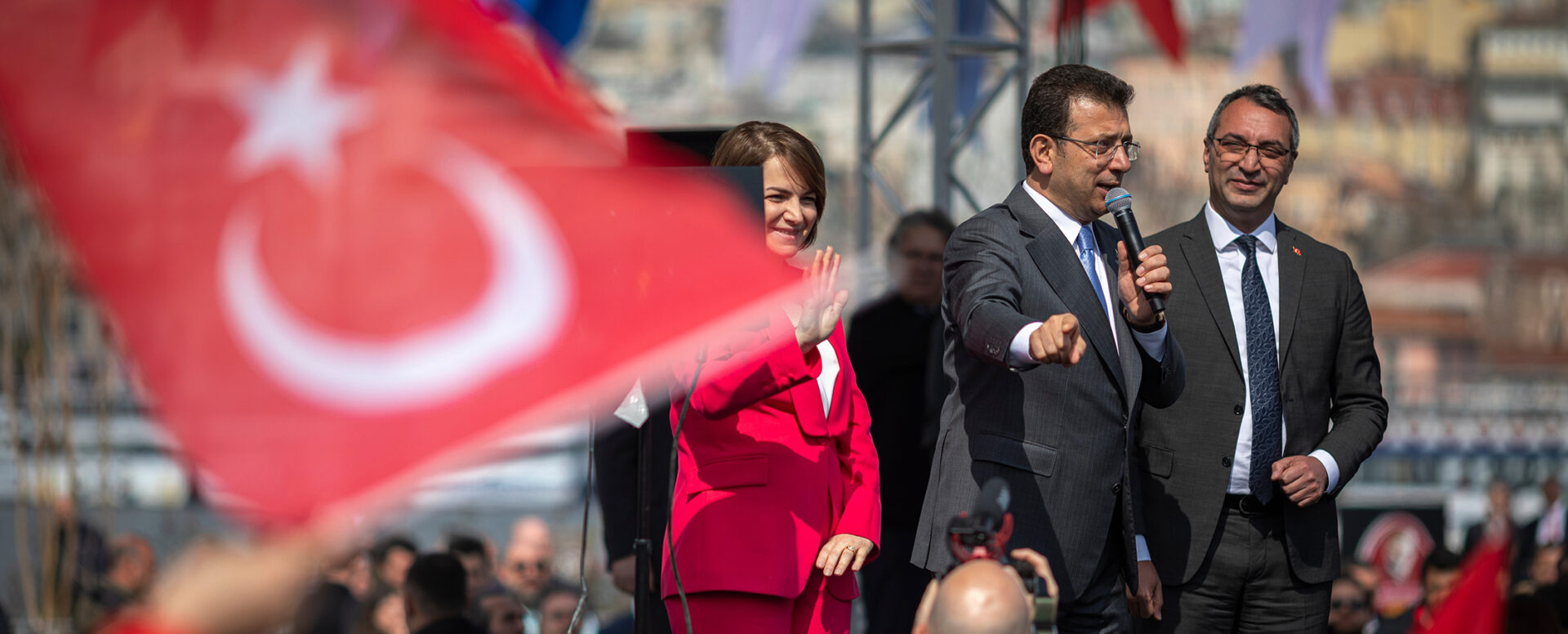
Header photo: ISTANBUL, TURKEY – March 19, 2024: Istanbul mayor, Ekrem Imamoglu rally ahead of polls before the local elections that will be on 31st of March. Sahan Nuhoglu/ Shutterstock.