



Countless Crises, One System
Theoretically, by most indicators and metrics, Lebanon should have collapsed by now. Since the 2019 October uprising – which was the largest wave of popular mobilization in the country’s post-civil war history – the state, and more importantly, its residents, has lived through what the World Bank classified as one of the worst economic contractions since the mid-19th century globally (World Bank Group, 2024), a catastrophic port explosion that killed hundreds in the heart of Beirut, a war between Hezbollah and Israel and more than two years of presidential vacuum. At the time, each of these was described as the ultimate rupture that would eventually force a systemic change; however, to no avail. What distinguishes the interval of 2025–2026 from the preceding waves of crises is not only the scale of the urgency; but also, the coincidence of three different shifts that previously were not aligned: a new executive with intentions of drastic reform credentials, a Hezbollah that has significantly weakened in ways not seen in years and a state apparatus with at least conditional access to international financing. Whether this coincidence amounts to a genuine opening – or whether it will be absorbed, as previous openings have been, into the system it was meant to disrupt in the first place – is what is being examined.
The Aoun – Salam Moment
The election of former commander-in-chief of the Lebanese army Joseph Aoun as President in January 2025 as well as the rapid nomination of former president of the International Court of Justice (ICJ), Judge Nawaf Salam, as Prime Minister, has ended more than two years of executive vacancy and caretaker governance under Najib Mikati. In this sense, Aoun’s election has reflected the altered balance of domestic power following the 2024 war between Hezbollah military factions and Israel’s army. Meanwhile, Judge Salam’s nomination, which was secured by a vote comprising of 84 out of 128 Members of Parliament (MPs), and against Hezbollah’s preference, was the product of organized pressure from opposition lawmakers, including the “Change” bloc of independent MPs elected in 2022 (Ghanem and Prentis, 2025), as well as the weight of international expectations that has been building since the Beirut port explosion went gravely unprobed and neglected.
As per his 2021 book, “Lebanon: Between Past and Future” (Salam, 2021),[1] Judge Salam was not a blank slate, having argued, in detail, for proportional representation, electoral districts organized around the governorate rather than the smaller qada and for a systematic separation of state appointments from confessional patronage. His appointment as Prime Minister was read, with appropriate caution, as a mandate to try (Kayssi, 2025).
Rather than settling for surface-level fixes, the first year saw a genuine effort to repair Lebanon’s broken institutions. From passing a budget designed to be zero-deficit in 2026 to finally staffing the Electricity Regulatory Authority after two decades of neglect, the government began filling the voids that had worsened the 2019 crisis. By reforming banking secrecy laws in April 2025 and appointing a new Central Bank governor, Karim Souaid, the country signalled a serious attempt to re-engage with the International Monetary Fund and move off the Financial Action Task Force “grey list” (Karam, 2026).
The Limits of Momentum and the Judicial Blockade
The reformist momentum in Lebanon soon collided with a sophisticated judicial blockade orchestrated by entrenched sectarian interests. While the new administration initially signalled a new era of accountability following their election and appointment in early 2025, the resistance was swift. Lebanon’s banking sector, facing the first serious prospect of accountability in years, mobilized sectarian networks to slow financial restructuring. Simultaneously, Speaker Nabih Berri used his control over the parliamentary agenda to protect political allies from judicial scrutiny.
In January 2025, Judge Tarek Bitar resumed the Beirut port blast investigation after years of politically induced dormancy. This phase of the probe culminated on 30 March 2026, when Bitar officially concluded the investigation and indicted 70 individuals (Assaf, 2026). However, the legislative response to these efforts was double-edged. Although the Parliament passed a judicial independence law in July 2025 that reduced executive appointments to the Higher Judicial Council, the legislation preserved a controversial provision allowing the government-appointed Public Prosecutor to suspend ongoing proceedings.
As Kassir (2025) argues, the reform movement was ultimately derailed by a banking lobby and sectarian figures who weaponized communal considerations to block structural change. Consequently, the “Change” bloc paid a significant electoral price in the May 2025 municipal elections, as their inability to bypass these structural hurdles disillusioned a support base expecting more immediate results. As the bloc remained fragmented and structurally outnumbered in the legislature, it could not sustain the persistent pressure required to finalize the reform agenda.
Financial Sovereignty vs. a Shadow Economy
The primary obstacle to the Salam government’s restorative plan remains the systemic opacity of the financial sector. The 72 USD billion gap in the financial system is not merely an accounting error but the fossilized remains of a decade-long Ponzi scheme managed by the Central Bank to fund state deficits and maintain the peg (World Bank Group, 2024). By early 2026, the central reform struggle had shifted to the Asset Quality Review (AQR) of the 14 largest banks, as this is one of the prerequisites for IMF re-engagement; however, the process remains stalled. This resistance reads as structural since the AQR would make accumulated losses legible and, as a result, politically actionable, which would then threaten the banking sector’s long-standing role as the infrastructure through which political elites socialize fiscal losses onto depositors and the public at large. This dynamic is further compounded by the persistence of a dual monetary system sustained by restricted deposit access and informal exchange offices, which continues to undermine coherent fiscal governance. Without amendments to the Bank Resolution Law establishing an independent resolution process (which is still pending parliamentary approval as of February 2026), the institutional reforms of 2025 risk functioning as cosmetic and surface-level adjustments over an unchanged predatory core.
War as the Permanent Exception
The November 2024 ceasefire between Israel and Hezbollah held poorly. Israeli strikes continued on an almost daily basis through 2025, and by October of that year more than 330 people had been killed, including at least 127 civilians according to UN monitoring (Human Rights Watch, 2026). In early March 2026, Hezbollah’s wilful entry into the broader US-Israel-Iran confrontation triggered a new round of full-scale bombardment. Within mere days, more than half a million people were displaced across the south and the southern suburbs of Beirut.
Moreover, on 9 March of this year, Lebanon’s parliament voted 76 to 41, with four abstentions, to extend its mandate by two years thereby postponing elections that were scheduled for May 2026 (Kayssi, 2026). The extension, one of many in Lebanon’s history since the civil war, was justified by “force majeure.” Holding credible elections under active bombardment, with large parts of the electorate displaced and significant territory inaccessible, was not a realistic proposition. Critics, including the Lebanese Forces and the Free Patriotic Movement, accepted that some delay was unavoidable but argued that two full years was constitutionally disproportionate and, more pointedly, shielded incumbent parties from electoral accountability at the moment when Hezbollah’s political position was most exposed.
The Security Dilemma and the Army’s Mandate
The security situation pulls in two directions at once. On one hand, Hezbollah’s military and financial losses since October 2023 created a domestic opening that had not existed before. The Salam government moved in ways that would have been unthinkable a year earlier: banning Hezbollah’s military activities by decree, expelling Iranian Revolutionary Guard personnel from Lebanese territory, and framing the ceasefire implementation around a genuine state monopoly on arms (Kayssi, 2026).
Hezbollah’s military and financial losses since October 2023
created a domestic opening that had not existed before.
The Salam government moved in ways that would have
been unthinkable a year earlier
The rise of Joseph Aoun, a president from the military institution, has securitized the reformist discourse. While this has provided the executive with the muscle to enforce decree-laws, it raises concerns regarding the long-term civil-military balance. In the current context of May 2026, the Lebanese Armed Forces (LAF) remain the only institution with cross-sectarian legitimacy, yet the pressure to use military force to resolve political deadlocks is increasing. As the situation on the ground remains momentarily unforeseen, with a fragile ceasefire implemented in April 2026 under threat, the potential for friction between the LAF and Hezbollah’s remaining cells remains one of the primary threats to the current ceasefire’s stability.
Diaspora, Remittances and the Rentier Trap
A crucial, yet often overlooked, variable in the 2026 landscape is the role of the Lebanese diaspora. Remittances have remained one of the few consistent sources of hard currency, estimated to represent a large portion of the country’s GDP, reaching about 33.3% in 2023 (World Bank Group, 2023). While this liquidity has prevented total starvation, it has also inadvertently sustained the status quo by providing a cushion that reduces the immediate social pressure for radical systemic change.
The last elections demonstrated the diaspora’s potential as a transformative voting bloc; nevertheless, the 2026 extension effectively silences this constituency for another two years. The Salam government did attempt to leverage the diaspora capital by reengaging the latter given their importance as a lifeline for the country and its history, but trust in the banking system is so low that these efforts have largely failed to materialize beyond philanthropic aid. This reliance on external capital flows creates a remittance trap where the State avoids the painful structural reforms necessary for a productive economy in favour of continued dependency on its citizens abroad.
What Civic Mobilization Has and Has Not Done
One thing the October 2019 protests permanently changed was the political landscape at the elite level as many of the independent MPs were a direct product of the uprising itself. They won seats in 2022 in a system that was built to prevent exactly that, and they played a decisive role in securing Salam’s nomination in January 2025. In Lebanese terms, it represents an unusually direct line from street mobilization to executive appointment. However, what civic pressure has not managed to do is translate institutional access into durable policy change. The May 2025 local elections were a corrective: voters who had supported these candidates in 2022 punished them for the gap between promise and delivery. The diaspora – several million Lebanese abroad, voting through the six non-resident seats established by the 2017 electoral law – has remained a consistently reform-oriented constituency, but diaspora votes cannot compensate for fragmentation within the domestic reformist bloc. The question that the two-year extension makes urgent is whether civic pressure can maintain coherence without an electoral outlet.
Window or Mirage? The Ill-fated Resilience of Consociationalism
Lebanon’s political system has outlasted everything thrown at it, and not always for good reasons. The Taif Accord of 1990 ended the civil war by redistributing power between confessional groups without touching the logic that made confessional power-sharing self-reproducing. The post-2005 period, the post-2019 moment, the immediate aftermath of the port explosion each produced a version of the same sequence, that is, genuine public pressure, partial elite response, as well as structural continuity.
What is different now is the combination of various elements. Hezbollah’s relative weakening is not conjunctural while the Salam government has international legitimacy and a stated programme of reform that goes beyond rhetorical commitments. Additionally, Lebanese civil society has spent six years building the organizational capacity and the documented evidence base that frank reform requires. Notwithstanding that, a sizable portion of the Muslim Shia community – Hezbollah’s traditional base – has grown visibly frustrated with a political project that has delivered war and economic isolation in place of the “resistance” dividend that it promised (Khatib, 2026).
Still, the reform coalition remains fragile, the security situation is volatile, and the financing for reconstruction is fiercely contested. By extending the parliamentary mandate for an additional two years, the political establishment has secured exactly the shield it needs to delay structural change. Lebanon’s history is defined by such openings – windows of opportunity that abruptly close before they can ever truly consolidate. Yet, the breakthrough of January 2025 was a tangible shift, not a mirage. Whether this opening can survive the external pressures and internal blockades remains the central, unresolved question. It is a moment of genuine precariousness, but for once, that uncertainty cuts both ways: it threatens the reformists, but it also leaves the old guard without their usual guarantees of stability.
References
Assaf, Claude. “Beirut Port explosion: Bitar closes investigation, focusing on indictment.” L’Orient Today, 31 March 2026.
Ghanem, Vanessa and Prentis, Jamie. “Lebanon’s PM designate Nawaf Salam calls for ‘new chapter rooted in justice’.” The National, 14 January 2025.
Human Rights Watch. “World Report 2026: Lebanon.” Human Rights Watch.
Karam, Patricia. “A First-Year Assessment of Lebanon’s Governing Coalition.” Washington, DC: Arab Center Washington DC., 2026.
Kassir, Jean. “Stalled Momentum and Incomplete Reforms in Lebanon.” Washington, DC: The Tahrir Institute for Middle East Policy, 2025.
Kayssi, Issam. “Nawaf Salam’s Text Messages.” Beirut, Lebanon: Malcolm H. Kerr Carnegie Middle East Center, 2025.
Kayssi, Issam. “An Extension Under Fire.” Beirut, Lebanon: Malcolm H. Kerr Carnegie Middle East Center, 2026.
Khatib, Lina. “The Degradation of Iran’s Proxy Model.” In Middle East Initiative. Belfer Center for Science and International Affairs, 2026.
Salam, Nawaf. Le Liban d’hier à demain. Arles: Actes Sud/Sindbad, 2021.
World Bank Group. “Personal remittances, received (% of GDP) – Lebanon.” 2023.
World Bank Group. “Lebanon Country Climate and Development Report.” Washington, DC., 2024.
[1] Translated from its original French title, “Le Liban d’hier à demain.“ace, 5 December 2025,https://carnegieendowment.org/research/2025/12/rethinking-power-sharing-agreements-in-libya.
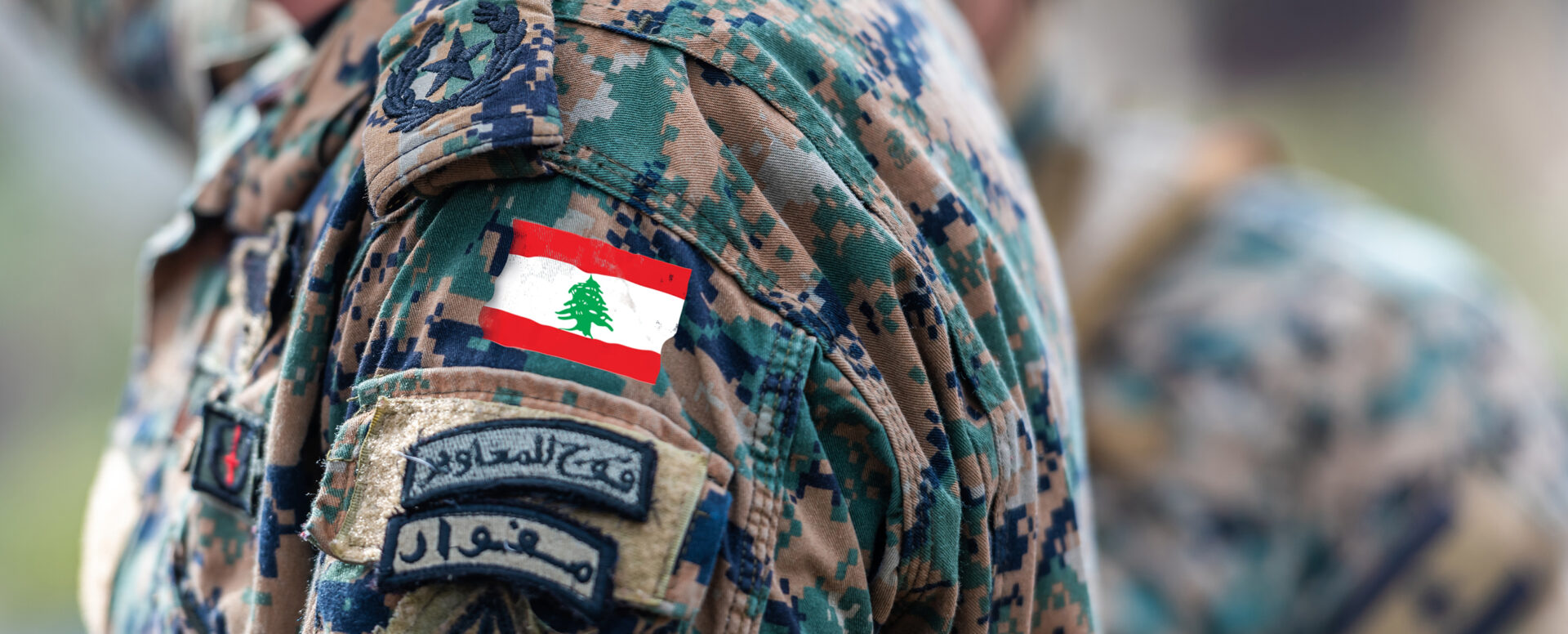
Header Photo: Beirut, Lebanon – February 12, 2020 – Lebanese army officer’s uniform with Lebanese Flag. Shutterstock. Paul Saad