



Climate Change as a Driver of Economic Restructuring
The Mediterranean Basin is considered as one of the main climate change hotspots and is already characterized by higher temperatures, longer droughts, an increased number of heatwaves and pressure on the coast (Cramer et al. 2018, IPCC 2022). Global and regional reports (IPCC, 2022; MedECC, 2020) concluded that these climatic variations have already induced massive environmental and socioeconomic consequences, with the most critical ones affecting water availability, natural environment and climate-sensitive economic activities.
Far from being simply an environmental issue in the Mediterranean, climate change is altering the economic structure of the Basin, with increased temperatures, water shortages and coastal degradation affecting the comparative competitiveness and sustainability of key sectors, such as agriculture, tourism and fisheries. In turn, pressures are influencing investment, labour flows and regional competitiveness. With southern and eastern Mediterranean economies being more dependent upon weather-dependent sectors, they are also subject to higher risks, which can exacerbate pre-existing economic imbalances in the Basin.
As a result, climate change is emerging as a structural force that redefines economic geography across the Mediterranean. Understanding these dynamics is essential for assessing not only sectoral impacts but also the broader transformation of the region’s economic order.
Why the Mediterranean Economy Is Structurally Exposed
The structural vulnerability of the Mediterranean economy to climate change, which stems from the unique composition and geographical distribution of its economic activities, requires careful attention. Indeed, the Mediterranean is one of the “hottest of the hot spots” in terms of climate change, with higher temperature rates than global averages, and an increased incidence of hydro-climatic extreme events (Cramer et al., 2018; IPCC, 2022). The production structure and employment do not appear evenly distributed in terms of sectors and geographical areas, with a concentration of production and jobs in sectors and localities particularly sensitive to climatic changes.
Consequently, exposure levels are exacerbated, which amplifies climate shock propagation, translating them into an economic problem that transcends specific sectors and can become a systematic risk (IPCC, 2022; MedECC, 2020). An exemplary illustration of this dependence is represented by the tourist sector. As one of the most popular tourist destinations in the world, various economies on the southern side of the Mediterranean, and in the Maghreb countries, rely heavily on the revenues they receive from tourism, both in terms of GDP, employment and foreign exchange receipts. The attractiveness of tourist destinations is heavily dependent on climate conditions, such as temperatures, water availability and the quality of the environment in the concerned area. Climate change poses major threats to tourism, such as increased heat stress, increased frequencies of extreme weather events and degraded coastlines, which threaten the allure of Mediterranean destinations, as well as its distribution during the season (MedECC, 2020). Particularly, very high summer temperatures may cause decreases in the summer demand in southern Mediterranean countries and thus contribute to a geographical or temporal redistribution of tourism flows. For the economies that are not diversified, this may entail widespread impacts on revenue, employment and development.
Water scarcity presents both an environmental
constraint and an economic constraint that will
affect the feasibility of agricultural systems
and the pattern of rural-urban migration
In many countries of the southern and eastern Mediterranean, agriculture is the second pillar of structural exposure to the economy; it still provides the main source of livelihood and employment in rural areas. Water resources available for agriculture are scarce and are not distributed equitably throughout the region, which already places added pressure on agricultural production in the region. This pressure is further exacerbated by climate change in the form of declining precipitation, increased evapotranspiration and more frequent droughts (IPCC, 2022; MedECC, 2020). These pressures affect crop yields, increase irrigation demand and raise production costs, thereby decreasing competitiveness. The rapid expansion of irrigation for water-intensive crops and the continued reliance on traditional agricultural practices increase their vulnerability. In many parts of the region, water scarcity presents both an environmental constraint and an economic constraint that will affect the feasibility of agricultural systems and the pattern of rural-urban migration.
An additional aspect of vulnerability associated with coastal zones is the concentration of economic activity in these spatially proximate areas. Large numbers of people live, work and hold property in the extensive coastal zones, largely found at lower elevations in the Mediterranean. These zones have been important sites of urbanization, transport nodes, industrial complexes and importantly, tourism facilities. These coastal areas have allowed for exchange and connectivity over the centuries, but concentration implies higher vulnerability to sea-level rise and coastal erosion, as well as extreme climatic events, such as storm surges and floods (IPCC, 2022; MedECC, 2020). Damage to infrastructure, loss of land and increased costs for protective measures could lead to significant amounts of economic hardship. Additionally, impacts to coastlines will have an impact on the supply and service networks operating throughout the coastal area, creating further macroeconomic impacts.
Finally, structural exposure is reinforced by pronounced asymmetries between northern and southern Mediterranean economies. While most northern Mediterranean countries are EU member countries characterized by a diverse economy, high levels of income and good institutional capabilities, these countries’ characteristics help them better absorb economic shocks and invest in adaptation. In contrast, many southern and eastern Mediterranean countries exhibit higher dependence on climate-sensitive sectors, lower levels of economic diversification and more limited fiscal and institutional resources (MedECC, 2020).
As such, the same climate shocks can have very different economic effects across the region, possibly even widening the development gaps. Overall, Mediterranean countries are “institutionally susceptible to climate change due to a combination of sector dependencies, resource scarcity, spatial concentrations and regional disparities, suggesting that climate change is more of an economic, rather than environmental, problem of growth, competitiveness and cohesion for the entire region” (IPCC, 2022; MedECC, 2020).
Tourism contributes up to 20-25% of GDP in some Mediterranean economies, while agriculture still accounts for more than 30% of employment in parts of North Africa. In some southern Mediterranean economies, agriculture still accounts for over a quarter of employment. As illustrated in Charts 1 and 2, these structural characteristics translate into high exposure to climate risks through tourism dependence, agricultural employment and water stress, particularly in southern and eastern Mediterranean countries. In addition, in some cases, such as Israel, high water stress reflects structural scarcity rather than weak management, as advanced technologies such as desalination and water reuse mitigate supply constraints.
CHART 1 Tourism Dependence and Agricultural Employment in Mediterranean Economies
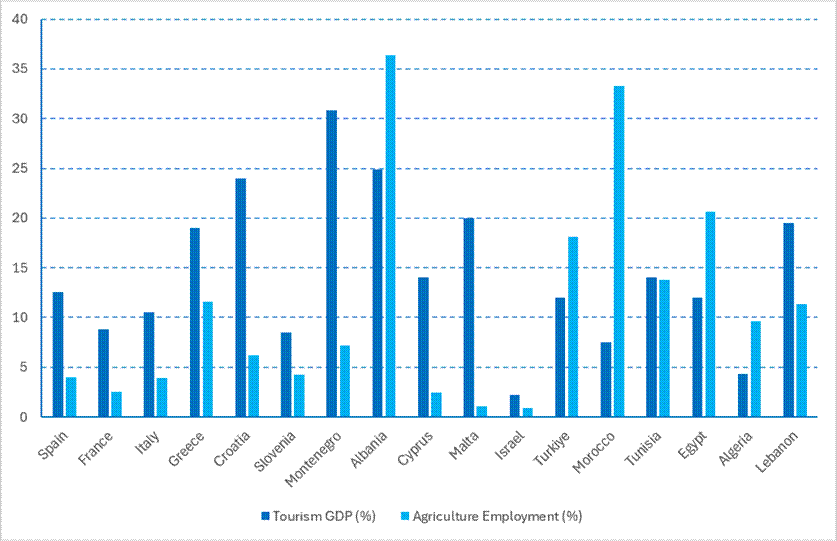
1. Tourism GDP (%): Total contribution (direct + indirect + induced) of tourism to GDP in 2023. (Source: World Travel & Tourism Council wttc.org).
2. Agriculture Employment (%): Share of total employment in agriculture (Source-Our Word in Data https://ourworldindata.org/grapher/share-of-the-labor-force-employed-in-agriculture). Agriculture employment refers to 2019 due to data limitations.
3. Countries with insufficient or unreliable recent data (e.g. Libya, Syria and Palestine/Gaza) are excluded due to data limitations and ongoing instability.
Chart 2 Water Stress and Coastal Population in Mediterranean Economies
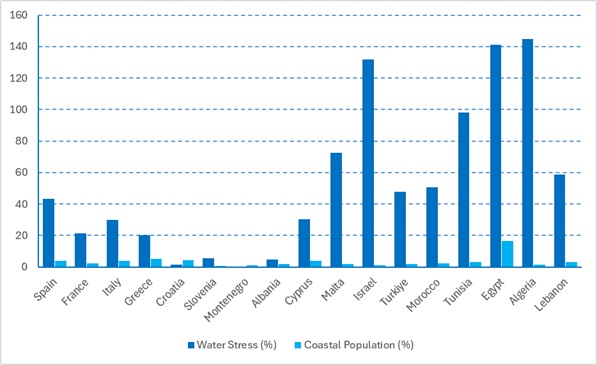
1. Water Stress (%): Total freshwater withdrawal as % of available resources in 2020-2022 average (Source FAO AQUASTAT Via World Bank https://data.worldbank.org/indicator/ER.H2O.FWST.ZS).
2. Coastal Population: Population living in areas where elevation is below five metres (% of total population) (World Bank https://data.worldbank.org/indicator/EN.POP.EL5M.ZS). Values refer to the latest available year (2015), as more recent data are not available.
3. Countries with insufficient or unreliable recent data (e.g. Libya, Syria and Palestine/Gaza) are excluded due to data limitations and ongoing instability.
4. Water stress data are not available for Montenegro due to limitations in reporting to international databases
Sectoral Transformations
The economic aspects of climate change in the Mediterranean region determine the composition, performance and sustainability of the economies in the region. The natural resource-dependent sectors, specifically agriculture and tourism, are the main sectors that are affected by climate change, while transversal effects, mainly through labour productivity, contribute to the change in the structure of economies. The effects of climate change in these sectors have the potential to restructure the economy in terms of production patterns, employment levels and regional specialization.
Agriculture and Water Constraints
Agriculture in the Mediterranean region is extremely dependent on climate conditions because water availability serves as the major pathway for impacts from climate change to affect agricultural production systems. Therefore, the combination of increased temperatures, decreased precipitation and increased evapotranspiration is contributing to increasing water scarcity throughout the region, especially in the southern and eastern Mediterranean region (IPCC, 2022; MedECC, 2020). Many quantitative assessments indicate that there will be measurable reductions in agricultural output and possibly reductions in GDP as a result of climate change, especially in southern Mediterranean countries. These reductions will have potential negative impacts on other economic sectors (Bosello & Eboli, 2013). Climate projections indicate that the yields of many crops will decrease by as much as 10-30% under high climate warming scenarios (IPCC, 2022; MedECC, 2020). These effects are exacerbated by an increasing frequency and length of droughts that result in declining soil moisture levels and reduce the growing season of crops.
The impacts on economies are diverse. Declining and volatile crop yields have negative impacts on overall production and farmer income levels, whereas increased demand for irrigation will enhance production costs. In drier regions, water demand from agriculture, municipalities and industry limits supply availability and enhances water costs at the margin. In the long term, competition of these demands with water for crop production will weaken the competitiveness of traditional Mediterranean crops such as cereals, olives and grapes (MedECC, 2020). The 2021-2022 drought in Morocco, which caused cereal production to drop by 67% compared to the previous year, illustrates how a single climate shock can rapidly destabilize an agriculturally dependent economy, with knock-on effects on food inflation, rural employment and import dependency (Morocco Ministry of Agriculture, 2022).[1]
In addition to short-run productivity effects, structural changes are taking place in the agriculture sector as a consequence of climate change. Farmers are adapting through changes in crops grown, use of technologies and changes in land-use practices. Some farming activity might migrate to a more favourable part of the world, or simply to a place where it is less difficult to access water. In other regions, marginal lands will be abandoned due to diminishing profitability. Such developments may have significant rural employment and demographic consequences, as the decline of the agricultural sector may intensify the rural-urban shift and increase disparities between regions.
Tourism and Climate Sensitivity
Tourism is another pillar of the economy of the Mediterranean region that is undergoing a major transformation because of climate change. This sector is highly dependent on climatic factors, where temperatures, environmental and coastal conditions influence both supply and demand within the sector. Higher temperatures and the increase in heat waves have led to a transformation of the attractiveness of traditional Mediterranean tourism destination countries, especially during the summer season (MedECC, 2020). There is evidence that increasing temperatures will lead to a transformation of tourism demand, which is temperature-dependent, and ideal temperatures range from 20°-30°C (Scott et al., 2019). Tourism accounts for between a fifth and a quarter of GDP in Greece and Croatia.
Economically, these changes affect the tendencies in demand and the cost of business operations. High temperature affects the comfort and satisfaction experienced by tourists leading to a reduction in the number of tourists visiting during peak seasons, particularly the hottest sites. In addition to this, environmental decay resulting from issues such as coastal erosion, loss of biodiversity and water scarcity may also decrease the aesthetic quality, and thus the value, of tourism-related assets. From the supply-side perspective, businesses also face cost increases in providing air conditioning, water supply and maintenance. This can lead to lower profit margins.
These changes are mainly caused by climate change in the tourism industry. The major one is the alteration of seasonality. With summer becoming less attractive in certain destinations, there will be a shift from the summer season to other seasons like spring and autumn, or destinations in northern regions. This results in winners, who benefit from the changes, and losers who lose out in the process. There is a spatial redistribution of tourism earnings. There can also be a change in investment patterns, including demand for infrastructure resilient to climate change and investment in other types of tourism. These changes are structural obstacles for countries which are overly dependent upon mass tourism development on their coastal areas.
Labour Productivity and Cross-Sectoral Impacts
Aside from sector-specific influences, the consequences of climate change can also be seen to have had cross-sector impacts across the Mediterranean economy through the effects that these changes are having on labour productivity. Higher temperatures and heatwaves can have negative impacts on the performance of workers both physically and mentally, especially in environments that are not climate-controlled (IPCC, 2022). Agricultural, construction and tourism sectors, among others, are highly susceptible due to their heavy dependence on manual labour and work outside the office space. In addition, marine ecosystems and fisheries are increasingly affected by warming and biodiversity loss, with implications for productivity, resource availability and economic sustainability (European Commission, 2022).
The economic consequences are enormous. Lower labour productivity means lower output per worker, higher production costs and, possibly, lower competitiveness. In extreme cases, this could mean cutting working hours or shifting working hours to cooler parts of the day, thus reducing overall labour supply. Heat-related health risks also cause more absenteeism and increased healthcare costs, which also affect economic performance.
These changes are not independent;
they feed back into each other, increasing
economic structural change, regional
competitiveness and development patterns
The 2023 summer heatwaves and wildfires in Greece and Türkiye, during which approximately 20,000 people were evacuated from hotels and homes in Rhodes alone and Greece, Italy, Algeria and Tunisia suffered a combined loss of over 1,350 square kilometres to blazes affecting 120,000 people, illustrate how climate extremes can simultaneously damage tourism infrastructure, disrupt peak season operations and generate widespread cancellations, even if aggregate annual visitor numbers partially recover.[2]
These factors, over time, may lead to shifts in the labour market and productive processes. Automation or implementation of technology that requires less heat exposure at work is a possibility for businesses. Economic activity may shift from sectors less affected by climate change or geographical locations that experience less heat exposure. However, given the variations in adaptive capability among nations, the loss of productivity will be experienced unequally, increasing economic disparity within the Mediterranean region (IPCC, 2022; MedECC, 2020).
Synthesis
In conclusion, these sectoral changes suggest a systemic nature of climate impacts on the Mediterranean economy. As shown in Figure 1, countries like Albania and Morocco combine high tourism dependence with significant agricultural employment, making them doubly exposed to the sectoral risks discussed here. Agricultural profitability is diminishing as water stress increases, tourism is undergoing redefinitions due to changes in climate attractiveness and environmental features, and a negative change in labour productivity is being recorded in a number of sectors simultaneously. These changes are not independent; they feed back into each other, increasing economic structural change, regional competitiveness and development patterns, and climate change appears as a major determinant of economic structural change in the Mediterranean region.
From Impacts to Systemic Economic Risks
The first layer of analysis is sectoral impacts, but climate change in the Mediterranean is increasingly seen as a source of systemic economic risk affecting macroeconomic stability, production networks and regional cohesion. A series of cumulative, interacting climate shocks translates into a major economic shock, which starts reshaping the regional economic order (MedECC, 2020). A critical manifestation of this risk comes from the rising frequency and magnitude of extreme weather events. Such events are more frequent across the Mediterranean in recent decades (IPCC, 2022, MedECC, 2020), and a series of droughts, heatwaves, floods and wildfires are being recurrently experienced across the Basin, which cause direct losses in infrastructure and physical and natural assets (IPCC, 2022, MedECC, 2020).
Aside from direct costs, such shocks create macroeconomic instability due to interruptions to production, reduced growth and increased uncertainty. While droughts may affect agriculture, thus raising food prices and deteriorating the balance of payments, floods and wildfires may place a huge fiscal burden through their reconstruction needs. The accumulation of shocks erodes resilience (in the absence of fiscal space) and likely leads to greater volatility in economic growth.
A second systemic channel concerns the losses in labour productivity, which magnifies the observed effects at the sector level. As temperatures increase, workers are less efficient in producing outputs at a steady pace, especially in sectors that rely heavily on labour inputs and working outdoors, such as agriculture, construction and tourism (IPCC, 2022). These productivity losses do not just occur in the affected sectors but also spread across the entire economy via unit labour costs and reduced efficiency, lowering long-term potential growth rates and competitiveness in economies that are already struggling with structural bottlenecks. Moreover, the need to adapt working hours or invest in protective measures further raises operational costs for firms.
Additionally, climate change has implications for supply chains and economic interdependence, which are vital for the operations of Mediterranean economies. The region’s economic model is structured around highly interdependent sectors such as tourism, agriculture, transport and services, which are directly exposed to climatic and environmental changes. Extreme events affecting a certain sector or locality may spill over through both production and distribution chains. If, for instance, crop production is adversely affected due to climatic disturbances, then this might impact food industries and external markets, and transport networks or coastal infrastructure being damaged would disrupt trade flows and the inflow of tourists. This level of interdependence adds new risks and systemic vulnerabilities as the crisis cannot be localized to a specific sector but spreads throughout the whole economy.
Climate change is not only cutting down
output in vulnerable sectors but also
shaping the spatial and operational
aspects of economic activity
Most importantly, climate change would amplify already present inequalities in the Mediterranean region. The economic divide between the two areas would only increase further, as Mediterranean countries in the north are typically wealthier and benefit from greater diversity of economic activities and stronger institutions, enabling them to cope better with the consequences of climate change than Mediterranean countries in the south and east, which rely heavily on economic activities threatened by climate change (MedECC, 2020). Thus, equal climate shocks would translate into much higher economic losses for the latter and, hence, a greater income gap, as well as an increase in social and political strains.
Such changes are profoundly affecting the basic structure of the Mediterranean economy. Climate change is not only cutting down output in vulnerable sectors but also shaping the spatial and operational aspects of economic activity. Some areas and sectors, which are less vulnerable to climate change or better placed to adapt, may achieve a comparative advantage, while others could find themselves continuously falling. This requires capital, labour and investment to be shifted around within the Mediterranean Basin and is being fuelled not just by market factors but also by the constraints imposed by climate change.
In this regard, climate change will constitute a primary force altering the Mediterranean economic system. Instead of merely isolated sectoral effects, long-term climatic change will involve a combination of macroeconomic instability, productivity decline, disruption in supply networks and increased disparities among the various regions. The fundamental structure of economic activity will therefore change, impacting patterns of growth, competitiveness and integration at the basin scale. (IPCC, 2022; MedECC, 2020). More recent policy-oriented analyses point to the increasing systemic nature of climate risks in the Mediterranean, with implications for economic stability, governance systems and long-term development pathways (MedECC, 2020).
Emerging Economic Reconfiguration
In addition to the above-mentioned risks, climate change is reshaping the economic map of the Mediterranean in terms of relative strengths, the spatial concentration of economic activities, fiscal policies and investment priorities. The changes are gradual but profound, and will ultimately have a long-lasting impact on growth and regional integration.
A first dimension is the transformation of comparative advantage across sectors and regions. The relative productivity of traditional Mediterranean sectors, such as agriculture and coastal tourism, is changing due to climate change. Some produce in dry zones becomes less productive because water, heat or oxygen are scarce. Other produce in more temperate environments may perform better (IPCC, 2022; MedECC, 2020). This dynamic does not imply a uniform decline, but rather a redistribution of economic potential. For example, northern coastal areas will benefit from better climatic conditions for tourism or agriculture, whereas southern regions may be faced with increasingly difficult conditions. These changes may affect trade, specialization and the economy of the Basin.
Another development is the relocation of economic activities within and between countries. If certain locations become less economically productive because of the impact of climate change, such as drought, water scarcity or risks associated with coastlines, then such economic activities would be moved away from these places. For instance, farmers might seek locations with assured water availability, tourism might gravitate toward cooler locations, or towards northern regions. Furthermore, coastal risks, such as rising sea levels and erosion, might act as a deterrent for investors in such risky environments, which will eventually lead to relocating development away from vulnerable coastal areas (MedECC, 2020).
The third dimension is the rising pressure on public finances that results from climate change. There are several ways climate change strains public finances, including, for example, the cost of dealing with the disaster itself, the need to rebuild and invest in adaptation and social protection. In the immediate future, disasters, such as floods, droughts and forest fires, exert pressure on public finances, while in the long run, public investment is necessary (IPCC, 2022). This is particularly true for most Mediterranean countries, especially the southern and eastern parts, which face fiscal constraints and, therefore, difficulty in responding to the situation. As a result, fiscal strain may occur with an increase in climate change-related expenditure coupled with declining revenue from certain industries affected by climate change, such as agriculture and tourism (IPCC, 2022).
Additionally, climate change influences investment structures, specifically in energy generation and infrastructure. An increase in temperature increases energy demands for cooling purposes, making it necessary for investments to be made in the energy sector (IPCC, 2022). On the other hand, the growing potential of renewables, especially solar power and wind energy, creates new investment opportunities. Such a flow of capital might contribute to development pathways of low carbon emission and resilience. The emphasis of investment in infrastructure is increasingly on building climate resilience. In particular, this includes investments in water supply and management, protecting coastlines from floods, and adapting cities and urban regions to new conditions.
Overall, the processes described show how, in addition to affecting performance on a sectoral basis, the consequences of climate change are producing a reconfiguration in the structure of the Mediterranean economic activities. The convergence of changing comparative advantages, re-spatialization, fiscal constraints and changing definitions of investment priorities points towards a pathway for a process of economic reconfiguration where climate change is central to new models of development (IPCC, 2022; MedECC, 2020). This emerging reconfiguration highlights the need to understand climate change as a structural economic force, with implications that extend far beyond environmental impacts.
Policy Implications: Adaptation as Economic Strategy
In the Mediterranean context, adaptation should be perceived not only as a response to environmental change but as a strategic economic tool to safeguard competitiveness, stabilize growth and reduce structural vulnerabilities. The region is exposed, and targeted and coordinated policies are needed to manage risks while supporting a transition to more resilient economic systems.
Water management is considered the first and foremost problem and one of the main concerns of climate change in the region. Efficient management of water resources and their redistribution for different purposes are critical to ensuring food production and meeting demands from other sectors (MedECC, 2020). The implementation of water resources management could help reduce the inefficiency and costs connected with the lack of resources thanks to the adoption of advanced technologies and pricing policies.
Adaptation should be perceived not only
as a response to environmental change but
as a strategic economic tool to safeguard
competitiveness, stabilize growth
and reduce structural vulnerabilities
Second, the introduction of climate-resilient strategies for tourism is necessary to ensure the stability and survival of one of the most significant economic sectors of the area. It should be associated with diversification and seasonal flexibility of products as well as the ability of the infrastructure to withstand heat conditions and degradation processes. Protection of the natural heritage of destinations, including coastlines and ecosystems, is another factor contributing to the sustainable development of the sector (IPCC, 2022; MedECC, 2020).
Third, the increasing impacts of heat on workers require further labour protection measures. Adjusting working hours, improving workplace health and safety and stimulating the use of protection technologies are efficient measures in reducing health hazards and productivity losses, especially in agriculture, construction and tourism (IPCC, 2022). These measures impact both economic and social policies, as they directly influence labour supply and efficiency.
Finally, regional cooperation is an important factor for decreasing unequally distributed impacts of climate change across the Mediterranean. The difference in capacities between EU and southern and eastern Mediterranean countries can indeed be mitigated through the coordination of policies, financial support mechanisms and knowledge exchange (MedECC, 2020). Joint initiatives related to water management, energy transition or climate financing can help reduce the gap among the countries of the region and improve their collective capacity.
In conclusion, the challenge of managing climate change as an economic opportunity requires climate policies in investment, institutions and development planning. By embracing climate policy in this way, countries in the region can reduce their exposure and vulnerability to climate risks and carve out a new path for resilient and sustainable growth.
References
Bosello, Francesco and Ebolı, Fabio. “Economic impacts of climate change in the Southern Mediterranean.” MEDPRO Technical Report No. 25. Brussels: Centre for European Policy Studies (CEPS), 2013. www.files.ethz.ch/isn/159586/MEDPRO%20TR25%20by%20Bosello%20&%20Eboli%20Final.pdf.
Cramer, Wolfgang; Guıot, Joël; Fader, Marianela; Garrabou, Joaquim; Gattuso, Jean-Pierre; Iglesıas, Ana; Lange, Manfred; Lıonello, Piero; Llasat, Maria Carmen; Peñuelas, Josep; Snoussı, Maria; Toretı, Andrea; Tsımplıs, Michael and Xoplakı, Elena. “Climate change and interconnected risks to sustainable development in the Mediterranean.” Nature Climate Change 8(11): 972-980, 2018.
European Commıssıon. Study on advancing fisheries assessment and management advice in the Mediterranean by aligning biological and management units of priority species (MED_UNITs Final Report). Luxembourg: Publications Office of the European Union, 2022.
IPCC. Climate Change 2022: Impacts, Adaptation and Vulnerability. Contribution of Working Group II to the Sixth Assessment Report of the Intergovernmental Panel on Climate Change. Cambridge: Cambridge University Press, 2022.
MEDECC. Climate and Environmental Change in the Mediterranean Basin: Current Situation and Risks for the Future. First Mediterranean Assessment Report. Marseille: Union for the Mediterranean, Plan Bleu, UNEP/MAP, 2020.
Scott, Daniel; Hall, C. Michael and Gösslıng, Stefan. “Global tourism vulnerability to climate change.” Annals of Tourism Research 77: 49-61, 2019.
[1] Mıddle East Onlıne. “Morocco’s cereal production drops by 67%.” Middle East Online, 9 August 2022. Available at: https://middle-east-online.com/node/764010.
[2] Euronews. “Vital tourism income has been lost due to Mediterranean summer of wildfires and extreme heat.” 7 August 2023. Available at: https://www.euronews.com/travel/2023/08/07/vital-tourism-income-has-been-lost-due-to-mediterranean-summer-of-wildfires-and-extreme-he.” Internationale Politik Quarterly, https://ip-quarterly.com/en/europes-geopolitical-confusion.