


As 2026 begins, Morocco is entering the final stretch of the legislative term inaugurated by the 2021 elections, which brought to an end the cycle of political opening initiated by the Arab Spring a decade earlier. The electoral collapse of the Islamist Party of Justice and Development after ten years in government, together with the formation of a coalition government composed of pro-Palace parties, seemed to herald a period of political stability and consolidation for the Palace. However, contrary to the expectations initially raised, the final stretch leading to the elections scheduled for 23 September 2026 is unfolding in a context of political uncertainty marked by the Gen Z 212 protests in the autumn of 2025 and by the inability of the current Prime Minister, Aziz Akhannouch (National Rally of Independents, RNI), to deliver on the electoral promises made five years earlier.
A Two-Speed Morocco
At the core of these challenges lies the widening inequality that continues to shape the country, rooted above all in the rural–urban divide. Despite Morocco’s economic recovery following the 2020 pandemic crisis, employment remains a structural weakness, as the labour market struggles both to absorb the country’s demographic growth and to return to pre-2020 levels. This becomes even more apparent when considering the urban–rural gap, with rural areas exhibiting a poverty rate nearly four times higher than that of urban areas, together with steadily worsening employment conditions.
The widening urban–rural gap and the growing vulnerability of rural areas underscores the current public concern over a two-speed Morocco, highlighting the country’s “socio-spatial segregation” (Makini, 2026). This divide is marked not only by the deterioration of structural opportunities in rural areas, but also by a persistent social gap between urban dwellers and rural populations, who are increasingly excluded from urban spaces.
A distinction between “Morocco” and “al-Maghreb”
(the country’s name in Arabic) has gained currency
as a way of highlighting the stark contrast between
the image projected to the outside world and
the more modest reality experienced by much of the population
This two-speed dynamic has multiple ramifications. Over the past year, a distinction between “Morocco” and “al-Maghreb” (the country’s name in Arabic) has gained currency as a way of highlighting the stark contrast between the image projected to the outside world and the more modest reality experienced by much of the population (Colin, 2025). Beyond its symbolic dimension, this distinction reflects deep disparities in investment patterns and socioeconomic development, placing additional pressure on the territorial distribution of resources within the education and healthcare systems (Abderrafie, 2026). Moreover, the two-speed divide underscores the limits of the constitutional reforms adopted during the Arab Spring, now 15 years ago, as these have increasingly given way to growing constraints on civil rights and to the King’s enduring formal and informal political influence.
In the face of these socioeconomic challenges, during his July 2025 speech to mark the 26th anniversary of Throne Day, King Mohammed VI announced a set of broad local development programmes to promote employment and basic services. Significantly, his intervention is part of a broader pattern of royal speeches delivered over much of the past decade acknowledging the country’s inability to advance a comprehensive social model. The current situation also contrasts with Prime Minister Akhannouch’s electoral promise to create one million net jobs over the 2021–2026 period. Taken together, these examples point not only to the government’s inability to improve the country’s economic situation, but also to its excessive commitment to an economic model that has proved incapable of fostering inclusive and territorially balanced development.
The Emergence of the Gen Z 212 Protests
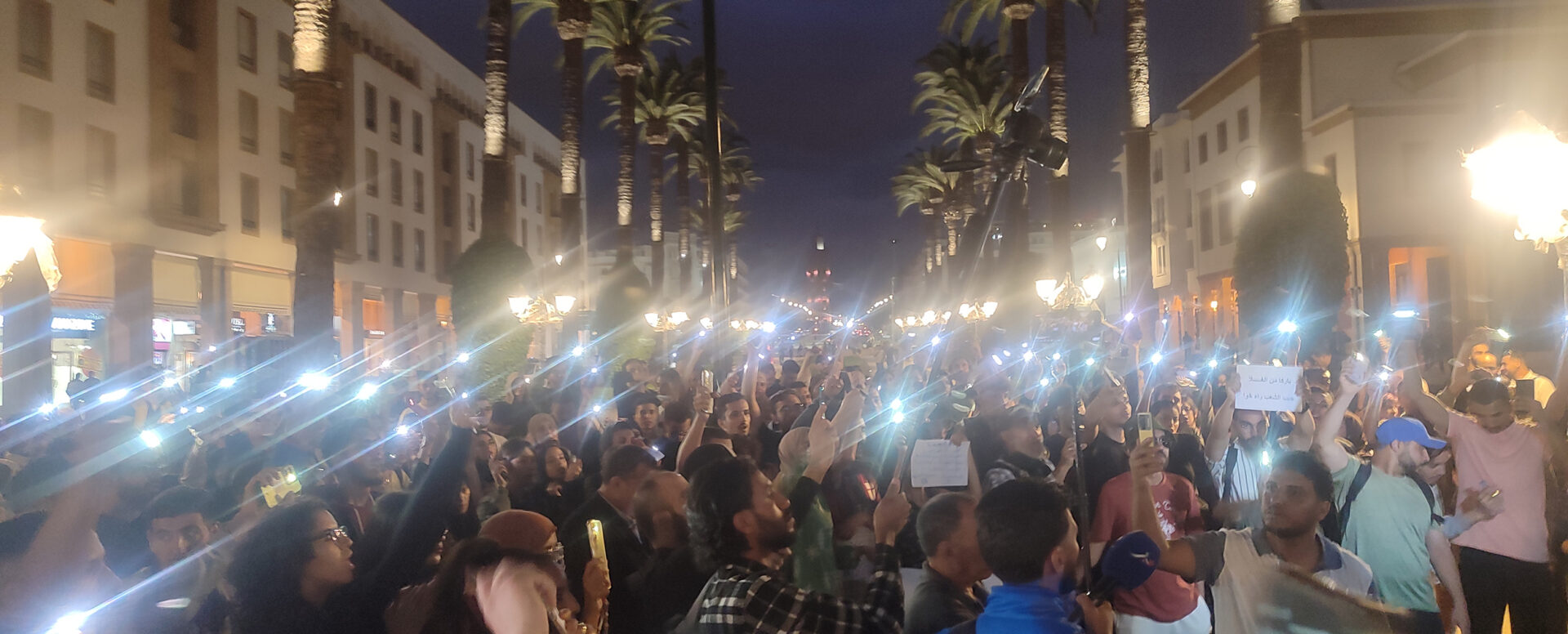
Popular discontent with Morocco’s uneven development crystallized in mid-September and October 2025 in the form of widespread protests organized under the banner of Gen Z 212. Initially triggered by a tragic series of maternal deaths at a hospital in Agadir, which laid bare the consequences of chronic underinvestment in healthcare, these mobilizations soon became linked to the wider wave of youth-led protests that has spread globally under the Gen Z label — reworked in the Moroccan case through a reference to the country’s international dialing code, +212. Starting on 14 September and rapidly expanding nationwide, the protests voiced growing frustration with an unequal economic model centred on investment in megaprojects with limited benefits for the broader population. The 2030 World Cup, co-hosted by Spain, Portugal and Morocco, lay at the centre of these criticisms as a clear example of this unbalanced pattern of investment.
While the movement’s mobilization structure may have appeared novel, its demands were not. Mobilizations were organized through the instant messaging platform Discord, which enabled dynamic real-time communication and facilitated lively, participatory discussions over actions, demands and strategies. With a server gathering more than a quarter of a million users, the platform reflected the search for new spaces beyond the control of the Moroccan regime, while also allowing anonymous participation as a means of minimizing repression. The result was a movement without formal structures, decentralized and independent from any political party or organization (Colin, 2025). Street mobilization was complemented by other, more established repertoires of action, such as consumer boycotts, which targeted, among others, PM Akhannouch, who ranks among Africa’s twenty richest individuals according to Forbes.
And yet, the socioeconomic demands expressed were well known, calling for quality public education and healthcare, an end to corruption and improvements in living conditions and employment opportunities. These demands, reminiscent of those voiced during the Arab Spring, highlight the persistence of socioeconomic grievances. Distinctively, however, the claims advanced by the Gen Z movement were addressed directly to the King, drawing on his role as the all-powerful “arbiter” of the political system. This points both to growing discontent with political parties and to the perception of their inability to deliver far-reaching solutions.
With a server gathering more than a quarter
of a million users, the platform reflected
the search for new spaces beyond
the control of the Moroccan regime
Surprisingly, King Mohammed VI’s response, delivered during his address at the opening of the parliamentary session on 10 October, avoided proposing any further political action. Instead, he stressed that “there should be no inconsistency or competition between national flagship projects, on the one hand, and social programmes, on the other,” while refraining from any explicit reference to the Gen Z 212 movement. Less subtle has been PM Akhannouch’s decision not to seek the premiership in the next elections, stepping down from the leadership of the RNI in favour of its newly elected leader, Mohamed Chouki.
Preparations for the forthcoming elections have been accompanied by the launch of an electoral reform aimed at strengthening anti-corruption measures and promoting the participation of young people and women. The reform provides public funding for the electoral campaigns of candidates under the age of 35, irrespective of whether they are affiliated with a political party, and introduces positive action measures to enhance women’s representation, including quotas and incentives for the formation of women-only lists in regional constituencies. Announced on 19 October, these measures appear to constitute a direct response to the youth discontent articulated in the Gen Z protests.
Territorial Integrity and Football as Pillars of Stability
Domestic political uncertainty contrasts with the progress achieved by Morocco’s foreign policy in recent years. Both the growing international support for its autonomy proposal on Western Sahara and Morocco’s football successes since its unexpectedly strong performance at the 2022 Qatar World Cup have enabled the Palace to divert attention from the country’s socioeconomic instability.
Rabat’s proposed solution to the Western Sahara issue has attracted growing international support since the United States recognized Morocco’s sovereignty over the territory in 2020. In June 2025, the United Kingdom joined this trend by endorsing the autonomy proposal as “the most credible, viable and pragmatic basis,” following the lead of countries such as Spain (2022) and France (2024).
The support extended by the United States to Morocco’s territorial interests was particularly evident in the last-minute negotiations over the renewal of MINURSO, the United Nations Mission for the Referendum in Western Sahara, on 31 October. For the first time, the UN Security Council resolution on Western Sahara (S/RES/2797) “[took] as its basis Morocco’s Autonomy Proposal with a view to achieving a just, lasting, and mutually acceptable resolution to the dispute.” Coinciding with the fiftieth anniversary of the Green March and Morocco’s occupation of the territory, this development further underscored the limitations of the UN initiative, which remains trapped in a zero-sum dispute between Morocco and the Polisario Front, further complicated by the reactivation of the conflict since 2020. The Security Council’s acceptance of Morocco’s proposal reflects both the broader normalization of Trump’s fait accompli politics (Barreñada, 2025) and the success of Morocco’s strategy of building support alongside the multilateral track.
The Security Council’s acceptance of Morocco’s proposal
reflects both the broader normalization of Trump’s
fait accompli politics and the success of Morocco’s
strategy of building support alongside the multilateral track
The rapprochement between Morocco and the United States was further evidenced by Morocco’s inclusion in the Peace Council established by the Trump administration to oversee the reconstruction of Gaza. Morocco was notably the only African country represented at the Council’s launch ceremony on 22 January.
Morocco’s position on Western Sahara was further reinforced by the European Union’s approval, on 2 October, of a revised trade liberalization agreement with Morocco. The new arrangement followed the Court of Justice of the European Union’s (CJEU) October 2024 ruling, which declared the previous agreement unlawful on the grounds that it extended to Western Sahara without the consent of the territory’s population. In its judgment, the Court made clear that any claim of consent would require, at a minimum, that the agreement deliver tangible benefits to the Sahrawi people and that products originating there be identified separately from those of Morocco, thereby underscoring the distinct customs status of the territory. The revised agreement seeks to address both requirements through EU provisions on sustainable development and humanitarian aid, as well as through the introduction of a distinct label of origin. While neither of these measures fully satisfies the CJEU’s conditions (the most telling example being that the new label, while formally different from the Moroccan designation, follows Morocco’s administrative naming of the territory), the parties were able to move beyond the legal constraints imposed by the Court (Petrangeli, 2025). This agreement once again highlights the EU’s struggle to reconcile its strategic interests with its commitment to international law.
Meanwhile, Morocco’s investment in football diplomacy, reinforced by its role as co-host of the 2030 World Cup, appears to have gained further momentum after the Confederation of African Football decided in March 2026 to overturn the outcome of the final between Morocco and Senegal, ultimately awarding Morocco the Africa Cup of Nations title following a tumultuous and controversial match.
Conclusion
The contrast between internal strains and external achievements has allowed the Palace to redirect attention toward the international prestige of Morocco’s diplomatic initiatives. At the domestic level, the inability of pro-Palace parties to advance an inclusive economic project has become increasingly evident, as has their declining legitimacy as intermediaries between the state and society. By contrast, Morocco’s successes in football diplomacy and in advancing its territorial agenda have served as important sources of national mobilization and political consolidation.
The inability of pro-Palace parties to advance
an inclusive economic project has become
increasingly evident, as has their declining
legitimacy as intermediaries between the state and society
Yet both sets of developments also point to the limits of short-term responses that remain unable to address the structural challenges facing the country in both domestic and international politics. On the domestic front, the limitations of the Gattopardian logic of “changing everything so that nothing changes” — frequently deployed by the Palace to defuse popular protest — are reflected in the recurrence of social mobilization amid persistent and growing discontent. On the international front, the gradual acceptance of Morocco’s autonomy proposal tends to sideline a central requirement for any lasting settlement: the consent of the Polisario Front. Although the outcome of the ongoing talks between Morocco and the Polisario Front under US auspices, initiated in Madrid in February 2026, remains uncertain, a unilateral proposal that fails to recognize the Sahrawi people’s right to self-determination is unlikely to bring the long-standing conflict to a durable resolution.
References
Abderrafie, Zaanoun. “How Can Morocco Move Beyond ‘Two Speeds’?” in MIPA Institute, 2026, https://mipa.institute/?p=13046&lang=en.
Barreñada, Isaías. “Sáhara Occidental: Ni momento de inflexión ni votación histórica.” in CEARC, 4 November 2025, www.cearc.net/sahara-occidental-ni-momento-de-inflexion-ni-votacion-historica/.
Colin, Francesco. “Gen Z 212 Earthquake Youth Shaking Morocco’s Politics.” in Arab Reform Initiative, 16 October 2025, www.arab-reform.net/publication/gen-z-212-earthquake-youth-shaking-moroccos-politics/.
Makini, Yassine. “Le ‘Visa social’: La frontière entre le Maroc et ‘Morocco’.” in Enass, 25 February 2026, https://enass.ma/le-visa-social-la-frontiere-entre-le-maroc-et-morocco/.
Petrangeli, Federico. “EU-Morocco Trade and the Western Sahara: A Prolonged Struggle between Law and Realpolitik. ” in Istituto Affari Internazionali, 2025, www.iai.it/en/publications/c41/eu-morocco-trade-and-western-sahara-prolonged-struggle-between-law-and-realpolitik.
Photo: GenZ 212 demonstrations in Rabat. 9 October 2025. Mounir Neddi. CC 4.0