



Is the current Mediterranean Tourism Model under Pressure?
The Mediterranean attracts approximately 30% of global tourist arrivals and accounts for 30% of global tourism receipts (ASCAME, 2022). Mediterranean tourism is an economic success story, and the region today is one of the most important tourism areas in the world. It creates significant opportunities for communities and investors, and it serves as a platform for cultural exchange across the sea basin.
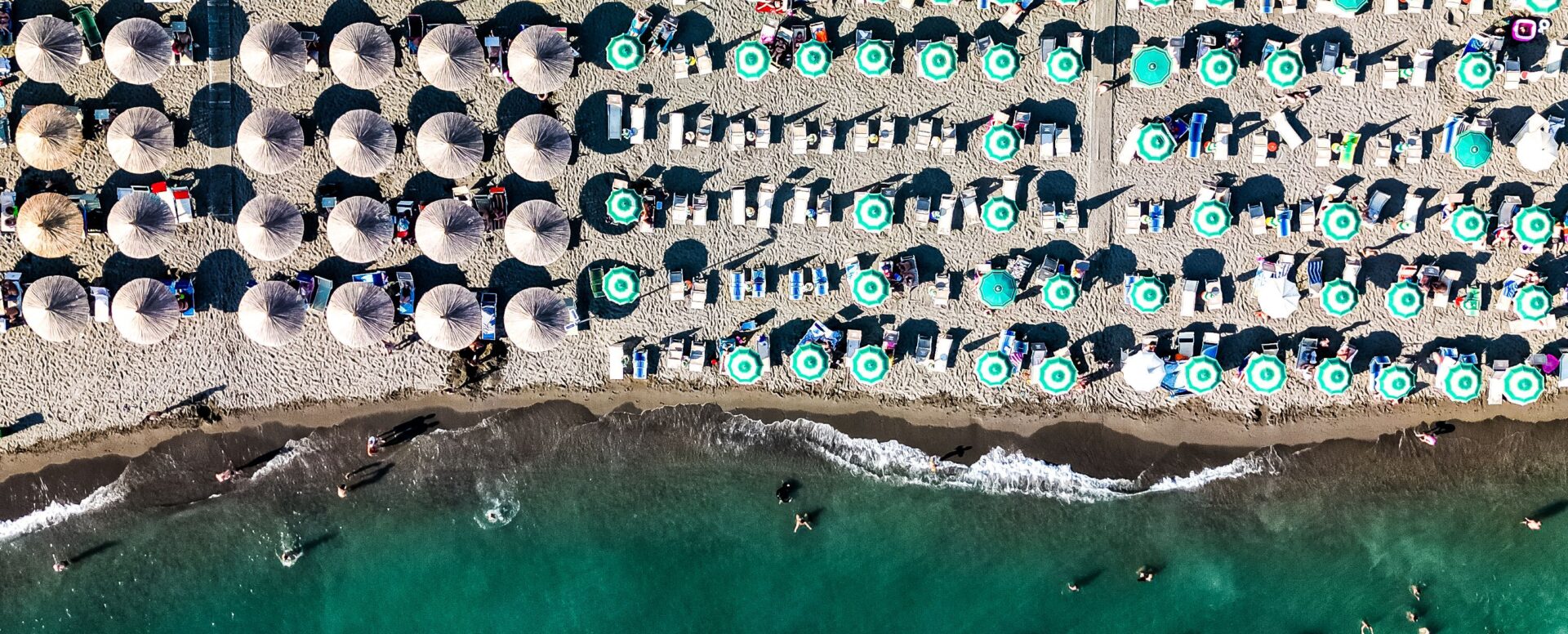
However, while Mediterranean tourism is undoubtedly an economic powerhouse, climate change is revealing the fragility of the region’s predominant tourism architecture centred on the sun, sea and sand model. The Mediterranean is a climate change hotspot, and the tourism sector is being challenged on several levels: the historically high concentration of tourism infrastructure along coastlines is now being tested by sea-level rise and erosion; more frequent drought events are forcing a re-evaluation of the management of water-intensive tourism infrastructure; and the traditional summer holiday is potentially losing its attraction as a result of increasingly extreme heatwaves during peak seasons at Mediterranean destinations. At the same time, some of the impact of tourism is being exacerbated by climate change, such as pollution and the overreliance of certain tourism activities on sensitive biodiversity.
Climate change is revealing the fragility
of the region’s predominant tourism
architecture centred on the sun, sea and sand model
This nexus between climate change and tourism is calling for a firm rethinking of the sector’s foundational structure towards climate resilience, inclusiveness and sustainability. This structure has traditionally relied on increasing tourist numbers, promoting mass tourism destinations characterized by short, profitable and climatically predictable summer seasons, and on the linear – and in many instances excessive – use of natural resources.
My recently published article on Mediterranean tourism in issue no.77 of Afkar/Ideas (Sciacca, 2026) highlights the relevance of the forthcoming EU Sustainable Tourism Strategy. The article identifies the strategy as an important opportunity to strengthen sustainable tourism in the Euro-Mediterranean region by mitigating the impact of tourism and leveraging the socioeconomic opportunities it creates through cohesive and integrated regional governance. In this article, however, I emphasize the next UN Climate Change Conference (COP31), taking place in the Mediterranean in Antalya (Türkiye) in late 2026, as a pivotal moment to place climate-resilient tourism more firmly on the regional sustainability agenda and accelerate progress towards a more future-ready regional tourism sector.
Why Is the Mediterranean Tourism Model Climate-Vulnerable?
Mediterranean tourism is traditionally reliant on coastal ecosystems, and coastal communities have often created an economic overreliance on the sector, amplifying its vulnerability to climate change impacts. In this sense, climate change represents a structural turning towards more resilient tourism models. Responding to these vulnerabilities is therefore crucial not only to prepare communities and infrastructure for climate-induced changes but also to maintain investor confidence.
The Mediterranean is warming approximately 20% faster than the global average, threatening the regional coastal and marine ecosystems, challenging economic sectors and jeopardizing the wellbeing of coastal communities. Mediterranean coastal communities and tourism operators are becoming increasingly familiar with floods, coastal erosion, droughts and water scarcity as they directly feel the pressures they impose.
Coastal communities have often created
an economic overreliance on the tourism sector,
amplifying its vulnerability to climate change impacts
The Mediterranean Sea’s temperature is expected to increase between 1.8°C and 3.5°C by 2100 (UNEP/MAP, 2021), increasing the susceptibility of coastal communities and ecosystems to climate change. Floods, coastal erosion, heatwaves and droughts are becoming more frequent across the region and with 70% of tourism development and activities concentrated on coastal areas (Plan Bleu, 2022), these climate events are exposing the regional tourism sector’s vulnerabilities.
How Is Climate Change Reshaping Mediterranean Tourism?
Climate change is already restructuring Mediterranean tourism and testing the stability and predictability of the sun, sea and sand model that is predominant across the region.
Heatwaves are destabilizing the summer-centred tourism market, prompting new travel patterns as visitors’ preferences shift towards the shoulder seasons. In Mediterranean Spain, for example, visitor flows from traditional source markets have declined because of heatwaves (Sánchez-Sánchez et al., 2024) and interest in cooler destinations is growing – a trend that some have called “Coolcations” (Khosravi, 2026).
Sea-level rise and erosion are stressing the infrastructure that supports the tourism sector (MedECC, 2024). In some destinations, coastal erosion is projected to increase with possible impacts on the coastal tourism sector and its attractiveness, as observed in Apulia (Italy) (Parate et al., 2024). These risks question the sustainability of coastal urbanization, which in many areas in recent decades has been driven by tourism.
Moreover, it is projected that the decline in regular precipitation will reduce the water supply in the Mediterranean by 10% by 2030 and by 25% by 2050 (Shanghai et al., 2020), affecting water availability both for residents and tourism infrastructure. This urgency has led to relevant calls for sustainable water management cooperation at the Mediterranean level (Union for the Mediterranean, 2024). Small and Medium-sized Enterprises (SMEs) are particularly vulnerable to climate events such as water scarcity, which often disrupt operations and increase their costs (UNFCCC, 2023), as shown in Sicily’s recent drought events (Nadeau, 2024).
Extreme floods and storms are becoming more frequent, damaging infrastructure that was not designed to withstand them. This is particularly the case for beach resorts, coastal hotels and community infrastructure that are directly exposed to storms and floods. Cyclone Harry’s devastating damage in the southern Mediterranean in early 2026 provides an exemplary case of the impacts of intensifying storms in the region (Chianetta & Luise, 2026), testing the resilience of destinations and exposing the sector’s overreliance on coastal infrastructure.
More broadly, from a value chain perspective, it is important to highlight that the impact of climate change on tourism is not only direct – affecting markets, infrastructure and resources – but also indirect, through effects across the tourism value chain. Tourism is highly dependent on ecosystem services, such as water, biodiversity, landscapes and food systems, and is supported by sectors such as agriculture. Any impact on these supporting systems will inevitably influence tourism products and services.
Beyond the Sun-Sea-Sand Model: Pathways to Resilience
A broader transition strategy is needed to promote a pathway towards a more
resilient tourism model in the region that supports and goes beyond technical measures and is underpinned by strong regional cooperation. Resilience in tourism would depend on diversifying and adapting the sector, along with fostering resource efficiency.
With COP31 taking place in the Mediterranean, tourism adaptation could emerge as a timely regional priority not only to foster the sector’s sustainability but also to ensure its competitiveness and continued benefits for communities.
In this context, the Mediterranean should continue to act quickly at the regional, national and sub-national levels to adapt tourism policies and planning in response to current and projected changes. Risk assessment and disaster preparedness should be integrated into these policies and planning tools. Infrastructure such as ports, airports, transport systems and accommodation facilities should become more resilient and better able to withstand direct and indirect climate impacts.
Growing implementation and financing of nature-based solutions in tourism will be critical to improving coastal protection and regenerating critical habitats for biodiversity. Similarly important are water-efficient technologies, water-related awareness-building among communities and operators, and the establishment of water contingency plans to manage water scarcity, especially during peak visitor seasons. Meanwhile, destinations should work towards reducing dependence on the summer season and diversifying their offer by promoting visits during shoulder seasons that rely less on the sun, sea and sand tourism model and more on cultural or ecotourism-based experiences.
Diversification should also occur at the spatial level, relieving tourism pressures on tourist hotspots and alleviating the often-excessive resource use in these areas. Climate-smart marketing strategies should be promoted to position many Mediterranean summer destinations as multi-season tourism destinations. At the same time, infrastructure and service providers should be prepared for this shift.
These strategic adjustments should be supported by integrated, multi-level and inclusive governance mechanisms that, where needed, are cross-border in nature. Tourism is transboundary, and cross-border collaboration is crucial to fostering policy coherence and harmonization within a highly diverse region where climate impacts are experienced to varying degrees across destinations.
Climate change is not only
reshaping Mediterranean tourism
but fundamentally redefining its model
Coordination should continue to be strengthened between tourism authorities, environmental agencies, private sector bodies and among ministries. This should help mobilize public and private funding for destination adaptation and create incentives for destinations and the private sector that invest in climate-resilient solutions. In particular, SMEs need key support to implement climate risk assessments and adaptation plans, access insurance schemes and obtain climate risk financing.
In the Mediterranean, climate change is affecting the tourism sector across multiple operational dimensions, requiring policies and governance instruments to adapt swiftly and coherently, and to promote both mitigation and preparedness for events and changes in sectoral trends. In this context, climate change is not only reshaping Mediterranean tourism but fundamentally redefining its model – from one dependent on seasonal and coastal concentration towards another that is more diversified, distributed and climate resilient.
References
Ascame. The new normal for Mediterranean tourism. Barcelona, 2022. Available at: www.ascame.org/new/the-new-normal-for-mediterranean-tourism/.
Chianetta, G. & Luise, F. Cyclone Harry: The Unavoidable Result of a Warming Mediterranean, and a Call to Faster Implementation of Available Solutions, 2026. Greening the Islands. Available at: https://greeningtheislands.org/cyclone-harry-the-unavoidable-result-of-a-warming-mediterranean-and-a-call-to-faster-implementation-of-available-solutions/.
MedECC. Climate and Environmental Coastal Risks in the Mediterranean. Marseille, 2024. Doi: 10.5281/zenodo.13754020.
Nadeau, B. L. This Italian vacation hotspot is turning tourists away as it runs out of water. CNN, 2024. Available at: https://edition.cnn.com/2024/07/06/climate/italy-sicily-water-shortage-drought-tourism-intl.
Parete, G. et al. “Climate impacts and adaptation strategies for coastal erosion, aquaculture, and tourism along the Adriatic side of Apulia region.” Frontiers in Climate, 6: 1378253, 2024. Doi: 10.3389/fclim.2024.1378253.
Plan Bleu. State of Play of Tourism in the Mediterranean, Interreg Med Sustainable Tourism Community project. Marseilles, 2022. Available at: https://planbleu.org/wp-content/uploads/2022/11/EN_VF_stateoftourism_PLANBLEU.pdf.
Sánchez-Sánchez, M. D.; De Pablos-Heredero, C.; Botella, J. L. M. Impact of heat waves on the redistribution of tourist flows: the case of Spain, 2024. Available at: www.preprints.org/frontend/manuscript/6bdd3965d268f0cd58e817d32e84d49b/download_pub.
Sciacca, A. El turismo azul mediterráneo en una encrucijada, 2026. afkar/ideas n.77. Available at: www.iemed.org/publication/el-turismo-azul-mediterraneo-en-una-encrucijada/.
Shanghai J. W. et al. Climate risk and response: Physical hazards and socioeconomic impacts: A Mediterranean basin without a Mediterranean climate?, 2020. McKinsey Global Institute. Available at: www.mckinsey.com/~/media/mckinsey/business%20functions/sustainability/our%20insights/a%20mediterranean%20basin%20without%20a%20mediterranean%20climate/a-mediterranean-basin-without-a-mediterranean-climate.pdf.
UNEP/MAP. Climate Change in the Mediterranean, 2021. Available at: https://www.unep.org/unepmap/resources/factsheets/climate-change.
UNFCCC. Mapping Study of the Capacity building Needs and Gaps of SMEs to Engage in Climate Action in the MENA Region: Final Synthesis Report, 2023. Available at: unfccc.int/sites/default/files/resource/MENA_SME%20Report_English.pdf.
Union for the Mediterranean. UfM emphasises importance of sustainable water management cooperation in drought-stricken Euro-Mediterranean region, 2024. Barcelona. Available at: https://ufmsecretariat.org/ufm-emphasises-importance-of-sustainable-water-management-cooperation-in-drought-stricken-euro-mediterranean-region/.
Photo: A vibrant aerial shot of Velipojë Beach, Albania, featuring colorful umbrellas and turquoise waters. Photo: Pexels