



Context and Origins: How the NCAG Came to Be
The National Committee for the Administration of Gaza (NCAG) is a transitional body mandated by the United Nations to manage day-to-day operations of civil service and administration in the Gaza Strip following the 2023–2025 war. Formally inaugurated on 16 January 2026 in Cairo, it is composed of independent Palestinian technocrats and operates under the supervision of the Board of Peace (BoP), chaired by US President Donald Trump.
The NCAG’s origins reveal a crucial founding tension. Palestinian factions had previously agreed — during Cairo talks in October 2024 — that any transitional committee should be established by a presidential decree from Mahmoud Abbas and report to the Palestinian Authority. That vision was discarded in favour of the US-Israeli preference: a technocratic body answering to neither Hamas nor the PA, but to the externally designed Board of Peace. The ECFR notes that the NCAG “was first envisaged as a Community Support Committee which Palestinian factions agreed to establish under the PA’s auspices.” The departure from this framework was itself a political act of considerable consequence.
The NCAG is one of four governance structures in the transitional framework, alongside the Board of Peace, the Gaza Executive Board, and an International Stabilization Force. The Board of Peace formally launched in January 2026, with Mladenov — a former UN Middle East envoy and former Bulgarian defence minister — appointed as its High Representative for Gaza.
TABLE 1 The National Committee for the Administration of Gaza
| Established | 14–16 January 2026 (first meeting in Cairo) |
| Chair | Dr Ali Shaath — engineer and former PA Deputy Minister (Planning & Transport, 1995–2016) |
| Composition | 15 Palestinian technocrats covering health, education, water, energy, finance, security, justice, agriculture, social affairs and communications |
| Legal Basis | UN Security Council Resolution 2803 (17 November 2025) & Trump’s 20-Point Gaza Peace Plan |
| Reports to | High Representative Nickolay Mladenov → Board of Peace, chaired by Donald Trump |
| Physical Status | As of March 2026: still unable to enter Gaza. Operating from Cairo. Israeli blockade ongoing since 20 January 2026. |
| Latest Threat | U.S.-Israel war on Iran (28 Feb 2026) has closed Gaza crossings, frozen donor mechanisms, and shifted global attention away from Gaza governance |
| Iran War Ceasefire | Two-week ceasefire agreed 7–8 April 2026 (brokered by Pakistan). Fragile; Lebanon excluded initially. Extended 21 April+. |
| Disarmament Talks | Stalled as of 21 April. Hamas refuses unless Israel fulfils Phase 1 ceasefire obligations. Ultimatum deadlines passed 11 and 15 April. |
| Deir al-Balah Election | Held 25 April. First Gaza election since 2006. Fatah-backed list won 6/15 seats; Hamas-aligned list 2/15. Turnout: 23%. |
The Board of Peace Summit — 19 February 2026: Promises and Their Limits
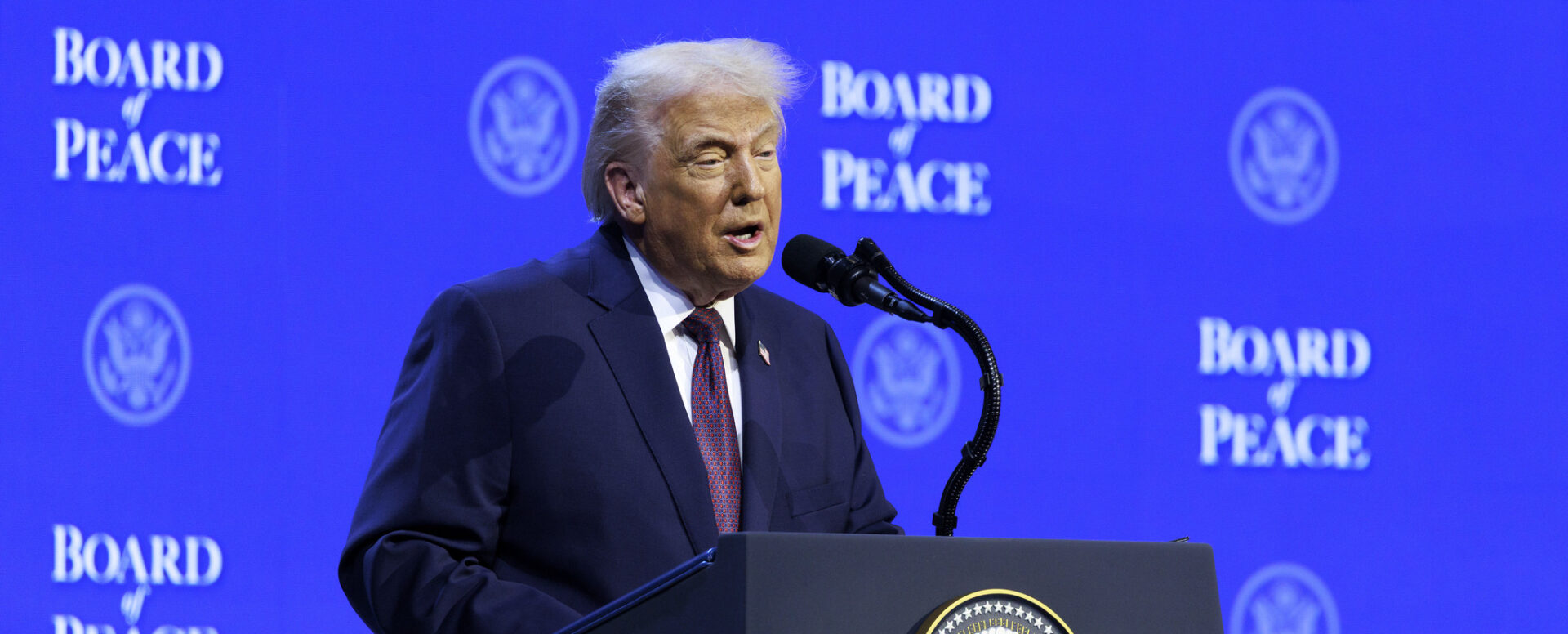
The inaugural Board of Peace summit in Washington on 19 February was the defining diplomatic moment for the NCAG’s operational launch. Attended by representatives from over 40 countries — including several heads of state — the summit produced concrete pledges but also exposed the gap between diplomatic ambition and ground-level reality. That gap would widen dramatically just nine days later.
Key Announcements
- USD 10 billion pledged for Gaza reconstruction, primarily from Gulf nations, though analysts have since noted that only approximately $7 billion has materialized in NCAG-accessible funds.
- Five countries committed troops to the International Stabilization Force, projected to comprise approximately 20,000 soldiers across five brigades covering Rafah, Khan Younis, Deir al-Balah, Gaza City, and Northern Gaza, with 26 watchtowers and a 350-acre military base.
- Plans to recruit approximately 12,000 police officers to re-establish internal security under a unified command, with Egypt designated as the lead training partner. Some 1,000 applicants registered in the first hours of the recruitment process.
- Shaath presented the committee’s “first 100-day” plan, covering emergency relief, water rehabilitation, medical supply chains and housing provision.
- Trump declared the Board “a turning point toward stability.” He stated he saw no need for military action against Hamas given the group’s commitment to disarm — a statement that would appear ironic within days given US strikes on Iran.
Shaath’s own remarks at the summit were notably sober. He reminded attendees that conditions on the ground were “extremely difficult,” that “large parts of Gaza are severely damaged and destroyed,” and that “law and order remain fragile.” The gap between his framing and the triumphalist tone of the summit hosts encapsulated the fundamental tension defining the entire enterprise. That tension would be sharpened, not resolved, by subsequent events.
The Nine-Day Window: From Summit to War
The Board of Peace summit concluded on 19 February. On 28 February — nine days later — the United States and Israel launched surprise airstrikes on multiple sites across Iran, killing Supreme Leader Ali Khamenei and several senior Iranian military officials. This transformed the regional and geopolitical context in which the NCAG operates from one of post-ceasefire governance-building to one of active regional war. The summit’s pledges, its timelines and its institutional momentum did not simply slow — they entered a fundamentally different strategic environment.
| Critical Context Shift The 19 February summit must now be read retrospectively, not as a launch point for NCAG operations, but as the last moment of relative stability before a regional war that has frozen donor mechanisms, closed Gaza’s crossings, shifted global attention and given Israel cover to deepen its military presence in and around Gaza without triggering significant international reaction. |
The Iran-US-Israel Ceasefire: Partial De-escalation (7–8 April 2026)
After 39 days of strikes and counterstrikes, the United States and Iran agreed to a two-week conditional ceasefire brokered by Pakistan, announced on 7–8 April 2026. Iran agreed to reopen the Strait of Hormuz during the truce period, easing a disruption that had sent global energy markets into turmoil. Trump declared a “total and complete victory.” The ceasefire was immediately contested: Israel maintained it did not include Lebanon and launched a significant wave of strikes there hours after the announcement. Lebanon and Israel subsequently agreed to a separate 10-day ceasefire on 16 April, extended to three weeks on 23 April. On 21 April, Trump extended the Iran truce pending further negotiations. (Al-Jazeera, 8 April 2026) | CNN, 7 April 2026
The ceasefire does not restore the pre-war diplomatic environment on which the NCAG’s operational timeline was premised: the Rafah Crossing remains partially restricted; donor disbursement mechanisms remain disrupted; and international diplomatic attention, while partially returning to Gaza, has not regained the momentum of the 19 February summit. Mladenov called for the Rafah Crossing to be fully reopened and noted that since late March, daily entry into Gaza was being gradually increased from a cap of approximately 50 people per day — still way below the level required to meet humanitarian needs. The ceasefire represents de-escalation, not restoration.
The US-Israel War on Iran (28 February Onward): The Variable No One Modelled
When this analysis was originally drafted, the prospect of a full-scale US-Israeli war on Iran was not a seriously modelled scenario. That is itself analytically significant: the entire architecture of the NCAG, the Board of Peace and the Gaza ceasefire framework was constructed on the assumption of a contained regional order in which the ceasefire would hold, donors would disburse, and the committee would gradually assume governance. That assumption no longer holds.
What Happened
On 28 February 2026, the United States and Israel launched coordinated surprise airstrikes targeting multiple Iranian sites in at least 26 of Iran’s 31 provinces, killing Supreme Leader Khamenei and dozens of senior military commanders. Iran retaliated with missile and drone strikes against Israel, US military bases and allied countries across the region. By day ten of the conflict, Iran had fired over 300 missiles at Israel — though Iranian missile capacity degraded sharply due to sustained US-Israeli suppression efforts. Israel simultaneously launched a ground incursion into southern Lebanon on 3 March, claiming to establish a “security layer.” The Houthis, restrained by prior US airstrikes on their leadership, confined themselves largely to rhetorical solidarity rather than direct military action.
Direct Consequences for Gaza
The impact on Gaza has been immediate, severe and multi-dimensional. Al-Jazeera’s ground reporting from 9 March captures the cascading effect: as soon as US-Israeli strikes hit Iran on 28 February, concerns surged in Gaza over how the latest conflict would affect a population already subjected to two years of genocidal war.
- Israel closed all Gaza crossings, specifically interrupting free circulation at the Egypt-Gaza border, using the Iranian conflict and the declared state of emergency as justification.
- Israeli forces suspended United Nations humanitarian movements and postponed planned rotations of international humanitarian staff, including medical evacuations and the return of people into Gaza.
- The NCAG’s already-stalled entry into Gaza was further frozen, with no timeline established and no diplomatic momentum available to press for it.
- Donor mechanisms for reconstruction financing have stalled. The $10 billion pledged at the 19 February summit, already underdisbursed at approximately $7 billion, faces further delays as Gulf donors and European governments redirect political attention and logistical capacity to the broader regional crisis.
- Israeli violations of the October ceasefire have intensified. According to the Ministry of Health in Gaza, Israeli attacks since the ceasefire began have killed at least 648 Palestinians and wounded nearly 18,000. Al-Jazeera reports that Israel continues to bombard Gaza on a daily basis, violating the 10 October ceasefire agreement.
- Analysts at ACLED note that the shift in international attention has given Israel significantly greater operational space to carry out military actions in Gaza without triggering major international reactions.
“Israel continues to carry out what he described as ‘systematic acts of genocide’ in Gaza, exploiting every opportunity to deepen conditions that make life increasingly impossible for an exhausted population.” — Ramy Abdu, head of the Euro-Med Human Rights Monitor, quoted by Al-Jazeera, March 2026.
Strategic Implications for the NCAG
The Iran war has transformed the NCAG’s structural position in three ways that compound each other.
First: The diplomatic bandwidth that made the 19 February summit possible — American political capital, Gulf state engagement, European institutional attention — has been almost entirely redirected. There is no credible international actor currently applying meaningful pressure on Israel to allow the NCAG entry into Gaza.
Second: The financial architecture is broken. Reconstruction pledges were conditioned on a stable ceasefire environment and functional donor mechanisms. The regional war has disrupted both. A Gaza analyst cited by al-Jazeera observes that “only a fraction” of pledged funds has materialized in NCAG-accessible channels.
External geopolitical dynamics
determine Palestinian realities
more decisively than any internal
governance arrangement
Third: The NCAG’s operational mandate — civilian administration, service restoration — presupposes a minimum of stability and access. Neither currently exists. The committee risks being a governance body in name while Gaza continues to be administered, in practice, by a combination of Israeli military control and Hamas security presence, with neither accountable to Gazan civilians.
The Iran war has also, paradoxically, strengthened one argument that had previously been used against the NCAG: that external geopolitical dynamics determine Palestinian realities more decisively than any internal governance arrangement. The committee was designed to operate in a world where the US was focused on Gaza. That world no longer exists, at least temporarily.
Structural Challenges and Systemic Risks
The Israeli Blockade: An Unresolved First Test
On 20 January 2026, just days after the NCAG’s inauguration, Israel blocked committee members from entering Gaza without providing a clear public rationale. As of early February, an unnamed Arab diplomat told The Times of Israel there was “no longer any timeline” for the NCAG’s entry, citing the committee not being “equipped to govern” and a lack of an “appropriate environment.” The outbreak of the Iran war on 28 February has made that environment significantly worse rather than better.
Haaretz, citing Palestinian and Arab officials, reported that both the PA and Hamas — despite their public endorsements — were quietly seeking to limit the committee’s effectiveness for self-interested reasons, and that the technocrats themselves feared targeting by Israeli-backed local armed groups. With the Iran war providing cover for Israel’s continued military operations in Gaza, the committee’s physical entry remains the single most concrete measure of whether this governance framework is real or performative.
Governance Without Authority: The Core Paradox
The IPI Global Observatory’s analysis remains the most precise structural critique of the NCAG’s design. Its assessment, published before the Iran war, has been validated rather than superseded by subsequent events:
“The NCAG’s mandate excludes control over borders, security arrangements, reconstruction financing and political timelines. It does not regulate movement, negotiate security frameworks, or control the disbursement of funding. It administers services within parameters defined elsewhere. Administration without authority is not governance. When a technocratic body is denied access and lacks decision-making power, it cannot function as a political authority. Instead, it risks becoming a symbolic institution that absorbs expectations and public frustration without possessing the capacity to alter underlying conditions.”
The IPI also warns of what it terms the “successful failure” scenario: the NCAG “succeeds administratively while reproducing a modified version of the status quo ante under a technocratic framework — marking not a transition but continuity under a different name.” This risk has intensified under conditions of regional war.
The Security Dimension: Hamas, the Yellow Line and the New Disarmament Plan
A critical design contradiction persists: the NCAG’s mission statement speaks of “establishing security control” as a core mandate, but the committee’s powers are limited exclusively to civilian affairs. Hamas retains de facto security control over Gaza. This was clarified after a 26 January meeting between Shaath and BoP member Tony Blair: the NCAG will play no role in the disarmament of armed groups.
Yet disarmament has now returned to the centre of the governance conversation — not through the NCAG, but through a separate and more coercive process being driven by Mladenov and the Board of Peace, discussed in detail in Section 6 below. Hamas, meanwhile, has reinforced its presence along the Yellow Line, signalling that it alone can provide the committee with the security coordination it needs to operate. The committee is operationally dependent on the very organization it was designed to replace.
The Legitimacy Deficit
The House of Commons Library briefing notes that while both Hamas and the PA have endorsed the committee, “many Palestinians remain sceptical of the NCAG’s autonomy.” The IPI articulates the structural dimension of this skepticism: the NCAG was “formed through agreement among the major Palestinian factions in Cairo, but its structure and scope have not been ratified by the Palestinian Authority’s formal institutional apparatus, such as a presidential decree or legislative mandate. As a result, it risks operating without clear, uncontested consent.”
A Gaza-based writer published in The New Humanitarian frames the problem with particular precision:
“Expertise is not legitimacy. Legitimacy comes from accountability. Shaath’s authority is not derived from elections, popular consultation, or a transparent process rooted in Gaza’s public life. It is derived from appointment within an externally designed framework. Gaza, after two years of devastation and amid continued external control, has no meaningful mechanism for conferring consent on a transitional committee installed from above.”
The Mladenov Disarmament Plan and the UN Security Council Speech (25 March 2026)
On 25 March 2026, Nickolay Mladenov addressed the UN Security Council at its monthly session on the Israeli-Palestinian conflict, speaking as High Representative of the Board of Peace and liaison to the NCAG. His address — and the detailed disarmament proposal that accompanied it — represent the most significant institutional development for the NCAG since the 19 February summit, and one that fundamentally alters the committee’s position and mandate.
The Speech: Key Positions
Mladenov told Security Council members that only “verified decommissioning combined with a new professional police force and a civilian administration eliminates the threat permanently.” He argued that “the evidence of the last 20 years debunks arguments that long-term Israeli military control of the enclave is necessary,” and called demilitarization “the only pathway that provides Israel with durable security.”
On the NCAG specifically, Mladenov confirmed that the committee had begun “vetting thousands of civilian police candidates,” with Egypt confirmed as the lead training partner for the 12,000-officer force. He linked reconstruction explicitly to disarmament:
“The people of Gaza want reconstruction, and reconstruction requires the decommissioning of weapons.” — Mladenov, UN Security Council, 25 March 2026.
He called on Security Council members to “use all means at their disposal to urge Hamas and all Palestinian factions to accept this framework without delay,” and warned: “If this process fails, the consequences will be devastating — a divided Gaza and the loss of any credible pathway to Palestinian statehood.” On the Rafah Crossing, Mladenov called for it to remain open following Israel’s closure during the Iran war, and revealed that starting the following day, the number of people permitted to enter Gaza would gradually increase from the current cap of approximately 50 per day.
The Disarmament Plan: Structure and Phases
Details of the formal disarmament document submitted to armed groups — obtained by al-Jazeera — reveal an eight-month, multiphase framework built on a step-by-step formula. The plan was presented to relevant parties during Cairo meetings in mid-March 2026.
Phase 1 (First Two Weeks): Stabilization and Entry
- Complete cessation of military operations by both Israel and Hamas.
- Implementation of all humanitarian protocols committed to under the October ceasefire.
- NCAG representatives allowed into Gaza to assume all security and administrative responsibilities.
Phase 2 (Days 16–60): Initial Disarmament
- Hamas and other Palestinian factions begin removing heavy weapons, initially from areas under Israeli military control, then from Hamas-controlled areas before day 90.
- Israel begins staged withdrawal from Yellow Line positions in parallel.
- Reconstruction materials begin entering Gaza contingent on compliance verification.
Phase 3 (Days 61–240): Full Decommissioning and Reintegration
- Complete decommissioning of all weapons including personal firearms.
- Structured amnesty arrangements and reintegration programmes for individuals affiliated with armed groups, allowing “re-entry into civilian life with dignity.”
- Verification by international monitors throughout the process.
- Reconstruction benchmarks linked to compliance milestones.
Times of Israel reports that two senior Arab officials familiar with the proposal expect Hamas to respond with a counter-offer within days. Hamas and Israel have not yet officially reacted publicly to the plan’s specific details.
Critical Analysis of the Disarmament Plan
Palestinian analysts and factions view the Mladenov plan with deep scepticism, and their objections have analytical substance. Gaza political analyst Wissam Afifa, quoted by al-Jazeera, describes the document as more of a “threat message” than a negotiating initiative.
One-sided conditions: Despite Mladenov’s invocation of “reciprocity,” the plan’s practical weight falls almost entirely on Palestinian disarmament. Hamas has consistently insisted that the first phase of the October ceasefire — which requires Israeli military withdrawal and unconditional aid entry — must be implemented before weapons are addressed. Neither condition has been fulfilled.
Mandate creep on the NCAG: Afifa warns that confirming the NCAG is now vetting police candidates represents an attempt to saddle the committee with a security enforcement role before the humanitarian crisis is addressed, effectively “turning it into an enforcement tool rather than a purely civilian administration.” This is significant: it means the NCAG’s character is being redefined by external actors without any formal revision of its mandate.
Context of regional war: The disarmament plan was presented to Hamas during a period when Israel was conducting a regional war with Iran, closing Gaza crossings, and killing Palestinians inside the Strip in ceasefire violations. Asking Hamas to disarm under these conditions, without any demonstrated Israeli good faith, is widely seen as politically untenable.
The committee that was designed
to transcend factional politics has been
drawn into the most politically
charged issue in Palestinian political life
The surrender framing: Palestinian experts previously told al-Jazeera that the plan, in effect, means the “political surrender” of Hamas. Hamas has stated that disarmament is an internal Palestinian matter to be discussed between factions, not imposed from outside.
The disarmament plan, whatever its eventual outcome, has already produced one concrete consequence for the NCAG: by linking reconstruction to weapons decommissioning and confirming that the committee is now vetting police, the plan has blurred the boundary between the NCAG’s “apolitical civilian” character and the explicitly political project of disarming Hamas. The committee that was designed to transcend factional politics has been drawn into the most politically charged issue in Palestinian political life.
April Ultimatums and the Collapse of Momentum
The disarmament question escalated sharply through April in a sequence that exposed the limits of the Board of Peace’s coercive strategy. On 7 April, the Board of Peace gave Hamas until the end of that week to accept the disarmament proposal, with the deadline conveyed by Mladenov directly at a Cairo meeting with senior Hamas officials. On 7 April 2026, The Times of Israel reported that the deadline was conveyed after “the group dragged its feet in responding to the proposal it first received nearly four weeks ago.” Hamas did not comply.
On 14 April, Haaretz (Liza Rozovsky and Jack Khoury, 14 April 2026) reported that Mladenov met for a second time with Hamas’s chief negotiator in Cairo, with a new Tuesday deadline set — and again no breakthroughs were made. Hamas officials told Haaretz that “without guarantees that Israel implements phase one of the cease-fire plan, disarmament is not on the table.” The Haaretz report also revealed that Mladenov met Hamas’s chief negotiator to discuss specifically Phase 2 of Trump’s Gaza plan, but sources confirmed no progress was achieved. A diplomatic source told the paper that Hamas was insisting on ironclad guarantees before any further movement.
On 21 April, The Jewish Chronicle reported that Mladenov confirmed to Reuters that talks had “effectively stalled.” He told Reuters: “We’ve had some very serious discussions with Hamas over the last few weeks. They’re not easy.” He nonetheless described himself as “fairly optimistic,” adding: “We have a matter of days, maximum a couple of weeks… because otherwise we will lose the momentum of what we have, and then every decision will become even more difficult.”
A tactically significant development emerged from Hamas’s counter-position: the group told mediators it was prepared to hand over weapons — but only to the NCAG itself, not to Israel or to any international body. This is analytically important for the committee’s institutional trajectory. Hamas may be prepared, under pressure, to grant the NCAG a security role it was never formally given — as a way of blocking a more direct Israeli or American role in overseeing disarmament. Whether the NCAG actually has the capacity or the political mandate to enforce any such arrangement remains, in the words of The Jewish Chronicle, “not clear.”
A separate but related issue concerns Hamas’s 40,000-plus civil servants. Hamas urged them in writing to cooperate with the NCAG, assuring them it was working to incorporate them into the new government structure. Hamas specifically sought incorporation of its approximately 10,000-strong police force into the new NCAG-supervised Palestinian police — a demand that four sources told Reuters is likely to be opposed by Israel. Former Hamas civil servants are permitted to apply to the new police force but must pass Israeli vetting. Those who Israel says were involved in the 7 October operation may not receive immunity. This creates a structural minefield: the NCAG is being asked to absorb the institutional workforce of the government it is replacing, while that workforce is subject to vetting by the occupying power.
| April 2026 Status: Disarmament Talks As of 27 April 2026: All disarmament ultimatum deadlines (11 April and 15 April) have passed without Hamas compliance. Talks continue in Cairo but no agreement has been reached. Hamas’s stated position: it will only disarm in exchange for full Israeli implementation of Phase 1 ceasefire obligations (withdrawal, unconditional aid entry) — obligations Israel has not fulfilled. The NCAG remains physically absent from Gaza. Mladenov describes the situation as “not easy” but remains publicly optimistic. |
Expert and Analytical Perspectives
Chatham House: Failure without Political Vision
Chatham House’s analysis warns that “the key pillars of the ceasefire plan, as well as hopes for broader regional stability, will fail without a political vision for Palestine.” It identifies two irreducible sticking points: Hamas’s refusal to disarm without Israeli withdrawal, and Israel’s refusal to withdraw from the Yellow Line. Both remain unresolved. The Iran war has added a third layer of complexity that Chatham House did not model: the complete paralysis of the diplomatic track that was supposed to resolve these sticking points.
Al-Shabaka: Technocratic Governance as Genocide Management
Yara Hawari, co-director of Al-Shabaka, argues that “the NCAG is more likely to function as a managerial apparatus that stabilizes conditions that enable genocide rather than challenging them.” She contends that “technocratic governance in Gaza — particularly under US oversight, given its role as a co-perpetrator in the genocide — should be understood not as a pathway to recovery or sovereignty, but as part of a broader strategy of genocide management.”
Hawari draws a direct institutional parallel to the PA’s West Bank role:
“This model is not new. It mirrors the role long assigned to the Palestinian Authority in the West Bank: a body tasked with administering daily life while Israel retains decisive control over land, movement, security and violence. The result has been prolonged political limbo in which services are delivered, elections are postponed, dissent is policed and occupation deepens uninterrupted.”
This analysis has gained rather than lost force since the Iran war. The conditions Hawari describes — service delivery without sovereignty, administration without accountability, management without liberation — are now reproduced in a regional context of intensified conflict rather than post-war stabilization.
Al Jazeera: The “Sovereignty-Minus” Model Under Pressure
Gaza analyst Wissam Afifa, cited consistently by al-Jazeera across multiple reports, has emerged as one of the sharpest ground-level analysts of the NCAG’s trajectory. His characterization of the governance structure as a “sovereignty-minus model where the National Committee takes orders from the High Representative, who takes orders from the White House” remains precise. The Mladenov disarmament plan and Iran war have deepened rather than altered this structure: both have further subordinated Palestinian institutional agency to external strategic priorities.
IPI Global Observatory: The “Successful Failure” Risk
The IPI’s warning about “administrative success” functioning as political defeat bears repeating in the context of the disarmament plan. If the NCAG does eventually enter Gaza and does begin vetting police candidates and restoring basic services, it may do so in a framework where:
- Security is externally managed via an international stabilization force;
- Reconstruction is conditioned on Hamas disarmament, not on Palestinian rights;
- Political questions are deferred indefinitely to a Board of Peace that expires in December 2027;
- And Palestinian governance is reduced, as Afifa observes, to municipal administration under foreign supervision.
The IPI’s conclusion that this marks “not a transition but continuity under a different name” has become more, not less, applicable with the Iran war reinforcing Israeli military dominance and reducing international accountability for its conduct.
Mondoweiss: The Shock Doctrine, Accelerated
Mondoweiss’s invocation of Naomi Klein’s shock doctrine — policies imposed on societies after extreme collective trauma when resistance is most diminished — has been given new analytical weight by the Iran war. Palestinian civil society was already traumatized by two years of genocidal war. The Iran war, by closing crossings, freezing reconstruction funds, and providing cover for continued Israeli military operations, has deepened the shock. The disarmament plan — presented in Cairo during a period of regional war and cross-border strikes — was submitted precisely at the moment when Palestinian capacity to resist its terms was at its lowest.
Peoples Dispatch: The Strategic Use of Unity
Peoples Dispatch’s more cautiously optimistic reading — that “the NCAG represents neither liberation nor capitulation, but Palestinians navigating catastrophic constraints with political nuance” — remains a necessary counterweight to purely critical analyses. The unprecedented cross-factional unity persists. Hamas’s engagement with the Mladenov disarmament plan, even if it culminates in rejection, is a form of political agency that did not exist during the post-2006 isolation period. Palestinian factions have submitted a counter-offer to the disarmament proposal, signalling engagement rather than unilateral refusal.
The window provided by Resolution 2803’s mandate (until December 2027) remains available, even if its terms are less favourable than originally anticipated. Palestinian civil society’s emphasis on using this period to build institutions capable of full sovereignty remains strategically sound, even if the conditions for doing so have deteriorated.
Palestinian Authority: The Deir al-Balah Election and the Legitimacy Strategy
The Structural Anxiety: Unchanged and Deepening
The Palestinian Authority’s official position remains one of endorsement of the NCAG. Its institutional anxieties, however, have deepened rather than dissipated. The PA’s original vision — that it would issue the founding decree, receive the committee’s reports and maintain institutional continuity over Gaza’s governance — was not realized. The NCAG reports to Mladenov and the BoP, not to PA institutions. This structural marginalization has now been compounded by the Mladenov disarmament plan, which envisions a future PA return to Gaza, but only after Hamas disarms and only after the PA completes a “reform programme” whose terms are not defined by Palestinians.
In November 2025, PA Vice President Hussein al-Sheikh had stated that the PA and Hamas had agreed that any future Palestinian technocratic government for Gaza would be headed by a minister nominated by the PA. That arrangement was not realized in the NCAG’s final formation.
The PA’s position was further complicated in April by a development that simultaneously strengthened and exposed its institutional logic. The Deir al-Balah election results — discussed in detail in the next section — demonstrated that the PA can mobilize electoral support in Gaza even under war conditions. But the same elections revealed the depth of Gaza’s institutional decay: with outdated civil registries, destroyed schools repurposed as polling stations, and ballot boxes printed locally for lack of materials, the PA’s “year of democracy” is occurring in conditions where the basic prerequisites for meaningful democratic participation are absent. Palestinian Prime Minister Mohammed Mustafa, commenting on the results, reiterated that “the Israeli occupation’s presence in Gaza still exists and must be urgently ended,” and linked the ongoing withholding of clearance revenues by Israel to a deliberate strategy of “suffocating the West Bank” alongside Gaza. (WAFA, 26 April 2026)
The Deir al-Balah Local Elections: A Deliberate Political Signal
On 23 February 2026, the Palestinian Central Election Commission announced that local elections scheduled for 25 April 2026 would be held in the West Bank and in one location in Gaza: the city of Deir al-Balah in the central Gaza Strip. The elections will cover 421 local councils in the West Bank and the single Gaza municipality.
This is not a logistical decision. It is a political act of considerable symbolic weight.
First local elections in Gaza since 2005: The announcement describes these as “the first local elections held in Gaza since 2005,” making them the first post-war democratic exercise of any kind in the Strip in two decades.
Institutional demonstration: According to The Times of Israel, “the step is aimed at demonstrating that Gaza and the West Bank can operate under a single political system” — something Netanyahu’s government, which opposes a two-state solution, has consistently sought to undermine. Holding even one Gaza election signals that Palestinian democratic institutions can and do function across the divided territory.
The NCAG connection: The Times of Israel notes that “voting in Deir al-Balah will likely require cooperation with the NCAG,” given the committee’s mandate over civilian administration in Gaza. This makes the election both a test of the NCAG’s functionality and a mechanism by which the PA attempts to reassert institutional linkage between the committee and Ramallah.
Hamas exclusion by design: The 2025 presidential decree requires all candidates to sign a statement committing to the PLO’s national programme, its international commitments and the decisions of international legitimacy — language that effectively bars Hamas members and affiliated sympathizers from standing. Multiple Palestinian factions including the PFLP, DFLP and civil society groups have protested the decree as violating the spirit of Palestinian democratic participation. The ECFR notes that five factions have formally rejected the conditions and warned of impacts on the electoral process.
The choice of Deir al-Balah is not random. Located in central Gaza, it sits in an area where the NCAG could theoretically extend its administrative reach if Israel permits entry. Running elections there would simultaneously test the NCAG’s local authority, advance the PA’s claim to institutional continuity across Gaza and the West Bank and exclude Hamas from the result — a trifecta of institutional, symbolic and political objectives.
The Iran war did introduce significant uncertainty into the 25 April election logistics. With crossings closed, movement restricted and Israeli military operations continuing, the elections commission was forced to improvise: ballot boxes were constructed locally, ballot papers printed within Gaza and schools replaced by tents as polling stations. Despite all of this, the election proceeded as planned on 25 April — a fact that is itself analytically significant and is addressed in full in the results section below.
The Election Happened: Results and Analysis ( 25–26 April 2026)
Against significant logistical odds, the election took place on 25 April as scheduled. Approximately 70,000 voters — less than five percent of Gaza’s total population — were eligible to cast ballots. Many schools that would normally serve as polling stations had been destroyed in Israeli strikes; the elections commission improvised, using tents and locally printed ballot papers. Ballot boxes were built in Gaza because Israeli security restrictions prevented materials from being brought in. On 25 April 2026, CNN quoted the regional elections director: “We were determined to hold these elections and find the necessary alternatives to ensure the success of the electoral process.”
Voter turnout was 22.66 percent — 15,962 voters out of 70,449 registered — compared to 56 percent in the West Bank. CEC Chairman Rami Hamdallah attributed the low figure to large-scale displacement and an outdated civil registry reflecting thousands of war dead and entire families relocated from Deir al-Balah. Hamas did not formally nominate candidates and did not attempt to block the vote; its police forces, however, surrounded the polling stations with armed guards. Reuters, 26 April 2026.
The 15 council seats were distributed as follows: Fatah-backed “Nahdat Deir al-Balah” — headed by engineer Hisham al-Dirawi, who worked at the municipality for decades including under Hamas until 2022 — won six seats. The Hamas-aligned list “Deir al-Balah Brings Us Together” won two seats. Two independent lists, “Future of Deir al-Balah” and “Peace and Building,” won the remaining seven seats. Abbas loyalists swept the West Bank elections. Times of Israel, 27 April 2026 | al-Jazeera, 26 April 2026.
Three analytical observations are essential. First, the election’s symbolic weight vastly exceeds its operational significance: 70,000 eligible voters in one city does not constitute democratic representation of Gaza’s 2.4 million people, and the newly elected council has no mandate beyond water, roads and electricity. Second, the result — Fatah winning a plurality but independent lists capturing nearly half the seats, with the Hamas-aligned list receiving only two seats — suggests neither a Fatah mandate nor a Hamas collapse, but rather a pragmatic communal vote. Palestinian analyst Reham Ouda (Times of Israel) noted: “By electing figures linked to Fatah, voters appear to be seeking unrestricted international support for municipal governance and a gradual political shift.” Third, and most consequential: the election occurred without the NCAG being present in Gaza, without it facilitating the process, and without any demonstrated administrative link between the committee and what happened on the ground.
| Critical Finding: NCAG Absent from Gaza’s First Election in 20 Years The 25 April Deir al-Balah election was run entirely by the PA’s Central Elections Commission without NCAG participation. If the committee does not enter Gaza before the next round of elections — planned for other Gaza localities — its institutional relevance to Palestinian democratic life will diminish further, regardless of its formal mandate. |
The Broader 2026 Palestinian Electoral Landscape
The Deir al-Balah election sits within a larger “year of Palestinian democracy” framework that Abbas announced, including Palestinian National Council elections in November, a Fatah congress in May, and potential presidential elections. Analyst Daoud Kuttab notes that “the new arrangements in Gaza under the control of the Trump administration, with strong involvement from the Israeli occupiers, might make free and fair elections in the Strip next to impossible.”
The credibility of this electoral process depends, in part, on what the NCAG is able to deliver institutionally. A committee that cannot enter Gaza cannot facilitate elections in Gaza. A committee that does enter Gaza and cooperates with the PA on electoral administration becomes, de facto, a bridge between the external governance framework and Palestinian democratic institutions — which is arguably the most legitimate role it could play.
The Palestinian People of Gaza: Between Necessity, Scepticism and the Iran Shadow
The 2.4 million people of Gaza — the NCAG’s primary constituency — now face a compounded crisis. Their perspective has not changed in its essentials: extreme humanitarian urgency coexists with deep political scepticism about external governance arrangements. But the Iran war has added a new dimension: the growing sense that Gaza has again become a secondary theatre in a conflict defined by others.
Khaled Abu Jarrar, a 58-year-old from Beit Hanoon sheltering in Gaza City’s former Legislative Council building, captured this mood in remarks to Peoples Dispatch: “In the media, they talk about withdrawals and reconstruction, but on the ground, the bombing continues from the north and the south, and things seem even more complicated.” His words were spoken before the Iran war. After 28 February, the situation he described has intensified.
The Iran war has added a new
dimension: the growing sense that
Gaza has again become a secondary
theatre in a conflict defined by others
On social media, Palestinians remain divided about the NCAG. Some criticize Shaath’s insufficient public response to Israeli ceasefire violations. Others maintain that the committee’s humanitarian mandate requires political restraint. This division has deepened as the NCAG’s inability to enter Gaza — now nearly three months after its formation — erodes confidence in its functionality.
The Iran war has also produced a specific psychological burden for Gazans: the fear that the ceasefire framework will collapse entirely, returning Gaza to full-scale military operations. With Israel closing crossings, suspending UN movements, and continuing strikes inside the Strip while simultaneously fighting Iran, the ceasefire’s operational reality has become increasingly hollow even as its formal existence is maintained. The humanitarian argument for accepting the NCAG remains compelling precisely because it is urgent. But urgency is not legitimacy, and an NCAG that cannot enter, cannot disburse and cannot protect is not yet a functioning governance body — regardless of the quality of its leadership.
The Deir al-Balah election provided a rare data point on Gazan political sentiment. The low turnout (23%) reflects not apathy but structural impossibility: displaced populations, destroyed schools, outdated registries and a city whose normal population had been partially scattered by the war. That said, the 56-year-old voter Mohammed Salman, quoted by CNN, captured a sentiment that the data alone cannot convey: “Our hope in these elections, God willing, is that they will reaffirm Palestinian nationalism, prevent the erasure of Palestinian identity and solidify our connection to this land, our roots and our ancestors.” This is the constituency the NCAG is ultimately accountable to. That it could not participate in — or even facilitate — Gaza’s first election in 20 years is an institutional failure whose significance will grow with time.
Real Opportunities: What the NCAG Can Still Achieve
The Deir al-Balah Pilot: Institutional Proof of Concept
The 25 April local election in Deir al-Balah happened. That is itself significant. Against destroyed infrastructure, displaced populations, armed Hamas police at the polling stations and Israeli-imposed restrictions on election materials, Palestinian democratic institutions managed to hold an election in Gaza for the first time since 2006. That this happened without the NCAG physically present — without the committee facilitating, overseeing or even formally participating in the process — is a double-edged finding. On one hand, it demonstrates that Palestinian institutional capacity exists independently of external governance frameworks. On the other, it raises a sharper version of the legitimacy question: if Palestinian democratic life in Gaza can proceed, however imperfectly, through the PA, the CEC and local civil society — what is the NCAG’s distinctive institutional contribution? NPR, 27 April 2026.
The election also produced a politically actionable result. The Fatah-aligned list’s plurality win, alongside the Hamas-aligned list’s defeat to just two of 15 seats, provides the PA — and by extension the governance architecture the NCAG inhabits — with a thin but real democratic data point in Gaza. If the committee enters Gaza and coordinates with the newly elected Deir al-Balah council on water, electricity and local services, it gains a municipal partnership that is both democratically sourced and operationally grounded. That remains the most immediately achievable opportunity available to the committee, and the window for it is narrowing.
The Disarmament Negotiation as Leverage
The Mladenov disarmament plan, while deeply problematic in its current form, has opened a negotiating space that did not exist before. Hamas’s willingness to engage with a counter-offer rather than refuse outright is a form of political agency. The NCAG can position itself as a facilitative actor in this negotiation — not as an enforcer of disarmament, but as the institution that will benefit from it, and that therefore has an interest in ensuring the conditions for Hamas’s acceptance are genuinely reciprocal. This is a subtle but real institutional role.
The Factional Unity Dividend
For the first time since 2006, all major Palestinian factions are publicly cooperating around a single governance structure. The Iran war has not broken this unity. If the NCAG can maintain its cross-factional support while navigating the disarmament question, it retains a form of Palestinian political credibility that the PA in the West Bank has consistently failed to sustain.
The Mandate Expiry as a Strategic Clock
Resolution 2803 expires in December 2027. This is approximately 21 months from now. Palestinian civil society’s strategic insight — that this window should be used to build institutions capable of full sovereignty when the mandate ends — becomes more urgent, not less, under conditions of regional war. Whatever can be built in this period in terms of civil registries, municipal governance bodies, professional cadres and accountability mechanisms will outlast the external mandate structure. The question is whether the NCAG can begin that institutional construction before it has formally entered Gaza. The answer is: partially yes, through capacity-building with diaspora professionals, coordination with UN agencies already operating in Gaza, and policy development work that can be deployed rapidly upon entry.
The Egypt-NCAG Partnership
Egypt’s designation as the lead training partner for Gaza’s new police force, and its active role in Rafah crossing logistics, positions Cairo as the NCAG’s most operationally important partner. Egypt’s diplomatic incentives to see the NCAG succeed — managing the Gaza situation, maintaining its role as a key regional broker and preventing refugee flows — are real. This partnership, if carefully managed, can provide the NCAG with a form of regional backing that partially compensates for the diplomatic vacuum created by the US shift toward the Iran war.
TABLE 2 Scenario Analysis: Four Trajectories Post-Iran War
| Scenario | Conditions Required | Implications for NCAG and Palestinian Governance |
| A. Constrained Partial Entry | Iran war de-escalates. US pressure resumes on Israel to allow NCAG entry. Committee enters Gaza (possibly via Deir al-Balah first). Hamas disarmament talks proceed slowly. | Partial service restoration. April elections in Deir al-Balah as proof of concept. Governance remains fragmented. “Municipal success” risks becoming cover for permanent sovereignty deferral. |
| B. Prolonged Paralysis | Iran war continues for months. Israel maintains Gaza closure. Donor mechanisms remain frozen. Disarmament talks collapse or stall. NCAG remains in Cairo. | NCAG becomes institutionally irrelevant, a paper structure. Palestinian blame assigned for governance failure. Hamas security control entrenches. Humanitarian catastrophe deepens. |
| C. Strategic Use of the Mandate | NCAG uses the 2026-2027 window to build institutions from outside Gaza. Deir al-Balah election succeeds. Disarmament talks produce a genuine reciprocal framework. Hamas accepts a phased arrangement. | Institutional foundations for sovereignty outlast BoP mandate (Dec 2027). NCAG earns operational legitimacy from demonstrated competence. Leverage created for negotiations on permanent status. |
| D. Framework Collapse (New Scenario) | Iran war escalates further. Israel resumes full military operations in Gaza, using the war as cover. Ceasefire collapses. Hamas rearms under cover of regional conflict. Disarmament talks abandoned. | NCAG dissolved or indefinitely suspended. Gaza reverts to direct Israeli military administration or extended military operation. October ceasefire framework discarded. Palestinian statehood discourse set back by years. |
Conclusion: Governing under Fire
The National Committee for the Administration of Gaza was designed for a post-ceasefire moment of cautious stabilization. It now operates in a moment of regional war, frozen crossings, suspended donor mechanisms, a coercive disarmament demand and a humanitarian catastrophe that has deepened rather than eased since the ceasefire began in October 2025.
The fundamental paradox identified in this analysis’s original version — that the NCAG is a governance body denied access to the territory it governs, with a mandate that excludes the decisions that actually determine Gaza’s fate — has intensified rather than resolved. The Iran war has stripped away what remained of the post-summit diplomatic momentum, exposed the fragility of financial commitments that were never fully secured and given Israel structural cover to continue its dual policy of formal ceasefire adherence and functional military control.
Three questions now define the NCAG’s immediate trajectory. The first is physical: will it enter Gaza? Without physical presence, no governance is possible. The second is institutional: will the Deir al-Balah local election on 25 April proceed, and if so, will the NCAG be able to facilitate it? The third is strategic: will Hamas’s response to the Mladenov disarmament plan produce a genuine reciprocal framework, or will the process collapse into another cycle of broken conditionality that leaves Gaza’s governance question permanently deferred?
The IPI’s warning — that the greatest risk is not operational failure but “administrative success” within a framework designed to defer sovereignty indefinitely — has become, if anything, more urgent under the conditions of regional war. Gaza may end up “reconstructed” in a form that permanently manages its population rather than empowers it. The Iran war has made this outcome more, not less, likely, by reducing Palestinian institutional leverage at precisely the moment when it was needed most.
What the NCAG needs, and what Palestinian governance structures have rarely had, is time that is not controlled by external actors, decisions that reflect Palestinian agency rather than international management and a political horizon that extends beyond the 2027 mandate expiry. None of these conditions currently exist. Whether they can be created within the constraints of the present moment is the central question of Palestinian political life in 2026.
The committee that was designed
to transcend Palestinian political
complexity has instead been pulled
into its deepest currents
The April 2026 developments have clarified rather than resolved the NCAG’s dilemma. The disarmament ultimatums have passed without compliance. The Deir al-Balah election — the most tangible democratic moment in Gaza in two decades — happened without the committee. The Iran ceasefire has reduced but not eliminated the regional pressures bearing on Gaza’s governance. The committee that was designed to transcend Palestinian political complexity has instead been pulled into its deepest currents: the disarmament question, the election question, the civil servant question, the legitimacy question. These are not technocratic problems. They are political ones. And the NCAG, whatever its formal designation, cannot resolve them from Cairo.
As of 3 May 2026, the NCAG still operates from Cairo. Disarmament talks remain stalled. The Deir al-Balah election has produced a municipal result, but not an NCAG governance presence. The Israeli Security Cabinet’s deliberations on renewed military operations mark a further stress test for a framework that has not yet reached the territory it was designed to administer. Gaza has voted in tents with locally printed ballots; the committee created to govern it has still not arrived.
Key Sources and References
ACLED. “Middle East Special Issue: March 2026.” U.S.-Israeli War with Iran, https://acleddata.com/update/middle-east-special-issue-march-2026.
Al Jazeera English. “How US-Israel War on Iran Deepens Gaza Crisis.” (9 March 2026) www.aljazeera.com/features/2026/3/9/how-us-israel-war-on-iran-deepens-gaza-crisis; “US Seeks Hamas Political Surrender in New Gaza Plan.” (26 March 2026), www.aljazeera.com/news/2026/3/26/us-seeks-hamas-political-surrender-in-new-gaza-plan; “Details Revealed of Board of Peace Plan for Gaza Disarmament.” (26 March 2026) www.aljazeera.com/news/2026/3/26/details-revealed-of-board-of-peace-plan-for-gaza-disarmament.
Al Jazeera. “Abbas Loyalists Sweep Palestinian Elections, Including Some Seats in Gaza.” (26 April 2026).
Al Jazeera. “US-Iran Ceasefire Deal: What Are the Terms, and What’s Next?” (8 April 2026).
Al-Quds Al-Arabi. “With the NCAG, Palestinian Self-Rule Enters a New Era.” (February 2026), www.alquds.com/ar/posts/229025.
Al-Shabaka / Yara Hawari. “The NCAG: Gaza’s Technocratic Turn to Genocide Management.” (January 2026), https://al-shabaka.org/policy-memos/the-ncag-gazas-technocratic-turn-to-genocide-management/.
Arab News / JNS. “Mladenov: Hamas Disarmament Could Pave Way for PA Return to Gaza.” (26 March 2026), www.jns.org/news/israel-news/mladenov-hamas-disarmament-could-pave-way-for-pa-return-to-gaza.
Arab News PK. “Gaza Must Rebuild Under Civilian Governance or Risk Renewed Conflict.” (26 March 2026), www.arabnews.pk/node/2637543/middle-east.
Chatham House. “Phase Two of Gaza’s Ceasefire Will Fail Without a Political Vision for Palestine.” (January 2026), www.chathamhouse.org/2026/01/phase-two-gazas-ceasefire-will-fail-without-political-vision-palestine.
CNN. “Gaza Holds First Elections in 20 Years Amid Stalled Ceasefire Process.” (25 April 2026).
Consortium News / Yara Hawari. “Gaza’s Technocratic Turn.” (February 2026), https://consortiumnews.com/2026/02/16/gazas-technocratic-turn/.
Daoud Kuttab. “Multiple Palestinian Elections in 2026.” (February 2026), https://daoudkuttab.substack.com/p/multiple-palestinian-elections-in.
European Council on Foreign Relations (ECFR), NCAG Entry; Local Elections 2026, Mapping Palestinian Politics, https://ecfr.eu/special/mapping_palestinian_politics/administrative-committee-gaza/; https://ecfr.eu/special/mapping_palestinian_politics/local-elections-2026/ .
Haaretz. Liza Rozovsky & Jack Khoury. “Facing a Tuesday Deadline, Hamas Still Opposes Board of Peace’s Disarmament Plan.” (14 April 2026).
IPI Global Observatory. “From Ambiguous Governance to Stabilization Failure in Gaza: The Limits of the Board of Peace.” (February 2026), https://theglobalobservatory.org/2026/02/from-ambiguous-governance-to-stabilization-failure-in-gaza-the-limits-of-the-board-of-peace/.
Israel Hayom. “Hamas Disarmament Deadline Expires – Israel Prepares to Resume Gaza War.” (9 April 2026).
Mondoweiss. “How Israel and the U.S. Are Using the Shock Doctrine to Impose a New Administration in Gaza.” (January 2026), https://mondoweiss.net/2026/01/how-israel-and-the-u-s-are-using-the-shock-doctrine-to-impose-a-new-administration-in-gaza/.
NBC News. “What Trump’s First Board of Peace Summit Signals About Gaza’s Future.” (20 February 2026), www.nbcnews.com/world/gaza/board-of-peace-gaza-trump-reconstruction-israel-rcna259860.
NPR. “Palestinian Officials Hail Local Elections in a Gaza Community and the West Bank.” (27 April 2026).
Peoples Dispatch / Mikaela Nhondo Erskog. “Gaza’s New Governance Framework Works Under and Against Imperial Oversight.” (February 2026), https://peoplesdispatch.org/2026/02/03/gazas-new-governance-framework-works-under-and-against-imperial-oversight/.
Reuters / U.S. News. “Palestinian Leader’s Loyalists Win Local Elections, Including Some Seats in Gaza.” (26 April 2026).
Security Council Report. “What’s In Blue — March 2026 Plan of Work.” https://www.securitycouncilreport.org/whatsinblue/2026/03/security-council-plan-of-work-for-march-2026.php.
The Jewish Chronicle. “Board of Peace Confirms Hamas Disarmament Talks Have Stalled.” (21 April 2026).
The New Humanitarian. “In Gaza, My Homeland is Being Transformed into an Engineering Project.” (February 2026), www.thenewhumanitarian.org/opinion/2026/02/09/Gaza-Board-of-Peace-homeland-transformed-engineering-project.
Times of Israel. “Board of Peace Envoy Lays Out Principles of Disarmament Plan Presented to Hamas.” (25 March 2026); Palestinian elections reporting, www.timesofisrael.com/board-of-peace-envoy-lays-out-principles-of-disarmament-plan-presented-to-hamas/.
Times of Israel. “Hamas Given Until Week’s End to Accept Disarmament Proposal.” (7 April 2026).
Times of Israel. “PA Leader Abbas’s Loyalists Win Local Elections, Including in Gaza’s Deir al-Balah.” (27 April 2026).
UK House of Commons Library. “Gaza 2026: Board of Peace and National Transitional Committee.” (February 2026); “US-Israel strikes on Iran: (February/March 2026”), https://commonslibrary.parliament.uk/research-briefings/cbp-10492/; https://commonslibrary.parliament.uk/research-briefings/cbp-10521.
WAFA. “Palestinian Central Elections Commission — Final Results of Local Elections.” (26 April 2026).
Wikipedia. “2026 Iran War.” https://en.wikipedia.org/wiki/2026_Iran_war, “2026 Israeli-United States Strikes on Iran.” https://en.wikipedia.org/wiki/2026_Israeli%E2%80%93United_States_strikes_on_Iran; “National Committee for the Administration of Gaza (Updated March 2026).” https://en.wikipedia.org/wiki/National_Committee_for_the_Administration_of_Gaza.
Xinhua. Palestinian Central Election Commission nominations announcement (23 February 2026), https://english.news.cn/20260224/60424c2d41a843adb11d2bde98a21292/c.html.
Photo: President Donald Trump at the Board of Peace session in January 2026. World Economic Forum. CC BY-NC-SA 4.0