



Wars often start small. They can result from state implosion, a leader’s decision to invade a neighbour or another set of factors. Sometimes, the seeds are sown much earlier, such as in the design of a state-sponsored project that in its implementation gathers pace, usurps others’ rights, provokes violent resistance and culminates in armed conflict, which then jumps borders and infects new actors, eventually washing over wider regions, possibly even the world. The dispute’s original source then may look small in comparison, yet its non-resolution continues to drive the conflagration.
So with the Israeli-Palestinian conflict, a Hundred Years’ War now in its 109th year. (The original in the 14th and 15th centuries lasted 116 years.) Its roots lie in the collapse of the Ottoman Empire during the First World War, the success and vigour of British colonialism and the search by the world’s persecuted Jewry for shelter in a state of their own. It first found expression in a declaration by the British Foreign Secretary, Arthur Balfour, in 1917, pledging British support for “the establishment in Palestine of a national home for the Jewish people.” That sent the ball rolling down the rock-strewn hills of Mandate Palestine, morphing into what today has become an avalanche that is wreaking death and destruction in its ever-widening path.
Gaza in a Cynical Regional Environment
Against this backdrop, events in the tiny Gaza Strip – representing just a part of the Israeli-Palestinian conflict – have, since October 2023, driven wars throughout the Middle East, directly affecting at least 14 countries in strictly military terms, depending on how you count. Once an isolated and neglected backwater, a small physical space packed mostly with refugees driven from their homes in what became the State of Israel and their descendants, today the Gaza Strip has become a primary fulcrum on which the world turns. Its people’s rejection of their enduring immiseration proved uncontainable.
It took a violent actor, deeply embedded in local society, to catalyse change. The majority of Palestinians in Gaza may not have embraced Hamas’ Islamist ideology – the group is the Palestinian manifestation of the Muslim Brotherhood – but many supported the notion of armed struggle to achieve national liberation. They just may not have been prepared for what Hamas was planning in pursuit of that goal, or for the means it used, and certainly not for the consequences its actions on 7 October 2023 brought onto their heads.
The main factor accounting for the escalation of the Gaza war beyond the Israeli-Palestinian conflict’s territorial confines was Hamas’ affiliation with a broader regional partnership confronting Israel. Operating from a position of relative weakness in fighting the Israeli occupation and siege of Gaza, the group needed external associates, and found these in Iran and Lebanese Hezbollah. Many in the Middle East had long professed support for the Palestinians, with governments even sending their armies to confront Israeli forces – in 1948, 1967 and 1973. But whether before or since then, they have exhibited no evident love for the Palestinians as a people or commitment to their plight, instead espousing great affection for a political cause whose invocation allows them to cement their domestic legitimacy. Many in the Middle East have long cast Israel as a colonial beachhead helping Western powers to divide and rule – and plunder – the region, and they additionally accuse it of harbouring expansionist ambitions of its own (which fanatical right-wing, and increasingly mainstream, Israeli rhetoric has fed).
Turning political narratives into military support is a leap none has been willing to make, however, in recognition of Israel being the region’s strongest military – and sole nuclear – power that moreover enjoys the United States’ backing. In 2024, Iran was arguably drawn into direct confrontation with Israel only reluctantly, and not out of solidarity with Hamas, even if Hamas created the conditions for Iran’s involvement.
Ever since the 1979 Islamic Revolution, Iran has profiled itself as an adversary of the Jewish State, a posture that served its revolutionary credentials among the peoples of a region whose governments were hostile to Iran’s new order. Israel and the US had supported the regime of the Shah, but from Israel’s side there may have been a certain benefit in having an external foe that helped strengthen internal consensus behind continued militarization while cementing support from Western states and distracting them from the ongoing occupation. Yet Iran posed no credible threat until its nuclear programme, launched during the Shah’s reign, started to advance under the Islamic Republic, whether it was peaceful, as Iran avowed, or military in nature, as its Israeli and Western detractors claimed. From that time on, in particular, Iran was in Israel’s crosshairs.
Its military forces weakened in the Revolution and eight-year war with Iraq, and, lacking a powerful external protector, Iran felt the need to build its own defences. It did so by encouraging a partnership of armed Arab militias (also including Syria), while building a missile arsenal and quietly proceeding toward a nuclear deterrent of its own – whether in reality or perception, this remained a matter of strategic ambiguity. It purportedly designed this alliance – the so-called Axis of Resistance – as a forward defence: if under attack from the US, Israel or both, it expected Hezbollah in Lebanon (supplied with armaments via Syria), Iraqi paramilitary groups (al-Hashd al-Shaabi) and the Houthis in Yemen to target Israel and US assets in the region. At least initially, its aim was to protect itself through a deterrent “ring of fire” surrounding Israel, forcing Israel to fight a multi-front war. In other words, Iran’s allies, provided with funds, arms and training, were chiefly there to defend it, not necessarily for Iran to defend them.
Hamas in Iran’s forward Defence Strategy
The ring of fire might have worked as a defensive strategy if Hamas had not jumped the gun by pressing its own agenda, thereby depriving Iran of control over timing and tactical decision-making. Previous Gaza wars (2008-2009, 2012, 2014, 2021) had remained contained within the beleaguered enclave, to the frustration of its Palestinian architects, who deemed the status quo – economic despair and growing popular opposition to Hamas – as unbearable. This may explain the audacity of the attack on 7 October 2023. Hamas may have intended to force Israel into lessening its siege on Gaza in exchange for the hostages, provoke Israel to the point it would overreach in its retaliation and thus incur opposition from its primary sponsor the US and/or incite Iran and its allies to leap to Hamas’ defence – to set in motion the ring of fire. Hamas miscalculated the impact its attacks would have, the reaction both of Israel and of its Western backers and the willingness of either Iran or others members of the axis to activate a mechanism in response to an attack about which they had not been consulted.
Biden gave Israel virtual carte blanche to retaliate
against the atrocities perpetrated by Hamas that day,
and freed from any constraints Israel set out to exact
a terrifying revenge on not just Hamas but the entire Gaza Strip
In the event, the Biden administration gave Israel virtual carte blanche to retaliate against the atrocities perpetrated by Hamas that day, and freed from any constraints Israel set out to exact a terrifying revenge on not just Hamas but the entire Gaza Strip. On the axis side, both Hezbollah and the Houthis in Yemen (Ansarallah) joined the fray, but seemingly only half-heartedly. Hezbollah tried to limit the face-off territorially to southern Lebanon, as had happened during their previous round in 2006. And the Houthis’ attacks against Israel represented mere pinpricks; their interdiction of maritime traffic in the Red Sea and Gulf of Aden, by contrast, caused a major disruption in international commerce. Iran preferred to refrain from direct military involvement.
The Hamas attack arguably set in motion the opposite logic of the one Hamas had hoped for. A year into the war, once Israel had recovered from the initial shock and struck at Gaza with great ferocity, it drew the conclusion that it could not afford to allow the axis to continue to exist, and that the time to defeat it was now. On 1 April 2024, the Israeli air force carried out a strike on Iran’s embassy complex in Damascus, killing, among others, the senior Revolutionary Guards commander overseeing Iran’s role in Syria and Lebanon. It is unclear whether Israel intended to start a direct conflict with Iran, but the fact is that Iran responded with its first direct attack on Israel. This created the opportunity for Israel, with US support, to turn the tables on the axis, ramp up the fight against all its members simultaneously and thus take the initiative in this multi-front war.
Iran’s forward Defence Strategy in Tatters
The results of the past two and a half years of fighting have been horrific. Israel used its overwhelming military power to great effect, yet still had to absorb painful blows from Iran and Hezbollah. In 2024, it decapitated the leadership of Hamas in Gaza and of Hezbollah in Lebanon, and destroyed a good part of the groups’ military capabilities. In two rounds of war with Iran, it smashed the country’s air defences, laying it open for further attacks against strategic targets such as its nuclear facilities (which came in June 2025). Its neutralization of Hezbollah (and Russia being bogged down by the war it launched against Ukraine) allowed a rebel group to topple the Syrian regime of Bashar al-Assad in late 2024, thus removing Iran’s main arms conduit to Hezbollah. Iran’s forward defence strategy had backfired, leaving its allies in disarray and its own vulnerabilities exposed. Further rounds of war in 2025 and 2026 added to the devastation. Israel was militarily involved in seven countries and territories in 2025, prompting accusations that it was seeking to establish hegemony in the region.
These successes came at a cost. Hezbollah’s missiles, which reached as far as Ashdod, a port city south of Tel Aviv, forced the evacuation of tens of thousands of inhabitants of northern Israel, causing persistent insecurity and economic disruption. A number of Iranian missiles evaded Israeli air defences, striking sensitive sites throughout the country and creating a general climate of insecurity. Even the Houthis’ attacks, while rarely lethal, contributed to the Israeli public’s sense of jeopardy. Iranian drones and missiles also wreaked unprecedented havoc on energy infrastructure and US military facilities in Gulf Arab states.
The impact on both sides was far worse in civilian terms, with the death toll in Gaza rising above 70,000 (including Hamas fighters) to date, and close to one thousand Israeli civilians. The Lebanese economy, already wrecked by financial implosion, was driven further to the edge, as Israel destroyed homes and infrastructure, killed up to 3,000 Lebanese and forced tens of thousands of residents of the south to seek shelter in other parts of the country. In a single day of airstrikes on Beirut on 8 April 2026 Israel killed more than 300 people. Aid agencies, underfunded and already severely stretched by wars in Gaza, Ukraine and Sudan, were hard-pressed to cope with a humanitarian crisis of this magnitude. In Iran, a US strike on a school early in the war killed some 175, mostly children. But the war’s humanitarian and environmental impact was felt throughout the country through mass displacement and the destruction of civilian infrastructure. Israeli strikes on fuel depots in early March caused a toxic cloud to rise over Tehran, exposing its population of ten million to oil-tainted rainfall. From its side, Iran’s move to close the Strait of Hormuz in March 2026 harmed the global economy, especially developing countries, jeopardizing food security for hundreds of millions of people.
Success and victory are often determined less
by military arithmetic than by psychological
and political factors, as well as by the ability
to sell one’s achievements, however limited, to home publics
With the wars in Lebanon and Iran on tenuous hold at the end of May 2026, with multiple reported ceasefire violations by Israel in Lebanon in particular, all sides could claim success: Iran and Hezbollah for having survived the repeated Israeli-US onslaughts; the US for having severely set back Iran’s nuclear programme, military capabilities and economy; and Israel for the same, in addition to having persuaded the US to jointly attack Iran. Success and victory are often determined less by military arithmetic than by psychological and political factors, as well as by the ability to sell one’s achievements, however limited, to home publics. Yet the US and Iran remain at daggers drawn, as Iran persists in its closure of the Strait of Hormuz and the US, as of the end of May, continues its naval blockade against Iranian shipping as a way to squeeze the country economically. And in Lebanon, Israel remains far from its goal of Hezbollah’s disarmament or the safe return of the population of northern Israel to their homes.
An Anxious Neighbourhood
On and near any battlefield, there are belligerents, and then there are bystanders. Often beset by deep anxieties about their country’s welfare amidst the surrounding chaos and threat of spillover, some of the latter may offer themselves as facilitators or mediators in search of an offramp from the fighting, if only to insulate themselves from harm as the conflict endures. Some are drawn in regardless. A brief word about each country in a jittery neighbourhood.
Turkey
Turkey, a longstanding political supporter of Hamas, angered Israel by publicly condemning the Israeli onslaught on Gaza, although has otherwise largely stayed out of the conflict. Along with Qatar, it has sheltered Hamas political leaders, with whom Turkish President Recep Tayyip Erdogan enjoys a certain ideological affinity, sprouting as he does from the same Muslim Brotherhood milieu. And it backed Qatar when it was blockaded by Saudi Arabia and the United Arab Emirates (2017-2021) and again when Doha came under harsh Israeli criticism from October 2023 onward for hosting Hamas.
On the regional chessboard, Israel’s near-destruction of Hamas constituted a net loss to Turkey, but the fall of Assad in Syria compensated for it (though Israel benefited as well). The successful insurgent push on Damascus in December 2024 received strong Turkish encouragement, if not active support, and Turkey has been the main external power with clout over the new Syrian order under President Ahmed al-Sharaa. So much so that Israel, viewing the spread of Turkish influence toward its border with Syria as a threat, expanded its military footprint in Syria up to the gates of Damascus.
During the most recent war on Iran, Turkey joined Pakistan, Saudi Arabia and Egypt in mediating between Iran and the US, helped by its reasonably good working relations with both. Meanwhile, Turkey has closed its airspace to Israeli flights, broken off all trade with Israel, and backed the genocide case against Israel at the International Court of Justice. This posture has further complicated its relationship with Israel, with voices in both Israel and the US comparing the supposed Turkish threat to Israel as akin to that posed by Iran, and accusing Turkey of harbouring neo-Ottoman hegemonic ambitions in the Middle East. Some suggest that Turkey is in Israel’s crosshairs – that after Iran, Turkey will be Israel’s next target. Yet the notion that Israel might attack a NATO member seems far-fetched for now. At the same time, any future Turkish role in Gaza seems unlikely, although Turkey did join the executive committee of the Board of Peace – established by the US as part of the October 2025 Gaza ceasefire – despite Israeli objections.
Egypt
Egypt’s approach to the spreading chaos in the Middle East has been driven mainly by fear that Israel would push Palestinians from Gaza into the Sinai desert. Such a scenario would leave the regime of President Abdel Fattah Sisi facing difficult security, political and economic challenges. On the security front, the arrival of large numbers of Palestinians would raise the spectre of long-term violence against Israel from Egyptian territory, possibly led by Hamas. Politically, it could re-galvanize followers of the regime’s main domestic foe, the Muslim Brotherhood, whose strength has been much diminished since the 2013 military coup that brought an end to its experiment in governance. Economically, caring for hundreds of thousands of Palestinians would represent an unprecedented financial burden that foreign aid would be unlikely to adequately alleviate.
This fear is the main reason Egypt settled on a mediating role on Gaza following the October 2023 Hamas attack on Israel. It forced it to work with the group’s leaders as a way to reach an agreement with Israel on who will control and govern Gaza, while allowing it to keep a close eye on them and gauge their intentions. Israel has largely accepted Egypt’s mediating role, trusting it to contain Hamas. Since the start of the 2026 Iran war, Egypt has also joined the mediating quartet that additionally comprises Pakistan, Turkey and Saudi Arabia, driven by the need for regional stability, which could also quieten the Gaza front. It has been able to play this role owing to its workable relations with all the main players: Iran, Israel and the United States.
Gulf Arab States
Iran carried out attacks on the six members of the Gulf Cooperation Council – Saudi Arabia, the UAE, Qatar, Kuwait, Bahrain and Oman – during the recent war, claiming they were aiding the US-Israeli war effort. All six host US military bases. In turn, the UAE and Saudi Arabia reportedly carried out counter-strikes against Iran, while voicing harsh criticism of Iran for targeting them and (according to some reports, and at least for a time) encouraging the US to finish off the regime, especially after President Trump appeared to be wavering in his initial stated determination to do so with the help of the Iranian people.
The Gulf Arab states had long worked to prevent precisely a scenario in which they would become collateral victims of a US-Israeli war on Iran. After Iran attacked Saudi oil infrastructure (though the Houthis in Yemen claimed authorship) and oil tankers off the Emirati coast in 2019, Emirati officials travelled to Tehran in an attempt to mollify the Iranian leadership. That effort initially appeared successful, and the UAE felt reassured in having neutralized Iran when it signed its normalization agreement with Israel a year later (the Abraham Accords). In 2023, China brokered a rapprochement between Iran and Saudi Arabia, with Iran apparently agreeing to restrain its regional proxies in exchange for Saudi trade and investments. The deal stood until the latest war, even if neither side had started implementing it in any meaningful way.
The UAE appears to have suffered the brunt of Iran’s missile and drone attacks, the majority of which struck civilian targets. Tehran has accused the Emirates of taking the US-Israel side in the war. To protect its economy from a drop in foreign business and tourism, Abu Dhabi forbade publication of information about incoming attacks and sites affected, which continued even after a ceasefire took effect in early April. The UAE’s partnership with Israel extended to Gaza as well. During the Gaza war, in 2023-2025, the UAE was the single largest donor of humanitarian aid to the territory, spending $1.8 billion. It occasionally condemned aspects of the Israeli war effort, and even signed a statement by the joint Arab-Islamic summit in August 2025 that held Israel “fully responsible for genocide” in Gaza, but otherwise has used diplomatic means to help Israel in preventing a future role for Hamas in Gaza. In signing the Abraham Accords in 2020, the UAE had already broken the principle underlying the 2002 Arab Peace Initiative by not conditioning normalization of ties with Israel on the creation of a Palestinian state. It is likely that for all these reasons Iran singled out the UAE for punishment during the recent war.
Iran targeted Saudi Arabia as well, and initially the Saudi leadership may have hoped that the war would end the Islamic Republic or at least significantly clip its powers, with Crown Prince Mohammed bin Salman reportedly speaking to the Trump administration of a “historic opportunity” to remake the Middle East. But faltering US fortunes in the war – in particular, Iran’s closure of the Strait of Hormuz in response to the attacks on its territory – may have persuaded Riyadh that it should settle for a negotiated end to the conflict, joining Pakistan, Turkey and Egypt in a mediating effort.
On Gaza, Saudi Arabia strongly condemned Israel’s war and pleaded with Washington to end it, but otherwise kept its diplomatic distance. If it had any inclination to normalize its relations with Israel prior to the war, it postponed any such initiative once the Gaza war erupted, keenly aware of the Saudi – and Arab – street’s fury over the destruction of Gaza. Only once a Gaza ceasefire fell into place in October 2025 did the Saudi leadership take the limited step of joining Trump’s Board of Peace, likely because it prefers being on the inside when decisions germane to its national security are taken.
Iran attacked the US Al-Udeid airbase in Qatar as well as its gas production facilities, causing significant damage. But Qatar may be suffering badly in particular from the closure of the Strait of Hormuz, as it has no alternative channel to export its natural liquefied gas. (Kuwait and Bahrain do not have alternatives for their oil exports either.) Qatari leaders travelled to both Islamabad and Washington in May to push for a diplomatic end to the war. In the previous two years, Qatar actively mediated on the Gaza war, joining Egypt in keeping a channel open to Hamas. Israel rewarded Qatar’s efforts to reach a ceasefire by attacking Hamas offices in Doha in September 2025 in a blatant breach of Qatar’s sovereignty. If Israel had hoped to thus scuttle ongoing talks, it may have miscalculated, as Washington promptly pushed Israel to agree to a ceasefire.
Syria
Keen to rebuild Syria, President Al-Sharaa has been able to keep his country out of the conflict, despite the fact that Israel continues to occupy part of the south and meddle in Syria’s internal affairs by playing the Druze card. Yet Israel has benefited from his rise to power, as a neutralized Syria is rendering the ring of fire less effective by depriving Iran of an open arms channel to Hezbollah.
Iraq
Iraq has engaged in a delicate balancing act between Iran and the US since 2003, but the recent war has sharply escalated the threat to its stability. The presence of Iran-backed paramilitary groups has drawn US and Israeli attacks, while Israel has reportedly used Iraq’s western desert to build secret refuelling bases for its air attacks on Iran. The war came at a moment of political transition following general elections late last year, complicating efforts by the government – be it the outgoing or incoming one – to rein in the armed groups, or at least prevail on them not to participate in the war. Yet the groups are important for Iran, for whom Iraq represents strategic depth.
Jordan
Jordan provided support to the US air force during the war and, in turn, became a target of Iranian drone and missile attacks. It has faced a difficult predicament, wanting to stay out of the war while being heavily dependent on Western, especially US, backing. It fears being drawn further into a regional conflagration if Israel were to force Palestinians from the occupied West Bank across the Jordan River as part of its annexationist push, which the Gaza war helped accelerate. To Jordan, this constitutes an existential threat. Statements by far-right Israeli politicians in favour of expelling the Palestinian population have fed Jordanian fears to unprecedented levels.
What Next?
The Middle East is undergoing a profound transformation – it is being remade. But the process of remaking is complex and hardly reflects the vision of the remakers. Israel has fallen short of its core objectives in Gaza, where Hamas survives and retains security control; in Lebanon, where Hezbollah, likewise, survives and is busy rebuilding while challenging Israel’s occupation of the south; and in Iran, where the Islamic Republic also survives, with its hands still on some 440 kilograms of highly enriched uranium buried under the rubble of the US bombardments of June 2025 and its nuclear ambitions undiminished if not reinforced. For the latter reason, the US, like Israel, has also not reached its declared objectives in Iran. The new Middle East thus looks as troubled as the old one, just with more human suffering as a result of the wars that continue to wreck it.
Unable to effect regime change in Iran or demolish Hezbollah in Lebanon or Hamas in Gaza, Israel faces the prospect of having to revert to its old practice of “mowing the lawn”: keeping its adversaries as weak as possible and on the defensive. That approach did not work in Gaza – witness the events of 7 October 2023 – but now, with Hamas’ strength greatly reduced, the time till a next “7 October” may be farther off. That said, the next outburst may come, not in Gaza, but in the West Bank, as at least one former Israeli intelligence chief has already warned. The European Union put new sanctions on Israeli settler leaders and organizations, but these will do little, as the problem is the overall state-sponsored settlement enterprise that threatens the lives and livelihoods of West Bank Palestinians, pushes them into ever-shrinking territory and deprives them of basic resources and economic opportunities.
The new Middle East thus looks
as troubled as the old one, just with
more human suffering as a result
of the wars that continue to wreck it
In Lebanon, the US has mediated several rounds of talks between the Lebanese and Israeli governments, and these have led to an extension of the April ceasefire till the end of June. But ceasefire violations are a daily occurrence: Hezbollah drone attacks on Israeli occupying forces in the south and Israeli border communities, and Israeli air strikes that have repeatedly reached beyond southern Lebanon into Beirut and the Beqaa Valley.
The Iranian regime has been weakened, but its domestic control appears to remain solid. Once the war comes to an end, it will face a major rebuilding task, and may seek to charge levies on vessels transiting the Strait of Hormuz to finance it. US sanctions are likely to remain for the foreseeable future, unless there is an all-encompassing deal that ends the conflict, and Iran’s relations with its Gulf Arab neighbours, which were on the up and up before the war, will take a major effort to repair. From their side, these states will find it hard to resume business with Iran, but they may not have much choice, given their dependence on the Strait of Hormuz for their oil and gas exports and imports of food and other essential commodities. They also face a big task rehabilitating their damaged energy infrastructure.
Until 2029, at least, positive change in the Middle East will still depend to a large degree on President Trump – whether he pursues negotiations and compromise with the US’ enemies or more war. His choices, in turn, are shaped by domestic politics in a situation where his Iran war enjoys less popular support than any previous US military engagement abroad. Trump will also have to manage the US relationship with Israel. It is clear that Prime Minister Benjamin Netanyahu can get the US to act in support of Israeli interests at times, but Trump has repeatedly placed limits on Israeli actions, and could do so again as he detects too wide a divergence from US interests.
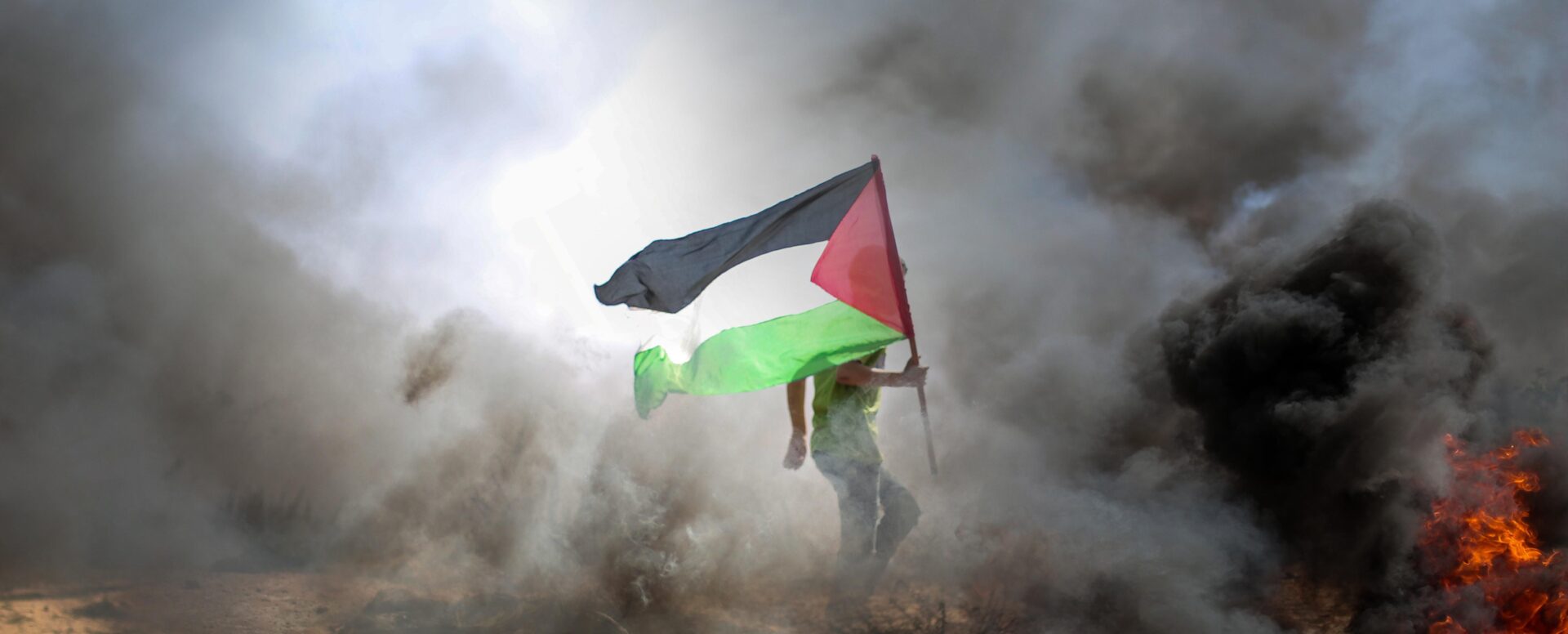
Photo: A protestor carrying a Palestinian flag amidst smoke and flames in Gaza. Pexels/Hosni Salah (Palestinian photographer residing in the Gaza Strip)