


Although there have been no significant changes in the political systems, the Maghreb has been undergoing a reconfiguration since Donald Trump was elected to a second presidential term. Keen to present himself as a peacemaker, the president seeks to resolve all manner of conflicts in the region, whether it be the Western Sahara conflict or the dispute between Algiers and Rabat.
With this in mind, and to bring the Western Sahara conflict to a close, Donald Trump has initiated negotiations, bringing the parties concerned or with an interest in the matter together around the same table. On two occasions, in Madrid (8–9 February 2026) and in Washington (23–24 February 2026), representatives from Morocco, the Polisario Front, Algeria and Mauritania met under the auspices of the United States of America, in the presence of Staffan de Mistura, the UN Secretary-General’s Special Envoy. During these meetings, the updated Moroccan autonomy plan was the only document on the table, thereby excluding the referendum on self-determination long sought by the Polisario Front and Algeria.
Still under discussion, this plan envisions the creation of an autonomous region with its own government, parliament and judiciary. Rabat will retain sovereign rights: national defence, foreign policy, currency, citizenship and symbols of sovereignty such as the flag.
By appeasing Donald Trump, Algiers
believes that the war declared on Iran
could provide an opportunity
to position itself as an economic player
Donald Trump’s US initiative in the Maghreb has shaken the stagnation that prevailed in the region and has also raised expectations among political leaders. Morocco, which signed the Abraham Accords in December 2025 and now benefits from a dual partnership with the US and Israeli, seeks to resolve the Western Sahara conflict by securing international recognition of the region’s “Moroccan nature”.
Libya, for its part, seeks to end the country’s fragmentation and restore national unity and a strong state whose authority extends across the entire territory. As for Algeria, it has adapted its rhetoric to Donald Trump’s methods. President Tebboune claims to have “transcended all ideological divides” by forging numerous partnerships with various states. This diplomatic about-face by Algeria represents a break with its diplomatic principles, particularly regarding Iran in its war with the United States and Israel. On March 1, 2026, Algiers – which had not expressed mourned the death of Supreme Leader Ali Khamenei – declared, through its Foreign Minister Ahmed Attaf, “Algeria’s total solidarity with the brotherly Arab countries that have been victims of military attacks.” This stance contrasts sharply with its reaction in June 2025 to Israeli airstrikes on Iranian territory, when Algeria had called on the United Nations Security Council to “fully assume its responsibility to protect international peace and security.” By appeasing Donald Trump, Algiers believes that the war declared on Iran could provide an opportunity to position itself as an economic player by increasing its oil production for export to countries experiencing supply difficulties since the war in Ukraine.
But Algiers also hopes to break out of its diplomatic and strategic isolation, particularly by re-establishing ties with the Sahel countries. Algiers’ decision to move closer to Washington undoubtedly explains its abstention from the vote on the UN Security Council resolution regarding the autonomy of Western Sahara (Resolution 2797 of 31 October 2025) as well as its failure to condemn the Israeli and US airstrikes on Iran.
For the Moroccan regime, which aspires to join the ranks
of the developed nations, it is out of the question
to squander this capital by showing that social
inequalities remain a major problem in Morocco
For Morocco, the past year has been eventful. Rabat continues to cultivate its image as a country that has made significant progress over the past 20 years. It has realized that attracting major foreign investment is also a matter of image. Hosting the Africa Cup of Nations (AFCON) was both an economic opportunity and an instrument of Moroccan soft power, even if many considered it a financial drain. This was precisely the criticism leveled by the young people of Gen Z 212, a protest movement that emerged in late September 2025. This group arose from the outrage sparked by the deaths of eight women at the Agadir Regional Hospital following their cesarean deliveries in August of the same year. Gathering nightly in the kingdom’s major cities, the movement’s protesters voiced social demands: better education and healthcare systems, and broader access to the labour market. They also denounced corruption and called for the resignation of Prime Minister Aziz Akhannouch. Faced with the anger of this hyperconnected movement, which communicates via the Discord platform, the government adopted a firm and coercive approach, with security forces killing three young protesters and more than 2,480 others being brought before prosecutors in various courts across the country. This is the largest wave of arrests since the one linked to the 2003 Casablanca bombings. For the Moroccan regime, which aspires to join the ranks of the developed nations, and which has demonstrated its capacity in terms of hospitality and infrastructure by hosting the Africa Cup of Nations and is set to co-host the 2030 FIFA World Cup with Spain and Portugal, has regularized migrants and has invested heavily in Africa, it is out of the question to squander this capital by showing that social inequalities remain a major problem in Morocco.
In addition to the repressive response, the government has also sought to quell the protests by allocating additional funding in the 2026 budget: 140 billion dirhams (13 billion euros) will be allotted to health and education, which should enable the creation of some 27,000 new jobs in the two sectors.
It has also attempted to address the demand for greater political representation by passing two bills (1 and 9 December 2025) establishing quotas for women and young people within political parties – a way of encouraging young people and women to become more involved in political life. One of the bills, concerning the organization of parties, imposes quotas requiring that 30% of members of party leadership bodies be women and 10% be young people under the age of 35. This response seems out of step with the demands of Gen Z 212, which focused primarily on the management of public services and the scale of spending on sporting events, the impact of which they do not see on their daily lives. As for political parties, the young people of the Gen Z 212 movement reject any form of rapprochement with Moroccan political parties.
In Tunisia, 15 years after a revolution
that seemed promising in terms of
regime change, the country
is sliding back into authoritarianism
In Tunisia, 15 years after a revolution that seemed promising in terms of regime change, the country is sliding back into authoritarianism. Repression has continued and intensified, targeting civil society organizations, journalists, human rights defenders, political opponents and certain judges. In 2025 and 2026, a significant shift can be observed in the way public authorities treat NGOs and civil society actors. Decisions to suspend activities for a period of one month have become increasingly frequent, revealing a desire to curtail civic space. A large number of associations and NGOs have fallen victim to this policy, including the Tunisian Association of Democratic Women (ATFD), the Tunisian Forum for Economic and Social Rights and independent media outlets, as well as the Tunisian Human Rights League (LTDH) and Lawyers Without Borders. Nearly thirty associations have had their activities suspended for a month, and 600 are under investigation.
Officially, the aim is to rectify tax and administrative issues, but numerous NGOs are denouncing these proceedings as attempts at intimidation. Founded in 1976, the Tunisian Human Rights League (LTDH) is one of the oldest in Africa and the Arab world. The political authorities justify the suspension of its activities on the grounds that the League allegedly missed the deadline for holding its Ordinary General Assembly. The government has also engaged in a standoff with the trade union confederation, the UGTT (Tunisian General Labour Union), founded in 1946, which spearheaded the the protests first against colonial rule, and then against the autocratic rule of Habib Bourguiba and Zine El-Abidine Ben Ali. Like the LTDH, the UGTT has been and remains a major player in Tunisian politics. Following the 2011 revolution, both institutions worked to ensure the country’s stability, an effort that earned them a share of the Nobel Peace Prize alongside two other national organizations united within a “quartet” tasked with finding a resolution to the political and institutional crisis of 2013. Deeply and historically hostile to the Islamist Ennahda party, the UGTT initially offered its tacit support to Kais Saied’s power grab in July 2021. This support was rewarded somewhat modestly, as in 2022 the trade union confederation secured a three-year agreement providing for a 3.5% pay rise for civil servants. However, this agreement is now coming to an end and the government refuses to enter into new negotiations: state coffers are empty and the government feels no need to negotiate with an organization it accuses of corruption. Faced with this situation, the trade union confederation has little room for manoeuvre to defend itself. It is, in fact, severely weakened by internal divisions and is accused of cronyism and corruption within its ranks.
This crackdown on civil society is occurring at a time when the country’s social and economic situation is particularly dire and protests are on the rise. The autumn of 2025 was marked by an economic and health crisis in Gabès, in the south-east of the country. Since 1972, residents have regularly suffered from poisoning caused by gas emissions from the Tunisian Chemical Group (GCT), which processes phosphate into agricultural fertilizer. In 2017, residents secured promises of a phased decommissioning of the plant and an end to waste dumping. But eight years later, the political establishment’s commitments have gone unfulfilled. It was to denounce what they consider a “slow poisoning” that more than 100,000 people demonstrated in this city, which has three times the cancer rate of the rest of the country. The government responded by promising minor changes and announcing the creation of an “oncology centre” in Gabès. No concrete political action has followed and the dismantling of the Group is not on the agenda; on the contrary, it has been announced that fertilizer production is slated to increase fivefold by 2030.
More broadly, the country’s social situation is cause for serious concern: the unemployment rate stands at nearly 40%, many small and medium-sized enterprises are going out of business, and over 100,000 graduates have left the country in recent years.
Tunisia cannot afford to alienate Donald Trump,
as the Tunisian army is partly funded by the
United States and the country also receives
financial aid from certain Gulf states
Tunisia is pursuing a policy of “diplomacy of restraint” towards Donald Trump. As with Algiers, the shift in stance toward Iran is evident. While Tunis had drawn closer to Tehran in recent years and had denounced the so-called Twelve-Day War in June 2025 as an attack on the sovereignty and security of the Islamic Republic, the statement from the Tunisian Ministry of Foreign Affairs was radically different, merely calling for wisdom and a return to the negotiating table, without even mentioning the assassination of Supreme Leader Ali Khamenei or condemning Israel and the United States. Tunisia cannot afford to alienate Donald Trump, as the Tunisian army is partly funded by the United States and the country also receives financial aid from certain Gulf states, including Saudi Arabia.
Like Algeria, Tunisia can no longer afford to be in diplomatic dissent with Donald Trump.
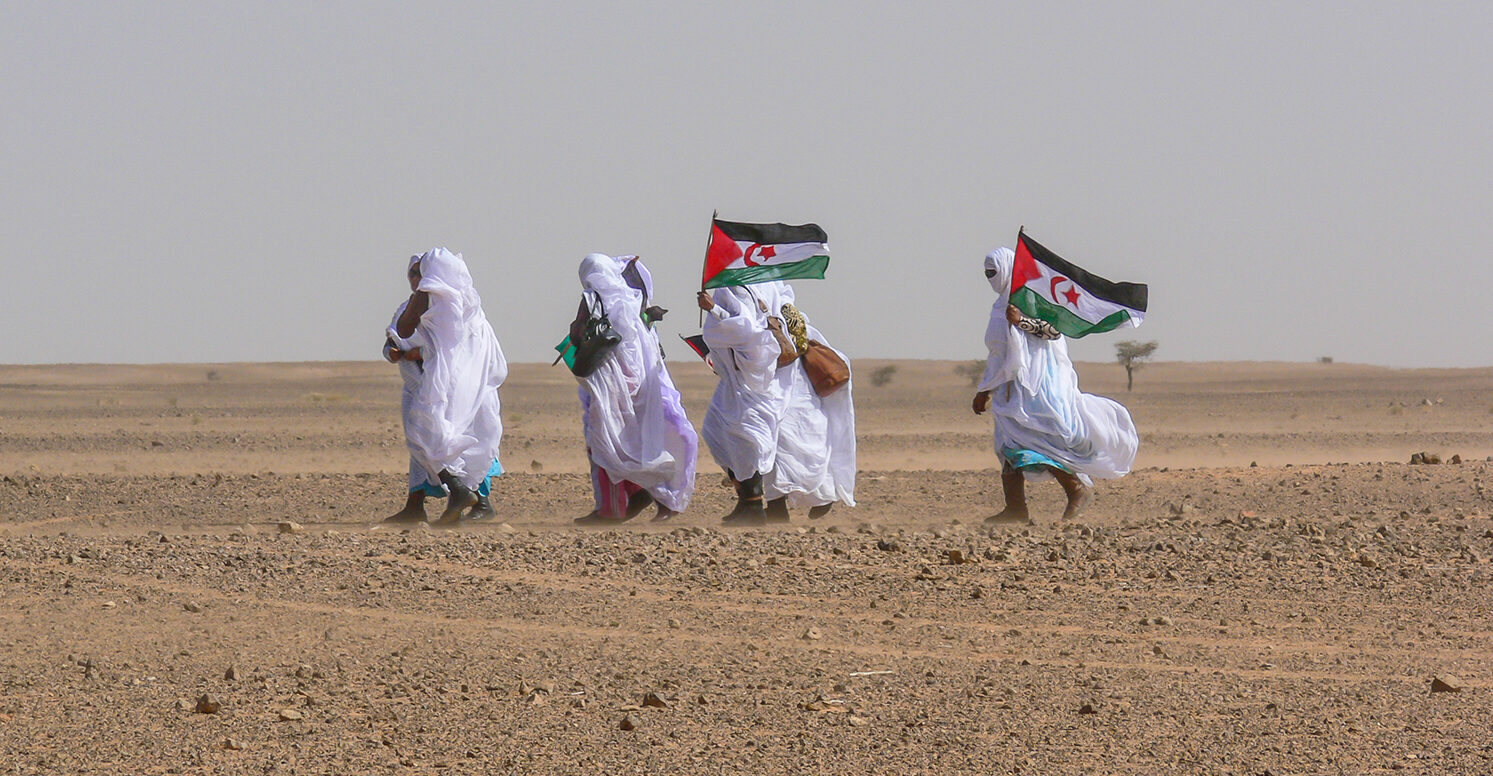
Header photo: Moroccan Western Sahara Wall, Western Sahara. March, 22, 2008. Demonstration calling for independence of the Sahara Occidental in front of the Moroccan Wall Shutterstock / Natalia de la Rubia.