



For centuries Syria has played a key role in both the Islamic and Arab worlds. The civil war (2011-2024), however, has significantly eroded the country’s political and security leverage. In December 2024, the Assad regime collapsed and was replaced by a new government led by Ahmad al-Sharaa. The World Bank estimates Syria’s economy at around $21 billion, representing an 83% decline since 2010, while the United Nations estimates that the cost of reconstruction will be more than $250 billion. Al-Sharaa’s government faces tremendous challenges, which include: re-building the economy, unifying ethnic and religious minorities, integrating into the regional system and defining relations with major global powers.
Internal Dynamics
The majority of the population are Sunni Arabs, but there are several ethnic and religious minorities that enjoy some autonomy and are not fully integrated into the state’s apparatus. These include the Kurds, Turkmen, Assyrians, Circassians, Armenians, Alawites, Christians, Druze, Yazidis and Jews. Under Assad’s decades-long rule, the Alawites dominated the military, state and economy. Naturally, they resent and resist losing the many privileges they had. Similarly, the Kurds controlled a large part of northern Syria and were strongly supported by the United States. The Kurds gained Washington’s backing due to the leading role they played in fighting the Islamic State (ISIS) and guarding thousands of its prisoners and their families. But in early 2026, the Trump administration withdrew its support from the Kurds and threw it behind President al-Sharaa and his aim to unite the country under his rule. Some Kurds saw the shift as a betrayal. Without American backing, the Kurdish force could not hold their neighbourhoods in the city of Aleppo and the rest of northern Syria. In late January 2026, the Kurds signed an agreement with the Syrian government ending what amounted to more than a decade of self-rule over large parts of northern Syria. The plan is to integrate the Kurdish armed forces into the Syrian Defence and Interior Ministry forces. The Kurdish-led civilian administration, which ran the enclave autonomously for years, will be integrated into state institutions along with its employees. Finally, most of the Druze arrived from neighbouring Lebanon in the 18th century and settled around Sweida in the region of Jabal al-Duruz (the Druze Mountain). Like other minorities, the Druze formed several militias during the civil war. Shortly after taking power, the al-Sharaa government ordered these militias to disarm.
Establishing and consolidating state control over all Syrian territories and disarming militias and integrating ethnic and sectarian minorities in the national institutions has been one of the major challenges facing al-Sharaa’s government since toppling the Assad regime in December 2024. Despite several bloody clashes, by early 2026 the central authority in Damascus had solidified its control over almost the entire country, although renewed ethnic and sectarian confrontations cannot be ruled out. This relative improvement in internal security should help al-Sharaa’s government to address the daunting economic challenges it faces.
Establishing and consolidating state control over all
Syrian territories and disarming militias and integrating
ethnic and sectarian minorities in the national institutions
has been one of the major challenges facing
al-Sharaa’s government since toppling the Assad regime
The 14-year civil war left a profound impact on Syria’s economy and society, triggering widespread devastation, an unprecedented humanitarian crisis and one of the largest displacement waves in the country and the region’s modern history. According to the World Bank, the civil war is estimated to have damaged nearly one-third of Syria’s pre-conflict gross capital stock, with direct physical damage to infrastructure, residential buildings and non-residential buildings estimated at $108 billion. The estimated physical reconstruction costs are nearly ten times the country’s 2024 gross domestic product (GDP), underscoring the urgent need for both internal stability and security as well as regional and international assistance.
In late 2025, the International Monetary Fund (IMF) concluded that Syria’s economy was showing signs of recovery. This assessment is based on: A) Improvement in consumer and investor sentiment under the al-Sharaa government; B) Gradual re-integration in the regional and global economy; C) Lifting of European and American sanctions; and D) Return of more than a million refugees. Most analysts express guarded optimism, and there are growing signs of economic growth and social stability, but regional integration is a crucial prerequisite for this transformation.
Regional Integration
For most of the civil war years, most Arab countries boycotted the Assad government and some supported different opposition groups. Gulf states, led by Saudi Arabia and the United Arab Emirates, resented the close ties Damascus had with Tehran. These tense Arab-Syria relations came to an end shortly before the fall of the Assad regime. The majority of Arab countries concluded that President Assad won the civil war and accordingly Syria was re-admitted into the Arab League and diplomatic relations resumed. Qatar, however, strongly opposed normalization with President Assad and has become one of the top supporters of President al-Sharaa.
Since early 2025, Qatar has played a key role in Syria’s economic recovery process. It was the second country to open its embassy in Damascus (after Turkey), sent massive financial assistance, invested in infrastructure projects in several sectors, including defence, energy, health and transportation, and provided strong diplomatic support. A major Qatari investment has been a $7 billion agreement to build four gas-based power stations and a solar farm in cooperation with Azerbaijan, Turkey and the United States. This is particularly important given that restoring reliable electricity is crucial to ensure economic recovery. In January 2025, the Emir of Qatar, Tamim bin Hamad al-Thani, became the first Arab leader to visit Damascus following al-Sharaa’s rise to power.
The estimated physical reconstruction costs
are nearly ten times the country’s 2024 gross
domestic product (GDP), underscoring the urgent
need for both internal stability and security
as well as regional and international assistance
Saudi Arabia is another major Gulf and Arab supporter of the al-Sharaa government. Given its large size and population, strong and growing economy, Islamic credentials and energetic and young crown prince, the kingdom sees itself as the natural regional leader. Before October 2023, the fragile balance of power in the Middle East had several players, i.e., Israel, Turkey, Iran, Egypt and the Gulf Cooperation Council (GCC) states. Since then, Israel has emerged as the unrestrained regional hegemon bombing Gaza, the West Bank, Lebanon, Syria, Iran and Qatar. As a leading Arab and Muslim country, Saudi Arabia seeks to restore a balance of power by working with Turkey, Egypt and other regional powers as well as by contributing to the re-building of Syria.
Against this background and working with Qatar and Turkey, Crown Prince Mohamad bin Salman has played a key role in restoring diplomatic relations between Washington and Tehran, lobbying to lift economic sanctions and re-integrating Syria into the regional and global orders. Jointly, Riyadh and Doha paid Syria’s $15 billion debt to the World Bank, and the two countries made substantial investments to stabilize Syria’s economy. This heavy Saudi political and economic investment in Damascus aims to protect the kingdom from the illicit drug trafficking that peaked under the Assad regime. It also gives Riyadh leverage against the surging Turkish and Israeli presence.
Before the outbreak of the civil war in 2011, Turkey and Syria enjoyed strong political and economic ties and presidents Erdogan and Assad were close allies. In the following years, Ankara opposed the Assad regime’s harsh response to widespread demand for political reform and Turkey hosted millions of Syrian refugees. In order to protect its national interests and restrain the Kurdish autonomous region in northern Syria, Turkish troops occupied parts of Syria and established a buffer zone. The fall of the Assad regime is widely considered a major victory for Turkey. A strong central authority in Damascus would facilitate the disarmament of Kurdish militias and the return of hundreds of thousands of refugees. Since early 2025 the Turkish government and private companies have been working closely with Arab, European and American counterparts to revive the Syrian economy and rebuild the national military. Ankara’s interest in establishing a strong central government in Damascus has arguably contrasted with the policies of another major regional power: Israel.
The fall of the Assad regime was seen as a “mixed blessing” in Israel. President Assad was not a friend of Israel. He was a close ally of Iran and Hezbollah. But since 1973, the borders between the two countries have been quiet. Both Bashar and his father Hafez tried and failed to negotiate an agreement with Israel similar to the 1979 Egyptian-Israeli Peace Treaty. Finally, unlike Hezbollah in southern Lebanon and the Houthis in Yemen, Assad did not allow attacks on Israeli targets from Syria in response to the war in Gaza, which began in October 2023. Meanwhile, given al-Sharaa’s former affiliation with al-Qaeda, Israel does not trust him and sees the Syrian President as seeking to present himself as a moderate while remaining a jihadist with an unchanged ideology. Within this context, the Israeli government has shown few, if any, signs of interest in accommodating the al-Sharaa government, instead taking several measures to neutralize Damascus’ military capabilities and prevent any potential future attack. These include striking military bases, weapons stores, airfields and other military sites, taking control of a demilitarized United Nations-patrolled buffer zone inside Syria and establishing a buffer zone in the southern part of the country. Israel has also vowed to protect the Druze and other Syrian minorities.
President al-Sharaa has shown no signs of challenging Israel’s provocations militarily and has repeatedly confirmed that he was not looking for confrontation with Israel. But a key element of statehood for any government is the ability to protect its people and borders. If Israel continues to undermine Syria’s sovereignty, public resentment will further rise. President al-Sharaa has a few options to push back, one of them is to coordinate with the United States. Israeli policy contrasts sharply with the Trump administration’s broader vision of the Middle East, in which Washington seeks to integrate Syria into a US-led security and economic architecture.
Global Powers
For decades US-Syria relations had been characterized by mutual hostility. Diplomatic relations were established in 1944 but were severed in the wake of the 1967 Arab-Israeli war. Shortly after relations resumed in 1974, Washington designated Damascus as a state sponsor of terrorism in 1979. In the following decades, the United States condemned Syria’s human rights record, regional policies and close ties with Moscow. In the 2010s, the United States formed the Global Coalition to Defeat ISIS, worked closely with the Kurds in Northern Syria, and deployed American troops to train them and prevent the Islamic State from regrouping.
Not surprisingly, Washington welcomed the fall of the Assad regime and the setbacks it has created for Iran, Russia and Hezbollah. A major turning point in the relations between the two countries took place in May 2025 when President Trump met with President al-Sharaa in Riyadh and some economic sanctions were lifted. The Trump administration urged the Syrian government to join the Abraham Accords, prevent the resurgence of ISIS and integrate the US-backed Kurdish-led militias in Syria’s northeast. Since then, Thomas J. Barrack, US ambassador to Turkey and special envoy to the Middle East, has arranged direct talks between senior Syrian and Israeli officials to de-escalate tensions, ISIS prisoners and their families have been relocated to Iraq and the majority of American troops have left Syria.
Like the United States, Europe has had a very troubled relationship with Syria. Shortly after the outbreak of the civil war in 2011, the European Union (EU) suspended all bilateral cooperation with President Assad. The EU strongly opposed the regime’s violation of human rights, close ties to Iran and Hezbollah and support of Russia’s invasion of Ukraine. More than a million Syrian refugees fled to Europe to escape the civil war, contributing to the rise in anti-immigrant sentiments in several European countries. The fall of the Assad regime marked the beginning of a new chapter in EU-Syria relations. Like Washington, Brussels lifted economic sanctions in May 2025 in order to help stabilize the economy and promote political stability. The EU has urged the al-Sharaa government to consolidate national reconciliation, respect rule of law and respect the political rights of all minorities. Finally, the EU has called on all regional powers to respect Syria’s sovereignty and territorial integrity and the need to maintain and expand counter-terrorism measures and destroy the remaining chemical weapons stockpiles.
Interestingly, the al-Sharaa government has managed to significantly improve relations with both Washington and Brussels while reconfiguring ties with Moscow. President Putin was a strong supporter of President Assad, and Russia’s military intervention in 2015 played a key role in keeping Assad in power. Russia operated a major airbase in Khmeimim and a naval base in Tartus. After the fall of the Assad regime, President al-Sharaa has taken a strong stance against Assad’s allies, Iran and Hezbollah, but not Russia. The Syrian leader understands and values the historical ties and shared economic and strategic interests between Damascus and Moscow. Russia is a permanent member of the Security Council, Syria’s weapons are entirely Russian and there are many food and energy agreements between the two countries.
Syria’s history, strategic location, ethnic and sectarian
make-up, and economic and security vulnerabilities
suggest that regional players and global powers will
compete to shape the country’s future and President
al-Sharaa’s choices
In the few months following Assad’s fall, Russian troops withdrew from deployment sites across Syria to their permanent bases and dismantled most of their military capabilities. They were placed under severe restrictions and Russian companies lost management and development contracts. This phase did not last long. Senior Syrian officials visited Moscow and met with President Putin and his top advisors. In October 2025, President al-Sharaa visited Moscow and confirmed that existing agreements between the two countries will be honoured, signalling an intention to preserve the status of Russia’s coastal bases, in line with Russian interests.
The Way forward
The Assad dynasty ruled Syria for more than five decades (1971-2024). The fall of Bashar al-Assad is undoubtedly a major turning point in Syria’s domestic and foreign policies, with significant regional and international ramifications. Syria’s history, strategic location, ethnic and sectarian make-up, and economic and security vulnerabilities suggest that regional players and global powers will compete to shape the country’s future and President al-Sharaa’s choices . After a little more than a year in office, it is too early to provide an accurate assessment of President al-Sharaa’s policies. But at least two takeaways can be drawn from recent developments. First, the civil war has ended and the government in Damascus has expanded and solidified its authority over almost all the country. Second, despite this relative success, al-Sharaa’s government has a long way to go. Economic, political and security systems are very fragile, and many things can go wrong. Simply stated, although the country faces many significant uncertainties, Syria is certainly in better shape today than it was in December 2024.
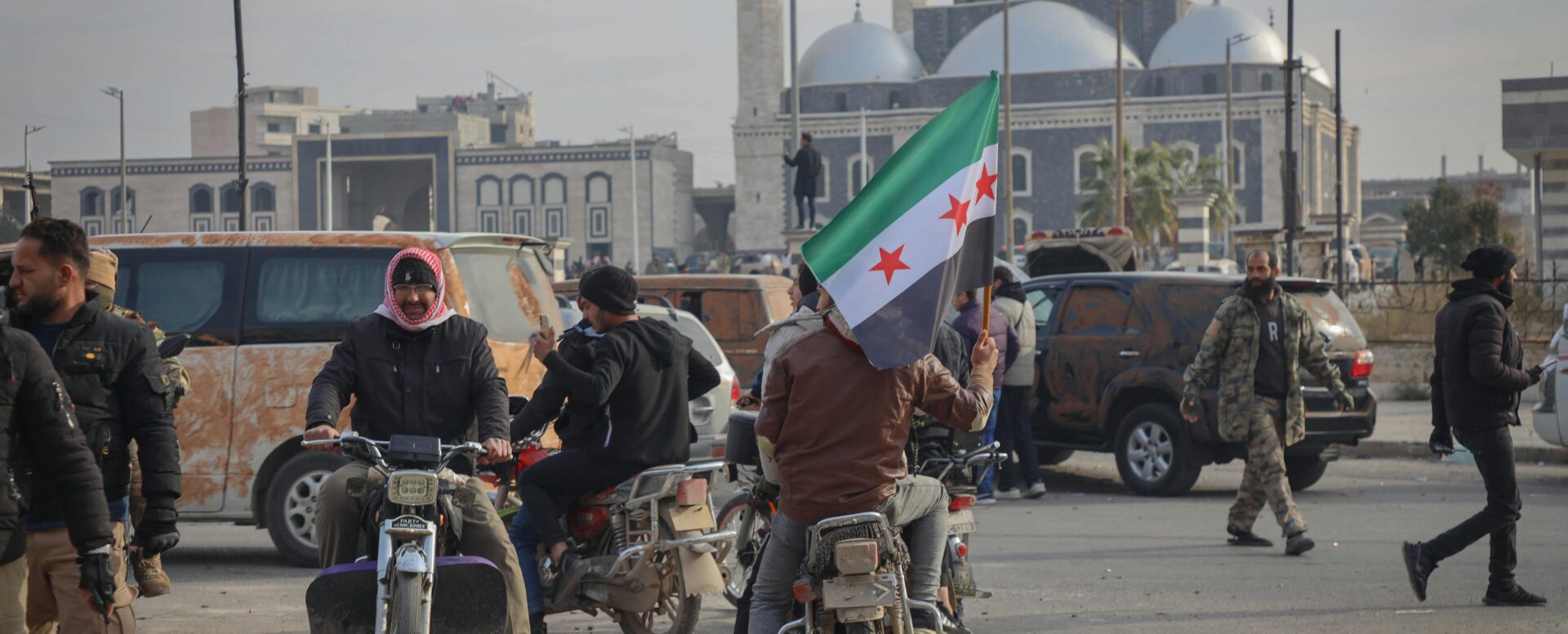
Photo: A lively street scene in Homs, Syria featuring people on motorbikes and a flag, on December 17 2024. Pexels – Ahmed akacha