


The informal economy is one of the main structural characteristics of labour markets across the MENA region. In several countries in the region, informal employment often exceeds 50% of total employment, while the shadow economy represents between 25% and 40% of GDP (OECD-ILO-UNDP, 2024). Although informality historically functioned as a labour market buffer and survival mechanism, its persistence may challenge productivity growth, fiscal sustainability and households’ wellbeing.
The relationship between informality and economic growth is complex. Part of the literature argues that informality is mainly the consequence of insufficient economic growth, demographic pressures and weak productive transformation (Loayza, 2016; La Porta and Shleifer, 2014; ILO, 2022). Another strand of literature considers informality itself as a factor limiting growth because it reduces productivity, weakens fiscal capacity and discourages investment (Schneider and Enste, 2000; Loayza, 2018; Ohnsorge and Yu, 2022). Increasingly, empirical evidence suggests that causality between informality and growth could be bidirectional (Mawusi, 2021; Loayza, 2018).
This debate has become particularly important in the MENA region economies facing repeated external shocks, youth unemployment and limited formal private sector job creation. Recent evidence from Egypt, Iraq and Jordan (OECD, ILO and UNDP, 2024) further shows that informality is deeply linked to structural vulnerabilities, low economic diversification and weak social protection systems. Informality therefore should not be analyzed as a temporary anomaly but as a central development challenge affecting economic resilience and inclusive growth.
Informality should not be analyzed
as a temporary anomaly but as a central
development challenge affecting
economic resilience and inclusive growth
This article adopts a literature review and comparative analytical approach. It synthesizes selected empirical studies using panel regressions, meta-analysis, business cycle analysis and cross-country datasets to examine the bidirectional relationship between economic growth and informality. The analysis draws on academic contributions, as well as recent institutional reports from the ILO, IMF, OECD and UNDP.
Economic Growth as a Key Enabler of Formalization
The dominant development economics literature argues that informality declines as economies modernize. Structural transformation generates a shift of labour from low-productivity informal activities towards formal sphere and modern services.
La Porta and Shleifer (2014) show that higher income economies systematically display lower levels of informality. Using a panel of 68 countries, they estimate that doubling GDP per capita reduces self-employment rates by nearly five percentage points. However, they also conclude that growth alone is insufficient and that improving entrepreneurial capabilities and education remains essential.
Similarly, ILO (2022) finds that growth is necessary but not sufficient for formalization. According to their estimates, a 1% increase in GDP per capita reduces informal employment by only 0.32% to 0.38%. The report further highlights that the structure of growth matters more than growth alone. Economies driven by diversified and technologically sophisticated sectors experience faster formalization than economies dependent on extractive industries or low-productivity services.
Loayza and Rigolini (2006) show that the effect of growth on informality is small in Latin American countries; for instance a five-percentage-point increase in GDP per capita growth rate will decrease the self-employment growth rate by less than 0.03 percentage points in Trinidad and Tobago, Costa Rica, Argentina, Uruguay, Chile, Mexico, Panama, Brazil, El Salvador, Colombia, Ecuador, Jamaica, Bolivia, Honduras and Peru. Additionally, the authors demonstrate that informality behaves counter-cyclically in most countries. Economic downturns increase informal employment, while recoveries only gradually reduce it.
Recent evidence from the OECD, ILO and UNDP (2024), tackling informality issues in the Arab region, highlights that repeated crises, including the Covid-19 pandemic, reinforced pre-existing structural informality. Emergency social protection measures that were implemented during the Covid-19 period protected livelihoods temporarily but did not fundamentally transform the productive structure or create sufficient formal employment opportunities. The report also stresses that informality in the MENA region is strongly associated with limited economic diversification, weak small and medium-sized enterprises (SME) integration into formal value chains and insufficient social protection coverage.
How Does Informality Constrain Economic Growth?
The reverse relationship is equally important. High levels of informality may become a significant obstacle to long-term economic growth. For instance, Informal businesses often remain small, undercapitalized and would not access the formal financial market. Furthermore, the literature shows that informal salaried employment exhibits low exit rates towards formal work, especially for younger and lower-educated workers.
Informality also narrows the fiscal space. Widespread tax evasion and weak social contribution systems reduce government revenues and constrain public investment in infrastructure, social protection, education, and the health system. In southern Mediterranean countries, already facing fiscal pressures and high social demands, this creates an important financial sustainability challenge. Schneider and Enste (2000), in their landmark cross-country study covering 76 developing, transition and OECD economies, show that a growing shadow economy exerts a negative effect on official GDP growth through tax erosion, misallocation of resources and reduced public investment capacity. More recently, Ohnsorge and Yu (2022) find that pervasive informality is associated with significantly weaker economic outcomes, including lower government resources to combat recessions, reduced per capita incomes, less financial development, and weaker investment and aggregate productivity. Loayza (2018) highlighted that informality could be a cause and a consequence of underdevelopment. The author emphasized that informal firms’ restricted access to credit, training and markets prevents them from growing or innovating, thereby depressing economy-wide productivity. Afonso et al (2020), through a meta-analysis of empirical studies, conclude that the average effect of the parallel economy on economic growth is statistically insignificant. However, the reported effects differ considerably with the type and number of countries included in the sample of primary studies. Elgin and Birinci (2015) identify an inverted-U relationship between informality and growth. At relatively low levels, informality may temporarily compensate for institutional weaknesses and provide employment opportunities. However, at very high levels, informality becomes a structural obstacle to productivity growth and economic transformation. This finding is particularly relevant for MENA region economies where informal employment often exceeds 60% of total employment. Nikopour and Habibullah (2008) similarly argue that the shadow economy has a positive effect on the official economy and this relationship depends on the level of development: this relationship follows an S-shaped cubic function: (i) in the early stages of development, the relationship is positive; (ii) in the later stages of development, it is negative; and (iii) at a certain level of income, there is a new inflection point, and a new upward phase starts.
Reducing structural informality should
be considered part of broader resilience
and inclusive growth strategies rather
than only a labour market objective
Finally, there is a growing consensus highlighting that causality runs in both directions. Mawusi (2021), using the ARDL model and Granger causality test, provides direct empirical evidence of bidirectional causality between the size of the informal economy and economic growth, meaning that slower growth expands informality while informality simultaneously depresses growth. This finding is consistent with Loayza’s (2018) findings, which suggest that informality is simultaneously a cause and a consequence of low economic and institutional development.
Recent OECD-ILO-UNDP evidence further highlights that high informality reduces resilience to shocks. Informal workers generally lack social insurance, unemployment protection and labour rights, making economic crises more damaging socially and economically. The report therefore argues that reducing structural informality should be considered part of broader resilience and inclusive growth strategies rather than only a labour market objective.
The Trap of Informal Employment in Mediterranean Countries
Mediterranean countries, particularly in the southern Mediterranean, illustrate the existence of a self-reinforcing cycle between slow structural transformation and persistent informality. Weak private sector dynamism, dependence on commodity revenues, high youth and women’s unemployment and limited industrial diversification reduce formal job creation.
Merouani (2023), using data from five MENA countries and discrete choice models, finds that while a portion of employers, the self-employed, the highly educated, men and the unmarried have made a voluntary choice, informal salaried employees and low-educated workers are predominantly working involuntarily in the informal sphere. Furthermore, the literature exhibits low exit rates towards formal work in MENA, especially for younger and lower-educated workers. Drawing on Labour Market Panel Surveys from Egypt, Jordan and Tunisia, Assaad and Krafft (2015) and Tansel and Ozdemir (2019) document that the Egyptian labour market is highly static: government employment is the most persistent state for both men and women, informal private wage work shows relatively low upward mobility, and transitions from informal to formal private employment are rare rather than the norm. More recently, Adair, AlAzzawi and Hlasny (2024) confirm pervasive labour market segmentation and low occupational mobility across three oil-importing MENA economies – Egypt, Jordan and Tunisia. Focusing on workers’ occupational mobility in relation to their previous status, age cohort, gender and other demographics, the authors found persistent segmentation and low occupational mobility in the three countries, concluding that informal employment in the region is driven primarily by structural constraints on the demand side rather than voluntary supply-side choices.
Taken together, this body of evidence suggests that informality in the southern Mediterranean is largely self-reinforcing. At the microeconomic level, workers who occupy informal employment, whether at labour market entry or following a shock, will face structural barriers such as lack of social insurance, limited access to credit and finance, skills mismatch and employer-side disincentives. These barriers make the transition to formal employment significantly challenging. At the macroeconomic level, the low inter-sectoral mobility amplifies the aggregate economic cost of informality, as it implies that productivity gains and fiscal resources, as well as social security contributions from formalization, are systematically foregone and that human capital accumulation is constrained over entire working careers.
Conclusion and Policy Recommendations
This article highlighted that the relationship between informality and economic growth is neither linear nor unidirectional. Economic growth can contribute to reducing informality, but only gradually and depending on the structure of growth itself. At the same time, persistently high informality constrains productivity, weakens fiscal capacity and slows structural transformation.
Southern Mediterranean economies therefore face a structural trap in which insufficient diversification, weak formal job creation and widespread informality reinforce one another. Breaking this cycle requires moving beyond narrow enforcement-based approaches and adopting integrated social protection systems and active labour market policies, improving institutional trust and engaging informal economy actors in the policymaking process.
Southern Mediterranean economies face
a structural trap in which insufficient
diversification, weak formal job creation
and widespread informality reinforce one another
First, growth strategies should prioritize economic diversification and labour-intensive sectors capable of generating formal employment. Manufacturing, digital services, green industries and modern logistics offer important opportunities for Mediterranean economies.
Second, simplifying administrative and tax procedures for small enterprises is essential. Excessive compliance costs often discourage formalization. Digital registration systems and simplified tax regimes for microenterprises can reduce barriers to entry.
Third, expanding universal and portable social protection systems is crucial. Workers are more likely to formalize when formality is provided at the doorstep and the benefits are tangible and immediate (health coverage, access to family allowances and finance in addition to delayed pensions). Indeed, expanding social insurance requires a better understanding of workers’ behaviours such as risk aversion and intertemporal choices and social value orientation. Social security reforms could align with these behaviours to ensure better adherence of informal workers to social security.
Fourth, improving governance and institutional trust remains fundamental. High informality is often associated with perceptions of corruption, low public trust, weak public services and unequal enforcement of regulations.
Finally, Euro-Mediterranean cooperation can support formalization through SME financing, technical assistance, digitalization programmes and investment partnerships. Recent OECD-ILO-UNDP initiatives in Egypt, Iraq and Jordan provide useful examples of integrated policy approaches linking formalization with resilience and structural transformation.
References
Afonso, Oscar; Sousa Monteiro, Sara and Thompson Maria. “A Growth Model for the Quadruple Helix Innovation Theory.” Structural Change and Economic Dynamics 52, 2020.
Elgin, Ceyhun and Birinci Serdar. “Not-So-Informal Informal Sectors: A Dynamic General Equilibrium Investigation.” Journal of Development Economics 117, 2015.
Adair, Philippe; Alazzawi, Shireen and Hlasny, Vladimir. “Fostering Decent Jobs, Formalising Informal Employment and Spurring Job Mobility in MENA Countries.” Economic Notes 53(2), 2024.
Assaad, Ragui and Krafft Caroline. “The Structure And Evolution Of Employment In Egypt: 1998-2012.” ERF working paper N°805, 2013. https://theforum.erf.org.eg/app/uploads/2014/07/805.pdf.
ILO. Women and Men in the Informal Economy: A Statistical Update. Geneva: International Labour Organization, 2023.
La Porta, Rafael and Shleifer, Andrei. “Informality and Development.” Journal of Economic Perspectives 28(3), 2014.
Loayza, Norman. “Informality in the Process of Development and Growth.” The World Economy, 39(12), 1856–1916, 2016.
Loayza, Norman and Rigolini, Jamele. “Informality Trends and Cycles.” World Bank Policy Research Working Paper 4078. Washington DC: World Bank, 2006.
Loayza, Norman. “Informality: Why Is It So Widespread and How Can It Be Reduced?” World Bank Research & Policy Brief No. 20. Washington DC: World Bank, 2018.
OECD/ILO/UNDP. “Informality and Structural Transformation in Egypt, Iraq and Jordan: A Framework for Assessing Policy Responses in the MENA Region.” Paris: OECD Publishing, 2024.
Mawusi, Charles K. “Does Informality and Trade Openness Impact Long-Run Growth? Empirical Evidence from Ghana.” Economics Bulletin 41(1), 2021, pp. 28–40.
Ohnsorge, Franziska and Yu, Shu. The Long Shadow of Informality: Challenges and Policies. Washington DC: World Bank, 2022.
Schneider, Friedrich and Enste, Dominik H. “Shadow Economies: Size, Causes, and Consequences.” Journal of Economic Literature 38(1), 2000, pp. 77–114.
Tansel, Aysit and Ozdemir, Zeynel Abidin. “Transitions across Labor Market States Including Formal/Informal Division in Egypt.” Review of Development Economics 23(4), 2019, pp. 1674–1695.nal Peace, 5 December 2025,https://carnegieendowment.org/research/2025/12/rethinking-power-sharing-agreements-in-libya.
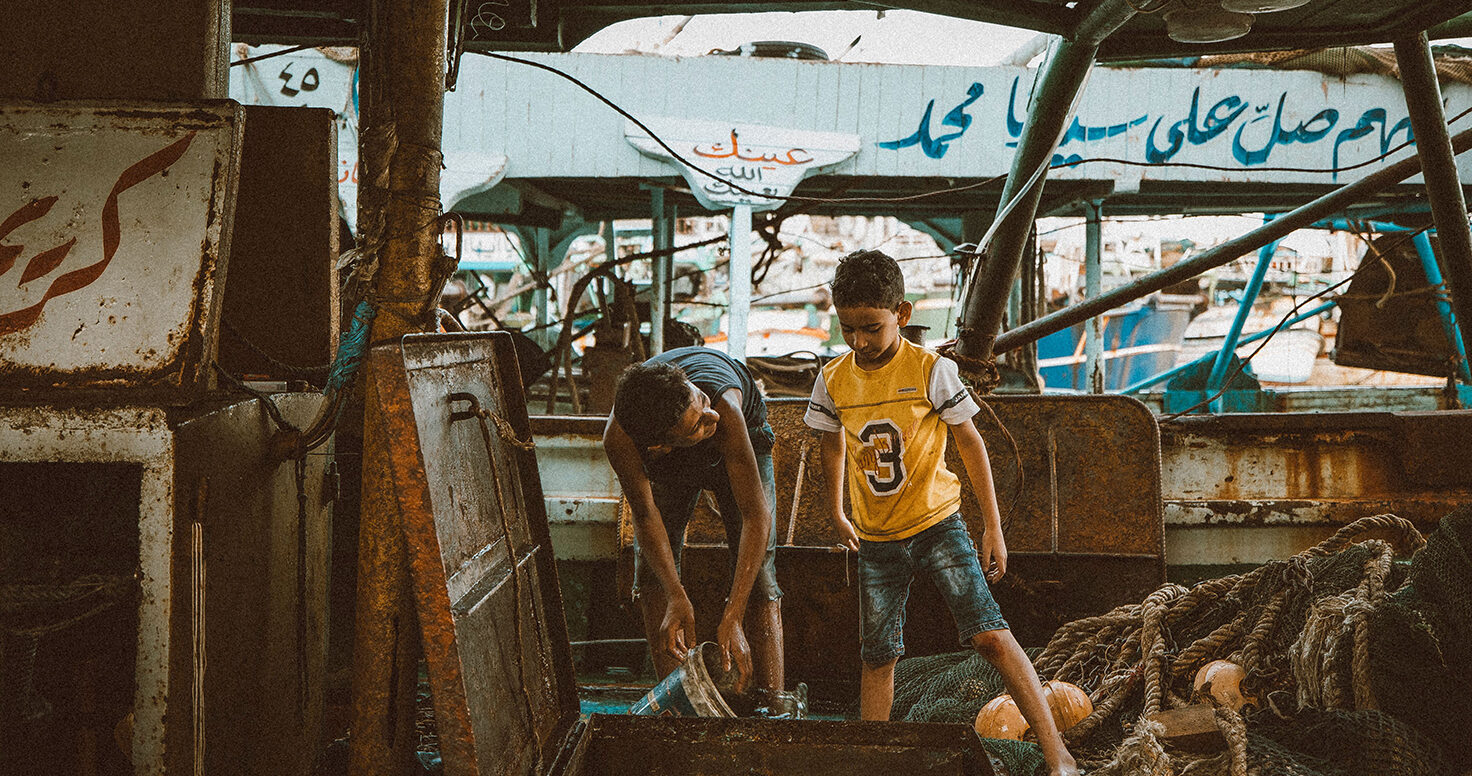
Photo: Damietta, Egypt. November 14th, 2025. By Eslam Mohammed Abdelmaksoud via pexels