


Since the 1980s, civil societies in the Maghreb have forged paths towards empowerment in the face of differing state agendas within highly hostile national contexts, taking advantage of a favourable international environment after the fall of the Berlin Wall. While authoritarianism has been a constant feature of governance in the Maghreb over recent decades, periods of openness, accommodation and controlled pluralism had nevertheless created certain opportunities and room for manoeuvre. These hard-won spaces of freedom, however, have gradually closed in the post-2011 period and even more markedly since 2019. The waves of protest during the Arab Spring, followed by the Algerian Hirak, far from opening up civic space in a lasting way, provoked an even stronger authoritarian and repressive reaction, resulting in the adoption of highly restrictive legal frameworks and arbitrary repressive practices against any form of opposition.
Maghreb civil society today faces a ‘double stranglehold’:
on the one hand, increasingly sophisticated and often
unpredictable internal repression by states; on the other,
a crisis of legitimacy and a reduction in external support
Maghreb civil society today faces a ‘double stranglehold’: on the one hand, increasingly sophisticated and often unpredictable internal repression by states; on the other, a crisis of legitimacy and a reduction in external support in an international context marked by the retreat of the liberal order. Between the growing criminalization of foreign funding, the tightening of legal frameworks and the structural weakening of organizations, civil society actors find themselves caught in a vice, forced to reinvent their methods of action and resistance.
The present article analyses these dynamics in three sections. The first part traces the authoritarian crackdown carried out by governments in the region, through the manipulation of legal frameworks and their arbitrary application, as well as the systematic repression of fundamental freedoms. The second part examines the reshaping of relations between Maghreb civil society and its external partners, notably the European Union, against a backdrop of a global decline in support for democracy. The third part explores the alternative forms of resistance and protest that are emerging despite the closure of traditional civic spaces.
Breaking Free from State Control: A Path Fraught with Obstacles
The constraints facing civil society organizations (CSOs) in the Maghreb — and in particular those dedicated to the defence of human rights — have become considerably more severe since 2011. The Algerian League for the Defence of Human Rights (LADDH), founded in 1985 by lawyer Ali Yahia Abdenour, was dissolved in 2022 by the Administrative Court of Algiers.[1] This emblematic case illustrates a broader trend: the undoing of decades of investment in the civic fabric, transforming former spaces of opportunity into extremely hostile environments in Morocco, Algeria and Tunisia.
In Tunisia, following the liberalization of the associative framework with the adoption of Decree-Law No. 2011-88 during the democratic transition period, the number of associations rose from 9,000 (before 2011) to 21,000 in 2022, and Tunisian civil society had secured significant European financial support (Walton & Aslam, 2024). This momentum was halted by the authoritarian regression under the presidency of Kais Saied, as demonstrated by the temporary and arbitrary suspension of emblematic Tunisian civil society organizations such as the Tunisian Association of Democratic Women (ATFD) and the Tunisian Forum for Economic and Social Rights (FTDES) in November 2025 (FIDH, 2025), and more recently, the Tunisian Human Rights League (LTDH), which was awarded the Nobel Peace Prize in 2015.
There’s a broader trend: the undoing of decades of investment
in the civic fabric, transforming former spaces
of opportunity into extremely hostile environments
in Morocco, Algeria and Tunisia
In line with its approach of “controlled pluralism,” Morocco enshrined the principle of civil society participation in state governance in its 2011 Constitution. However, these promises have not been kept, and the forums created to put this principle into practice have, at best, been empty shells or privileged spaces for co-opting selected organizations to bolster the image of a reformed governance. Associations opposed to the monarchy, such as Attac Morocco or the Moroccan Association for Human Rights, are being hindered.[2]
The tool most frequently used by Maghreb regimes to curb civil society is the manipulation of the legal framework. Laws on associations, arbitrary registration procedures, and penal provisions relating to terrorism and cybercrime constitute a legal arsenal deployed selectively to distinguish “partner” actors from “disruptive” ones. The Algerian regime relies on Article 87 bis of the Penal Code, revised in June 2021, which defines terrorist acts. Under the guise of combating extremism, this provision has been broadened to include actions that could undermine “state security,” “national unity” or “the stability of institutions.” These vague formulations allow the regime to criminalize acts of peaceful activism, calls to demonstrate or public criticism of the authorities by equating them with terrorist acts. The Algerian regime has thus perfected the use of these laws to criminalize dissent and prevent the activities of human rights organizations: in addition to suspending organizations such as the LADDH and RAJ, in March 2026 the Algerian authorities sealed the offices of the association SOS Disparus, which is engaged in the fight against enforced disappearances in Algeria and is affiliated with the Collective of Families of the Disappeared in Algeria (CFDA).
Authoritarian Crackdown: Criminalization and Closure of Spaces
Beyond the repression against formal organisations, it is the whole range of fundamental freedoms – which constitute the ecosystem necessary for the emergence of an autonomous civil society – that is under threat. Freedom of expression is being undermined by the imprisonment or judicial harassment of journalists: the cases of Omar Radi and Maati Monjib in Morocco are examples of this.[3]
In Algeria, freedom of expression has been particularly targeted since the 2019 Hirak protests and dissenting voices have been silenced. Censorship of online media is a recurring tool for controlling information, as evidenced by the authorities’ blocking of several online news sites such as Interlignes or the two sites belonging to the Interface Médias group: Maghreb Emergent and Radio M, which are censored within Algeria but accessible from abroad. Many activists, intellectuals and human rights defenders have fallen victim to this simply for posting on social media. The Algerian legal system’s relentless persecution of the poet and Hirak activist Mohamed Tadjadit[4] illustrates this unchecked slide towards authoritarianism. In Algeria, this authoritarian crackdown is also reflected in the adoption in February 2026 of a law on the revocation of nationality, denounced by several human rights organizations as a legal instrument aimed at criminalizing all forms of dissent, including among the diaspora (Groupe de solidarité Algérie, “Déchéance de la nationalité algérienne: une loi anticonstitutionnelle et contraire aux engagements internationaux de l’Algérie.” EuroMed Rights, 3 March 2026).
In Tunisia, too, the repression of civil liberties has intensified
considerably since the 2021 constitutional coup, with
suspensions and dissolution proceedings targeting dozens
of NGOs, the arrest of journalists and activists
In Tunisia, too, the repression of civil liberties has intensified considerably since the 2021 constitutional coup, with suspensions and dissolution proceedings targeting dozens of NGOs, the arrest of journalists and activists, and the country’s fall to 137th place out of 180 in the World Press Freedom Index (Garavoglia, 2026).
Media censorship and the criminalization of social media posts are part of a broader shrinking of the space for freedoms, which now also affects the academic world. Academic freedoms are increasingly threatened by a combination of mechanisms ranging from political control over university appointments and campus surveillance to the direct repression of critical students and researchers, in a context where approximately 75% of teachers in the region practise self-censorship (MECAM Papers, 2025).
Freedom of assembly is also increasingly being curtailed, as evidenced by the restrictions imposed on demonstrations of solidarity with Palestine in several countries across the region. In Algeria, a country that maintains a rhetoric of support for just and sacred causes such as that of Palestine, only one solidarity demonstration was authorized after the start of the genocide in Gaza. Although tolerated in Morocco, pro-Palestinian demonstrations have been subject to increasing repression.[5] This is also the case in Tunisia; in April 2026, the Tunisian authorities attempted to prevent the launch of a second flotilla for Gaza by arresting seven members of the steering committee, accusing them of embezzlement.
In Morocco, following the GenZ 212 protests in September 2025, Human Rights Watch’s 2026 annual report documents the violent crackdown on demonstrators, resulting in three deaths and 2,100 arrests, including 330 children (Human Rights Watch, 2026). This intensification of repression was also condemned by the Moroccan Association for Human Rights (AMDH) and the Association of Unemployed Graduates of Morocco, which described the conviction of hundreds of young people from the GenZ 212 movement as a “judicial massacre”.[6]
The curtailment of individual freedoms in the Maghreb has also had consequences for the gains made in the sphere of women’s rights. Esther Barbé and Lorena Oyarzún (2026) point out that women’s rights have become a key barometer of the changing international order. In the three Maghreb countries, formal progress through the ratification of international conventions has not been accompanied by legal advances that would guarantee the protection of recognized rights.[7]
Financial Asphyxiation and the Stigma of the “Foreign Agenda”
The second aspect of this stranglehold affects civil society organizations’ ability to mobilize international support. Within this context of the declining liberal order, external funding is being targeted by the region’s authoritarian governments, which justify the restrictions imposed by invoking a narrative of sovereignty that accuses foreign donors of interference. This discourse legitimizes the economic stranglehold on the most critical organizations.
This calls into question one of the European Union’s main mechanisms for exporting the liberal democratic model. Since the launch of the Euro-Mediterranean Partnership in Barcelona in 1995, civil society has been placed at the heart of European strategies for democratization and the export of human rights standards. Its role, however, was paradoxical: although essential in rhetoric, it occupied a subordinate position in practice and was disconnected from the security and economic priorities that dominated the Euro-Mediterranean agenda. The events of 2011 temporarily revived initiatives to support civil society, particularly in the context of the Tunisian transition, but the priority given to stability and state interlocutors was never fundamentally called into question. Tunisian civil society has received substantial financial support from the European Union, with an initial Programme to Support Civil Society in Tunisia (Programme d’Appui à la Société Civile en Tunisie – PASC), launched in January 2014 with a budget of €7 million for the 2013–2016 period. Other instruments have been subsequently mobilized. Numerous pitfalls have been identified, however, relating to the imbalances aggravated by the European funding model: an excessive concentration on NGOs often located in major urban centres, to the detriment of organizations more focused on the urgent economic and social needs of the population[8] and addressing structural dependency (Henneberg, 2025). New obstacles have also emerged, further limiting this financial support. In November 2023, President Kais Saied called on the government to address the issue of foreign funding of associations, which he described as “extensions of foreign intelligence networks.”[9] The draft law intended to replacing Decree-Law 2011-88 is causing concern among Tunisian civil society organizations by granting the government discretionary power to authorize or refuse funding to associations.[10] In Algeria, this trend is the oldest and most systematic: Law No. 12-06, adopted in January 2012, prohibits associations from cooperating with foreign associations (Article 23) or receiving foreign funding (Article 30) without prior authorization from the authorities.[11] In Morocco, with a supposedly more liberal framework, associations targeted by the government face pressure exerted directly on donors and through defamation by pro-government media outlets, which accuse them of being foreign agents.
In the face of this resistance, the European Union maintains an ambiguous stance. Khakee and Wolff (2022) highlight how the “projection of democracy” – a process through which the EU transmits norms through everyday interactions – is selective, prioritizing areas where its interests align with those of local organizations.
By protecting themselves from external
interference at home, liberal democracies
undermine their own arguments in favour
of transnational funding for civil society
As Anna Khakee points out, this tension is now exacerbated by a “double standard” that undermines the normative credibility of Western democracies. By tightening their own national security rules – driven in particular by fears of Russian interference in electoral processes – European states are seeing their ability to defend their Maghreb partners’ right to funding diminish, thereby indirectly validating the authoritarian rhetoric of “defending sovereignty.” This phenomenon is what Khakee describes as a normative trap: by protecting themselves from external interference at home, liberal democracies undermine their own arguments in favour of transnational funding for civil society. (Khakee, 2025).
Strategies of Resistance and the Reshaping of Protest
Despite the closure of civic spaces and the intensification of repression, protest has not disappeared in the Maghreb. Whereas traditional structures – formal NGOs, independent trade unions – have been neutralized or forced into self-censorship, other forms of resistance are emerging: more diffuse, less easily controlled by the authorities, and often more deeply rooted in local realities.
These dynamics form part of what Asef Bayat has theorized as “non-movements”: collective actions by unorganized actors – street vendors, young people from working-class neighbourhoods, women – who, through their daily practices and their occupation of public space, assert their rights and chip away at state authority without resorting to formal structures, which protects them from the repressive measures deployed against associations.
Struggles for access to water and against industrial pollution or mining have become new arenas of confrontation with the state. These protests – such as those in Zagora, Morocco, for access to water; and in Tiaret, Algeria; or against pollution in the industrial zone of Gabès, Tunisia – are opening up new avenues of confrontation with the governments in power. The collectives driving these protests sometimes present themselves as “apolitical” in order to strengthen their local base and avoid repression, while building social legitimacy that can lead to political mobilization when necessary (Walton and Aslam, 2024).
Gabès has become one of the epicentres of the protest movement challenging the injustices inherited from development models that pay little heed to the dignity and basic needs of the population. The environmental movement in Gabès, which has been organized since 2012 around the “Stop Pollution” campaign against industrial pollution by the Tunisian Chemical Group – which has turned the region into an ecological and health disaster zone – shows the protest potential of this type of mobilization. In October 2025, the movement organized a general strike and a demonstration, and many activists were repressed (Jahmi, 2026).
Such latent discontent among the population fuels protest movements that resurface periodically, as seen in Morocco with the GenZ 212 protests in September 2025, triggered by the deaths of eight pregnant women at Agadir Hospital, a symbol of the state’s failure in the healthcare sector, even as colossal sums were being invested in sports infrastructure in preparation for the 2030 FIFA World Cup. Chowra Makaremi defines them as “affective resistance” to policies of cruelty (Makaremi, 2025). The demand for justice and dignity has run through all protest movements since 2011, which are constantly reorganizing and adapting to the repressive methods deployed by authoritarian regimes. The GenZ 212 movement in Morocco demonstrates the inexhaustible creativity of forms of civic engagement and the ability to repurpose social media platforms such as Discord to create an alternative public space and partially circumvent repression.
Maghreb civil society faces a double stranglehold
– internal repression and increasingly complicated
external support that undermines civil society organizations
Finally, it is worth highlighting the growing role of actors who, under the guise of providing services – such as community radio stations, associations supporting marginalized groups, and crisis solidarity networks –, are consolidating their social legitimacy and expanding networks that could be mobilized for political purposes. This dimension is particularly evident in Morocco, Algeria and Tunisia, where groups rooted in local communities are managing to mitigate the state’s failings while simultaneously forming potential hotbeds of dissent.
Towards a Redefinition of Support for Civil Society
Faced with the erosion of their legitimacy, Maghreb regimes have intensified and diversified their repressive strategies, creating environments that are structurally hostile to the emergence and consolidation of autonomous civil societies. Maghreb civil society faces a double stranglehold – internal repression and increasingly complicated external support that undermines civil society organizations, which, since the 1980s, have played a major role in the defence of human rights. These constraints have led to a reconfiguration of forms of resistance against authoritarianism and against models of governance that neglect and marginalize peripheral regions, vulnerable populations and a youth plagued by unemployment and exclusion. It is these marginalized spaces that have become the epicentre of new waves of protest led by collectives mobilized around issues that directly affect their dignity. This reshaping requires a fundamental revision of approaches to external support for civil society.
Bibliography
Aliba, Ilyas. “Declining academic freedom in the Maghreb.” MECAM Papers, No. 14, 6 March 2025. Halle (Saale): Merian Centre for Advanced Studies in the Maghreb (MECAM). DOI: https://dx.doi.org/10.25673/118452. ISSN: 2751-6482.
Barbé, Esther and Oyarzún, Lorena. “Guerra cultural y orden internacional: contestación y resistencia de los derechos de las mujeres.” Revista CIDOB d’Afers Internacionals 142 (April 2026), pp. 7-29. https://doi.org/10.24241/rcai.2026.142.1.7
Jahmi, Chaker. “Gabes: Struggle for Survival in the Face of Denial,” Nawaat, 26 May 2026.
FIDH. “Tunisia: Arbitrary suspension of ATFD and FTDES – Freedom of association under attack.” International Federation for Human Rights (FIDH), 30 October 2025.
Garavoglia, Matteo. “Suspensions, arrests, dissolutions: Tunisia intensifies its crackdown on NGOs.” Middle East Eye, 29 May 2026
Henneberg, Sabine. “Civil society’s development in Tunisia’s democratization process, 2011-2021.” Mediterranean Politics, Vol. 30, No. 4: 727-749, 2025.
Human Rights Watch. “Morocco and Western Sahara: Events of 2025,” in World Report 2026. New York: Human Rights Watch, 2026.
Khakee, Anna. “Reframing the politics of civil society support,” in New approaches to defending global civil society. Brussels: European Democracy Hub, 2025.
Khakee, Anna and Wolff, Sarah. “EU democracy projection in the Southern Mediterranean: A practice analysis.” Mediterranean Politics, Vol. 27, No. 4: 419-434, 2022.
Walton, Oliver and Aslam, Wali. “Challenging and reinforcing the status quo: Services, civil society and conflict in the MENA region.” World Development, No. 181, 2024.
[1] www.lemonde.fr/afrique/article/2023/01/23/en-algerie-les-autorites-dissolvent-la-principale-ong-de-defense-des-droits-humains_6158947_3212.html and www.lemonde.fr/afrique/article/2023/02/01/en-algerie-la-dissolution-de-la-ligue-des-droits-de-l-homme-illustre-l-escalade-repressive-du-regime_6160088_3212.html.
[2] The Moroccan government regularly refrains from issuing official registration certificates authorizing these associations’ local offices, thereby rendering their activities illegal in the eyes of the authorities. The vast majority of the AMDH’s 90 regional offices do not have this authorization. See “The stifling gag on civil society in Morocco”.
[3] See the interview with Maati Monjib describing the harassment he has endured from the judicial authorities since his release following a royal pardon in 2024..
[4] Mohamed Tadjadit is being prosecuted on charges of terrorism and “conspiracy against the state,” which carry the death penalty (EuroMed Rights et al. “Joint statement demands immediate release of Algerian Hirak poet Mohamed Tadjadit risking a death penalty sentence ahead of November 11 hearing.” EuroMed Rights, 11 November 2025).
[5] On 10 December 2024, International Human Rights Day, the Court of First Instance in Aïn Sebaâ, Casablanca, sentenced Ismail Lghazaoui, an activist with the Boycott, Divestment and Sanctions (BDS) movement, to one year’s unconditional imprisonment and a fine of 5,000 dirhams. https://menarights.org/en/articles/maroc-halte-la-repression-des-voix-pro-palestiniennes.
[6] Mecheri, Hamid. “Des ONG marocaines alertent sur des niveaux dangereux de la répression et de la normalisation du Makhzen,” AL24 News, 16 April 2026.
[7] See Human Rights Watch. World Report 2026: Tunisia – Events of 2025. New York: Human Rights Watch, 2026. www.hrw.org/world-report/2026/country-chapters/tunisia; and Brouksy, Omar. “Libertades individuales y mecanismos de legitimación política e institucional en Marruecos.” Revista CIDOB d’Afers Internacionals, No. 135 (December 2023), p. 53-70. DOI: doi.org/10.24241/rcai.2023.135.3.53.
[8] International grants are generally awarded through calls for proposals that involve a complex process; this is not conducive to the inclusion of local CSOs that are not well integrated into existing networks and do not necessarily have the structure required to manage large grants. On this subject, see the Feuille de route pour l’engagement de l’UE et de ses États membres avec la société civile en Tunisie [Roadmap for the engagement of the EU and its Member States with civil society in Tunisia] (2022–2027), Delegation of the European Union to Tunisia
[9] Le Temps News (Tunisia), “Financements étrangers des associations: des députés proposent un tour de vis pour mettre fin aux dérives,” 8 April 2026.
[10] Ammar, Amir, “Projet de loi sur les associations en Tunisie: vers une société civile fragiliséev,” Village Justice, 27 March 2024. See also: Amnesty International’s statement on the Tunisian bill, 2024.
[11] “Preliminary Remarks by Mr. Clément Nyaletsossi Voule, Special Rapporteur on the Rights to Freedom of Peaceful Assembly and of Association, Visit to Algeria, 16 – 26 September 2023,” Algeria, 26 September 2023, OHCHR.
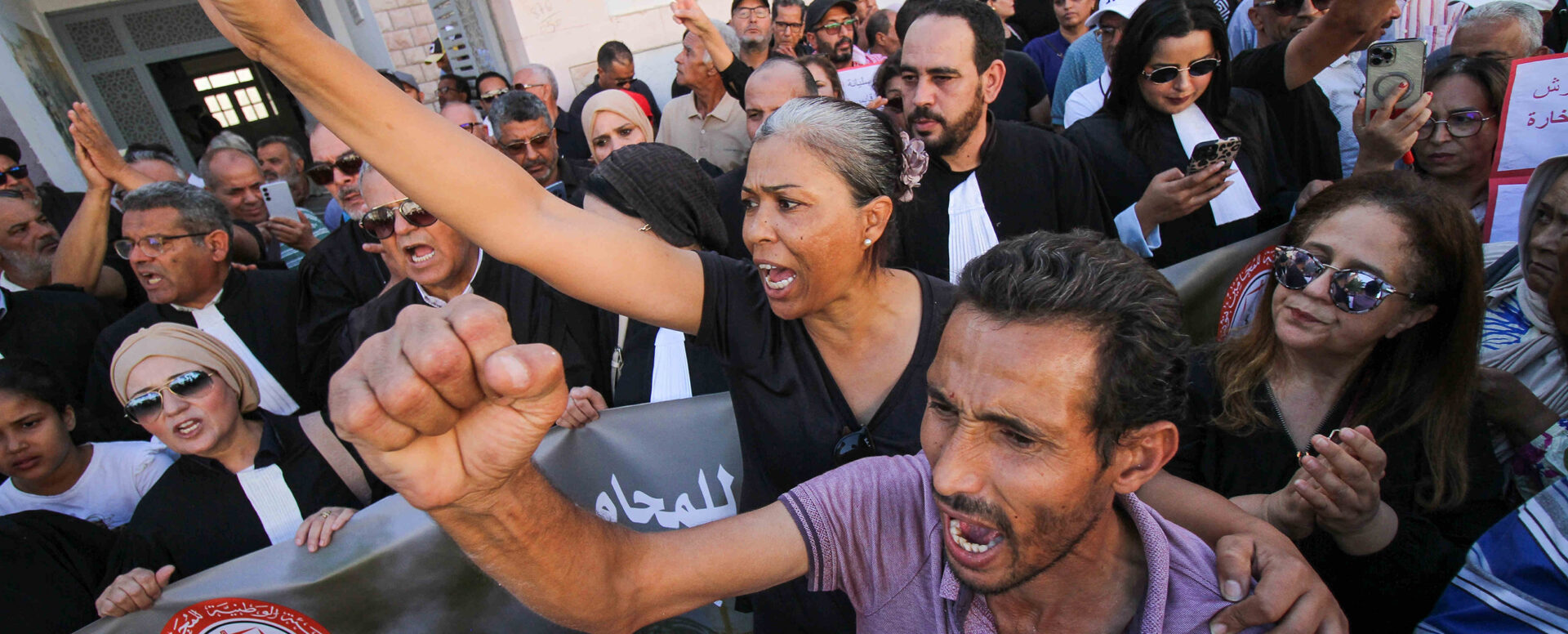
Header Photo: Protesters carry placards and chant slogans as they march in the southern city of Gabes on October 21, 2025. Workers in Gabes launched a general strike on October 21 following weeks of protest over the chemical factory residents blame for a spike in serious health issues. Shutterstock / Hassen Mrad