


On 6 August 2025, Milorad Dodik, the longtime leader of the Independent Alliance of Social Democrats (SNSD), the chief ethnic Serb political party in Bosnia and Herzegovina (BiH), was removed from office as President of the Republika Srpska (RS) entity following a criminal conviction by the Court of Bosnia and Herzegovina. Dodik was initially charged in 2023, following amendments to the country’s criminal code by High Representative Christian Schmidt, for defying the decisions of the Office of the High Representative (OHR), the chief adjudicating authority of the Dayton Peace Agreement (DPA).
Although Dodik’s removal was widely celebrated in BiH and large segments of the international community, the court’s decision – and the events surrounding his initial charging – were not without controversy, nor have the full consequences of the case against him been resolved as of mid-2026. The case itself and its legal-political stakes are complex and require careful unpacking, as they reflect both the possibilities and limits of substantive political change in Dayton-era BiH.
A Brief Biography of Milorad Dodik
It is impossible and unnecessary to provide a full accounting of Dodik’s various provocations during his nearly thirty years at the forefront of Bosnian politics. The basic contours of his personal and political trajectory, however, provide relevant context.
After a four-year stint in local politics in the Laktaši municipality in northern Bosnia, Dodik began his national political career in 1990 as a member of Ante Marković’s short-lived Union of Reform Forces of Yugoslavia. In the period between 1991 and 1992, however, Dodik abandoned the Reformists and joined an ostensibly “independent” section of the broader Serb nationalist movement which, led by Radovan Karadzic’s Serb Democratic Party (SDS), began creating parallel political institutions, including a separatist assembly, within what was then still the Socialist Republic of Bosnia and Herzegovina (SR BiH). Dodik remained aligned with what eventually became the RS entity for the duration of the Bosnian War (1992-1995) (Drljević, 2025). He is also alleged to have spent much of the war running a profitable cigarette smuggling operation (Klix, 2025).
After 1995 he emerged as a leading opposition figure to the still dominant SDS regime in the post-war RS entity. With the direct backing of the US, Dodik became Prime Minister of the entity in 1998. His government only lasted until 2001, although his SNSD increased its seat share in the RS entity assembly in every electoral cycle after 1998 (i.e. in 1998, 2000 and 2002). During this time both Dodik and the SNSD presented themselves as political moderates. Dodik publicly distanced himself from the wartime RS leadership, openly referred to Karadžić and Ratko Mladic as war criminals, and explicitly recognized the systematic executions of over 8,000 Bosniak men and boys in the Srebrenica enclave by the self-declared Army of the Republika Srpska (VRS) as a genocide (Bašić, 2024).
By the time of Dodik’s initial criminal charging
in August 2023, he had become a veritable pariah
in the eyes of much of the political West, and
doubtlessly the most destabilizing figure in the Western Balkans
In 2006 Dodik’s SNSD won both the legislative and presidential elections in the RS entity. The party’s programme and rhetoric began to shift rapidly: its erstwhile political moderation was replaced by an increasingly hardline nationalist stance. By the early 2010s, Dodik and the SNSD had abandoned all their previous positions: they now explicitly advocated for the secession of the RS entity, denied the facts of the Srebrenica Genocide and most every other atrocity perpetrated by the VRS, glorified Karadžić and Mladić as heroes, and began forging ever-closer ties with Moscow (and the newly reconstituted nationalist leadership in Belgrade under Aleksandar Vučić) (Fella, 2025). In 2012, the party was expelled from the Socialist International for its hardline nationalist turn. In 2017, Dodik was placed on US sanctions for undermining the DPA. These measures were expanded to nearly the entire senior leadership of the SNSD and Dodik’s own family – and expanded to include charges of widespread corruption – through several successive rounds of US sanctions, which, in the interim, were also imposed by the UK (Rogers, 2025).
In sum, by the time of Dodik’s initial criminal charging in August 2023, he had become a veritable pariah in the eyes of much of the political West, and doubtlessly the most destabilizing figure in the Western Balkans (Mujanović, 2019).
The Legal-Political Facts of Dodik’s Trial and Conviction
As Dodik’s politics radicalized, he and his party became increasingly more opposed to the role of the OHR in BiH’s post-war political governance. During the tenure of High Representative Valentin Inzko, Dodik began claiming that the OHR had unlawfully transferred large swaths of constitutional authorities from the entities to the state level using its executive Bonn Powers. This was not true, and in fact Dodik’s own SNSD had supported all major reform initiatives over the preceding decade, including the creation of a unified Bosnian Armed Forces, which had mildly rationalized the country’s governance. Nevertheless, Dodik began increasingly demanding a return to what he referred to as “the authentic Dayton” (izvorni Dayton), i.e. the political status quo in BiH as it had existed in the immediate aftermath of the war (Hambo, 2025).
When Inzko was replaced as High Representative by Christian Schmidt in the summer of 2021, Dodik also claimed that he had been unlawfully appointed. This too was untrue but with the backing of the Russian Federation, Dodik launched a series of pointed attacks against Schmidt, including threats to arrest him if he entered the territory of the RS entity. Frustrated by Dodik’s escalatory brinkmanship, in April 2023 Schmidt invoked the Bonn Powers to amend the country’s criminal code to criminalize defiance of the decisions of the OHR and the BiH Constitutional Court. Weeks later, the RS assembly passed a set of laws which purported to suspend the application of decisions of the OHR and Constitutional Court in the RS entity, and barring the publication of their decisions in the entity’s public gazette. These decisions, in turn, were then struck down by both the Constitutional Court and the OHR, after which the BiH Public Prosecutor charged Dodik, and Miloš Lukić, the director of the RS public gazette, with defying the decisions of the OHR (Zvijerac, 2023).
Dodik’s eventual trial was itself a spectacle.
He initially claimed he would refuse to appear in front
of the Court, then did so, then claimed he nevertheless
did not recognize the authority of the Court, and so on
Dodik’s eventual trial was itself a spectacle. He initially claimed he would refuse to appear in front of the Court, then did so, then claimed he nevertheless did not recognize the authority of the Court, and so on. His assorted antics, and the high-profile nature of the case, dragged out proceedings until February 2025, when he was found guilty in the first instance. In the interim, Lukić was acquitted. Following Dodik’s initial conviction, he again made a series of threats against the presiding judge, Schmidt, and threatened to declare the immediate secession of the RS entity. At his behest, the SNSD government in Banja Luka also passed an omnibus package of laws which claimed the entity was unilaterally withdrawing from a host of state-level institutions and national laws (Euronews, 2025). The Constitutional Court again intervened quickly and struck down the totality of these measures. However, Dodik was then separately charged by the BiH Public Prosecutor and Court of Bosnia and Herzegovina for acts against the constitutional order, and a warrant for his arrest was issued.
What ensued thereafter was at once the most significant political crisis in post-war Bosnian history to date and an utterly bizarre political spectacle (Ćerimagić, 2025).
RS entity police refused to enforce the warrant for his arrest; the head of SIPA, the state police, and a Dodik cadre, likewise refused to dispatch his officers against his political boss, and subsequently resigned from his post; officials in Sarajevo at once appealed for calm, lambasted their counterparts in Banja Luka, but also declined to risk direct confrontation between rival police forces in the country to secure Dodik’s capture; European officials privately urged their Bosnian counterparts to enforce the warrant but declined to provide direct assistance to Sarajevo to do so; while Dodik himself travelled repeatedly to Belgrade, Budapest, and Moscow to flaunt his purportedly untouchable status (Fouda, 2025)
In July 2025, Dodik surrendered himself to the Court of Bosnia and Herzegovina, chaperoned into the chambers by the head of the country’s intelligence community, the OSA. It remains publicly unclear how the OSA director Almir Džuvo secured Dodik’s compliance, but the court subsequently opted to suspend the warrant and charges against Dodik, with a pledge to reactivate both if he resumed his threats against the country’s constitutional order. A month later, the Constitutional Court found Dodik guilty in the second degree and sentenced him to one-year in prison and barred him from all public offices in BiH for a period of six years. Dodik opted to pay a fine to avoid jail time, and after a brief period of political grandstanding, quietly accepted his removal as President of the RS entity.
The Fallout after Dodik’s Conviction
In November 2025, the BiH Central Elections Commission (CIK) organized a special election to name Dodik’s successor as the entity’s President. Siniša Karan was selected as the SNSD candidate, while the SDS, with the support of the broader RS opposition, nominated Branko Blanuša. The 23 November elections produced a contested result: Karan claimed victory, but Blanuša and the RS opposition claimed that the polls had been marred by widespread fraud. A month later, confirming the opposition allegations, the CIK decided to annul the results of the elections in 17 municipalities, and 136 polling stations, and organized a re-run of the elections in those areas for February 2026. It was the second time in less than four years that the entity’s presidential elections had been marred by significant irregularities and had been ordered to be re-run by the CIK – the same had occurred during Dodik’s contested 2022 win over Jelena Trivić. On 8 February 2026, Karan confirmed his win by a final margin of 50.53% against Blanuša’s 48.09%, albeit on a paltry turnout of just 35.77% (2026) It was the best result by the opposition since 2014.
The prospects of long-delayed constitutional
reform in BiH, including the implementation
of the binding rulings of the European Court
of Human Rights, however, remain distant
In the interim, and in the wake of the 2024 US presidential elections, the second Trump administration lifted all sanctions against Dodik and his regime. The official justification was the purported concessions made by Banja Luka in withdrawing the secessionist omnibus law which had already been struck down by the BiH Constitutional Court and the OHR. Critics, however, alleged that the sanctions relief was, in fact, the result of a high-priced lobbying campaign launched by Dodik in Washington, for which he had paid millions to the likes of former Trump National Security Advisor Michael Flynn, former Illinois Governor Rod Blagojevich, and a host of other Republican-aligned operators (Vogel, 2025). Dodik, however, remains under UK sanctions, and over the course of 2025, Germany, Austria, Poland, Lithuania, Estonia and Slovenia imposed entry bans against him, while the Dutch Parliament unanimously called on the government of the Netherlands to do the same. Hungary and Croatia blocked EU-wide sanctions.
As of spring 2026, Dodik remains the party president of the SNSD but that too is being challenged in the Bosnian courts. As the party receives public financing, it is possible the courts will conclude that his ban from public office therefore extends to his role as party leader before the end of the year. Meanwhile, the Trump administration is continuing to normalize relations with Banja Luka, especially with respect to the planned Southern Interconnector Pipeline project, which has become, in effect, the sole focus of American policy in the country. But the defeat of Viktor Orban in Hungary has left Dodik without a major European ally, and the SNSD is, arguably, at its weakest politically within BiH in more than a decade. The RS opposition hopes to at least secure one major win against the bloc at the next BiH general elections, either snatching the RS post on the BiH presidency, the entity presidency, and/or a governing majority in the RS assembly.
The prospects of long-delayed constitutional reform in BiH, including the implementation of the binding rulings of the European Court of Human Rights, however, remain distant.
References
Bašić, Denaida. “Put do Dodikove amnezije: Od priznavanja genocida do negiranja i brutalnih uvreda.” N1, 19 April 2024. [Cited: 4 May 2026.] https://n1info.ba/vijesti/put-do-dodikove-amnezije-od-priznavanja-genocida-do-negiranja-i-brutalnih-uvreda/.
Ćerimagić, Adnan. “A Dangerous Standoff: The Battle for Bosnia’s Institutions.” RUSI, 25 March 2025. [Cited: 4 May 2026.] www.rusi.org/explore-our-research/publications/commentary/dangerous-standoff-battle-bosnias-institutions.
“2026. CIK BiH saopštio preliminarne rezultate: Karan novi predsjednik Republike Srpske.” RTVBN, 8 February 2026. [Cited: 4 May 2026.] www.rtvbn.com/4087781/cik-bih-saopstio-preliminarne-rezultate-karan-novi-predsjednik-republike-srpske.
Drljević, Vedran. “Hronologija političkog života Milorada Dodika: Od probosanskog političara do optužbi za urušavanje ustavnog poretka.” Forbes BiH, 18 March 2025. [Cited: 4 May 2026.] https://forbes.n1info.ba/aktuelnosti/hronologija-politickog-zivota-milorada-dodika-od-probosanskog-politicara-do-optuzbi-za-urusavanje-ustavnog-poretka/
Euronews.“Bosnian Serb leader Milorad Dodik’s new laws spark major political crisis.” Euronews, 3 June 2025. [Cited: 4 May 2026.] www.euronews.com/my-europe/2025/03/06/bosnian-serb-leader-milorad-dodiks-new-laws-spark-major-political-crisis.
Fella, Stefano. “Bosnia and Herzegovina: secessionism in the Republika Srpska.” UK House of Commons, 12 December 2025. [Cited: 4 May 2026.] https://commonslibrary.parliament.uk/research-briefings/cbp-10013/.
Fouda, Malek. “State-level security agency fails to arrest Bosnian Serb leader Milorad Dodik.” Euronews, 24 April 2025. [Cited: 4 May 2026.] www.euronews.com/my-europe/2025/04/24/bosnian-police-fail-to-arrest-republika-srpska-leader-milorad-dodik.
Hambo, Semir. “Šta je to izvorni Dejton kojim Dodik obmanjuje javnost.” Klix, 5 March 2025. [Cited: 4 May 2026.] www.klix.ba/vijesti/bih/sta-je-to-izvorni-dejton-kojim-dodik-obmanjuje-javnost/250304092.
Klix. “Kako se bogatio Milorad Dodik: Ratna nafta, šleperi za šverc cigareta i krediti koje nije vraćao.” Klix, 14 March 2025. [Cited: 4 May 2026.] www.klix.ba/vijesti/bih/kako-se-bogatio-milorad-dodik-ratna-nafta-sleperi-za-sverc-cigareta-i-krediti-koje-nije-vracao/250314109.
Mujanović, Jasmin. “Serb ‘Auxiliary Force’ Escalates Threats to Bosnia’s Stability.” Just Security, 22 April 2019. [Cited: 4 May 2026.] www.justsecurity.org/63715/serb-auxiliary-force-escalates-threats-to-bosnias-stability/.
Mackinnon, Amy and Rogers, Alex. “The Maga push overturning US policy in the Balkans.” The Irish Times, 1 December 2025. [Cited: 4 May 2026.] www.irishtimes.com/world/europe/2025/12/10/the-maga-push-overturning-us-policy-in-the-balkans/.
Vogel, Kenneth P. “Sanctions Lifted on a Putin-Backed Autocrat After Lobbying by Trump Allies.” The New York Times, 29 October 2025. [Cited: 4 May 2026.] www.nytimes.com/2025/10/29/us/politics/milorad-dodik-sanctions-trump.html.
Zvijerac, Predrag. “Kratko i jasno: Zašto je Milorad Dodik pred sudom?” Radio Free Europe/Radio Liberty, 10 October 2023. [Cited: 4 May 2026.] www.slobodnaevropa.org/a/dodik-optuznica-schmidt-bih/32631502.html.
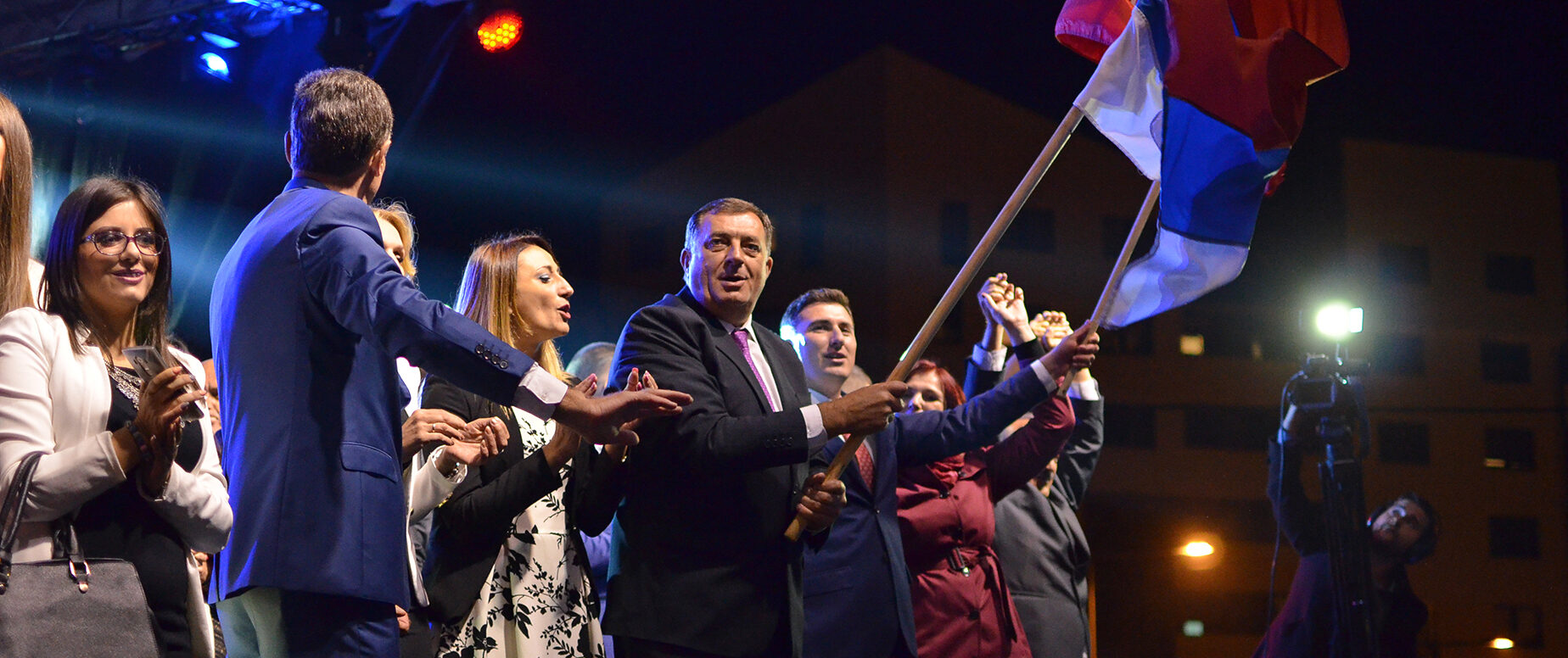
Header photo: PALE, BOSNIA AND HERZEGOVINA – SEPTEMBER 25: Milorad Dodik greets fans in Pale after meeting and referendum on the National Day of Republika Srpska on September 25, 2016. Shutterstock / RSplaneta