


In September 2025, Algerian President Abdelmadjid Tebboune appointed a new government headed by Sifi Ghrieb, who had previously served as Minister of Industry and Pharmaceutical Production. This shift from a government directed by former career diplomat Nadir Larbaoui underscored the need for change, to place economic transformation at the centre of the Tebboune administration’s agenda and to prioritize an operational cabinet that can rapidly and concretely address the population’s accumulating struggles. While this new cabinet is expected to undergo another reshuffle within a few months, it will still assume the critical mission of preparing the ground for the upcoming legislative elections, in addition to showcasing more efficiency and creativity concerning the economic and day-to-day issues facing the average citizen. At the top of the list of key challenges that Algeria, and therefore the cabinet, will have to address are bureaucracy, digitalization, socioeconomic grievances and industrial revival.
Legal Amendments for the New Rules of the Game
The Ghrieb government – along with key political stakeholders, including leading parties – is currently gearing up for legislative elections scheduled to take place by mid-2026. In the run-up to these elections, which will inevitably influence the political agenda and impact the national scene before the 2029 presidential elections, multiple legal and partisan dynamics are shaping local developments. In that context, the establishment forces, particularly the presidency and current cabinet, have actively sought to structure the opposition camp into carefully monitored and directed partisan and institutional schemes. Such willingness is demonstrated by the recent regulatory reforms, including the newly proposed law on parties and elections and constitutional amendments (Slimani, 2026). The most significant legal change concerns the new constitution, which will propose restructuring the Supreme Council of the Magistracy and its prerogatives, specifically increasing the power of the President. It is also expected that the new constitution will allow the President to call for snap local elections, a prerogative that was lacking in the 2020 constitution.
At the top of the list of key challenges that Algeria,
and therefore the cabinet, will have to address
are bureaucracy, digitalization, socioeconomic
grievances and industrial revival
These amendments will, in turn, ensure changes in the electoral code. The Independent National Electoral Authority, established as a direct outcome of the 2019 protest movement that ousted former President Abdelaziz Bouteflika, will retain its duty, while the logistical preparation of elections will now be the responsibility of the Interior Ministry. More consequential shifts are planned, however, for the new law on political parties (Amir, 2026). For instance, political parties will have to participate in at least one of two consecutive elections or face the risk of dissolution. Additionally, and in line with President Tebboune’s previously stated firm opinions on political financing, foreign funding will be banned and parties will be obliged to declare all their financial sources and be subject to stricter scrutiny. It will also become mandatory for parties to ensure internal democracy and transition of power by imposing a five-year term limit for all party leaders, which can only be renewed once.
The direct results of these legal amendments will influence the upcoming legislative cycle and formation of the next government. While Algeria has historically struggled with low voter turnout, more political parties are expected to take part in the upcoming elections, which, as a result, will incentivize the popular bases of these parties to cast their votes. In fact, and following the 2024 presidential elections, which already saw the participation of the long-standing representatives of the opposition, the Socialist Forces Front (FFS) and Islamist Movement of Society for Peace (MSP), the June 2026 legislative elections will also witness the inclusion of parties that have traditionally opted for the boycott option, including the Trotskyist Workers’ Party.
Legislative Elections for a New Status Quo
Although voter turnout remains the most important challenge of the current administration for the upcoming legislative and local elections, the composition of the Parliament is unlikely to be significantly altered. Establishment parties, composed essentially of the ruling National Liberation Front and Democratic National Rally, will retain the majority required to pass laws. However, the classic opposition front, primarily represented by the FFS and MSP, is likely to consolidate its position. At the same time, the MSP’s results will be a good indicator for its competition capacity in the next presidential race and the expansion of conservative forces within Algerian society.
Building consensus in Algeria is not only
a matter of ensuring inclusivity, but also responds
to an emerging trend that is reshaping balances of power
Following the legislative elections, negotiations will swiftly begin to form a new government, which will constitute a critical stabilization effort for the Tebboune administration. Since Tebboune’s accession to power in 2019, his administration has favoured the technocratic government pathway instead of a political cabinet. This strategy could be read within the broader context of Tebboune’s independent candidate status in the 2019 and 2024 presidential elections, the urgency of technical solutions for citizens’ grievances and the hesitation of partisan elites to assume the political cost of a post-protest movement transition. However, it has become clear that political consensus is needed at a time of severe geopolitical shifts and to address the regional challenges facing Algeria, pressuring the current administration to seek refuge in political and partisan consensus. Nonetheless, this consensus cannot be sustainable without the inclusion of other social and economic actors, particularly civil society and private business operators and investors.
Building consensus in Algeria is not only a matter of ensuring inclusivity, but also responds to an emerging trend that is reshaping balances of power. Beyond the classic structures of political parties and elites, non-state actors are increasingly involved in decision-making, as they capitalize on technological tools, including social media, to amass power and political relevance. For example, influencers have become a central player in Algerians’ daily lives, which grants them a growing and impactful place within political and social ecosystems. This reflects a global trend where social media platforms are quickly becoming the new uncensored and unregulated parliaments for the masses. Being aware of this change in paradigms, authorities are currently preparing a new regulatory framework for influencers that aims to label their work under official structures and allows for their inclusion in social security and taxation schemes.
The Economy First: Industrial Agenda and Structural Limitations
Despite the apparent urgency of political dossiers, the government, political actors and the population are all also focused on socioeconomic grievances in addition to economic strategy and growth. In that context, President Tebboune’s second-term bid placed the economy at the heart of his electoral programme and has since bolstered state expenditures to support government projects and social welfare policies. At the same time, international financial and economic institutions have underscored government efforts to ensure stability and promote economic diversification (World Bank Group, 2025). The current administration has invested political capital in key reforms in terms of reducing Algeria’s reliance on the oil and gas industry and facilitating the investment and business environment. This approach is destined to deliver on the administration’s promise of industrial revival and improving Algerians’ day-to-day lives.
For the current administration in Algeria, ensuring social and political stability is synonymous with an industrial revival, which will allow it to meet the rising expenditure bill and provide job opportunities. To achieve this economic milestone, the government has put forward a plan that capitalizes on public investments, the inclusion of young entrepreneurs and attracting foreign investors, particularly in promising sectors such as technology, agriculture and various industries. In 2025, the Tebboune administration announced a significant financial portfolio of 50 billion dollars in infrastructure project investments, aimed at boosting industrial activity, while simultaneously finalizing a crucial law proposal on public-private partnerships. Moreover, this dynamic is part of a broader programme to capitalize on the private sector’s potential, including through the inclusion of the youth segment, which benefits from administrative facilitation to establish innovative startups that respond to local needs. These domestic projects are complemented by government efforts to attract foreign investors, which have so far especially yielded results with Italy, Turkey and Qatar. However, this ambitious agenda is faced with multiple challenges related to bureaucracy, a difficult business environment, an outdated banking sector and government tactics to respond to the growing local energy consumption of industrial stakeholders while providing more gas volumes for exports to meet increasing European demands (Gunn, 2026) amidst the war in the Middle East.
For the current administration in Algeria,
ensuring social and political stability
is synonymous with an industrial revival,
which will allow it to meet the rising
expenditure bill and provide job opportunities
In December 2025, Algerian President Tebboune signed the new finance bill for 2026, amounting to a budget of 135 billion dollars in line with a general trend since 2020 to increase public expenditure. While this suggests the administration’s desire to invest state funds in economic growth, it also highlights structural concerns with the national economic model. For instance, the budget deficit was projected to reach 61 billion dollars in 2025 (Mebtoul, 2025), representing 21% of the overall gross domestic product. A big part of this deficit is provoked by extravagant social welfare policies and their annual cost for the treasury. Furthermore, this deficit is combined with a gradual depreciation of the national currency. At the same time, economic operators are still subject to administrative hurdles, including bureaucratic measures. And, while the policy of supporting local production through import bans has indeed bolstered local brands, it has also translated into market shocks, price speculation and the emergence of unregulated micro-importers (Idir, 2025), who contribute to the informal market.
Between political developments and economic policy, Algeria is managing a difficult transition after the twenty years of rule of former President Abdelaziz Bouteflika. While similarities exist between the former and current administration, it is also safe to say that the Tebboune leadership has its own strategy and approach to sensitive political and economic dossiers and prioritizes a rigid political agenda and nationalist economic vision. However, an important lesson of the 2019 protest movement is that Algeria requires consensus building to achieve and maintain stability. In that sense, the challenge for the current administration on the domestic level will be to manage the high expectations of the population after the collapse of the Bouteflika regime, while working on realistic policy advancements that consider the country’s potential and limitations. The future of Algeria, as the Tebboune administration begins to near the end of its reign, will be determined by the capacity of all actors to bypass ideological and political divisions and polarization, establish a serene environment for inclusive dialogue and empower the private sector to unlock genuine and robust economic growth.
References
Amir, Nabila. “Loi sur les partis politiques: Les amendements retenus examinés par l’APN.” El Watan. 4 March 2026. https://elwatan.dz/loi-sur-les-partis-politiques-les-amendements-retenus-examines-par-lapn/.
Gunn, Michael. “Europe Makes a Beeline for Algerian Gas Yet Again.” Bloomberg. 23 March 2026. www.bloomberg.com/news/newsletters/2026-03-23/next-africa-iran-war-fires-up-demand-for-algeria-s-gas.
Idir, Ali. “Commerce du cabas: l’Algérie fixe les règles pour devenir petit-importateur.” Tout sur l’Algérie. 30 August 2025, www.tsa-algerie.com/commerce-du-cabas-lalgerie-fixe-les-regles-pour-devenir-petit-importateur/.
Mebtoul, Abderrahmane. “Loi de finances 2025: Quel est l’impact du déficit budgétaire.” La Sentinelle. 6 January 2025. https://lasentinelle.dz/index.php/2025/01/06/loi-de-finances-2025-quel-est-limpact-du-deficit-budgetaire/.
Slimani, Nabil. “Algeria’s 2020 Constitution faces a shake-up: early elections and political power in focus.” Annahar. 5 February 2026. www.annahar.com/en/region/north-africa/275525/algerias-2020-constitution-faces-a-shake-up-early-elections-and-political-power-in-focus.
World Bank Group. “How Algeria is Crafting a Dynamic Economy for Tomorrow.” 18 April 2025. www.worldbank.org/en/news/feature/2025/04/18/how-algeria-is-crafting-a-dynamic-economy-for-tomorrow.
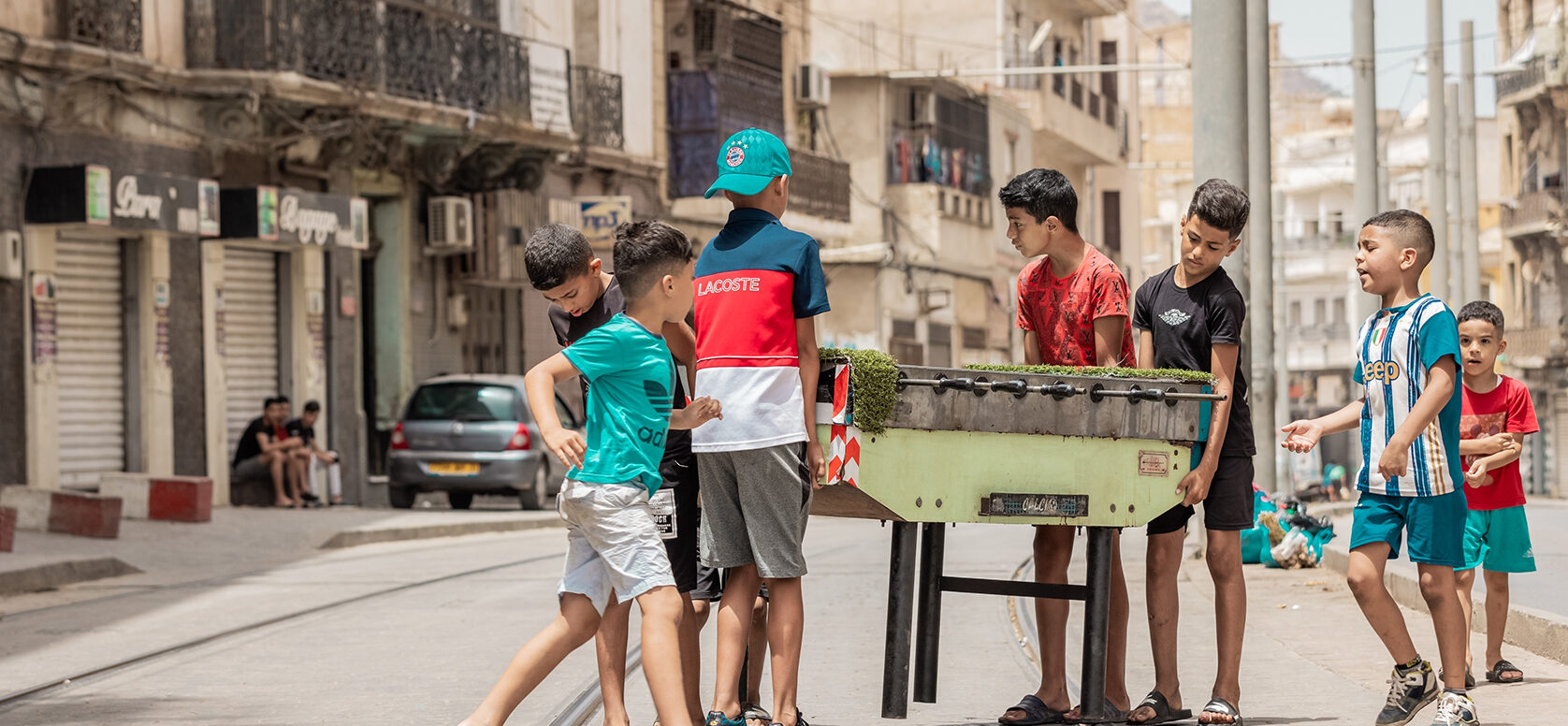
Photo: A group of algerian kids are carrying hand football machine over the tram rail tracks in Algiers. 21 July 2022. By Anze Furlan / Shutterstock