




Problematic Centrality or Central Problem of Irregular Migration?
Over the past few decades, migration from the Maghreb, and by extension from Africa, to Europe has been progressively redefined through the lens of security, leading to the entrenchment of the dominant ‘illegal immigrant’ category at the heart of migration policies, border security measures and public discourse.
The category of irregularity, central to measurement mechanisms, tends to obscure the complexity of contemporary migration trajectories, which are characterised by their diversification, hybridisation and embeddedness within social, educational, economic and gendered dynamics.
We propose a critical re-examination of contemporary Maghrebi migration based on a two-pronged analytical approach. First of all, we will undertake an empirical assessment of irregular crossings of the European Union’s borders using Frontex data for the period 2009–2025, identifying cycles, geographical reconfigurations and the effects of border control policies. Secondly, we will demonstrate that the centrality of the ‘irregular migrant’ category tends to obscure the diversification of mobility, marked by the rise in skilled, student and female migration.
The centrality of the ‘irregular migrant’
category tends to obscure the diversification
of mobility, marked by the rise in skilled,
student and female migration
By adopting an intersectional approach, the analysis highlights the blind spots in measurement systems, as well as their political implications. This chapter argues that there is a growing disconnect between a regime of visibility dominated by securitization, and the reality on the ground, characterized by the increasing complexity of migration trajectories. It highlights the need to rethink Euro-Mediterranean governance of mobility from an analytical, inclusive and strategic perspective capable of moving beyond the reduction of migration to mere irregularity and re-situating it within the framework of the Barcelona Process (Barcelona Declaration, 1995):[1] “building an area of shared prosperity” in the Mediterranean, a crossroads of civilizations where the intermingling of cultures and religions constitutes a common heritage.
Problem Statement & Methodological Approach
This centrality is widely invoked in political and media circles; it acts as a screen whose narrative focus helps to shape a dominant portrayal of migration as a phenomenon of crisis, pressure and threat, yet it obscures forms of mobility that are more discreet but no less formative of the Mediterranean region. In other words, what is measured and made visible only partially reflects the complexity of contemporary migration dynamics. This discrepancy invites us to question not only the evolution of migratory flows, but also the categories through which these flows are understood. The focus on a reductive category contributes to the homogenization of migrants. Hence our central line of inquiry: What does the centrality of irregularity in our understanding of contemporary Maghrebi migration conceal?
This chapter begins with the hypothesis that the centrality of irregularity in knowledge and governance frameworks produces a simplifying effect that obscures profound changes in Euro-Maghreb mobility. Indeed, beyond irregular crossings – which are largely under-documented (only the flows are known, while the stock remains unknown) –, we observe a growing diversification of migration profiles: students, skilled workers, circular mobility, empowered women’s trajectories, and hybrid forms of mobility combining different statuses throughout the migration journey.
To grasp this complexity, we propose combining two levels of analysis: (i) The first relies on the use of available data to identify major irregular trends and geographical reconfigurations of flows;[2] (ii) The second employs an intersectional approach to bring out the invisible dimensions of mobility. This framework allows us to distinguish between a regime of visibility structured by a security and statistical logic, and the real mobility on the ground, characterized by its diversification and increasing complexity.
The methodology will be based on a quantitative approach utilizing available databases (Frontex, IOM, UNESCO, OECD, reports), combined with critical analysis and an intersectional perspective aimed at identifying how legal status interacts to produce visible or invisible migrants.
Visibility Regime: Irregular Migration Through Frontex Data
Regardless of the methodological limitations[3] of Frontex data, they offer a holistic overview of irregular flows, allowing for comparison of the scale by year over a historical period. Several insights emerge from an examination of charts 1–8.
A Differentiated Structural Trend in Maritime Routes
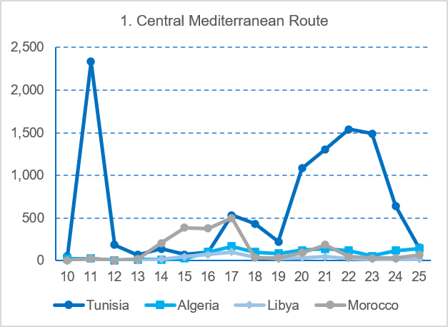
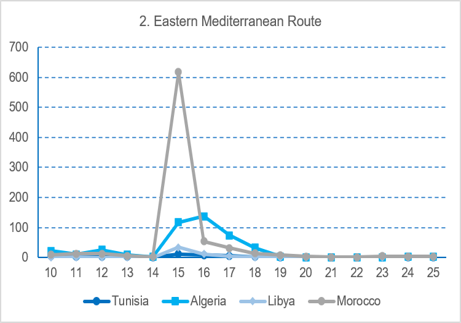
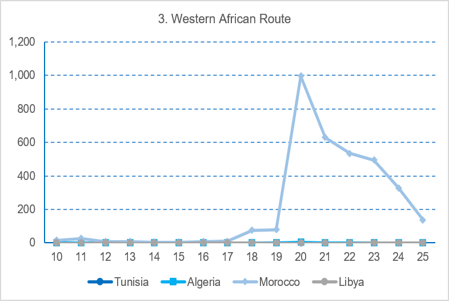
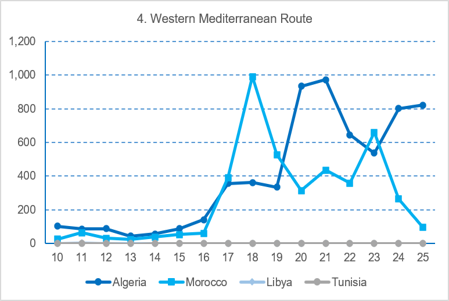
The four charts (1, 2, 3 and 4) relating to irregular crossings into the EU by sea provide key insights on the reconfiguration of Maghreb mobility between 2010 and 2025. Unlike land routes, they reveal significantly higher volumes, but above all, a strong spatial polarization around a few major maritime corridors. They also highlight a fundamental characteristic: maritime flows do not follow a continuous cumulative trend but evolve according to cycles of concentration, displacement and route reorganization through a ripple effect.
A General Characteristic: Maritime Centrality and the Reconfiguration of Corridors
Taken together, the charts show that irregular maritime migration constitutes the main statistically visible pattern of Maghreb mobility. However, this centrality does not imply stable flows. The data series show: (i) peaks that are localized in time and correlate with regional political changes; and (ii) shifts in centrality between routes. In other words, the permanence of the phenomenon does not imply route stability. It is the corridors that shift.
The Central Mediterranean: The Main Corridor
Chart 1 appears to be the most significant. It displays Tunisia’s clear dominance, with an initial exceptional spike (a post-2011 disruption effect), followed by a rapid reversal, then a relatively moderate decline, with a new upturn as of 2020, peaking between 2021 and 2023, before a relative decline at the end of the period following complex negotiations between Tunisia and Italy, with the EU in the background. Socio-economic deterioration and the decline in domestic and regional political stability partly determine the prominence of the routes following the temporary relaxation of control measures. Algeria, Libya and Morocco remain present, but at significantly lower levels.
This route thus emerges as the main axis, with the capacity for rapid reactivation thanks to its geographical proximity to Italy and established migration networks. It illustrates the persistence of a key corridor, albeit one whose intensity fluctuates considerably.
Eastern Mediterranean Route: A Marginal Route with Sporadic Episodes
Chart 2 is characterised by generally low volumes across all Maghreb countries. The most striking feature is the very sharp peak in Morocco around 2015, accompanied by a slight increase in Algeria. Following this period, flows fell rapidly to near-zero levels. This pattern suggests that this is not a permanently structured route for Maghreb migration, but rather appears to be an opportunistic corridor mobilised on a temporary basis. This sequential nature indicates a pattern of cyclical migration windows rather than stably anchored flows.
West African Route: Emergence of an Atlantic Reconfiguration
Chart 3 reveals a particularly interesting dynamic. Until the late 2010s, volumes remained very low. From 2020 onwards, however, there was a dramatic increase from Morocco, followed by a gradual decline, down to levels that nevertheless remain higher than those at the beginning of the period. This trajectory suggests the emergence of an Atlantic reconfiguration of mobility that functions as an alternative corridor for irregular migration; the latter is not confined to the strictly Mediterranean region, but extends into peripheral areas, confirming the spatial elasticity of migration trajectories.
Western Mediterranean Route: Shift in Centrality Between Morocco and Algeria
Chart 4 highlights a particularly clear reconfiguration of the western route, characterized by the dominance of Morocco and Algeria, with rapid increases and relatively sustained fluctuations. This development reflects a redistribution of migration centrality within the western Mediterranean coastline. This route appears as an area of competition and constant reorganization of flows rather than a single, unambiguous corridor.
CHARTS 1-4 Average Monthly Flows of Irregular Entries into the EU by Sea Each Year from 2010 to 2025
Source: The author, based on Frontex data (2026)
Ultimately, the analysis of maritime routes shows that irregular migration from the Maghreb is less a matter of a linear progression of volumes than a dynamic system of reconfiguration of migratory corridors characterized by effects of concentration, shift and adaptation to regional changes and control mechanisms. Consequently, what becomes visible in the statistics differs from what actually structures mobility: adaptive, differentiated and spatially reconfigurable trajectories.
Land Routes: Low Volumes and High Volatility
The four charts (5, 6, 7 and 8) provide a highly informative insight into land-based crossings. They show that, contrary to a homogeneous representation of irregular migration, land trajectories are low in volume, geographically differentiated and highly sensitive to political contexts and the effects of route displacements.
Across all land routes, one initial observation is clear: volumes remain generally limited compared to maritime routes. This means that land mobility does not constitute the bulk of traffic. However, the low volume of these land routes should not obscure their analytical value. They reveal patterns of circumvention and spatial redistribution. A second salient feature is their high volatility. The peaks observed are often brief, concentrated in time, and followed by rapid declines, indicating that land routes correspond more to windows of opportunity than to stable dynamics.
Eastern Mediterranean Route: Former Algerian Centrality
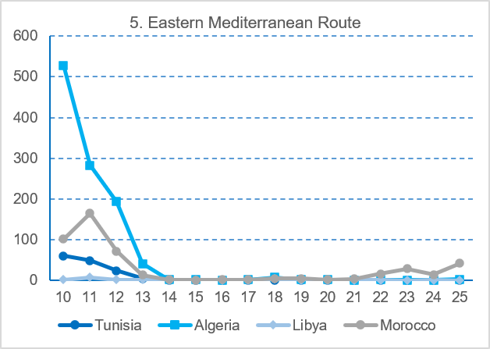
Chart 5 highlights an initial Algerian presence (2010 and 2013) followed by a rapid decline to the point of near-disappearance after 2014. Morocco also shows relatively significant levels at the start of the decade. Tunisia and Libya remain marginal. This sequence can be interpreted as reflecting a temporary opening phase rather than an eastern migratory corridor. The sharp decline after 2014 suggests that this route did not constitute a sustainable structural axis but rather a temporary window of opportunity.
Western Mediterranean Route: Shift Towards Morocco and Return of the Spanish Route
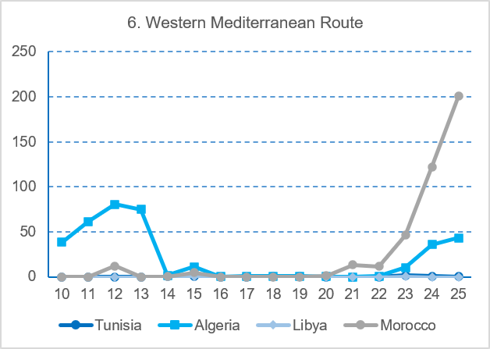
Chart 6 shows a markedly different pattern. Algeria appears to have a relatively significant presence (2010–2013), while Morocco remains at a low level. As of 2021, the dynamics change radically,[4] with flows from Morocco increasing sharply, and a very marked acceleration between 2023 and 2025. This increase signals a shift towards the west in irregular land-based migration. The western coast is once again becoming an area of attraction, not because of uniform growth, but through a redistribution of available and possible routes.
Eastern Border Route: Low Volumes but Gradual Diversification
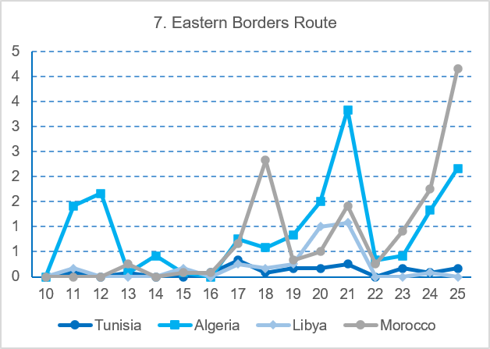
Chart 7 confirms the numerically marginal nature of this route. Nevertheless, two elements warrant attention. Algeria appears as the most prominent country, with a few sporadic increases, registering three scissor effect fluctuations alternating with Morocco, which takes off at the end of the period, peaking in 2025.
This trend indicates that, despite low volumes, the eastern route remains an area of diversification in migration pathways and reflects the existence of longer trajectories that go beyond the conventional patterns of Mediterranean transit. In other words, this route reveals less a mass dynamic than a geographical extension of mobility strategies when needed.
Western Balkans Route: Sporadic Peaks and Opportunistic Corridor Logic
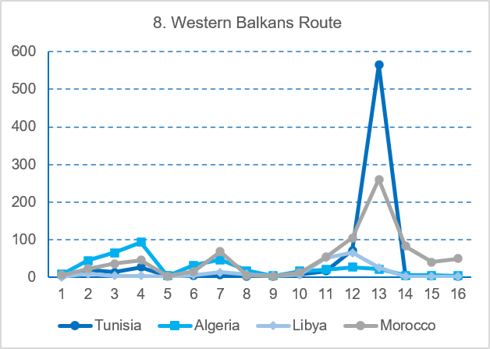
Chart 8 most clearly illustrates the adaptive nature of land routes. It shows very pronounced peaks, but they are concentrated over a short period of time and vary in intensity across all countries. This pattern suggests the existence of an opportunistic corridor as a functional transit space, which can be rapidly activated and then partially closed off, creating a ‘migration window’ effect.
CHARTS 5-8 Average Monthly Flows of Irregular Entries into the EU by Land per Year (2010-2025)
Source: The author based on Frontex data (2026)
The analysis of land routes shows that crossings do not follow a homogeneous or linear pattern. They take the form of flexible trajectories, spatially reconfigurable and sensitive to geopolitical changes, revealing that control policies tend less to suppress mobility than to shift its forms and routes.
Overall Interpretation: A Cyclical, Non-Linear Phenomenon
Leaving aside monthly flows, an initial observation emerges: (i) irregular migration from the Maghreb does not follow a linear pattern nor is it confined to a stable geographical area. On the contrary, a comparative analysis of sea and land routes reveals a system of movement characterized by cycles of concentration, displacement and spatial reconfiguration, closely dependent on contexts, control mechanisms and the actors’ capacity to adapt; (ii) The second observation is that maritime routes constitute the primary area of statistical visibility, while land routes remain quantitatively more modest.
However, this asymmetry in terms of volume should not lead us to regard land routes as secondary. On the contrary, they reveal mechanisms of circumvention, diversification and redeployment of routes. In mirror image, maritime routes operate according to a logic of constant reorganization, in which the relative closure of an area tends less to reduce mobility than to shift its geography. Taken together, these results show that the stability of the migration phenomenon does not entail the stability of routes or volumes.
Maritime routes operate according to a logic
of constant reorganization, in which the relative closure
of an area tends less to reduce mobility than to shift
its geography (…) the stability of the migration phenomenon
does not entail the stability of routes or volumes
Frontex data measure detected border crossings, not individuals. While they make certain irregular migrant categories visible because they are generated by border control systems, other essential aspects remain hidden. Irregular migration flows to countries on the north shore of the Mediterranean by air are virtually invisible. Similarly, the efforts undertaken by south-shore countries to intercept attempted departures remain largely unknown.
In this sense, the empirical analysis of routes serves as the starting point for an examination of the changes in Maghreb mobility and its varied dimensions. It is precisely this analytical shift from what is visible statistically to the real and invisible complexity of these trajectories that the following section addresses.
From Statistical Visibility to the Real and Diverse Nature of Movements
The analysis of Frontex data does not exhaust the reality of migration; it primarily reflects a regime of visibility by describing not the phenomenon itself (irregular migrants) but rather attempts at migration via irregular channels – one of its politically and administratively perceptible forms. However, one of the contributions of an intersectional approach lies precisely in shifting the focus towards social groups that remain partially invisible within border control systems.
Contemporary migration patterns
from the Maghreb are characterized
by a diversification of profiles,
trajectories and mobility systems
Contemporary migration patterns from the Maghreb are no longer limited to attempts at irregular migration and to irregular migrants – typically male, low-skilled, arriving through family reunification or following traditional transit routes. Today, they are characterized by a diversification of profiles, trajectories and mobility systems: a growing proportion of women, students and skilled workers, hybrid trajectories combining several successive statuses, sometimes marked by periods of irregularity, etc. We shall attempt to identify some of these segments, if only partially, using the limited data currently available.
A Growing Feminization of Migration Flows
The evolution of Maghreb migration to Europe reflects a profound transformation in migration patterns over the last two decades. In addition to historically dominant forms, there is now a diversification of mobility, driven by the restructuring of labour markets, higher education, women’s career paths and the emergence of transnational mobility.
The migration stocks revealed by OECD data on the feminization of Maghreb migration provide significant insight here. They show that, over the period 2014–2024, the female populations born in Algeria, Morocco and Tunisia had been experiencing steady growth in several destination countries in Europe and beyond, often at a rate exceeding that of the overall growth of migrant populations, including male populations.
The case of Algeria is particularly telling, with substantial growth over a decade. The increase observed in Turkey is especially remarkable, both in terms of volume and relative intensity, revealing geographical diversification and, in some cases, exceeding gender parity. The growth in the proportion of women migrants from Morocco has reached or is approaching equilibrium in several European regions. Tunisia is following a similar albeit more moderate trend, with steady growth (Chart 9).
As these data are based solely on the criterion of birthplace as recorded in the host country, they may underestimate the true scale of female emigration. Data from the Arab Barometer on migration intentions by gender confirm this trend in several countries in the MENA region.
CHART 9 Feminization Ratio (Female/Male) in Migration from the Maghreb (2014-2024)
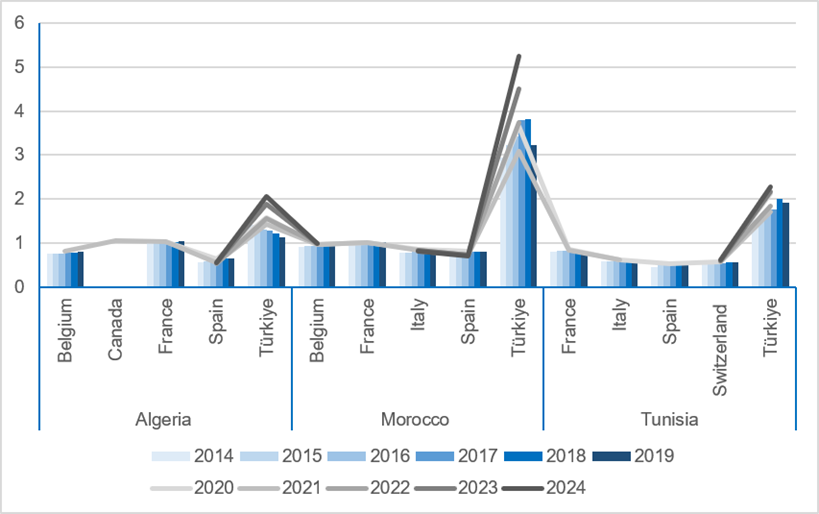
Source: OECD data: Stocks of foreign-born population. Unit of measure: Persons. Latest update: 3 November 2025
The stabilization of the number of female migrants from the Maghreb, their geographical spread and the rise in the proportion of women indicate a qualitative and quantitative change. These trends reflect more autonomous life paths, shaped by educational, professional and transnational factors.
Maghrebi Student Mobility
The new generations of migrants from the Maghreb are increasingly made up of groups of students and graduates linked to international recruitment. Their pathways combine education and professional integration, and often lead to long-term migration. In other words, the actual pattern of mobility today appears broader, more stratified and more socially differentiated.
Chart 10 demonstrates a sustained increase in the number of Maghrebi students abroad, while Table 1 illustrates the Maghreb’s significant weight among international students, primarily in France, due to the historical and linguistic conditions that shape movements and networks.
Maghrebi student mobility is no longer
a temporary or marginal phenomenon;
rather, it is part of a structural shift
in attitudes within the countries of origin
One key point emerges from this analysis: Maghrebi student mobility is no longer a temporary or marginal phenomenon; rather, it is part of a structural shift in attitudes within the countries of origin. It reflects the mismatch between education and labour market demand,[5] the massification of higher education, graduate unemployment, and increasing job insecurity; but it also reveals a strategy of investment and integration into the global skills market.
CHART 10 Total Number of International Students in Higher Education by Country of Origin (2000-2022)
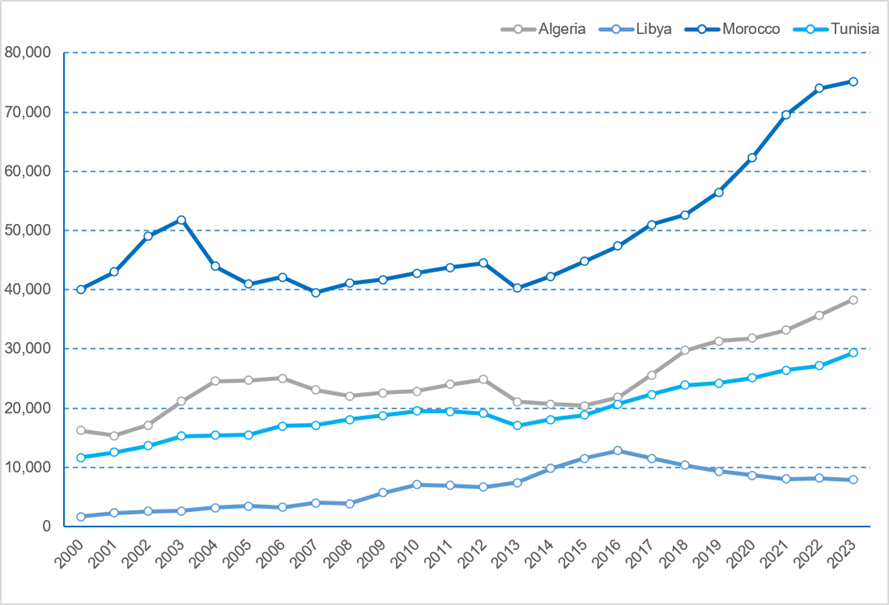
Source: UNESCO, February 2025
TABLE 1 Top Countries of Origin for International Students in France (2023-2024)
| Ranking by country of origin | Number of students 2023-24 | Percent-age of total (%) | Change over 5 years | |
| 1 | Morocco | 43,354 | 10 % | +4 % |
| 2 | Algeria | 34,269 | 8 % | +10 % |
| 6 | Tunisia | 15,224 | 4 % | +17 % |
Source: Campus France, 2025
This phenomenon often acts as an interface between academic mobility and professional migration. The intention to migrate among students is quite significant (Hadibi et al., 2024). It now constitutes a central segment of the contemporary Euro-Mediterranean mobility landscape, at the intersection of individual and family educational strategies, qualification pathways and the dynamics of transnational professional labour market integration.
Skilled Migration of North Africans: The Case of Doctors
In the absence of harmonized statistics that would allow for the identification of all categories of highly qualified professionals practising in Europe, the case of Maghrebi doctors in France provides a prime vantage point due to the long-standing history of Euro-Maghreb medical mobility.
Table 2 illustrates the outflow of skilled professionals. The most striking feature is the high overall emigration rate among doctors; however, these figures are incomplete, as only licensed professionals are included. This suggests that the mobility of doctors is part of a broader, less visible movement of graduates and unrecorded skilled professionals (those in the process of having their qualifications officially recognized, those sitting the medical exam, non-tenured staff, and those without specific status, such as interns, trainees and attached practitioners).
TABLE 2 Overall Emigration Rate to France by Country of Birth and Place of Graduation (2022)
| Tunisia | Morocco | Algeria | |
| Overall emigration rate (by country of birth) | 14.2 % | 18.0 % | 25.1 % |
| Overall emigration rate (by country of graduation) | 9.7 % | 4.2 % | 8.0 % |
| General practitioners | 2.6 % | 2.4 % | 3.5 % |
| Specialist doctors | 14.4 % | 5.1 % | 12.6 % |
Source: Zehnati, A. (2022), based on data from the Ministries of Higher Education and Health of the three Maghreb countries, the French National Institute of Statistics and Economic Studies (INSEE) and the Conseil national de l’Ordre des Médecins (CNOM, France).
The intention to migrate among students
is quite significant. It now constitutes
a central segment of the contemporary
Euro-Mediterranean mobility landscape
The table shows that the presence of doctors from the Maghreb in France is not merely a quantitative migratory phenomenon, but rather the selective mobility of skilled workers. It appears less as a simple, uniform drain of doctors than as the professionally concentrated movement of the most highly qualified individuals encompassing a range of talents (athletes, engineers, IT specialists, researchers, entrepreneurs, artists, etc.). The facets of scientific migration from the Maghreb are diverse (Musette, 2016) and are not without impact on the erosion of the middle classes in Maghreb countries (Hadibi & Musette, 2023).
Conclusion
The actual pattern of migration from the Maghreb today appears to be broader, more stratified and more complex. One of the major effects of the central focus placed on irregularity within policy frameworks is the creation of a hierarchy of visibility. Certain forms of mobility take centre stage in the public sphere, while others remain marginal and receive little attention. This asymmetry is neither neutral nor a sufficient framework for understanding contemporary Maghreb migration; it stems from a process of politically constructing migration as a social problem rather than a complex reality.
This has a twofold effect. On the one hand, it limits our understanding of contemporary change; on the other, it fuels a reductive interpretation, in which migration is perceived more as a matter of border control and a threat, and less as a lever for co-development. Politically, the loss is twofold: the Maghreb diaspora risks becoming frustrated by its symbolic invisibility; furthermore, this bias is particularly sensitive in a European context marked by the rise of populist movements that exploit migration as a tool for political polarization and which are gaining ground, including within so-called mainstream right-wing political parties.
A perspective that is fully in line with the Pact on Migration and Asylum – which prioritizes the promotion of legal pathways – and the Pact for the Mediterranean – which recognizes people as the driving force behind change, connections and innovation – would benefit from shifting the focus on migration from the realm of crisis to that of the governance of regional interdependencies. This shift implies not so much a denial of irregular migration, as a repositioning of migration within a broader context for the future of the Euro-Mediterranean region.
The strategic challenge for Europe and the societies of the Maghreb is therefore not merely to manage irregular migration more effectively, but to build frameworks for migration governance. It is a matter of moving from border management to the governance of integrated spaces, of a shared heritage and a shared future, all the more so as the European context lends itself to this (ageing population, skills shortages and geopolitical realignments), in addition to the strengths of the south shore (harmonization of higher education systems under the Bologna Process, a young population, geographical and cultural proximity, and energy).
Bibliography:
Arab Barometer. Wave VIII. 2024. www.arabbarometer.org/surveys/arab-barometer-wave-viii/.
Campus France (ed.). La mobilité étudiante dans le monde. Paris: France, 2025.
“Barcelona Declaration.” adopted at the Euro-Mediterranean Conference held on 27-28 November 1995. https://ufmsecretariat.org/wp-content/uploads/2015/10/Declaracion-de-Barcelona-1995.pdf
FRONTEX. Statistics on irregular border crossings. 2026. www.frontex.europa.eu/.
Hadibi, Z., & Musette, M. S. “Does Brain Drain Weaken or Strengthen the Middle Classes in the Maghreb Countries?” Maghreb-Machrek, 254 (2-3): 65-79. 2023.
Hadibi, Z.; Musette, Y. & Kherbachi, S. “Migration intentions of academics in Bejaia (Algeria).” Maghreb-Machrek, 6 (2): 23-39. 2024.
Musette, M. S. (ed.). De la fuite des cerveaux à la mobilité des compétences ? une vision du Maghreb. Algiers: Centre de Recherche en Économie Appliquée pour le Développement – CREAD, 2016.
OECD Organisation for Economic Co-operation and Development. OECD Data Explorer, 2025. www.oecd.org/en/data/datasets/oecd-DE.html.
IOM International Organization for Migration. Migration Data Portal, 2025. www.migrationdataportal.org/.
Zehnati, A. ”L’émigration des médecins, en particulier vers la France, et la desserte médicale au Maghreb”, Belgeo: 1, 2024.
[1] Set against the backdrop of the 1990s, the Barcelona Declaration refers to the important role played by migration in Euro-Mediterranean relations, on six occasions focusing on the central issue of irregular migration: to reduce migratory pressures, to combat illegal immigration, to make proposals concerning migration flows and pressures. Conversely, the issue of regular migrants is addressed only marginally, just once and solely in terms of improving the living conditions of migrants legally established in the Union.
[2] The stock is only made visible during the regularization process.
[3] The data relates to illegal border crossings and not to the number of people involved.
[4] Recall a relaxation of border controls between Morocco and Ceuta in 2021 – “In May 2021, approximately 8,000 to 10,000 migrants, mainly Moroccans and Sub-Saharan Africans, crossed the border into Ceuta in just a few days.” This data is obscured by Frontex statistics.
[5] “The migration of young Mediterranean talent and the challenge of employability,” Friedrich Naumann Foundation for Freedom, 04-07-2023, www.freiheit.org/spain-italy-portugal-and-mediterranean-dialogue/migration-young-mediterranean-talent-and-challenge.
Header photo: Silhouette of people walking and pointing against a stunning sunset backdrop. Pexels / Nesrin Ozturk