



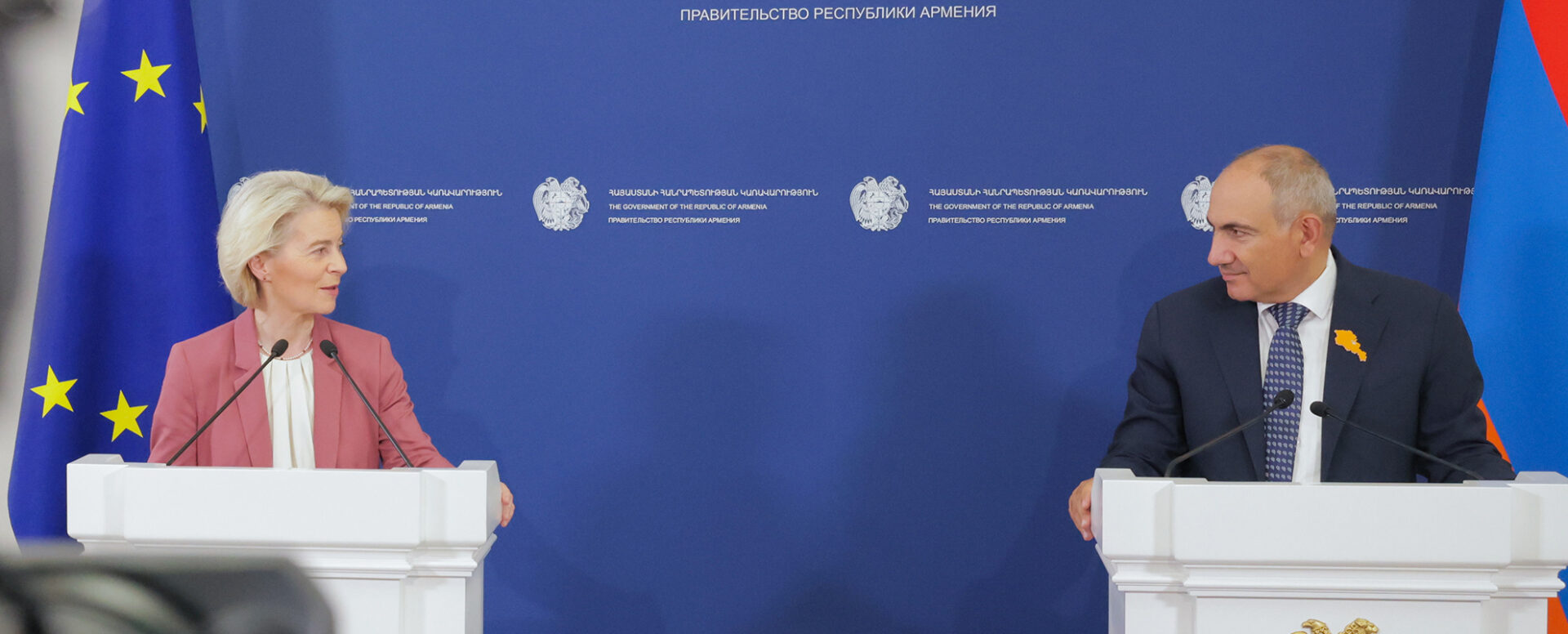
The EU’s Experiment in Russia’s Neighbourhood
Over the past year, Armenia has hosted more high-level European Union and United States delegations than any other country in the South Caucasus. These visits, from summits to working meetings and symbolic stops, have sent a consistent message: Armenia is looking for closer ties with Western partners and wants clearer support for this trajectory.
What is currently happening around Armenia is the first such experiment of its kind. It involves a post-Soviet country that has started expressing a desire to integrate with the European Union while still formally remaining part of Russia-led economic and security alliances. The European Union, affected by the war in Ukraine, prefers not to turn its back as it normally would in such situations. Instead, it is ready to explore how to support Armenia’s intentions, even if this means deepening relations without making any firm commitments.
But it still remains unclear whether this process can lead to a more structured path of integration, similar to Ukraine or Moldova. Much will certainly depend on how the EU’s internal processes can shape further enlargement, along with the ongoing geopolitical shifts. A major open question in the meantime is how to support Armenia’s resilience while it is still transitioning from Russian alliances towards closer relations with the West. The outcome will likely depend on wider developments in Europe and on Armenia’s own political choices.
Acceleration under Existential Threat
Armenia’s shift towards the European Union grew out of rising frustration with Russia. After the 2020 Nagorno-Karabakh war, Armenia was left with a weakened military and an economy that still suffered from the Covid-19 pandemic. As Azerbaijan regained control over much of the disputed territory in the conflict zone, the Armenian-Azerbaijani border became longer and turned into an active frontline. The 2021 parliamentary elections reduced domestic tensions, but the country remained exposed to renewed conflict.
In the immediate aftermath of the war, Armenia still relied on Russia as its main security partner, despite the country’s disappointment at Moscow’s refusal to intervene during the conflict in 2020. Russia remained Armenia’s key ally through its membership of the Collective Security Treaty Organization (CSTO). Russian peacekeepers were deployed to Nagorno-Karabakh in coordination with the Russian military base in the Armenian town of Gyumri, while Russian border guards took control of key sections of the border with Azerbaijan.
Expectations that Russia’s
increased presence would
bring stability faded quickly
Expectations that Russia’s increased presence would bring stability faded quickly. By spring 2021, Azerbaijani forces had advanced along the border, followed by renewed clashes in Nagorno-Karabakh later that year. Moscow expressed concern but did not change the situation on the ground. By the end of 2021, Armenia had already begun sensing that Russian involvement was not enough and accepted the European Union’s invitation to launch talks with Azerbaijan in Brussels. Russia’s invasion of Ukraine in February 2022 accelerated this shift, as Moscow’s focus moved away from the South Caucasus. Azerbaijan then took advantage of Russia’s distraction and launched a major incursion into Armenian territory in 2022, followed by the blockade and takeover of Nagorno-Karabakh a year later, which led to the exodus of the entire local Armenian population.
During this period, the European Union became Armenia’s most consistent external partner. After the 2020 war, Brussels launched assistance programmes in southern Armenia, which was most exposed to the new frontlines. Following renewed border incidents in 2022, the EU was quick to deploy a civilian observation mission – a step it had previously taken only in closely aligned partner countries. While small incidents have continued, the mission has helped prevent larger escalations and stabilized the situation. On top of that, the European Union started providing non-lethal support to Armenia, while some of its Member States supplied weapons and military equipment that could no longer be procured from Russia.
Expanding Bilateral Relations
In parallel with developments on the security front, Armenia and the European Union started expanding their bilateral agenda. Their relations are built on the Comprehensive and Enhanced Partnership Agreement (CEPA), signed almost a decade ago in a very different political context for both Armenia and Europe (Comprehensive and Enhanced Partnership Agreement between the European Union and Armenia n.d.). Replacing it was not a realistic option since the agreement required ratification by all EU Member States. Instead, in 2025 Armenia and the EU agreed on a new Strategic Agenda built around CEPA but also designed to formalize deeper cooperation and broaden its scope (Strategic Agenda for the EU-Armenia Partnership 2025).
A key European interest is the development of Armenia’s transport and connectivity potential (von der Leyen n.d.). This fits into the EU’s wider effort to strengthen transport links between Europe, the Middle East and Asia. In 2024, the EU launched a three-year programme worth €270 million to support economic development and critical infrastructure in Armenia. Even before that, it had supported loans for the construction of roads and tunnels aimed at improving internal connectivity. Looking ahead, the EU has also indicated readiness to support the upgrading of border crossings once Armenia’s borders with its neighbours open. Some EU officials have signalled interest in larger investments, including projects linked to Armenia-Türkiye normalization and the eventual opening of their border. All these efforts are seen as support for Armenia’s transition away from dependence on Russia and toward deeper relations with the EU.
For Armenia, this cooperation with the EU goes beyond economic development and transport links. In 2024, the National Assembly adopted a law expressing the country’s intention to pursue future EU membership. The step was largely symbolic but came after Prime Minister Nikol Pashinyan’s speech in the European Parliament in 2023, where he said Armenia would be ready to move further along the European path if the EU showed readiness to welcome the step (Pashinyan 2023). Since then, Armenia and the EU have advanced discussions on visa-free short-term travel for Armenian citizens. In 2026, the EU also deployed another civilian mission to Armenia to help address security challenges, including disinformation and hybrid threats, particularly in the context of electoral processes. These efforts contributed to Armenia’s desire to continue along the path toward closer relations with Europe.
Economic Chains
Armenia’s main vulnerability remains its economic and infrastructure dependence on Russia. The country continues to import Russian natural gas at discounted prices, while key infrastructure assets are still owned by Russian companies. Russia also remains Armenia’s largest trading partner. This role has grown further since Western sanctions on Russia redirected parts of regional trade through Armenia.
Reducing this dependence is a slow and difficult process. Over the past three years, Armenia, the European Union and the United States have discussed several cooperation plans aimed at diversification. One result has been US support for efforts to replace Armenia’s Russian-built and operated nuclear power plant, while the EU has increased funding for solar energy development. At the same time, Yerevan has begun reviewing the ownership of major companies held by Russian investors. In 2025, the Armenian government increased its stake in the country’s largest mining complex, which is also its biggest taxpayer, and took control of the electricity distribution network in Yerevan.
Russia also remains Armenia’s largest
trading partner. This role has grown further
since Western sanctions on Russia
redirected parts of regional trade through Armenia
Further progress in reducing Russia’s economic influence will likely depend on opening the border with Türkiye and launching direct trade. These steps have been delayed for years due to the lack of a final peace agreement with Azerbaijan. Several analysts have predicted significant economic growth if these ties normalize (Movchan, Giucci, and Haentschel 2022). Armenian officials have also suggested that future energy diversification could include purchasing gas from Azerbaijan if an agreement becomes possible.
Two Key Factors for Progress
Even if Armenia and the European Union manage to reduce the economic risks, two major factors will still shape the speed and depth of their future cooperation. The first is regional stability. Any new escalation between Armenia and Azerbaijan, not to mention another war, would likely freeze much of the planned cooperation with Brussels and discourage European investment. Renewed conflict in the South Caucasus could also strengthen security concerns inside the European Union and make some Member States more cautious about supporting closer political alignment with Armenia.
To avoid this scenario, Armenia has continued direct talks with Azerbaijan, leading to several agreements brokered by US President Donald Trump at the White House in August 2025. Since then, the border situation has remained relatively calm while regional cooperation has expanded. Armenia and the United States have started work on a transit route through southern Armenia linking Azerbaijan with Nakhichevan and Türkiye, while Azerbaijan opened parts of its railway infrastructure for Armenian transit trade, including access to the Kars-Akhalkalaki railway through Georgia and Türkiye. At the same time, Türkiye lifted restrictions on bilateral trade with Armenia and signalled readiness to restore direct transport links. The main unresolved issue remains a final peace agreement, which will likely require constitutional changes in Armenia and a public vote in the coming months. Armenian authorities have provided few public details, as the issue remains politically sensitive and highly polarizing.
If Tbilisi restores closer relations with Brussels,
Armenia’s integration efforts would no longer appear isolated,
but rather part of a broader strategic corridor connecting
Europe with the South Caucasus, Central Asia and the Middle East
The second factor is the European Union’s own political readiness to deepen relations with Armenia. So far, Brussels has shown clear interest in expanding cooperation. During the summit of the European Political Community in Yerevan in May 2026, the President of the European Council, Antonio Costa, said Armenia was “in the heart of Europe, which is exactly where it belongs”(Costa 2026). Yet it remains uncertain how far the EU and its Member States will be willing to go in the coming years, especially as attention remains focused on enlargement commitments already made to Ukraine and Moldova. The rise of far-right political movements in parts of Europe along with increased living costs and growing military spending could also make some governments less willing to consider new candidate states.
Geography remains another challenge. Armenia has no direct border with the EU and depends on access through Türkiye and the Black Sea region. In this context, Georgia’s possible return to the European path could significantly improve Armenia’s position. Since stepping away from the EU track during its domestic political crisis in 2024, Georgia has become a missing link in wider regional political plans. If Tbilisi restores closer relations with Brussels, Armenia’s integration efforts would no longer appear isolated, but rather part of a broader strategic corridor connecting Europe with the South Caucasus, Central Asia and the Middle East.
Bibliography:
“Comprehensive and Enhanced Partnership Agreement between the European Union and Armenia.” Delegation of the European Union to Armenia. www.eeas.europa.eu/delegations/armenia/comprehensive-enhanced-partnership-agreement-between-european-union-armenia-cepa_en?s=216 (26 May 2026).
Costa, António. 2026. “Opening Remarks by President António Costa at the Meeting of the European Political Community.” Consilium. www.consilium.europa.eu/en/press/press-releases/2026/05/04/opening-remarks-by-president-antonio-costa-at-the-meeting-of-the-european-political-community/ (26 May 2026).
Movchan, Veronika, Giucci, Ricardo, and Haentschel, Emily. 2022. Opening of Common Border between Armenia and Turkey: Impact on Armenian Trade. Berlin/Yerevan: German Economic Team. www.german-economic-team.com/wp-content/uploads/2022/06/GET_ARM_PB_07_2022.pdf.
Pashinyan, Nikol. 2023. “Prime Minister Nikol Pashinyan’s Speech at the European Parliament.” Prime Minister of the Republic of Armenia. www.primeminister.am/en/statements-and-messages/item/2023/10/17/Nikol-Pashinyan-Speech/ (26 May 2026).
“Strategic Agenda for the EU-Armenia Partnership.” 2025. https://enlargement.ec.europa.eu/news/european-union-and-armenia-adopt-new-strategic-agenda-deepen-partnership-2025-12-02_en.
Von der Leyen, Ursula. “Opening Statement by the President at the First EU-Armenia Summit.” European Commission. https://ec.europa.eu/commission/presscorner/detail/en/statement_26_989 (26 May 2026).
Header Photo: On July 2, 2026, Ursula von der Leyen, President of the European Commission, traveled to Yerevan, Armenia. Source: EC – Audiovisual Service. Photographer: Dati Bendo. © European Union , 2026