


Energy Strategy in the Pact for the Mediterranean in the Context of EU Energy Policy Since the Start of the War in Ukraine
Thirty years after the launch of the Barcelona Process, the new Pact for the Mediterranean (2025) has emerged as an attempt to breathe new life into weakened Euro-Mediterranean relations, incorporating a renewed energy agenda in a profoundly transformed geopolitical context. Within this framework, energy takes on particular prominence, especially within the economic pillar, which brings together a wide range of initiatives aimed at promoting renewable energy, grids and industrial integration in decarbonized value chains. However, beyond their formal importance within the Pact’s design, these proposals cannot be analysed in isolation. As this article will argue, they must be interpreted in the light of a broader shift in how the European Union’s energy relations are conceived, shaped by the new strategic environment that has arisen in the wake of Russia’s 2022 invasion of Ukraine. This context has reconfigured European priorities in matters of energy security, supply diversification and the green transition, whilst also conditioning its approach to its Mediterranean partners. Thus, the rekindled emphasis on renewables and regional economic integration reflects not only a renewal of Euro-Mediterranean cooperation, but also the adaptation of the EU’s external energy policy to the new dynamics of competition, interdependence and decarbonization that characterize the current international system. This may be why this initiative has been described as “an exercise in DIY Euro-Mediterranean energy policy” (Escribano, 2025).[1]
In short, this makeshift approach is an attempt to patch together the latest trends in Europe’s energy proposals for the region. This attempt is being undertaken in the spirit of the Barcelona Process to create a common area of peace and prosperity, following the Union for the Mediterranean’s characteristic “project-based” logic and using a set of tools and a typology more typical of the new direction embarked upon in response to the war in Ukraine (see Table 1).
TABLE 1 Comparative Evolution of European Union Energy Policy in the Mediterranean
| Political rationale | Energy instruments | Flagship project types | |
| Renewed Mediterranean Policy (1989) | Economic cooperation. The Mediterranean is not conceived of as an energy area | No specific energy instruments | Basic energy infrastructure (implicit) |
| Barcelona Process (1995) | Regional regulatory integration. Institutionalization of the energy vector, subordinated to economic integration | Energy sector dialogue | Electricity interconnections, gas cooperation (Algeria), Euro-Med energy forums |
| Union for the Mediterranean (2008) | Project-based cooperation. Switch to regional energy project policy | Energy/climate platforms | DESERTEC, Medgrid, Mediterranean Solar Plan |
| Post-Ukraine (2022) | Geopolitical and energy security outlook, linked to a decarbonization policy | Hydrogen infrastructure, renewables, grids | H2 energy corridors, electricity interconnections, energy partnerships |
The stated energy goal of the Pact for the Mediterranean is to set a common agenda capable of unlocking the southern Mediterranean’s renewable energy potential, thereby accelerating decarbonization, improving energy security and enhancing industrial competitiveness across the entire Euro-Mediterranean region. It thus seeks to foster socio-economic development and attract foreign investment to the southern shore.
As Escribano (2025) explains, the main initiative is the creation of the T-MED Investment Platform, conceived as a coordination tool to develop a pipeline of projects linked to renewable energy generation and low-carbon hydrogen production. It additionally aims to advance energy integration through both trans-Mediterranean and national networks associated with Projects of Mutual Interest (PMIs), as well as promote the development of clean technologies. PMIs include energy infrastructure projects for the transport of electricity, hydrogen and carbon dioxide that the European Union considers strategic and that are developed in collaboration with third countries. Hence, on paper, the initiative aims “to create mutual benefits – from producing clean energy, to unlocking private investment.”[2]
However, the Pact’s proposals do not exist in a vacuum, as the context of the European Union’s energy initiatives and those of its Member States cannot be separated from a new security logic that has permeated all proposals since 2022.
What is presented as an energy transition is actually
a “defensive” strategy whose primary objective
is not to transform the energy model, but
to reduce dependence on Russian fossil fuels
To better understand what is meant by this logic and how it affects the Mediterranean, it is worth examining how the region features in the main energy initiatives, namely, those undertaken by Europe in response to the Ukraine war. An analysis of the three main initiatives – REPowerEU,[3] EU External Energy Engagement in a Changing World[4] and the European Critical Raw Materials Act[5] – shows that, together with decarbonization (with a significant emphasis on nuclear energy and carbon-capture technologies), the core rationale driving their proposals is security against Russia and other actors. Thus, what is presented as an energy transition is actually a “defensive” strategy, which, in Charbonnier’s (2022) terminology, would be a “peaceful weapon”: measures defined “in response to,” whose primary objective is not to transform the energy model, but to reduce dependence on Russian fossil fuels.
In this context, the proposals targeting the Mediterranean cannot be analysed in isolation from this ultimate goal. Nor should they be analysed without taking into account the (prior) adoption of the EU Taxonomy in 2020, which, although not explicitly focused on the Mediterranean, does lay down the conditions for funding energy projects in North Africa, which, in any case, must be compliant with EU standards.
CHART 1 Summary of Types of Measures Proposed for the Mediterranean as Part of the Measures Adopted Following the Start of the War in Ukraine
| REPowerEU Plan (2022) |
| Diversification of the gas supply via the Mediterranean (Algeria for natural gas; Egypt and Israel for liquefied natural gas (LNG)) Promotion of South-North energy corridors (green hydrogen from North Africa to the EU) Electricity and gas interconnections (to Spain, Italy and Greece) |
| EU External Energy Engagement (2022) |
| Energy partnerships with southern Mediterranean countries (Morocco: renewables and electricity; Algeria: gas; Egypt: hydrogen and gas)Team Europe energy transition initiatives (transition funding and support for energy infrastructure)Reinforced energy diplomacy (EU coordination with Member States and market integration)Hydrogen: global marketplace development with production in North Africa |
| CRMA – Critical Raw Materials Act (2024) |
| Identification of Mediterranean countries as strategic partners for critical minerals (e.g. Morocco for phosphates)Partnerships for extraction, processing and recycling (e.g. Morocco for batteries and refining)Import diversification |
Source: The author
To assess the scope of these proposals, they must be analysed in the context of the goals set out in the documents in which they were formulated. All three documents from Chart 1 share two fundamental points: the European Union’s geopolitical positioning and a new definition of what is meant by energy security.
The European Geopolitical Vision and Its Impact on Mediterranean Energy Strategy
Since 2022, the European Union’s energy and raw materials policy has taken a distinctly geopolitical turn. Initiatives such as REPowerEU, the EU External Energy Engagement Strategy and the Critical Raw Materials Act respond, firstly, to the desire to phase out energy imports from Russia and the need to redefine Europe’s position in an international system shaped by competition from China in the fields of renewables and global energy infrastructure and the perception of growing Chinese influence in North Africa. Against this backdrop, the reconfiguration of dependencies – especially with regard to Russia and China – has once again been accompanied by a strategic reassessment of the Mediterranean region.
This is the context in which the proposals summarized in Chart 1 have been put forward. It can be inferred from them that the Mediterranean is being (re)configured as a nearshoring hub for energy. The EU tends to prioritize nearby supply sources, such as North Africa, that allow it to reduce logistical risks, increase security of supply and, above all, step up its ability to influence production, transport and regulatory conditions. Projects such as the Euro-Mediterranean green hydrogen corridors and the European target of importing up to 10 million tonnes of renewable hydrogen by 2030 illustrate this logic of energy regionalization. This is compounded by the significant investment planned for North Africa, where countries such as Morocco and Egypt account for nearly 80% of African hydrogen projects.
What sets this strategy apart from earlier ones (the first three rows from Table 1) is that this nearshoring is part of a broader geopolitical vision linked to the European Union’s push for strategic autonomy. The EU External Energy Engagement Strategy is a direct result of this. From this perspective, the Mediterranean emerges as an ideal area. Geographical proximity, economic asymmetry and the Europe Union’s regulatory clout make it possible to forge relationships that enable Europe not only to secure its resource supply, but also set the rules, standards and institutional frameworks.
Security ceases to be a purely
internal goal to become a guiding
principle of the Union’s external action
At the same, in all three of the analysed documents, this strategy includes a clearly competitive dimension vis-à-vis China. Growing European involvement in Africa, including commitments of over 15.5 billion euros to renewable energy and electrification projects, reflects an attempt to counter Chinese influence in energy infrastructure and funding. In this context, the Mediterranean and North Africa act as testing grounds for alternative geoeconomic models: in contrast to the Chinese approach, focused on infrastructure and massive funding, the EU declares that it will promote partnerships based on sustainability.
This logic also encompasses the field of critical raw materials. Structural dependence on China, which accounts for as much as 90% of global refining of certain minerals and dominates broad segments of the value chain, has been identified as a strategic vulnerability. In response, the European Union is promoting a diversification strategy that includes the development of partnerships with African and Mediterranean countries, integrating these territories into new, more resilient supply chains.
Overall, the geopolitical shift in European energy policy reveals that the process of decoupling from Russia has given rise to a series of proposals in which the Mediterranean emerges as an energy nearshoring hub that would allow the EU not only to replace energy flows, but also to redefine its role in the international system, an issue that has become even more pressing since early 2025, due to the turbulent political winds and the increasingly mercantilist logic of the Trump administration.
A New Conception of Energy Security
Not unrelated to the aforementioned geopolitical positioning, one of the most salient aspects of the analysed documents is the reformulation of the concept of energy security and, consequently, of the Mediterranean region’s potential role in it.
Most obviously, in these documents, the “traditional” concept of security of supply, referring to imported fossil fuels, has been replaced by a concept of security focused on access to renewable sources, the design of electricity grids and hydrogen infrastructure, all of which, as will be seen, is moreover part of a security policy defined in each document.
Under the REPowerEU Plan, the European Union redefines the concept of energy security, moving away from a vision focused exclusively on access to resources in order to adopt a broader approach combining resilience, diversification and strategic autonomy. This new vision emerges in a context of systemic crisis set off by Russia’s invasion of Ukraine, which has laid bare the inherent vulnerability of “traditional” energy dependencies, understood as the result of a conflict of interests between exporting and importing territories.
In this regard, energy security is conceived, firstly, as resilience, understood as the European energy system’s ability to absorb external shocks in a way that does not compromise its operation. Secondly, it is based on the diversification of sources, routes and suppliers, with the aim of preventing critical dependencies on a single actor. Finally, it is closely linked to strategic autonomy, that is, the EU’s ability to guarantee its energy supply under conditions compatible with its own political and economic interests.
This redefinition is accompanied by the aforementioned explicit logic of urgency and the need to decouple from Russia, viewed as a geopolitically unreliable supplier.
At the same time, energy security continues to be functionally conceived as the guarantee of continuity of supply and price stability, both of which are essential to the functioning of the European economy. However, unlike in previous approaches, these goals have now been integrated into a broader framework that assigns a central role to the geopolitical dimension. Thus, securing energy entails not only securing access to resources, but also doing so under conditions that strengthen the system’s adaptive capabilities, reduce strategic dependencies and firmly establish the Union’s position in the new international context.
In keeping with this revised definition of energy security, the EU External Energy Engagement Strategy (2022) even further broadens the concept, explicitly integrating energy, climate and geopolitical dimensions into a single analytical framework. As a result, security is no longer understood solely in terms of supply but rather is replaced by a broader definition, in which the energy transition, climate action and international stability are regarded as mutually dependent. This approach reflects the growing interrelationship between the climate agenda, including decarbonization and the roll-out of renewables, and the Union’s goals for its own strategic positioning within the international system.
In contrast to REPowerEU, in which the pressing need to decouple from Russia is key, the external dimension introduces a cooperative security logic, whereby the stability of partner regions is understood as a prerequisite for Europe’s own security. Accordingly, the EU organizes its external energy action through partnerships that simultaneously seek to guarantee supply and promote political, economic and regulatory stability in third countries. This logic is particularly apparent in the Mediterranean and Africa, where investment in energy infrastructure, renewables and hydrogen reflects not only supply needs, but also regional stabilization goals in the face of dynamics perceived as potentially disruptive. In this context, the “reliable partners” narrative, which would once again include the Mediterranean countries, takes on new importance.
Overall, the EU External Energy Engagement Strategy complements and deepens the logic first launched under REPowerEU: whilst the latter redefines security in terms of resilience, diversification and strategic autonomy, the external dimension extends this framework to include a broader conception whereby Europe’s energy security also depends on its ability to establish stable regional environments, forge selective partnerships and project its influence in key areas, such as the Mediterranean.
Thus, security ceases to be a purely internal goal to become a guiding principle of the Union’s external action in the new geopolitical context. This transformation is on particularly clear display in the Mediterranean, where the EU is not only seeking to secure energy supplies, but also to actively shape its regional environment through concrete initiatives.
One important example is the push for Euro-Mediterranean green hydrogen corridors, conceived of not only as instruments for energy diversification, but also as mechanisms for functional integration with North Africa. Projects such as the SoutH2 Corridor, intended to transport hydrogen from North Africa to European industrial hubs, seek to meet objectives related to both security of supply and the geoeconomic organization of the Mediterranean region.
This logic is further reinforced by the investment initiatives in African renewable energy undertaken as part of the Global Gateway strategy. The funding packages, which total over 15.5 billion euros, aim not only to expand the available energy supply, but also to solidify the European Union’s sphere of influence. All together, this suggests that, in the Mediterranean, European energy security takes the form of infrastructure, funding and partnerships, with a view to shaping a regional space in which the EU not only gains access to resources, but also aspires to set the rules and consolidate its sphere of influence.
Along the same lines, the Critical Raw Materials Act (CRMA) introduces a complementary dimension focused on economic and technological security, broadening the scope of the concept of security to include industrial value chains. In this context, the security of supply of critical raw materials is redefined as an essential element of European industrial sovereignty, as it directly impacts strategic sectors such as renewable energy, electric mobility or digital technology. Unlike the more reactive approach taken by the REPowerEU plan, the CRMA embraces a “de-risking” logic, geared towards not so much complete decoupling – which is not feasible in the short term – as the selective reduction of excessive dependencies, especially with regard to China, which accounts for between 60% and 90% of the global processing of several critical minerals.
This approach is closely linked to the aforementioned logic of strategic autonomy: the EU is not seeking self-sufficiency, but rather the capacity to manage interdependencies under favourable conditions. To this end, the CRMA shores up and deepens the external projection already present in the REPowerEU Plan and the EU External Energy Engagement Strategy, extending the geopolitical dimension to the material supply chains underpinning the energy transition.
The Mediterranean once again plays a pivotal role in this reconfiguration. In keeping with the logic of energy nearshoring, the EU is cultivating partnerships with countries in North Africa and its surroundings not only for energy production, but also as potential nodes in the value chains for critical materials and associated technologies. At the same time, the de-risking logic can be seen in concrete diversification targets intended to limit dependence on a single supplier.
In this context, security ceases to refer solely to energy supply to encompass the EU’s capabilities to control or influence key links in the value chains. The initiatives in the Mediterranean – from investment in energy infrastructure to the organization of industrial partnerships – exemplify how European policy transfers its concept of economic security to the external sphere. Thus, as in the case of energy, the CRMA helps to consolidate a model in which external action is organized around the strategic management of interdependencies, using the Mediterranean region as a key vector to boost resilience, reduce risks and project power in the new geopolitical context.
The projects that best illustrate this geopolitical shift in Europe’s energy policy are the Euro-Mediterranean hydrogen corridors. In particular, the SoutH2 Corridor[6] project has emerged as the strategy’s flagship project, insofar as it combines the goals of energy security, strategic autonomy and geopolitical influence in the Mediterranean region.
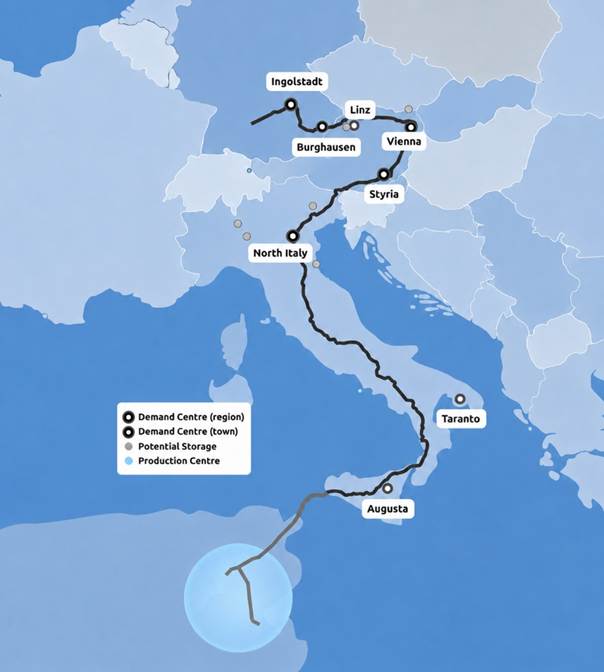
The SoutH2 Corridor, backed in 2025 under multilateral agreements between Member States and their Mediterranean partners, provides for the construction and adaptation of some 3,300 to 4,000 kilometres of infrastructure connecting North Africa (mainly Algeria and Tunisia) with Central Europe (through Italy, Austria and Germany). With an estimated capacity of around 4 million tonnes of hydrogen per year, it is key to reaching Europe’s target of importing up to 10 million tonnes of renewable hydrogen by 2030, as established in the REPowerEU plan and its associated strategies.
One of the most important aspects from a security perspective is that the project largely relies on the reuse of existing gas infrastructure, which could be interpreted as part of a logic of controlled regional integration, whereby the EU not only diversifies its suppliers, but also reorganizes energy flows in areas in which it can exert greater influence.
From a geopolitical vantage point, the corridor is part of the Global Gateway initiative, which reinforces its external dimension. From this perspective, it is not only an energy infrastructure project, but also a foreign policy instrument aimed at solidifying relations with North Africa under the logic of “reliable partners.” In this regard, the SoutH2 Corridor reflects the idea that the stability and development of neighbouring regions are necessary conditions for European energy security.
It is believed that the Euro-Mediterranean
corridors will make it possible to reduce
exposure to global bottlenecks and
dynamics dominated by third parties
This project is moreover part of a broader vision organized around the concept of the European Hydrogen Backbone,[7] which provides for the development of a European hydrogen grid based on both the conversion of existing gas pipelines and the construction of new infrastructure, including offshore and onshore connections. This networked approach directly reflects the logic of resilience and diversification that informs the new security paradigm: it is not a matter of replacing one dependency with another, but rather of building a meshed system that minimizes risks and enables flexibility in the face of external shocks.
From the perspective of open strategic autonomy, these corridors show how the EU seeks to maintain interdependencies, only under favourable structured and asymmetric conditions. Unlike the dependence on Russian gas, based on a relatively rigid relationship, the development of infrastructure such as the SoutH2 Corridor would enable the EU to actively shape the rules of exchange, from regulatory standards to funding and governance mechanisms.
The project also has direct implications for economic and technological security as defined under the Critical Raw Materials Act. Green hydrogen is emerging as a core vector for the decarbonization of strategic industrial sectors, which makes guaranteeing its stable supply a key aspect of industrial sovereignty. In this context, it is believed that the Euro-Mediterranean corridors will make it possible to reduce exposure to global bottlenecks and dynamics dominated by third parties, aligning them with the de-risking logic, which consists of diversifying without entirely breaking off global interdependencies.
On the whole, the SoutH2 Corridor and associated projects within the European Hydrogen Backbone exemplify the territorial materialization of the EU’s new concept of security. At this point, it is worth asking whether a project such as the SoutH2 Corridor is suited to this new scenario. To this end, as Regueiro-Ferreira and Doldán-García (2020) propose, we will now submit the case to certain elements of Domhoff’s (2013) power analysis.
Architecture of Power and Governance in the SoutH2 Corridor
The first thing this analysis reveals is the existence of a dominant elite comprised of major energy corporations, pivotal European states and EU institutions. The core decision-makers consist of gas transport companies (such as Snam, TAG or BayerNet) and the governments of certain key countries (especially, Italy and Germany), which are promoting the project as part of the energy security strategy and European industrial policy. This bloc fits Domhoff’s concept of a corporate-political coalition that defines strategic priorities and translates them into concrete infrastructure, relying on the EU’s institutional apparatus to ensure funding, favourable regulations and legitimacy.
Within this framework, Tunisia and Algeria occupy a clearly subordinate yet strategic position that is aligned with the classic logic of producing countries found in previous energy models. Their state-owned companies – most notably, Sonatrach in Algeria and ETAP/STEG in Tunisia – are integrated into the project as suppliers of resources and productive space, but not as actors that define the corridor’s governance. This replicates a pattern of peripheral integration whereby they contribute land, renewable resources and hydrogen production potential, whilst the key decisions (infrastructure, routes, standards, funding) are taken by the European core. Thus, their role is primarily structured through bilateral agreements, energy partnerships and cooperation mechanisms driven by the EU, rather than through an equitable participation in decision-taking. From this point of view, this initiative seems unlikely to contribute to the development of the Southern region or, therefore, to contribute positively to European security, through greater regional stability, as the EU had hoped.
Tunisia and Algeria occupy a clearly
subordinate yet strategic position that is
aligned with the classic logic of producing
countries found in previous energy models
This may well be why, in March 2025, the Transnational Institute released a statement entitled “We say no to the South H2 Corridor.” The main grounds for their opposition is their consideration of the project to be neocolonial and extractivist, due to its use of North African resources to supply Europe without yielding local benefits. In fact, for some time now, export-oriented macro-projects such as the SoutH2 Corridor have been widely criticized for reproducing neocolonial and extractivist dynamics due to being based on the transfer of resources from North Africa to Europe without guaranteeing equitable benefits at the local level (Hamouchene and Sandel, 2023). In keeping with what Amory B. Lovins (1976) called the “hardpath,” these types of initiatives would be conducive to a centralized, capital-intensive energy model controlled by large corporate actors, attempting to replicate the forms of capture, transport and control found in the fossil fuel system in the renewables sector. In this regard, rather than providing a clean break, the hydrogen corridor economy would tend to reinforce the lock-ins of fossil capitalism, allowing major energy companies to leverage their existing gas infrastructure, capture new markets and maintain their dynamics of accumulation (Szabo, 2021).
MAP 1. SoutH2 Corridor
Beyond that, an analysis of the project’s investors reveals other important aspects that point to conclusions in addition to those that can be drawn from applying a centre-periphery approach to the project.
Although it is not the most important aspect in the case of the SoutH2 Corridor, an increasingly large presence of fossil fuel and global finance capital can be found in other hydrogen projects in the region. In the present case study, whilst it does not make up the dominant core – in which Central European industrial policy and Italian energy capital continue to prevail – the presence of sovereign wealth funds and international private capital, in particular from the Gulf, introduces a new layer of financial power that could influence the project’s development. Funds such as Saudi Arabia’s Public Investment Fund (PIF), the Abu Dhabi Investment Authority (ADIA) or Mubadala Investment Company have increased their stakes in European energy assets and transition infrastructure, including grids, hydrogen and renewables, seeking to position themselves in future energy value chains.
Rather than providing a clean break,
the hydrogen corridor economy would
tend to reinforce the lock-ins of fossil capitalism
This capital not only provides funding, but also introduces logics typical of the Gulf’s fossil fuel financial capital (marking the energy transition strategy? seeking legitimacy under a discourse of environmental and sustainable governance?) or global private financial capital, oriented towards profitability and long-term asset management, which can strain the stated objectives of a fair transition or local development. In Domhoff’s terms, these actors would expand the economic elite to include a transnational dimension, reinforcing the weight of fossil fuel financial capital in decision-making.
The inclusion of these investors, which does not appear to be targeted at reducing dependence and the prevailing colonial extractivist model, therefore also poses a key challenge for the European Union: how to structure regulatory and governance frameworks that integrate this capital without losing strategic autonomy or renouncing its aspirations to set the rules and solidify its sphere of influence?
References
Charbonnier, P. Écologie de guerre : un nouveau paradigme. Groupe d’Études Géopolitiques, 2022.
Domhoff, G. W. Who Rules America? The Triumph of the Corporate Rich (7th ed.). McGraw‑Hill, 2013.
Escribano, G. La energía en el nuevo Pacto por el Mediterráneo: renovación, perspectivas y omisiones. Real Instituto Elcano, 2025. Available at: www.realinstitutoelcano.org/analisis/la-energia-en-el-nuevo-pacto-por-el-mediterraneo-renovacion-perspectivas-y-omisiones/
European Commission. REPowerEU Plan. 2022a. https://commission.europa.eu/topics/energy/repowereu_en
European Commission. EU External Energy Engagement in a Changing World. 2022b. https://eur-lex.europa.eu/legal-content/EN/TXT/?uri=CELEX:52022JC0023
European Commission. Critical Raw Materials Act. 2024. https://commission.europa.eu/strategy-and-policy/priorities-2019-2024/european-green-deal/green-deal-industrial-plan/european-critical-raw-materials-act_en
European Commission. Pact for the Mediterranean – One Sea, One Pact, One Future – a shared ambition for the region. 2025a. https://north-africa-middle-east-gulf.ec.europa.eu/news/pact-mediterranean-one-sea-one-pact-one-future-shared-ambition-region-2025-10-16_en.
European Commission. Southern Hydrogen Corridor (SoutH2 Corridor). 2025b. https://international-partnerships.ec.europa.eu/policies/global-gateway/southern-hydrogen-corridor-connecting-north-africa-italy-austria-and-germany_en
European Hydrogen Backbone (EHB). https://ehb.eu/
Hamouchene, H., and Sandwell, K. Dismantling Green Colonialism: Energy and Climate Justice in the Arab Region. Pluto Press, 2023.
Lovins, A. B. “Energy strategy: The road not taken?” Foreign Affairs, October 1976. Available at: www.foreignaffairs.com/united-states/energy-strategy-road-not-taken-amory-lovins.
Mañé‑Estrada, A. “Renewables geopolitics: Toward a new generation of energy conflicts?” Peace Review, Vol. 35, No. 4, p. 562-573, 2023. DOI: 10.1080/10402659.2023.2270476.
Regueiro-Ferreira, R. M., and Doldán-García, X. R. “The Network of Dominant Owners of Wind Development in Galicia (Spain) (1995–2017): An Approach Using Power Structure Analysis.” Energies, Vol. 13, No. 22, p. 6080, 2020. https://doi.org/10.3390/en13226080.
Szabo, J. “Fossil Capitalism’s Lock-ins: The Natural Gas-Hydrogen Nexus.” Capitalism Nature Socialism, Vol. 32, No. 4, p. 91–110, 2021. https://doi.org/10.1080/10455752.2020.1843186.
Transnational Institute. We say no to the South H2 Corridor. 2025. www.tni.org/en/article/we-say-no-to-the-south-h2-corridor.
[1] www.realinstitutoelcano.org/analisis/la-energia-en-el-nuevo-pacto-por-el-mediterraneo-renovacion-perspectivas-y-omisiones/.
[2] European Commission (2025a), Pact for the Mediterranean.
[3] European Commission (2022a), REPowerEU.
[4] European Commission (2022b), EU External Energy Engagement
[5] European Commission (2024), Critical Raw Materials Act.
[6] European Commission (2025b), Southern Hydrogen Corridor.
[7] European Hydrogen Backbone (n.d.). https://ehb.eu/.