



By April 2026, the conflict between the Sudanese army and the Rapid Support Forces (RSF) was entering its fourth year with no end in sight. Having moved beyond the initial phase in which both sides sought to extend their control across the entire territory – or at least over key strategic points such as the capital, Khartoum, or the most important land routes –, they are now focussing on securing control of their respective core regions. The RSF appears to have realised the futility of its initial efforts to subdue the central provinces and secure a solid bridgehead on the Red Sea. Following the “strategic” withdrawal from Khartoum and its surroundings in 2025, it has been concentrating its attacks on the vast regions of Kordofan and Darfur in the western half of the country. There, particularly in the latter area – the birthplace of the paramilitary militias that gave rise to the group – it aspires to establish its own stronghold from which to launch a renewed offensive towards the east or, should the conflict reach a stalemate with no decisive outcome for either side, to establish an autonomous political entity. To this end, it currently has direct access to neighbouring states Chad and Libya, which have shown themselves to be sympathetic to its cause. The Chad government had closed its nearly 900-kilometre border with Sudan in late February 2026, claiming that it did not wish to interfere in “a domestic matter.” However, numerous journalistic and intelligence reports suggest that N’Djamena has been providing military and logistic support to the RSF contingents, in retaliation, amongst other reasons, for the alleged collusion of the military in Khartoum with armed rebel factions, primarily the Zaghawa community. The involvement of eastern Libya, a country de facto divided into two semi-autonomous entities based in Tripoli and Benghazi, has been more evident, despite denials from its leaders, as well as those of Chad and other neighbouring governments. General Khalifa Haftar, based in Cyrenaica, maintains a direct supply line for logistic support and weapons with the RSF and a number of opposition militias, such as the Sudan People’s Liberation Movement–North. The army, for its part, held certain strategically important towns in the so-called Northern and Southern Kordofan regions (in the country’s centre-west), where it nevertheless continues to suffer significant setbacks, although it has managed to restore some semblance of stability in Khartoum and is advancing in the south-eastern regions of Sennar and Blue Nile. Its main objective now appears to be focused on resuming economic activity in the ports and major cities of the east, where the bulk of Sudan’s export production and processing is concentrated, and, of course, on controlling access to the Nile River, Sudan’s vital artery. The hostilities have reached such a level of ferocity – exacerbated by the constant interference of regional and international powers – that few now recall the origins of this merciless war, which stems, first and foremost, from the egos of the two main figures involved. General Abdel Fattah Burhan, Chief of Staff, faces off against his not-so-long-ago partner and comrade-in-arms, Mohamed Hamdan Dagalo, known as “Hemedti”, leader of the RSF. As allies, in 2021 they orchestrated what they termed a “necessary action” to oust the civilian government established after the fall of the dictator Omar al-Bashir in 2019. This was nothing new in Sudan’s history, rife with military coups; what was unusual in this case was that power was to be shared by Burhan and Dagalo, who, despite seeing eye to eye with Burhan on a number of shared interests, proved reluctant to integrate his paramilitary forces into the regular army. Disagreements over this issue and, more generally, over the respective spheres of authority of the two men, led to Dagalo’s sudden and unexpected attack on military detachments in Khartoum and elsewhere in the country in 2023. The rest is part of the familiar tale of horror and suffering on a continent torn apart by the partisan disputes of elites indifferent to the priorities of their citizens.
The hostilities have reached such a level of ferocity
that few now recall the origins of this merciless war,
which stems, first and foremost, from the egos
of the two main figures involved
As can be imagined, it is the general population that is paying the heaviest price for this fratricidal conflict. A United Nations report marking the third anniversary of the war indicated that 60% of the total population – estimated at 50.5 million – was at risk of extreme poverty and in urgent need of humanitarian aid. Estimates – always unreliable in this type of conflict where humanitarian organizations cannot operate on the ground due to obstruction by the warring factions – point to 14 million displaced people, both within and outside the country, with an approximate death toll of 400,000 in the first three years of the war. Neighbouring countries such as Chad are already hosting one million refugees, with similar or higher figures in Egypt and South Sudan, in addition to those attempting to flee to Europe via the dangerous Libyan route – some sources report that some 15,000 Sudanese managed to reach Europe via North Africa during 2025. In the meantime, the national economy has suffered a 30-year setback and the country needs millions in investment to guarantee food security for the majority of the population. Both sides, particularly the RSF, have been accused of war crimes, including indiscriminate bombing of civilian areas, markets and refugee camps. One such camp, Zamzam in North Darfur province, together with the neighbouring Abu Shouk camp, has been subjected to systematic attacks as the RSF’s offensives intensify in their attempt to seize the last remaining government strongholds in the Darfur region. Here, the capture of the city of El Fasher by armed groups opposed to Khartoum triggered a mass exodus of the population in late 2025, accompanied by harrowing videos and images reflecting the scale of the crimes committed against civilians, including the looting and destruction of hospitals. The fact that both the army and the militias fighting it have opted for the indiscriminate use of drones to hound their rivals, who are often stationed in relatively densely populated areas, has caused an exponential rise in the number of civilian casualties, particularly among children. This is compounded by the minefields, which have multiplied exponentially in the disputed areas, as well as the tens of thousands of unexploded ordnance and bombs scattered across a large part of the country, particularly in cities that have suffered prolonged sieges and relentless bombardment, such as the aforementioned El Fasher, which was besieged by the RSF for some 500 days. Another factor explaining the rising civilian death toll lies in the tendency of both sides to launch terror campaigns in areas controlled by the enemy, with the aim of forcing mass displacement – either to hamper the defenders’ ability to move or encourage outbreaks of internal rebellion. There are also the unfortunately well-documented punitive operations against civilians accused of colluding with the enemy or, quite simply, of not having offered sufficient resistance. These punitive measures include the mass rape of women and girls, the forced recruitment of minors, the abduction of wives and children to force combatants to surrender, and, of course, the scorched-earth policy. As is often the case in this type of conflict, women and children bear the brunt of the punishment.
A United Nations report marking the third anniversary
of the war indicated that 60% of the total population
– estimated at 50.5 million – was at risk of extreme
poverty and in urgent need of humanitarian aid
In the face of this crisis – the most serious on the planet – the international community’s response must be described as insufficient, if not merely token. On certain occasions linked to this horrific human calamity, such as the aforementioned third anniversary of the “Sudanese tragedy”, some governments and international organizations hold high-profile conferences to assess the situation and, as the case may be, provide assistance to the population. At the most recent conference, held in Berlin in mid-April 2026, some $1.5 billion were pledged, half of which came from the European Union. Delegates from the main European states participated in the deliberations, with Germany, Great Britain, France and Spain leading the way, alongside the EU and the African Union as regional bodies, some fifty Sudanese non-governmental organizations, and the United States, whose involvement can be described as modest.
According to the organisers, the funds were to be used to meet the basic needs of millions of people, through measures to restore drinking water supplies, rebuild schools and medical centres, and maintain hygiene and public health – the accumulation of rubbish and waste, posing a risk of highly contagious diseases, has become a constant feature in many places. However, it is reasonable to assume that this third international humanitarian summit on Sudan will suffer the same fate as its predecessors in Paris and London because, beyond making grand proclamations about the “need” to help, no concrete mechanisms have been put in place to ensure the proper distribution of the agreed aid and the administration of the funds. On numerous occasions, it is factions aligned with one of the warring sides that control the distribution of aid; and this aid, when it does arrive, ends up being diverted for the personal gain of the militias or the military establishment, which are eager to secure the population’s support. The Sudanese government complained that it had been excluded from the sessions, in which the RSF also did not participate, and accused the organizers of being “neo-colonialists”. Donors have ample reason to mistrust both Burhan’s and Dagalo’s supporters; however, without effective mechanisms or neutral bodies on the ground to assist civilians, it is virtually impossible to ensure the fair and effective distribution of humanitarian aid. Previous initiatives, such as the Jeddah Platform, launched in 2023 by the Saudis and the Americans with the backing of the African Union and the Intergovernmental Authority on Development (IGAD), have also failed to yield tangible results despite having been initially accepted by the warring factions.
Moreover, this is not simply another dispute between rival power blocs, but a regional crisis affecting states and international organizations that claim to be seeking viable solutions to bring it to an end. The case of the so-called Quad, the quartet comprising Egypt, the United States, Saudi Arabia and the United Arab Emirates, is significant. On several occasions, it has called for a humanitarian truce and direct talks between the warring sides, without much success so far. Among other reasons, this is because its members are supporting one of the sides, to varying degrees depending on the case. The UAE, despite denials from Abu Dhabi, is supplying arms and funding to the RSF, whilst Egypt is collaborating with the Sudanese army and Saudi Arabia has also recently leaned towards the latter, given its well-known reservations about the Muslim Brotherhood, whom Riyadh blames for the “radicalization” of certain military commanders in Khartoum. Washington, for its part, views this game of thrones among its regional allies with obvious apprehension and is wary of taking sides. In the wake of the El Fasher massacre, the Trump administration threatened in early 2026 to impose an arms embargo on the RSF, after contacting with the G7 countries and facing pressure from Egypt and Saudi Arabia, which support the Sudanese army. The latter had on several occasions accused the UAE, with a harshness exceptional by the standards of traditional Arab diplomacy, of attempting to provoke a territorial split in Sudan and the destabilisation of the region as a whole. The US president himself stated that he would become personally involved in the Sudanese issue. Such involvement, if it has indeed taken place, has not served much purpose. On the contrary, the Sudanese conflict is beginning to become chronic, despite, or perhaps because of, the manoeuvring of African and Middle Eastern regional powers.
This is not simply another dispute between
rival power blocs, but a regional crisis affecting
states and international organizations that claim
to be seeking viable solutions to bring it to an end
To complicate matters, in addition to the aforementioned cases of Chad and eastern Libya, which are sympathetic to the RSF, Ethiopia also appears to have sided with the RSF, given its tensions with Egypt and the Sudanese army over the Nile’s water resources. Iran has on several occasions shown its support for Burhan, particularly in light of rumours suggesting that Israel is providing some form of assistance to the RSF via the Emirates. The RSF accuses Türkiye of supplying Khartoum with the swarms of drones that enabled government troops to counter-attack the paramilitaries in the central provinces, which in turn led to a fresh delivery of drones to the RSF from the UAE and the aforementioned phenomenon of “dronization”. The scope of the fighting is therefore extending beyond Sudan’s borders, with clashes having been reported between rival factions in border areas or with the armed forces of neighbouring countries. The Chadian army has reported incursions by Sudanese fighters seeking to “settle scores” with other militias based on the other side of the border. The danger of internationalization of the conflict is even more worrisome in South Sudan, with the national army clashing with RSF detachments in the disputed province of Heglig (South Kordofan), where significant oil fields are concentrated on both sides of the border. Both the South Sudanese government in Juba and the government of the Republic of Sudan in Khartoum, along with the RSF, had reached an agreement whereby the former’s armed forces would manage the 75 existing wells. Crude oil extracted from areas belonging to South Sudan reaches the Red Sea via its northern neighbour, and the RSF wishes to benefit from these revenues both in the town of Heglig – which currently belongs to the Republic of Sudan but is claimed by the South – and in certain municipalities situated within South Sudan’s borders. As the economic needs of the warring parties increase, we will see greater tensions with neighbouring countries and the armed groups operating within them, whether over control of river courses, hydrocarbons, or mineral and precious metal deposits.
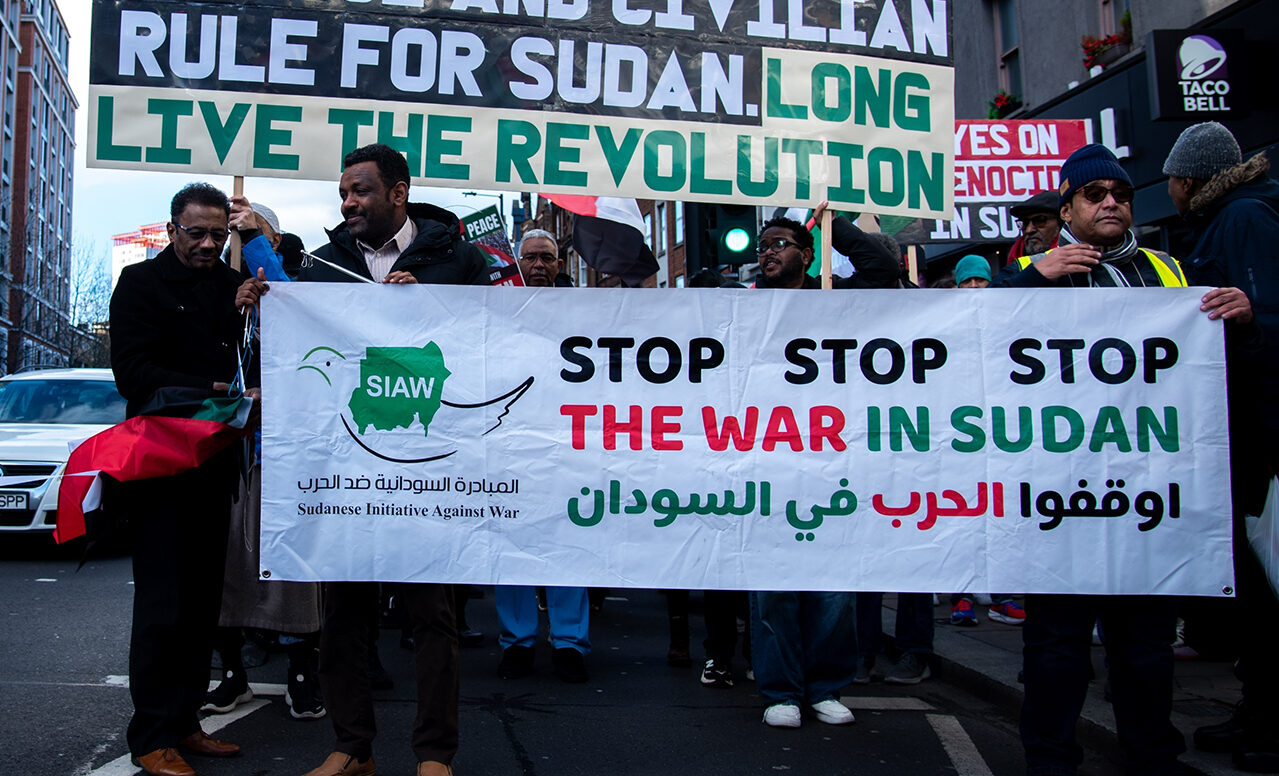
Photo: London, England, UK – December 20, 2025: A protestor holds a flag while chanting during the March for Sudan — End the War, Defend the Revolution, Expose the Imperialist Order. Shutterstock | Loredana Sangiuliano