


In the past two years, the world has looked in disbelief towards the European Union.[1] For two entire years, the European Union continued business as usual with Israel, as its atrocity crimes against civilians in Gaza were livestreamed on social media, as the International Court of Justice warned of plausible genocide and as the International Criminal Court issued an arrest warrant for war crimes and crimes against humanity against Israeli Prime Minister Netanyahu. This had no effect on EU-Israeli relations. Diplomatic relations continued normally as the EU convened the Association Agreement meeting in February 2025. The EU remained Israel’s biggest trading partner, accounting for 32% of Tel Aviv’s total trade in 2024,[2] including non-preferential trade with illegal settlements, making them economically sustainable, arguably in violation of the non-recognition obligation of the Geneva Convention. Arms trade also continued. While some EU Member States stopped selling arms to Israel, Germany — Tel Aviv’s second largest arms provider — augmented its exports relative to previous years.[3] Furthermore, between 2021 and 2025, Israel sold arms to 23 European countries, accounting for 41% of its total arms exports,[4] a trade which sustains the Israeli arms industry. Only in September 2025, did the European Commission propose some soft measures which were directly put on hold once Israel agreed to Trump’s ceasefire, showing that the EU was well aware that it had sufficient leverage. As Israel continued the destruction of civilian infrastructure, forced displacement and attacks on medical workers, journalists and the United Nations Interim Force in Lebanon (UNIFIL), and as settler violence and de facto annexation in the occupied West Bank, including East Jerusalem, augmented, the EU began discussions on banning trade with illegal settlements, the outcome of which is uncertain at the time of writing.
This European behaviour makes limited sense from both a rationalist/realist and a normative/liberal IR perspective. From a realist perspective, in today’s multipolar world, Europe is having to deal with a war with Russia which has made many parts of Europe more dependent on energy sources from the Global South —, which is precisely those countries the EU alienates with its position. At the same time, Israel has not allied with Europe on Russia; Tel Aviv’s relations with Moscow have remained rather stable since 2022. Furthermore, Israel’s war increasingly engulfed the whole region, from Syria, Yemen and Qatar, to Iran and the Gulf Cooperation Council (GCC) states, further driving up energy prices and increasing instability at the EU’s borders. These real impacts on European citizens notwithstanding, the EU has not taken any notable diplomatic initiative to protect European interests. To the contrary, the EU as a diplomatic actor seems to have largely disappeared.
The EU is making the international law-based
order — an order built on the horrors of two
world wars — increasingly precarious, as
it applies it to Ukraine but not to Gaza
Turning to a normative/liberal perspective, the EU has a vested normative stake in the international law-based order, even more so in the current moment in which the world order is transforming. In global crises such as Ukraine or Gaza, actors are negotiating the basic principles, rules and institutions that will govern their interactions and relations in the future.[5] It is in this particular moment in which order is negotiated that the EU is making the international law-based order — an order built on the horrors of two world wars — increasingly precarious, as it applies it to Ukraine but not to Gaza.[6] This also applies to the internal dimensions of this order, that is, domestic democratic orders. Public discontent has been continuous in Europe, as evidenced by the ongoing protests across the continent. Public opinion surveys have indicated a clear opposition to and unease with Israel’s war in Gaza and the wider region.[7] However, rather than taking public opinion and discontent seriously, several European countries have begun to erode constitutionally protected freedoms, such as the freedom of speech on their foreign policy vis-à-vis Israel.[8]
But if EU behaviour harms its realist interest and normative fabric, why then has the EU continued business as usual for two years? What crisis of Europe are we facing here?
To attempt to answer this question, this essay inquires into dominant European imaginations of its role as a “peace project” in three historical periods — after decolonization, during the unipolar moment of the so-called “international liberal order” and in the current transition to multipolarity — and how they had concrete effects on what becomes possible or thinkable in terms of European foreign policy in Israel/Palestine. It argues that after decolonization, Europeans have presented themselves to the world as a civilized/civilian power in the 1970s/80s and as a normative power in the 1990s/2000s. With these imaginations, they could first relegate the European past to the past and then re-gain the moral high ground in teaching peace. Since the 2010s, these imaginations increasingly gave way to a civilizational imagination of Europe, which has been the context in which the collapse of the European Union as a peace project within the international law-based order has occurred in Gaza, but also the larger Middle East.
Europe as a “Peace Project”
The European Community, later European Union, has first and foremost been imagined as a peace project, a promise to establish durable peace in Europe on the ashes of the Second World War. However, as an intra-European project, what did this project mean for the world outside of Europe and the violence it had been subjected to through European colonialism? Would this community also be a “peace project” towards them?What has been Europe’s promise to the world after decolonization?
To understand this, we need to look into the EC/EU’s ideal geopolitical imaginations with which Europe projects itself into the world with real geopolitical effects.[9] These imaginations relate to the EU’s own biography, which constitutes its “sense of community” and provides the EU with a “knowledge about its place in ‘the world’,” that is, “where we come from and where we are, or could be, going.”[10] Integral to this process are silences, that is, memories of the past and visions of the future which are occluded, silenced and excluded.[11]
Since the 1950s, the imagination of Europe as a peace project has been rooted, as Ole Wæver has argued, in a temporal, rather than spatial, othering of the European past as “other.”[12] As Luisa Bialasiewicz has described it, in Europe’s imagination, this other was a “dialectical negation of what used to be ‘all-too European’,” the “mosaic of (inherently belligerent and competitive) nation states, bound within an always tenuous balance of power.”[13] What has, however, been typically occluded in this imagination is that many European states were not actually nation states, but transnational empires.[14] Indeed, what has been largely missing is a reckoning with this colonial past in the European imagination.
Gurminder Bhambhra has noted that the whole world decolonized, but Europe did not.[15] Following World War II, the post-war political elites attempted to come to terms with their own destructive past within Europe. The memory of the world wars and the Holocaust has played an important role in this process, whilst Europe’s colonial past has, instead, largely been ignored.[16] Europe’s past as “other” thus included/s significant amnesia and makes it impossible for the legacies of that past — the past’s contemporary manifestations — to be taken seriously.[17] Regarding Israel/Palestine specifically, there is no awareness in Europe of the very concrete and ongoing legacies and impact which the European history of antisemitism and colonialism has to this day on Israelis and Palestinians. Europe has reconstructed and is prospering; Israelis and Palestinians are in perpetual conflict and the Palestinians remain a stateless people deprived of their inalienable rights, both individual (the right of return of the Palestine refugees) and collective (to self-determination and national independence).
In what follows, I will now discuss changing imaginations of Europe as a peace project in relation to three different world orders — that is, the period after decolonization, the unipolar moment of the so-called liberal international order and the transition to multipolarity. I will explore how these imaginations have set a context and informed the EU’s diverse positions in Israel/Palestine.
After Decolonization: Civilian Power Europe
In 1957, the Rome Treaty was signed, in the midst of the Algerian War of Independence with Algeria being initially associated with the European Community. Shortly before, in 1956, the power of the European colonial empires in the Middle East and North Africa had already been sealed. After the UK, France and Israel had invaded Egypt, the US and the Soviet Union convened an emergency meeting in the UN General Assembly for the first time and forced the three to withdraw in line with international law, that is, the inadmissibility of the acquisition of territory by war. The Europeans now lacked both influence and legitimacy in its neighbouring region. This became of increasing concern to the Europeans in the wake of the 1967 and ‘73 wars, which, from a European perspective, raised both security and economic concerns, particularly also due to the oil boycott. Thus, the European Political Cooperation (EPC) on foreign policy was formed in 1970, defining foreign policy primarily on one issue, the Arab-Israeli conflict.
With the European Community, the Europeans could present themselves as a “new animal” on the world stage, and so regain a position as a legitimate actor in world politics in an age of decolonization. The very concrete historical responsibilities which continue(d) to exist at the Member State level for the colonial period became rather obscure. The EC formed an image of a civilian power Europe which actively distanced itself from the European past without taking actual responsibility for it. Historical responsibility has, instead, been relegated to a distant other. The dominant imagination of the European Community’s role in the world was a “civilian power,”[18] a power short on force and strong on economics, “civilized” by the rule of law, cooperation and multilateralism, and which constrained the use of military force.
This imaginary established a context for policy in Israel/Palestine. In 1980, the Europeans issued the Venice Declaration, in which they insisted on the UN as a guarantor, on the Palestinian right to self-determination, on including the PLO in the negotiations, on the need to end the occupation and on the illegality of the settlements. It directly contested the US’ role in the region, which had begun to sideline the UN and international law, promoting the land-for-peace paradigm: as opposed to the Europeans, the US no longer insisted on de-occupation in line with international law (the inadmissibility of the acquisition of territory by war or annexation), but conditioned de-occupation on peace agreements. The Europeans therefore acted largely in opposition to the US position and more in line with that of the UN General Assembly, whose resolutions had established the inalienable rights of the Palestinian people.[19]
The Liberal International Order and Normative Power Europe
The world order changed dramatically with the fall of the Berlin wall and the onset of the US’ unipolar moment, and with it the order it promised to the world: the so-called liberal international order. The idea of a European peace project flourished in that order. As the past had now entirely disappeared into the “end of history,” the EU claimed a moral high ground to bring its peace project to the world. Thus, a shift took place from a civilian power towards a normative one; from a power which promised compliance with international law, to a power which imagined itself through the diffusion of its norms, establishing what counts as “normal” in international relations.[20]
In Israel/Palestine, the EU moved under
the US-led “Middle East Peace Process”
as a payer, rather than a player, diverging
from its previous focus on international law
The European experience of establishing a security community in Europe, with both the European Community and the Conference for Security and Peace, came to be seen as a model to be emulated in the Mediterranean with the Barcelona Process, which accompanied the Oslo negotiations — and collapsed with them. As a result, the EU began to focus on other pillars of the international liberal order, promoting free trade and liberal market democracies with the European Neighborhood Policy. Increasingly, the EU looked like a normative empire of sorts: “a vast, composite and ever-expanding entity with ‘fuzzy’ borders.”[21]
In Israel/Palestine, the EU moved under the US-led “Middle East Peace Process” as a payer, rather than a player, diverging from its previous focus on international law. The Europeans, while continuing to insist on the illegality of the settlements, no longer insisted on de-occupation in line with international law. Rather, the EU now began to sign up to the idea that an occupied people had to negotiate their rights with the occupying power giving the latter a de facto veto over their statehood. In its paradigmatic 1999 Berlin and 2002 Seville declarations, the EU supported the Palestinian right to self-determination, but not to a state, which is only mentioned as an option or objective to be achieved through negotiations.[22] Statehood was also conditioned on democracy. However, after the parliamentary elections in 2006, the EU followed the US’ no-contact policy with Hamas, which reinforced the division of the Palestinian political community and indirectly strengthened Hamas’ military wing. The EU could have set up the same condition for all actors, that is, to comply with international law, which would have strengthened the international law-based order. But instead the EU requested the recognition of Israel by Hamas, while it has never requested Israeli governments to recognize Palestine. Indeed, many European governments do not even recognize Palestine themselves.
The Multipolar World and Civilizational Power Europe
A shift in world order and in the EU appeared after the economic crisis in 2008. The world became more multipolar or multiplex,[23] while Europe faced an identity crisis. As the EU’s promise of “prosperity and peace” was undermined by the financial crisis and the onset of a deep security crisis with Russia,[24] the EU’s foundational myth began to be contested. Far right parties began to score well in elections with platforms largely built on Euroscepticism. This Euroscepticism was, however, rather quickly defeated through two principal developments: on one hand, far right parties such as Viktor Orban’s Fidesz soon realized the EU’s economic value and thus sought to transform rather than exit the EU; on the other hand, parties in the centre began to buy into some far right ideas to re-shape the EU as an “ethnoregionalism” — that is, an “ethnic/cultural version of European identity analogous to ethnonationalism, which is closely connected to the idea of whiteness,” emphasizing Europe’s “civilizational distinctiveness.”[25] Within this imagination of Europe, a reinterpretation of the past was proposed: the far right promotes the idea of a Judeo-Christian culture which stands in opposition to a shared Muslim other.[26] This imagination actively forgets both Europe’s long history of antisemitism and violence against European Jews, as well as the Middle East’s long history of co-existence between Muslims, Christians and Jews. It constitutes a form of anti-Muslim racism which treats antisemitism exclusively as a Muslim problem vis-à-vis the State of Israel, projects the European past onto Muslims[27] and splits minorities in Europe.
The von der Leyen Commission — the so-called “geopolitical commission” — seems to have at least partially embraced such a formation of European identity. The discourse of EU policymakers began to “[give] way to a more civilizational discourse based on the uniqueness of its culture” and “European values.”[28] Migration and “protecting the European way of life” became central to the “geopolitical commission” to articulate and enact EU identity. Migration policy — to paraphrase David Campbell — has thus become a political discourse and practice that became “central to the constitution, production and maintenance” of EU identity.[29] Thus, it was an internal issue, rather than foreign policy, on which the EU began to act. It began to foster an idea of internal unity at the cost of valuing its diversity in an increasingly multipolar world where it tries to leverage such unity to hedge against other powers (rather than leveraging diversity to connect with other regions).[30] The Commission also proclaimed that the EU must relearn the “language of power,”[31] and therefore no longer imagine itself as “the antithesis of geopolitics”[32] or as a peace project. Its other main focus, besides migration, has been shared defence and security, as well as the ReArm Europe programme. Diplomacy has been increasingly excluded from this imagination. While previous time periods had featured EU flagship initiatives — the Euro-Arab Dialogue, the Barcelona Process, the ENP and the JCPOA — diplomacy is mostly absent in the EU today.
Europe as a civilizational power has become
provincialized in international politics (…)
the idea of a peace project has collapsed.
It can, however, be re-imagined
Besides translating into a lack of diplomatic vision, the civilizational imagination of the EU has also been the lens with which Europe’s leading politicians reacted to Israel’s war on Gaza and the larger Middle East. The European Council conclusions of 26 October mention Israel’s right to defend itself in line with international law, but no Palestinian right to self-defence in line with international law. Palestinians feature as either terrorists or their human shields in the European discourse, a de-humanization which deprives Palestinian civilians of their rights under international law. Similarly, international law did not apply to Iran once it was attacked in March 2026 by the US and Israel during ongoing indirect nuclear negotiations. In their statements, neither the President of the Council, Antonio Costa, nor the High Representative, Kaja Kallas, nor the President of the Commission, Ursula von der Leyen, mentioned the US and Israel’s violation of the UN Charter.
What Lies ahead?
Europe as a civilizational power has become provincialized in international politics. It cannot afford such a provincialization as it is forced to renegotiate its relationship with Russia and as the world is transforming. Amitav Acharya has described the world as a multiplex cinema where various powers and regions have a diverse range of films on offer. The EU after Gaza has no film on offer in this world; the idea of a peace project has collapsed. It can, however, be re-imagined. Decisive in such a reimagination is the need to: 1) Address silences in European memories, notably on the colonial era and its echoes today; 2) Embrace Europe’s diversity, which makes Europe particularly well positioned to connect with the world; and 3) Apply international law unequivocally to protect it as a pillar around which the global transition of order converges. Engaging in such a reimagination will enable the EU to rediscover its diplomatic agency in a multiplex world.
[1] Mishra, Pankaj. The World After Gaza. London: Fern Press, 2025.
[2] European Commission, “EU Trade Relations with Israel.” https://policy.trade.ec.europa.eu/eu-trade-relationships-country-and-region/countries-and-regions/israel_en.
[3] Bundesministerium für Wirtschaft und Klimaschutz (BMWE). “Jährliche Berichte der Bundesregierung über ihre Exportpolitik für konventionelle Rüstungsüter.” www.bundeswirtschaftsministerium.de/Redaktion/DE/Slider/Aussenwirtschaft/publikationen-faq-ruestung.html.
[4] SIPRI. “Trends in International Arms Transfers.” SIPRI, March 2026, https://www.sipri.org/sites/default/files/2026-03/fs_2603_at_2025.pdf .
[5] Huber, Daniela. “Israel/Palestine and the Normative Power of the ‘Global South’.” IAI Commentaries, 22 March 2024, www.iai.it/en/pubblicazioni/israelpalestine-and-normative-power-global-south.
[6] For a longer discussion, see Huber, Daniela “Organized Hypocrisy and the Logic of Coloniality. Explaining the EU’s Divergent Response to Grave Violations of International Law in Russia/Ukraine and Israel/Palestine.” JCMS: Journal of Common Market Studies, 2025, doi:10.1111/jcms.13737.
[7] Silver, Laura. “Most People across 24 Surveyed Countries Have Negative Views of Israel and Netanyahu.” Pew Research Center (blog), www.pewresearch.org/short-reads/2025/06/03/most-people-across-24-surveyed-countries-have-negative-views-of-israel-and-netanyahu/.
[8] European Civic Forum. “Civic Space Report 2025.” Civic Space Report, 2025, https://civic-forum.eu/wp-content/uploads/2024/05/CIVIC-SPACE-REPORT-2024-RESTRICTIONS-ON-PALESTINE-SOLIDARITY.pdf.
[9] Bialasiewicz, Luiza. “Spectres of Europe: Europe’s Past, Present, and Future.” in Stone, Dan (ed.), The Oxford Handbook of Postwar European History, Oxford University Press, 2012, p. 0, doi:10.1093/oxfordhb/9780199560981.013.0005.
[10] Berenskoetter, Felix. “Parameters of a National Biography.” European Journal of International Relations, Vol. 20, No. 1. March 2014, p. 269, doi:10.1177/1354066112445290.
[11] Bachmann, Veit and Sidaway, James. “Zivilmacht Europa: A Critical Geopolitics of the European Union as a Global Power.” Transactions – Institute of British Geographers, Vol. 34 (2009), doi:10.1111/j.1475-5661.2008.00325.x.
[12] Wæver, Ole. “European Security Identities.” JCMS: Journal of Common Market Studies, Vol. 34, No. 1, 1996, pp. 103–132, doi:10.1111/j.1468-5965.1996.tb00562.x.
[13] Bialasiewicz, Luiza. op. cit. 107.
[14] Bhambra, Gurminder K. “A Decolonial Project for Europe.” JCMS: Journal of Common Market Studies, Vol. 60, No. 2, 2022, pp. 229–244, doi:10.1111/jcms.13310. As such, it should be noted that the multipolarity of today’s nation states is different to the multipolarity of the past’s transnational empires.
[15] Pace, Michelle and Roccu, Roberto. “Imperial Pasts in the EU’s Approach to the Mediterranean.” Interventions 22, no. 6, 17 August 2020: 671–85.
[16] Nicolaidis, Kalypso and Fisher-Onar, Nora. “Europe’s Post-Imperial Condition.” in Behr, Hartmut and Stivachtis, Yannis A. (ed.), Revisiting the European Union as Empire, Routledge, 2015, pp. 115–133.
[17] Bhambra, Gurminder K. op. cit. 231
[18] Duchêne, François. “The European Community and the Uncertainties of Interdependence.” in Max Kohnstamm and Wolfgang Hager, (ed.), A Nation Writ Large? Foreign-Policy Problems before the European Community, London: Palgrave Macmillan UK, 1973, pp. 1–21, doi:10.1007/978-1-349-01826-0_1.
[19] Huber, Daniela. The International Dimension of the Israel-Palestinian Conflict. A Post-Eurocentric Approach, New York: SUNY Press, 2021, https://sunypress.edu/Books/T/The-International-Dimension-of-the-Israel-Palestinian-Conflict.
[20] Manners, Ian. “Normative Power Europe: A Contradiction in Terms?” JCMS: Journal of Common Market Studies, Vol. 40, No. 2 , 2002, pp. 235–258, doi:10.1111/1468-5965.00353.
[21] Del Sarto, Raffaella A. “Normative Empire Europe: The European Union, Its Borderlands, and the ‘Arab Spring’.” JCMS: Journal of Common Market Studies, Vol. 54, No. 2, 2016, pp. 215–232, doi:10.1111/jcms.12282.
[22] European Council. “Berlin Declaration.” www.europarl.europa.eu/summits/ber2_en.htm.
[23] Acharya, Amitav; Estevadeordal, Antoni and Goodman, Louis W. “Multipolar or Multiplex? Interaction Capacity, Global Cooperation and World Order.” International Affairs, Vol. 99, No. 6, November 2023, pp. 2339–2365, doi:10.1093/ia/iiad242.
[24] Glencross, Andrew. “The EU and the Temptation to Become a Civilizational State.” European Foreign Affairs Review, Vol. 26, No. 2, May 2021, https://kluwerlawonline.com/api/Product/CitationPDFURL?file=Journals\EERR\EERR2021022.pdf.
[25] Kundnani, Hans. Eurowhiteness: Culture, Empire and Race in the European Project, London: Hurst, 2023.
[26] Greene, Toby. “Judeo-Christian Civilizationism: Challenging Common European Foreign Policy in the Israeli-Palestinian Arena.” Mediterranean Politics, Vol. 26, No. 4, August 2021, pp. 430–450, doi:10.1080/13629395.2020.1739928.
[27] Özyürek, Esra. Subcontractors of Guilt: Holocaust Memory and Muslim Belonging in Postwar Germany. Stanford University Press, 2023.
[28] Kundnani, Hans. “What Does It Mean to Be ‘pro-European’ Today?” The New Statesman, www.newstatesman.com/world/2021/02/what-does-it-mean-be-pro-european-today.
[29] Campbell, David. Writing Security, Revised edition, Minneapolis: University of Minnesota Press, 1998, p. 8.
[30] Bouris, Dimitris; Fisher-Onar, Nora and Huber, Daniela Verena. “Towards Allyship in Diversity? Critical Perspectives on the European Union’s Global Role.” JCMS: Journal of Common Market Studies, Vol. 63, No. 5, 2025, pp. 1393–1419, doi:10.1111/jcms.13763.
[31] Borrell, Josep. “Embracing Europe’s Power | by Josep Borrell.” Project Syndicate, www.project-syndicate.org/commentary/embracing-europe-s-power-by-josep-borrell-2020-02 .
[32] Kundnani, Hans. “Europe’s Geopolitical Confusion.” Internationale Politik Quarterly, https://ip-quarterly.com/en/europes-geopolitical-confusion.
* An earlier version of this article has appeared in Italian in Paradoxa, Anno XX, No. 2, 2026
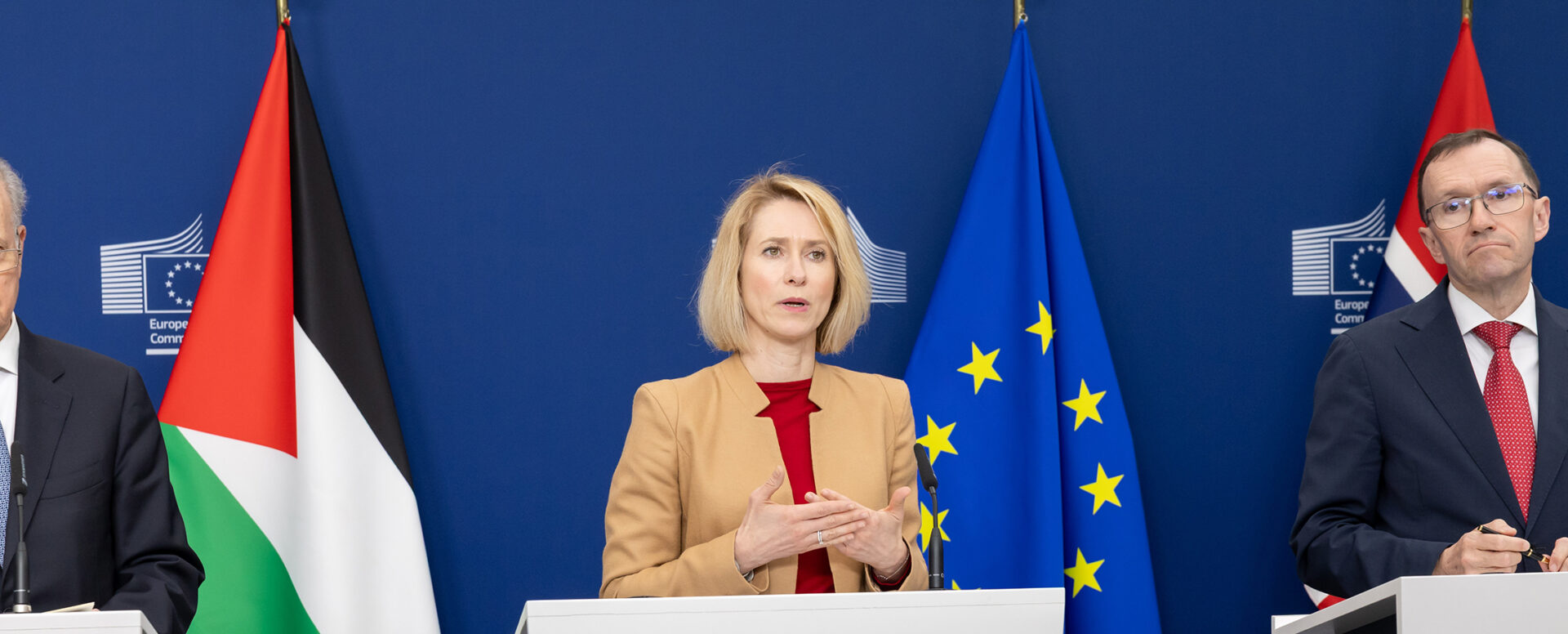
Header Photo: Kaja Kallas, Vice-President of the European Commission and High Representative of the Union, at the Meeting of the Ad Hoc Liaison Committee (AHLC) on Palestine.20/04/2026. EU Audiovisual Service. Photographer : Xavier Lejeune/ Aurore Martignoni. © European Union, 2026