


Something significant is happening in the Mediterranean, though it is not always easy to read. Across the region, from the Iberian Peninsula to the Levant and from the North African coast to the Aegean, large pools of state-controlled capital are flowing into ports, energy grids, new cities, railways and logistics corridors. The source of much of this capital is familiar: the sovereign wealth funds of the Gulf states, flush with hydrocarbon revenues and operating at a historically unprecedented scale. The destinations are varied but the pattern is consistent. Hard infrastructure, long-duration assets and the connective tissue of regional and global trade.
The instinctive response in parts of the European policy and analytical community has been one of suspicion. A 2025 report by the Stiftung Wissenschaft und Politik, Germany’s leading foreign policy think tank, characterized Gulf sovereign wealth funds as instruments that use capital as leverage in geopolitical negotiations, documenting cases in which Gulf financial flows supported political consolidation in Egypt and were deployed as diplomatic signals toward the G7.[1] The EU’s progressively tightening Foreign Direct Investment (FDI) screening framework, revised in December 2025 to mandate screening across all Member States in critical sectors including energy, transport and digital infrastructure,[2] reflects a broader trend in which foreign state capital in European infrastructure is treated as a potential security concern. The intellectual genealogy of that trend, as analysts at the Istituto Affari Internazionali and others have documented, runs primarily through anxieties about Chinese investment, most visibly the cancelled Chinese acquisitions of port terminals at Trieste and Rijeka in 2021–2022.[3] [4] But its logic is now applied more broadly, and the distinction between Chinese and Gulf capital is not always made with the care it deserves.
This article argues that the geopolitical framing, while not entirely without foundation, is largely misapplied to Gulf sovereign wealth funds in the Mediterranean, and that acting on it has real costs. The surge of Gulf Sovereign Wealth Funds (SWF) capital into Mediterranean infrastructure is, at its core, a financial story. These are institutions managing pools of capital so large that finding sufficient investable assets is itself a structural challenge. Infrastructure (ports, energy, logistics, urban development) offers the scale, long duration and stable returns that funds of this size require. The Mediterranean, sitting at the intersection of three continents and offering investment environments ranging from mature EU markets to high-growth developing economies, is a rational destination.
That does not mean there are no questions worth asking. There are, but they are different questions from the ones that dominate European policy discussions. The real issues concern governance, the terms on which capital-constrained southern Mediterranean states receive investment, local development linkages and the regulatory architecture needed for cross-Mediterranean energy connectivity. A more calibrated analytical and policy framework, one that seriously considers how sovereign wealth funds actually work, is long overdue.
The Capital Overhang: Why Gulf Sovereign Funds Must Invest at Scale
Any serious analysis of Gulf sovereign wealth fund activity in the Mediterranean must begin not with the Mediterranean but with the funds themselves. Understanding why they invest, and at what scale, is the necessary foundation for interpreting where they invest and what that means.
Global sovereign wealth fund assets under management reached approximately $13.2 trillion in 2023, a 14% increase on the previous year, according to the IE University Center for the Governance of Change. The Gulf states sit at the centre of this picture. Together, Gulf sovereign wealth funds account for roughly 40% of total global SWF assets, and six of the 10 largest funds in the world are Gulf-domiciled. The “Oil Five,” comprising Saudi Arabia’s Public Investment Fund (PIF), Abu Dhabi’s ADIA and ADQ, Qatar’s QIA and Abu Dhabi’s Mubadala, account for a disproportionate share of active investment globally. By the first half of 2024, more than 54% of all sovereign wealth fund deployment across the globe originated from Middle Eastern funds, the highest concentration since at least 2009.[5]
These figures are important because they demonstrate how Gulf SWF investment is, above all, a capital deployment problem. Hydrocarbon revenues, especially during periods of elevated oil prices, generate surpluses that dwarf the domestic absorptive capacity of Gulf economies. These funds must invest abroad. The question is not whether but where and in what. Investment decisions are driven first and foremost by the logic of institutional portfolio management: finding assets that match the fund’s return requirements, risk tolerance, liquidity needs and investment horizon.
The pivot toward infrastructure across the SWF universe is not a Gulf-specific phenomenon, nor a strategic choice to acquire leverage over host countries. It reflects a global rebalancing of institutional portfolios in response to macroeconomic conditions. In 2024, sovereign wealth funds allocated 61% of direct investments to infrastructure and real estate, surpassing equity allocations for the first time in a decade.[6] The International Forum of Sovereign Wealth Funds notes that this shift reflects infrastructure’s capacity to offer stable cash flows, inflation protection and long investment horizons, precisely the characteristics that large, long-term pools of capital require. The Invesco 2024 Global Sovereign Asset Management Study found that infrastructure had overtaken both real estate and private equity as the leading alternative asset class for SWFs, with an average allocation of 7.7% of assets.[7]
There is a further structural point worth making. At the scale at which leading Gulf funds now operate (PIF is targeting $2.67 trillion in assets under management by 2030, while ADIA manages close to $1 trillion), finding sufficient investable opportunities is genuinely difficult.[8] Infrastructure projects in the Mediterranean, with their combination of scale, regulatory frameworks and long contract durations, are among the relatively limited universe of assets that can absorb this kind of capital. The Mediterranean’s infrastructure deficit is, from a sovereign fund perspective, as much an opportunity as a development challenge.
The Mediterranean as an Asset Class
If infrastructure is the asset class, the Mediterranean offers a distinctive investment landscape worth examining by sub-region and sector. The common thread across Gulf SWF activity in the region is not geopolitical opportunism but a financially coherent logic of diversification, yield and scale.
Southern Europe: Mature Markets, Energy Transition
The northern Mediterranean, particularly Spain, Greece and Italy, offers Gulf investors the combination of EU regulatory frameworks, rule of law and significant infrastructure investment needs, especially in energy. Spain has emerged as one of the most active recipients of sovereign wealth investment in the EU. In 2023, total SWF investment in Spain reached nearly €7 billion, the second highest year on record and a 160% increase on the previous year. In 2024, momentum continued, driven primarily by renewable energy and digital infrastructure.[9]
The most significant actor in this space is Masdar, Abu Dhabi’s state-backed clean energy company, which has transformed itself into one of the world’s largest renewable energy platforms. Between 2022 and the end of 2024, Masdar grew its portfolio capacity from 20 GW to 51 GW, a 150% increase. In Spain, Masdar acquired Saeta Yield from Brookfield for approximately €1.2 billion (adding 745 MW of predominantly wind assets and a 1.6 GW development pipeline across Spain and Portugal) and partnered with Endesa to acquire a 49.99% stake in a 2 GW portfolio of operational solar assets for €817 million, one of the largest renewable energy transactions in Spain in recent years.[10]
In Greece, Masdar completed the full acquisition of TERNA ENERGY, the country’s largest renewable energy developer, in a deal with a total enterprise value of approximately €3.2 billion, the largest energy transaction ever on the Athens Stock Exchange and among the largest in the EU renewables industry. TERNA ENERGY operates 1,224 MW of installed capacity across wind, solar, hydro and biomass, and is constructing the 680 MW Amfilochia pumped hydro project, one of the largest in Europe.[11]
These transactions are instructive precisely because they fit so naturally within the logic of institutional infrastructure investment. Masdar has an explicit mandate to reach 100 GW of global renewable energy capacity by 2030. Spain and Greece offer large, mature renewable energy markets, established regulatory frameworks, EU-guaranteed rule of law and assets with long-term contracted cash flows. For a capital-rich institution with a 2030 target, these are not strategic bets on Mediterranean geopolitics. They are straightforward portfolio acquisitions.
Egypt: The Centrepiece
No single transaction better illustrates both the financial logic of Gulf SWF activity in the Mediterranean and the genuine complexity it can involve than ADQ’s $35 billion investment in Egypt announced in February 2024. Egypt’s largest single foreign direct investment in its history, the deal saw ADQ acquire development rights to Ras El-Hekma, a 170 million square metre coastal site on Egypt’s north Mediterranean coast, for $24 billion in fresh foreign currency, with a further $11 billion conversion of existing UAE central bank deposits into equity stakes across a basket of Egyptian assets.[12]
ADQ, established in 2018 and now managing $225 billion in assets, has a well-established track record of investing in large-scale urban development, logistics infrastructure and supply chain assets. Ras El-Hekma, designed as a next-generation Mediterranean city comprising tourism facilities, a free zone, residential and commercial space, and green energy infrastructure, represents the kind of large-format, long-duration investment that sovereign funds of this scale require. The projected $150 billion in cumulative investment over the life of the development illustrates both the ambition and the scale of the opportunity.
But the deal is also unusual in ways that complicate a purely financial reading. It arrived at a moment of acute economic crisis for Egypt: severe foreign currency shortages, a significant gap between official and parallel exchange rates and a stalled IMF programme. The $24 billion in fresh ADQ capital unlocked an $8 billion IMF Extended Fund Facility that was concluded within days of the first tranche clearing.[13] Without the Ras El-Hekma cash, the IMF programme would in all likelihood not have proceeded on those terms.
Does this make the deal geopolitical? Not necessarily, but it does make it more than purely commercial given the sovereign-to-sovereign dimension. ADQ secured development rights at commercially attractive terms precisely because Egypt’s fiscal position made it a motivated seller. Whether that represents opportunism or partnership (and the answer is probably somewhere between the two), the episode illustrates that sovereign fund investment in the Mediterranean is not always conducted on a purely arm’s-length commercial basis. Notwithstanding, in this case, the commercial considerations for ADQ came first.
The Egypt story also reflects a broader pattern: the UAE has positioned itself as an indispensable partner for North African states seeking large-scale development capital. Egypt’s Suez Canal Economic Zone has concluded agreements with Abu Dhabi Ports Group to develop projects at East Port Said, West Port Said and Al Areesh. Following the Ras El-Hekma deal, Qatar’s sovereign vehicle Qatari Diar signed a $29.7 billion development agreement for the Alam El-Roum area on Egypt’s north coast, suggesting a model of sovereign-to-sovereign urban development at a scale that may well be replicated further.[14]
Morocco: A Diversified Model
Morocco represents a third variant: a country with relative macroeconomic stability and a strengthening record as an investment-grade destination, where Gulf engagement has broadened significantly in scale and sectoral footprint in recent years. The UAE emerged as Morocco’s largest foreign investor in 2024, contributing MAD 3.1 billion ($310 million) in foreign direct investment — 18.9% of Morocco’s total net FDI and a 57.8% increase on the previous year, outpacing traditional investors, including Germany and China.[15] In May 2025, that relationship was consolidated further through a landmark $14 billion infrastructure partnership covering energy and water security projects, developed through a consortium including the Mohammed VI Investment Fund, TAQA Morocco and Nareva and widely described as the largest private investment programme in Morocco’s history.[16]
Among the most ambitious elements of UAE energy engagement is a planned green hydrogen initiative involving TAQA Morocco in the Dakhla-Oued El-Dahab region, targeting 6,000 MW of renewable-energy generation. Selected under Morocco’s Green Hydrogen Offer programme in March 2025, the project is expected to produce green ammonia and e-fuels for export, positioning Morocco as a potential clean-energy supplier to European markets.[17]
The Geopolitical Over-Reading: Where It Comes from and Why It Misleads
The geopolitical interpretation of Gulf SWF activity in the Mediterranean is not entirely without foundation. These funds are state-owned. Their governments have foreign policy interests. Some investments, Egypt being the clearest example, are structured in ways that blur the line between financial transactions and strategic partnerships. And ports, energy infrastructure and urban development sites are, by their nature, strategically sensitive assets.
The SWP Berlin analysis referenced above represents a version of this concern, and it is worth engaging with seriously.[18] The report documents genuine cases in which financial flows and political leverage are intertwined: Saudi threats to sell European bonds during G7 deliberations on seized Russian assets, and Gulf capital that helped consolidate the Sisi government in Egypt. These cases are real, but the question is whether they constitute the dominant logic of Gulf SWF investment or are better understood as edge cases, generalized into a misleading analytical frame.
The problem with geopolitical framing
as a general account is that it conflates
the strategic sensitivity of an asset class
with strategic intent on the part of the investor
The problem with geopolitical framing as a general account is that it conflates the strategic sensitivity of an asset class with strategic intent on the part of the investor. Gulf sovereign wealth funds are, first and foremost, institutional investors with mandates, investment committees, return thresholds and governance frameworks. The day-to-day reality of how these institutions make decisions is considerably more mundane than the geopolitical narrative allows.
The EU’s FDI screening framework, finalized in December 2025, has progressively hardened in response to these concerns.[19] But the intellectual genealogy of European investment screening is rooted in anxieties about Chinese capital, not Gulf capital.[20] China’s Belt and Road Initiative, which has attracted scrutiny, involves state-directed investment explicitly linked to diplomatic objectives, financing that can create structural dependencies and investing entities that are often extensions of the Chinese State rather than financially autonomous institutions. Gulf sovereign wealth funds are different in most relevant dimensions. They are governed by investment mandates requiring demonstrable financial returns, operating through competitive market mechanisms and subject to governance frameworks that have improved significantly since the adoption of the Santiago Principles in 2008.
The EU’s own FDI screening data provides at least partial support for this reading. Despite a 75% increase in screening activity in 2024 (EU Member States handled 3,136 authorization requests), 92% of cases were cleared in Phase 1, and the cases that attracted the deepest scrutiny overwhelmingly involved manufacturing and technology sectors rather than Gulf infrastructure acquisitions.[21] Masdar’s acquisitions in Greece and Spain, which involved critical energy infrastructure, attracted regulatory scrutiny but proceeded without significant impediment, consistent with the view that informed regulators, examining the actual governance and decision-making structures of these funds, find them commercially rational rather than strategically threatening.
There is also a political economy dimension to the over-reading worth naming. The geopolitical framing provides cover for economic nationalism dressed in security language, allows politicians to signal toughness on foreign capital and offers analysts a compelling narrative that places familiar anxieties about dependency, sovereignty and great power competition onto a new stage. None of these motivations is a sufficient reason to accept a misdiagnosis.
The Real Questions: Governance, Dependency and Development
Rejecting the geopolitical over-reading is not the same as declaring Gulf SWF investment in the Mediterranean unproblematic. There are real questions worth asking, though they are different ones from those that dominate the current conversation. Three clusters of concerns deserve serious attention.
Governance and Transparency
The Santiago Principles, adopted in 2008 under IMF auspices, established a voluntary framework of governance and transparency standards for sovereign wealth funds. The leading Gulf funds have made measurable progress. But the Principles remain voluntary, their implementation is uneven globally, and they were designed primarily to reassure Western governments that SWF investment did not carry hidden political conditionalities. They were not designed to address the governance of funds as landlords, operators and long-term stakeholders in host communities.
When a sovereign fund acquires a controlling stake in critical national infrastructure (a port, a power grid, a new city development), what obligations does it carry with respect to the host state’s public interest? The Ras El-Hekma development has attracted criticism from Egyptian civil society groups, who have raised concerns about community displacement, environmental impact and profit-sharing terms.[22] These are legitimate governance questions entirely distinct from claims about geopolitical motivation.
Terms of Investment and Structural Dependency
The Egypt case also illustrates a concern that is more economic than political: the terms on which fiscally distressed states receive Gulf capital. When a country facing acute balance of payments pressure must offer development rights to prime coastal land, rights it might negotiate very differently under better circumstances, the resulting investment relationship is asymmetric, if not necessarily exploitative. Several southern Mediterranean states have fiscal positions that limit their negotiating leverage. The policy response is not to restrict Gulf investment, since these countries need the capital, but to invest in the capacity of southern Mediterranean states to negotiate investment terms that adequately protect the public interest. This is a development policy challenge, not a national security one.
Local Development Linkages
A third concern involves the quality of economic development that Gulf SWF infrastructure investment actually generates. Large-scale projects have in some cases been criticized as enclave investments: physically large but economically isolated, employing imported labour and management expertise and generating profits that flow abroad. ADQ’s stated goals for Ras El-Hekma include 750,000 direct and indirect jobs and an annual contribution of $25 billion to Egypt’s GDP.[23] Whether these targets are met will depend on the degree to which the development actively incorporates local supply chains, supports Egyptian entrepreneurs and builds workforce capacity rather than importing it. The gap between the headline investment figure and actual local development impact is the critical metric, and one that host governments, development institutions and civil society should monitor closely.
The North Africa–Europe Energy Corridor
One final area merits specific attention: the emerging possibility of a North Africa–Europe green energy corridor linking North African wind and solar resources to European demand via undersea cables and green hydrogen pipelines. TAQA’s commitment in Morocco, Masdar’s growing Mediterranean renewable energy presence and the EU’s stated ambition to import green hydrogen as part of its post-Ukraine energy security strategy are all elements of a plausible future connectivity architecture spanning the Mediterranean.[24] This is commercially attractive and climatically important. But the governance frameworks for cross-Mediterranean energy infrastructure are underdeveloped. The EU’s regulatory capacity on the northern shore is robust; the equivalent capacity on the southern shore is not. Building a governance architecture fit for purpose requires significant investment in multilateral frameworks and southern Mediterranean regulatory capacity, and it requires that investment now, before the infrastructure is built.
Conclusion: Towards a More Calibrated Framework
The Mediterranean is not a theatre for a new round of great power competition in which Gulf sovereign capital plays the role of the emerging strategic threat. It is a region in which the world’s largest pools of institutional capital are meeting one of the world’s most significant infrastructure deficits, with consequences that are largely positive but imperfectly understood and inadequately governed.
Done well, Gulf sovereign wealth fund investment
in Mediterranean infrastructure represents a significant
opportunity (…) The risk is not that this investment
happens. The risk is that it happens poorly: under terms
that benefit the investor more than the host
The task for analysts and policymakers is to get the basic diagnosis right. Gulf sovereign wealth funds are financial institutions operating under financial mandates. Their growing presence in Mediterranean infrastructure reflects the logic of institutional portfolio management (the search for scale, yield and long duration) more than any strategic design to acquire leverage over Mediterranean states. Treating them as instruments of statecraft, or applying regulatory frameworks designed primarily for a Chinese investment threat could generate friction with partners who are, on balance, benign, and may deter capital that the region badly needs. Done well, Gulf sovereign wealth fund investment in Mediterranean infrastructure represents a significant opportunity: for the energy transition, for regional connectivity and for the economic development of countries that have long struggled to attract patient, long-term capital at the required scale. The risk is not that this investment happens. The risk is that it happens poorly: under terms that benefit the investor more than the host, without the governance frameworks that ensure accountability and surrounded by a policy discourse that mistakes financial logic for political strategy. The Mediterranean deserves better than that, and, for that matter, so do the investors.
[1] Roll, Stephan. “Sovereign Wealth Funds and Foreign Policy,” SWP Research Paper 2026/RP 03, Stiftung Wissenschaft und Politik (SWP). The report notes that Gulf SWFs have used capital as leverage in geopolitical negotiations and documents cases including the consolidation of President Sisi’s rule in Egypt following the 2013 coup.
[2] European Commission, Investment Screening — Trade and Economic Security. The Commission adopted five initiatives in January 2024 to strengthen economic security, of which FDI screening reform was one. Interinstitutional negotiations concluded on 11 December 2025.
[3] Marconi, Federica. “A Shifting European Paradigm in FDI Screening: From Market Protection to Economic Security,” Istituto Affari Internazionali, 2025. The IAI analysis confirms that EU FDI screening evolved primarily in response to Chinese investment concerns from around 2016 onwards.
[4] Doppen, F.; Notteboom, T. & De Bièvre, D. “In the eye of a geopolitical storm: responses of port management bodies to investment screening in the EU.” Journal of Shipping and Trade vol. 10 (2025). https://doi.org/10.1186/s41072-025-00213-3. The paper notes that cancelled Chinese acquisitions of terminals at Trieste and Rijeka in 2021–22 were emblematic of the political climate driving screening policy.
[5] Capapé, Javier and Johnson, Drew. Sovereign Wealth Funds 2024 Report, IE University Center for the Governance of Change, 2024.
[6] IFSWF, Annual Review 2024: Resilience and Realignment. The IFSWF notes infrastructure and real estate exceeded equity allocations for the first time in a decade in 2024.
[7] Invesco, Global Sovereign Asset Management Study 2024.
[8] “Saudi Arabia’s PIF Sets Ambitious $2.67 Trillion Asset Goal by 2030.” Arabian Post. April, 2025.
[9] CAPAPÉ, Javier and JOHNSON, Drew op. cit.
[10] Masdar, Masdar’s Capacity Up By 150% to Over 50GW in Two Years, 2025. See also Masdar, Masdar Expands Solar and Wind Portfolio in Europe, 2024, covering the Saeta Yield and Endesa transactions.
[11] Masdar, Masdar Cements Major European Expansion with Completion of 100% Acquisition of TERNA ENERGY, 2025.
[12] ADQ, ADQ-led consortium to invest USD 35 billion in Egypt, February 2024. See also: Shawkat, Yahia Understanding Egypt’s Ras Al-Hekma Land Deal: No Panacea, Tahrir Institute for Middle East Policy, March 2024.
[13] US State Department, 2024 Investment Climate Statements: Egypt. The IMF Extended Fund Facility of $8bn was concluded within days of the first ADQ tranche clearing in late February 2024.
[14] Arab Finance. “From Ras El-Hekma to Alam El-Roum: Comparing Egypt’s Mega Deals,” 2025. The Qatari Diar agreement for Alam El-Roum was signed following the ADQ Ras El-Hekma model.
[15] Faouzi, Adil. “UAE Emerges as Morocco’s Top Foreign Investor in 2024 with MAD 3.1 Billion.” Morocco World News, September 2025.
[16] Ibid. The $14 billion megadeal signed in May 2025 covers a 1,400-kilometre high-voltage transmission line connecting Western Sahara to Casablanca and four seawater desalination facilities with a combined annual production capacity of 900 million cubic metres.
[17] MEED. “TAQA and Acwa Power to build Morocco green hydrogen plants.” December 2025.
[18] Roll, Stephan, op. cit. The SWP report documents cases in which Gulf capital has served as political leverage, including in Egypt (post-2013 coup) and via Saudi threats to sell European bonds during G7 deliberations on seized Russian assets.
[19] European Council. Foreign direct investment: Council and Parliament reached political agreement to improve FDI screening. 11 December 2025. The new Foreign Investment Screening Regulation will repeal and replace Regulation (EU) 2019/452.
[20] Marconi (2025), op. cit.
[21] Tolley, Louise and Bourne, Emily. “EU FDI screening adapts to evolving geopolitical risks.”A&O Shearman, November 2025. EU Member States handled 3,136 authorisation requests in 2024, a 75% increase on the prior year. 92% were cleared in Phase 1.
[22] Shawkat (2024), op. cit. The Institute raised concerns about community displacement, environmental impact and profit-sharing terms in the Ras El-Hekma development.
[23] ADQ (2024), op. cit. The Egyptian State retains a 35% equity stake in the Ras El-Hekma development vehicle. Projected job creation of 750,000 and annual GDP contribution of $25bn are ADQ’s stated targets.
[24] Sidło, Katarzyna. “Europe and the Gulf at a strategic turning point.” European Union Institute for Security Studies, March 2026.
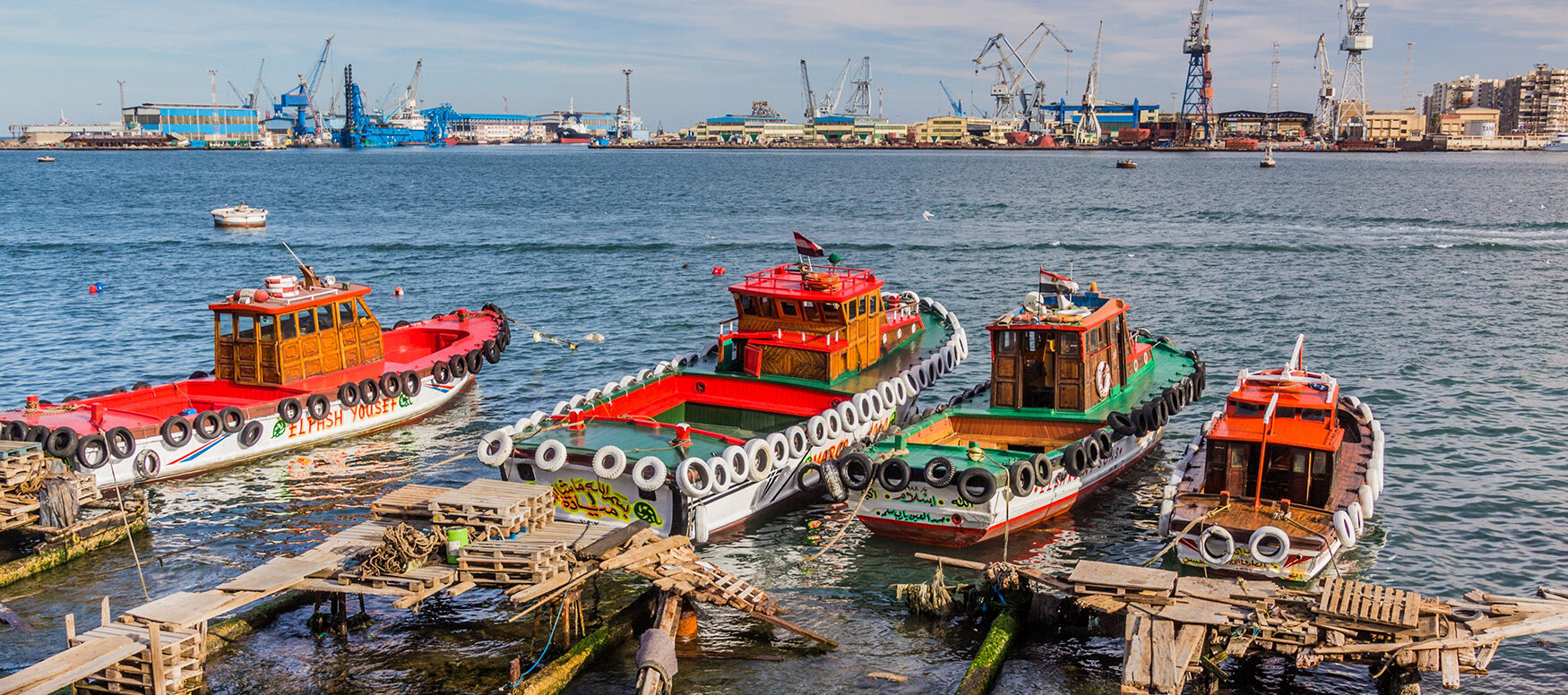
Header photo: PORT SAID, EGYPT – FEBRUARY 3, 2019: View of the Suez canal in Port Said, Egypt. Matyas Rehak/Shutterstock. Egypt’s Suez Canal Economic Zone has concluded agreements with Abu Dhabi Ports Group to develop projects at East Port Said, West Port Said and Al Areesh.