


To speak of the Mediterranean is to speak of a central arena in European history and, for Spain –, a profoundly Mediterranean country – a key pillar of its international influence. It is a sea that unites, where shared interests, sensibilities and destinies intersect. A sea rich in cultures, civilizations and peoples who have coexisted, traded and engaged in dialogue for centuries and which, in the current climate, is poised to become a benchmark for 21st-century multilateralism.
Today, the Mediterranean region is navigating a period of immense complexity. The eastern Mediterranean is experiencing one of the most critical phases seen in decades. The tragedy in Gaza, the spread of violence to Lebanon and the persistence of regional tensions remind us of the extent to which instability in this region has consequences that transcend its borders, affecting international security as a whole. Despite this reality, Europe was too slow to accord the Mediterranean the strategic attention it deserves. For years, Europe’s gaze has been directed more intensely towards the East, while the South was all too often relegated to fragmented, excessively bilateral and insufficiently ambitious cooperation. This imbalance – which does not serve our continent’s interests – must be reversed. We, the European countries bordering the Mediterranean, have demonstrated exemplary solidarity with Ukraine and the Eastern Neighbourhood, while the European Union has strengthened its commitment to the South, recognizing that stability in the Mediterranean is inseparable from stability in Europe. There can be no comprehensive European foreign policy unless the Mediterranean occupies a central place within it.
Spain has always championed this vision. For decades, our country has been one of the main driving forces behind a dedicated, coherent Mediterranean policy equipped with its own instruments. We therefore welcome the fact that the European Union now has a Commissioner for the Mediterranean and a Pact for the Mediterranean. This is a highly significant political step forward – the result of continuous reflection, dialogue and perseverance – in which institutions such as the IEMed have played a decisive role through their efforts in building networks, generating knowledge and fostering thought. This achievement is shared by those on both shores who have understood that the Mediterranean requires a strategy of its own, a long-term vision and sustained political will.
But paving the way is not the same as travelling it. The task ahead requires translating the Pact’s priorities into tangible results. It is not enough to simply state objectives; we must turn them into projects, investments, opportunities and trust. This is the responsibility of the Member States, the European institutions and, in particular, the Mediterranean countries, which must exercise constructive, demanding and loyal leadership. It is also a task for our partners, who must help define proposals and give them substance. Only in this way – through dialogue and joint effort – will the Mediterranean take its rightful place in European foreign policy, and will the Union’s actions rise to the levels required for our common future.
The political dimension of this agenda is inseparable from its economic and social dimensions. The true measure of our Mediterranean ambition will be our ability to generate shared prosperity. We need to promote the development of clean energy that harnesses the extraordinary solar and wind potential of North Africa. Stepping up physical and digital connectivity between our economies is essential to attract investment, foster innovation and create real opportunities for young generations on both shores who are calling for a future, jobs and dignity. We also need an orderly, safe and humane migration policy that combines responsibility, cooperation and respect for fundamental rights. There will be no lasting stability without shared development, nor sustainable development without stability.
In this endeavour, we have a unique institutional asset: the Union for the Mediterranean, with its permanent headquarters in Barcelona. It is the only international organization in which all forty-three countries from both shores sit at the same table. That fact alone speaks to the uniqueness of the Mediterranean as a space for dialogue and cooperation. The Union for the Mediterranean is not merely an institutional structure; it is a vibrant network of government forums, expert platforms, universities, research centres, civil society organizations and economic actors working every day to strengthen the Euro-Mediterranean area. Thirty years after the 1995 Barcelona Conference, this network remains one of the most solid expressions of the shared commitment to cooperation and multilateralism in our time.
This dialogue – which is also a Euro-Arab dialogue – must be strengthened at a time when the world seems to be moving towards polarization and retrenchment. The Mediterranean region has both the capacity and the responsibility to continue reinforcing and expanding our rules-based international system and multilateralism through long-term policies and solid consensus.
The future of the Mediterranean is not yet written; it is up to us to write it. It will be whatever we are capable of building together. With all the resources we already have at our disposal, which allow us to look to the horizon with confidence and conviction. There are institutions, universities, businesses, social organizations and entire generations who continue to work on both sides of the sea to forge closer ties and open up new horizons. There is a European experience which demonstrates that cooperation can transform former areas of confrontation into areas of peace. And there is, above all, a Mediterranean resolve that looks to the future and perseveres despite the challenges.
It is up to us to turn that resolve into reality. The Mediterranean must not merely be a region that Europe contemplates from its shores, but one of the places from which Europe thinks, acts and builds its future. The Mediterranean lies at the heart of Europe. And Europe, with all its historical responsibility and all its capacity for action, must be at the heart of the Mediterranean.
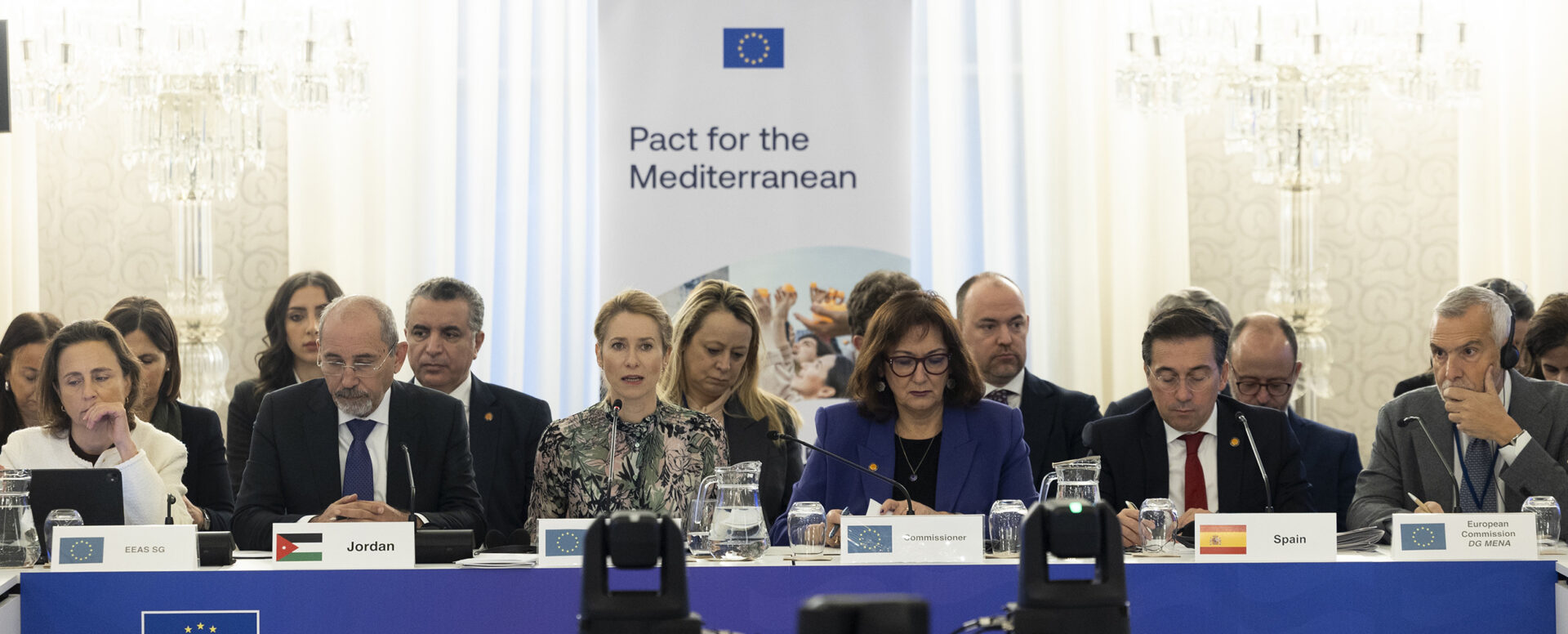
Header Photo: Launching of the Pact for the Mediterranean in Barcelona (28 November 2025). Photo courtesy of Union for the Mediterranean.