


Generation Z has become a convenient label to describe a new wave of youth mobilization across the world. In Mediterranean North Africa, however, it should be used with caution. The grievances associated today with Gen Z — unemployment, blocked mobility, weak public services, corruption, police suspicion, distrust of parties, the desire to leave, etc. — did not start with this generation. They were already central to the anger of the young people who led the Arab uprisings in 2010 and 2011. What changed is the political environment in which these grievances are expressed, and the tools available to express them.
In all the countries of the region, Gen Z has no party, no single leadership, no fixed programme and no unified doctrine. It is visible instead through a style: distrust of formal intermediaries, reliance on social media, rejection of old elites, sensitivity to public services and specific causes, and a capacity to move quickly from online anger to street mobilization. It is also marked by fragmentation. Sometimes it appears as a protest movement. Sometimes it appears as silence, irony, migration, football chants, online denunciation, Palestine solidarity or simply the refusal to accept “politics as usual.”
The paradox is that North Africa today resembles 2011 in many ways, but with less innocence. Socioeconomic conditions are deteriorating, or are perceived to be doing so by many young people. Public services are under pressure. The gap between visible wealth and everyday hardship has become more obscene. Social media circulates images of failure, humiliation, corruption and comparison at a speed that was unimaginable in 2011. Artificial intelligence adds another layer of complexity: many young people are being told to acquire skills for a labour market that is itself being transformed before they even enter it. And AI opens their eyes even more than social media did in 2011. At the same time, the political systems of the region have learned from 2011. They monitor, repress, contain, co-opt and wait. Regimes and youth alike are a grown-up version of their 2011 predecessors.
Uneven National Trajectories
Tunisia
Tunisia illustrates the exhaustion of the post-2011 cycle. It was the country where young people helped bring down a dictatorship, and where the following decade opened unprecedented spaces for parties, elections, civil society, protest and public debate. Yet this opening did not produce durable trust. Political parties fragmented. Parliament became associated with conflict and empty performance in the eyes of many Tunisians. Civil society remained important, but often appeared distant from the language and daily concerns of many young people. For a large part of Tunisian youth, democracy was judged according to what it produced – or did not produce: dignity, jobs, public services, justice, representation and the possibility of a future.
This helps explain the initial youth support for President Kais Saied. While he did not create the anti-party mood, he benefited from it and gave it direction. His rise was made possible by a widespread belief that the post-2011 political class had failed, especially among younger Tunisians whose political socialization occurred during the disappointments of the democratic decade rather than under Ben Ali. Many younger Tunisians initially supported Saied’s July 2021 suspension of parliament and concentration of power, without necessarily anticipating the authoritarian order that followed (although many did not know what they were signing up for at that point).
Yet the post-2021 order did not rebuild youth participation. On the contrary, formal politics narrowed further, electoral participation fell dramatically and the new political system offered little space for meaningful youth representation. An increasingly authoritarian order replaced the imperfect democratic system. The result is more ambiguous than a simple pro-Saied or anti-Saied youth positioning. Some young people welcome the weakening of parties. Some fear repression. Some are indifferent. Many want to leave. Others still rise up around specific causes, mostly through informal organizations.
In Tunisia, therefore, youth politics has moved elsewhere. It appears in online commentary, satire and anger. It appears in professional mobilizations, such as those of young doctors. It appears in local protests, for instance around pollution and public health, like in the southeastern city of Gabes in 2025. It appears in Palestine solidarity, which has given many younger Tunisians a morally clear cause at a time when domestic politics feels compromised. It appears in football terraces, rap, alternative media and youth culture. These are spaces where young people still speak, belong, confront authority and recognize each other.
Algeria
Algeria offers another version of the same problem. The 2019-20 Hirak was not a Gen Z movement in the strict sense. It was intergenerational and national. Yet Gen Z Algerians were central to its rhythm, aesthetics, slogans and digital circulation. The movement opened a political imagination that was not captured by parties; its young leaders did not trust the old opposition. It demanded a different relationship between society and the State. The Hirak eventually collapsed under the combined weight of the pandemic, repression, fatigue and the regime’s capacity to wait out the street. What remains is a more silent political landscape that is not necessarily happy with the results. A generation can be politicized and still not appear in the streets. It can be angry and still stay at home. It can reject the system and still not find a form through which to act, until it does.
Morocco
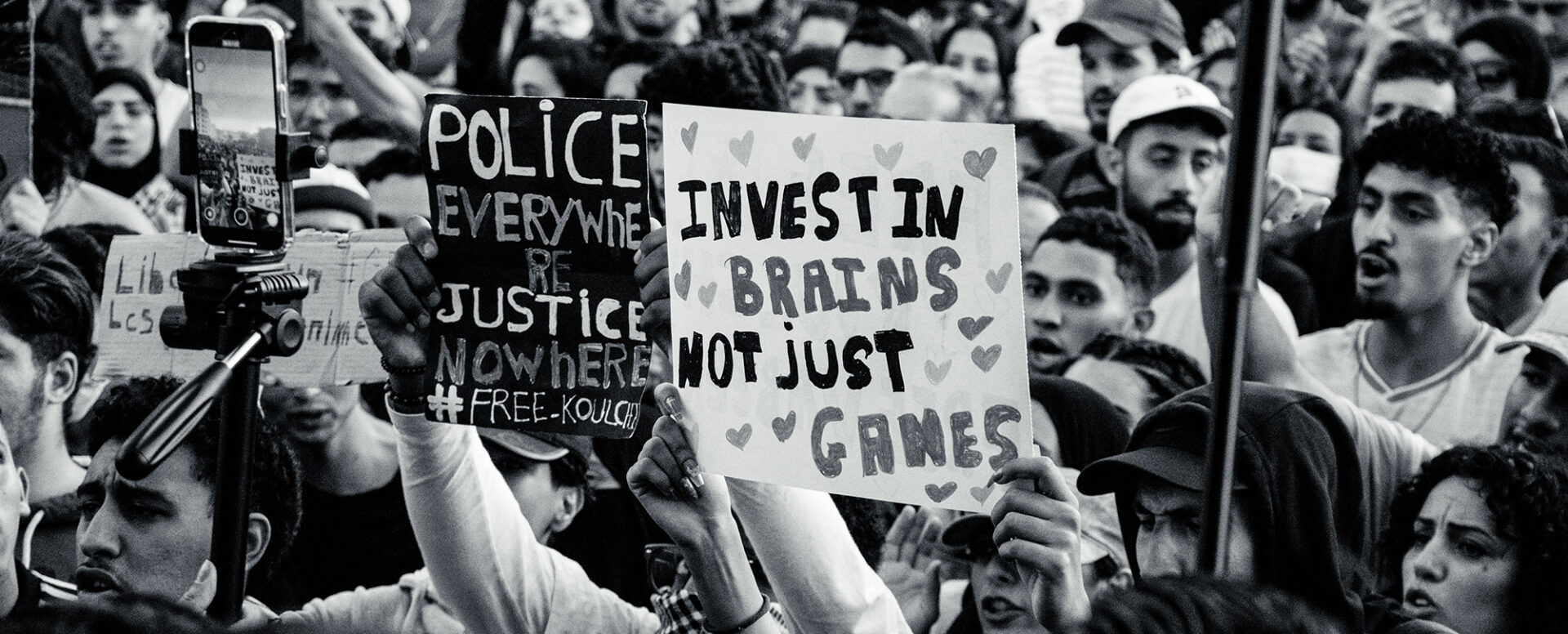
Morocco is the clearest recent case of a Gen Z mobilization. Gen Z 212 was striking because it was digital-native, youth-led and focused on concrete issues: health, education, unemployment and public spending. Its strength came from its simplicity. It did not ask young people to enter an ideological party or wait for a long-term programme. It pointed to a visible contradiction: a country investing heavily in prestige, infrastructure and spectacle (the 2030 World Cup) while many young people experience hospitals, schools and job markets as broken. The Moroccan case shows how quickly youth anger can grow when a specific issue becomes a symbol of wider injustice.
Digital mobilization can embarrass
the State, attract attention and bring
thousands into the streets. But it
still need some form of organization
if they want to transform anger into institutional change
But Morocco also shows the limits of this model. Digital mobilization can embarrass the State, attract attention and bring thousands into the streets. It can force social questions into the national conversation. But it also faces division and the problem of what comes next. Leaderless movements are harder to co-opt, but they are also harder to sustain. They can refuse old politics, but they still need some form of organization if they want to transform anger into institutional change.
Egypt
Egypt represents the other extreme. There, the surveillance state seems to have so far prevented the possibility of a Gen Z movement. The memory of 2011-2013 is still present, and it is also a warning. The cost of mobilization is extremely high. Independent organizations have been weakened, political parties are marginal, universities are monitored and even Palestine solidarity can be risky when it threatens to spill over into domestic criticism. Under these conditions, youth politics survives in coded language, occasional ad hoc movements and online behaviour shaped by self-censorship.
Yet Egypt should not be mistaken for a stable absence of youth politics. It is rather a compressed political field. The grievances are there. Social media still circulates comparison, anger and ridicule, even under surveillance. The Gaza War also showed that public sentiment can be powerful even when the State prevents it from becoming an autonomous movement. It also showed the weakness of the regime in the face of a perceived enemy like Israel. Egypt may look politically closed, but closed systems can accumulate pressure. Sometimes it is the delay of revolt. 2011 is a testimony to this prophecy.
Libya
Libya is different again. There, Gen Z faces weak representation as well as splintered statehood. The country’s young people grew up amid militias, rival governments, insecurity, foreign interference and corruption. Their Millennial predecessors in 2011 had a revolutionary moment, however chaotic and tragic its aftermath became. Gen Z was left to pick up the pieces. In such conditions, youth mobilization becomes local, episodic and often tied to immediate material or security concerns. And when youth mobilize, they face both the wrath of the State and that of the armed militias.
There is also fatigue in Libya. After years of violence, many young people are less interested in grand political narratives. Some are absorbed into local patronage systems, armed structures or migration economies. Others retreat into private life or digital spaces. Where repression elsewhere in the region often takes the form of arrest and prosecution, activism in Libya may also expose young people to abduction or lethal violence.
Overarching Gen Z Themes
Internet
A major difference with the generation of 2011 is the way in which many members of Gen Z acquired their political education. They did not learn politics through political parties, schools, unions or civic programmes, but through screens. On their smartphones, they watched political conflicts, police violence, corruption scandals, wars, migration disasters and the lives of their peers abroad. Gaza, in particular, became a permanent political classroom, while social media allowed them to compare their own blocked futures with what they saw elsewhere. This gave them a strong awareness of injustice and power, but not necessarily a clear understanding of institutions, procedures, representation or political organization.
The same platforms that expose abuses
also circulate rumours, exaggeration,
conspiracy theories, state propaganda
and highly polarized narratives, often
imported from abroad
The same platforms that expose abuses also circulate rumours, exaggeration, conspiracy theories, state propaganda and highly polarized narratives, often imported from abroad. The result differs from one country to another. Egypt represents the extreme case, where surveillance and self-censorship shape what young people can say and how they say it. Morocco showed how online anger could quickly move into the street through Gen Z 212. Tunisia displays a constant flow of digital criticism and mockery, but without an equivalent national mobilization able to transform it into sustained action. In Algeria, social media preserves the images, slogans and memory of the Hirak even after the street movement was contained. In Libya, however, the fragmentation of the State and media landscape makes the emergence of a unified national digital public more difficult. Social media, therefore, has made Gen Z more politically exposed and often more politically conscious, but not necessarily better organized.
Palestine
As for Palestine, it has long been one of the most powerful causes of youth mobilization across North Africa. From Tunisia and Algeria to Morocco, Egypt and Libya, it provided a political language that young people could understand and adopt even when domestic politics was closed. The war on Gaza gave this mobilization a new intensity for Gen Z. Young people followed the destruction in real time, circulated images and testimonies, organized boycotts and demonstrations and connected the Palestinian cause to broader questions of injustice, freedom, dignity and Western double standards.
Yet the space allowed for such mobilization differed from one country to another. In Egypt, solidarity with Palestine became risky whenever it threatened to turn into criticism of the regime. In Morocco, it was complicated by the country’s normalization with Israel. In Algeria, support for Palestine was compatible with official discourse, but autonomous mobilization remained controlled. In Tunisia, it became one of the most visible causes around which young people mobilized after 2021, but, like in Algeria, it had to be under control or the authorities would intervene to contain it. In Libya, the fragmentation of the State prevented a unified national movement, although Palestine remained strongly present in public discourse, and accusations of normalization with Israel continue to be raised by younger Libyans against some of their leaders. Pro-Palestinian action, therefore, is one of the main arenas through which North African youth learn politics, express anger and define their relationship with power, without a formal organization to supervise it.
Football
Football forms another important space of youth mobilization across North Africa, but it plays a different role from Palestine. Palestine provides a moral and transnational cause, whereas football offers local belonging, class identity and regular confrontation with authority. Ultras groups are among the few durable and disciplined youth-led structures operating outside political parties and formal civil society organizations. Stadiums teach forms of collective action, like coordination, loyalty, secrecy and resistance to police control.
Football forms another important space
of youth mobilization across North Africa;
it offers local belonging, class identity
and regular confrontation with authority
In Egypt, ultras played an important role in the political environment surrounding the 2011 uprising and in confronting the security forces later. In Algeria, football songs and supporter culture fed directly into the language, humour and symbols of the Hirak. In Tunisia, stadiums remain spaces where political chants circulate and where campaigns such as Taalam Oum transformed the death of a young football supporter in 2018 into a wider protest against police violence. Morocco has some of the strongest ultras cultures in the region, and their songs frequently address unemployment, corruption, migration and blocked futures. In Libya, football clubs can still provide local identity and collective belonging in a fragmented national setting, although this is limited by militia power and political division. Gen Z may therefore reject parties and formal associations, but it continues to participate in some structured collective spaces that produce political language, solidarity and confrontation.
Self-Representation
Rap, online memes, alternative media and influencer culture form another political space for North African youth. Many reject the language used by governments, political parties, NGOs and traditional media, which they often see as artificial, moralizing or disconnected from their lives. Instead they create their own vocabulary to speak about police violence, migration, neighbourhood life, drugs, unemployment, blocked adulthood, class resentment, etc.
In Tunisia, several artists and youth-led platforms continue to interpret the frustrations of everyday life, emerging year after year, often in ways that challenge official narratives and authority. Algeria and Morocco also have influential rap and supporter cultures that translate social anger into songs, jokes, slogans and visual codes. In Egypt, political expression is more coded because of repression and surveillance, but there is a major underground scene there as well. In Libya, these cultural scenes are less nationally integrated, while social conservatism, fragmented media spaces and coercion constrain their reach. These practices do not produce an organized political movement. They are closer to what Asef Bayat calls a youth “nonmovement,” or the “Battle over fun” (Bayat 2013): dispersed actions that may appear cultural or individual, and non-serious, but that actually transform into an alternative mode of activism.
Migration
Another important expression of youth politics in North Africa is simply exit, very often in an informal way. Migration is usually presented as an economic or personal choice, but it is also a political response to the failure of the state. When governments, parties, elections, protest movements and civil society seem unable to produce change, leaving the country becomes more rational than investing time and energy in collective action. This usually happens during what Alcinda Honwana calls “waithood”: the prolonged period during which young people struggle to find stable employment, secure housing, marry, form a family and gain recognition as independent adults (Honwana, 2012).
Migration is usually presented
as an economic or personal choice,
but it is also a political response
to the failure of the state
Their political project gradually becomes individual escape rather than collective transformation. This helps explain why deep anger and deteriorating living conditions do not always produce visible protest. Yet the desire to leave creates unstable societies, because it coexists with resentment at being unable to leave safely and legally, or at feeling compelled to abandon one’s country in order to build a decent life.
Conclusion
Across North Africa, then, Gen Z is emerging after the exhaustion of the Arab uprisings and the disappointment of the Millennials, after the failure or blockage of democratic transitions, after the weakening of parties and civil society and during a new phase of socioeconomic pressure. It is also emerging in a changing digital environment where young people see everything. This constant exposure creates political awareness, even without immediate mobilization.
This generation is political, but in a different manner. Young people may speak through memes, chants and other means. They may also choose exit over voice, especially when migration appears more realistic than reform. Still, the region is not politically frozen. North Africa is in a permanent 2011-like situation. The ingredients are present: socioeconomic frustration, discredited institutions, digitally connected youth, declining trust and states that appear strong but often fail to deliver.
This generation is political, but
in a different manner. Young
people may speak through memes,
chants and other means
Across the region, surveys repeatedly show that young people are more likely than older generations to consider emigration. The scale differs between countries, but the common pattern is revealing. This applies to growth-champion Morocco, natural resources rich Algeria, impoverished Tunisia, fragmented Libya and military-led Egypt.
All this has implications beyond North Africa. European policies that treat the region’s young people mainly as potential migrants, labour-market beneficiaries or security risks will miss the political meaning of their disengagement. Training programmes, entrepreneurship initiatives and digital connectivity cannot compensate for the absence of representation, credible institutions and public services. Gen Z mobilization may remain fragmented, cultural or episodic, but it is already revealing the limits of political systems that look presentable to European capitals, offer stability without participation and economic reform without a convincing future. It may also reappear suddenly and with force, as it did in Morocco in 2025, when a concrete event crystallized wider resentments.
References
Bayat, Asef. Life As Politics: How Ordinary People Change the Middle East. Stanford University Press, 2013. https://www.sup.org/books/middle-east-studies/life-politics.
Honwana, Alcinda. The Time of Youth: Work, Social Change, and Politics in Africa. Lynne Rienner Publishers, 2012.
Header photo: A Gen-Z protest in Morocco. July 6, 2025. Pexels.