




Artificial intelligence is transforming labour markets and economies across the Mediterranean, but its effects vary considerably across the region. While debates in high-income economies have focused on AI’s implications for productivity and the automation of professional occupations, developing economies face a different set of constraints. AI is being introduced into labour markets characterized by widespread informality, high youth unemployment, limited social protection and constrained fiscal capacity. The central question is therefore not only how AI will affect employment, but how its risks and benefits will be distributed across countries with widely differing economic capabilities and within societies divided between a relatively small formal, skilled workforce and a much larger informal and precariously employed population.
This paper examines how AI is reshaping labour markets and paths to productivity gains across the Mediterranean, with particular attention to North African and Middle Eastern countries. It argues that without deliberate industrial policy, sustained investment in digital skills and efforts to build domestic technological capabilities rather than relying primarily on imported AI systems, AI is likely to widen inequalities both within and across countries and reinforce dependence rather than promote inclusive development. These concerns are reflected in existing measures of AI readiness. The IMF’s AI Preparedness Index shows a strong correlation between AI preparedness and income levels, with most MENA economies remaining well below OECD countries. Disparities within the wider region are equally pronounced: while Gulf states are investing heavily in AI infrastructure and sovereign AI strategies, much of North Africa and the Levant remain at an earlier stage of digital infrastructure development.
The analysis focuses on developing Mediterranean economies and therefore does not examine the European Mediterranean in detail. Nevertheless, southern Europe remains an important part of the regional AI landscape as the principal market for North African nearshore outsourcing and an important source of investment, technology transfer and regulatory influence. European AI and industrial policies will therefore shape how neighbouring developing economies are integrated into emerging AI value chains. The paper draws on the task-based automation framework (Acemoglu and Restrepo, 2019), the literature on adverse incorporation (Heeks, 2021) and evidence from international organizations and the region’s IT outsourcing and business process outsourcing industries.
A Task-Based Framework for Understanding AI’s Labour Market Effects
Much of the popular discourse on AI and jobs treats automation as a binary threat: either a task is done by a machine or it is done by a person, and every technological advance simply shifts employment from the latter category to the former. Efforts in the emerging economic literature, have put forward models that decompose production into a continuum of tasks, some allocated to labour and some to capital. Automation shifts the task boundary in favour of capital, producing a displacement effect: workers previously performing a task lose that portion of demand for their labour (Acemoglu and Restrepo, 2019). But technological change also creates entirely new tasks, often ones that did not previously exist, in which labour retains a comparative advantage. This is the reinstatement effect, and historically it has been the dominant countervailing force against technological unemployment (Acemoglu and Autor, 2011; Acemoglu and Restrepo, 2019). Whether AI is net job-destroying or job-creating in a given economy depends empirically on the relative strength of these two effects, which in turn depends on the composition of that economy’s existing task content, its skills base and its capacity to generate genuinely new economic activity around the technology.
MENA labour markets are, on average,
less directly exposed to automation
and AI precisely because of high
informality and uneven digital readiness
This framework matters enormously for the Middle East and North Africa, because the region’s task content of production differs systematically from that of the advanced economies where most automation research has been conducted. Three structural features stand out. First, informality. The World Bank’s regional flagship report notes that MENA labour markets are, on average, less directly exposed to automation and AI precisely because of high informality and uneven digital readiness. This is a symptom of a structural problem: informal, low-productivity work is simply less amenable to substitution by capital in the short run, but it also means the region risks missing out on the productivity gains from AI altogether while remaining fully exposed to the indirect and second-order effects of automation abroad (World Bank, 2025). The risk is not displacement in the narrow occupational-exposure sense used in Global North studies; it is a widening of the productivity gap that entrenches informality rather than resolving it.
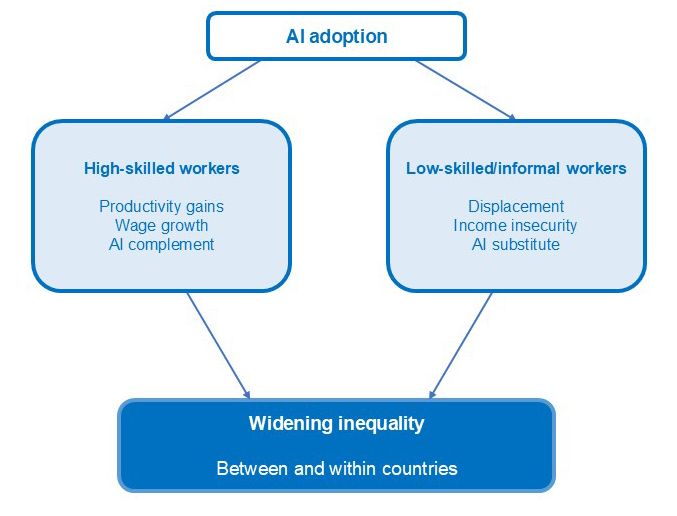
CHART 1 AI Adoption Inequality
Second, public sector dominance in formal employment. Across much of the region, and particularly in Algeria and Egypt, the public sector remains the single largest formal employer, especially for university graduates. Public administration is precisely the kind of routine-task-intensive, rules-based environment that generative AI and robotic process automation are best suited to disrupting, from document processing to case management to basic legal and administrative drafting. Because public employment in the region has historically functioned as an implicit welfare and legitimacy mechanism as much as a productive one, AI-driven efficiency gains here carry political economy implications well beyond the labour market.
Public employment in the region has historically
functioned as an implicit welfare and legitimacy
mechanism as much as a productive one,
AI-driven efficiency gains here carry political
economy implications
Third, a youth bulge colliding with weak job creation. The World Bank’s MENA jobs agenda underscores that some 300 million young people are projected to enter regional labour markets over the next 25 years, at a time when GDP growth of roughly 3.3 percent annually since 2000 has not translated into commensurate job creation (World Bank, 2025b). This means that the reinstatement effect – new tasks, new firms and new sectors – must do considerably more work in this region than in ageing, labour-scarce economies, simply to keep pace with demography, before it can be credited with absorbing any workers displaced by automation.
Adverse Integration into the Global AI Economy
The dominant framework for understanding digital inequality has long been the digital divide, which views inequality as a problem of exclusion: some populations remain outside the digital economy because they lack connectivity, devices or digital skills. Heeks (2021) argues that this framing has become inadequate as digital engagement has expanded across the Global South because it cannot explain why inequality often persists, or even widens, as digital inclusion deepens. He therefore introduces the concept of adverse digital incorporation, which describes inclusion on terms that allow more powerful actors, such as platforms, multinational firms or states, to extract disproportionate value from the labour, data or resources of less powerful participants. From this perspective, inequality arises not from exclusion but from the conditions of inclusion. The same logic applies to AI: participation in AI systems can reinforce existing inequalities when the gains from adoption accrue disproportionately to those who control the underlying technologies, data and infrastructure.
Mainstream frameworks have largely focused on concepts of AI access and readiness. The IMF’s AI Preparedness Index evaluates economies across four pillars: digital infrastructure, human capital and labour market policy, innovation and economic integration, and regulatory and ethical frameworks (International Monetary Fund, 2024). Two patterns clearly emerge from applying this framework to the Mediterranean and Middle East. The first is a sharp intra-regional divide. Analysis by the International Institute for Strategic Studies finds that of the roughly US$320 billion in AI-related economic gains projected for the Middle East by 2030, itself only around 2 percent of an estimated US$15.7 trillion global total, the overwhelming majority is expected to accrue to Saudi Arabia, the UAE and, to a lesser extent, Egypt, with the rest of the region receiving a negligible share (IISS, 2025). Disparities in fiscal space, energy availability and water resources, themselves inputs into the datacentre and compute infrastructure that AI requires, are driving this divergence, with poorer countries in the region at risk of falling further behind even as their wealthier neighbours accelerate (IISS, 2025).
CHART 2 AI Preparedness Index in Selected Mediterranean and Gulf Economies
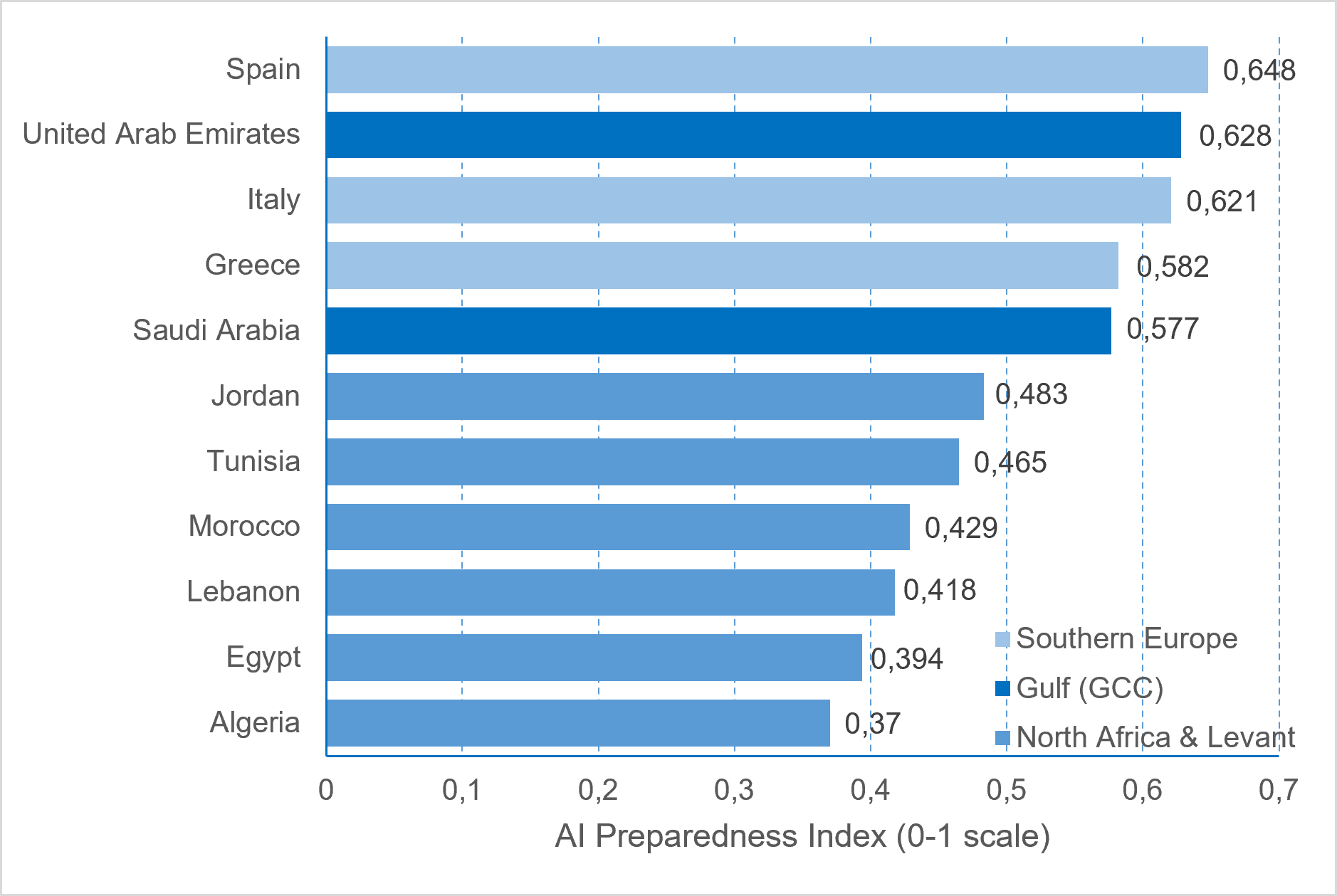
The second pattern is that digital readiness across the Arab world does not map neatly onto income alone. Existing classification places Egypt, Jordan, Lebanon, Morocco and Tunisia in an intermediate “digital potential” tier, above lower-readiness states such as Algeria, Libya and Mauritania, but well below the GCC “digital leaders” (Arab Reform Initiative, 2026). This intermediate positioning is significant: these are precisely the economies with sufficient human capital and digital infrastructure to plausibly capture some of the AI-driven productivity gains, provided complementary skills and regulatory investments are made, but they are also exposed to the risk of being squeezed between low-cost, low-skill competitors and higher-value Gulf and European AI ecosystems if those investments are not made.
A joint ESCWA–ILO Regional Office for Arab States study, Artificial Intelligence and Employment Futures for the Arab Region, models three alternative scenarios for employment, skills and productivity out to 2035, explicitly incorporating the region’s large informal sector into its projections (ESCWA and ILO-ROAS, 2025). This is methodologically important: as work on AI exposure in other high-informality contexts has argued, occupational exposure measures built for formal, contract-based labour markets systematically understate, or simply misdescribe, the actual livelihood exposure facing informally employed and self-employed workers, who may lose income through AI-driven price competition or platform disintermediation without formally losing a “job” that shows up in unemployment statistics.
However, beyond exposure and preparedness gaps, there is a deeper structural risk that these indices do not fully capture: the terms on which North Africa and the Levant are being drawn into global AI value chains may themselves be unfavourable, independent of how “ready” a country’s infrastructure or skills base is. Rather than treating exclusion from a system as the central risk, the classic “digital divide” framing, the framework of adverse digital incorporation argues that inclusion itself can be the mechanism of disadvantage, where a more advantaged party extracts disproportionate value from the labour or data of a less advantaged one (Heeks, 2021). Applied to AI, this reframes the regional question: the risk is not only that Algeria, Egypt or Jordan might be left behind by AI, but that they are already being incorporated into AI value chains on adverse terms, as sources of cheap human labour for data annotation and content moderation, as low-margin nodes in outsourced customer service now being displaced by the very models their labour helped train, and as consumers and licensees of AI systems developed, trained and owned entirely outside of the region, with the associated rents accruing to firms and states elsewhere.
The risk is not only that Algeria, Egypt
or Jordan might be left behind by AI,
but that they are already being incorporated
into AI value chains on adverse terms
This dynamic parallels long-standing critiques of the global value chain literature, which has shown that participation in global production networks does not automatically translate into inclusive upgrading, and can instead reproduce and deepen inequality between lead firms and dependent suppliers and workers elsewhere. For developing Mediterranean countries, the practical implication is that measures of AI “preparedness” or “exposure” alone are insufficient: a country can score reasonably on infrastructure and human capital while remaining structurally locked into a subordinate position in the AI economy, absent a deliberate strategy to build domestic technological capability rather than simply consuming and servicing AI built elsewhere.
The Risks: Deepening Inequality and Labour Displacement in an Already Strained Labour Market
The previous sections established, respectively, why the region’s task content of production differs from that of the advanced economies where automation research originated, and why exposure or readiness indices understate the risk by treating AI adoption as a matter of capacity rather than of the terms on which countries are incorporated into AI value chains. This section moves from theory to consequence: which workers and which countries are likely to bear the resulting costs, and through what concrete channels.
Where Displacement Is Likely to Land First
As mentioned earlier, the occupations most immediately exposed to generative AI are concentrated in exactly the segments that have historically absorbed university graduates and lower-skilled formal-sector workers alike: routine administrative and clerical work, translation, basic accounting, first-line customer service and paralegal drafting. ESCWA’s Skills Monitor work, tracking online job postings across the Arab region, finds a persistent and widening mismatch between the skills regional education systems produce and the skills employers demand, with traditional clerical and administrative skill sets losing relevance faster than digital and AI-adjacent skills are being acquired (ESCWA, 2021; ESCWA, 2023). The region’s outsourcing and offshoring industry sits squarely in this exposed segment. Voice-based customer relationship management, still the largest single component of Moroccan digital-export revenue (TechAfrica News, 2025), and entry-level BPO work in Egypt, priced explicitly on labour-cost advantage over competitors such as Poland and Turkey (Link Development, 2024), are precisely the tasks that conversational AI agents substitute most readily. This means that the region’s most dynamic job-creation engine of the past decade is also one of its most automatable.
A Widening Gap between Countries
The resources needed to manage this transition — fiscal space to fund reskilling, sovereign investment in compute and AI infrastructure — are distributed as unevenly as AI’s benefits themselves. Saudi Arabia’s data authority alone has trained several hundred thousand citizens in data and AI skills (Alshahrani et al., 2025), a scale of investment no non-Gulf economy in the region can approach. Algeria, Tunisia and Jordan are contending with the same displacement pressures on far thinner fiscal margins, which means the gap in outcomes is likely to widen even where the initial exposure to AI is similar. This is a distributional risk that compounds, rather than simply mirrors, the structural position described in the previous section: countries with weaker fiscal capacity are less able to intervene in the terms of their own incorporation into AI value chains and are simultaneously less able to cushion the domestic labour market consequences of that incorporation.
A Widening Gap within Countries
The same asymmetry recurs domestically. A relatively small, urban, well-educated cohort is positioned to use AI as a productivity-enhancing complement – precisely the workers with the formal contracts, employer-provided training and bargaining power to renegotiate their tasks rather than simply lose them. The much larger informally employed and underemployed population has none of these protections, and, as noted previously, often does not appear in formal exposure statistics at all even when its livelihood is affected through price competition or the erosion of informal service niches. The result is not simply “more” inequality but a specific kind: displacement concentrated among those least able to absorb it, and productivity gains concentrated among those already best positioned in the labour market.
Weak Governance as a Risk Multiplier
The region’s regulatory starting point offers little protection. Regulatory and ethical frameworks are, globally, the weakest pillar of the IMF’s AI Preparedness Index, and nearly half of countries assessed score zero on national AI policy (International Monetary Fund, 2024). Most economies in the MENA region currently lack binding data protection or algorithmic accountability frameworks capable of governing AI use in hiring, credit allocation or public administration. Absent such frameworks, the displacement and inequality risks identified above are more likely to be resolved in favour of capital and against labour, since affected workers have little institutional recourse, turning a set of risks that are, in principle, manageable through policy into outcomes that are simply allowed to occur.
The Opportunities: Digital Industrial Policy as the Central Lever
The risks above are real, but a one-sided narrative of displacement would misread both the theory and the regional evidence. The opportunities set out below are not, however, opportunities that materialize automatically from AI adoption itself; each depends on a deliberate digital industrial policy to redirect adoption towards capability-building rather than passive consumption. Industrial policy is the thread connecting every opportunity discussed in this section: without it, the same technologies discussed below are just as likely to reproduce an instance of adverse integration.
Digital Industrial Policy as a Precondition, Not an Afterthought
Historically, successful late industrializers built domestic technological capability through deliberate state intervention, targeted protection, public investment in skills and research infrastructure, and conditionalities placed on foreign investment and technology transfer, rather than through unmanaged exposure to global markets. The same logic applies to AI. Morocco’s explicit reframing of its offshoring strategy away from “low-cost labour models” towards “high-value digital services” (Outsource Accelerator, 2026) and Jordan’s National AI Strategy and Implementation Plan, which sets out 68 targeted projects across data governance, digital skills and AI-enabled public services with the explicit ambition of positioning Jordan as a regional hub for high-value technology services rather than a passive adopter (Digital Watch Observatory, 2025), are early examples of digital industrial policy in the region. These are attempts to use state coordination to shape where in the AI value chain domestic firms and workers sit. The central policy claim of this paper is that the difference between AI as a source of adverse integration and AI as a source of productive transformation is precisely this kind of deliberate industrial policy, not the technology itself.
Productivity Gains in a Chronically Low-Productivity Region
MENA’s core economic problem over the past quarter of a century has not been an absence of employment growth per se, but the absence of productivity-driven growth: the World Bank’s decomposition of regional GDP growth into population, participation and productivity components finds that productivity per worker has contributed disappointingly little to the region’s growth since 2000 (World Bank, 2025b). AI-enabled tools, in logistics optimization, agricultural precision farming, energy grid management and public administration, represent a rare opportunity to raise total factor productivity in economies where capital deepening alone has repeatedly failed to do so. But realizing this requires industrial policy to direct adoption towards productive sectors and domestic firms, rather than allowing productivity gains to flow disproportionately to foreign technology vendors and a narrow set of capital owners, which would raise aggregate output while doing little for employment or domestic firm capability.
The Reinstatement Effect: New Tasks in Digital Services Exports, If Upgrading Is Actively Managed
The same offshoring and outsourcing industry that faces displacement risk in its lower-value segments also represents the region’s best-positioned sector to capture the reinstatement effect, but only where governments actively manage the transition. Morocco’s shift towards IT outsourcing and knowledge process outsourcing mirrors the early stages of India’s trajectory followed two decades earlier, moving from voice-based call centre work up the value chain into software development, AI model fine-tuning, data annotation and localization, and consulting (Atlas Brief, 2026). Egypt’s positioning as a hub not only for BPO but also for digital transformation consulting and technology parks points in the same direction (Link Development, 2024), while Jordan’s ICT sector body has set an explicit, state-endorsed target of doubling its ICT workforce by 2033, partly by capturing global talent shortages in AI-adjacent skills. Left to firms alone, however, there is no guarantee that automation of the low-value layer is matched by reinvestment in higher-value services; this is precisely where industrial policy, co-investment in firm-level upgrading, conditional incentives tied to skills transfer and public investment in shared digital infrastructure, determines whether the reinstatement effect actually materializes domestically or whether the gains accrue to foreign clients and platform owners while domestic workers absorb the displacement.
New Occupational Categories and the AI Value Chain
Global evidence on reinstatement is instructive here: AI engineering as an occupational category has grown extremely rapidly worldwide, and demand for AI-adjacent skills — prompt engineering, model evaluation, data curation and annotation, AI ethics and compliance — is a genuinely new task category with low barriers to entry relative to, say, semiconductor manufacturing (Ur Rehman et al., 2026, discussing the reinstatement effect empirically). The region’s relatively young, increasingly digitally literate population and its existing base of Arabic-language digital content and linguistic expertise represent a plausible comparative advantage in the fast-growing market for Arabic-language AI model training, data annotation and localization, Jordan alone already produces a disproportionate share of Arabic-language web content relative to its population (Trade.gov, 2026). But comparative advantage in raw language data is not the same as comparative advantage in owning and monetizing the resulting models; without a deliberate industrial policy to build domestic capability in model development, curation standards and data governance, the region risks supplying the raw material for Arabic-language AI while the value, and the associated intellectual property, is captured by firms headquartered in the United States or China.
Conclusion
This paper has argued that the consequences of artificial intelligence for developing Mediterranean economies cannot be understood through the narrow lens of automation alone. Drawing on the task-based framework of technological change, it showed that AI will generate both displacement and reinstatement effects, but that the balance between them will depend on countries’ productive structures, skills base and capacity to create new, higher-value economic activities. It further argued that existing measures of AI exposure and readiness are insufficient because they overlook the terms on which countries are integrated into the global AI economy. Building on Heeks’ concept of adverse digital incorporation, the paper demonstrated that AI may deepen inequalities not simply by excluding countries from technological progress, but by incorporating them into AI value chains on subordinate terms, as providers of low-value labour, data and services while the ownership of technology, intellectual property and economic rents remains concentrated elsewhere.
These dynamics are likely to be particularly acute across North Africa and the Levant. High levels of informality, weak labour market institutions, limited fiscal capacity and dependence on imported technologies increase the risk that AI will widen inequalities both within and between countries. At the same time, the region possesses important assets – a young population, expanding digital services sectors and growing technical capabilities – that could allow AI to become a source of productivity growth, economic diversification and higher-value employment. Whether this potential is realized, however, will depend less on the technology itself than on the policies that shape its adoption.
AI is not an exogenous technological shock to which
governments simply adapt. It is a political
and economic transformation whose distributional
consequences are profoundly shaped by state action
The central implication is, therefore, that AI is not an exogenous technological shock to which governments simply adapt. It is a political and economic transformation whose distributional consequences are profoundly shaped by state action. Digital industrial policy should not be viewed as a complementary measure introduced after AI adoption, but as the primary mechanism through which countries determine whether AI reinforces dependency or builds domestic technological capability. Investment in digital infrastructure, skills, research, regulatory capacity and domestic innovation ecosystems is essential if developing Mediterranean economies are to capture a greater share of the value created by AI rather than merely supplying the labour, data and markets on which that value depends.
Ultimately, the question is not whether developing Mediterranean economies will participate in the AI revolution, they already are. The more consequential question is the terms of that participation. Without deliberate efforts to move beyond technological consumption and low-value service provision, AI risks reproducing existing patterns of uneven development in a new technological form. With sustained investment in domestic capabilities and an ambitious digital industrial strategy, however, AI could instead become a catalyst for structural transformation, productivity growth and more inclusive development across the region.
References
Acemoglu, D. and Autor, D. “Skills, Tasks and Technologies: Implications for Employment and Earnings.” in Handbook of Labor Economics, Vol. 4B. Amsterdam: Elsevier, 2011, pp. 1043–1171.
Acemoglu, D. and Restrepo, P. “Automation and New Tasks: How Technology Displaces and Reinstates Labor.” Journal of Economic Perspectives, 33(2), 2019, pp. 3–30.
Alshahrani, A. et al. “Artificial Intelligence and the Gulf Cooperation Council Workforce: Adapting to the Future of Work.” 2025, arXiv preprint, arXiv:2511.05927.
Arab Reform Initiative. “AI in the National: AI Strategies of the Arab Region.” 2026. Available at: www.arab-reform.net/.
Bessemer Venture Partners. “Roadmap: Reinventing IT Services in the Age of AI.” Atlas, Bessemer Venture Partners, 2025.
Digital Watch Observatory. “Jordanian Artificial Intelligence Strategy and Implementation Plan (2023–2027).” 2025.
Economic and Social Commission for Western Asia (ESCWA) Skill Diversification in the Arab Region. United Nations Digital Library, 2021.
Economic and Social Commission for Western Asia (ESCWA). “Skills Trends in the Arab Region in the Wake of ChatGPT (Generative AI).” ESCWA Policy Brief E/ESCWA/CL2.GPID/2023/CP.1, 2023.
Economic and Social Commission for Western Asia and International Labour Organization Regional Office for Arab States (ESCWA and ILO-ROAS) Artificial Intelligence and Employment Futures for the Arab Region. Beirut: United Nations ESCWA, 2025.
Heeks, R. “From Digital Divide to Digital Justice in the Global South: Conceptualising Adverse Digital Incorporation.” Centre for Digital Development, Global Development Institute, University of Manchester, 2021.
Information and Communications Technology Association of Jordan (int@j). “Jordan’s ICT Sector Aims to Double Workforce by 2033.” 2025.
International Institute for Strategic Studies (IISS). “The Uncertain Dividends of AI in the Middle East.” IISS Online Analysis, 27 May 2025.
International Monetary Fund AI Preparedness Index (AIPI): Technical Note. Washington, DC: IMF. 2024. (Underlying methodology: Cazzaniga, M. et al., 2024.)
Link Development (2024). “The Rise of Egypt as a Global IT Offshoring Hub.” Available at: linkdevelopment.com.
Outsource Accelerator. “Morocco Revamps Offshoring to Boost Digital Economy by 2030.” 3 February 2026.
Ponte, S. et al. “From the Editors: Global Value Chains and Economic Inequality.” Journal of International Business Studies, 2026 (editorial), on adverse inclusion and exclusion mechanisms in GVC governance.
TechAfrica News. “Morocco’s Tech and Outsourcing Sector Drives $2.8 Billion in Exports.” 24 October 2025.
Trade.gov. “Jordan: Digital Economy.” U.S. International Trade Administration Country Commercial Guide, 2026.
Ur Rehman, et al. “AI Civilization and the Transformation of Work.” 2026, arXiv preprint, arXiv:2603.27497.
World Bank Embracing and Shaping Change: Human Development for a Middle East and North Africa Region in Transition. Washington, DC: World Bank, 2025a.
World Bank. “A Jobs Agenda for the Middle East and North Africa.” World Bank Blogs (Arab Voices), 6 March 2025b.
Header photo: Lightspring / Shutterstock.