


Formal negotiations over the global framework that will succeed the United Nations’ 2030 Agenda for Sustainable Development (i.e. the post-2030 Agenda) will begin next year. For the Mediterranean, these discussions provide a rare opportunity to shape a future global sustainable development governance framework that better reflects the realities of one of the world’s most climate-exposed and geopolitically interconnected regions.
This article argues that Mediterranean actors should enter the post-2030 debate by advancing a regional framework — such as a Mediterranean Just Transition framework — that builds on the 2030 Agenda by providing a shared approach to managing the region’s interconnected transitions across climate action, water security, resilient food systems and energy systems, while ensuring that social justice remains at the centre. Many of the institutional foundations for such an approach already exist. The challenge is to connect them into a coherent, political vision.
The 2030 Agenda and the Paris Agreement: More Than a Decade Later
In 2015, the international community adopted the 2030 Agenda for Sustainable Development and its 17 Sustainable Development Goals (SDGs), replacing the Millennium Development Goals (MDGs). Emerging from the 2012 Rio+20 Summit and a three-year UN consultation process, the SDGs redefined sustainable development as a universal agenda, linking social, economic and environmental objectives under five pillars — People, Planet, Peace, Prosperity and Partnerships — with the overarching commitment to “leave no one behind” (UN, 2015). The Paris Agreement, adopted later that year, complemented this vision by committing countries to limit global warming to well below 2°C, while pursuing efforts to stay within 1.5°C above pre-industrial levels.
Together, the SDGs and the Paris Agreement established a shared vision for the future, reflecting the notion that sustainable development and climate action are deeply interconnected and mutually reinforcing. Synergies across the SDGs (and between the SDGs and NDCs) generally outweigh trade-offs (Iacobuţă et al., 2021; Pradhan et al., 2024).
More than a decade later, implementation has fallen well short of expectations. No country is on track to achieve all the SDGs by 2030, while successive crises have stalled or reversed progress and widened existing inequalities. The Mediterranean mirrors these disparities, with countries of the northern basin performing far better on the SDG Index than many countries on the southern shore.
Indeed, the SDGs have provided a powerful common language, but far less evidence of transformative political change (Biermann, 2025). Financing gaps, fragmented governance, weak political commitment and the Covid-19 pandemic have all undermined implementation. Peacefulness is at a historic low and global fragility at an unprecedented level, according to the 2025 Global Peace Index and the OECD 2025 States of Fragility Report respectively. At the same time, critics question whether the SDGs’ emphasis on economic growth is compatible with ecological limits (Kotzé, 2018; Adelman, 2018). The Paris Agreement faces similar shortcomings: the first Global Stocktake issued at COP28 in Dubai confirmed that the world remains off track to meet its climate goals; 2024 became the first calendar year in which the global mean temperature exceeded 1.5°C above pre-industrial levels.
What Comes after 2030 and Why Does It Matter for the Mediterranean?
With only four years remaining until the end of the 2030 Agenda, attention is increasingly turning towards the future of global sustainable development governance. Formal negotiations on a successor framework are expected to begin at the UN High-Level Political Forum (HLPF) in September 2027. However, discussions among governments, international organizations, researchers and civil society actors are already well underway, with competing visions emerging for what should follow.
One of the most widely discussed options is to extend the implementation horizon towards mid-century, allowing additional time to achieve an agenda that was unprecedented in its scope and level of political agreement among countries (see Fuso Nerini et al., 2024). Others advocate expanding the framework through the inclusion of new goals, such as those addressing animal health and welfare, in response to criticisms that the SDGs remain overly anthropocentric in their framing (Verkuijl et al., 2025). Conversely, some have called for a more streamlined approach, with fewer and more focused goals, citing concerns that the current SDG architecture has become too broad and complex for effective implementation.
While the Mediterranean is a bio-region shaped by shared
environmental systems and socioeconomic pressures,
it does not align neatly with the geopolitical categories
that structure much of the multilateral system
The debate around the post-2030 Agenda is particularly significant for the Mediterranean, a region where climate change, environmental pressures, and geopolitical instability have had compounding impacts since 2015. The Mediterranean is widely recognized as a climate hotspot, warming approximately 20 per cent faster than the global average. Yet climate impacts are far from uniform across the region. Recent evidence highlights substantial spatial differences, with particularly severe consequences from rising temperatures, prolonged droughts and shifting precipitation patterns in the Levant, the Adriatic, the Aegean and the Iberian Peninsula (Lazoglou et al., 2024).
At the same time, Mediterranean countries face growing exposure to interconnected geopolitical and socioeconomic shocks. The war in Ukraine deepened food insecurity across North Africa, particularly in major wheat-importing countries such as Egypt and Tunisia by disrupting grain and fertilizer supply chains. Conflicts in Lebanon and Palestine have further strained regional stability, while escalating tensions around the Strait of Hormuz have underscored the vulnerability of energy systems and markets across the region. These pressures are compounded by persistent regional asymmetries in governance capacity, economic resilience, trade integration and access to critical resources, which shape countries’ ability to absorb and respond to such shocks.
These interconnected challenges highlight the need for governance approaches that better match the scale and nature of the risks facing the Mediterranean. The post-2030 Agenda debate increasingly recognizes the importance of regional implementation, with the 2026 Sustainable Development Report emphasizing the role of “effective global, regional and national governance frameworks” (Sachs et al., 2026, p.ix). Yet, the Mediterranean is not addressed as a distinct regional space in the report.
This reflects a broader institutional challenge: while the Mediterranean is a bio-region shaped by shared environmental systems and socioeconomic pressures, it does not align neatly with the geopolitical categories that structure much of the multilateral system. Unlike the UN’s official regional groups, which are organized primarily around geopolitical blocs, Mediterranean cooperation is advanced through dedicated regional frameworks and institutions, including the Union for the Mediterranean (UfM), which holds Observer Status at the UN. The question for the Mediterranean is how to shape a global governance framework capable of addressing the interconnected transitions that will define the region’s future, while overcoming the institutional gaps that currently limit its ability to influence global sustainability agendas.
The Mediterranean Has the Foundations, but Not Yet One Post-2030 Agenda Framework
The Mediterranean does not enter the post-2030 debate without institutional foundations. Over the past decade, a wide range of regional organizations, monitoring mechanisms and policy initiatives have been addressing the SDGs in numerous ways. While they provide many of the building blocks for a regional post-2030 Agenda framework, they are often organized around individual institutions, sectors or policy priorities rather than a shared vision of transformation. Some of these initiatives also remain outdated.
A first foundation lies in knowledge generation and sustainability monitoring. The Mediterranean Observatory on the Environment and Sustainable Development, established under Plan Bleu within the framework of the United Nations Environment Programme (UNEP)/Mediterranean Action Plan (MAP) and the Barcelona Convention, has played a central role in this area. Its Mediterranean Sustainability Dashboard has been an important tool for tracking regional progress, but its updates have become increasingly sparse. The latest data available date back to 2021, while the 2024 quantitative evaluation of the Mediterranean Strategy for Sustainable Development (MSSD) for 2016–2025 relied largely on data collected between 2019 and 2022. Comparable challenges can be observed elsewhere, including in the Sustainable Development Solutions Network Mediterranean (SDSN Med), whose latest comprehensive assessment of the 24 Mediterranean countries was published in 2021. Similarly, the Simplified Peer Review Mechanism (SIMPEER) for National Strategies for Sustainable Development has not been updated since 2019.
Beyond monitoring, regional institutions have also developed broader sustainability strategies that reflect the interconnected challenges facing the Mediterranean. Although many of these initiatives extend beyond 2030, they have not yet been presented as part of a wider post-2030 Agenda contribution. Among them is the revised MSSD for 2026–2035, coordinated by UNEP/MAP and the Mediterranean Commission on Sustainable Development (MCSD), adopted in Cairo last December. While the full strategy document has not yet been published, its announced priorities signal a more integrated approach, linking climate action, ecosystem restoration, sustainable resource management, food and water systems, resilient cities, circular economies, sustainable finance and strengthened governance and partnerships (UNEP/MAP, 2026).
At the European level, the European Union’s Pact for the Mediterranean, launched in November 2025 and complemented by an implementation Action Plan in April 2026, introduced a broader vision for EU–Mediterranean cooperation. Structured around three pillars — people as a driver of change; stronger and more sustainable integrated economies; and security, preparedness and migration management — the Pact brings together social, economic, environmental and security dimensions within a single framework (European Commission, 2026).
Similarly, the UfM launched its first Climate Action Plan in July 2026, seeking to enable a more structured approach to regional climate cooperation (see European Commission, 2025). Building on the 2021 Ministerial Declaration by UfM Ministers responsible for the Environment and Climate Action, the Plan provides an opportunity to position Mediterranean climate action more explicitly within emerging post-2030 discussions and strengthen links between climate and sustainable development pathways.
The Rise of Just Transition Policy in the Mediterranean
While the SDGs provided a common set of objectives and indicators, the scale and interconnectedness of current challenges require governance approaches focused on managing complex transitions across sectors, territories and societies, and in ways that place justice at the centre. Across the Mediterranean, the language of transition is already increasingly prominent and provides the foundations for a Mediterranean Just Transition framework.
For example, the Mediterranean Commission on Sustainable Development (MCSD) has explicitly centred its work on the green transition (UNEP/MAP, 2025), while the renewed MSSD has placed climate adaptation, energy security and the energy transition at the heart of regional cooperation (UNEP/MAP, 2026, p. 13). These priorities are to be translated into concrete initiatives within the Strategy, from TERAMED’s ambition to deliver 1 TW of renewable energy capacity by 2030 to the Mediterranean Experts on Climate and Environmental Change (MedECC), whose forthcoming Second Mediterranean Assessment Report (MAR2) will include a dedicated chapter on “Societal Transformation for a Sustainable Future.” Similarly, the UfM 2030GreenerMed Agenda, launched in 2021 and updated and validated earlier this year, identifies support for the transition towards a green, circular and socially inclusive economy as its first priority.
The scale and interconnectedness of current
challenges require governance approaches
focused on managing complex transitions
across sectors, territories and societies
A similar emphasis on systemic transformation underpins the UNEP/MAP–Plan Bleu MED 2050 foresight exercise. Rather than predicting a single future, MED 2050 explores alternative development pathways, several of which envisage profound changes in governance, production systems and North–South cooperation (Plan Bleu, 2025). One scenario proposes a specifically Mediterranean model of sustainable development based on “strong sustainability,” requiring fundamental transformations in economic models, living conditions and governance structures, alongside more balanced regional relations (ibid.). Another envisages a renewed Euro-Mediterranean partnership centred on a “blue-green” transition, including through the extension of the EU Green Deal – whose Just Transition framework is a critical component – to the Mediterranean via a proposed Mediterranean New Deal.
At the same time, transition governance raises questions about who benefits, who bears the costs and how decision-making processes can be made more inclusive. For example, MedWaves, one of UNEP/MAP’s six Regional Activity Centres, has advanced a Just Transition perspective on the circular economy, emphasizing that sustainability policies must be designed around several principles of justice, including: procedural (i.e. fairness in decision-making), distributive (i.e. fair allocation of costs and benefits), recognition (i.e., recognizing who is most impacted) and restorative (i.e., addressing and redressing past harms) (MedWaves, 2026). Such policy discourse reflects a broader shift away from the implementation of individual goals towards the governance of interconnected transitions across climate, energy, the circular economy and other sectors, particularly through a justice-oriented lens.
Towards a Mediterranean Just Transition Framework: Priorities for the Post-2030 Agenda
The International Labour Organization (ILO), a leading institutional advocate of Just Transition, defines it as the “greening of the economy in a way that is fair and inclusive for all people and creates decent work opportunities,” emphasizing that transition pathways must reflect different national and regional circumstances rather than follow a one-size-fits-all model (ILO, 2015). Similarly, the Intergovernmental Panel on Climate Change (IPCC), the leading authority on climate science, defines Just Transition as “a set of principles, processes and practices that aim to ensure that no people, workers, places, sectors, countries or regions are left behind in the transition from a high-carbon to a low-carbon economy” (IPCC, 2022, p. 2925).
Just Transition is not a replacement for sustainable
development but rather a framework for making
sustainability transformations more equitable and politically feasible
This broader interpretation demonstrates that Just Transition is not a replacement for sustainable development but rather a framework for making sustainability transformations more equitable and politically feasible. Its emphasis on inclusion and leaving no one behind closely echoes one of the core principles of the 2030 Agenda. Recent research has also highlighted the continued relevance of sustainable development principles within Just Transition approaches among actors involved in global climate policymaking (Faus Onbargi and Malerba, 2026).
To advance a Mediterranean Just Transition framework in the context of the post-2030 negotiations, several steps could be considered:
- First, establish a regional platform for dialogue and coordination. The UfM, as the main Euro-Mediterranean cooperation platform and an organization with Observer Status at the United Nations, could, in collaboration with UNEP/MAP and other relevant regional actors, convene a dedicated Post-2030 Agenda Commission to bring stakeholders together and facilitate the development of a shared Mediterranean Just Transition framework.
- Second, define sectoral transition pathways and strengthen the regional evidence base. Building on existing initiatives such as MED 2050, Mediterranean actors could identify transition pathways across diverse sectors and territories, including agriculture, water management, tourism, fisheries, waste, energy systems and urban development. This process would require renewed and harmonized data to establish a common evidence database on regional vulnerabilities, transition priorities and opportunities, building on existing monitoring initiatives under UNEP/MAP and other regional knowledge networks.
- Third, strengthen financing and implementation mechanisms. The Post-2030 Agenda Commission could identify how existing regional and international financing instruments can be better aligned to support a Mediterranean Just Transition framework, particularly in territories and communities facing the greatest vulnerabilities. This would include exploring opportunities to mobilize climate, development and sustainable investment finance towards locally grounded transition pathways.
Through these steps, Just Transition can provide a common language for connecting existing Mediterranean initiatives while creating a stronger political vision for the post-2030 era. Rather than entering future negotiations as a collection of fragmented, sectoral priorities, Mediterranean actors have an opportunity to articulate a shared regional approach — a Mediterranean Just Transition framework capable of shaping both the region’s future and the evolution of global sustainable development governance.
References
Adelman, S. “Chapter 2: The Sustainable Development Goals, anthropocentrism and neoliberalism.”In French, D. & Kotzé, L. J. (Eds.), Sustainable Development Goals : Law, Theory and Implementation, pp.15-40. Cheltenham and Northampton: Edward Elgar Publishing, 2018.
Biermann, F. “Political impact and steering effects.” In Biermann, F.; Hickmann, T.; Kang, Y. H.; Sénit, C. & Sun, Y. (Eds.), Essential Concepts for Implementing the Sustainable Development Goals: An A-Z Guide (1 ed.) (pp. 122-124). Taylor & Francis, 2025. https://doi.org/10.4324/9781003519560-17.
European Commission. Climate Action Plan for the Mediterranean launched. News article. Brussels: Directorate-General for Climate Action, 1 July 2026. https://climate.ec.europa.eu/news-other-reads/news/climate-action-plan-mediterranean-launched-2026-07-01_en.
European Commission. Pact for the Mediterranean Factsheet, 16 October 2025. https://north-africa-middle-east-gulf.ec.europa.eu/pact-mediterranean-factsheet_en.
Faus Onbargi, A. & Malerba, D. “Surveying Just Transition pathways in global climate policy.” Climate Policy, 2026. https://doi.org/10.1080/14693062.2026.2623367.
Fuso Nerini, F.; Mazzucato, M.; Rockström, J.; van Asselt, H.; Hall, J. W.; Matos, S.; Persson, Å.; Sovacool, B. K.; Vinuesa, R. & Sachs, J. D. “Extending the Sustainable Development Goals to 2050: A road map.” Nature, 630, 2024, 555–558. https://doi.org/10.1038/d41586-024-01754-6.
Iacobuţă, G.; Höhne, N.; van Soest, H. L. & Leemans, R. “Transitioning to Low-Carbon Economies under the 2030 Agenda: Minimising Trade-Offs and Enhancing Co-Benefits of Climate-Change Action for the SDGs.” Sustainability, 13(19), 10774, 2021, 1-22. https://doi.org/10.3390/su131910774.
ILO. Guidelines for a Just Transition: Towards Environmentally Sustainable Economies and Societies for All, 1-23. International Labour Organization (ILO), Geneva, 2015. www.ilo.org/sites/default/files/wcmsp5/groups/public/@ed_emp/@emp_ent/documents/publication/wcms_432859.pdf.
IPCC. “Annex II: Glossary.” In Möller, V. ; van Diemen, R.; Matthews, J. B. R.; Méndez, C.; Semenov, S.; Fuglestvedt, J. S. & Reisinger, A. (Eds.), Climate Change 2022: Impacts, Adaptation and Vulnerability (pp. 2897-2930). Intergovernmental Panel on Climate Change (IPCC). Cambridge (UK) and New York: Cambridge University Press, 2022.
Kotzé, L. J. “The Sustainable Development Goals: An existential critique alongside three new-millennial analytical paradigms.” In French, D. & Kotzé, L. J. (Eds.), Sustainable development goals: Law, theory and implementation (pp. 41-65). Cheltenham: Edward Elgar Publishing. 2018.
Lazoglou, G.; Papadopoulos-Zachos, A.; Georgiades, P. et al. “Identification of climate change hotspots in the Mediterranean.” Sci Rep 14, 29817 (2024). https://doi.org/10.1038/s41598-024-80139-1.
MedWaves. Weaving a Just Transition to Circular Economy through territorial cooperation: Policy Recommendations from the Innovative Sustainable Economy Mission, 2026. https://innovative-sustainable-economy.interreg-euro-med.eu/wp-content/uploads/sites/2/c4i_policy_paper_2026_v5.pdf.
Plan Bleu. MED 2050, The Mediterranean by 2050, A foresight by Plan Bleu, 2025. https://planbleu.org/wp-content/uploads/2025/01/Rapport-MED-2050-EN-1.pdf.
Pradhan, P.; Weitz, N.; Daioglou, V.; Abrahao, G. M.; Allen, C.; Ambrosio, G.; Arp, F.; Asif, F.; Bennich, T. et al. “Three foci at the science-policy interface for systemic Sustainable Development Goal acceleration.” Nat Commun, 15(1), 8600, 2024, 1-4. https://doi.org/10.1038/s41467-024-52926-x.
Sachs, J.D.; Lafortune, G.; Fuller, G. & Iablonovski, G. Implementing Sustainable Development: 2030 and Beyond. Sustainable Development Report 2026. Paris: SDSN, Dublin: Dublin University Press, 2026. DOI: 10.82163/225.
UN. Transforming our World: the 2030 Agenda for Sustainable Development. A/RES/70/1, 1-41. United Nations (UN), New York, 2015. https://sdgs.un.org/sites/default/files/publications/21252030%20Agenda%20for%20Sustainable%20Development%20web.pdf.
UNEP/MAP. MCSD advances 2026-2035 Mediterranean Sustainability Strategy and Green Transition at 21st Meeting in Corinth. News, 11 July 2025. www.unep.org/unepmap/news/news/mcsd-advances-2026-2035-mediterranean-sustainability-strategy-and-green-transition-21st.
UNEP/MAP. Session 2. Synergies with UNEP/MAP Mediterranean Strategy for Sustainable Development 2026-2035. 19th Meeting of the UfM Regional Platform on Sustainable Blue Economy 21-22 April 2026, Barcelona, UfM Secretariat, 2026. https://medblueconomyplatform.org/wp-content/uploads/2026/04/4.MSSD_2026-2035_UfM_v2-FINAL-replacement-OK.pdf.
Verkuijl, C.; Sebo, J.; Minelli, A.; Browne, K. et al. Integrating Animal Health and Welfare into the 2030 Agenda and Beyond. Stockholm Environment Institute & Center for Environmental and Animal Protection, 2025. https://enviroanimal.org/integrating-animal-health/.
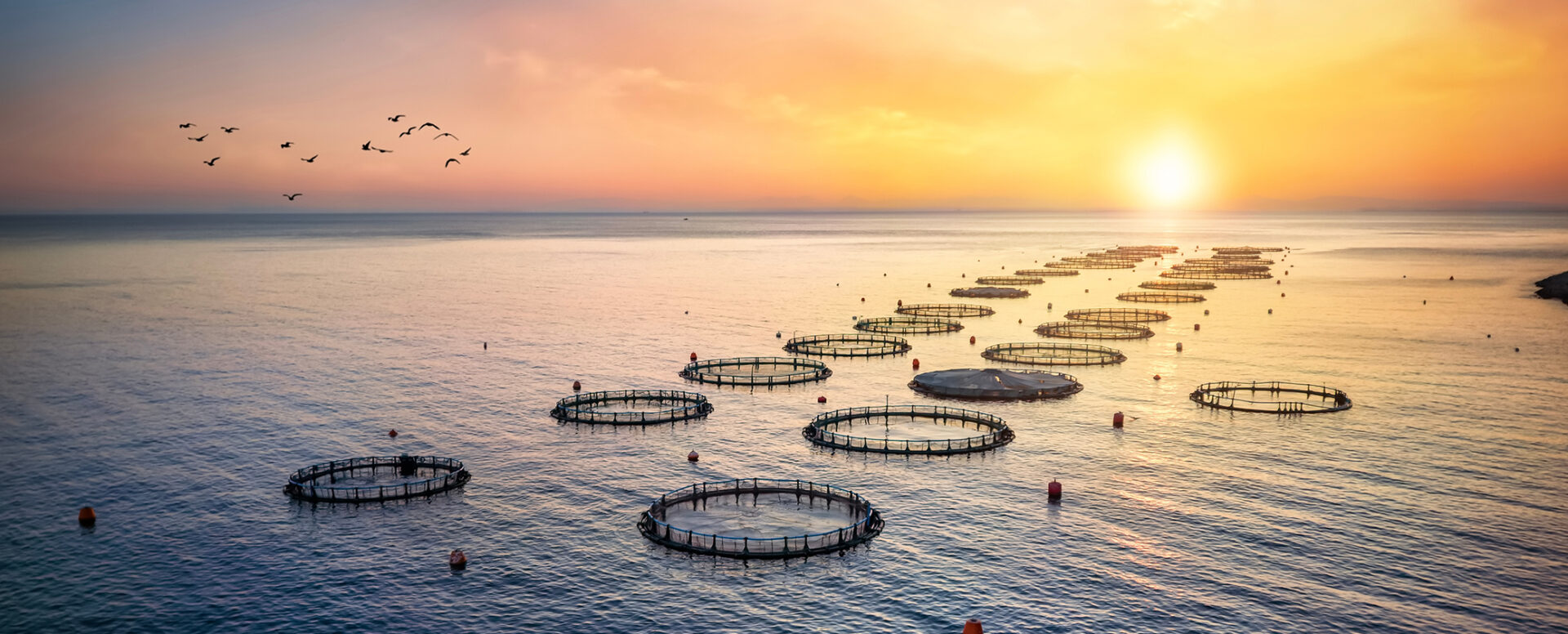
Header photo: High angle aerial view of a a fish farm off the coast in the blue, mediterranean sea in Greece during sunset time. 27 March 2023. Sven Hansche / Shutterstock