


The Big Picture: Climate, Water and Food Are One System
The Mediterranean is one of the most water-stressed regions on Earth, and one of the fastest-warming: its temperatures are rising about 20% faster than the global average.[1] In a region this exposed, water is not just one sector among many; it is the link that ties climate, agriculture, energy and environment together, so when water runs short, all these areas feel the squeeze.
A poor rainy season in North Africa does not remain a weather story for long. Within a single growing season it can become a larger food-import bill, a wave of livestock sales, higher food prices and, for some rural families, a reason to leave the land. Experts call this chain reaction the climate-water-food nexus: a system so tightly linked that a shock to one part quickly spreads to the rest, which is why responses that treat water, food and energy separately can backfire, solving one problem while worsening another.[2]
In a single season, a rainfall shortage had
become a hunger crisis, a reminder that
the nexus bites hardest where institutions
and irrigation systems are already weak
The year 2025 showed how this works in practice. It was dominated by drought, extreme heat and wildfires hitting many countries at the same time. By early August, about 51% of the land across Europe and the Mediterranean was in drought – the largest area for that time of year since monitoring began in 2012, and worse than the severe drought of 2022.[3]
The heat broke records on land and at sea. Spain had its hottest summer since records began in 1961, averaging 24.2°C from June to August and reaching 45.8°C in Jerez de la Frontera, in southern Spain.[4] The sea was just as unusual: the Mediterranean had its second-warmest year on record, June 2025 was its hottest June ever, and at the peak a marine heatwave of “strong” intensity or higher covered 62% of the sea surface; the entire basin saw heatwave conditions at some point in the year.[5] A hotter sea feeds more moisture and energy into the air, helping fuel the sudden, violent storms that increasingly interrupt the dry season.
These hazards did not arrive separately; they piled on top of one another. Europe recorded its largest-ever wildfire-burned area, about one million hectares,[6] and a single summer of heat, drought and floods affected about a quarter of all EU regions, with estimated losses near €12 billion in Italy and over €10 billion in France.[7] The lesson, now widely shared among Mediterranean experts, is straightforward: managing water, food and energy in separate boxes no longer works.
From Dry Fields to Empty Granaries
The clearest example of the chain reaction was the 2025 grain harvest. Syria suffered its driest year in decades. Between November 2024 and May 2025 rainfall was more than 50% below normal – the lowest in ten years – and only about 40% of farmland could be planted.[8] Wheat production fell to about 1.2 million tonnes – roughly 40% down on the previous year and more than 60% below the five-year average – against a national need of around 4 million tonnes.
The Food and Agriculture Organization (FAO) put the resulting wheat gap at about 2.73 million tonnes, enough to feed roughly 16 million people for a year, and warned that the number of food-insecure Syrians could pass 14 million.[9] In a single season, a rainfall shortage had become a hunger crisis, a reminder that the nexus bites hardest where institutions and irrigation systems are already weak.
When the resource is effectively
capped, the real challenge shifts
from finding more water
to using and sharing it better
Morocco showed the same pattern in a milder form. After a multi-year drought – winter rainfall from December 2024 to February 2025 ran more than 60% below normal – the 2025 cereal harvest came in at about 4.5 million tonnes, roughly 13% below the long-term average.[10] That left the kingdom leaning even harder on imports: its cereal-import bill had already reached about 27 billion dirhams (USD 2.9 billion) in 2024,[11] almost a third of the food-import bill, with 2025/26 grain imports forecast near 11 million tonnes.[12] Strong rains late in 2025 finally broke the cycle and pointed to a much better 2025/26 season – proof of how much food security still hangs on a single rainy season.
Elsewhere, the damage was structural. In Türkiye’s driest year in more than half a century, about 700 sinkholes opened across the Konya plain – the country’s breadbasket – as groundwater fell four to five metres a year under heavy, often unlicensed pumping, and some areas turned to water rationing.[13] Tunisia began 2025 with national dam reserves at about 36% of capacity – a slight recovery from 23% in 2024 – while losing roughly 600,000 m³ of stored water a day to summer evaporation and about 30% of its piped supply to leaks.[14] And in Sicily, two years of drought drained reservoirs and hit citrus, wheat and vineyards, with damages set at around €2.7 billion.[15]
At the Limit: Jordan and the Eastern Mediterranean
If North Africa shows the nexus under repeated drought, the eastern Mediterranean shows it at the very limit of available water. Jordan is among the most water-scarce countries in the world: it has less than 100 m³ of renewable freshwater per person each year – only 61 m³ per capita per year in 2025 – far below the 500 m³ mark for “absolute scarcity.”[16] The country’s renewable supply now covers only about two-thirds of demand, and water stress – the share of available water actually withdrawn – has climbed from roughly 80% to 100% in two decades.[17]
Demand keeps rising against a fixed supply. Population growth, swelled by waves of refugees, has pushed up consumption even as warming cuts rainfall and groundwater recharge; in some governorates, many households receive water supply only about once every two weeks and buy water tanks for the gaps.[18] When the resource is effectively capped, the real challenge shifts from finding more water to using and sharing it better.
Jordan’s main answer is the Aqaba-Amman Water Desalination and Conveyance Project, the National Water Carrier, costing more than USD 3 billion and backed by international climate finance, including the Green Climate Fund. This will desalinate Red Sea water at Aqaba and pump it about 450 km north, delivering some 300 million m³ a year – roughly 40% of the country’s municipal needs by 2030. [19][20] It is a textbook nexus fix – and a textbook nexus dilemma: a partly solar-powered project that solves a water shortage by taking on a large new energy and financing burden.
When Water Crosses Borders: the Nile and the Medjerda
When water crosses borders, the nexus becomes political. Egypt entered 2025 below the absolute-scarcity threshold of 500 m³ per capita, drawing roughly 97% of its freshwater from a single river – the Nile – and allocating 80–85% of it to agriculture.[21] Yet farming only generates about 11% of GDP while employing roughly a quarter of Egyptians, and imports 60-70% of its wheat and ranks as the world’s largest wheat buyer, so any reduction in Nile availability translates directly into food-import exposure.[22]
The defining cross-border event of 2025 came upstream: Ethiopia declared the Grand Ethiopian Renaissance Dam – Africa’s largest, at more than 5,000 megawatts of electricity – complete and inaugurated it in September 2025.[23] For Ethiopia the dam means energy and development; for Egypt and Sudan downstream it adds a powerful new variable to the water-food equation. Without a binding agreement on how to share water in dry years, the dam’s operating rules – not rainfall alone – will decide who absorbs the shortfalls.
The same dynamic plays out on a smaller scale in the Maghreb. The Medjerda river, shared by Algeria and Tunisia, supports a large share of Tunisia’s population, but upstream dam-building and rising use in Algeria have cut the flow reaching Tunisia, deepening crop and livestock losses in its interior.[24] Shared rivers are where the Mediterranean’s nexus is least governed – and where one country’s decisions most heavily impact another’s.
The Sea Feels It Too
The nexus does not stop at the coast; the sea is where it all ends up and constitutes the “ecosystems” piece of the water-energy-food-ecosystems puzzle. In 2025, intense marine heatwaves – rated strong, severe or extreme – covered 93% of the Mediterranean, the third-largest extent on record after 2023 and 2024.[25] Across Europe, river flows ran below average for most of the year, further straining the coastal waters that fisheries depend on.[26]
The damage is visible. Repeated heat has triggered mass die-offs, cut some coral populations by as much as 90%, pushed the noble fan mussel towards extinction and stressed the Posidonia oceanica seagrass meadows that act as fish nurseries and carbon stores.[27] Warmer water also holds less oxygen and welcomes invasive species such as the Atlantic blue crab, whose surge during the 2023 marine heatwave damaged more than half of Italy’s clam and mussel production and forced the government to declare emergency measures.[28] The agricultural lobby organization Coldiretti has set the cost to the fishing industry at around €100 million.[29]
All of this loops straight back to food. Fishing is an income and protein source for coastal communities on both shores of the sea, and the same falling river flows that worsen scarcity on land also reduce the sea’s productivity. In the Mediterranean, protecting the sea is not separate from water and food security – it is part of the same account.
What Needs to Happen Next
Climate, water and food can no longer be governed as separate policy domains. The events of the year – across the southern, eastern and northern shores alike – demonstrated that interventions designed in isolation are increasingly prone to failure, and that durable water security now depends on integrated, cross-sectoral governance. On this basis, four priorities should guide Mediterranean policy in the period ahead.
First, governments should invest in climate-resilient, low-carbon water infrastructure, including renewable-powered desalination, treated-wastewater reuse, and the restoration of wetlands and aquifers, designed to withstand climatic extremes rather than historical averages. Second, equal priority should be given to demand-side management and water-use efficiency, since reducing consumption is generally more cost-effective and less carbon-intensive than augmenting supply; precision irrigation, leakage reduction and digital monitoring are central instruments in this regard.
Third, the region must strengthen transboundary water cooperation, the weakest link in its institutional architecture, through binding allocation arrangements and joint drought-management mechanisms. Fourth, climate and adaptation finance should be directed deliberately towards the areas facing the most extreme water stress and climate risk, where needs are most acute and bankable project pipelines remain underdeveloped, supported by de-risking instruments and blended finance. Underpinning all four, decision-making must remain inclusive of the communities most exposed – smallholders, pastoralists, coastal fishers and the women and young people who manage water under conditions of scarcity. Pursued together, within a genuine water-energy-food-ecosystems nexus framework, these measures can transform water from a recurring source of risk into a shared foundation for resilience and cooperation across the Mediterranean.
[1] MedECC, Climate and Environmental Change in the Mediterranean Basin – First Mediterranean Assessment Report (MAR1), Cramer, W.; Guiot, J. and Marini, K. (eds.), UfM/Plan Bleu/UNEP-MAP, Marseille, 2020, doi: 10.5281/zenodo.4768833; summarized at UNEP/MAP, “Climate Change” factsheet. www.unep.org/unepmap/resources/factsheets/climate-change.
[2] Drobinski, P.; Rivera Ferre, M.G.; Abdel Monem, M. et al. “Nexus approach to enhance water-energy-food security and ecosystems resilience under climate change in the Mediterranean.” npj Climate Action, vol. 4, art. 115, 2025, doi: 10.1038/s44168-025-00308-4.
[3] European Drought Observatory (Copernicus Emergency Management Service / EU Joint Research Centre), figure for 1–10 August 2025, analysed by Agence France-Presse; portal: https://drought.emergency.copernicus.eu/; report: https://phys.org/news/2025-09-europe-mediterranean-coast-drought-august.html.
[4] Associated Press. “Spain sweltered under hottest summer on record in 2025, weather agency says.” 16 September 2025, citing AEMET (Spanish State Meteorological Agency): https://abcnews.go.com/Business/wireStory/spain-sweltered-hottest-summer-record-2025-weather-agency-125629262 .
[5] Copernicus Marine Service (CMEMS), 2025 Annual Ocean Health Bulletin, 2026, https://marine.copernicus.eu/bulletin/2025-annual-ocean-health-bulletin; and CMEMS press release, 8 July 2025 https://marine.copernicus.eu/press/press-releases/june-2025-marks-third-warmest-june-record-globally-record-high-intensity.
[6] Copernicus Climate Change Service & World Meteorological Organization, European State of the Climate 2025 ESOTC, 2025: https://wmo.int/news/media-centre/european-state-of-climate-2025-record-heatwaves-from-mediterranean-arctic-while-glaciers-shrink-and .
[7] Usman, S. et al. “Dry-roasted NUTS: early estimates of the regional impact of 2025 extreme weather.” European Economic Review, 2025 University of Mannheim / European Central Bank: www.preventionweb.net/news/extreme-weather-events-summer-2025-europe-faces-long-term-losses-126-billion-euros.
[8] FAO, GIEWS Country Brief: Syrian Arab Republic, reference date 18 August 2025: www.fao.org/giews/countrybrief/country.jsp?code=SYR.
[9] FAO, June 2025 assessment, reported by Reuters; see AGBI. “Drought causes wheat failure as Syria faces food crisis.” 20 August 2025: www.agbi.com/agriculture/2025/08/drought-causes-wheat-failure-as-syria-faces-food-crisis/ .
[10] FAO, GIEWS Country Brief: Morocco, reference date 2 February 2026: www.fao.org/giews/countrybrief/country/MAR/pdf/MAR.pdf .
[11] Office des Changes (Foreign Exchange Office), via Ecofin Agency, January 2026: www.ecofinagency.com/news-agriculture/2601-52254-morocco-sees-best-cereal-output-in-five-years-in-2025/2026 ; import forecast from FAO/USDA in World Grain, December 2025: www.world-grain.com/articles/22227-focus-on-morocco.
[12] FAO, GIEWS Country Brief: Morocco, reference date 2 February 2026: https://www.fao.org/giews/countrybrief/country/MAR/pdf/MAR.pdf.
[13] Reuters, “Sinkholes in Turkey’s agricultural heartland fuel farmers’ concerns,” 23 December 2025: www.usnews.com/news/world/articles/2025-12-23/sinkholes-in-turkeys-agricultural-heartland-fuel-farmers-concerns; “2025 brought Türkiye its harshest drought in 50 years,” Daily Sabah, citing the Turkish State Meteorological Service: www.dailysabah.com/turkiye/2025-brought-turkiye-its-harshest-drought-in-50-years-expert-says/news.
[14] Omar, Noura “Securing Tunisia’s Constitutional Right to Water,” Carnegie Endowment for International Peace, 2025: https://carnegieendowment.org/sada/2025/02/securing-tunisias-constitutional-right-to-water-policy-solutions?lang=en; Institute for Economics & Peace, Ecological Threat Report 2025, via Vision of Humanity: www.visionofhumanity.org/tunisias-worsening-water-crisis-2025/.
[15] European Commission, “EU Climate Action Progress Report 2025, Chapter 6:” https://climate.ec.europa.eu/eu-action/climate-strategies-targets/progress-climate-action/eu-climate-action-progress-report-2025/chapter-6-climate-resilience-and-adaptation_en.
[16] UNICEF figure cited by Al Arabiya, “Jordan’s growing water crisis,” 5 December 2025: https://english.alarabiya.net/News/middle-east/2025/12/05/jordan-s-growing-water-crisis-quenching-the-drying-land; lower estimate from World Bank/MIGA project documentation, 2025: www.miga.org/project/aqaba-amman-water-desalination-and-conveyance.
[17] Al Arabiya, citing Jordan’s Ministry of Water and Irrigation, 5 December 2025: https://english.alarabiya.net/News/middle-east/2025/12/05/jordan-s-growing-water-crisis-quenching-the-drying-land.
[18] Xinhua. “Jordan battles severe water crisis with managed distribution, strategic projects.” 23 September 2025, citing the Ministry of Water and Irrigation: https://english.news.cn/africa/20250923/5c87b818632740ceaedf96bc8116faaf/c.html.
[19] Government of Jordan, reported by Al Arabiya, 5 December 2025: https://english.alarabiya.net/News/middle-east/2025/12/05/jordan-s-growing-water-crisis-quenching-the-drying-land.
[20] Green Climate Fund. “Funding Proposal FP288 (Aqaba–Amman Water Desalination and Conveyance Project).” 2025: www.greenclimate.fund/project/fp288.
[21] Egyptian Ministry of Water Resources & Irrigation (Minister Hani Sewilam), via Ahram Online, 2026: https://english.ahram.org.eg/News/565510.aspx; framing of “absolute scarcity” from Atlantic Council, “Egypt has a water problem—and no, it’s not only the GERD”: www.atlanticcouncil.org/blogs/menasource/egypt-has-a-water-problem-and-no-its-not-only-the-gerd/.
[22] Atlantic Council (agriculture’s share of GDP and employment): www.atlanticcouncil.org/blogs/menasource/egypt-has-a-water-problem-and-no-its-not-only-the-gerd/; Egypt’s standing as a leading wheat importer per USDA Foreign Agricultural Service data.
[23] Daily News Egypt. “Egypt warns UNSC that Ethiopian Nile Dam threatens its water security.” 9 September 2025: www.dailynewsegypt.com/2025/09/09/egypt-warns-unsc-that-ethiopian-nile-dam-threatens-its-water-security/; see also AllAfrica, July 2025: https://allafrica.com/stories/202507030548.html.
[24] Meddeb, Hamza. “Tunisia’s Climate Crisis, Economic Downturn, and Growing Dependency on Algeria.” Carnegie Endowment for International Peace, 2025: https://carnegieendowment.org/europe/research/2025/04/tunisias-climate-crisis-economic-downturn-and-growing-dependency-on-algeria.
[25] Copernicus Marine Service (CMEMS), The 2025 Annual Ocean Health Bulletin, Mercator Ocean International, 27 March 2026: https://marine.copernicus.eu/bulletin/2025-annual-ocean-health-bulletin.
[26] Copernicus Climate Change Service (C3S) and World Meteorological Organization, European State of the Climate 2025 (ESOTC 2025), ECMWF/WMO, 2026: https://wmo.int/news/media-centre/european-state-of-climate-2025-record-heatwaves-from-mediterranean-arctic-while-glaciers-shrink-and.
[27] Euronews. “Record heat in the Mediterranean Sea sparks fears for marine life.” 1 July 2025, citing ICATMAR and the Marine Biological Association: www.euronews.com/2025/07/01/record-breaking-sea-temperatures-in-the-mediterranean-spark-fresh-warnings-from-scientists; on Posidonia, Copernicus ESOTC 2025: https://climate.copernicus.eu/esotc/2025/marine-heatwaves-impacting-mediterranean-biodiversity.
[28] Martellucci, R. et al. “Mediterranean marine heatwave 2023: ecosystem and fisheries impacts in Italian waters.” Copernicus Ocean State Report 9 (State Planet), 2025: https://sp.copernicus.org/articles/6-osr9/9/2025/. On the scale of damage and the government response, see Associated Press, August 2023: www.nbcnewyork.com/news/national-international/if-you-cant-beat-them-eat-them-italy-declares-war-on-invasive-atlantic-blue-crabs/4607027/.
[29] Coldiretti estimate, reported by The Times, 2023: www.yahoo.com/news/oyster-tax-breaks-could-save-174507185.html.
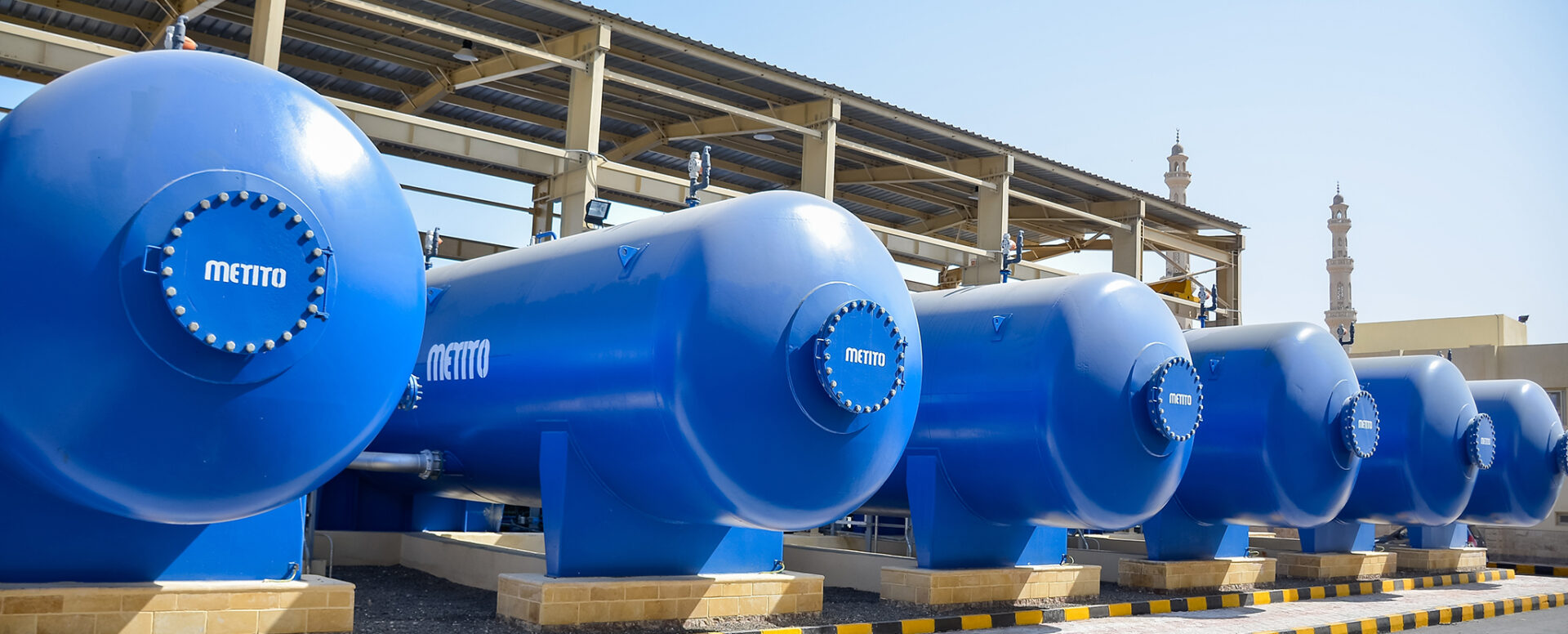
Photo: El Yosr seawater desalination plant in Egypt ,Hurghada September 23, 2017. The facility is part of Egypt’s water infrastructure projects supporting freshwater production and sustainable development along the Red Sea coast. Tarek ibrahim / Shutterstock