
 Co-edition with Fundación Análisis de Política Exterior
Soft Power in the Arab Gulf States During a Time of War
(The text published here is the original English version. In its print edition, afkar/ideas publishes the article in Spanish and French translation)
It has been nearly four months since the US-Israel war on Iran began, subjecting neighboring Arab Gulf States into the crossfire of conflict. Neighboring Gulf states, which increasing have become a hub for the region’s cultural production, were experiencing an unprecedented renaissance prior to the war, fueled by massive state-led investment and diversification agendas away from a reliance on fossil fuels. While the ongoing war has caused a sudden downturn in tourism, leading to the cancellation and postponement of numerous events and projects, the cultural scenes in the Arab Gulf states are showing remarkable resilience to adapt to a period of uncertainty and economic shortfall while preserving their heritage, hope and determination to realize visions that have long been in the marking.
Since the United States and Israel first attacked on February 28, Iran has targeted the GCC, seven Arab countries in the Persian Gulf that share political and economic ties, with thousands of missiles and drones. While Iran targeted American bases in the region, civilian, aviation and energy infrastructure across the Gulf was also attacked causing great alarm and uncertainty. The United Arab Emirates, Qatar, Saudi Arabia, Kuwait and Bahrain, which host American military bases, were each subjected to regular strikes. All these states have also invested heavily in their culture and heritage to grow their respective creative economies, boost tourism and wean off a reliance on hydrocarbons.
“Despite everything that has happened, the Arab cultural presence has remained active and influential — and perhaps even more conscious of its role as a form of soft power”
As war persisted and the Strait of Hormuz remained closed, many abroad continue to wonder how the Gulf’s growing cultural infrastructure, which had lured so many around the world to its shores over the past few years, would survive.
“What the present situation reveals is that cultural acceleration and geopolitical stability are deeply interconnected,” said art theorist and curator Paco Barragán. “The Gulf’s cultural ecosystem has benefited enormously from being perceived as a relatively stable hub connecting Europe, Asia and Africa. When that perception is challenged, the cultural sector experiences immediate pressure.
At the same time, emphasizes Paco Barragán, “the crisis demonstrates a degree of institutional resilience”. Most major institutions remained operational during the first few weeks of strikes, exhibitions continued, and long-term projects such as the Guggenheim Abu Dhabi, the Zayed National Museum and numerous regional initiatives have not been abandoned. “Art Dubai has also demonstrated agility by introducing, for the first time, a risk-sharing model whereby gallery participation costs are partially tied to commercial success at the fair”, he added. “Rather than signaling systemic weakness, these responses suggest that the region’s cultural infrastructure is entering a phase of institutional adaptation and consolidation”.
While challenges concerning shipping, air travel and economic hardship have impacted regional and global cultural events in the short turn, entities in the Gulf have been finding ways to adapt and resiliently go forward.
“Will Art Dubai even happen?” quipped several guests during the opening of the 61st Venice Biennale at the beginning of May.
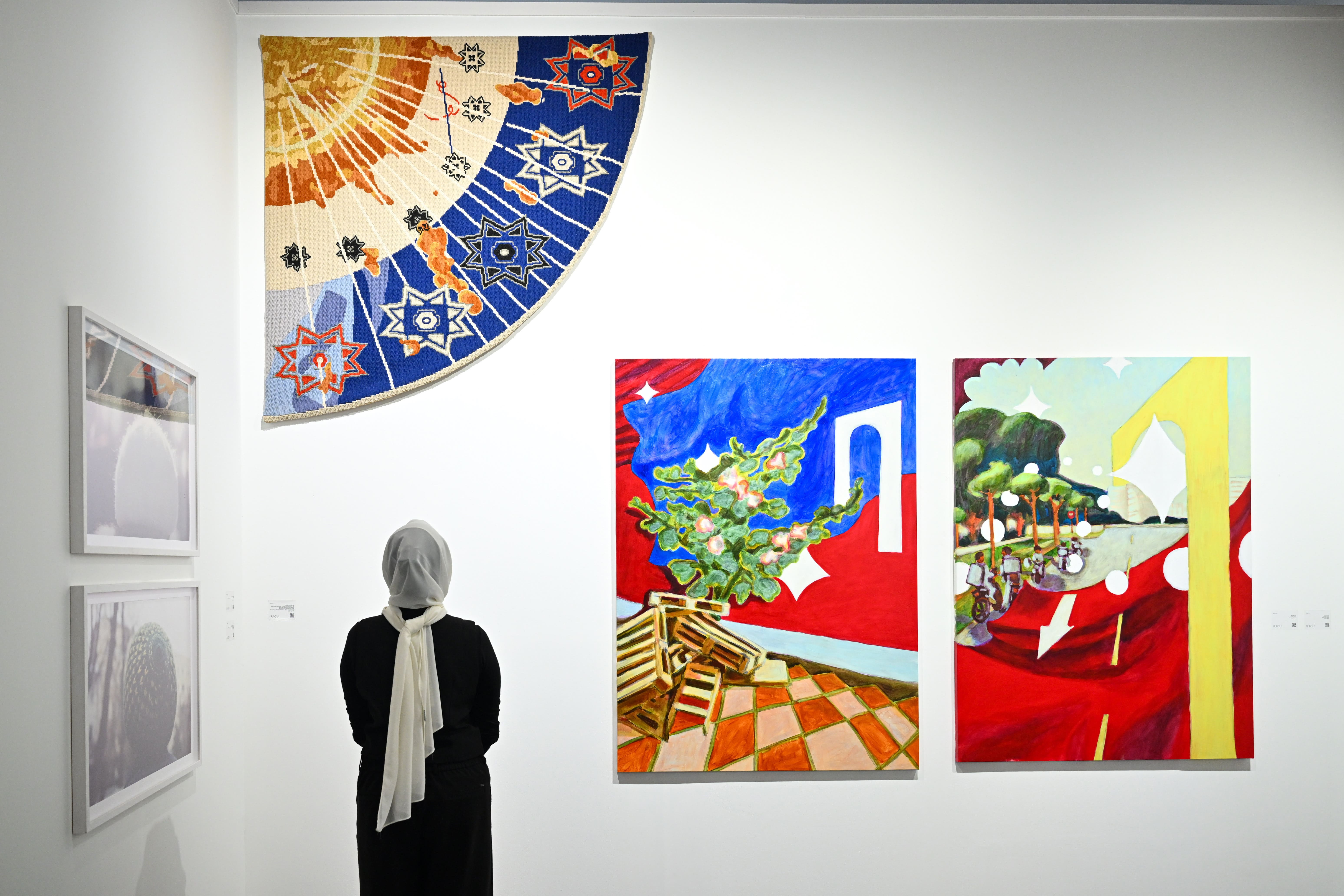
To much surprise among the global art community, the fair, among the region’s leading events for modern and contemporary art went ahead despite the war. The 20th annual Art Dubai fair had been postponed from its slated date of mid-April by one month to mid-May. Retitled ‘Art Dubai Special Edition,’ the fair was reduced to just 50 exhibitors from its planned 120 exhibitors and bolstered by an expanded program. While contingency plans were put in place in case of attacks or renewed emergency alerts, local, regional and even a few international collectors visited the fair in solidarity. The mood was upbeat and positive with attendees expressing a steadfast belief in the United Arab Emirates’s ability to come back—perhaps even stronger from this period.
“This is one of the best editions of Art Dubai”, said Iranian American gallerist Leila Heller who runs branches of her eponymous gallery in Dubai and New York. “We have had huge support from Art Dubai. We feel supported and protected. Everyone has come out; it’s packed and crowded and people have been super excited to see art again! There is wonderful patronage in this country; art and culture are part of its sustainability.”
Shipping delays due to the closure of the Strait of Hormuz and dwindling airlines operating to and from the Gulf caused delays and rerouting of artworks and supplies for exhibitions being staged during the Venice Biennale. Even so, the national pavilions of Saudi Arabia, the United Arab Emirates and Qatar all opened on time. In Saudi Arabia, the highly anticipated Black Gold Museum, tracing the history of oil through art, opened during the war in Riyadh in early April 2026.
Aghrab Idrāk: Thresholds of Perception an exhibition at Palazzo Cavanis and symposium marking VCUarts Qatar’s first participation during the Venice Biennale postponed its opening to June 1 due to logistical issues from the war.
“One of the most striking aspects of Qatar’s cultural ecosystem has been its resilience”, said Amir Berbic, Dean of VCUarts Qatar. “Decades of investment in arts education, museums, design, research, and cultural infrastructure have created an environment capable of adapting to challenging circumstances while continuing to move forward. This strong foundation has enabled the cultural sector not only to withstand periods of uncertainty but also to maintain its commitment to creativity, innovation, and exchange”.
At Virginia Commonwealth School of the Arts in Qatar, which was established in 1998 as the first university in Doha’s Education City, “that resilience has been especially evident,” says Berbic. The institution has spent close to three decades cultivating creative talent, fostering international partnerships, and building a vibrant community of artists, designers, researchers, and cultural leaders. “As a result, the response to recent regional geopolitical challenges has been characterized not simply by disruption, but by continuity, adaptability, and a sustained commitment to educational and creative excellence,” he emphasizes.
In the United Arab Emirates, the culture community banded together, developing initiatives to boost sales during a moment of economic uncertainty. One example is the exhibition Déjà Vu, a first-of-its-kind collaboration staged in Alserkal Avenue, Dubai’s leading cultural district in the industrial venue Concrete. Running from 24 April to 8 May, the 14-day selling exhibition brought together 20 of the United Arab Emirates’ leading contemporary art galleries. The exhibition was staged as a joint rescue initiative to support galleries navigating a disrupted spring art season due to the Iran war. The event was organized intentionally with transparent pricing, with many works priced under $10,000 to target the country’s growing pocket of young collectors and provide vital quick cash flow to local art entities during a time of great need.
“Despite everything that has happened, the Arab cultural presence has remained active and influential — and perhaps even more conscious of its role as a form of soft power that reflects the pulse of society and offers alternative narratives”, said Iyad Qanazea, a Palestinian businessman runs Qanazea Gallery in Abu Dhabi. “The culture sector went into over-drive, and everyone played a role to persist and show up for our community through every effort. I am grateful to be part of that scene”.
Qanazea decided to open his gallery in Abu Dhabi in 2023 due to the wealth of opportunities the city offered alongside its growing cultural sector and rapid rise of museums. “It was a natural decision for me”, he says. “Today, the city stands as one of the most significant emerging cultural hubs globally, with serious investment in cultural infrastructure and a stable institutional environment that encourages long‑term projects”. On Saadiyat Island in Saadiyat Cultural district, a wealth of museums serves as testament to this growth”, he adds.
Last year, in 2025, Abu Dhabi experienced a landmark year for its cultural scene, with the opening of five museums across the emirate. These included the centerpiece of the Saadiyat Cultural District, Zayed National Museum, dedicated to the legacy of the late Sheikh Zayed bin Sultan Al Nahyan; the Natural History Museum Abu Dhabi, featuring 13.8 billion years of history and marking the largest natural history institution in the Middle East; teamLab Phenomena Abu Dhabi, an expansive, multi-sensory, interactive art space by the Japanese-born art collective of the same name; Al Maqta Museum, located within the reconstructed historic Al Maqta’a Fort, which previously served as a customs house and celebrating the early socio-cultural evolution of the Al Maqta’a area; and Al Ain Museum, the country’s first museum, which reopened in late 2025 following a massive redevelopment blending ancient heritage with modern exhibition areas.
Despite setbacks from the Iran war, as of now the long-awaited Guggenheim Abu Dhabi is still slated to open its doors to the public at the end of 2026.
“Abu Dhabi’s audience is diverse and curious, creating an ideal space to present Arab art within a global context and to contribute to the cultural dialogue the city is actively shaping”, adds Qanazea.
Paco Barragán has written about what he calls “institutional velocity” in the global art system, highlighting the Gulf’s historically accelerated tempo of growth. The concept of institutional velocity, he explains, “refers to the extraordinary speed with which the Gulf has built museums, biennials, art fairs, collections and cultural infrastructure over the past 15 years—a process that took approximately 50 years in Latin America and 25 years in East Asia”.
How has the region been able to develop its cultural infrastructure at such speed?
Most Gulf Arab nations are relatively young: Kuwait, Bahrain, Qatar, Oman and the United Arab Emirates, which used to be called the Trucial States or British protectorates, gained full independence from the British Empire during the early 1970s. While Saudi Arabia was never colonized, it began a nation state in 1932.
Decades of investment in arts education, museums, design, research, and cultural infrastructure have created an environment capable of adapting to challenging circumstances while continuing to move forward
“Unlike many Western institutions constrained by lengthy bureaucratic processes, Gulf cultural projects have often been able to move from vision to implementation within remarkably short timeframes,” adds Paco Barragán.
“The current regional conflict undoubtedly introduces new uncertainties”, he adds. “Travel disruptions, security concerns, rising insurance costs and the psychological impact of geopolitical instability inevitably affect cultural mobility and international participation. However, I would be cautious about interpreting this solely as evidence of fragility”.
While many projects and events have been postponed and are still on hold, many are still placing hopes in the region’s comeback. The fall season is gearing up to be a lively one. The first edition of Frieze Abu Dhabi is due to take place from November 19-22, alongside the second edition of Nomad Abu Dhabi, the collectible design fair and in Doha, a packed calendar of events will take place, including the delayed Doha Design Biennial taking place from November 5 to December 31 and the inaugural edition of Rubaiya Qatar, a national contemporary art quadrennial featuring installations, commissions, and exhibitions from over 50 global artists spread across multiple city sites and cultural hubs.
“The Gulf is currently one of the most active regions globally in terms of cultural development, experimentation and institution-building”, said Maria Gracia de Pedro, Founder of Artepreneur, a boutique human resources company specializing in culture. “Engaging with the region today means participating in conversations that are shaping how future cultural ecosystems will operate.
Paco Barragán stresses that it is wrong moment for the international art world to disengage with the Gulf. He believes that periods of uncertainty make cultural exchange more important.
Art fairs, museums, biennials and cultural institutions are not merely commercial platforms; they are also spaces through which dialogue, knowledge and international relationships are maintained when political circumstances become more complex.
“More fundamentally, the Gulf is no longer a peripheral player in the global art system”, he says. “Over the past 15 years it has become one of its most dynamic regions, attracting major institutions, collections, artists, curators and cultural investment. To place engagement on hold would be to misunderstand the long-term nature of this transformation.”
Gracia de Pedro holds the same belief as Paco Barragán.
“For us, engagement is not only about market opportunities; it is about people: supporting artists, creating professional pathways, encouraging exchange between regions and contributing to a more connected cultural sector”, she says. “Periods of uncertainty are precisely when maintaining dialogue becomes most valuable. Cultural relationships built today often become the foundation for long-term collaboration, resilience and growth tomorrow”./