
 Co-edition with Fundación Análisis de Política Exterior
Fraying Primacy: How the Iran War May Accelerate a Middle East Hedging Order
(The text published here is the original English version. In its print edition, afkar/ideas publishes the article in Spanish and French translation)
The most consequential impact of the US-Israeli war against Iran may be whether the conflict reshapes how regional states perceive great-power reliability, restraint, and strategic utility. The war is not merely a military event whose significance will be determined by battlefield outcomes. It is a strategic signal — one being read carefully in Riyadh, Ankara, Abu Dhabi, Cairo, and beyond — and the signal being received is not the one Washington intended to send.
The Limits of American Primacy
For the better part of three-quarters of a century, the United States structured its Middle East strategy around a coherent if often contested logic whereby American power underwrote regional stability, suppressed threats before they metastasized, guaranteed the free flow of oil through critical maritime chokepoints, and extended a security umbrella that allowed allied governments to defer hard choices. The logic was never without critics, and the execution was never without failures.
That architecture is now visibly under stress in ways that predate the Iran conflict but which the conflict has significantly accelerated. The core problem is not simply that the United States has used force, but that its use of force has repeatedly generated outcomes that contradict the stability rationale used to justify it. The 2003 invasion of Iraq dismantled the regional balance of power and enabled Iranian expansion that US policy has spent two decades trying to contain. Interventions in Libya contributed to state collapse that became a vector for instability across North Africa. The withdrawal from Afghanistan transmitted a message about American staying power that the region registered well before the current conflict.
The Iran war adds a further layer to this pattern. War aims have been inconsistent from the outset, oscillating between the elimination of Iran’s nuclear capability and broader aspirations of regime change or strategic transformation. The gap between de-escalatory rhetoric and military behavior has been wide enough to register across the region. Red lines have shifted; escalation dynamics have proven difficult to control.
The core problem is not simply that the United States has used force, but that its use of force has repeatedly generated outcomes that contradict the stability rationale used to justify it.
The conflict has sharpened doubts not about American power itself, but about the reliability, competence, and strategic judgment guiding its use. These are not synonymous, and they have not been for some time. US military capability remains unmatched in firepower, logistics, technological sophistication, and destructive reach. But military capability is only one component of what makes an external power a credible strategic partner. Regional governments increasingly assess not only who can project force, but who can translate it into durable political outcomes without generating uncontrolled escalation.
Regional actors are not naïve about these dynamics. They observe that American administrations shift priorities with electoral cycles, that security guarantees are conditional, that partnerships are instrumentalized, and that Washington has repeatedly recalibrated or abandoned commitments when domestic or strategic priorities change. The Iran conflict has not created these perceptions; it has consolidated them.
For many regional governments, the main strategic risk is no longer limited to Iran’s efforts to expand its influence and challenge the regional order. It also includes the danger of being drawn into conflicts driven by external powers that they have little ability to control and decreasing confidence in their ability to restrain.
China: The Beneficiary of American Overextension
China’s position in the evolving Middle Eastern order is frequently mischaracterized either as a rising hegemon preparing to fill the vacuum left by American retreat, or as a distant economic actor with no meaningful strategic role. Neither characterization captures the reality. Beijing’s advantage is structural and comparative rather than absolute. China is not “winning” the Middle East. It is benefiting from Washington’s self-inflicted losses.
The starting point for understanding China’s position is its genuine vulnerabilities in the region. Beijing remains heavily dependent on Gulf energy — a dependence that will persist despite renewable expansion. Belt and Road investments run through politically unstable environments, while maritime routes via the Strait of Hormuz and the Red Sea are central to Chinese commerce yet beyond Beijing’s ability to secure unilaterally. China lacks regional alliance structures, expeditionary military capacity, and any appetite for the kinds of security commitments such roles would require. Sustained regional conflict therefore translates into direct economic exposure.
Yet the Iran war strengthens China’s diplomatic position even as it heightens these vulnerabilities. The apparent paradox reflects a mismatch between what regional states seek and what Beijing offers. They are not seeking a new patron; historical experience with external patrons has been uneven at best. Instead, they are prioritizing diversified partnerships that reduce dependence on any single power’s volatility. China, despite its limits, presents itself as economically engaged, rhetorically restrained, and deliberately non-escalatory.
Beijing has actively cultivated this positioning, emphasizing sovereignty and diplomatic resolution while contrasting its approach with what it frames as American militarism. This is partly narrative construction. But narratives gain traction when they align with observed behavior. For many regional governments, US conduct during the Iran conflict has reinforced the credibility of China’s framing. The 2023 Saudi-Iran normalization agreement, brokered by Beijing, already demonstrated that China could produce diplomatic outcomes in areas where Washington had become more rigid — a development which one Emirati political scientist described as marking a new “post-American Gulf era.” The current conflict could reinforce that perception.
The key analytical distinction is that China is not replacing the US-led order; it is benefiting from its erosion. Replacement would require China to assume security burdens, institutional commitments, and political risks it has consistently avoided. By contrast, erosion requires only that China remain economically relevant, diplomatically present, and comparatively restrained while US actions reduce its own perceived reliability.
Russia: Opportunism Amid Managed Decline
Russia’s role in the evolving regional order differs fundamentally from China’s. Beijing benefits from economic weight and relative restraint. Moscow operates from a position of structural weakness managed through tactical disruption. Its influence in the Middle East remains real, but increasingly opportunistic. Russia is less interested in building a new regional order than in preventing one from consolidating around Western preferences.
This approach reflects both strategic intent and material limitation. Russia lacks the economic capacity to compete seriously with either the United States or China as a provider of regional public goods. Its military bandwidth is constrained by the war in Ukraine, its economy remains vulnerable to sanctions and structural weakness, and its ability to project sustained power across the region is limited. Despite signing a comprehensive strategic pact with Tehran in January 2025, Russia offered only rhetorical condemnation of US and Israeli strikes during the Iran conflict and withheld meaningful military assistance — reaffirming that Moscow can no longer shape Middle Eastern security dynamics and is instead working to hold onto remnants of influence.
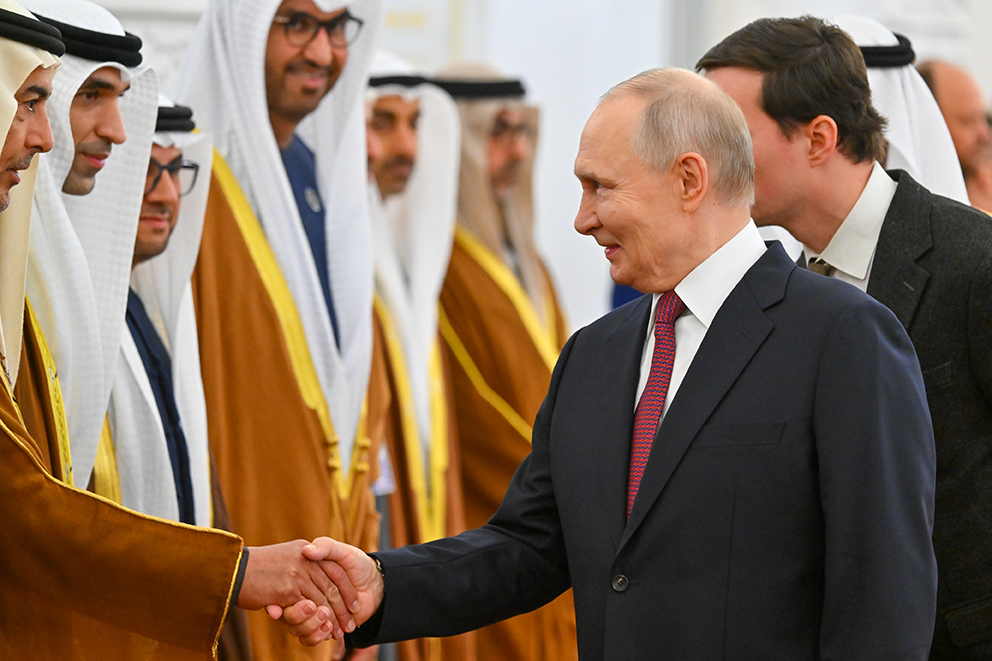
What Moscow can still offer is something different: diplomatic flexibility, arms relationships, energy coordination through OPEC+, and a willingness to challenge American preferences without imposing political conditions. Russia has maintained ties with Iran while simultaneously engaging Gulf monarchies, positioned itself as a critic of US unilateralism, and leveraged regional crises to complicate Western strategic calculations. The closure of Hormuz has driven oil prices higher, infusing Russia’s struggling state budget with much-needed revenue — a windfall extracted from a crisis Moscow did nothing to prevent. Russia’s comparative advantage lies not in offering a superior order, but in operating effectively within chronic instability itself.
Unlike China, which ultimately requires a relatively predictable regional environment to protect trade and energy flows, Moscow often gains influence precisely where uncertainty, mistrust, and geopolitical competition intensify. The Iran conflict is accelerating exactly that kind of environment.
The Rise of Strategic Hedging
The most consequential geopolitical development emerging from the Iran conflict is not occurring primarily in Washington, Beijing, or Moscow. It is unfolding in the strategic calculations of regional states — in the recalibration underway in Riyadh, Abu Dhabi, Ankara, Cairo, and elsewhere.
These states are not choosing sides in a new Cold War. Middle Eastern governments are not seeking ideological alignment but asking more immediate questions: which relationships enhance autonomy, which dependencies create vulnerability, and which external actors are reliable enough to engage with without generating new risks.
The response increasingly points toward multi-vector alignment and transactional diplomacy designed to maximize flexibility. The pattern is visible in concrete behavior across the region. Saudi Arabia restored diplomatic ties with Iran through an agreement facilitated by Beijing while simultaneously pursuing US security guarantees and defense cooperation. It later joined BRICS in January 2024 — a move Saudi Foreign Minister Faisal bin Farhan Al Saud described as “a beneficial and important channel” for economic cooperation rather than an ideological commitment.
The UAE has simultaneously deepened US technology ties through a $1.5 billion Microsoft partnership with its AI flagship G42 while maintaining extensive Chinese technology infrastructure that prompted US pressure to force G42 to choose between Washington and Beijing — a demand Abu Dhabi navigated by formally divesting from Chinese firms while preserving broader strategic ambiguity.
Turkey, a NATO member, purchased Russia’s S-400 air defense system in 2019, triggering its expulsion from the F-35 program — a move analysts described as intended primarily to assert strategic independence from NATO allies rather than to genuinely align with Moscow. Turkey’s foreign policy in 2025 remained defined less by choosing sides than by managing risk exposure and maintaining relevance across multiple theaters, including serving as a key mediator between Russia and Ukraine.
These arrangements do not constitute coherent blocs or ideological realignment. They function instead as overlapping insurance mechanisms in a region shaped by uncertainty about external reliability. The underlying assumption is not that the United States is exiting the Middle East, but that no external power — including the United States — can be treated as a fully dependable guarantor of stability.
The trajectory is reinforced by the likely persistence of Iranian power. If Tehran emerges weakened but politically consolidated and strategically adaptive, regional governments may view its deterrent capabilities and proxy networks as enduring structural features rather than temporary challenges. Under such conditions, hedging becomes less a choice than a necessity embedded in the regional security environment itself.
The emerging order is therefore not multipolar in a classical sense. It is a hedging order: one in which regional states treat all external powers as simultaneously useful and potentially risky — sources of leverage, but also sources of exposure.
This marks a deeper shift in Middle Eastern geopolitics. Even states that once organized their strategies around American primacy are now acting on the assumption that dependence itself has become a liability. Resilience increasingly requires diversification, managed distance, and sustained maneuverability across competing external poles rather than reliance on any single one.
Conclusion
The temptation, in analyzing the Iran conflict’s geopolitical consequences, is to reach for a clean succession narrative in which China replaces the United States as a new hegemon filling the vacuum left by American overextension. That narrative is flawed — not simply because China lacks the capacity or inclination to underwrite regional security, but because it assumes that regional order must be hegemonic at all, and that primacy is always replaced rather than diluted.
The defining feature of the emerging era is not who leads the region, but the absence of anything that functions as leadership at all.
The more accurate conclusion is less orderly. The Iran war may mark a turning point not through the emergence of a successor power, but through the further erosion of the conditions that make hierarchical regional order possible. American military superiority will remain unmatched for the foreseeable future, yet it is increasingly decoupled from the production of strategic coherence. The central question is no longer who can prevail in conflict, but who can provide the predictability and consistency required for long-term alignment and investment decisions.
On these dimensions — legitimacy, predictability, and strategic coherence — US performance has weakened most visibly, and it is these deficits that now structure regional behavior. Russia will continue to exploit instability without being able to organize it. China will expand economic ties and diplomatic presence without assuming security burdens. Regional states will continue to hedge, diversify, and compartmentalize relationships, building resilience precisely against great-power volatility, including that of the United States.
The result is not a transition from one order to another, but a shift into a more persistent condition, namely competitive disorder. It is a system in which no external power can reliably impose structure, in which regional states operate through continuous balancing rather than stable alignment, and in which American military dominance coexists with declining strategic centrality. The defining feature of the emerging era is not who leads the region, but the absence of anything that functions as leadership at all./