


Genesis and Political Context
The EU Pact for the Mediterranean[1] — announced by European Commission President von der Leyen in her 2024-2029 government manifesto, the “Political Guidelines” — is the latest iteration of a policy lineage stretching from the 1995 Barcelona Declaration[2] — whose 30th anniversary provided the ceremonial backdrop for the Pact’s formal launch in Barcelona on 28 November 2025 — through the Euro-Mediterranean Partnership, the 2004 ENP, the 2008 Union for the Mediterranean (UfM), the 2011 EU Joint Communication on “A Partnership for Democracy and Shared Prosperity with the Southern Mediterranean” and the 2021 New Agenda for the Mediterranean. Each of these frameworks was presented at inception as a qualitative leap beyond its predecessor and a new effort in co-owned equitable EU-Mediterranean partnership. However, each in its own way fell short of its stated ambitions, at least in part. The 2025 Pact arrived, therefore, with expectations but also with a certain handicap built into its DNA: southern Mediterranean partners have learned from three decades of experience that EU strategic communications rarely translate into the structural transformation they promise.
Still, the 2025 Pact was generally welcomed as a necessary and determined symbol of an EU political recommitment to the Mediterranean and the MENA region – as some sort of European rediscovery of the Mediterranean and the Gulf region after relations with the region had been subsumed for two entire decades into the EU Neighbourhood Policy.[3] What distinguishes the new initiative institutionally is the creation, under the von der Leyen II Commission (2024–2029), of a dedicated Commissioner for the Mediterranean — a portfolio assigned to the Croatian politician and EPP vice-president Dubravka Šuica — and of a new European Commission department, the Directorate-General for the Middle East, North Africa and the Gulf (DG MENA).[4] This institutional innovation signalled genuine political will at Commission level and has been the most concrete organizational change the EU has introduced in this policy space since the creation of DG NEAR in 2015, which merged the management responsibility for EU neighbourhood and enlargement policies. It also, however, raised questions about coherence and potential duplication: the new Commission DG operating alongside the European External Action Service (EEAS), the Commission’s DG INTPA (in charge of international partnerships and related financial instruments under the Global Gateway) and the relevant geographic desks of the Council Secretariat. Boubekeur and Weck, in the Konrad-Adenauer-Stiftung’s pre-adoption policy analysis, explicitly warned that “clarifying potential duplication between the UfM Secretariat and the Commission’s new DG MENA/ South Med may be important” — a concern that remained little addressed in the Pact’s text and governance architecture.[5]
Architecture: The Three-Pillar Structure and Its Logic
The Pact is organized around three “interlinked thematic pillars”:
Pillar I — People: Driving Force for Change, Connections and Innovation covers higher education and vocational training (centred on a proposed Mediterranean University), youth mobility, cultural heritage protection, civil society empowerment and the creation of a Mediterranean Youth Parliamentary Assembly.[6]
Pillar II — Stronger, Sustainable and Integrated Economies addresses clean energy and green technology (with the flagship Trans-Mediterranean Renewable Energy and Clean-Tech Cooperation Initiative, T-MED), digital infrastructure, trade facilitation and supply chain integration (health, agriculture, critical raw materials), and a blue economy agenda.
Pillar III — Security, Preparedness and Migration Management encompasses disaster preparedness and a European Firefighting Hub in Cyprus, “whole-of-route” migration governance aligned with the external dimension of the EU Pact on Migration and Asylum, a regional EU–Southern Mediterranean forum on peace and security and hybrid threat resilience.
The architecture is deliberately flexible: it does not establish a uniform multilateral framework binding on all ten partner countries simultaneously. Instead, it operates on the principle of “variable geometry,” allowing individual partners — Algeria, Egypt, Israel, Jordan, Lebanon, Libya, Morocco, Palestine, Syria and Tunisia — to join or lead specific initiatives according to their national priorities and capacities.[7] This flexibility is presented as a strength. Critics, however, note that it simultaneously reduces the Pact’s systemic coherence and its leverage: if partners can opt in and out of individual initiatives at will, the Pact risks fragmenting into a catalogue of bilateral micro-projects rather than constituting a genuinely regional framework.
Furthermore, the Pact looks at EU-Mediterranean relations rather exclusively through a regional cooperation lens. While a number of its proposed initiatives will have to be implemented on a bilateral level between the EU and individual southern Mediterranean partner countries, its approach remains thoroughly regional. However, 80-90% of the substance of EU-MED cooperation has actually traditionally been implemented with a bilateral framing. At no point have the European institutions — in the Pact document or any other strategy announcement — announced their intention to offer to the Mediterranean partners an update of the existing 20 to 30-year-old Association Agreements, considered creating a solid contractual basis for relations with the two countries that are presently not linked to the EU through any kind of legally binding agreement — Syria and Libya —or suggested new measures to stimulate trade and investment in the region through enhanced access to the EU single market. While it may be understandable given its intricacies and institutional complexities that no such proposal was tabled, the fact that no openings of this nature have been proposed remains a lost chance. 15 years after the ill-fated EU proposal of 2011 to Morocco, Tunisia, Egypt and Jordan to conclude new Deep and Comprehensive Free Trade Agreements (DCFTA) with the European Union following the example of Ukraine, Moldova and Georgia, the toolbox for enhancing new trade and investment dynamics essential for growth and job creation in the region and partnership with Europe continues to be deliberately overlooked.
Notably absent from the Pact’s formal architecture is also any binding conditionality mechanism linked to democratic governance or human rights. The text speaks of “rights-based migration management” and references the EU’s values framework, but it conspicuously avoids the kind of explicit political conditionality that characterized the original Barcelona Process and that has been progressively eroded in successive iterations of the ENP under the pressure of migration control imperatives and geopolitical competition with China, Russia and Gulf actors in the MENA region. As the EuroMeSCo Euromed Survey 15 noted, the EU’s response to the Israeli-Palestinian conflict is widely viewed as “undermining its core values and credibility” in the region.[8]
The institutional novelty of DG MENA also reflects a broader recalibration within the European Commission. Going beyond the DG NEAR experience, which managed the European Neighbourhood Policy instruments primarily through contractual programming cycles, DG MENA is designed to operate with a more geopolitical mandate — closer in spirit to the EEAS but with a Commission budgetary footprint. The creation of a Gulf directorate (DG MENA-C) as part of the new set-up is the best proof for this ambition. This hybrid positioning is analytically interesting but operationally untested: it may generate further tension with the EEAS over who speaks for the EU in Rabat, Cairo or Riyadh. The Pact text itself obviously offers no clear delineation of competences, and the question of lead responsibility for individual country dialogues has reportedly been the subject of interservice tension during the first months of implementation. Institutional innovation without clear governance architecture risks producing the opposite of its intended effect: not greater coherence, but a multiplication of mandates that partners must navigate simultaneously.
The UfM Secretariat in Barcelona presents an additional governance layer that the Pact does not fully resolve. Established in 2008, the UfM remains the primary institutional platform for multilateral Euro-Mediterranean engagement, with 43 member states and a track record of project co-labelling in areas ranging from water infrastructure to women’s economic empowerment. The Pact frames the UfM as a key implementation partner, and the EuroMeSCo Survey 15 finds that stakeholders broadly support its continued role as a vehicle for “working with other regional actors to improve high-level dialogue with the neighbours of our neighbours.” However, the relationship between the UfM and the new DG MENA remains structurally ambiguous: while the administrative functioning of the UFM continues to depend significantly on DG MENA finance and the UfM secretariat owes a lot of its technical capacity to European Commission input, both claim a mandate over regional project identification and partnership facilitation, without always a clear division of labour. The risk is not cooperation but competitive duplication, with partner governments receiving overlapping outreach from two EU-linked entities that may not always be coordinating.
Governance Framework: Innovation and Deficit
The Action Plan as a Living Document
The most distinctive governance innovation of the Pact is its “rolling Action Plan,” conceived as a “living document” to be updated twice yearly. The first iteration, presented on 17 April 2026 — delayed slightly beyond the originally foreseen Q1 2026 timeline — identified 21 concrete actions across the three pillars out of the originally announced “more than 100 initiatives.”[9] The selection is revealing: the 21 actions prioritized for immediate implementation cluster heavily around the People pillar (eight actions) and the Security/Migration pillar (nine actions), with only four actions under the Economy pillar — arguably the most structurally significant for long-term regional stability.
This asymmetry reflects broader political economy pressures within the EU: Member States’ most urgent shared interest in the southern neighbourhood remains migration management, while the transformative economic agenda — green hydrogen corridors, supply chain integration, deep and comprehensive trade liberalization — requires a longer-term political investment that is harder to deliver within electoral cycles and that faces resistance from domestic industrial lobbies in both the EU and the partner countries. Stanicek, in his EPRS briefing, notes that the EuroMeSCo Euromed Survey 15 identified “economic development, trade and investment” as the top policy priority for southern Mediterranean partners, with environment and climate adaptation second — a sequencing that sits in tension with the Action Plan’s security-heavy rollout.[10]
Parliamentary Oversight: A Structural Weakness
The Pact was adopted as a Joint Communication — a non-legislative instrument — by the Commission and the High Representative. The Council adopted conclusions on 20 November 2025, and the European Council endorsed the Pact on 18 December 2025. The European Parliament was not a legislative co-author of the Pact; its role is confined to political scrutiny, budgetary leverage and the consent procedure for any future association agreements with partner countries. The EP’s Committee on Foreign Affairs (AFET) and its Sub-Committee on Security and Defence (SEDE) have engaged with the Pact through hearings and resolutions, but their structural influence over implementation remains indirect and fragmented across multiple committee jurisdictions (AFET, DEVE, INTA, LIBE).[11]
The democratic accountability gap
in Euro-Mediterranean policy has been
a recurring source of criticism since
the Barcelona Process in 1995
This is not merely a procedural point. The democratic accountability gap in Euro-Mediterranean policy has been a recurring source of criticism since the Barcelona Process in 1995, and the Pact does not offer much to heal the problem. The proposed Mediterranean Youth Parliamentary Assembly — one of the 21 first-phase actions — is a welcome symbolic gesture toward participatory governance, but it carries no decision-making authority and no formal connection to either the EP or the national parliaments of partner countries.
The structural weakness in parliamentary oversight is compounded by a parallel deficit at member state level. The Council conclusions of 20 November 2025 expressed broad political support for the Pact, but they did not establish a dedicated Council formation or working-party configuration to monitor its implementation. Euro-Mediterranean affairs continue to be handled primarily through the MENA Working Party (COMEM) and the relevant geographic formations of the Foreign Affairs Council, supplemented by the COREPER process. This means that the implementation of the Pact — a cross-pillar document spanning external relations, migration, energy, trade and development cooperation — is monitored through institutional channels that were designed for bilateral diplomatic management, not for the oversight of a structural regional programme. The risk of implementation falling through the institutional cracks between Council configurations is real and remains unaddressed in the Pact’s governance architecture.
The Co-ownership Paradox
The Pact’s foundational rhetoric of “co-ownership, co-creation and shared responsibility” deserves scrutiny. The consultation process conducted between April and June 2025 — comprising bilateral missions, online surveys, thematic workshops and the ministerial meeting of 14 July 2025 — was described by Commissioner Suica as unprecedented in its inclusivity.[12] However, this statement ignores the considerably more comprehensive and longer public consultation involving not only states, partner organizations, researchers and civil society but also the League of Arab States that the European Commission and the EEAS had organized already in 2015, leading to a complete overhaul of the European Neighbourhood Policy, and not least its southern branch.
The academic literature on Euro-Mediterranean relations offers an even more sceptical reading. As Ftaklaki argues, “there is a persistent asymmetry between the rhetoric of equality of partnership and the de facto agenda-setting power of the EU, thus limiting the potential for genuine co-ownership on the Southern side.”[13] The Pact was designed in Brussels, presented to partners for comment, and adopted by EU institutions before being formally endorsed by southern partners at the Barcelona ministerial meeting of 28 November 2025. The sequence is revealing: co-ownership in Euro-Mediterranean relations seems to continue meaning, in practice, that EU institutions set the framework and southern partners negotiate its application to their national contexts. In that respect, it does not differ from previous iterations of EU Mediterranean initiatives since the inception of the Barcelona Process in 1995 and in particular the launch of the Union for the Mediterranean.
The conceptual tension in the co-ownership rhetoric reflects a deeper structural problem in EU external relations: the EU’s claim to partnership is more credible in sectors where it offers genuine financial transfers or regulatory access — such as, for example, the prospect of a trade agreement, Erasmus+ mobility for students or EIB financing for infrastructure. This is less the case in areas where the EU’s primary interest is the management of negative externalities: irregular migration, terrorism or energy supply insecurity. In these areas, the “partnership” frame tends to obscure a fundamentally asymmetric transaction in which the EU is rather purchasing services from partner governments, and where southern publics — who bear the domestic costs of migration enforcement and energy reorientation — have no meaningful voice in the negotiation. The Pact’s failure to create binding participatory mechanisms for civil society and parliamentary actors on both shores of the Mediterranean perpetuates this structural asymmetry and undermines the credibility of its co-ownership claims before implementation has properly begun. It would be too short-sighted, however, to blame this on the EU side alone. It is also a consequence of the authoritarian nature and weakness of democratic scrutiny mechanisms in many of the EU’s southern Mediterranean partner countries, whose governments are open to transactional relations with the European Union.
Implementation: Eight Months on
What Has Been Delivered
By July 2026, the tangible deliverables of the Pact are modest though real. The first Action Plan’s 21 actions include, across the three pillars:
Under Pillar I: the Mediterranean University Initiative (establishing a Secretariat for cross-shore university consortia); the Youth Parliamentary Assembly; a Euro-Med initiative for culture, sport and tourism; schemes modelled on Youth Guarantee National Plans; the MED Skill Tracker; support for media organizations; enhanced apprenticeship programmes; and cultural heritage protection measures.[14]
Under Pillar II: T-MED and its Investment Platform; a digital interconnection initiative (“Tech Business Offer”); and two further economy-related actions on supply chains and critical raw materials.
Under Pillar III: the European Firefighting Hub in Cyprus; MED-OP (combating organized crime with Justice and Home Affairs agencies); border management capacity-building; and the whole-of-route migration approach — the largest single cluster of first-phase deliverables, with nine actions in total.[15]
None of these initiatives has yet reached full operational maturity. Most are in the feasibility study or early coordination phase that typically precedes substantive implementation by 18–24 months. The Carnegie Endowment for International Peace, in its pre-adoption assessment, predicted that the Pact would be “signed, not much loved by its adherents” and that “cross-Mediterranean relations [would remain] unimproved in any tangible way.”[16] While this verdict may be premature at the eight-month mark, the first Action Plan’s content provides limited grounds for optimism.
The second Action Plan is expected in autumn 2026. Its content will be an important litmus test for whether the Pact can move beyond the feasibility and coordination phases into genuine operational delivery. Three questions will be decisive: whether the T-MED Investment Platform secures binding investment commitments from private financial actors; whether the whole-of-route migration approach generates measurable reductions in irregular departures alongside a credible expansion of legal pathways; and whether the Mediterranean University Initiative produces substantive cross-shore academic programmes rather than a further layer of institutional branding. Without meaningful progress on these fronts, the autumn 2026 update risks confirming the Carnegie Endowment’s pre-adoption verdict rather than refuting it.
The Implementation Gap: Structural Causes
Three structural pathologies underlie the implementation gap that has plagued Euro-Mediterranean policy since Barcelona and that the Pact has not yet overcome.
First, instrument fragmentation. The Pact has no dedicated budget line. Its financial architecture is a mosaic of existing instruments — NDICI-Global Europe (€79.5 billion, 2021–2027), EFSD+, Global Gateway, EIB Global, Horizon Europe and Erasmus+ — each with its own programming cycle, conditionality framework and implementing modalities. Boubekeur and Weck identify this “fragmentation of financing” as a primary structural weakness: “funds are dispersed across multiple EU instruments, often repackaged without clear visibility. This fuels scepticism about the EU’s political will.”[17] The EPRS briefing notes that the post-2027 MFF under negotiation envisages a dedicated geographical pillar for the Middle East, North Africa and the Gulf at EUR 42.93 billion — which, if confirmed, would provide the financial visibility that the Pact currently lacks.[18]
Second, the migration-security instrumentalization. The third pillar of the Pact accounts for nine of the 21 first-phase actions. ECRE and civil society organizations have noted that this framing reproduces the logic of “externalization” — outsourcing EU border control functions to third-country governments — rather than addressing structural drivers of irregular migration: unemployment, governance deficits, climate displacement and the limited availability of legal pathways.[19] EuroMed Rights, representing 68 organizations from 30 countries, has stated that the Pact “had not taken into account many of the victims of repression by regimes in the region.”[20] The Konrad-Adenauer-Stiftung is more measured, calling for migration cooperation to be recast as a “co-responsibility” — combining legal pathways, local labour absorption investment and credibility monitoring tools — rather than a predominantly security-led framework.[21]
Third, geopolitical incoherence introduced by the Israeli-Palestinian conflict. The Pact covers ten southern Mediterranean partners, including Israel and Palestine. The ongoing conflict in Gaza creates a fundamental political tension that the Commission’s communication largely sidesteps. Several Arab partners — most notably Algeria and to an extent Tunisia — have signalled reservations about full engagement in a regional framework that includes Israel under current conditions. Youngs, writing in September 2025 before the Pact’s adoption, identified this as a potential structural flaw: the Pact “repeats the Barcelona Process’s design flaw by inviting Israel into the initiative, importing the conflict into the framework.”[22] The proposed regional EU–Southern Mediterranean forum on peace and security — one of the Pact’s more ambitious institutional innovations — has not yet convened, and its prospects remain uncertain.
One of the most transformative levers the EU possesses
— preferential market access, regulatory convergence
and investment protection — is managed through
a separate institutional channel that is not formally
integrated into the Pact’s implementation logic
A fourth structural pathology deserves mention: the governance deficit at the interface between the Pact and the EU’s trade policy. Euro-Mediterranean trade relations are governed primarily by a network of Association Agreements and Deep and Comprehensive Free Trade Area (DCFTA) negotiations — instruments that fall within the remit of DG TRADE and the Council’s Trade Policy Committee, not DG MENA or the Pact’s governance architecture. DG MENA or the EEAS can only try to coordinate and nudge the work of the structures with a primary responsibility for trade and investment policies but not provide strategic leadership. This deficit, which also predecessor structures such as DG NEAR (since 2015) and DEVCO (since 2011) suffered from, will make itself felt particularly in relations with the Gulf but also weakens efforts to build up stronger economic ties with North African nations. The result is that one of the most transformative levers the EU possesses — preferential market access, regulatory convergence and investment protection — is managed through a separate institutional channel that is not formally integrated into the Pact’s implementation logic. Until this institutional bifurcation is resolved, the Pact’s economic pillar will remain structurally constrained regardless of the quality of its initiative design.
A Critical Assessment
The Pact for the Mediterranean in many regards is a more resolute policy initiative than its immediate predecessor, the 2021 New Agenda for the Mediterranean. The creation of a dedicated Commissioner and DG represents genuine institutional investment that will only bear fruit, however, if leadership and a sense of initiative are combined with a true effort in partnership politically and structurally, and not only rhetorically and occasionally.
The rolling Action Plan architecture, with its transparency commitments, is an improvement over the monitoring void of previous frameworks. The T-MED energy initiative responds to a structurally important shared interest — Europe’s need to diversify energy sources post-Ukraine and the southern partners’ need for investment and technology transfer in green energy. The emphasis on youth, skills and mobility is at least meant to address the region’s most acute demographic challenge, even if a further mobilization of regulatory trade and investment tools is still outstanding.[23]
These merits, however, sit alongside structural weaknesses that are unlikely to be resolved by institutional goodwill alone.
The Pact lacks legal bindingness: it is a political framework, not a treaty or legislative act – essentially, it is a strategy paper of the EU executive. Its governance depends entirely on the sustained political will of the 27 EU Member States, the Commission, the EEAS and ten partner governments — a coalition of interests that will be subjected to continuous centrifugal pressures from internal EU politics, geopolitical shocks and bilateral crises.
It also omits the essential bilateral dimension of the Euro-Mediterranean Partnership and does not, at this stage, envisage an update of the existing network of Association Agreements. While many of these have stood the test of time and contributed greatly to economic development in the region, they do nevertheless require updating, not least in light of the development of the worldwide service economy over the past decade (finance, digital, communication…).
The Pact lacks financial additionality: without a dedicated envelope, the Pact cannot credibly signal to partners the scale of EU commitment that would justify the political investments — and the domestic political costs — that genuine structural reform in the southern neighbourhood requires. As one observer has noted, the absence of a dedicated budget line suggests “insufficient funding,” with most EU external funds already programmed until 2027.[24]
There are two ways in which the Pact falls short on democratic legitimacy. Firstly, the European Parliament’s role remains advisory and peripheral, while the concept of “co-ownership” has not been operationalized in mechanisms that give southern partners genuine agenda-setting power rather than the right to comment on a Brussels-drafted framework. Secondly, it risks replicating the conditionality erosion that hollowed out the European Neighbourhood Policy: the progressive subordination of governance, rule of law and human rights conditionality to short-term security and migration management interests produces frameworks that are politically sustainable in Brussels but that fail to generate the structural transformation in partner countries on which long-term Euro-Mediterranean stability actually depends. Ftaklaki’s diagnosis of the Pact’s governance architecture as “a political umbrella that repackages existing instruments while leaving institutional overload, implementation gaps and power asymmetries largely intact” remains, eight months into implementation, difficult to rebut.
The 30th anniversary of the Barcelona Declaration was an appropriate moment for strategic stocktaking. The Pact for the Mediterranean is a well-crafted political document and a sincere attempt to learn from three decades of under-delivery. Whether it escapes the implementation gap will depend less on its architectural design than on the political will to fund it adequately, to hold it accountable through credible democratic oversight and to sustain coherent engagement with the region across the full spectrum of EU external policies — trade, migration, energy, GASP/GSVP — rather than allowing the security and migration imperative to crowd out the transformative human development agenda that remains the only durable foundation for a genuinely common Mediterranean space.
Bibliography
Boubekeur, Amel, and Weck, Winfried. Recommendations for the “Pact for the Mediterranean.” Berlin: Konrad-Adenauer-Stiftung, October 2025. 7 pp. www.kas.de/documents/282499/282548/Recommendations+New+Pact+for+the+Mediterranean.pdf/5a77ef9d-53f7-ab6b-1f92-1a4968d7f604.
ECRE (European Council on Refugees and Exiles). “Pact for the Mediterranean.” 23 October 2025.
European Commission. “Pact for the Mediterranean: Enhancing Jobs, Energy and Security.” Press release, 16 October 2025. https://commission.europa.eu/news-and-media/news/pact-mediterranean-enhancing-jobs-energy-and-security-2025-10-16_en.
European Commission. “EU presents first Action Plan under the Pact for the Mediterranean.” Press release, 17 April 2026. https:// north-africa-middle-east-gulf.ec.europa.eu/news/eu-presents-first-action-plan-under-pact-mediterranean-2026-04-17_en.
European Commission and High Representative of the Union for Foreign Affairs and Security Policy. The Pact for the Mediterranean: One Sea, One Pact, One Future — A Shared Ambition for the Region. Joint Communication JOIN(2025) 26 final. Brussels, 16 October 2025. https://data.consilium.europa.eu/doc/document/ST-14203-2025-INIT/en/pdf.
European Commission. Statement by President von der Leyen on the Pact for the Mediterranean. STATEMENT_25_2405. Brussels, 16 October 2025. https://ec.europa.eu/commission/presscorner/api/files/document/print/es/statement_25_2405 /STATEMENT_25_2405_EN.pdf.
Ftaklaki, Eleftheria. “Security Without Trust? The New Pact for the Mediterranean and the Crisis of Euro-Mediterranean Governance.” Ordine internazionale e diritti umani (2026): 117–131. www.rivistaoidu.net/wp-content/uploads/2026/03/5_FTAKLAKI.pdf.
Köhler, Michael A. The Role of EU international Policy in the Face of the Russian Threat, the Rise of Trump and the Reconfiguration of the Middle East, in: IEMed Mediterranean Yearbook 2025, Barcelona 2025, pp. 114-125.
IEMed/EuroMeSCo. Shaping Policy: Regional Consultation on the New Pact for the Mediterranean. EuroMeSCo Euromed Survey 15. Edited by Rim Filali Meknassi, Xavier Aragall, Fabiola Alejandra Pérez Huerfano, and Javier Garcia. Barcelona: European Institute of the Mediterranean, June 2025. Legal deposit: B 12568-2025.
www.euromesco.net/wp-content/uploads/2025/06/Survey15_final2_web.pdf.
MENA Fem Movement. “A Pact Without Justice: How the EU’s Mediterranean Agenda Deepens Extraction, Inequality and Displacement in MENA and the Global South.” 31 March 2026. https://menafemmovement.org/a-pact-without-justice-how-t he-eus-mediterranean-agenda-deepens-extraction-inequality-and-displacement-in-mena-and-the-global-south/.
Sénat (French Senate). The Pact for the Mediterranean. Research Note. Paris: Sénat, November 2025. www.senat.fr/fileadmin/cru-1762483659/Europe_et_international/Europe/Notes/EUR_2025_361_Note_actu_Pacte_MeditV3_en-GB_VF.pdf.
Sidlo, Katarzyna. New Pact for the Mediterranean. The Future of EU-Mediterranean Relations on the 30th Anniversary of the Barcelona Process, in: IEMed Mediterranean Yearbook 2025, Barcelona 2025 pp.17-21.
Stanicek, Branislav. The Pact for the Mediterranean: Co-creating a space of peace, prosperity and stability through a genuine partnership. EPRS Briefing PE 779.223. Brussels: European Parliamentary Research Service, November 2025.
www.europarl.europa.eu/RegData/etudes/BRIE/2025/779223/EPRS_BRI(2025)779223_EN.pdf. Youngs, Richard. “The EU’s Dead-on-Arrival Pact for the Mediterranean.” Carnegie Europe. Washington DC/Brussels: Carnegie Endowment for International Peace, 18 September 2025. https://carnegieendowment.org/research/2025/09/the-eus-dead-on-arrival-pact-for-the-mediterranean
[1] European Commission and High Representative of the Union for Foreign Affairs and Security Policy, The Pact for the Mediterranean: One Sea, One Pact, One Future, Joint Communication JOIN (2025) 26 final (Brussels, 16 October 2025).
[2] von der Leyen, Ursula, Europe’s Choice. Political Guidelines for the next European Commission 2024-2029, p. 28 https://commission.europa.eu/document/download/e6cd4328-673c-4e7a-8683-f63ffb2cf648_en?filename=Political%20Guidelines%202024-2029_EN.pdf. The Barcelona Declaration was adopted at the Euro-Mediterranean Conference of 27–28 November 1995. It established the Euro-Mediterranean Partnership on three baskets: political/security, economic/financial, and social/cultural/human. See EPRS, PE 779.223, p. 2 (Box 1: Timeline of EU-Mediterranean relations).
[3] Köhler, Michael A. “The Role of EU international Policy in the Face of the Russian Threat, the Rise of Trump and the Reconfiguration of the Middle East.” in: IEMed Mediterranean Yearbook 2025, Barcelona 2025, pp. 114-125; Sidlo, Katarzyna “New Pact for the Mediterranean. The Future of EU-Mediterranean Relations on the 30th Anniversary of the Barcelona Process.” in: IEMed Mediterranean Yearbook 2025, Barcelona 2025 pp.17-21.
[4] Stanicek, Branislav, The Pact for the Mediterranean: Co-creating a space of peace, prosperity and stability through a genuine partnership, EPRS Briefing PE 779.223 (European Parliament, November 2025), p. 2.
[5] Boubekeur, Amel and Weck, Winfried, Recommendations for the “Pact for the Mediterranean” (Konrad-Adenauer-Stiftung, October 2025), p. 4.
[6] JOIN(2025) 26 final, pp. 4–6 (Pillar I initiatives). See also Action Plan, Spring 2026, Pillar I actions (Mediterranean University Initiative, Youth Parliamentary Assembly, Euro-Med initiative for culture, sport and tourism, Youth Guarantee schemes, MED Skill Tracker, media support, apprenticeships, cultural heritage).
[7] Stanicek, op.cit. PE 779.223, p. 2: “The Pact is open to engaging with partners beyond the southern Mediterranean, including the Gulf, sub-Saharan Africa, the Western Balkans and Türkiye.” On variable geometry: French Senate Research Note, The Pact for the Mediterranean (Sénat, November 2025), p. 2: “the pact offers a flexible framework, allowing for variable participation by partners.”
[8] IEMed/EuroMeSCo, Shaping Policy: Regional Consultation on the New Pact for the Mediterranean, EuroMeSCo Euromed Survey 15 (Barcelona: European Institute of the Mediterranean, June 2025), key findings: “the EU’s response [to the Israeli-Palestinian conflict] is widely viewed as undermining its core values and credibility in the region.”
[9] European Commission, Statement by President von der Leyen on the Pact for the Mediterranean, STATEMENT_25_2405 (Brussels, 16 October 2025): “more than 100 concrete ideas and actions.” First Action Plan: 21 actions across three pillars.
[10] Stanicek, op.cit. PE 779.223, p. 10, citing EuroMeSCo Survey 15 findings on priority policy areas.
[11] Stanicek, op.cit. PE 779.223, pp. 11–12 (Position of the European Parliament). The EP established a Delegation to the PA-UfM (DMED), a
Delegation for Relations with the Maghreb countries (DMAG) and a Delegation for relations with the Mashreq countries (DMAS), but these are consultative in nature.
[12] JOIN(2025) 26 final, p. 2: “The Pact is the result of an extensive consultation process with the 10 southern Mediterranean partners, EU Member States, the European Parliament, the European Economic and Social Committee, the Committee of the Regions, non-EU neighbouring countries, UN agencies and other international organizations.” The ministerial meeting took place on 14 July 2025.
[13] Ftaklaki, Eleftheria. “Security Without Trust? The New Pact for the Mediterranean and the Crisis of Euro-Mediterranean Governance.” Ordine internazionale e diritti umani (2026), pp. 124–125.
[14] Action Plan, Spring 2026, Pillar I (8 actions): Mediterranean University Initiative; Youth Parliamentary Assembly; Euro-Med initiative for culture, sport and tourism; Youth Guarantee schemes; MED Skill Tracker; support for media organizations; enhanced apprenticeships; cultural heritage protection.
[15] Action Plan, Spring 2026, Pillar III (9 actions): European Firefighting Hub (Cyprus); MED-OP; secure borders; whole-of-route migration approach; and five further actions on security, resilience and migration governance.
[16] Youngs, Richard. “The EU’s Dead-on-Arrival Pact for the Mediterranean.” Carnegie Europe (Carnegie Endowment for International Peace, 18 September 2025), https://carnegieendowment.org/research/2025/09/the-eus-dead-on-arrival-pact-for-the-mediterranean.
[17] Boubekeur and Weck, op. cit., p. 4
[18] Stanicek, op.cit. PE 779.223, p. 3: post-2027 MFF proposed on 16 July 2025; total new Global Europe instrument: €200.3 billion; geographical pillar for Middle East, North Africa and the Gulf: €42.93 billion; global pillar: €12.68 billion. These are Commission proposals, not yet agreed by the Council and EP.
[19] MENA Fem Movement. “A Pact Without Justice: How the EU’s Mediterranean Agenda Deepens Extraction, Inequality and Displacement in MENA and the Global South.” 31 March 2026, https://menafemmovement.org/a-pact-without-justice-how-the-eus-mediterranean-agenda– deepens-extraction-inequality-and-displacement-in-mena-and-the-global-south/. ECRE, “Pact for the Mediterranean.” 23 October 2025, https://ecre.org/pact-for-the-mediterranean/ .
[20] Stanicek, op.cit. PE 779.223, p. 10, citing EuroMed Rights (68 organizations from 30 countries)
[21] Boubekeur and Weck, op. cit., p. 6: “Migration as co-responsibility — combining expanding legal mobility pathways, investing in sectors that can absorb labour locally, and creating monitoring tools that measure credibility.”
[22] Youngs, op. cit.: “The pact repeats the Barcelona Process’s design flaw by inviting Israel into the initiative, importing the conflict into the framework.” See also IEMed/EuroMeSCo, Survey 15, on the Israeli-Palestinian conflict undermining EU credibility.
[23] Stanicek, op.cit. PE 779.223, p. 4: “Southern Mediterranean countries have burgeoning youth populations facing high unemployment and skills gaps. The EU’s population is ageing.” The region is home to over 510 million people (p. 5).
[24] Stanicek, op.cit. PE 779.223, p. 10 (Pierre Mirel, Fondation Robert Schuman): “the absence of dedicated or new budget line(s) suggests insufficient funding. Most EU external funds are already programmed until 2027.”
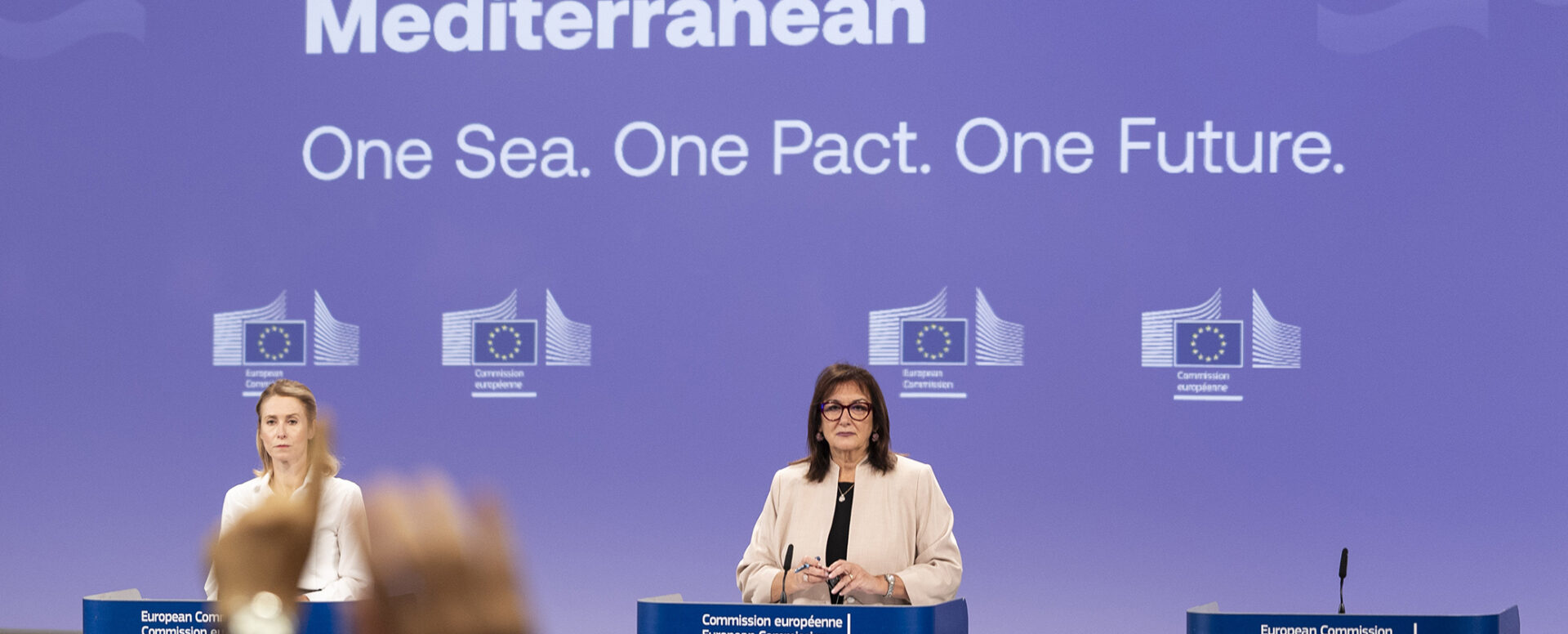
Photo: Read-out of the weekly meeting of the von der Leyen Commission by Kaja Kallas, High Representative of the Union and Vice-President of the European Commission, and Dubravka Šuica, European Commissioner, on the Pact for the Mediterranean. Photographer : Lukasz Kobus. Copyright: European Union, 2025