



Gender plays a critical role in shaping the experiences and perspectives of those involved in conflict-affected zones as civilians, combatants but also victims and perpetrators of violence. For a long time, the role of Israeli and Palestinian women has been viewed through the lens of feminist activism and peace movements, sacralizing sisterhood and drawing optimistic avenues for peaceful coexistence. Breaking with this optimistic approach, the intersection of gender with the Israeli-Palestinian conflict has been reframed by the politicization of sexual and gender-based violence (SGBV) in the context of the 7 October attacks. Accusations of SGBV by Hamas and other Palestinian factions against Israelis (civilians and soldiers) highlighted how this specific form of violence can be a weapon of war.
Unprecedented in the history of the Israeli-Palestinian conflict, SGBV, especially mass rapes and sexual mutilations, has gained significant global attention. As noted by Reem Alsalem, United Nations Special Rapporteur on Violence against Women and Girls, its Causes and Consequences, women have disproportionately borne the brunt of the conflict in Israel and Gaza: “while these atrocities affect both women and men, their impact is gendered and disproportionately affects women.”[1]
A June 2024 report by the Independent International Commission of Inquiry on the Occupied Palestinian Territory stated that both Israel and Hamas had committed sexual violence and torture, along with intentional attacks on civilians. Both sides have denied the accusations and used international bodies and human rights organizations’ reports and allegations of SGBV to further their narratives, influence international opinion and justify their actions. The increased attention given to the gendered nature of the conflict is certainly legitimate given the atrocities which took place; at the same time, this issue has been subject to significant political manipulation. For the first time, the gender dimension of the conflict, with an extra focus on sexual violence, has been at the heart of both the physical and symbolic battlefield.
For the first time, the gender dimension
of the conflict, with an extra focus on
sexual violence, has been at the heart
of both the physical and symbolic battlefield
The Gendered Dimension of the Conflict until 7 October, 2023
On both sides, and for a long time, the protracted conflict has been a major impediment to the promotion and implementation of women’s rights and gender equality.
Militarization and Nationalism through a Gendered Lens
In Israel, while women have been active in politics and social life since the pre-state period of the Yishuv, they have often been underrepresented in key decision-making positions. The permanent state of war has given tremendous importance to military service. The Israeli Defense Forces (IDF) have been central to Israeli national identity, which has strong links to hegemonic masculinity and citizenship, minorizing women and marginalizing non-Jewish communities.
In Palestinian society, the struggle against occupation has shaped gender roles, assigning specific responsibilities and identities to men as fighters and women as supporters and preservers of culture and family. Women’s participation has been constrained by traditional gender roles, political instability as well as fundamentalist and conservative political/societal forces, despite numerous well-known figures, including female combatants, being involved in armed activities.
On both sides those considered as heroines or terrorists have fuelled the image of exceptionality with a few iconic women supporting the national cause.
Israeli and Palestinian Women’s Activism for Peace
In Israel-Palestine, women have often been portrayed as agents for social justice, human rights and coexistence. Indeed, several initiatives led by women on both sides, such as the Jerusalem Link, Machsom Watch, Women in Black or the Coalition of Women for Peace, have aimed to foster dialogue, mutual understanding and cooperation. These initiatives have often focused on humanizing the “other” and building solidarity across divides. Though facing significant challenges, they have at times, especially during the Oslo period in the 1990s, succeeded in influencing political discourse and encouraging policymakers to consider more peaceful and inclusive approaches to conflict resolution.
However, the continuation of the conflict, especially the second Intifada in 2000, followed by many Israeli military operations in Gaza since 2008, have hampered peace efforts. Women involved in those groups have faced criticism and social ostracism from within their own communities, where their actions have been seen as naive, betrayal or a normalization of the enemy.
Social and Economic Vulnerabilities of Women
The social and economic consequences of the conflict on gendered dynamics have been underlined. Feminist academics and activists on both sides have analysed the vulnerabilities of women and girls, including their exposure to violence, displacement and economic hardships. These impacts have resulted in increased caretaking responsibilities, exposure to political and domestic violence, limited employment opportunities, restricted healthcare access and educational barriers. Their roles as primary caregivers have been intensified in times of crisis, placing additional burdens on them.
Furthermore, Palestinian women have documented the gendered consequences of Israeli occupation.[2] Restrictions on movement and access to resources have further hindered their participation in the labour market. Conflict has also restricted access to healthcare services, particularly in the Gaza Strip and parts of the West Bank. Women have faced challenges in obtaining necessary medical care, including maternal and reproductive health services. Conflict-induced displacement has disproportionately affected women, who had to navigate the challenges of securing housing, food and safety for their families in unstable environments. The conflict has also disrupted educational opportunities for girls, particularly in the Palestinian territories. Schools have often been damaged or used as shelters during periods of intense violence, and mobility restrictions have impeded regular attendance.
The Issue of Gender-Based Violence in the Conflict since 7 October, 2023
7 October marked a turning point in the public recognition and political treatment of SGBV in the Israeli-Palestinian conflict. SGBV does not constitute a new phenomenon in Israel-Palestine and has already been documented by human rights and feminist organizations. However, since October 2023, both sides have been accused of systematic and deliberate violence (that may constitute war crimes and crimes against humanity) and the political manipulation of human suffering, attracting unprecedented worldwide attention.
SGBV as a Weapon of War
Hamas’ attack on 7 October (that killed nearly 1,200 Israelis and foreign nationals) included numerous human rights violations, including acts of SGBV. Reports accused Hamas and fighters from other Palestinian groups of having targeted civilians and committing sexual violence (rapes, sexual mutilations, etc.) during these attacks.[3] The UN Special Representative on Sexual Violence in Conflict reported in March 2024 that her team found “clear and convincing information” of rape and sexualized torture being committed against hostages seized during the 7 October attacks and that “there are reasonable grounds to believe that conflict-related sexual violence occurred in multiple locations in southern Israel, including rape and gang rape.”[4] This has been part of a broader pattern of abuses, including taking hostages (251 were taken captive into Gaza) and launching indiscriminate rocket attacks on civilian areas. For Cochav Elkayam-Levy, a former Israeli government lawyer who headed a non-governmental commission advocating for recognition of sexual assault crimes on 7 October,[5] Hamas “weaponized” sexual violence in order to harm Israeli morale.
In response to the Palestinian groups’ attacks, Israel has conducted extensive military operations in Gaza. More than 37,900 Palestinians, most of them civilians (and most of them women and children), were killed between 7 October and 1 July, according to the Palestinian Ministry of Health. Israeli forces have reduced large parts of Gaza to rubble and left the vast majority of Gaza’s population displaced and in harm’s way. The IDF has been accused of committing acts of SGBV “throughout the Occupied Palestinian Territories […] during ground operations in conjunction with evacuations and arrests” (27 May 2024, report of the Independent International Commission of Inquiry on the Occupied Palestinian Territories, including East Jerusalem and Israel).[6] Women and men have reportedly been victims of forced public stripping and nudity, sexualized torture and abuse, and sexual humiliation and harassment. Videos and photos have been circulating on social networks, including some taken by Israeli soldiers. Investigators from the UN’s Commission of Inquiry noted “gender persecution targeting Palestinian men and boys,” as men have faced massive arbitrary detention and enforced disappearances. During the 56th session of the Human Rights Council in Geneva in June 2024, the Palestinian Women’s Centre for Legal Aid and Counselling held side events on sexual violations perpetrated by the IDF against Palestinian women in the West Bank and Gaza. Based on testimonies, the organization aimed to prove that Israeli SGBV began prior to the operation in Gaza.
Information Warfare: SGBV as a Tool of Political Instrumentalization
The political instrumentalization of SGBV is not just a by-product of the violence; it is also a tool fuelling the conflict.
The Israeli political leadership, which until then had not been known as a fervent defender of women’s rights, immediately reacted to SGBV perpetrated by Hamas. Supported by Israeli feminist and human rights organizations, it criticized the UN for its immediate muted response to sexual violence, as well as international feminist movements, accused of supporting the Palestinian cause and downplaying the assaults. Israeli government officials and spokespeople regularly wielded rhetoric implying that the fight against Hamas was synonymous with the fight for women’s freedom. As such, it weaponized gender issues (for instance rape) to justify its military intervention. Although it has happened in other conflict zones (i.e. Afghanistan), it is a first in the context of the Israel-Palestine conflict.
In response, Hamas denied the accusations and Palestinian human rights organizations criticized Western media for paying outsized attention to allegations of Hamas-perpetrated sexual violence, while turning a blind eye to SGBV perpetrated by Israeli soldiers against Palestinians. They accused them of partiality and lack of sensitivity to Palestinians’ daily reality of violence. In doing so they have tried to delegitimize the Israeli military offensive, to mobilize the international community and to balance the sense of international public opinions’ outrage.
Furthermore, the mediatization of atrocities by politicians, activists and journalists came at a time when Israel has constantly refused to cooperate with the UN Commission’s investigation. This has fuelled disinformation, conspiracy theories and the false argument of “lack of proof,” used by those who have denied the accusations, despite images, videos and testimonies being gathered and circulated. It has also complicated the capacity of professionals to carry out undisputable investigation, with respect and dignity for the victims and survivors.
Since October 2023, both sides have denied all allegations. Both sides have developed intense information campaigns on violations of human rights perpetrated by their adversaries/enemies. Israeli, Palestinian but also international human rights and feminist movements have found themselves trapped in this war of narratives, which is another sign of the political stalemate and the lack of prospect for an end to the conflict.
[1] United Nation Human Rights Office of the High Commissioner, “Women bearing the brunt of Israel-Gaza conflict: UN expert.” Press Releases, 20 November 2023.
www.ohchr.org/en/press-releases/2023/11/women-bearing-brunt-israel-gaza-conflict-un-expert.
[2] Among others: Women’s International League for Peace and Freedom, Palestinian Women Under Prolonged Israeli Occupation: the Gendered Impact of Occupation Violence, Universal Periodic Review of Israel, Joint Submission to the UPR Working Group 29th Session (Jan 2018), 2017. https://wilpf.org/wp-content/uploads/2017/11/Palestine-UPR_web-2-5.pdf.
[3] Sexual Crimes in the October 7 War, Special Report of the Association of Rape Crisis Centers in Israel, ARCCI, 21 February 2024.
[4] Office of the Special Representative of the Secretary-General on Sexual Violence in Conflict, Mission Reports – Official Visit of the Office of the SRSG-SVC to Israel and the Occupied West Bank, 29 January – 14 February 2024. https://news.un.org/en/sites/news.un.org.en/files/atoms/files/Mission_report_of_SRSG_SVC_to_Israel-oWB_29Jan_14_feb_2024.pdf.
[5] Hilo Glazer, “The Scope of Hamas Campaign of Rape Against Israeli Women is Revealed, Testimony After Testimony.” Haaretz, 30 November 2023. www.haaretz.com/israel-news/2023-11-30/ty-article-magazine/.highlight/hamas-campaign-of-rape-against-israeli-women-is-revealed-testimony-after-testimony/.
[6] Human Rights Council, Report of the Independent International Commission of Inquiry on the Occupied Palestinian Territory, including East Jerusalem, and Israel, A/HRC/56/26, 27 May 2024.
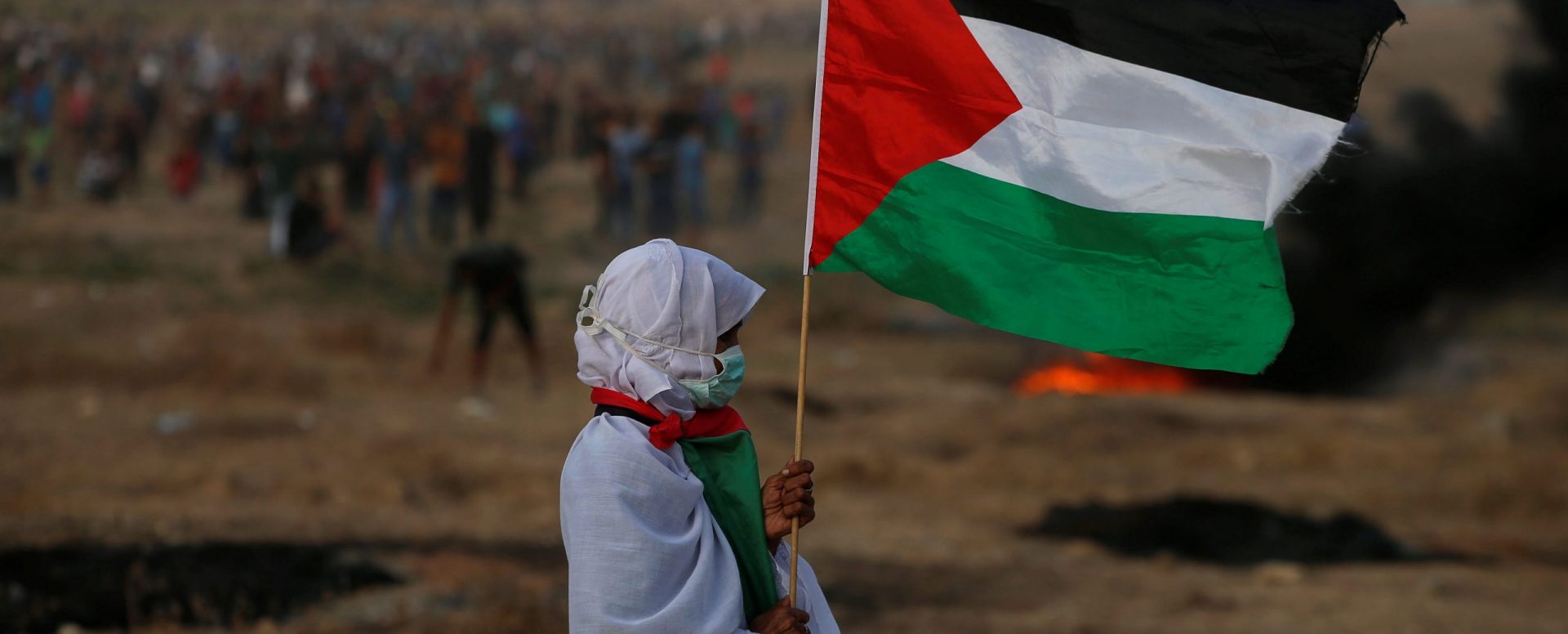
Header photo: A woman holds a Palestinian flag during a protest calling for lifting the Israeli blockade on Gaza and demanding the right to return to their homeland, at the Israel-Gaza border fence in Gaza October 19, 2018. REUTERS/Mohammed Salem