


The Architecture of Power on the Horizon of 2025
The year 2025 saw the definitive consolidation of Mohamed Ould Cheikh Ghazouani’s political plans. Since his re-election on 29 June 2024, the Mauritanian political landscape has begun to stabilize, a situation that, whilst ensuring continuity, raises profound questions regarding the nature of the country’s political system.
The architecture of power in Mauritania is today defined by a hyper-concentration of decision-making mechanisms in a strongly presidential model. This structure does not operate in isolation, but rather through an almost organic symbiosis between the president’s party, Insaf, the government apparatus, and the leaders of the main state institutions. This institutional amalgam has resulted in top-down management of public affairs, with the ensuing immediate and tangible impact on the domestic economy.
From a macroeconomic perspective, Ghazouani’s leadership can be considered effective. The government has proved capable of navigating the turbulent waters of the post-Covid global economy and the current economic, geopolitical, and energy crises, keeping a tight rein on inflation and ensuring that GDP growth forecasts are met, in line with the projections of multilateral organizations. However, these figures mask a far more nuanced and, at times, bleak social and economic reality.
Mauritania remains a country of stark contrasts. Notwithstanding its macroeconomic successes, the United Nations Human Development Index (HDI) ranks the country 163rd out of 193 states and territories, in the lowest tier of human development. This “low human development” classification serves to show that political stability does not always translate to social peace. Over the past year, civil protests – often catalysed by an opposition eager to find cracks in the Insaf monolith – have highlighted the real loss of purchasing power and skyrocketing cost of living.
In the social arena, the “unfinished business” includes not only economic, but also structural and identity-related issues. The inclusion of the migrant population and persistent complaints regarding the exclusion of Mauritanian citizens of Black African origin and the Haratin (descendants of former Arabized slaves) provide the basis for a latent social tension. This is compounded by an education system that falls well short of the minimum quality standards and a precarious public healthcare network, challenges that GDP growth alone seems unlikely to solve.
Economic Resilience in a Context of Global Instability
Mauritania’s ability to withstand the tensions of a changing and deeply vulnerable international context was one of the main topics of academic and political debate in 2025. Whilst other Sahelian economies have succumbed to the pressures of global inflation, armed conflicts, and the volatility of the commodity markets, Mauritania has proved remarkably resilient.
The Mauritanian economy is not only resilient,
but has also shown moderate, but steady growth.
In 2025, GDP grew by 5.5%, placing the country
above the global growth average
The annual reports of the International Monetary Fund (IMF) and the World Bank Group support the official government data: the Mauritanian economy is not only resilient, but has also shown moderate, but steady growth. In 2025, GDP grew by 5.5%, placing the country above the global growth average. The country’s management of its public debt, which has held steady at a reasonable 47.8% of GDP, is likewise notable, as is the inflation rate, which, despite having risen from 2.8% in 2024 to 4% in 2025, remains enviable compared to those of neighbouring countries.
The Role of Administrative Reform and Transparency
This success is no coincidence, but rather the product of a series of administrative measures that have strengthened the country’s response capabilities. Mauritania has embarked on a path – not without obstacles – towards transparency in economic data. This pivot towards “good governance” has taken the form of concrete actions:
- Independent institutions: The September 2025 appointment of the chair of the Anti-corruption Authority marked a turning point in the political will to oversee the use of public funds.
- Reform of public companies: The adoption, in November 2025, of the Independent Commission of Public Establishments and Companies (CESPI) seeks to professionalize the management of state-owned enterprises, moving them away from traditional political patronage.
- Strengthening of the tax system: Efforts have been made to optimize the tax system to reduce dependence on foreign aid and control the debt. However, this gives rise to an interesting contradiction: whilst the IMF is pressing for higher taxes on products such as fuel to encourage sustainability and bring down the deficit, the government risks triggering social unrest if it cuts subsidies for essential goods.
Crucially, Mauritania is aiming for growth capable of allowing it to cast off the chains of pure extractivism. Whilst iron, gold and copper remain the pillars sustaining the trade balance, sectors such as agriculture and fisheries are seeing a resurgence. However, these sectors are at the mercy of their extreme vulnerability to climate change. Without massive investment in irrigation infrastructure and modernization of the fishing fleet, they will remain hostage to the drought and flood cycles that plague the region.
The Challenge of Migration Management: Between International Cooperation and Internal Tensions
Once at the periphery of public policy, management of migration flows is today at the very heart of the Mauritanian political agenda. In 2025, the issue emerged as a cross-cutting phenomenon with ramifications affecting everything from the stability of the informal labour market to the country’s diplomatic stance towards the European Union (EU).
The Partnership with the European Union: An “Outsourcing” Model under Scrutiny
In March 2025, Nouakchott and Brussels agreed a new cooperation framework, whose full implementation marked the rest of the year. With funding to the tune of €210 million, the agreement is presented under a rhetoric of “shared responsibility” and “solidarity.” However, a detailed academic analysis points to a clear move by the EU within its Global Gateway Strategy to make Mauritania a buffer against migration to the Canary Islands.
The agreement is organized around five core areas, which have sparked intense public debate:
- Training and employment: The attempt to create local opportunities in order to discourage young Mauritanians from leaving.
- Protection and asylum: Strengthening Mauritania’s capacity to receive refugees, especially those fleeing the trouble in Mali.
- Legal migration: An area that, in practice, has shown much slower progress than the more punitive ones.
- Combatting trafficking in human beings: Shoring up police and judicial intelligence.
- Border management: Perhaps the most controversial point, due to the active involvement of Frontex, tasked with providing high-tech equipment and militarized training to local security forces, which amounts to outsourcing by the EU of its border control.
The Paradox of Public Perception: The 2025 Afrobarometer
Despite the government’s narrative concerning the benefits of the agreement, the shift in migratory policy has elicited a growing sense of rejection amongst the local population. The data from the May 2025 Afrobarometer report are telling: even as Mauritania is emerging as a strategic destination and transit point, civil society in the country is deeply reluctant to host migrants.
Even as Mauritania is emerging as
a strategic destination and transit point,
civil society in the country is deeply
reluctant to host migrants
The internal contradiction within Mauritanian society is clear: on the one hand, around 3 in 10 Mauritanians consider emigration their sole means of getting ahead; on the other, 6 in 10 are vehemently opposed to the free movement of people within West Africa for labour purposes. This latent xenophobia is fuelled by the perception that immigrants (who currently make up 9% of the working population) compete for precarious social services and jobs in the informal sector, in a country where youth unemployment stands at around 32%.
Human Rights and “Transit Centres”
International criticism peaked in the Human Rights Watch (2025) report. Based on interviews conducted over a five-year period (2020-2025), the document denounced Spain and the EU’s complicity in practices of arbitrary detention and mistreatment. The Mauritanian government’s response has primarily consisted of explaining how the “Transit Centres” were created in accordance with international standards.
Whilst these centres are supposed to provide dignified conditions for vulnerable individuals (unaccompanied minors and trafficking victims), human rights organizations have questioned their effectiveness. The official figure of 18,300 migrants repatriated between January and July 2025 bears witness to the scale of the return operation Mauritania is carrying out to fulfil its commitments to Europe, striking a delicate balance to avoid breaching the principle of non-refoulement (non-return) in asylum cases.
Political Stability vs Democratic Quality: The Mirage of National Political Dialogue
In January 2026, in his report on the previous year to the National Assembly, Prime Minister Mokhtar Ould Diay described his administration as a success story of “transparency and digitalization.” But beneath the surface of this administrative modernization lies a semi-presidential system with a persistent authoritarian drift.
Insaf’s Hegemony and the Fragmentation of the Opposition
The party system in Mauritania in 2025 confirmed Insaf’s consolidation as a “dominant authoritarian party.” Not only does it control the legislative branch, but it also acts as an extension of the state apparatus, blurring the boundaries between the party and the administration. Meanwhile, in the face of its omnipresence, the opposition is highly fragmented:
- IRA (Initiative for the Resurgence of the Abolitionist Movement): Led by Biram Dah Abeid, it continues to focus on denouncing the caste system and slavery, but its personalistic and populist drift hinders the formation of broad coalitions. Despite being refounded in 2020 as Refoundation for a Global Action (RAG), it continues to be known by the acronym IRA.
- Tawassoul (Islamists): Traditionally the main opposition force, this party has been in the throes of an identity crisis since its shift towards orthodoxy. This has prompted its more moderate cadres to defect and migrate into the presidential orbit, including, most strikingly, its former leader, Ould Mansour.
- RFD (Rally of Democratic Forces): The old guard of the Mauritanian left is suffering from generational and electoral attrition, which has relegated it to the sidelines of the party system
National Dialogue as a Tool for Control
One constant throughout Ghazouani’s time in office has been the call for “national dialogue.” In political science terms, such calls serve as ad hoc safety valves for reducing political and social pressure in times of crisis (such as the rising cost of living). By gathering actors outside Parliament, the President undermines democratic institutions, replacing legislative debate with informal talks in which the executive branch always has the final say.
The Regional Context: Mauritania, the Collapse of the Sahel and the Shadow of Western Sahara
Mauritania is, by definition, a “gatekeeper” state. Its stability is all that prevents the instability of the Sahel from reaching the Atlantic coast and the borders of the Maghreb.
The Conflict in Mali and the Challenge to Territorial Integrity
Relations with Mali are certainly the greatest national security challenge. The porosity of the eastern border has enabled continuous raids by armed groups (both jihadists and militias linked to the Malian state and foreign mercenaries). As of 31 December 2025, Mauritania had taken in more than 309,000 refugees and asylum seekers, the vast majority of whom were fleeing from the conflict in Mali.
Ghazouani’s strategy has been one of “patient containment.” Despite the provocations and violations of its territorial space, the Mauritanian army has avoided direct military escalation, aware that open war with Mali would irreparably destabilize the country’s fragile domestic equilibrium.
The Maghreb Balancing Act: The Sahara, Algeria and Morocco
On its northern flank, Mauritania continues to practise “active neutrality” with regard to the Western Sahara conflict. In this regard, its public stance – especially since its presidency of the African Union in 2024 and two-year term on the UN Security Council in 2024 and 2025 – stands out for its advocacy of respect for international law as the means for resolving the conflict in this non-self-governing territory. The country has declined to participate in geopolitical experiments such as the G3 of Maghreb states (Algeria, Tunisia, Libya–Tripolitania) so as not to antagonize Morocco. Nevertheless, the creation of a free trade zone with Algeria is proof that Nouakchott seeks to diversify its economic alliances to prevent dependence on any single neighbour.
Gaps in the Social Structure: Gender, Ethnicity, and Economic Inequality
The economic modernization that Ghazouani’s government projects abroad clashes head-on with a domestic social structure in which traditional inequalities and gender disparities dictate the everyday reality of Mauritanians.
Women’s Autonomy under the Burden of Polygamy
The situation of women in Mauritania cannot be analysed solely through Western parameters of employment or education; it is deeply bound up in a complex mix of religious, ethnic, and cultural factors. One fact that is often overlooked in macroeconomic analyses, but is nevertheless central to the country’s sociology, is that 10.7% of Mauritanian women live in polygamous households, of whom 55% live in rural areas.
This phenomenon is not merely a marital statistic, but an indicator of the limitations on women’s autonomy. The regions with the highest percentages are Hodh Ech Chargui (14%), Nouakchott Nord (12%) and Hodh El Gharbi (11%). Living in households in which the husband and domestic space are shared with other wives usually results in reduced decision-making power with regard to the family economy, reproductive health and children’s education.
This lack of autonomy is exacerbated by a persistent education gap: 40% of married women have no formal education at all. This lack of human capital locks them into almost absolute economic dependence. Indeed, data from 2025 show that only 21% of Mauritanian women have paid employment. Without access to land ownership or financial credit, Mauritanian women are largely excluded from the benefits of GDP growth.
The Open Wound: The Persistence of Slavery and Its Modern Forms
Despite legislative efforts and official pledges to international bodies, slavery remains the “great stain” on Mauritania’s human rights record. In its 2025 index, the Walk Free Foundation reported figures that highlight the gravity of the situation: 2.4% of the population lives in a regime of absolute deprivation of liberty and fundamental rights.
Without access to land ownership
or financial credit, Mauritanian
women are largely excluded
from the benefits of GDP growth
The most alarming statistic, however, is that concerning vulnerability: 62% of the Mauritanian population is at risk of falling into what is known as “modern slavery.” This technical concept refers not only to ancestral hereditary slavery (still present in remote areas), but also to new forms of exploitation: 1) forced labour, especially in extractive and agricultural sectors; 2) debt bondage, in which workers are bound to their employers for life, unable to pay off unpayable debts; and 3) domestic servitude, a reality hidden behind the walls of the urban elite, whereby women and girls of Haratin origin work in conditions of semi-slavery.
The fight against these practices is spearheaded by organizations such as the IRA, but the Mauritanian judicial system is often slow and, sometimes, complicit with the traditional power structures underpinning these forms of domination.
Green Hydrogen and Fossil Fuels: The New Diplomatic Currency
If migration is the challenge for Mauritania, then energy is its great promise for the 21st century. The country has grasped that its position as a “gatekeeper” is not only geographical or migratory, but also energy-related.
The Greater Tortue Ahmeyim (GTA) Megaproject
The economic stability of 2025 was largely reliant on the exploitation of gas and other fossil fuels. However, the true promise in the long-term strategy is the Greater Tortue Ahmeyim (GTA) project, being developed along the maritime border with Senegal. This project not only secures export revenues, but also positions Mauritania as a strategic partner for a Europe eager to diversify its energy sources in the wake of the Russian gas crisis.
The Bet on Green Hydrogen
Mauritania aspires to become a global leader in green hydrogen production. Thanks to its vast tracts of desert with high levels of solar radiation and constant wind, the country has a natural competitive advantage. Green hydrogen production is not just an environmental issue; it is a foreign policy tool.
For the EU, investing in Mauritanian hydrogen fulfils a dual purpose. On the one hand, it enhances energy security, by ensuring a clean, nearby supply. On the other, through political anchoring, insofar as it links the Mauritanian economy to European standards, it secures a stable ally in a region (the Sahel and West Africa) that is slipping into the sphere of influence of Russia (through the Wagner Group) and China.
Conclusions: A Future of Precarious Balances
Mauritania entered 2026 as a country marked by both macroeconomic successes and extreme social fragility. Mohamed Ould Cheikh Ghazouani’s administration has achieved the seemingly impossible: maintaining stability in a country surrounded by coups d’état (Mali, Niger, Burkina Faso) and migration crises.
Yet “structural challenges” persist. The sluggish pace of social reform, stark disparities between coastal and inland regions, and lack of a true culture of civic engagement threaten to hollow out the benefits of economic growth.
The “gatekeeper’s” future hinges
on its weakest link, on not pushing
its own citizens past the breaking point
The international community and, especially, Spain and the EU must decide whether their relationship with Mauritania will continue to be based exclusively on outsourcing borders and energy security or whether they will start to press for democratization and social cohesion to move beyond mere rhetoric of “national dialogue” and become a reality for the Black African population, the Haratin, and Mauritanian women. The “gatekeeper’s” future hinges on its weakest link, on not pushing its own citizens past the breaking point.
References
Jaldi, Abdessalam; Liga, Aldo and Nafti, Hatem. “Analyse rétrospective des élections maghrébines de 2024.” Policy Center for the New South, PP-03/2025.
Anfaara, Florence Wullo et al. “Exploring the link between household structure and women’s household decision-making autonomy in Mauritania.” Journal of Biosocial Science, Vol. 56, No. 5, p. 831–844, 2024.
Afrobarometer. Cuestiones migratorias y opinión pública en Mauritania. Barcelona: Afrobarometer, May 2025.
International Monetary Fund. Mauritania: Staff Report for the 2025 Article IV Consultation. Washington D.C.: IMF, 2025.
Human Rights Watch. Informe sobre la gestión de la migración y derechos fundamentales. New York: HRW, 2025.
UN Refugee Agency (UNHCR). Global Trends: Forced Displacement in 2025. Geneva: UNHCR, 2026.
Walk Free Foundation. Global Slavery Index 2025: Mauritania. Perth: Walk Free Foundation, 2025.
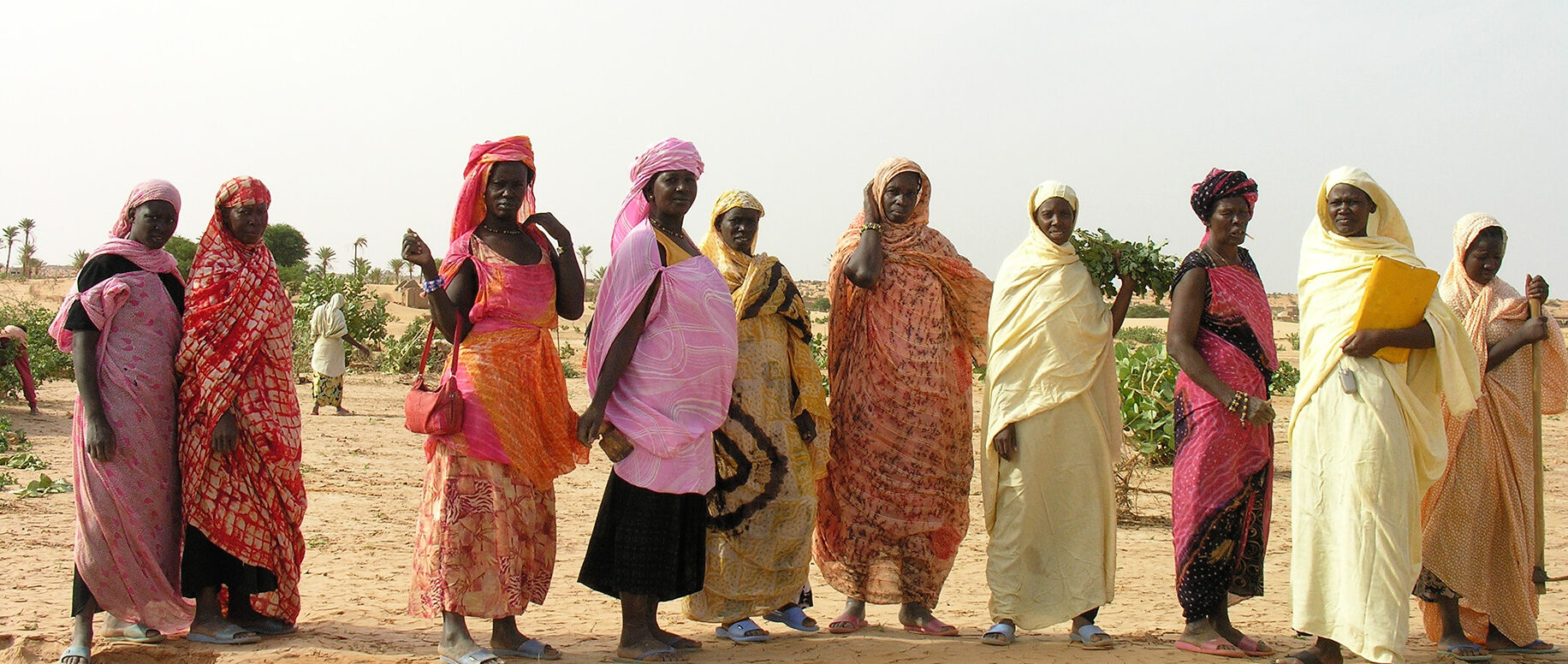
Header photo: Tidjikja, Tagant, Mauritania, 15th October 2005: Women from agricultural cooperative posing for the camera. Shutterstock / Alphorom