



The illegal war launched by the United States and Israel against Iran on 28 February 2016 has triggered a conflict in the region that has highlighted how quickly regional crises translate into internal economic pressure. Egypt has not officially entered the conflict, but it has paid the price with soaring inflation in March, reaching 15.2%, a record depreciation of the pound to 63 pounds per euro, and a sharp rise in fuel and electricity prices, in addition to other measures imposed by the Abdel Fattah al-Sisi regime.
These signs suggest that this is not a temporary crisis affecting a stable economic system, but rather yet another stress test that reveals deep structural weaknesses at the political level. These shortcomings underpin an authoritarian governance model that is creating a two-tier society. At the same time, the country’s heavy financial dependence on the Gulf States – the primary targets of Iranian retaliation following attacks on their territory –, due to both remittances from Egyptians working there and the enormous direct investments received in recent years, particularly from the United Arab Emirates (UAE), has been strained by tensions between the Gulf States and Egypt due to the latter’s lack of military involvement in the war in Iran.[1] The disagreements that have arisen seem to indicate a strain on future relations, and, coupled with governmental inefficiency and regional unrest, suggest a need for profound systemic reforms in Egypt and improved crisis management.
A Balancing Act: Tensions with the Gulf and the Role of Mediation
Iran’s retaliation for the war launched by Israel and the United States on its territory has led to the selective closure of the Strait of Hormuz, through which a fifth of the world’s oil and a large proportion of liquefied natural gas passes, a severe impact on the energy market, and the Israeli re-occupation of southern Lebanon, alongside bombings of its capital, justified by the presence of the Shiite organization Hezbollah. The Gulf States, for their part, have come under Iranian attack due to the presence of US military bases on their territories, as well as suffering attacks against energy infrastructure and desalination plants.
At the time of writing, Egypt has so far been spared direct Iranian retaliation because it does not host any US military bases on its territory. On the diplomatic front, the Egyptian authorities condemned Iran’s airstrikes against its neighbours from the outset, without mentioning the Israeli-US aggression. In addition to numerous telephone conversations, Foreign Minister Badr Abdelatty undertook a regional tour in mid-March, visiting Qatar, the UAE, Oman, Jordan and Saudi Arabia, and met with the Secretary-General of the Gulf Cooperation Council (GCC), while President al-Sisi visited the UAE and Qatar, and subsequently Bahrain and Saudi Arabia (Kamel, 2026). During his tour, Abdelatty focused on conveying three messages: Egypt’s condemnation of the attacks against the Gulf States, the assertion that Gulf security is an extension of Egyptian security, and the need to establish mechanisms for collective Arab action and a ‘joint Arab force’. Egypt has had no choice but to show solidarity with the Gulf states, as they are its main donors. In its strategy for financial survival, the al-Sisi regime has even gone so far as to cede swathes of national territory, as happened in the case of Ras al-Hikma, a strip of land on the country’s northern coast, which in 2024 was sold for $35 billion to Emirati funds, in what is considered the largest foreign direct investment in Egypt’s history.
Egypt has had no choice but to show solidarity
with the Gulf states, as they are its main donors (…)
The Gulf capitals were nevertheless hoping for
a more decisive response from Egypt
The Gulf capitals, Riyadh and Abu Dhabi in particular, were nevertheless hoping for a more decisive response from Egypt, as they view Iran as a direct threat that must be neutralized. They expected the deployment of military support forces from the outset, logistical and intelligence assistance, and broad media and public backing. The Gulf States wanted Cairo to become involved in the US and Israeli war by supporting the US security umbrella, which has underpinned Gulf security doctrine for decades rather than opting for collective security instruments that would protect the security and sovereignty of the Arab states in the region (Hassan, 2026).
Egypt’s stance, therefore, did not meet the Gulf states’ expectations at that initial stage, as Egyptian policymakers chose to maintain, to a certain extent, a position of ‘forced neutrality’. Cairo is forced to tread a fine line in its security, economic and political positions within an extremely volatile regional environment, sometimes falling into contradictions. In contrast to its subordinate and externally dependent role in economic terms, there is a rhetorical discourse defending national sovereignty and political autonomy, exemplified, for instance, by the refusal to host Palestinian refugees forcibly displaced from Gaza in the Sinai. Egypt views the expansion of Israeli influence in the region with concern should the Iranian regime be overthrown. The war against Iran is perceived as part of the plan to reshape the Middle East devised by Israeli Prime Minister Benjamin Netanyahu, according to which the region would come under Israeli leadership with US support, posing a direct threat to Egypt’s national security and sovereignty. Egypt, like other regional actors such as Saudi Arabia and Turkey, does not disapprove of the existence of a regional counterweight to Israel, even if it cannot express this publicly. This is why President al-Sisi has sought to position himself as a mediator in the conflict, along with Turkey, Pakistan and Saudi Arabia, and has held direct telephone conversations with Iranian President Massoud Pezeshkian.[2]
Relations between Egypt and the Gulf States have suffered and would require a fundamental rethink if they are to safeguard their common interests. Inter-Arab tensions and rivalries are being reignited even before the conflict has ended, and all indications point to a realignment of alliances in the region.
The Economic Impact of the War
Egypt’s economic situation is critical, as it has been plagued by structural deficiencies for decades, leaving it in a position of enormous vulnerability. In 2024, it faced the threat of bankruptcy, which it managed to avoid thanks to loans received from the International Monetary Fund (IMF) and the European Union (EU), and the multi-billion-dollar financial injections from the Gulf monarchies (Azaola, 2025). The war against Iran has not only posed a threat to regional security but has also triggered an economic crisis with direct repercussions for Egypt, even though the country has not officially entered the conflict. Energy markets, investor confidence, remittance flows and trade routes are channels through which regional instability has affected the Egyptian economy (Omran, 2026).
Egypt relies heavily on Israel for its energy supply, but Israel cut off natural gas supplies for a month following the outbreak of the war. Israeli gas exports account for 17% of Egypt’s domestic consumption and come primarily from the Leviathan gas field in the eastern Mediterranean. In 2025, these exports increased following the signing of a $35 billion agreement for the supply of 130 billion cubic metres over fifteen years (Kamel, 2026). This type of Egyptian-Israeli trade has continued despite the genocide perpetrated by Israel in the Gaza Strip since October 2023, with the exception of isolated instances, as in June 2025 following the Israeli and US attacks on Iran (Bustani, 2026). Israel’s decision to cut off supplies prompted the Egyptian regime to activate an emergency plan to ensure local supply and increase imports of liquefied natural gas through long-term contracts with other international suppliers – from Indonesia and the Netherlands – in a pragmatic-strategic shift towards global markets (Abdelhalim, 2026). The government immediately imposed restrictive measures to reduce energy consumption and prevent blackouts such as those occurring in previous years. The restrictions, in place from late March to early April, included switching off street lighting – roadside lighting and billboards – and closing cafés and restaurants at 9 pm (an hour later on Thursdays and Fridays), which was extended to 11 pm in mid-April. By the end of the month, the government had to lift these measures – except for the requirement to work from home on Sundays – due to protests from shopkeepers and those in the hospitality, leisure and tourism sectors over the losses they were incurring, bearing in mind that revenue from the tourism sector accounts for 5% of the country’s Gross Domestic Product (GDP).
All this pressure led to a sharp depreciation of the pound, which began to recover following the announcement of a ceasefire on 17 April, alongside a cascade of price rises and inflation that reached its highest level in ten months (15.4%) in March 2026. Fuel subsidies were cut, with fuel prices rising by 14%; the price of gas rose by more than 30%, electricity by around 20%, and train and metro fares by 25%, although subsidies for bread were maintained, benefiting millions of people living below or near the poverty line in a country that is the world’s largest consumer of this staple food. The impact of the war could be even greater if there are disruptions in the Suez Canal, whose revenues account for 7% of GDP. Following the attacks of 7 October 2023 and the brutal Israeli offensive on Gaza, Yemen’s Houthis attacked merchant ships in solidarity with Palestine in the Bab el-Mandeb Strait and the Red Sea, causing maritime traffic to fall by more than half and putting pressure on Suez Canal revenues ever since.
The war against Iran is perceived as part
of the plan to reshape the Middle East devised
by Netanyahu, according to which the region
would come under Israeli leadership
The war, however, may serve as a pretext for the al-Sisi regime to impose harsh economic measures that would plunge the population into a new level of austerity. Subsidies for the most vulnerable social groups could be phased out or cut, taxes raised, or a new emergency loan requested from the IMF, as already happened in 2016, during the Covid pandemic in 2020, following Russia’s invasion of Ukraine in 2022, and in 2024 when the country was on the brink of bankruptcy. Egypt is, in fact, the second most indebted country to this organization after Argentina.
To date (the spring of 2026), the Egyptian population has not expressed its rejection of these measures through demonstrations or protests. However, it cannot be ruled out that, if power outages increase during the summer due to the use of air conditioning and prices continue to rise, strikes and other forms of collective action may be organized, despite the regime’s efforts to strengthen repressive measures. The safety net provided by Gulf bailouts is no longer guaranteed due to the reduced financial capacity of these countries, and perhaps in retaliation for Egypt’s apparent ‘neutrality’, meaning that al-Sisi’s regime may face a deep financial crisis similar to that of early 2024. External financing is becoming increasingly uncertain and will be subject to greater conditionality.
Bibliography
Abdelhalim, Ahmed “How The Iran War Is Exposing Egypt’s Structural Economic Fragility”, Dawn, 27/04/2026 https://dawnmena.org/how-the-iran-war-is-exposing-egypts-structural-economic-fragility/.
Azaola, Bárbara “La nueva República de al-Sisi: un país a dos velocidades”, Afkar/Ideas, (76), Autumn/Winter 2025, pp. 47-51.
Bustani, Hisham “Le « gazoduc arabe » au service d’Israël”, Orient XXI, 08/04/2026https://orientxxi.info/Le-gazoduc-arabe-au-service-d-Israel.
Harb, Imad K. “Egypt and the Gulf: A Relationship under Pressure”, Arab Center Washington, 21/04/2026 https://arabcenterdc.org/resource/egypt-and-the-gulf-a-relationship-under-pressure/.
Hassan, Mahmoud “Egypt and the Gulf states: Sharp differences over the Iran war”, Middle East Monitor , 07/04/2026 www.middleeastmonitor.com/20260407-egypt-and-the-gulf-states-sharp-differences-over-the-iran-war/.
Hassan, Mahmoud “Iran war used as a pretext for harsh measures in Egypt”, Middle East Monitor, 22/04/2026 www.middleeastmonitor.com/20260422-iran-war-used-as-a-pretext-for-harsh-measures-in-egypt/.
Kamel, Adel “Face à la guerre régionale, l’Égypte cherche sa voie”, Orient XXI, 02/04/2026 https://orientxxi.info/Face-a-la-guerre-regionale-l-Egypte-cherche-sa-voie.
Omran, Mohammed “A Warning Signal, Not Yet a Crisis: Is Egypt at Risk of Repeating Its Currency History?” Arab Reform Initiative, 03/04/2026 https://www.arab-reform.net/publication/a-warning-signal-not-yet-a-crisis-is-egypt-at-risk-of-repeating-its-currency-history/.
This work forms part of the findings of the following research projects: “Legados históricos. Dinámicas sociopolíticas y transformaciones regionales” [Historical Legacies: Sociopolitical Dynamics and Regional Transformations] (2025-GRIN-38501), a research project under the University of Castilla-La Mancha’s 2025 research programme, co-funded by the European Regional Development Fund (ERDF); and “Los legados históricos del Magreb en disputa: discurso, nación y ciudadanía” [The Contested Historical Legacies of the Maghreb: Discourse, Nation and Citizenship] (PID2024-157462NB-I00), funded by MICIU / AEI / 10.13039/501100011033 / ERDF, EU.
[1] On 7 May 2026, official Emirati news agencies announced the deployment of Egyptian air forces and Rafale fighter jets on their territory, coinciding with al-Sisi’s visit to Abu Dhabi. In a statement issued the following day, the Egyptian Ministry of Foreign Affairs reiterated its “full solidarity with the UAE and support for all measures and actions taken by that country to protect its security, stability and national resources,” without mentioning the military deployment. This move, and the absence of an immediate official statement, raised many questions among Egyptian public opinion regarding the nature of these forces, the limits of their mission, and whether this signalled a shift in Egypt’s policy of not becoming militarily involved in the ongoing conflict. Social media users criticized the Egyptian army’s involvement in the defence of a Gulf country and demanded its non-involvement in regional conflicts that benefit the United States, Israel and the survival of the regime and its allies. “Egypt Sends Fighter Jets to the UAE to Defend Against Iranian Attacks”, Egyptian Streets, 08/05/2026 https://egyptianstreets.com/2026/05/08/egypt-sends-fighter-jets-to-the-uae-to-defend-against-iranian-attacks/#google_vignette.
[2] “Egyptian President Holds Phone Call with Iranian President”, WANA, 14/03/2026 https://wanaen.com/egyptian-president-holds-phone-call-with-iranian-president/.
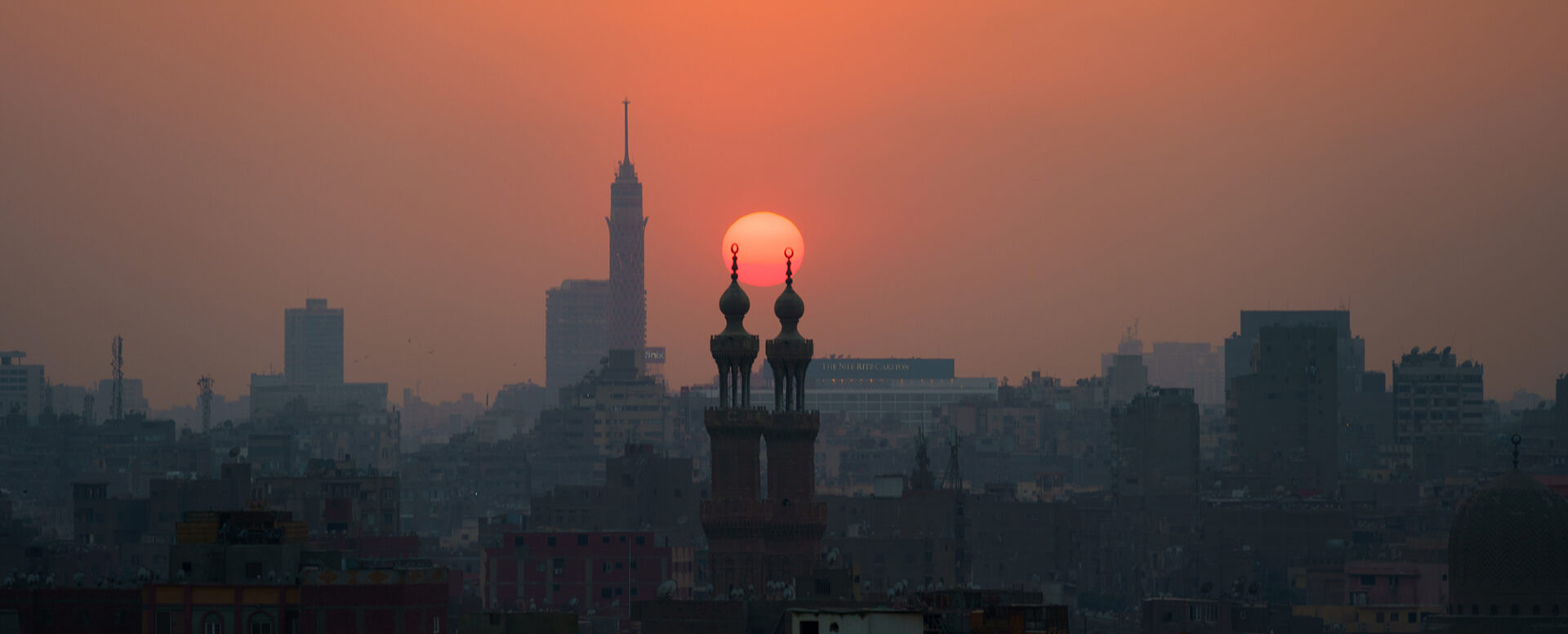
Photo: Power cuts are usual in Cairo during summer due to the use of air conditioning. Cairo, Egypt – September 5, 2022 : Cairo city skyline during sunset. Shutterstock / Munzir Rosdi.