



Reports of the death of the international legal order are greatly exaggerated, as Mark Twain might have said – but only because the reports are looking at the wrong corpse. What has died is not the international legal order itself, but the plausible deniability so many sought to preserve around its operation. That distinction has a precise meaning. The institutions persist. The language of universal norms endures. What has ended is the plausibility of the claim that the system functions as a genuine constraint on power, as opposed to a resource through which power legitimates itself. The order is not dead; it has been reclassified — and that reclassification, once made, is not easily undone.
That is where we all stand today in the aftermath of the Gaza war — including the genocide proceedings brought before the International Court of Justice, in which the Court issued provisional measures on that basis. The central question now is what follows, as the fragmentation of the rules-based order reverberates across the international system, and as we stand by until the next crisis hits, which is all but inevitable.
It bears remembering: the post-1945 legal architecture was never designed to eliminate conflict. The UN Charter, the Geneva Conventions, the instruments of international humanitarian law that accumulated across the Cold War and after were designed to bound conflict, to restrain it, to contain it: to impose reputational and material costs on states that violated its terms, to narrow incrementally the scope and brutality of war, to render power accountable to something beyond itself.
That was the promise; yes, it was never fully kept. But the gap between promise and performance remained narrow enough — across enough cases, over enough decades — to sustain the belief that the system operated mostly according to principles, not only interests or base power politics. That belief is now untenable for anyone to hold – not purely as the result of Gaza, but Gaza drove the final nail into the coffin of that claim.
Moreover, Gaza demonstrated with a clarity rarely available to analysts of international order that selectivity correlates reliably with patron relationships — under conditions of exceptional scrutiny, sustained over time and with comparatively little ambiguity about either the conduct itself or the reasons for its protection.
Does Gaza mean the die is cast, and that nothing may yet be salvaged? Not necessarily – that remains a question of political will – but what can no longer be sustained is the pretence that selectivity is incidental, rather than foundational, to the operation of the so-called rules-based order.
Constraint Was the Promise
The comparison that matters most when we consider Gaza is Ukraine. Russia’s full invasion in February 2022 was met with asset freezes, sustained weapons transfers, International Criminal Court (ICC) engagement, coordinated diplomatic isolation and Security Council mobilization — instruments integrated into sustained operational pressure on a state that had violated the system’s foundational prohibition on territorial conquest.
The system did not compel Russian withdrawal; but it did perform according to its stated and declared logic. A state (Russia) violated international law (by invading Ukraine), and thus, real and cumulative costs were imposed. That is what constraint is supposed to look like; that is what imposing a price is supposed to look like (arguably, at the bare minimum – many Ukrainians would have preferred much more than that).
Gaza was different. Gaza is different. Not because selectivity within the international order was newly discovered, but because Gaza exposed it with unprecedented clarity under conditions of sustained scrutiny. It was in this context that United Nations senior official Philippe Lazzarini warned Gaza was becoming “a graveyard of international humanitarian law,” and that UN special rapporteur Francesca Albanese warned of “the collapse of the international rule of law.”
In Ukraine, legal mechanisms
functioned as instruments of pressure.
In Gaza, they functioned as symbolic at best,
and procedural background noise at worst
In January 2024, the International Court of Justice (ICJ) issued provisional measures requiring Israel to take all measures within its power to prevent acts falling within the Genocide Convention’s scope, to ensure its forces committed no prohibited acts and to enable humanitarian assistance at scale. Israel did not modify its operational conduct in any way that satisfied those requirements – but no sanction followed. Humanitarian access, documented across successive assessments by UNRWA and the World Food Programme, remained at levels those agencies described in terms of engineered famine — a characterization grounded in measurement, not rhetoric, attributable to deliberate Israeli policy choices on border crossings and aid coordination rather than the fog of war. The Security Council passed a ceasefire resolution in March 2024, after months of United States vetoes. But the fighting continued. The ICC issued arrest warrants for senior Israeli officials on charges of war crimes and crimes against humanity. The institutional density of legal scrutiny reached levels rarely achieved in any modern conflict. But the operational consequences for Israel were negligible.
In Ukraine, legal mechanisms functioned as instruments of pressure — insufficient ones to actually roll back the Russian advance, but instruments nonetheless. In Gaza, they functioned as symbolic at best, and procedural background noise at worst: running parallel to the conflict, intersecting with it in no operationally meaningful way.
The conclusion to be drawn is not simply that the system is inconsistent; it is that the inconsistency directly correlates with patron relationships with a regularity that rules out accident. Selective enforcement in individual cases can be dismissed as political expediency. Selective enforcement that tracks alliance hierarchy across repeated high-profile cases shows not a bug in the system – it shows that this is the system itself. Explaining why this asymmetry persists requires examining both the nature of Israeli regional power and the role American backing plays in reproducing it.
Israeli Paramountcy and American Cover
Paramountcy is distinct from classical hegemony in a specific sense: hegemony, as normally understood, involves institutionalized hierarchy — an ordering of interests and acknowledged rules that subordinate actors can navigate even when they resent them. Paramountcy, as used here, denotes dominant regional power exercised without that institutionalized structure: without stable and mutually acknowledged rules, without a codified architecture of interests and without the compensating predictability that hierarchy, however coercive, provides. The dominant power shapes, constrains and unsettles regional behaviour, but does not stabilize it.
This logic may (and often does) coexist with territorial expansionism in specific theatres, but it is not reducible to it. The broader strategic objective is the preservation of decisive asymmetry across the surrounding regional environment. This is not to say that no ordering exists at all – it does. Tacit thresholds and deconfliction arrangements exist, but they are asymmetric, uncodified and liable to revision under pressure, which is a different thing from the legible institutional order that characterizes hegemony in the strictest sense of the word.
This logic operates across several dimensions:
- Frequent recourse to preventive military action — strikes targeting future rather than imminent threats — and to preemptive responses to assessed imminent attack, often employing disproportionate force by design rather than operational accident. Both recur as persistent features of Israeli practice, at times intertwined with territorial, buffer-zone or demographic objectives.
- A sustained assertion of unilateral freedom of military and intelligence action across state boundaries — across Gaza, Lebanon, Syria, Yemen, Iran, Tunisia and Qatar, varying substantially in form, intensity and justification but consistent as a broader pattern.
- Territorial revisionism in specific theatres — particularly through annexationist, settlement-expansion, buffer-zone or demographic-restructuring logics in Palestinian, Syrian, and at times Lebanese contexts — not necessarily as a coherent state-wide imperial doctrine, but as a recurring strategic tendency tied to the consolidation of strategic depth and asymmetric advantage. Maximalist territorial imaginaries associated with concepts such as “Greater Israel” remain influential within parts of the Israeli political and ideological spectrum, even if unevenly translated into operational state policy.
- A normative exceptionalism toward international law and multilateral institutions expressed not merely through non-compliance, but through the rhetorical posture accompanying it: the recurrent denial of the legitimacy or jurisdiction of bodies issuing findings, rather than simply rejection of the findings themselves.
- Demonstrated asymmetric escalation dominance — the capacity to raise the costs of confrontation faster than adversaries can absorb them, generating a structural deterrence premium that makes the system self-reinforcing.
Several provisos qualify this characterization, and they matter.
Israeli paramountcy remains aspirational and incomplete. The relevant ceiling is not simply that no state achieves all its objectives simultaneously — that is trivially true of every actor in international politics. The more specific limits are these: Israeli reach beyond a defined operational perimeter degrades substantially; its dominance has demonstrated difficulty sustaining itself under prolonged, distributed counter-pressure across multiple theatres simultaneously; and its control over political outcomes — as distinct from military outcomes — is considerably weaker than its kinetic capacity would suggest. Israel is attempting to bring this form of paramountcy into existence rather than having secured it.
Israeli paramountcy as a regional structure
has American choices as internal components
of its definition: without them, the structure
does not function at a reduced level; it ceases to be what it is
It is also a profoundly destabilizing form of dominance. Classical imperial paramountcy — coercive and often catastrophic for those subjected to it — nonetheless imposed a legible and institutionalized hierarchy that state-level actors could navigate, because its rules and interest-rankings were sufficiently codified to be consulted. Israeli paramountcy offers the inverse: it generates insecurity and escalation risk without providing compensating predictability. The dominant power does not stabilize; it unsettles. Where classical paramountcy was codified sufficiently to be navigable, Israeli paramountcy has no equivalent framework — no stable and mutually acknowledged rules, and no institutional hierarchy of interests that regional actors can reliably consult. That absence dramatically increases escalation risk and makes the hierarchy more difficult to sustain over time.
Most consequentially for what follows: Israeli paramountcy is structurally dependent on external support in a way that classical paramountcy never was — specifically, on American weapons supply, intelligence sharing and Security Council diplomatic cover. The claim is a counterfactual causal one: withdraw that support, and the regional position, as currently configured, could not be sustained in its present form. This external dependency is both a ceiling on Israeli autonomy and a permanent vulnerability at the core of its regional dominance.
This dependency has a further implication: American choices are not merely supportive of Israeli conduct in the way that an external patron supports a client — they are constitutive of the structure itself. American backing is not an enabling condition that stands outside the arrangement and could be varied independently, while the arrangement persisted in some recognizable form. It is built into what the arrangement is. Israeli paramountcy as a regional structure has American choices as internal components of its definition: without them, the structure does not function at a reduced level; it ceases to be what it is. On this reading, accountability for the consequences of Israeli paramountcy cannot be analytically confined to Israeli decision-making alone.
Israeli operations in Lebanese airspace continued through and beyond the Gaza campaign with limited diplomatic friction. Strikes in Syria targeting military infrastructure and Iranian-aligned personnel proceeded without the diplomatic response that comparable actions by other states would have generated. These were not reactive operations made under battlefield pressure, but were sustained policy choices, tolerated by Washington at each stage.
The American record across the conflict is specific and observable. Washington transferred weapons to Israel — including precision munitions and aircraft — throughout a campaign in which the ICJ had issued provisional measures requiring Israel to prevent acts falling within the Genocide Convention’s scope. It exercised its Security Council veto on multiple ceasefire resolutions before abstaining on a third; the cumulative message of that sequence was legible to anyone watching. It announced a pause on one category of heavy bomb transfers in May 2024, then reversed it. It issued successive statements expressing concern about civilian casualties that carried no operational consequence, and supported aid mechanisms — the Joint Humanitarian Operations Centre, the temporary floating pier — that did not materially alter conditions on the ground as measured by UNRWA and the World Food Programme.
Washington will manage the ceiling of conflict,
not its content, and international law
is not the criterion on which it decides either
No one observing that sequence closely concluded that the United States lacked leverage over Israel; they concluded it lacked the will to apply that leverage at meaningful cost to the relationship, and thus it failed to change any genuine calculation among the Israelis that would have resulted in a change of behaviour.
The resulting reputational shift is precise. The United States demonstrated that it could prevent escalation outward — the carrier groups in the eastern Mediterranean in the conflict’s early stages almost certainly deterred wider regional war, and that contribution should not be dismissed. But Washington simultaneously demonstrated that it would not constrain its ally’s operational conduct inward. That combination is exactly what regional governments observed. The message was legible: Washington will manage the ceiling of conflict, not its content, and international law is not the criterion on which it decides either.
American influence in the Middle East has rested partly on military dominance and partly on the perception that Washington operates according to principles that generate predictability; that there are some (albeit only a few) things it will insist upon regardless of alliance relationships. That perception has now been revised; while the final consequences are not yet clear, influence erodes not when power declines, but when its application becomes legibly conditional on who is asking.
A Visible Strain within the Western System
The European dimension reinforces the same argument from a different angle, and matters precisely because it was not primarily a wider Arab or regional Middle Eastern reaction. What emerged over the course of the Gaza war was not a rupture within the Western system so much as a visible strain within it: a growing tension between the universal language through which the system describes itself and the hierarchically differentiated manner in which many governments increasingly understand it to operate.
Several European governments spent much of the Gaza war in visible tension with aspects of American policy — supporting ICJ processes, moving in some cases toward recognition of Palestinian statehood, and at times acknowledging the scale of Palestinian civilian suffering more directly than Washington was prepared to do. But the divergence was uneven, hesitant and carefully bounded. NATO coherence broadly held; intelligence and military coordination with the United States persisted; and few European governments proved willing to impose meaningful material costs on Israel despite increasingly severe rhetoric. The significance of the divergence therefore lay less in immediate policy rupture than in what it revealed about accumulating European unease.
That unease long predated Gaza, and its sources were multiple — but Gaza made visible something specific: that a single guarantor applying universal norms through legible alliance hierarchy is a structural vulnerability, not merely a political inconvenience.
The resulting concern was not that American power had become incoherent, but that its application had become increasingly legible as differentiated by relationship and strategic priority. The commitment itself — particularly toward Israel — remained highly predictable. What became less credible was the expectation that proclaimed universal principles would constrain that commitment when the two came into conflict. European governments were hardly naïve about prior episodes of selective application, from Iraq to extraordinary rendition. What Gaza altered was the degree of visibility and the difficulty of sustaining rhetorical insulation around it.
The strategic autonomy debates now accelerating in Brussels and several European capitals should be understood in that context. Gaza did not create that fragmentation, nor did it fundamentally reorder the transatlantic relationship; it exposed and accelerated dynamics already underway, reinforcing a broader perception that dependence on a single security guarantor whose commitments are increasingly differentiated by strategic hierarchy constitutes a structural vulnerability. Most European governments still prefer preservation of the transatlantic relationship to any plausible alternative. Yet the simultaneous desire for greater autonomous capacity reflects a growing recognition that strategic dependence and strategic predictability are no longer assumed to be identical.
The trajectory has been named from unexpected quarters. Mark Carney, in his capacity as Canadian Prime Minister, argued earlier this year that the global order is not collapsing but fragmenting — reorganizing into competing blocs where transactional coordination substitutes for universal governance. The formulation is useful precisely because it comes from a Western leader with no interest in dramatizing the system’s failure: it reflects an assessment, not a critique. European strategic autonomy debates are among its clearest transatlantic expressions.
Yet precisely because American credibility on the universal application of international law has been weakened, expectations increasingly shift toward Europe as the only remaining Western pole potentially capable of restoring some measure of normative coherence to the system. Whether European governments possess either the unity or political will required for such a role remains uncertain. But the expectation itself matters, because it reflects a growing perception that whatever remains of rules-based legitimacy may depend less on Washington than on whether other actors are prepared to operationalize it independently of American hierarchy management.
From Constraint to Alignment
None of this renders international law irrelevant: it persists as a rhetorical resource, shaping what governments can say even when it does not determine what they do. But the distinction between law as a tool of legitimation and law as an operational constraint has widened to the point where most governments have stopped treating them as the same thing. That shift is epistemological as much as strategic — not merely a behavioural adjustment but a change in what kind of thing international law is understood to be. That kind of shift is slow to form and slower to reverse.
The deeper problem is generational. Analysts, diplomats and officials now moving into senior positions across the region and across the world formed their professional judgment during a period bookended by Iraq in 2003 and Gaza in 2023 — two high-visibility conflicts in which the rules-based order was tested under exceptional scrutiny and found to operate according to alliance hierarchy, rather than legal principle. That is the baseline from which the next generation of regional security policy will be constructed. Not cynicism inherited from practitioners who remember a more functional system, but a settled, empirically grounded assumption that power precedes law and alliances precede institutions.
As confidence in universal application declines,
states increasingly look toward smaller coalitional,
regional or bloc-based arrangements to supply
the predictability and coordination that universal
institutions no longer reliably provide
The distinction matters because inherited cynicism and baseline assumption operate differently. A practitioner who remembers a more functional system, or who at least believes one existed, retains a counterfactual: things could be otherwise; the gap between the promise and the performance is contingent, not structural. A practitioner who formed their professional judgment entirely within the post-Iraq, post-Gaza period has no such counterfactual to draw on. The dysfunction is not a deviation from a remembered baseline — it is the baseline. Policy built on inherited cynicism still gestures toward the ideal while discounting it. Policy built on settled assumption dispenses with the gesture. The institutional language persists — it is too embedded in diplomatic practice to disappear — but it is deployed as vocabulary rather than commitment. That is a different kind of system, even if it resembles the old one in its surface forms.
What is emerging in parallel is not the disappearance of order, but the regionalization of its enforcement. As confidence in universal application declines, states increasingly look toward smaller coalitional, regional or bloc-based arrangements to supply the predictability and coordination that universal institutions no longer reliably provide. The result is not anarchy, but fragmentation: overlapping systems of selective enforcement operating through regional alignments rather than universally recognized norms.
What follows is not a dramatic rupture. The institutions persist. The language of universal norms endures in diplomatic registers. This is why the Twain formulation holds, but only narrowly: the corpse that was never the right one to examine — the legal architecture itself — remains standing. What has been buried is the operational premise on which its legitimacy rested. The reclassification from constraint to legitimation resource is structural, and structural assumptions do not reverse through declarations of recommitment.
The system did not fail quietly. It failed under full institutional scrutiny — legal, journalistic, governmental — with every accountability mechanism running and none of them biting. The next major crisis will not be managed by officials who expect international law to constrain the dominant patron. They already assume it will not. That is no longer cynicism inherited from an older generation that remembers something better. It is the baseline — empirically formed, professionally settled and increasingly built into policy.
- H. A. Hellyer, Ph.D., has operated at the nexus of government policy and think tanks for the past 20 years, focusing on geopolitics and security in the wider Arab world and Middle East region, as well as Europe and Southeast Asia. He is senior associate fellow at the Royal United Services Institute for Defence and Security Studies (UK) and at the Center for American Progress (USA). Formerly deputy convenor of the UK government’s working group on tackling radicalization and extremism, Hellyer has held positions at the Brookings Institution, the Carnegie Endowment and the UK Foreign Office.
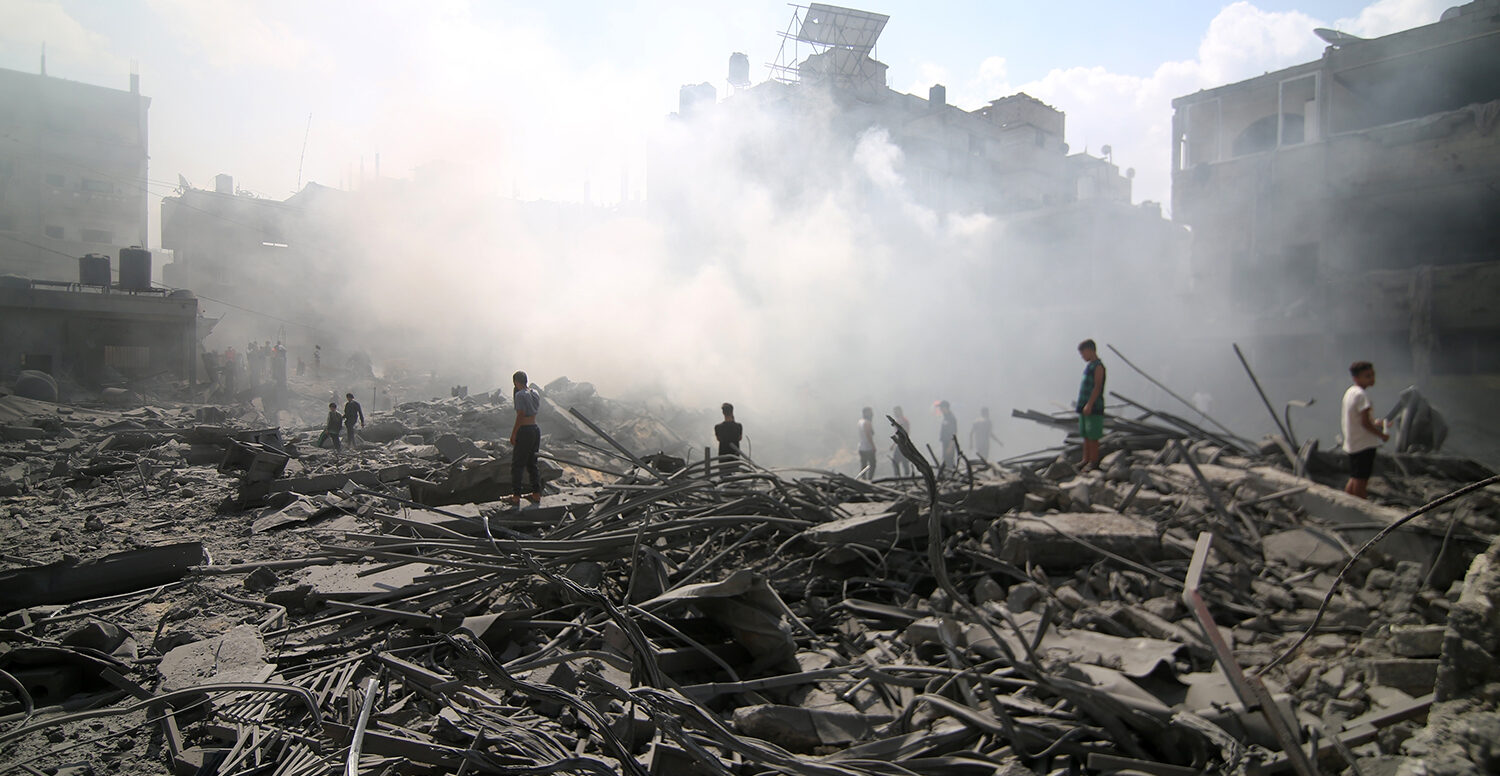
Header photo: Palestinians look for survivors after an Israeli airstrike in Rafah refugee camp, southern Gaza Strip, on October 12 2023. Shutterstock – Anas-Mohammed