



A Region on the Move
A farmer in the Nile Delta dealing with increasing saltwater intrusion, a Lebanese coastal household suffering from recurring water shortages, and a migrant arriving on the shores of southern Europe are usually viewed as distinct cases. However, these situations are becoming increasingly connected across the Mediterranean Basin. In fact, the region represents a deeply interconnected system where climate change, demographic concentration, economic inequalities, political instability and governance fragility overlap to increase the vulnerabilities of local communities (Plan Bleu, 2025). With mobility gradually emerging as one of the most visible manifestations of these accumulated stresses (IOM, 2026).
The Mediterranean is already among the regions most exposed to climate change impacts. Recent assessments indicate that the basin has warmed by approximately 1.54°C since pre-industrial times (0.4°C higher than the global average). With 2050 forecast to rise by 2.2°C, while sea-level rise will increase by 40 cm (Plan Bleu, 2025). This will translate to: 1) more frequent and prolonged heatwaves; 2) less predictable rainfall patterns and 3) prolonged drought incidents.
These changes are already affecting agricultural systems, water availability, terrestrial and marine ecosystems, coastal infrastructure and the broader resilience of local communities. The region is also under increased demographic pressures (Plan Bleu, 2025).
Moreover, combined pressures threaten livelihoods where migration decisions become less of a sudden reaction to environmental collapse and more of a part of a gradual adaptation process that accumulates over time (IOM, 2026), making the Mediterranean one of the world’s principal migration corridors (UNHCR, 2025).
2025: A Year of Overlapping Crises
The year 2025 was marked by extensive movements across the Mediterranean. Conflicts and violence displaced 32.3 million individuals internally, while disasters resulted in another 29.9 million relocations throughout the year (IDMC, 2026). On a global scale, 42 countries witnessed internal displacement caused by both conflicts and disasters (IDMC, 2026).
More specifically, conflicts in the Middle East have caused 2.76 million internal displacements in Palestine and about 531,000 displacements in Syria (IDMC, 2026). Additionally, climate-related incidents, including significant wildfires caused internal displacement in Greece’s Attica region and Türkiye’s Izmir province. Türkiye had recorded 156,000 Internally Displaced People (IDP) due to disasters (see Map1; IDMC, 2026).
MAP 1 Internal Displacements by Conflicts and Disasters in 2025 in the Mediterranean Region
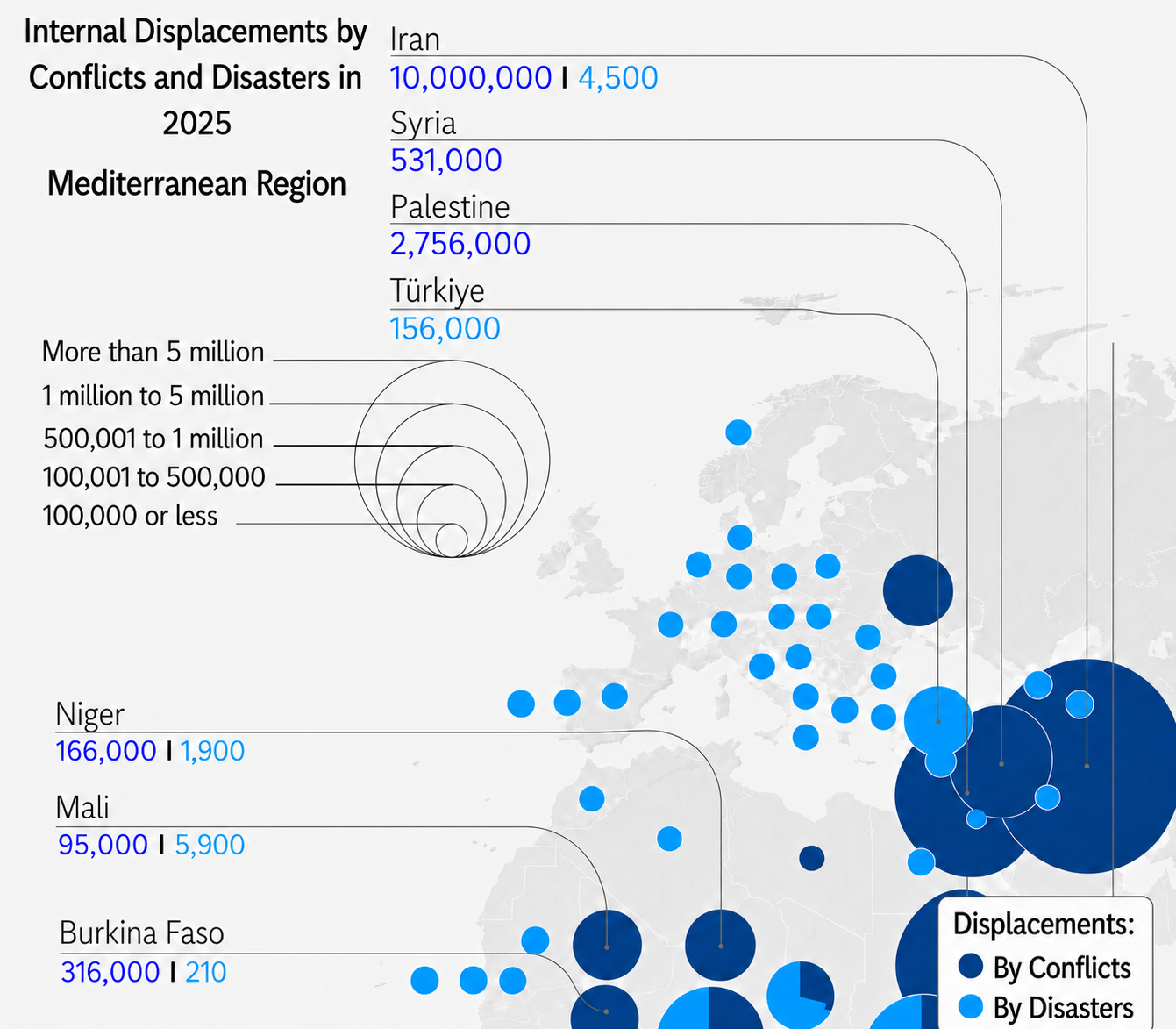
Adapted from IDMC, 2026.
Cross-border movements through central, eastern, and western Mediterranean routes, continued to be very active during 2025. For instance, 154,500 arrivals to southern Europe were recorded (including Italy, Malta, Cyprus, Greece and Spain; UNHCR, 2026).
Map 2 below shows movements across these routes: sea arrivals registered by Italy reached 66,316, whereas Spain recorded 37,388 sea and land arrivals through the western Mediterranean and Atlantic routes. Crete, in Greece, also registered 19,857 irregular arrivals, mainly linked to departures from eastern Libya (MMC, 2025).
MAP 2 Map of Mediterranean Migration Routes in 2025
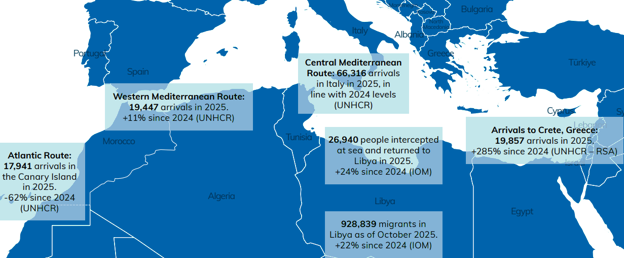
MMC, 2025.
Moreover, the Mediterranean migration corridors continued to be among the deadliest migration corridors worldwide, where more than 2,100 deaths and disappearances occurred during 2025 (IOM, 2026; MMC 2025).
A System Under Pressure: Climate, Vulnerability and Mobility
Around the Mediterranean, especially in the MENA region, mobility schemes cannot be understood if separated from the environmental and socioeconomic context of the region. The cases outlined below make this climate-vulnerability-mobility linkage more obvious.
- Around 50% of the Egyptian population lives in the Nile Delta where sea-level rise is becoming a major threat. Projections show that by 2050 the productivity of wheat and maize (major crops in Egypt) will be reduced by 15% and 19%, respectively, further hindering food security (Cairo University and IOM, 2025). Consequently, migration becomes an important aspect of households’ adaptation strategy.
- The Levant region increasingly lies at theintersection of armed conflicts, environmental impacts and population displacement. In 2025, almost 2.8 million and 531,000 internal displacements occurred respectively in Palestine and Syria due to conflicts (IDMC, 2026). Combined with prolonged droughts, water stress and infrastructure degradation, these factors have aggravated the humanitarian situation (IOM, 2026; IDMC, 2026).
- Migration flows to southern European countries also experience the growing effect of climate impacts: the massive wildfires of 2025 have caused mass displacements in Greece and Turkey (IDMC, 2026). Heatwaves, droughts and other climate impacts are all projected to intensify (Plan Bleu, 2025).
- The Mediterranean cannot be treated as an isolated island, for instance, in 2025, about 316,000 displacements were reported in Burkina Faso, 166,000 in Niger, and almost 95,000 in Mali (IDMC, 2026). These displacements in the Sahel region have impacted the North African transit corridor and even Mediterranean-wide mobility trends (IOM, 2026).
Where Policy Falls Short
The term “climate refugees” is increasingly visible in political and media narratives, and yet it lacks both a clear legal framework and a universally accepted definition. For instance, the 1951 Refugee Convention, defines “refugees’’ as persons who are fleeing persecution based on their race, religion, nationality, political beliefs or membership to a particular social group. Thus, “climate refugees” do not qualify under this convention (Cairo University and IOM, 2025; IOM, 2026). It is therefore more precise to use terms such as climate displacement, climate mobility or climate-induced migration.
More recently, climate-induced migration is increasingly recognized in global frameworks and agreements such as the Global Compact for Safe, Orderly and Regular Migration (2018), the United Nations Framework Convention on Climate Change (UNFCCC), Warsaw International Mechanism for Loss and Damage, Agenda 2030 for Sustainable Development, etc. (Cairo University and IOM, 2025; IOM, 2026).
Nevertheless, there are still gaps at the policy level that hinder long-term adaptation planning and proactive efforts to address the root causes of vulnerability and displacement (IOM, 2026):
- Limited implementation of regional policy measures.
- Weak integration of different policy fields (disaster risk reduction, climate adaptation, displacement governance, etc.).
- Reactive and fragmented crisis-response approaches.
Changing Migration Patterns across the Mediterranean
The Mediterranean has witnessed many variations in migration dynamics, in terms of magnitude and geographic distribution.
According to UNHCR data, arrivals to Europe, through Mediterranean routes, exceeded one million people in 2015, decreased to about 96,800 in 2020, increased again to approximately 275,200 in 2023 and then declined to around 154,500 in 2025 (UNHCR, 2025).
Current migratory corridors are fluctuating between the three main routes (central, eastern, and western) due to different border control policies, regional political conflicts and instability, and transit conditions (UNHCR, 2025):
On the central Mediterranean route, Italy has reported more than 66,000 irregular maritime arrivals, (88% of which departed from Libya), whereas arrivals departing from Tunisia decreased by 75% compared with 2024. Departures from Algeria toward Italy increased by 43%, Algeria becoming a major departure point along the western route, accounting for around 75% of movements, compared with 40% in 2024 (MMC, 2025). The geography of arrivals also changed in the eastern Mediterranean, where Crete recorded 19,857 arrivals in 2025 (a 285% increase compared with 2024) reflecting the growing consolidation of the Libya–Crete corridor (MMC, 2025).
Environmental stresses coupled with other systemic pressures will increase the vulnerability of migration dynamics, while disaster-related movements will mostly remain within the same countries and regions (IOM, 2026).
Linking Climate Stress to Migration Dynamics
Climate-induced mobility dynamics in the Mediterranean involves different temporal and spatial patterns, further demonstrating interlinkages between climate change and other factors:
environmental events (such as storms, floods and wildfires) may result in immediate and sometimes temporary, displacement. About 17.9 million displacements in 2025 were attributed to storms, representing around 60% of all disaster displacement cases (IDMC, 2026). Meanwhile, slow-onset climate pressures (such as droughts, water shortages and declining agricultural productivity) contribute to slower, more gradual migration processes. These movements are not driven by climate factors alone, but interconnected with broader systemic pressures, and thus harder to quantify (Cairo University and IOM, 2025).
Climate mobility trajectories also vary considerably. They initially occur within countries or neighbouring regions before potentially evolving into international or multi-staged migration pathways, such as displacement from the Sahel region toward North Africa, turning these areas into transit corridors and pathways to Europe (IDMC, 2026; IOM, 2026).
Despite living in areas highly exposed to environmental risks, vulnerable people may also take the decision to stay. These “trapped populations” lack the financial resources, governance support or legal pathways needed to relocate (Cairo University and IOM, 2025).
Future Scenarios: How Migration May Evolve
Future migration flows will be influenced by a combination of drivers rather than by climatic effects alone. Movements will not necessarily be uniform, but rather unpredictable in time and space, and determined by both climate effects and the region’s ability to address risks and manage crises (Plan Bleu, 2025).
In that regard several scenarios are proposed:
- The Stability Scenario: assuming that regional cooperation is increased and adaptation strategies are implemented. Such strategies would entail stronger Mediterranean cooperation on water governance, coastal protection, renewable energy transition and urban resilience planning. Under this scenario, migration pressures will be mitigated.
- The Gradual Pressure Scenario: that would emerge in the absence of proper adaptation initiatives where environmental degradation is not managed and unequal socioeconomic conditions worsen. Such a scenario will lead to the aggravation of migration pressures, especially in coastal areas and urban agglomerations, particularly in North Africa and the eastern Mediterranean.
- The Crisis Scenario: suggesting a combination of multiple crises, climate-related and others. This scenario will lead to massive migration waves and considerable pressures on regional governance and humanitarian organizations.
Conclusion: Governing Mobility in a Changing Climate
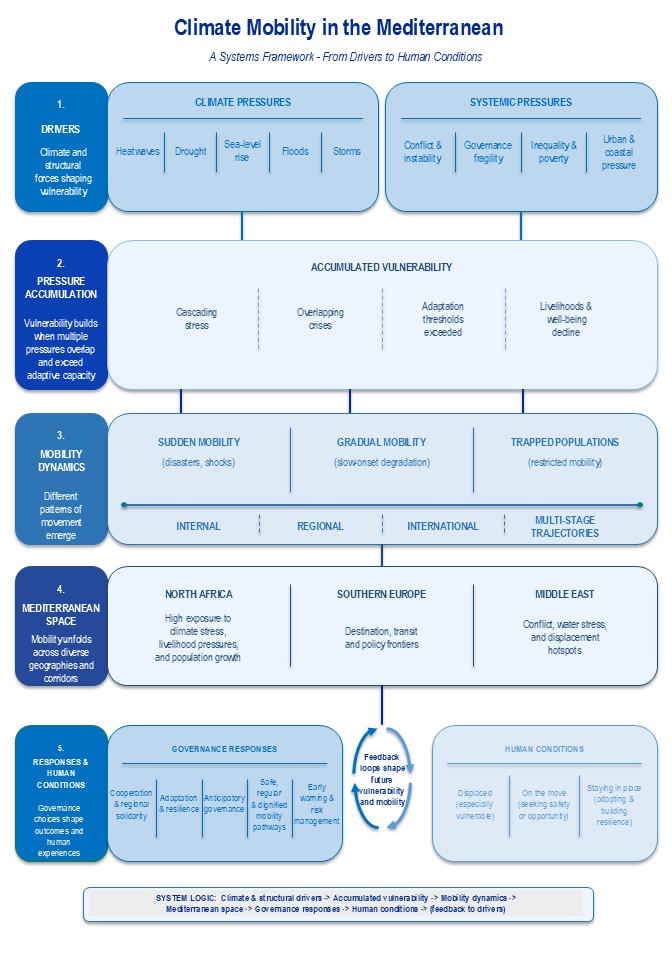
The different dimensions discussed can be synthesized through a systems perspective linking climate and systemic pressures, accumulated vulnerability, mobility dynamics, governance responses and human conditions across the Mediterranean (see Chart 1).
CHART 1 Climate Mobility in the Mediterranean: A Systems Framework Linking Pressures, Vulnerability, Mobility and Human Conditions
The Mediterranean is one of the most exposed regions to climate change. Its impacts are progressively becoming a “risk multiplier” instead of the main driver of displacement. Climate pressures will then interact continuously with other system pressures, particularly in highly vulnerable areas.
Migration dynamics have shifted around the Mediterranean Basin in terms of size and spatial distribution. They could also follow a pattern of multi-staged movements, starting with internal or regional displacement and ending with international migration. Moreover, these dynamics depend on the type of environmental pressures and how these affect people’s vulnerability. For instance, climate disasters may cause sudden displacements while slower environmental processes lead to slower movements. Furthermore, some people are trapped in their place of origin because they cannot afford to migrate.
Future Mediterranean mobility dynamics will depend mostly on governance capacity, regional cooperation and adaptation measures. Mediterranean communities will become increasingly vulnerable without the implementation of anticipatory and integrated policies.
What is needed now is a holistic and anticipatory governance approach to addressing climate-related mobility. Policies should enhance climate adaptation, ensure water security, protect coastlines, build resilient infrastructure, promote sustainable agriculture and develop socioeconomic resilience. They should also include coordinated actions to expand preparedness, early warning and response systems, in addition to securing improved international cooperation frameworks.
A comprehensive approach to climate-mobility governance must focus on achieving three complementary objectives: 1) assisting those already displaced, 2) assistance to people on the move and 3) support to vulnerable communities wishing to stay by enhancing their resilience and adaptation. Moreover, the creation of safe, regular, and dignified mobility options for people whose lives are increasingly affected by environmental hazards should be strongly considered (IOM, 2026).
Migration and displacement dynamics across the Mediterranean should no longer be perceived as a single migration crisis but rather as a result of the transformation of the region under the impact of several factors.
References
Cairo University and International Organization For Migration (IOM). Climate Change and Migration in the Middle East and North Africa (MENA) Region. Cairo: Cairo University and IOM, 2025. https://crisisresponse.iom.int/sites/g/files/tmzbdl1481/files/uploaded-files/Climate-Change-and-Migration-2025.pdf. ISBN (PDF) 978-92-9268-113-5
Internal Displacement Monitoring Centre (IDMC). Global Report on Internal Displacement 2026. Geneva: IDMC, 2026. www.internal-displacement.org/global-report/grid2026/.
International Organization for Migration (IOM). World Migration Report 2026. Geneva: IOM, 2026. https://publications.iom.int/books/world-migration-report-2026. ISBN (PDF) 978-92-9278-064-7.
Mixed Migration Centre (MMC). Quarterly Mixed Migration Update: North Africa, Quarter 4 – 2025. Geneva: MMC, 2025. https://mixedmigration.org/wp-content/uploads/2026/01/QMMU-2025-Q4-North-Africa.pdf.
Plan Bleu. Mediterranean Foresight Report for 2050. Marseille: Plan Bleu, 2025.
United Nations High Commissioner For Refugees (UNHCR). Europe Sea Arrivals Dashboard. Geneva: UNHCR, 2026. https://data.unhcr.org/en/situations/europe-sea-arrivals.
Header Photo: Four individuals walking on a rural plowed field under a cloudy sky, wearing warm clothing (Pexels)