


For several months now, there has been a growing number of international initiatives aimed at creating the conditions for a unified Libyan state. For over a decade, Libya has been plagued by institutional division, pitting an interim executive based in Tripoli against a legislative authority – the House of Representatives – based in Benghazi in the East of the country. While both entities enjoy international recognition from the United Nations, the House of Representatives has nevertheless withdrawn its support from the Tripoli government, transferring it, since March 2022, to a rival executive based in Benghazi. At the same time, armed groups and their external allies continue to exert influence over the institutions. The government of current Prime Minister Abdelhamid Dbeiba is maintaining its position by negotiating the support of powerful militias based in the West of the country, while in the East, Field Marshal Khalifa Haftar remains the central figure of military power at the head of the Libyan Arab Armed Forces (LAAF).
Following the failure of the latest UN roadmap and the cancellation of the presidential and parliamentary elections in December 2021, the Libyan political landscape remains locked in a status quo that benefits the ruling elites. This division now appears set to become entrenched, while international initiatives and external influences are helping to perpetuate a power-sharing system based on maintaining balance between the dominant forces.
The New Roadmap of the United Nations Support Mission in Libya (UNSMIL): An Inclusive Power-Sharing Model that Benefits Elite Transactions
In August 2025, Hannah Tetteh, appointed Special Representative of the UN Secretary-General and Head of the United Nations Support Mission in Libya (UNSMIL), launched a new roadmap to break the country’s political deadlock. Following the resignation of Abdulaye Bathilie, she is the eighth representative to attempt to revive the political transition process and find a solution to the conflict in Libya. Building on the models already tested in recent years by UNSMIL, the new roadmap presented by Hannah Tetteh is structured around three main pillars: laying the legal and constitutional foundations for presidential and parliamentary elections; reunifying the institutions around an interim unity government; and relaunching a national dialogue – known as the Structured Dialogue – with civil society. Although UNSMIL’s mandate was renewed by the United Nations Security Council last October, its objective of unifying the institutions and organizing elections within twelve to eighteen months has since been significantly undermined. The Libyan experience has already demonstrated that overly restrictive deadlines often prove unrealistic and are regularly missed due to persistent differences, ambiguities in the wording of agreements and conflicting interests related to power-sharing arrangements.
The “power-sharing” model as advocated
by UNSMIL in the various pillars of its
roadmap only serves to reinforce the coalition
of ruling elites, ensuring that nothing changes
In fact, the “power-sharing” model as advocated by UNSMIL in the various pillars of its roadmap only serves to reinforce the coalition of ruling elites, ensuring that nothing changes. By bringing together representatives of competing institutions on an equal footing, the quest for consensus among the parties to the conflict has paradoxically contributed to halting the transition. Rather than opening a way out of the crisis, these mechanisms have established a system of deadlock in which every decision remains contingent on the reciprocal approval of rival actors. This consensus-based logic, often vague and subject to constant renegotiation, provides the Libyan actors with a transactional framework conducive to defending their own interests, concluding informal arrangements, or even reaching agreements aimed at preventing any developments likely to weaken their positions, in particular by impeding the organization of elections. Also, the repeated failures of previous interim governments to organize credible elections and continue the transition have led to an impasse in the political process and have prevented the renewal of those in power.
Ultimately, the power-sharing mechanisms formulated by UNSMIL, while ostensibly promoting inclusivity and consensus-building, tend in practice to produce façade arrangements that ultimately foster the consolidation of the existing elites. Added to this are criticisms levelled at UNSMIL’s roadmap, whose inclusion criteria for negotiations can sometimes appear arbitrary and contribute to undermining its legitimacy. Moreover, the gridlock caused by such mediation models has given way to alternative initiatives driven by external powers.
Power-Sharing According to the US Roadmap: A Model of Exclusion in the Name of Stabilization
Indeed, Donald Trump’s return to power has coincided with a strengthening of the White House’s influence on the Libyan political scene through Massad Boulos, White House Senior Advisor for Africa. After his participation in the peace agreement concluded in July 2025 between the Democratic Republic of Congo and Rwanda, Massad Boulos is now attempting to establish a new power-sharing pact in Libya, based not on the logic of inclusion advocated by UNSMIL, but on exclusion. Indeed, the American envoy has held a series of meetings since autumn 2025 with the Dbeiba and Haftar clans to reach agreements between these supposed rivals with the aim of unifying the country. The American political solution envisions another form of power-sharing, consisting of institutionalizing the current balance of power within the framework of a new government: Ibrahim Dbeiba, nephew of the current Prime Minister, would replace his uncle, and Saddam Haftar, son of Khalifa Haftar and commander of the FAAL, would be appointed head of the Presidential Council. Following this same logic of unification, joint military drills between the rival Western and Eastern armed forces were conducted in early April as part of the annual Flintlock special operations exercises organized by the United States Africa Command (AFRICOM). That same month, the American envoy also succeeded in getting rival institutions to approve the first unified state budget in thirteen years. Whereas this process could represent some progress in terms of transparency and stability, certain points remain unresolved since no legislative framework governs the ratification of this document. While an audit is planned for August 2026 under American auspices, this step also and above all reveals the Trump administration’s commercial ambitions in Libya. The objective is less to reach a political solution that would take into account all Libyan voices than to achieve a minimum of stability to ensure the opening of the Libyan market to foreign investment. Between January and May, important trade agreements were signed with major US firms in the energy and aerospace sectors, such as Chevron, ConocoPhillips and Boeing. However, the US strategy fails to take into account the profound issues that are at stake in the Libyan conflict and could generate a new wave of instability in the medium term. The exclusionary logic of this power-sharing has already begun to draw criticism and has led to negotiations between local actors and armed groups marginalized by the American roadmap. This is particularly likely to plunge the country back into a phase of intense competition by encouraging marginalized actors to reconfigure their political alliances and seek the support of foreign powers in order to counter the initiative led by Washington.
The Balance of Power Survives the Reconfiguration of Geopolitical Power Dynamics
The era of proxy war, which had frozen the country into two distinct camps since 2014 through alliances forged between Libyan actors and their external backers, is now giving way to a more balanced reconfiguration of geopolitical power dynamics. In 2019, the offensive led by Khalifa Haftar’s forces on the capital resulted in the active involvement of the Wagner Group on his side, while Turkish forces deployed in the West to support the Tripoli government. Since the ceasefire ratified in October 2020, the various stakeholders have diversified their contacts and partnerships with the aim of safeguarding both their economic and security interests. Turkey has thus fostered closer ties and then strengthened its relations with institutional actors in the East, as well as with the Haftar clan. Through this strategic repositioning, Ankara seeks to have the maritime agreement signed in 2019 with the former Tripoli government ratified by the Eastern authorities on the one hand, and to facilitate the establishment and expansion of its businesses in Libya on the other. Turkey’s rapprochement with actors in the East was also accompanied by a warming of its relations with Egypt and the United Arab Emirates, Khalifa Haftar’s main backers since 2014. At the same time, disagreements between these two regional sponsors surfaced at the end of 2025 regarding the Libyan issue, differences that are part of a broader context of disagreements between Riyadh and Abu Dhabi on the regional stage, in Yemen and Sudan. The United Arab Emirates’ support for the Sudanese Rapid Support Forces (RSF) through the alleged intermediation of Khalifa Haftar clashes with the Egyptian and Saudi strategies and interests in the region, the latter having chosen to support the regular armed forces of Abdel Fattah al-Burhan. In January 2026, the Saudi Foreign Minister visited Egypt to launch a joint initiative between Saudi Arabia and Egypt aimed at restricting RSF logistical support. These efforts apparently consist of exerting coordinated pressure on Khalifa Haftar in order to destabilize the smuggling networks used by Abu Dhabi to support the FRS. In this regard, Kufra Airport in southern Libya has been temporarily closed several times. In compensation, a $4 billion arms delivery contract financed by Saudi Arabia has allegedly been concluded between the Haftar clan and Pakistan in order to reduce Abu Dhabi’s influence in the Libyan East. At the same time, Saudi Arabia has also become friendlier with the Tripoli authorities in order to increase pressure on the Eastern actors: high-level dialogues have been conducted between Tripoli and Riyadh to deepen security and economic cooperation between the two countries. By the same token, it seems that Russia is also attempting to do a balancing act on the Libyan question. While maintaining significant military cooperation with Haftar’s forces, Moscow has also been strengthening its ties in terms of diplomatic cooperation with Tripoli since 2024. In the context of the war in Ukraine and considering the destabilization experienced in Syria and Mali, Libya represents a strategic asset in Russia’s policy of influence. As far as European countries are concerned, even the states that initially had divergent positions on Libya, such as France and Italy, are progressively aligning on the need for stabilization, in particular due to issues relating to the management of migratory flows and energy security. The authorities and enterprises of both countries are intensifying their relations with both Tripoli and Benghazi, thus de facto helping to perpetuate the polarization of power relations in Libya.
The dominant Libyan actors exhibit
a particular capacity to leverage
international initiatives and geopolitical
reconfigurations to their advantage
Ultimately, power-sharing arrangements in Libya tend less to pave the way for political transformation than to reactivate arrangements among elites aimed at preserving their positions. In this context, the dominant Libyan actors exhibit a particular capacity to leverage international initiatives and geopolitical reconfigurations to their advantage, integrating them into their strategies for consolidating their foothold. Whatever the efforts currently being made by external actors, the Libyan political transition seems to be moving towards the stabilization of a polarized political order to the detriment of any real prospect for change.
Bibliography:
Bin Musa, Ali. ‘‘Rivalry and Cooperation: Russia and Türkiye Navigate Libya’s Geopolitical Labyrinth’’, Middle East Council on Global Affairs, May 2025, https://mecouncil.org/publication/rivalry-and-cooperation-russia-and-turkiye-navigate-libyas-geopolitical-labyrinth/.
Duval, Jarry, “En Libye, les États-Unis à la manœuvre pour un pouvoir unifié entre Ouest et Est”, Jeune Afrique, 13 May 2026.
Mathews, Sean, “Pakistan delivers weapons to Libya’s Haftar as part of Saudi-financed deal, sources say”, Middle East Eye, 21 April 2026, www.middleeasteye.net/news/pakistan-delivers-weapons-libya-khalifa-haftar-sources-say.
Mezran, Karim and Cristiani, Dario, “The problem with the US power-sharing plan for Libya”, Atlantic Council, 15 May 2026 www.atlanticcouncil.org/blogs/menasource/the-problem-with-the-us-power-sharing-plan-for-libya/.
Rahem, Soraya, ‘‘Rethinking Power-Sharing Agreements in Libya’’, Carnegie Endowment for International Peace, 5 December 2025,https://carnegieendowment.org/research/2025/12/rethinking-power-sharing-agreements-in-libya.
* Soraya Rahem is also a researcher with the Équipe Monde Arabe et Méditerranée (EMAM), and affiliated to the Center for Economic, Legal and Social Studies and Documentation (CEDEJ) in Cairo.
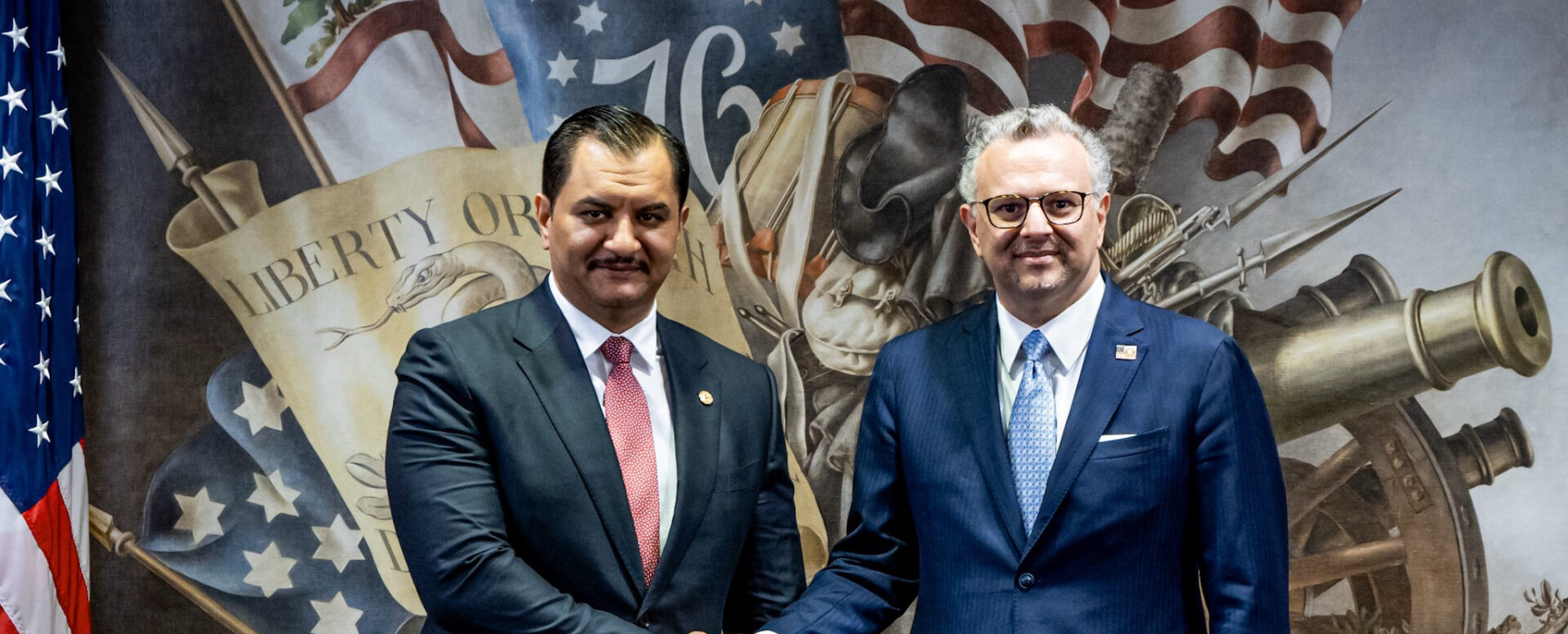
Photo: U.S. Senior Advisor for Arab and African Affairs, Massad Boulos, with the Libyan National Army Deputy Commander, Saddam Haftar, son of Khalifa Haftar, the commander of the Libyan National Army. Photo: https://x.com/US_SrAdvisorAF