



In the past three years, as the Middle East descended into one conflict after another, the US steadily increased its military presence in the region before launching kinetic operations against the Houthis in Yemen and Iran’s Islamic Republic. Though the American show of force did not directly target external powers such as Russia and China, both faced a dilemma: support their local partner, namely the Iranian regime, and risk antagonizing Washington, or stand on the sidelines of the military escalation.
Chinese and Russian responses have varied, but overall, they have stayed below the threshold for triggering a direct confrontation with the US. This reveals a mutual desire not to risk a major war over the Middle East, a battleground that remains, in the end, secondary to the three external powers. However, both Moscow and Beijing have used indirect means to undermine US intervention in the Middle East. As a consequence, Washington’s entanglement in its conflict with Iran has ramifications for great power competition in Asia as well as in Europe.
The Return of US Military Interventions in the Middle East
The Middle East wars that began after Hamas’ surprise attack on Israel on 7 October 2023, have led US administrations to use force in the region to a level unseen since the peak of the war on terror two decades earlier. Initially, the Biden administration deployed military assets to the Middle East to prevent regional escalation. The logic was that as Israel launched its operation in Gaza to retaliate against Hamas, Washington would demonstrate its resolve to intervene if Iran used the events as an opportunity to launch an attack on Israel.
This scenario did not materialize. However, the US quickly faced an unanticipated crisis at sea. Soon after the Israel Defense Forces (IDF) launched its air and ground campaign in Gaza, the Houthis in Yemen entered the fray. The militia began launching missiles and drones at merchant ships crossing the Red Sea. The disruption of commercial sea lanes forced international companies to divert their vessels en route to Asia via the Cape of Good Hope. In the meantime, the Biden administration launched a naval operation, Prosperity Guardian, meant to restore freedom of navigation. At first, the US was able to rally many of its NATO allies behind the operation, but soon the latter became the object of disputes between both sides of the Atlantic. The steady flow of US military aid to Israel amid the IDF’s brutal treatment of Palestinian civilians in Gaza led many European governments to distance themselves from Washington and to launch their own operation, Aspides. The US administration also publicly tried to rally China to the operation, arguing that restoring freedom of navigation was a shared interest, but to no avail.
After the return of Donald Trump to the White House in January 2025, US military strategy significantly escalated. Amid the failure of its naval operation in deterring the Houthis, Washington launched Operation Rough Rider, an air campaign targeting the Houthis’ leadership and infrastructure inside Yemen. Though the operation failed to weaken Yemen’s non-state actor, it ended in a ceasefire that included a pledge from the Houthis not to target US vessels.
However, the most dramatic shift in the US military posture was its direct confrontation with Iran. First, the Trump administration joined Israel in Operation Midnight Hammer, also known as the 12-day war, in June 2025. Launched without evidence of an imminent threat, the operation was intended to destroy Iran’s nuclear facilities and missile inventories. In the aftermath of this short war, the US President claimed victory and said Iran’s nuclear programme had been “obliterated.” Intelligence agencies and international bodies remained more cautious, though. Eventually, both the US and Israel resumed operations in late February 2026, this time launching a war that, at first, called for the collapse of the Iranian regime. Despite initial tactical gains such as the targeted killing of Iran’s Supreme Leader, Ayatollah Khamenei, Washington failed to bring about the fall of the Islamic Republic. Instead, the remnants of the regime in Tehran retaliated by firing missiles at Gulf states and disrupting the flow of merchant ships transiting the Strait of Hormuz. At the time of writing, a fragile ceasefire has put an end to the fighting but left most of the contentious issues (Iran’s nuclear ambitions, its ballistic arsenal) unresolved.
In other words, the Middle East wars of the past three years were driven by local disputes – whether between Israelis and Palestinians or Israelis and Iranians – but they steadily led the US to play a central role. As a result, the US’s direct intervention forced other external powers to adapt, starting with Russia.
Russia’s Quiet Military Support to the “Axis of Resistance”
As the US deepened its military engagement across the Middle East, Russia struggled to preserve its local influence. After October 2023, developments in the Middle East significantly undermined Russia’s regional strategy, particularly its partnerships with Syria and Iran.
From the Kremlin’s standpoint, Syria mattered primarily because it provided the Russian Navy direct access through its base in Tartous. The sudden fall of the Assad regime in Damascus in December 2024 might not have been directly caused by Israel’s conflicts in Gaza and Lebanon, but it left Russia without its primary partner in the Levant. Though Moscow has since found a way to maintain diplomatic relations with the new regime of Ahmed Al-Sharaa and kept a military presence in the country, Russian clout in Syria has undoubtedly diminished.
This left Iran as Russia’s sole strategic partner in the region. In recent years, the Kremlin has led a policy of rapprochement with Tehran that included close military cooperation and even extended to the Houthis in Yemen. The strengthening of Moscow-Tehran ties predates the conflict between Iran and the US and Israel. It started around the beginning of 2023, when Moscow increasingly relied on Tehran’s military support to shore up its armed forces on the Ukrainian battlefield. Iran reportedly supplied the Russian military with munitions, artillery shells, short-range ballistic missiles and, most importantly, drones like the Shahed-131/136 and Mohajer-6.[1] The rapprochement led both countries to sign a new strategic partnership in early 2025 during a visit of Iran’s President Masoud Pezeshkian to Moscow. The timing of the agreement was no coincidence: announced three days before President Trump’s inauguration in Washington, it was meant as an act of defiance against the US.
Russia has acted in a way that does not signal
full engagement with Iran. Instead, its attitude
suggests opportunistic and low-cost cooperation
to indirectly undermine US war efforts
Russia’s strategic partnership with Iran does not include a public pledge of solidarity, implying a Russian intervention to help the regime in Tehran. Still, in recent years, Moscow has quietly provided logistical and intelligence support to Iran and the Houthis that goes beyond mere restraint. In 2024, Russia reportedly shared intelligence with the Houthis to support their targeting of ships in the Red Sea.[2] A similar pattern emerged after the US-Israel war against Iran started in February 2026. Specifically, Russia is believed to have shared intelligence with Iran to target US military bases and facilities in the Arabian Peninsula.[3] Moscow may also have shared lessons with Iran from its use of Shahed drones on the Ukrainian battlefield to help the Islamic Revolutionary Guard Corps (IRGC) update its tactics in attacking Gulf states.
Russia’s military support for Iran and the Houthis could ultimately help the latter attack US troops, yet it did not trigger substantial action from Washington beyond mere condemnations. One can only speculate about the reasons for this lack of reaction. So far, Russia has acted in a way that does not signal full engagement with Iran. Instead, its attitude suggests opportunistic and low-cost cooperation to indirectly undermine US war efforts. Russian decision-makers may assess this gambit as manageable because of the White House’s desire for a diplomatic breakthrough between Russia and Ukraine. Since Operation Epic Fury started, the Trump administration has adopted an approach that decoupled the Iran conflict from the Russia-Ukraine war. As a result, the US appeared to assess that confronting Russia over its military involvement with Tehran was not worth jeopardizing the slim chance of an agreement with Moscow over the conflict with Kyiv.
China Playing the Quiet Power
Like Russia, China has been forced to adapt amid US military interventions in the Middle East. Unlike Moscow, Beijing’s influence in the region has been ascending since the mid-2010s, amid the rise to power of Xi Jinping and the launch of his foreign policy signature, the Belt and Road Initiative.
Though the Chinese footprint in the Middle East was initially driven by Beijing’s energy imports from the region, it expanded to include other sectors such as Chinese investments in port infrastructures in countries like the UAE, Oman, Qatar, Israel, or in high-technology through the deployment of 5G networks in the Gulf or the development of industrial partnerships in artificial intelligence. It also involved cooperation with traditional US partners, such as Saudi Arabia and the UAE, in sensitive domains, including arms sales and joint military drills. By the beginning of 2023, China also looked keen to play a new diplomatic role, brokering a reconciliation agreement between Saudi Arabia and Iran.
However, a few months later, as the Gaza war broke out, Beijing found itself in a delicate position. Whereas the US quickly increased its military presence in the region, China maintained a safe distance from the conflict. The military escalation went against the Chinese narrative conveyed to Arab and Iranian officials over the past decade, that Beijing prioritized economic cooperation over security confrontation. Such a posture was effective when Middle Eastern countries leaned toward reconciliation and rapprochement. China’s Arab Policy Paper, issued in 2016, clearly posited “win-win results” while condemning “external interference.”[4] But this rhetoric proved ill-suited to the regional environment, which, after 7 October, became a zero-sum game. As a result, Chinese diplomatic influence during the following years proved underwhelming. In 2024, a delegation of Arab foreign ministers visited Beijing out of frustration with US support to Israel in the Gaza war. Arab officials hoped to find in China a counterweight to the US, but left Beijing without any substantial commitment from the Chinese government.
Like Moscow, Chinese strategy amounts
to a limited intervention intended more
to get the US entangled in the conflict
than to save the Iranian regime
Admittedly, there have been several diplomatic initiatives led by China. In July 2024, it convened a reconciliation meeting between Palestinian factions, including Hamas and Fatah. In March 2026, Chinese Foreign Minister Wang Yi and his Pakistani counterpart announced a five-point initiative aimed at ending the US-Israel-Iran war. However, those initiatives never went beyond mere announcements, suggesting they were performative. In both the Red Sea crisis and the Hormuz crisis, Beijing opted for its own solution by making deals, respectively, with the Houthis and the Iranian regime, to protect its vessels.
Still, China does not refrain from engaging with the warring parties. Alongside Russia, China has played a significant role as Iran’s strategic partner. The three countries have conducted many consultations and military exercises in recent years. In March 2025, they conducted their fifth annual naval drill in the Gulf of Oman since 2019. China is also suspected of providing military support to the IRGC. In April 2025, the US Department of the Treasury sanctioned six Chinese entities and six individuals accused of supplying Iran with sensitive technology for its ballistic program.[5] Then, a few months later, Israeli and American media accused China of helping Iran rebuild its missile arsenal in the aftermath of the 12-day war. The journalists did not provide specific details or evidence.[6] But historically, China did contribute to Iran’s ballistic programme. In the 1990s, Beijing provided support on specific technologies such as propulsion and guidance systems. Some of Iran’s ballistic missiles, later used by Hezbollah or the Houthis, are believed to be copies of Chinese systems.[7]
In the latest Iran-US conflict, China adopted an ambivalent position similar to that of Russia: officially staying away from the hostilities while supporting Iran through various means. Indeed, Beijing has reportedly helped Iran sustain its missile and drone arsenal amid the US and Israel air campaign. Like Moscow, this Chinese strategy amounts to a limited intervention intended more to get the US entangled in the conflict than to save the Iranian regime. Some observers see this as China and Russia using Iran as a proxy in their rivalry with the US.[8] So far, Washington has chosen to downplay the importance of those Chinese measures here as well. Instead, as Donald Trump embarked on his trip to China in May 2026, his administration appeared hopeful that China could help the US in forcing Iran to accept a diplomatic settlement. The Chinese government refrained from making any public promise, though, and instead issued a simple call to reopen the Strait of Hormuz.
The Impact of Middle East Wars on Strategic Competition
Since the US operation Epic Fury started, numerous commentators have speculated that the real target of the Trump administration was China, not Iran. The theory posits that after toppling the regime of Nicolas Maduro in Venezuela, Washington again attacked a key energy supplier of Beijing to strangle China’s economy. This geopolitical tale surely appeals to observers focused on great-power competition, but it neglects two things. First, it dismisses the unique hostility between the US and Iran that has shaped their bilateral relations for the past four decades. From that perspective, Operation Epic Fury was not about China but rather Washington’s desire to destroy Iranian nuclear ambitions and possibly bring about regime change in Tehran. Moreover, the narrative inflates Chinese reliance on Iran’s energy supplies. True, 45% of China’s oil imports transit the Hormuz Strait, but oil represents less than 20% of the country’s total energy consumption. Following active policies to diversify its energy supply sources, build extensive strategic reserves, and expand renewable energy, China is now considered 85% energy self-sufficient.[9] Beijing’s economy may suffer from the war (especially in sectors such as petrochemicals and aviation), but not as much as its US partners in Europe and Asia.
The US military’s inconclusive performance in destroying Iran’s
missile launchers and in preventing a closure of the Hormuz Strait
may lead China and Asian governments to wonder about
the US’s ability and resolve to intervene in a similar crisis in Asia
So far, the connection between the Middle East wars and great power competition has been circumstantial rather than direct. In fact, the Trump administration appears more interested in keeping those two challenges separate. From that perspective, prior to the visit to China by President Trump, the Middle East figured only as a potential distraction from the real issues at stake between Washington and Beijing – that is, the trade war or the dispute over Taiwan’s future. Even after the Iran-US talks in April failed to deliver a peace agreement, Mr Trump’s visit to Beijing was seen as a potential way to convince China to help Washington close the deal.
If there is a mutual desire to prevent a US-China clash over the Middle East wars, the US’s involvement in the region affects its rivalry with China in other ways. It questions the American ability to sustain a credible level of commitment to its Asian partners, such as the Philippines, South Korea and Japan, while waging wars in the Middle East. The reallocation of radars associated with the US THAAD batteries in South Korea to the Gulf highlights a clear and present dilemma for US officials: Is it possible to strengthen the defence of troops and partners in the Middle East while maintaining a similar resolve in the Indo-Pacific?
Asked a similar question, former US Secretary of Defence Lloyd Austin replied, “the US can walk and chew gum at the same time.”[10] Austin’s expression of confidence does not reflect the very real issues facing the US military in its war efforts against Iran. The massive use of munitions in the first month of the conflict may lead to shortages in the stockpiles of its most advanced weapons systems for several years. It calls into question the US defence industry’s ability to ramp up production.
Furthermore, the US military’s inconclusive performance in destroying Iran’s missile launchers and in preventing a closure of the Hormuz Strait may lead China and Asian governments to wonder about the US’s ability and resolve to intervene in a similar crisis in Asia, be it in the South China Sea or the Taiwan Strait.
Closer to Europe, the Iran war also influences the course of the Ukraine-Russia conflict and, beyond that, relations between the US, Europe and Moscow. Following Iran’s move to disrupt the transit of ships through the Strait of Hormuz, the US administration issued a temporary sanctions waiver to allow countries to buy Russian oil. The sanctions had been initially imposed in reaction to the Russian invasion of Ukraine in 2022. The American decision to ease pressure on Russia was intended to allow its partners, such as European countries and India, to compensate for the loss of Gulf energy with Russian energy. However, the move also created a new, more favorable environment for Russia, with economic and strategic ramifications. As it launched a new offensive against Ukrainian troops in the spring of 2026, the Kremlin likely assessed it had the upper hand. In that logic, the US looked inclined to meet Russian demands, given Washington’s urgent needs on the battlefield in the Middle East.
Middle Eastern conflicts are unlikely to lead
to an open confrontation between those three
countries in the Middle East, but they are
steadily reshaping the balance of power and
the credibility of US alliances worldwide
This development was further exacerbated by the renewed tensions between the US and its European allies stemming from the Iran war. After the dispute between Washington and its NATO allies over the US’s desire to annex Greenland earlier in 2026, the Iran war sparked new disagreements. European governments stayed away from the US operation and declined President Trump’s invitation to deploy warships to the Strait of Hormuz to reopen it. In fact, France’s President Emmanuel Macron led a counter-initiative to prepare a naval mission with European and Asian partners, distinct from the US, to be launched only after the war ends. This triggered anger and frustration in Washington toward NATO countries, particularly those hosting American troops. The White House openly discussed excluding Spain – arguably the most vocal country on the continent in opposing the Trump administration – from NATO. Then, after German Chancellor Friedrich Merz said publicly that the US “is being humiliated by the Iranian leadership,” Washington announced the withdrawal of 5,000 troops from Germany.[11] The operational implications of that measure might be modest, but the strategic significance of the repeated transatlantic disputes is not. It reveals an unprecedented rift among NATO countries, calling into question the ultimate value of the alliance’s sacrosanct Article 5.
From that perspective, the Middle Eastern conflicts of the past three years have reshaped the great-power competition between the US, China, and Russia. They are unlikely to lead to an open confrontation between those three countries in the Middle East, but they are steadily reshaping the balance of power and the credibility of US alliances worldwide. Until now, European countries have refused to follow the US into its Middle Eastern adventures, but they may not escape the ripple effects, be it in the reopening of the Strait of Hormuz or, more importantly, in Russia’s renewed assertiveness in the east.
[1] Samaan, Jean-Loup, “How Russia’s Middle East Strategy Threatens Gulf Security.” Arab Gulf States Institute, 25 March 2025. https://agsi.org/analysis/how-russias-middle-east-strategy-threatens-gulf-security/.
[2] Barnes, Julian, “Russia Could Expand Its Assistance to Houthis, U.S. Says.” New York Times, 25 October 2024, www.nytimes.com/2024/10/25/us/politics/russia-houthis-weapons.html.
[3] Grove, Thomas; Czerny, Milan & Faucon, Benoit, “Russia Is Sharing Satellite Imagery and Drone Technology With Iran.” Wall Street Journal, 17 March 2026. www.wsj.com/world/russia-is-sharing-satellite-imagery-and-drone-technology-with-iran-0dd95e49.
[4] “China’s Arab Policy Paper.” January 2016, Website of the State Council of the People’s Republic of China. https://english.www.gov.cn/archive/publications/2016/01/13/content_281475271412746.htm.
[5] US Department of the Treasury, ” Treasury Targets Network Procuring Missile Propellant Ingredients for Iran.” 29 April 2025. https://home.treasury.gov/news/press-releases/sb0116.
[6] Daftari, Amir “Iran Turns to China for Missile Boost: Report.” Newsweek, 15 August 2025. www.newsweek.com/israel-report-iran-china-missile-boost-2114156.
[7] Olson, Erik, “Iran’s Path Dependent Military Doctrine.” Strategic Studies Quarterly, vol.10, no.2, Summer 2016, pp.74-75. www.jstor.org/stable/pdf/26271505.pdf?refreqid=fastly-default%3A7343489f7f84da87e0973c56f93b725d&ab_segments=&initiator=&acceptTC=1.
[8] Azad, Tahir Mahmood “How China and Russia keep Iran fighting – without firing a shot.” Think China, 10 April 2026. https://www.thinkchina.sg/politics/how-china-and-russia-keep-iran-fighting-without-firing-shot.
[9] Sun, Yun “How Does the Iran War Affect China’s Energy Security?” War on the Rocks, 17 March 2026. https://warontherocks.com/how-does-the-iran-war-affect-chinas-energy-security/.
[10] Garamone, Jim “Austin: How the US walks, chews gum at the same time.” DOD News, 13 June 2022. www.war.gov/News/News-Stories/Article/Article/3061381/austin-how-the-us-walks-chews-gum-at-the-same-time/.
[11] Borger, Julian “US is being ‘humiliated’ by Iran’s leadership, says Friedrich Merz.” The Guardian, 27 April 2026. www.theguardian.com/world/2026/apr/27/us-humiliated-iran-leadership-trump-merz.
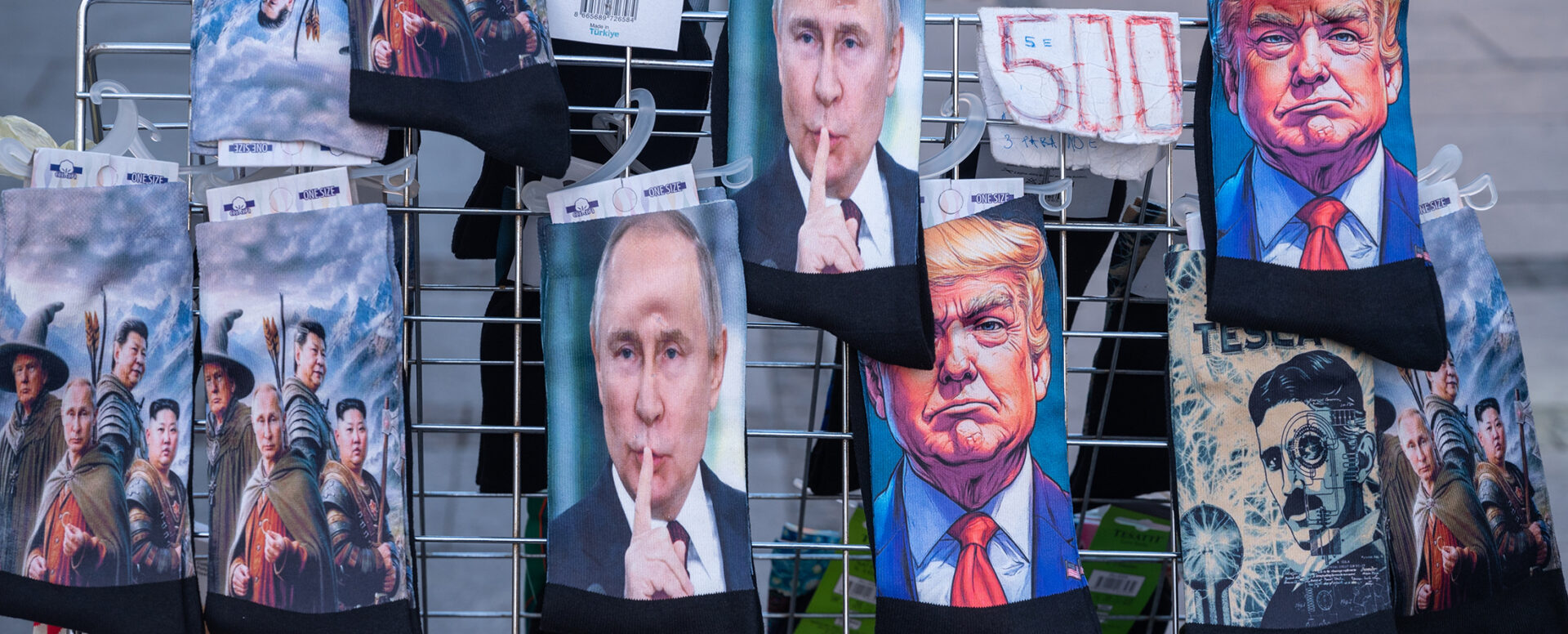
Photo: Belgrade, Serbia. October 27th 2025. Socks for sales on a Belgrade street, images of world leaders such as Putin, Trump, Xin Jinping and Kim Jong Un as characters. Shutterstock / Dave Colman