



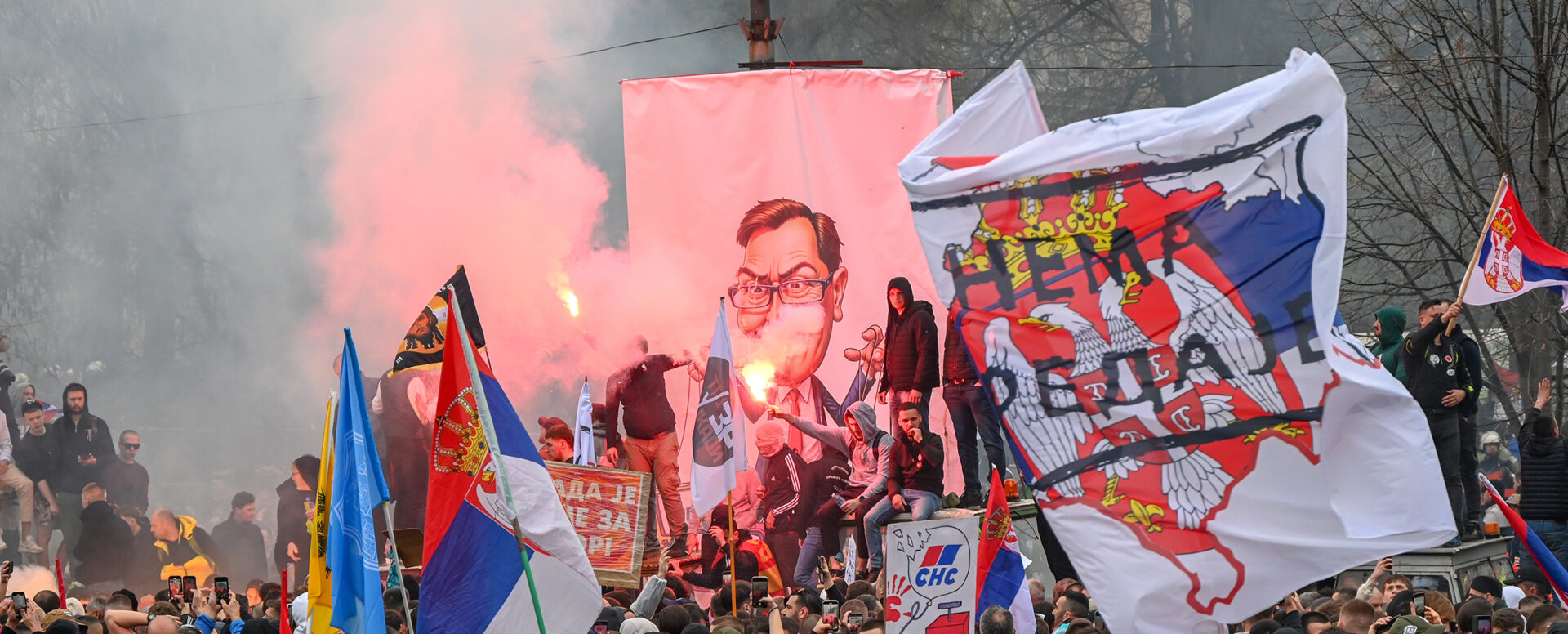
Serbia finds itself in a deep political crisis after many years of democratic decline and increasingly strong anti-government protests. However, the stage is now set for a new phase where the government of Aleksandar Vučić faces a serious electoral challenge for the first time since 2012, after a year and a half of mass student protests that have shifted public opinion and given birth to a potentially victorious political alternative.
The country was in shock on 1 November 2024 when the concrete canopy of the newly renovated railway station in the city of Novi Sad collapsed, killing 16 people, including children. But the Novi Sad tragedy will not be remembered solely as an accident with a horrible loss of human life, but also as a historic event which triggered major political processes.
The Novi Sad tragedy was followed by several waves of protests, the crucial ones being the student-led protests that erupted in late November after a group of students commemorating the tragedy was attacked by government loyalists. The students started blocking their universities, and the protests also spread to high schools and received significant support from teachers and the academic community.
In 2025, the student-led protests grew into probably the largest protest movement in Serbian history, with historically large rallies in cities such as Belgrade, Novi Sad and Nis and the mass mobilization of citizens across the country. The Serbian government itself claimed that there were more than 23,000 (unregistered) protests in Serbia in just the first nine months of 2025, meaning that there were more than 85 protests per day (Radio 021, 2025).
In 2025, Serbia became a powder keg
ready to blow, but the protests eventually
witnessed a transformation which laid a potential
path towards peaceful democratic transition
It was clear throughout 2025 that such widespread and persistent protests were not going to simply wither away, as they had deep roots with citizens’ dissatisfaction with Serbia’s democracy, corruption and state capture. They were also fuelled by the government’s behaviour after the tragedy, growing stronger as the repression increased. In 2025, Serbia became a powder keg ready to blow, but the protests eventually witnessed a transformation which laid a potential path towards peaceful democratic transition.
Why Have These Protests Been So Strong?
The size and the intensity of the Serbian protests after 1 November 2024 cannot simply be explained by the Novi Sad tragedy, as they represented a culmination of several processes in the last several years. First, the increasing frustration of Serbian citizens with unchecked corruption, a culture of impunity and toxic propaganda. Second, the strengthening of autocracy under the regime of Aleksandar Vučić, which eroded trust in elections and other democratic processes. Third, they built on several other waves of mass protests, which had taken place every year since 2016 and increased in size and intensity.
As the Serbian democracy eroded, and corruption, state and media capture and media propaganda rose, so the Serbian citizens mobilized in greater numbers against the government. The more the government appeared stable thanks to easy electoral victories in highly unfair conditions and with significant irregularities, the more pressure came from the streets.
The citizens’ anger was directed against
the government but did not transform into
support for a specific opposition political movement
But the nature of the Serbian regime had another major consequence for the specific type of social mobilization. As citizens’ trust in political processes eroded, mass protests became increasingly detached from politics. Protests in 2021 erupted because of a planned controversial lithium mine, in 2023 because of two mass shootings in which 19 people lost their lives, and then again in mid-2024 because of the restart of the lithium mine project.
The citizens’ anger was directed against the government but did not transform into support for a specific opposition political movement. Political institutions were delegitimized and participation in political processes such as elections was seen by many as futile or even collaborationist.
The Student List as a Potential Game-Changer
This background helps explain why such a large protest movement erupted after the Novi Sad tragedy and why it took so long for it to transform into a political movement. Namely, the students laid out a list of four demands, none of which had anything to do with a change of government. The students repeated that “institutions should do their job,” and that they only care about their demands and not about who fulfils them.
It was during this phase without political articulation that the largest protests and marches took place in February and March 2025, including the historically large rally in Belgrade on 15 March. While most participants clearly desired government change, the students were yet to make such statements. The aversion towards politics and dominant anti-political narratives prevented the students from going political themselves or allying with opposition parties.
Things changed after the aforementioned 15 March rally, when the students came to terms with the idea that their demands will not be fulfilled regardless of the number of protestors in the streets, and when the governments’ violent actions before and during that event – including the alleged use of a sonic weapon against a peaceful and silent crowd – exposed the government’s autocratic nature.
When the students finally acknowledged that Vucic’s government needed to go, they demanded elections and started the process of forming a “Student List” for them; and this was a significant step forward in the political articulation of the protests. Building on the popularity of their protests and their demands, the students believed that the best way to challenge the government was by going political themselves.
The Student List, however, was not to be made out of students, but out of non-students who the students would choose through a very complicated and thorough nomination and vetting process. Political party membership of their future candidates was not forbidden, but opposition parties as such were clearly sidelined and expected to support the student list.
Almost one year after the elections were demanded and the Student List was envisioned, elections remain elusive and the Student List is not yet completed. The protests themselves have largely faded – albeit with an ever-present potential for a flare-up – with the focus primarily turning towards the anticipated elections and the ambition to defeat the government through the ballot box.
But the student protests have already achieved a major change. They managed to shift the public opinion against the government for the first time since 2012, and it is believed that the Student List can directly challenge the ruling coalition. This, however, still does not guarantee its victory in the elections, as the coming phases pose significant obstacles and dangers.
Repression Increases When Government Feels Threatened
As the government started feeling threatened by the student protest movement, its repression also grew significantly. While in previous mass protests and in the first months of the student protests the government mostly refrained from using violence (with some notable exceptions), the period from June to September 2025 saw violence on an unprecedented scale, with mass arrests and unjustified violent actions by the police and government loyalists against citizens.
The government also increased its pressure on the media, with a significant rise of incidents and physical attacks on journalists, with 116 recorded in 2025 by the Independent Journalists’ Association of Serbia (IJAS, 2026). Attempts were also made to further consolidate media capture through the expansion of state-owned Telekom Srbija and takeover of United Media – owners of two major critical TV channels and a few other media outlets. The process is still ongoing, with the most recent news being the removal of the director of the most important independent media outlet TV N1, Igor Bozic, by the company’s new management in April.
Repression also increased against the academic community, since the universities have proven to be a major pocket of resistance. On 31 March 2026, the police raided the rectorate of the University of Belgrade, allegedly investigating the death of a student in another university building a few days prior. These actions have prompted strong reactions from abroad, including from the EU Enlargement Commissioner Marta Kos, but they have also solidified the image of the University of Belgrade and its rector Vladan Dokic as major anti-government actors, with Dokic touted as a possible presidential candidate.
Local Elections Raise Concerns
The increased repression, but also changes in public opinion, could both be tested in local elections which took place in Serbia in 2025 and early 2026, with five being held in 2025 and 10 more on 29 March 2026. The ruling coalition managed to win in all 15 elections, but with significant controversies. The election results were actually positive for the opposition – led primarily by students – as opposition lists achieved significantly better results than in previous elections in the same municipalities.
On the other hand, the level of electoral irregularities also rose significantly, along with violence against observers and journalists. Shocking scenes of violence from the 29 March elections represent a stark warning for the future, demonstrating that the government will react to being endangered with increasing violence and intimidation, which, in turn, means that the risk of violence is raised as elections become competitive.
The main lessons from these local elections, especially those on 29 March, is that the ruling parties have indeed become beatable – more because of a higher turnout and opposition voter mobilization than a drop in votes for the ruling coalition –, but also that major irregularities and widespread violence could be expected.
Soon after the March local elections, president Vučić started to openly discuss the possibility of early elections in the summer. It is not yet known whether the government will opt for summer elections or postpone them further until autumn or perhaps into 2027. The decision will certainly be made based on calculations concerning the ruling parties’ electoral strength vis-à-vis the Student List and the opposition, and their projections as to whether time works for or against the government.
What Is Next for Serbia?
Despite all the discussion about possible elections in the coming months, the only certainty is that parliamentary elections need to be held by the end of 2027, and presidential elections by spring 2027. Whether there will be early parliamentary and/or presidential elections and whether the government might merge the two, depends solely on its strategic calculations.
Currently the protests have largely faded, and even if they erupt occasionally, they do not bring such massive crowds as in 2025. However, the students are still able to mobilize the citizens for their cause. They gathered more than 400,000 signatures of support in only two days in late December and are currently engaged in a campaign-like battle against the government with stickers, flyers and banners. With their slogan “Students are winning!,” the students still look like a winning side in future elections.
The danger of large-scale violence
is very real and should motivate
the opposition to at least coordinate
to enable a peaceful transition
However, there are certain factors which are making the picture look less bright for the opposition. To start with, despite examples of cooperation in local elections, there is no unified opposition front that brings together the students, opposition political parties and other pro-democratic actors. The students will soon complete their own electoral list and are not interested in any cooperation or even coordination with the opposition. On the other hand, most opposition parties call for dialogue with the students and are unwilling to unconditionally support the Student List and back out from the next elections.
This all means that instead of a unified front facing the ruling coalition, a situation may arise in which the existence of many different lists would lead to a loss of votes to below the 3% threshold. The prevalence of different polarizing topics that are dividing the government’s opponents would also contribute to the disappearance of a referendum-like atmosphere, which is what is needed for a high turnout and victory against a well-entrenched ruling coalition.
The main questions, therefore, are: what will the opposition look like when it contests the next elections? And how far is the government willing to go to prevent a loss of power? The danger of large-scale violence is very real and should motivate the opposition to at least coordinate to enable a peaceful transition. If there were no such path, then the streets could become the primary battleground once again and Serbia could be plunged into an even deeper socio-political crisis.
Header photo: Belgrade, Serbia 03 15 2025 – Many students at a big protest. A large picture of Serbian President Aleksandar Vucic and the inscription NO SURRENDER. Shutterstock / Vanja Stokic