


The Shifting Dynamics of the Geopolitical Order
Since the Obama administration, there has been much talk about the famous pivot to Asia in American policy and the loss of interest in and centrality of the Mediterranean world. Unfortunately, in recent times, the Mediterranean has once again reclaimed its role as the epicentre of international conflict and a generator of global conflicts. As if the long succession of violent cataclysms, with serious impact on the Mediterranean world and global reach following 9/11 and the wars in Afghanistan, Iraq, Libya, Syria, Lebanon and many others were not enough, the war in Ukraine and the cruel destruction of Gaza have once again brought global attention to the complex Mediterranean world.
But some things have changed fundamentally since the 1990s. That was a time of hope when – after the fall of the Berlin Wall in 1989 – the Madrid Conference in 1991, the Oslo Accords in 1993 and the launch of the Euro-Mediterranean Partnership or Barcelona Process demonstrated the possibilities for cooperation between Europe and the countries of the southern and eastern Mediterranean to build an area of peace and stability, shared economic progress, and dialogue and understanding among peoples and cultures around our sea. It was also a world in which Euro-Mediterranean relations offered a unique perspective, in the sense that the European Union was the fundamental relationship for all the countries of the southern and eastern Mediterranean on the economic, trade and investment levels, as well as on the political level. The Mediterranean was also an extension of the European security system on what was known as NATO’s southern flank, under the protection of the United States, whose presence was predominant in military terms, but relatively limited in economic terms, except on both sides of the Suez Canal, in Egypt, Jordan and, above all, Israel. Beyond this, in the Middle East, US interests were certainly growing for reasons historically linked to the oil sector in the Gulf countries. Since the famous meeting between President Roosevelt and King Abdulaziz ibn Saud of Saudi Arabia aboard the USS Quincy upon the former’s return from the Yalta Conference in 1945, the United States’ deal with the Gulf countries as a supplier and guarantor of security in exchange for stability and security of oil supplies was sealed. That distant world had disappeared, but its geopolitical significance continued and was even reinforced after the demise of the bipolar world of the Cold War and throughout the era of US hegemony in the 1990s and 2000s.
Europe will have to continue to guarantee
its stability and well-being, both within
Europe and in its Mediterranean Partner Countries,
on which its own stability and well-being depend
Certain factors have transformed this landscape, primarily China’s economic growth and the emergence of a changing, more multipolar geopolitical dynamic in which the Mediterranean region is subject to the intersecting influences of major powers such as the United States, China, Russia and the European Union, alongside those of new, particularly active regional powers such as Türkiye, Saudi Arabia and Egypt itself. It is difficult to predict how this changing geopolitics of the Mediterranean will evolve and, consequently, it is also difficult to predict the role that the European Union will have to play. But this does not make the issue any less relevant, since, in this shifting and even dangerous world, Europe will have to continue to guarantee its stability and well-being, both within Europe and in its Mediterranean Partner Countries, on which its own stability and well-being depend.
At the global level, the impact, undoubtedly enormous, that US policy under President Donald Trump will ultimately have remains to be determined. Global attention is currently focused, quite rightly, on the developments of the war in Ukraine, its much-televised negotiations and the endless suffering of the Palestinians in Gaza. But it is clear that, serious as they are, these are only partial realities of a broader picture in which global geopolitics is being reconfigured.
The End of the American Century: What Can We Expect from Mr Trump?
China’s economic growth and the emergence of important regional powers such as India — which also aspires to global dominance — Türkiye, Brazil, and South Africa have led to speculation about the end of the unipolar world under US hegemony, with the possible end of the “American century.” There is even talk of a possible new Yalta, such that, instead of a new bipolar world now led by the United States and China, a more multipolar – or, you might say, pluripolar – world could emerge, with zones of influence divided among the global powers with the complicated participation of regional powers in each of their spheres.
Mr Trump’s second term seems to be disrupting many things. We will therefore see what becomes of his “Make America Great Again” (MAGA) proposal. It has been pointed out that Donald Trump’s foreign policy, however confusing and contradictory it may be, is linked to the populist tradition of President Jackson, of exercising presidential power to the detriment of Congress, with anti-elitist and nationalist rhetoric based on simple and forceful ideas in both domestic and foreign policy. It is the polar opposite of the idealistic Wilsonian-inspired policy, with influences from the so-called Hamiltonian mercantilist policy. The multiple trade battles and tariff negotiations initiated by Trump certainly have, in this regard, the ultimate goal of reindustrializing the United States, fundamentally seeking to bring industries back from China.
No Arab country will accept the idea
of building a beautiful Riviera in Gaza
based on the massacre of Palestinians
and military occupation
Regarding the aspects of Trump’s policies that most directly affect the Mediterranean, two factors play a central role: on the one hand, relations with Russia, attempting to negotiate peace or at least a ceasefire and a freeze on the conflict in Ukraine; and on the other, the alliance with Israel. This has led to surgical strikes against Iran’s potential nuclear capabilities and support for the policies of Netanyahu, who has been accused of genocide by many international voices and of war crimes against the civilian population of Gaza by the United Nations itself. In any case, Hamas’ terrorist attack in October 2023 and Israel’s devastating response in Gaza have blocked any possibility of continuing the Abraham Accords for now. No Arab country will accept the idea of building a beautiful Riviera in Gaza based on the massacre of Palestinians and military occupation.
But, like it or not, the global equation is unique, however complex it may be, and the Trump administration’s approach to China and Russia will have an impact on all of this. This has a crucial effect on the Mediterranean, given China’s growing economic presence and Russia’s military one. Russia first returned militarily to Syria in 2015, providing decisive support to Bashar al-Assad’s regime, and regaining the former Soviet naval base in Tartus and a new air base in Hmeimim. When al-Assad fell, Russia moved troops to locations in General Haftar’s Libya and in the Sahel countries, whose new dictators have accepted the personal protection of Wagner mercenaries, now known as Africa Korps.
The key question for Ukraine, and also for the Mediterranean and Africa, is whether Trump will continue the American policy of strengthening the democratic world of like-minded countries in Europe and other continents, traditionally understood as the West, in opposition to an authoritarian bloc led by China and Russia, or whether Trump will actually try to draw Russia into some kind of alliance with the United States, weaning it away from its current close understanding with China. This would be the reverse of Nixon and Kissinger’s policy of containment, which sought to draw Mao’s China away from the Soviet Union. In that scenario, Trump could now play his cards the other way around, seeking an alliance with Russia that would distance it from China – a difficult task in any case, but a tempting one, especially if the traditional democratic character and values that the West has defended until now are disregarded –, and the price could be the surrender of Ukraine or part of it. Such an eventuality would be a catastrophe for Europe, and also for its Mediterranean partner countries, given the effects on Syria, Libya and the Sahel of Russia’s new presence and activity in the region.
Europe and the New Global South
Europe suffered a severe blow when, in February 2022, a large number of non-Western countries, especially in the broad sphere of what had been labelled the Third World, abstained or voted against the United Nations General Assembly resolution condemning Russia’s invasion of Ukraine. This highlighted the emergence of what has been called the Global South, whose fundamental driving force is the BRICS countries. This was when their attitude crystallized, that is, the attitude of the heir countries of the so-called Third World and, in some ways, of what had been the Non-Aligned Movement (NAM), created in Bandung in 1955, which disappeared with the end of the Cold War during the era of American hegemony in the 1990s and 2000s. The new Global South now understood the Ukraine war as one between Europeans that did not concern them and in which they did not want to show solidarity with the attacked country, Ukraine, by condemning Russia. The contrast was extremely stark compared to the unanimous and strong reaction from Europe and the Western bloc. Europe, like the Biden administration in the United States, approved successive strong packages of economic sanctions against Russia and began sending large quantities of defensive weaponry to Ukraine. One result of Putin’s “special military operation” – its large-scale invasion of Ukraine – was the revitalization and extraordinary strengthening of NATO, with the addition of the traditionally neutral countries of Sweden and Finland, which now felt threatened by the aggressive expansionist policy of Putin’s Russia.
The vote came as a major surprise and disappointment for Europe. As many as 40 countries abstained or voted against condemning Russia for its invasion of Ukraine, and as many as 58 members abstained and 24 voted against Russia’s expulsion from the United Nations Human Rights Council in April 2022. Among the Mediterranean and Arab countries, Algeria voted against and Egypt, Jordan, Kuwait, Oman, Qatar, Saudi Arabia and Tunisia abstained. Even Morocco abstained from the General Assembly’s condemnations, leaving the room so as not to be recorded as abstaining.
In reality, this broad movement was just another milestone, albeit an important one, in a process that had begun many years earlier with the creation of the BRICS group of countries, whose first summit was held in Yekaterinburg in 2009, hosted by Medvedev and Putin and attended by the leaders of Russia, Brazil, India and China. At the ministerial level, their coordination began in 2006 at the Saint Petersburg Economic Forum, at the behest of Russian Minister Lavrov. In 2010, South Africa joined them, and the group has expanded, primarily in 2024, with the addition of Egypt, the United Arab Emirates, Indonesia, Ethiopia and Iran. Saudi Arabia, which had been invited, has not completed its accession, and Milei’s Argentina declined the invitation. A new BRICS “partner countries” category has been created and a large number of countries have expressed their interest. Among these, Türkiye stands out in terms of the Mediterranean, as it seeks to increase its international influence through BRICS, politically as well as economically and commercially, although the decision has not yet been made. The incorporation of Egypt and the Emirates into the BRICS grouping, plus the plausible accession of Saudi Arabia and the possible accession of Türkiye, which has already expressed an interest, means that the BRICS movement will have a very significant influence in the Mediterranean and the Middle East and North Africa (MENA) region.
The success achieved by BRICS, despite the enormous differences between member countries, is based on their common rejection of the liberal international order, which they see as heavily biased in favour of the United States and European countries, reflecting the reality and their relative weight on the international stage in 1945, which is very different from today. They therefore share, along with most of the Global South, a denunciation of the international order inherited from the broad anti-colonialist movement and what was traditionally called Third Worldism. While some, such as China and Russia, are revisionists of the international order, the degrees of rejection vary greatly. In general, what they demand is reform of the United Nations Security Council, a point on which, interestingly, neither Russia nor China, which are permanent members with veto power, are enthusiastic. Their position is not to eliminate the veto power, but to expand the number of permanent members with veto power to include India, Brazil and a representative from Africa. The most commonly shared demand is to reform the international economic institutions of the Bretton Woods system: the World Bank (WB), the International Monetary Fund (IMF) and the World Trade Organization (WTO), the successor to the former General Agreement on Tariffs and Trade (GATT). This view is clearly shared by a very broad group of countries, and by international public opinion, if we consider, for instance, that the former Benelux countries have greater decision-making power or weighted influence in the IMF’s governing bodies than India, which has a population of 1.5 billion. What is also criticized is what they consider to be the hypocrisy of the Western countries, preaching and defending democracy and human rights when they have supported all kinds of dictators who were favourable to them and even carried out a large number of military interventions on different continents, especially the disastrous invasion of Iraq, with such serious global consequences. This does not prevent countries as authoritarian and undemocratic as Russia and China from being prominent members of the BRICS and dictatorships from abounding in the Global South.
An important feature of the BRICS countries is that none of them are former colonial powers. This also links them to the former Non-Aligned Movement (NAM), in which, ironically, both Russia and China took part as observers but with enormous influence, considering the countries of the Third World to be their natural allies and partners against global capitalism.
Driven mainly by China, which exercises notable leadership due to its demographic, economic and commercial weight within the BRICS, initiatives have been developed that seek to compete with, and eventually replace, the Bretton Woods initiatives of the liberal international order. In the economic sphere, they have launched, among other institutions, the New Development Bank, based in Shanghai, and the BRICS Contingent Reserve Arrangement, in open response and competition – albeit at a great distance – with the World Bank and the International Monetary Fund, respectively. A key point for the BRICS, for the Global South in general and for China in particular, is their desire to see the dollar replaced as the international currency, thus far with little success. Even today, the dollar is involved in 90% of foreign exchange transactions and accounts for 60% of the world’s central bank reserves. We shall see how this all ends if Trump manages to destabilize the US Federal Reserve System in order to oust its disaffected chairman, Jerome Powell.
In any case, the differences between the BRICS countries make agreements difficult. There are countries of enormous size, such as China and India, which are also in open competition and even have border conflicts, while the others are generally regional powers. The most serious contrast is with the developing countries as a whole. China’s trade pattern with African and Latin American countries is one of exporting industrial products in exchange for mineral or agricultural raw materials, following a pattern not so different from the classic colonial trade of the former Western metropolises. Even more serious is the case of Russia, whose exports are mainly, apart from gas and oil, arms – with major customers in the Mediterranean such as Algeria, Egypt and Türkiye – and military protection for dictators in the Sahel and Sub-Saharan Africa.
In the political and security sphere, although not part of the BRICS architecture, the Shanghai Cooperation Organization (SCO) stands out as a major success for China and Russia in the global movement challenging Western hegemony. Created in 2001 by China, Russia, and the former Soviet Central Asian countries, it was joined by India and Pakistan in 2017 and Iran in 2022. It is noteworthy that, mainly due to the presence of China and India, the SCO represents 40% of the world’s population and nearly 30% of global GDP. In addition to its permanent members, the SCO has 14 “dialogue partners,” including Türkiye, Saudi Arabia and Egypt. It is clear, then, that the Euro-Mediterranean Partnership is no longer the only game in town, as it was in the 1990s… The SCO summit held in Tianjin in early September 2025 was attended by up to 20 heads of state and government, as well as UN Secretary-General António Guterres and the Association of Southeast Asian Nations (ASEAN) Secretary-General Kao Kim Houru, chaired by Xi Jing Pin and with the presence of an exultant Vladimir Putin, rehabilitated there once again after being rehabilitated by Donald Trump in Alaska.
In addition to economic and cultural cooperation projects, the SCO focuses primarily on security issues, particularly the fight against terrorism and other threats, which has led, among other tasks, to joint military exercises. However, it does not have a security guarantee such as NATO’s Article 5. Also of enormous importance are the successes achieved in the fight for narratives through widely broadcast television channels in all countries of the Global South, especially Russia Today (RT) and Chinese networks aimed at Africa and Latin America. Equally significant is the spread of social media, which more effectively counters the traditional preponderance and dominance of Western channels and their cultural output, such as film and music. Throughout Africa and the Arab world, the anti-Western and anti-European effectiveness of such media is enormous.
The fundamental battle is now that of the narrative, which had already been won in 1995 with the enthusiastic acceptance of the Barcelona Final Declaration, but which must now be fought again. The influence of the broad movement of protest against the West on the southern and eastern Mediterranean countries is no less significant. The great inequalities between the North and South of the Mediterranean persist. All the Arab Mediterranean countries have been colonies or protectorates of European metropolises, mainly France or Great Britain, with the result that their public opinion and leaders feel, to varying degrees, solidarity with the demands of the Global South against historical colonialism and against Western domination of the liberal international order.
Accusations of double standards are shared
by public opinion and governments in the Global
South,and the partner countries of the southern
and eastern Mediterranean are certainly no exception
Added to all this is now the most serious impact, which has been the United States’ openly supportive attitude towards Netanyahu’s Israel and Europe’s lukewarm and disparate reaction to the killing of Palestinians and Israel’s cruel destruction of Gaza. Accusations of double standards are shared by public opinion and governments in the Global South, and the partner countries of the southern and eastern Mediterranean are certainly no exception. Europe is also accused of giving disparate treatment to refugees fleeing the war in Syria in 2015, with the European Union managing to immobilize them in Türkiye by paying €6 billion to the Turkish government, compared to the swift and effective reception given to Ukrainian refugees in Europe in 2022. The Mediterranean partner countries also perceive the extraordinarily restrictive visa policy for travel to the European Schengen area as serious discrimination. A series of grievances have therefore accumulated in the Global South, and especially in the Mediterranean partner countries, which hinder understanding and complicate cooperation between the north and south shores of the Mediterranean.
Europe: Towards a New Pact with Mediterranean Partner Countries
The exacerbation of tensions on a global scale creates a complicated scenario, both globally and for the Mediterranean in particular. The transformation of the international order, with the hegemony of the United States giving way to a new world order that is still in the making, reflects the growing tension between the major powers and the emergence of demands from the Global South, which continues to insist on its neglected demands for equal treatment in multilateral institutions and greater opportunities for economic and social development. For the Mediterranean world, the risks are greatly increased by the two cruel wars currently underway in Ukraine and Gaza. In this context, the European Union has proposed launching a new Pact for the Mediterranean.
During his tenure, High Representative Josep Borrell wondered whether Europe could continue to be a herbivore in a world of carnivores. This concern does not affect strictly European interests alone. Although Mediterranean Partner Countries legitimately share the concerns and demands of the Global South, they are still subject to greater risks of instability than Europe itself. The conclusion is that the destinies of the countries of the northern and southern Mediterranean are linked by a common interest in preserving stability and peace in their region and in promoting the most appropriate policies for the economic and social progress of both North and South. For all these reasons, on this 30th anniversary of the Barcelona Process, the European Union has proposed the launch of a New Pact for the Mediterranean. This is aided by a clear perception by all of the gravity of the moment and the risks that concern everyone. The southern Mediterranean countries’ adherence to the legitimate and positive demands of the Global South must not lead to positions that are counterproductive to the interests of their countries and populations. The aspiration for a more balanced, just multilateral order must be shared by countries on both the northern and southern shores of the Mediterranean. But the most promising manifestation of multilateralism as a path to peace and progress for Mediterranean countries is undoubtedly the Euro-Mediterranean Partnership initiated by the Barcelona Process. While it is certainly true that not all the objectives set forth in the 1995 Barcelona Final Declaration have been achieved, this does not mean that such cooperation ceases to be the most promising strategy for development and stability available to Mediterranean countries.
Given this situation, the relaunch of the Barcelona Process through the New Pact for the Mediterranean is facilitated by the fact that a new period is beginning for the European institutions, with a new Commission endowed with a specific Commissioner for the Mediterranean and a new Directorate-General for the Middle East and North Africa. These are interesting developments, as there was a clear need to separate the European Union’s very different policies, such as the European Neighbourhood Policy (ENP) towards the East and towards the South. Finally, there is a new institutional framework in Brussels designed specifically for the Mediterranean and the Arab world, which includes the Arab Gulf countries in the equation, without which it is impossible to fully understand what is happening in the Arab Mediterranean countries, and whose assistance can be extremely positive in increasing the effectiveness of the Euro-Mediterranean Partnership.
The broad consultation launched by the European Commission among academic experts and institutional leaders as well as civil society across all Euro-Mediterranean countries through the European Institute of the Mediterranean (IEMed) and the EuroMeSCo network, which brings together 126 institutions from European countries and the Arab world, has made it possible to identify the demands of the South before designing this New Pact for the Mediterranean. The very broad consultation in the countries of the North and especially those of the South has made the Pact more relevant to the real problems and citizens of the partner countries. In any case, it has given it greater legitimacy by listening closely to the demands of the South.
The first finding of the Survey launched by IEMed and EuroMeSCo is that the Barcelona Process continues to be a positive and important symbolic institutional reference, even though it has not yet lived up to expectations in terms of tangible results. For the design of the New Pact for the Mediterranean, the Survey indicates that the most important challenges facing the region are, first and foremost, the persistence of conflicts, particularly between Palestine and Israel, but also those in Libya, Syria, Cyprus, Western Sahara, etc. Secondly, it identifies the challenge of economic inequalities in the region and the low degree of economic integration between the countries of the southern Mediterranean. The new Pact must also address the need for cooperation policies to tackle the threat of climate change and the need to promote the dual energy and digital transition. The responses provided by stakeholders and civil society also highlight the need to promote governance reforms, strengthening the rule of law, transparency and citizen participation. Finally, the Survey points to the need to empower young people through improvements in education, social inclusion and mobility policies. In short, as the new Commissioner Dubravka Šuica has stated, in the current situation of a changing world where security threats have increased, the multilateral order has eroded and old alliances have weakened, it is necessary to strengthen Euro-Mediterranean cooperation from a truly strategic perspective. The Commission announced in a Communication to the European Council and Parliament that it will present the New Pact for the Mediterranean in October, after which it will be submitted for approval to the Euro-Mediterranean Ministerial Conference at the end of November, in commemoration of the 30th anniversary of the Barcelona Process.
Despite the policies and actions of Vladimir Putin
and Donald Trump, Europe and the Global South,
especially the Mediterranean, should not be
antagonists but protagonists of common progress
According to the announcement, there are three main areas to be covered by the New Pact: Firstly, people-related issues: investing in education, vocational training and job creation, especially for young people. Secondly, the more directly economic focus: mobilizing capital and the private sector as drivers of investment projects. The third dimension announced for the Pact concerns security issues, including the fight against terrorism, organized crime and the prevention of radicalization. Similarly, the new Pact must incorporate the promotion of legal pathways for organized labour migration that prevent human trafficking and allow for legal and organized migration flows to the benefit of countries and citizens on both sides of the Mediterranean. Finally, the role and financing of the Union for the Mediterranean (UfM), which is also designing its new strategy, will be particularly vital for this New Pact, in order to leverage synergies between institutions and achieve the objectives of co-development between the North and South of the Mediterranean.
The launch of this New Pact for the Mediterranean is an opportunity that cannot be missed. The exacerbation of tensions and confrontation between the major powers, fuelled by the aggressive policy of the Trump administration on the one hand, and Russia’s military expansionism on the other, both in Ukraine and in the Syrian civil war since 2015, and its subsequent shift to Libya and the Sahel countries, must not derail the co-development mechanisms that should result from the proper implementation of the New Pact for the Mediterranean. To this end, it is crucial to continue advancing towards the objectives set out in 1995, which are ultimately to build a zone of peace and security, shared economic progress and dialogue and understanding between the different peoples and cultures around the Mediterranean. The values of the Barcelona Process are precisely what can enable the Global South, and first and foremost the Mediterranean Partner Countries, to empathize positively with their European Union partners. Despite the policies and actions of Vladimir Putin and Donald Trump, Europe and the Global South, especially the Mediterranean, should not be antagonists but protagonists of common progress, now open to the participation of other actors. But this common progress must be real, and both the North and the South have a responsibility in this regard.
Bibliography
Belhaj, Ferid. “The New Trump Administration: Selective Multilateralism and the New South’s Challenge for Global Relevance.” Policy Brief 62/24, November 2024. Policy Center for the New South.
Belin, Célia. “MAGA goes global: Trump’s plan for Europe.” Policy Brief, 7 May 2025, European Council on Foreign Relations.
Ben Hammouda, Hakim. “El sur global: disidencia y utopía de un mundo mejor.” In afkar/ideas, n. 75, summer 2025.
Brender, Reinhold. “In Danger of Falling Short: The EU, the Global South, and the Reform of Multilateralism.” Egmont Paper, 127, February 2024. Egmont – The Royal Institute for International Relations.
Cherif, Youssef. “The BRICS+ Takes All? Not Yet, But Maybe Soon.” In IEMed Mediterranean Yearbook 2024. European Institute of the Mediterranean, Barcelona, 2024.
Ghanem, Dalia. “Beyond ‘Forum Shopping’. A strategic EU approach to the evolving BRICS+.” In Ekman, Alice and Everts, Steven (eds.). Contestation. The new dynamic driving global politics. EUISS Chaillot Paper, 183, May 2024.
Goritz, A. “Rethinking EU Partnerships with the Global South.” German watch Policy Brief, October, 2024.
Grant, Charles. “Donald Trump’s return to office: Ten consequences.” 28 March 2025, Centre for European Reform.
Jaldi, Abdessalam. “The Crisis of Multilateralism viewed from the Global South.” Policy Paper 05/23, April, 2023. Policy Center for the New South.
Jütten, Marc and Falkenberg, Dorothee. “Expansion of BRICS: A quest for greater global influence?” European Parliamentary Research Service, March 2024.
Laipson, Ellen. “President Trump and the Middle East: New Policies? New Paradigms?” In IEMed Mediterranean Yearbook 2025. European Institute of the Mediterranean, Barcelona, 2025.
Leonard, Mark. “The Post-American Middle East.” 19 June 2023, European Council on Foreign Relations.
Ochoa de Olza, Begoña. “Donald Trump, the world order and the European Union: Neoimperialism or Second Cold War.” Opinion Paper. IEEE 31/2025.
Pardo de Santayana, José. “Las potencias revisionistas y el Sur Global.” In Panorama estratégico 2024, Instituto Español de Estudios Estratégicos (IEEE), 2024.
Patrick, Stewart. “BRICS Expansion and the Future of World Order: Perspectives from Member States, Partners, and Aspirants.” Carnegie Endowment for International Peace, March 31, 2025.
Saxer, Mark. “The coming world order.” Social Europe, 5 May, 2022.
Sidło, Katarzyna. “Calibrated engagement: Evolving relations between the EU and the Gulf region.” EUISS Brief 18, Jul 2025, European Union Institute for Security Studies.
Shea, Jamie. “Winning back the Global South: difficult but not impossible.” 2 June 2023 Friends of Europe.
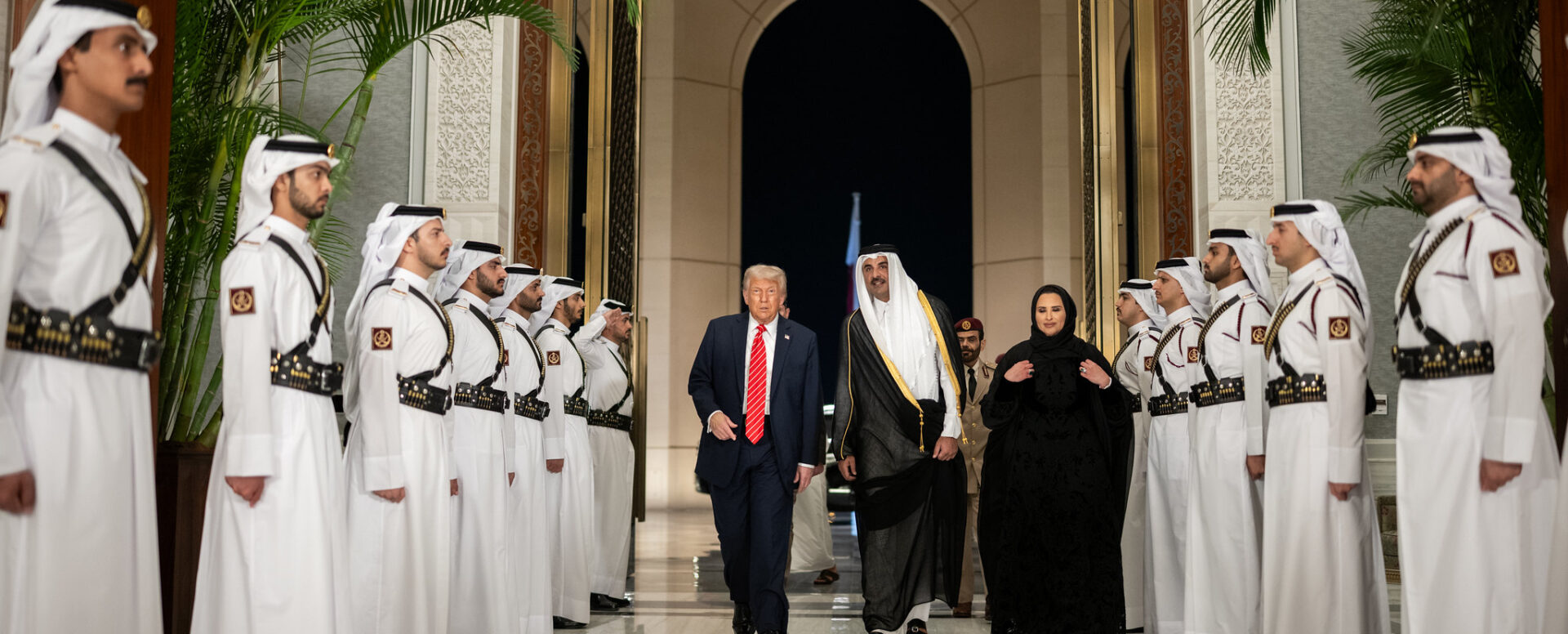
Photo: President Donald Trump is greeted by Amir of Qatar Sheikh Tamin bin Hamad Al Thani and his wife, Sheikha Jawaher, before an official State Dinner at Lusail Palace in Doha, Qatar, Wednesday, May 14, 2025. (Official White House Photo by Daniel Torok)