



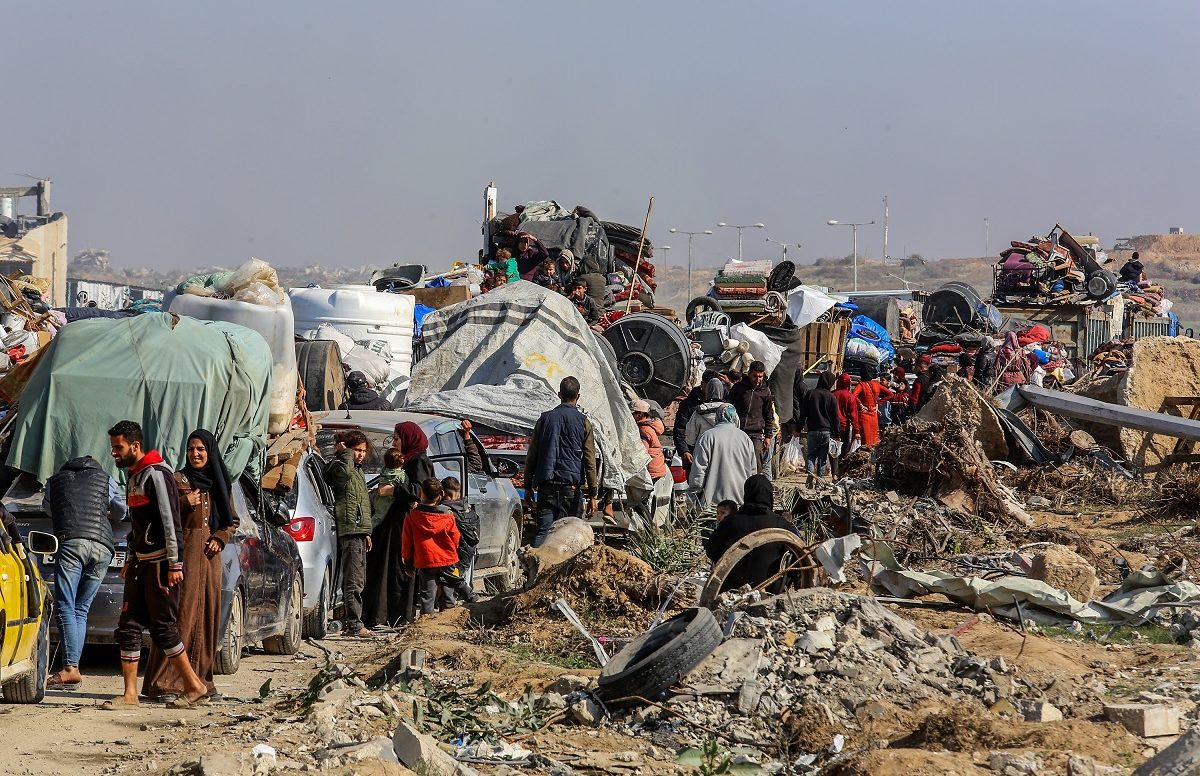
In May 2025, Israel’s government expanded its military operations and announced the long-term re-occupation of the Strip and the forced displacement of the population. It also introduced a new and highly problematic mechanism to distribute aid. The prompt expulsion of 2.2 million Palestinians from Gaza does not seem to be a likely scenario. But long-term Israeli security control, the concentration of the population in a small part of the Strip, the destruction of livelihoods and completely inadequate humanitarian aid will make the Strip unlivable and push Palestinians out in the mid-term. An alternative that promises long-term stabilization in line with international law would be based on the Arab League’s plan for the reconstruction of Gaza. The document initially envisages a non-partisan administrative committee and, in the mid-term, the assumption of control by a reformed Palestinian Authority, supported by a UN-mandated international presence. The end point would be a two-state arrangement. That would also allow for Israel’s integration into the region.
The 7 October 2023 attacks on Israel by Hamas and other armed groups from the Gaza Strip constituted a watershed moment for Israel – for state and society alike – and triggered an unprecedented military escalation. In response to the attacks, Israel declared a state of war, launched military operations and imposed a far-reaching blockade on the Gaza Strip, which was eased but not lifted two weeks later. Fighter jets and ground troops not only targeted the weapons arsenals, military and civil command structures and fighters of the armed groups, but the operations also led to a very high death toll among the civilian population, an unprecedented humanitarian crisis and the large-scale destruction of livelihoods in the coastal territory.
By the beginning of June 2025, almost 55,000 Palestinians had been killed in the Gaza Strip, around 45 percent of them women and children. Tens of thousands were still missing, probably buried under rubble. More than 120,000 had been injured, many of them severely (OCHA, 2025a). Around 90 percent of the population had been internally displaced, many having to flee time and again. Still, they were often unable to find effective protection as refugee shelters and tent camps were bombed repeatedly. Malnutrition, diseases and epidemics were just some of the effects of the persistent lack of supplies. Many Gazans, especially children, are likely to suffer from severe life-long effects. Also, by the spring of 2025, over 90 percent of houses in the Gaza Strip had been destroyed or severely damaged (OCHA, 2025b). The civil infrastructure, including schools, hospitals and water, sewage and electricity supplies, had been gravely affected, as had Gaza’s cultural assets, production facilities and agricultural land (World Bank/EU/UN, 2025). With Israel’s “Operation Gideon’s Chariots” in May 2025, the destruction was realized at an even greater speed than in the months before, with the razing of entire neighbourhoods. As a result, the Gaza Strip will be unlivable for the foreseeable future.
Ceasefire and Donald Trump’s Plan for a “Gaza Riviera”
In mid-January 2025, even before he took office as US President, Donald Trump managed – in concert with Egypt and Qatar and based on the groundwork of the Biden administration – to commit Israel and Hamas to a ceasefire and an exchange of hostages and prisoners. The agreement was intended to culminate in a permanent ceasefire, the opening of border crossings and the reconstruction of the coastal territory within three to five years.
The Riviera idea legitimized the approach
of forced displacement, a war crime, and
thereby made long-standing ambitions
of the Zionist right acceptable
The agreement, the first phase of which entered into force on 19 January 2025, could have paved the way for ending the war and moving towards long-term stabilization. However, not only were many of the arrangements for phases two and three of the agreement not settled [AM1] from the start, but also US President Trump undermined its further implementation by presenting a vision for the Gaza Strip in early February 2025. Accordingly, the Strip would be developed into a “Middle East Riviera” and its population permanently resettled in states, such as Egypt and Jordan (Stokols, 2025).
The Riviera idea legitimized the approach of forced displacement, a war crime, and thereby made long-standing ambitions of the Zionist right acceptable, repackaged as new and unconventional thinking. Already, the approach had gained momentum in Israel’s national-religious spectrum since 7 October 2023. There had been calls for a new “Nakba” (i.e., a repeat of the flight and expulsion of the Palestinian population from the territory of the emerging State of Israel in 1948) as well as Israeli resettlement of the coastal territory (Hauser Tov, 2023; Hasson/Fink, 2024). Trump’s phantasm also strengthened the intransigence of Israeli Prime Minister Benjamin Netanyahu, who had no interest in entering phase two of the agreement (mainly for domestic political reasons) and henceforth described Trump’s vision as the “only viable option” (Prime Minister’s Office 2025; Asseburg/Lintl, 2025).
“Gideon’s Chariots”: New Approaches, New Instruments
On 18 March 2025, Israel breached the ceasefire, launched new air strikes and soon after embarked on another ground offensive in Gaza. From now on, according to Netanyahu, negotiations on ceasefires and exchanges of hostages and prisoners would only take place under fire. The aim of the military operation, according to the Prime Minister, was to force Hamas to release all hostages and to agree to the disarmament and exile of its leaders and fighters (Mackenzie/Almughrabi, 2025). In the same vein, on 2 March, Israel had already imposed a complete blockade on the Gaza Strip – similar to the beginning of the war – and stopped the delivery of water and electricity. Once more, hunger was used as a weapon. The humanitarian situation deteriorated dramatically as a result. The progress that had been made in providing aid to the population during the ceasefire was rolled back resulting in a looming famine (IPC, 2025). Also, at the end of March, a migration department was set up in the Israeli Ministry of Defence to organize the “voluntary” emigration of the Palestinian population of the Gaza Strip.
At the beginning of May 2025, the Israeli security cabinet approved the massive expansion of military operations and a new approach to the distribution of humanitarian aid. According to Prime Minister Benjamin Netanyahu, the objectives of the military operation named “Gideon’s Chariots,” which was launched on 18 May, remained the same as at the start: to defeat Hamas, free the hostages and ensure that the Gaza Strip no longer poses a threat to Israel. Yet, for the first time, he openly spelled out how this was to be achieved: the entire coastal area would be reoccupied and placed under Israeli security control, Hamas disarmed, its leadership exiled and the Trump plan implemented. To that effect, the local population was to be initially crammed into a southern zone comprising less than 20 percent of the Gaza Strip’s total area – with the ultimate aim of “voluntary resettlement” (Berman/Freiberg 2025).
The Gaza Humanitarian Foundation (GHF)
The expanded military operation was to be accompanied by a new humanitarian approach. After 11 weeks of complete blockade, humanitarian aid was to resume. It was to be distributed directly to the population by a non-governmental organization (NGO) not previously involved in Gaza at a small number of distribution points (initially four compared to the more than 400 from before) in a “sterile zone” secured by the Israeli army and protected by private security companies. In addition, the amount of relief supplies was to be limited to the absolute minimum necessary for survival (Fabian/Berman 2025) – with the planned number of calories per person well below the minimum humanitarian standard. According to Israel’s government, the purported purpose of the new approach was to prevent looting and to ensure Hamas could no longer divert supplies and use them to finance its operations. Yet, Israel did not provide any evidence for such diversion by Hamas under the former system of aid distribution, and the UN and other aid organizations reject such claims.
The new mechanism subjected humanitarian aid
to the political objectives of the Israeli government
– the concentration of the population in a small area
of the Gaza Strip and its ultimate expulsion
The new mechanism subjected humanitarian aid to the political objectives of the Israeli government – the concentration of the population in a small area of the Gaza Strip and its ultimate expulsion. For this purpose, an opaque NGO, the Gaza Humanitarian Foundation, was set up, funded by unknown sources, Israel and the US. Israel also engaged and armed Palestinian mercenaries, in particular from the Abu Shabab family, as security contractors (Rasgon, 2025). The new scheme exposed Gaza’s civilian population to dangerous situations, and, distribution turned out to be haphazard and chaotic, with 245 people killed and 2,150 injured by gunfire in the vicinity of the distribution sites in the first two weeks of operations (OCHA, 2025c). Also, the authorized aid deliveries were completely inadequate to meet the needs of the population. The approach thus contradicted the basic humanitarian principles of humanity, impartiality, neutrality and independence – which is why the UN Country Team and NGOs involved in humanitarian aid rejected it outright. And the arming of Palestinians with a history of looting and partly Jihadist orientation promised to sow more chaos in the future.
Delegitimization of UNRWA
Israel’s new aid scheme also had to be understood in the context of a change in attitude towards the UN. After 7 October 2023, and with the ensuing war in Gaza, the relationship between Israel’s government and the UN and its sub-organizations, which had already been strained, deteriorated drastically. In this context, the United Nations Relief and Works Agency for Palestine Refugees in the Near East (UNRWA) became a prime target of the Government of Israel. In the past, despite all the criticism of UNRWA, Israel had relied on the agency’s stabilizing role. At the end of December 2023, however, the press reported on a classified report by the Israeli Foreign Ministry that showed how UNRWA was to be gradually removed from the Gaza Strip and replaced (Times of Israel, 2023). In the same vein, the paper which Prime Minister Netanyahu tabled in February 2024 for post-war Gaza also envisaged UNRWA being replaced by other aid organizations (Magid, 2024). It seems that the situation was viewed as an opportunity to get rid of an agency that had long been regarded as problematic due to its perceived role in perpetuating the refugee issue – even though the right of return of Palestinian refugees is independent from UNRWA’s mandate.
After 7 October, the Israeli government delegitimized UNRWA as an “arm of Hamas” (Ministry of Foreign Affairs, 2024). It specifically accused 12 UNRWA employees of being involved in the atrocities of 7 October 2023 and of a significant proportion of its staff being active in armed groups. As a result of the Israeli accusations, 16 countries, including the largest bilateral donors, the US and Germany, partially suspended their payments to UNRWA. This plunged the aid organization into an existential crisis at a time when it was most needed for life-saving aid and services in the Gaza Strip – with no other organization able to provide the staff, the long years of experience and the infrastructure, including around 13,000 employees, warehouses and vehicles.
UNRWA initiated two investigations to examine the Israeli allegations. One found no substantive evidence for the Israeli allegations that a substantial part of the staff was active in armed groups (Independent Review Group, 2024). The other came to the conclusion that nine employees may have been involved in the attacks of 7 October (UNRWA 2024). They were dismissed immediately. The actions of individual employees could not, however, be attributed to the organization as a whole. Accordingly, individual donor states had already resumed their payments to the agency after a confidential interim report at the end of February 2024. Others, such as Germany, followed suit. The US, on the other hand, did not go back to providing support.
Yet, UNRWA’s investigations and reform endeavours did nothing to change the Israeli government’s stance. At the end of January 2025, two laws against the aid organization entered into force in Israel. The organization has since been prohibited from operating on Israeli territory; Israeli authorities and officials, in turn, are banned from having any contact with UNRWA. For the work of the relief organization in Gaza, this initially meant that Israel withdrew the protection status of UNRWA facilities and its staff. Consequently, direct coordination and military deconflicting were no longer possible. In addition, UNRWA personnel could no longer enter Gaza via Israel and UNRWA aid deliveries were not allowed to pass through the crossings (Israel Policy Forum, 2025).
The Arab League’s Reconstruction Plan
In May 2025, with the expansion of Israeli military operations and the announcement of a long-term reoccupation of the Gaza Strip and the spectre of the forced displacement of its population (initially internally and later abroad), stabilization of the region became a distant prospect.
There were certainly alternative approaches. At the beginning of March 2025, the Arab League presented a counter-proposal to Trump’s Riviera Plan (League of Arab States, 2025a). The paper was an update of a strategy paper from 2024, supplemented by a three-phase plan drawn up by Egypt for humanitarian aid, early recovery measures and reconstruction. According to this approach, the Gaza Strip would be rebuilt without displacing the population abroad. Instead, Gazans would be housed in temporary shelters until the respective construction phase was completed.
Above all, reconstruction would be embedded in a political framework. According to the plan, an administrative committee of local experts – without the involvement of Hamas or other political groups and under the umbrella of the Palestinian Authority (PA) – would initially be responsible for reconstruction. After six months, a reformed PA would then take control. Jordan and Egypt would train Palestinian security forces in preparation. Security for both peoples, Palestinian and Israeli, would be guaranteed by a UN-mandated international presence in the Gaza Strip and the West Bank. The reconstruction would be financed via a donor conference and complemented by a process aimed at permanent conflict settlement on the basis of two states along the 1967 borders.
Yet, questions remained how the plan could be implemented in practice. There were two major sticking points. First, the Arab League declared that, besides a UN-mandated international presence, there should be only one legitimate security apparatus in the Gaza Strip (League of Arab States, 2025b). However, its document did not detail how this goal would be achieved. Representatives of Hamas, whose popularity had suffered but which remained the dominant force in the Gaza Strip, repeatedly signaled that they were willing to relinquish control of the coastal territory. By July 2025, they also indicated that they were ready to halt arms production and smuggling and dismantle its armed presence within the framework of a long-term ceasefire (Times of Israel, 2025). The PA officially confirmed its readiness to take control. Yet, it was not well positioned to do so as it was increasingly treated as an enemy by Israel’s radical government, its financing was precarious, it was unpopular among the Palestinian population and it was already overburdened by the fight against armed groups in the West Bank. It therefore remained unclear whether and how Hamas would be disarmed, whether its leadership and fighters would leave or be deported from the coastal strip or whether the “Islamic Resistance Movement” would only officially withdraw from the political sphere in order to continue to determine policy from behind the scenes. Also, a continued presence of Hamas personnel, a takeover of control by the PA, UN-mandated troops in Gaza and the West Bank as well as a two-state perspective were in stark contrast to the positions of the Israeli government. Accordingly, Israel’s Foreign Minister and the US government immediately rejected the Arab plan (Gritten, 2025).
Which post-War Order for Gaza?
The Arab states, in turn, made it clear that their financial and political commitment would only be forthcoming within the framework of a process that included the prospect of conflict settlement and Palestinian sovereignty. Also, Cairo and Amman in particular consider their national security to be at risk by large-scale displacement of Palestinians and are therefore vehemently opposed to taking in large numbers of displaced persons. They rightly point out that they had already taken in large contingents of refugees from Palestine and other conflict areas in the past. In Jordan, the majority of the population is already of Palestinian descent. And Amman is very concerned that further expulsions from the West Bank could follow in the near future.
As a result, none of the two main approaches – military reoccupation and expulsion on the one hand versus reconstruction, medium-term control by the PA, international presence and two-state arrangement on the other – has the support of all relevant external actors, in particular the Arab Gulf states, Egypt and Jordan, as well as the US.
The EU should work with Arab partners
to help operationalize and implement
the Arab reconstruction plan in order
to promote a lasting conflict settlement
Yet, lasting stabilization will only be achieved if these actors rally around a unified approach toward the parties to the conflict. This would have to include a solid security plan that contains the elements of a DDR process by Hamas, a return of the PA and an international security presence, as well as a process of de-occupation and lifting of the blockade by Israel and a concrete prospect of Palestinian self-determination.
Germany, France, Italy and the United Kingdom have rhetorically backed the Arab approach. The US Special Envoy for the Middle East, Steve Wittkoff, has described it as a starting point for further talks and a first step with “many convincing elements” (Magid, 2025).
The EU and its Member States should now urgently and emphatically commit themselves to ensuring unconditional humanitarian access to the Gaza Strip, finally stopping the bloodshed and preventing further destruction of livelihoods and displacement there and in the West Bank. They should work with Arab partners to help operationalize and implement the Arab reconstruction plan in order to promote a lasting conflict settlement in the Middle East in accordance with international law, which would also allow for Israel’s full integration into the region. In this context, it would be crucial to strengthen the UN and its sub-organizations as the core of the multilateral order. UNRWA, for example, will be indispensable in bridging the transition from emergency aid to reconstruction.
Ultimately, success will depend on whether it is possible to get the US administration on board and jointly dissuade Israel’s government from relying purely on military force. Europeans and Arabs urgently need to join forces in that endeavour.
References
Asseburg, Muriel. “Welche Nachkriegsordnung für Gaza?” Vereinte Nationen. Berlin: Deutsche Gesellschaft für die Vereinten Nationen, to be published in June 2025.
Asseburg, Muriel; Lintl, Peter. “Israel’s Radical Government.” German Institute for International and Security Affairs (SWP), SWP Comment 16/2025, 16 April 2025, www.swp-berlin.org/publikation/israels-radical-government.
Berman, Lazar; Freiberg, Nava. “Netanyahu sets implementation of Trump’s Gaza relocation plan as new condition for ending war.” The Times of Israel, 22 May 2025, www.timesofisrael.com/netanyahu-implementation-of-trumps-gaza-relocation-plan-is-condition-for-ending-war/.
Fabian, Emanuel; Berman, Lazar. “Official: IDF to launch major Gaza op if no deal signed by end of Trump’s Mideast visit.” Times of Israel, 5 May 2025, www.timesofisrael.com/official-idf-to-launch-major-gaza-op-if-no-deal-signed-by-end-of-trumps-mideast-visit/.
Gritten, David. “US and Israel reject Arab alternative to Trump’s Gaza plan.” BBC, 5 March 2025, www.bbc.com/news/articles/cn7vd4pnxx3o.
Hauser Tov, Michael. “’We’re Rolling Out Nakba 2023,’ Israeli Minister Says on Northern Gaza Strip Evacuation.” Haaretz, 12 November 2023, www.haaretz.com/israel-news/2023-11-12/ty-article/israeli-security-cabinet-member-calls-north-gaza-evacuation-nakba-2023/0000018b-c2be-dea2-a9bf-d2be7b670000.
Hasson, Nir; Fink, Rachel. “Netanyahu Ministers Join Thousands of Israelis in ‘Resettle Gaza’ Conference Calling for Palestinians’ Transfer.” Haaretz, 28 January 2024, www.haaretz.com/israel-news/2024-01-28/ty-article/ministers-from-netanyahus-party-join-thousands-of-israelis-at-resettle-gaza-conference/0000018d-512f-dfdc-a5ad-db7f35e10000.
Independent Review Group on UNRWA. “Final Report for the United Nations Secretary-General, Independent Review of Mechanisms and Procedures to Ensure Adherence by UNRWA to the Humanitarian Principle of Neutrality.” 20 April 2024, www.un.org/sites/un2.un.org/files/2024/04/unrwa_independent_review_on_neutrality.pdf.
Integrated Food Security Phase Classification (IPC). “Gaza Strip: IPC Acute Food Insecurity and Acute Malnutrition Special Snapshot.” 12 May 2025, www.ipcinfo.org/fileadmin/user_upload/ipcinfo/docs/IPC_Gaza_Strip_Acute_Food_Insecurity_Malnutrition_Apr_Sept2025_Special_Snapshot.pdf.
Israel Policy Forum. “Understanding Israel’s New Anti-UNRWA Laws.” January 2025, www.israelpolicyforum.org/anti-unrwa-laws/.
League of Arab States. “Early Recovery, Reconstruction, and Development of Gaza.” March 2025a, https://static-cdn.toi-media.com/www/uploads/2025/03/Arab-Proposal-.pdf.
League of Arab States. “Cairo Statement Issued by the Extraordinary Arab Summit (Palestine Summit).” 5 March 2025b, www.bit.ly/cairostatement_news532025.
Magid, Jacob. “After initial rejection, US sends mixed signals on Arab alternative to Trump’s Gaza plan.” Times of Israel, 7 March 2025, www.timesofisrael.com/after-initial-rejection-us-sends-mixed-signals-on-arab-alternative-to-trumps-gaza-plan/.
Magid, Jacob. “Netanyahu presents post-war plan to cabinet, aims for ‘local officials’ to govern Gaza.” Times of Israel, 23 February 2024, www.timesofisrael.com/presenting-post-war-plan-to-cabinet-pm-aims-for-local-officials-to-govern-gaza/.
Mackenzie, James; Al-Mughrabi, Nidal. “Israeli PM Netanyahu vows to pressure Hamas after ceasefire proposal.” Reuters, 30 May 2025, www.reuters.com/world/middle-east/israeli-pm-netanyahu-vows-pressure-hamas-after-ceasefire-proposal-2025-03-30/.
Ministry of Foreign Affairs. “FM Katz addresses the Munich Security Conference.” 16 February 2024, www.gov.il/en/pages/fm-katz-addresses-the-munich-security-conference-16-feb-2024.
OCHA. “Reported impact snapshot Gaza Strip.” 28 May 2025a, www.ochaopt.org/content/reported-impact-snapshot-gaza-strip-28-may-2025.
OCHA. “Reported impact snapshot Gaza Strip.” 7 May 2025b, www.ochaopt.org/content/reported-impact-snapshot-gaza-strip-7-may-2025.
OCHA. “Statement on Gaza by Tom Fletcher, Under-Secretary-General for Humanitarian Affairs and Emergency Relief Coordinator.” 12 June 2025c, www.unocha.org/publications/report/occupied-palestinian-territory/statement-gaza-tom-fletcher-under-secretary-general-humanitarian-affairs-and-emergency-relief-coordinator-12-june-2025.
Prime Minister’s Office. “Excerpts from PM Netanyahu’s Remarks to the Conference of Presidents of Major American Jewish Organizations.” 16 February 2025, www.gov.il/en/pages/event-conference160225.
Rasgon, Adam. “Who Leads the Israeli-backed Palestinian Militia in Gaza?” New York Times, 6 June 2025, www.nytimes.com/2025/06/06/world/middleeast/israel-gaza-palestinian-militia-hamas-abu-shabab.html.
Stokols, Eli. “Trump says US will ‘take over the Gaza Strip’.” Politico, 4 February 2025, www.politico.com/news/2025/02/04/trump-says-us-will-take-over-the-gaza-strip-00202508.
Times of Israel. “Israel hoping to push UNRWA out of Gaza post-war – report.” 29 December 2023, www.timesofisrael.com/israel-hoping-to-push-unrwa-out-of-gaza-post-war-report/.
Times of Israel. “Saudi report says Hamas could offer guarantees on disarmament, paving way for lasting Gaza ceasefire.“ 4 July 2025, www.timesofisrael.com/liveblog_entry/saudi-report-says-hamas-could-offer-guarantees-on-disarmament-paving-way-for-lasting-gaza-ceasefire/.
UNRWA. “Note to correspondents – on the OIOS investigation of UNRWA.” 5 August 2024, www.unrwa.org/newsroom/official-statements/note-correspondents-%E2%80%93-oios-investigation-unrwa.
World Bank/EU/UN 2025. “Gaza and West Bank Interim Rapid Damage and Needs Assessment.” February 2025, https://thedocs.worldbank.org/en/doc/133c3304e29086819c1119fe8e85366b-0280012025/original/Gaza-RDNA-final-med.pdf.
[1] This article is an updated and expanded version of ASSEBURG, Muriel 2025a. My thanks go to Ida Büsch for her support.