


The complexity of the current global context requires new parameters that take into account the growing role of cultural relations and their impact on international policies. Although the notion of culture as “soft power” is not new, it has traditionally been conceived as a complement to the external projection of states. In the realm of international politics, the cultural factor has often served geostrategic interests, as illustrated by the theory of the “clash of civilisations.” The growing flexibility of international relations in the face of increasingly complex governance and the greater involvement of diverse actors beyond those of the state are some of the factors that could explain the growing centrality of the cultural dimension and its influence. Hence, both in its dimension of external projection (cultural diplomacy) and in its facet of cooperation and cultural action, it has gone from being considered a background aspect to becoming one of the pillars of international relations, on a par with the economy and its commercial dimension, and policy and its security dimension (Saddiki, 2009; Papaioannou, 2018).
This permeability of the cultural dimension in international relations and foreign policies has translated into multilateral cooperation, especially in relation to the most urgent issues on the global agenda. Hence the increasingly close association of culture with the global dimension of sustainable development, through its cross-cutting integration into the 2030 Agenda.[1] At present, cultural and local stakeholders[2] are driving a strong movement to make culture and art a specific Sustainable Development Goal (SDG), in view of their role in local social transformation in the field of global sustainability (Cabral and Gehre-Galvão, 2022). There is also a growing convergence of frameworks and declarations that highlight their specific role in building inclusive and sustainable societies. The centrality of cultural rights in the global agenda and the protection of their contribution to cultural life has been regularly underlined since the Fribourg Declaration on Cultural Rights.[3] Similarly, heritage has come to be seen as a catalyst for sustainable development and peace-building. By the same token, cultural cooperation in its purely productive dimension has given way to the transformative and sustainable interest of creativity and cultural industries.[4]
These dimensions shape the current global narrative around cultural relations in the international context[5] and have their own regional interpretation in Euro-Mediterranean relations.[6] One of the main characteristics is their traditional focus on improving mutual perceptions between the north and south shores of the Mediterranean, revolving around the axis of relations between the West and the Muslim world. Thus, since the Barcelona Declaration of 1995, European and Mediterranean partners have understood that intercultural dialogue and human exchanges could further strengthen their relations. The cultural dimension, hand in hand with civil society, was proposed as a complementary tool to the process of economic and political partnership, at the same time constituting one of the most sensitive elements of the process throughout this period (Aubarell, 2017).
The EU’s global strategy in 2016 emphasized the people-to-people approach and aligned European cultural diplomacy with global trends lending culture a much more inclusive value, opening the door to the active integration of non-state cultural agents,[7] in addition to national cultural institutes. Different actors and social stakeholders in the region[8] expressed support for stimulating exchanges between intellectuals, artists and cultural agents, as well as the preservation of heritage, always in line with the promotion of dialogue and mutual knowledge.
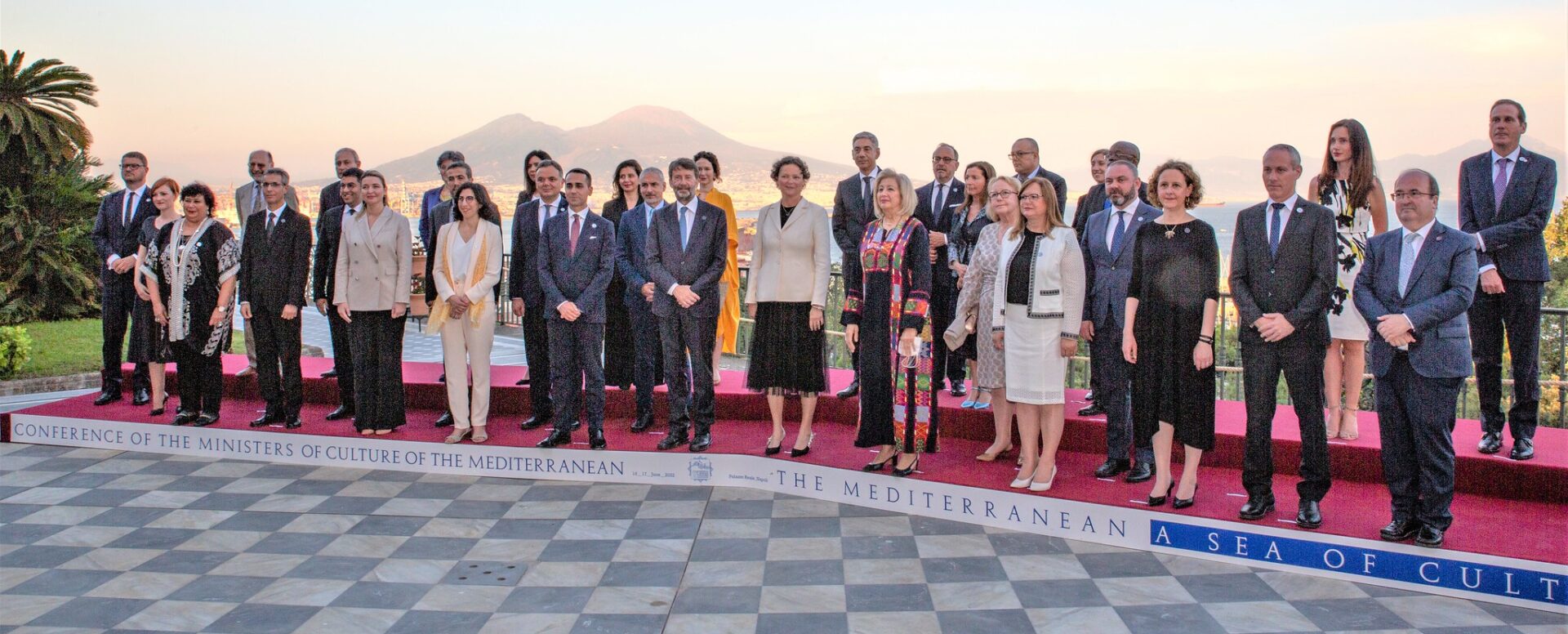
In the Mediterranean area, this dimension addressed social, economic and security challenges and highlighted the role of culture as a vector for peace, democracy and economic development. The objectives of this external strategy focused on three areas of action: creative potential and its relationship with social and economic development; the promotion of peace and the fight against radicalization through intercultural dialogue; and finally, cooperation in the field of cultural heritage. These principles were reflected in the Euro-Mediterranean Ministerial Conference on Culture held in Naples in 2018 with the same objectives: a desire for socioeconomic cooperation, the fight against radicalization, and cooperation in the heritage, digital and sustainability spheres.[9]
Euromed Cultural Cooperation Programmes
The deployment of these principles has not yet led to a cultural diplomacy strategy that can be classified as such in the Euro-Mediterranean region, although it has led to numerous programmes. With a very broad interpretation of the cultural dimension, these programmes have covered a variety of approaches straddling the social and cultural spheres, such as heritage, tourism, youth, media, the arts and cultural policies.
The European Union and its partners have begun to generate the necessary conditions for the development of Euro-Mediterranean cultural diplomacy initiatives, although the resources available remain insufficient and largely depend on instruments of a temporary and limited nature (Trobiani, 2017). Overall, this cultural cooperation has resulted in numerous functional aspects relating to technical assistance, capacity-building and exchange.
The EU and its partners have begun to generate
the necessary conditions for the development
of Euro-Mediterranean cultural diplomacy initiatives
The various cultural cooperation programmes of the initial period, most notably Euromed Heritage and Euromed Audiovisual, primarily involved incentivizing a dynamic of contacts and relations (Roca, 2008). The next generation of regional programmes prioritized a focus on strengthening cultural actors on the southern shore of the Mediterranean. Thus, the MedCulture 2014-2018 programme was based on supporting the development and improvement of cultural policies and practices relating to the cultural sector. The CREACT4Med (CReative Entrepreneurs ACTing FOR the future MEDiterranean) 2021-2024 programme, in its turn, opened an interesting line of support to the vibrant young creative industries sector in south-shore countries. Neither programme, however, offered much scope for cooperation and the promotion of Euro-Mediterranean partnerships. The potential and demand of the stakeholders involved have led to the development of platforms such as the Alliance for the Creative Mediterranean (ACM) initiative, led by the Euro-Mediterranean Economists Association (EMEA), which aims to foster a dynamic ecosystem for cultural and creative entrepreneurship in the Mediterranean region. This is a particularly interesting and promising dimension in a region with a large youth population and a growing cultural environment (Ouchtati, 2024).
From a cultural and creative sector perspective, the Creative Europe programme, focused exclusively on these actors, will, to a certain extent, be open to cooperation with third countries in 2021-2027, providing an environment for mobilization and resources to be harnessed by actors in the region. The European cooperation fostered by this same programme through national delegations or platforms of national cultural institutions such as EUNIC – EU National Institutes for Culture (which offers direct microgrants to local actors in each Arab country) follows the approach of supporting artistic and cultural projects through mobility funds and artist residencies. Some of these programmes also have a regional scope, such as the regional Saphir programme, aimed at young people working in the field of culture.
As we have stated, the cultural approach has been primarily understood from the perspective of the need for mutual understanding and interculturality. In this regard, the Euro-Mediterranean project has had the support of the Anna Lindh Foundation (ALF), an institution that has been fostering the people-to-people approach since 2005, prioritizing the promotion of exchanges and youth programmes and mobilizing Euro-Mediterranean civil society networks, including cultural stakeholders. The opening of a new line on international relations and culture[10] within the framework of the ALF responds to the need to incorporate cultural action into intercultural dialogue in an inclusive and cross-cutting manner. This line of action is largely promoted by the national networks of this foundation, which include a large number of civil society organizations from the artistic and cultural spheres.
In the field of cultural diplomacy, understood as external action, we will see how it continues to be largely channelled through state-led strategies (also through the EU National Institutes for Culture – EUNIC platform), with this cooperation being primarily one of external European projection and promotion of cultural cooperation.[11] Through these institutes, external cooperation is also deployed in alliance with regional actors such as the League of Arab States (LAS), platforms that promote cultural exchange and collaboration. A prominent example is Halaqat, an artistic and cultural platform in the Arab world involving artist residencies, performances, exhibitions and other cultural activities, initially co-financed by the European Union under the name EU-LAS Culture (2021-2023).
A particularly relevant development in terms of strategic visibility and medium- and long-term sustainability in the field of Euro-Mediterranean relations is the Mediterranean Capitals of Culture programme,[12] jointly promoted by the Union for the Mediterranean (UfM) and the Anna Lindh Foundation (ALF). This programme, which is still being consolidated, opens up multiple possibilities for contributing interesting shared value to this cultural dimension, as well as for incorporating inclusive initiatives based on heritage and cultural values. Committing to this type of initiative, beyond the binary vision of understanding between the two shores of the Mediterranean, would deepen the construction of shared identities from the local level and would contribute a unique meaning to Mediterranean cultural projection in its most genuine aspect of integrative cultural diplomacy.
New Dynamics and Priorities of Mediterranean Cultural Relations
One of the defining characteristics of international cultural relations in the Mediterranean area is that, beyond the strategic objectives and the external projection promoted by the organizations of the region, they include the dynamics of a wide variety of stakeholders who interact with each other at different levels, promoting actions from their perspectives as cultural agents, civil society organizations and citizens in general. A network of cultural policies is fostered either through various national initiatives or regionally-based projects involving civil society and private organizations and integrating cultural and knowledge centres (Helly, 2017). Hence the interest in identifying the dynamics and priorities emerging from the actions and positioning of these agents in the context of the main social and political challenges of their international relations.
It is interesting in this sense to highlight the centrality of culture as a principle of social transformation. This concept has been strongly perceived since the beginning of the Arab uprisings of 2011, along with the central role played by culture and creativity open to global trends (González-Quijano, 2013). The Arab Springs could have provided a significant boost to cultural relations in the region, but this did not happen. Nevertheless, despite the difficulties, many public, private or philanthropic institutions have been supporting the cultural sector in the region at various levels, including in the fields of entrepreneurship and the creative sector, training and exchange. In this way, cultural cooperation has adapted to deal with difficult political circumstances, dramatic conflicts and the challenges facing democratic cultural expression and free circulation.
Cultural cooperation has adapted to deal
with difficult political circumstances,
dramatic conflicts and the challenges facing
democratic cultural expression and free circulation
One of the most pressing challenges facing Euro-Mediterranean relations if they are to be effective is the difficulties encountered in exchange and mobility. In the socio-cultural context, this has led many of these actors to gravitate towards Africa and the Gulf states. These countries are currently among the main promoters and axes of such “cultural cooperation,” thus influencing the anthropization of relations. This is precisely why the added value of European cooperation in this area is so important. We should also consider the need for the development of new regional strategies in the South, through the promotion of closer interregional cooperation with organizations such as the Arab League, the Arab Maghreb Union (AMU) and the Gulf Cooperation Council (GCC), endowing it with joint resources (Trobiani, 2017).
An environment that must also combine future needs that are global and include Artificial Intelligence (AI) and digitalization. The representatives of Arab countries agree on the need to ensure equitable access to digital tools and reduce the digital divide. Initiatives such as the digitization of cultural heritage and data protection have been emphasized, together with the impact of digital transformation on cultural economies and the urgency of ethical legislative frameworks and AI literacy programmes.[13]
To a large extent, the demand for collaboration with Europe focuses on fundamental aspects such as technical assistance and knowledge transfer and training, especially in relation to local empowerment and development. Facilitating the empowerment of cultural actors and their access to European markets through equitable participation and co-production is a field of interest for European cooperation agencies. This approach of positioning Europe’s role in relaunching the Mediterranean as a space of union between North and South, without delving into the political implications, revolves around artistic mobility and professionalization. Spheres such as the audiovisual sector are priority areas of interest (Ramzy, 2025), as demonstrated by initiatives such as the Medimed Euromed Docs Market, which has been promoting Euro-Mediterranean audiovisual co-production for more than 25 years, and has managed to emerge as an activity committed to the most pressing issues, as in the case of the acclaimed documentary “No Other Land.”
With the current shift towards the creative economy, arts and culture as tools for mere economic development have lost prominence. Significantly, key actors such as the Arab Fund for Arts and Culture (AFAC) and El Mawred Al Thaqafy are fostering a vision of community engagement and inclusion. Both institutions continue to play a fundamental role in the Arab region thanks to international funding, acting primarily as a link between European funds and direct support to artists. This inclusive dimension will be key to the work of organizations involved in intercultural dialogue. The national networks of the Anna Lindh Foundation have promoted the Tangier Declaration (2024) on culture in Mediterranean international relations,[14] in which they point to the need to overcome the instrumentalizing view of culture in international relations, emphasizing how interculturality must work with socially engaged art as a means for citizens’ participation, the promotion of dialogue, inclusion and community empowerment. There is also an emerging demand by the Euro-Mediterranean community for the promotion of committed cultural action that incentivizes and supports the work of professionals and entrepreneurs, politicians, civil society agents and scholars in the face of the ongoing, dramatic crises, with appropriate programmes fostering a network of cultural resilience and mediation. From this same perspective, the need is corroborated for cultural diplomacy that is not reduced to a tool of influence but rather consists of genuine cooperation centred on mutual understanding and shared values, beyond state agendas. The idea is to support an integrated, balanced cultural ecosystem, encompassing medium-sized organizations and small initiatives, and providing long-term support to small-scale projects.
One of the most difficult and sensitive aspects
is the development of a cultural strategy that
responds to the necessary spaces for human
and cultural relations in the context of crises and conflicts
Undoubtedly, one of the most difficult and sensitive aspects is the development of a cultural strategy that responds to the necessary spaces for human and cultural relations in the context of crises and conflicts. In this regard, the conflict in the Middle East, heightened after the 7 October 2023 attacks and Israel’s response in Gaza, has generated a humanitarian crisis in the region, including problems of access to education and culture, while exacerbating polarization, dehumanization and radicalization in the Euro-Mediterranean region. This situation clearly demonstrates the need for multilateral instruments that promote Track 1.5 diplomacy, integrating non-formal mechanisms and non-state actors in conflict resolution processes. A solid cultural agenda for the promotion of shared values, fostering spaces of trust in the face of the timid reaction of Euro-Mediterranean cooperation when it comes to providing spaces and resources that strengthen the role of civil society and provide the region’s cultural agents with the necessary international context of peace. Cultural and dialogue programmes aimed at youth to address challenges such as radicalism and encourage democratic participation are also a priority (Traidi, 2025).
Lending value to cultural relations with an entity of their own is currently a necessary commitment, as reflected in the results of the consultations on the New Pact for the Mediterranean.[15] In the opinion of Euro-Mediterranean actors and experts, the people-to-people dimension and cultural diplomacy should constitute key pillars of the Pact. Far from playing a complementary role, cultural exchange is seen as one of the fundamental elements for building social cohesion and mutual trust. This network of Euro-Mediterranean actors calls for a more horizontal space of relations, centred on human capital and citizen involvement, leaving behind the donor-recipient logic. This reaffirms the desire for cultural diplomacy to be conceived as a strategic tool for trust and the projection of soft power in a multipolar world that requires inclusive, respectful and people-centred alliances. To continue investing in the construction of a project of competitive, sustainable Euro-Mediterranean relations with a global impact, values matter.
References
Aubarell, Gemma. “Tendencias interculturales y cambio social en la región Euromediterránea” Quaderns de la Mediterrània, 22, pp. 261, 2021. www.iemed.org/wp-content/uploads/2021/09/Tendencias-interculturales-y-cambio-social-en-la-region.pdf.
Cabral, R. and Gehre Galvão, T. “Reimaginar la Agenda 2030 de la ONU conectando los ODS con Cultura, Arte y Comunicación.” Revista Latinoamericana de Ciencias de la Comunicación. 21, 41 (Dec. 2022), 44–59. DOI: https://doi.org/10.55738/alaic.v21i41.931.
Helly, Damien. “Cultural Diplomacy and Cooperation in the Mediterranean: A Constant Investment.” IEMed Mediterranean Yearbook 2017 www.iemed.org/publication/cultural-diplomacy-and-cooperation-in-the-mediterranean-a-constant-investment/.
González Quijano, Yves. “La ‘fusión cultural’: ¿una revolución árabe?” Afkar Ideas No. 39, 2013.
Ouchtati, Sana. “Cultural Cooperation and the Role of New Creative Industries in the MENA Region.” IEMed Mediterranean Yearbook 2024. www.iemed.org/publication/cultural-cooperation-and-the-role-of-new-creative-industries-in-the-mena-region/.
Papaioannou, K. “A Theoretical Approach to the Terms of Cultural Policy and Cultural Diplomacy as Pillars of ‘Soft Power’.” IJASOS- International E-journal of Advances in Social Sciences 4 11 503–506, 1 August 2018.
Ramzy, Chaymaa. “Informe de Identificación de Necesidades – State of the Arts.” Taller de Formulación: Proyecto de Cooperación con el Mundo Árabe en el Sector Audiovisual MASAR AL AMAL, www.festivalamal.com/_files/ugd/f142d9_132d5a0cf5e6487ea31dbcb3484b7aa5.pdf.
Roca, Imma. “Cultural Cooperation in the Euro-Mediterranean Partnership from 1995 to 2008.” IEMed Mediterranean Yearbook 2009. www.iemed.org/publication/cultural-cooperation-in-the-euro-mediterranean-partnership-from-1995-to-2008/#_ftn2.
Saddiki, Said. “El papel de la diplomacia cultural en las relaciones internacionales.” Revista CIDOB d’afers internacionals, 2009, No. 88, p. 107-18, https://raco.cat/index.php/RevistaCIDOB/article/view/164488.
Traidi, Aida. “Gaza: impacto de la guerra en la cohesión social euromediterránea.” afkar/Ideas, No. 74, 2025. www.iemed.org/publication/gaza-impacto-de-la-guerra-en-la-cohesion-social-euromediterranea/.
Trobiani, Riccardo. “EU Cultural Diplomacy in the MENA region: a qualitative mapping of initiatives promoting regional cooperation.” EL-CSID Working Paper, 2017 https://cris.unu.edu/sites/cris.unu.edu/files/EL-CSID_Working_Paper_2017-02.pdf.
[1] UNESCO (27 January 2022. Last update: 20 April 2023). Cutting Edge. From standing out to reaching out: cultural diplomacy for sustainable development.
[2] 6th UCLG Culture Summit 2025 | Culture 21.
[3] UNESCO (17 January 2019). Cultural rights: tenth anniversary report – Report of the Special Rapporteur in the field of cultural rights.
[4] UNESCO (29 October 2021. Last update: 20 April 2023). Foro Internacional sobre la Economía Creativa para el Desarrollo Sostenible.
[5] “World Conference on Cultural Policies and Sustainable Development – MONDIACULT 2025,” UNESCO.
[6] European Parliamentary Research Service – EPRS, Euro-Mediterranean cultural cooperation, 2024.
[7] European Parliament. “Towards an EU strategy for International cultural relations.” 2016.
[8] European Economic and Social Committee – EESC. “Economic, social and cultural rights in the Euro-Mediterranean region (own-initiative opinion).” 2017.
[9] “MedCulture Press Kit, Conference of Ministers of Culture of the Euro-Mediterranean.” Naples, 2022.
[10] The international relations and culture dimension prompted an avenue of reflection by national ALF networks during the ALForum held in Tirana (June 2025) and is part of the lines of action of the public policy programme in the new 2025-2028 ALF Multi-Annual Work Programme.
[11] “International cultural relations: Council adopts conclusions.” Council of the EU, 8 April 2019.
[12] “Mediterranean Capitals of Culture & Dialogue: A yearlong celebration of Euro-Mediterranean identities and cooperation.”
[13] “Arab States countries discuss cultural policies during the MONDIACULT 2025 regional consultation.” UNESCO news, 3 February 2025, last update: 6 May 2025.
[14] The Tangier Declaration was drawn up within the framework of the Anna Lindh Foundation’s Inter-Network Action, held in Morocco from 6 to 8 March 2024 under the theme “Cultural Diplomacy: A Mechanism for Intercultural Dialogue.” It contains reflections and proposals regarding the need for a renewed approach to cultural diplomacy as a driver of cohesion, inclusion and social transformation. Based on the Declaration and the joint work of the national networks of Belgium, France, Ireland, Tunisia, Spain and Morocco, this initiative presented a series of proposals that were discussed during the Anna Lindh Foundation Forum in Tirana (June 2025).
[15] The consultations on the New Pact for the Mediterranean, the 15th Euromed Survey (with over 700 responders consisting of stakeholders in 24 countries) and the “Consultation Circles” held in Rabat, Cairo and Brussels involved multiple stakeholders, including policymakers, youth, civil society members and business leaders.
Header Photo: Conference of Euro-Mediterranean Culture Ministers in Naples on 16-17 June for the protection of culture as an instrument of peace, dialogue and innovation (Anna Lindh Foundation)
