



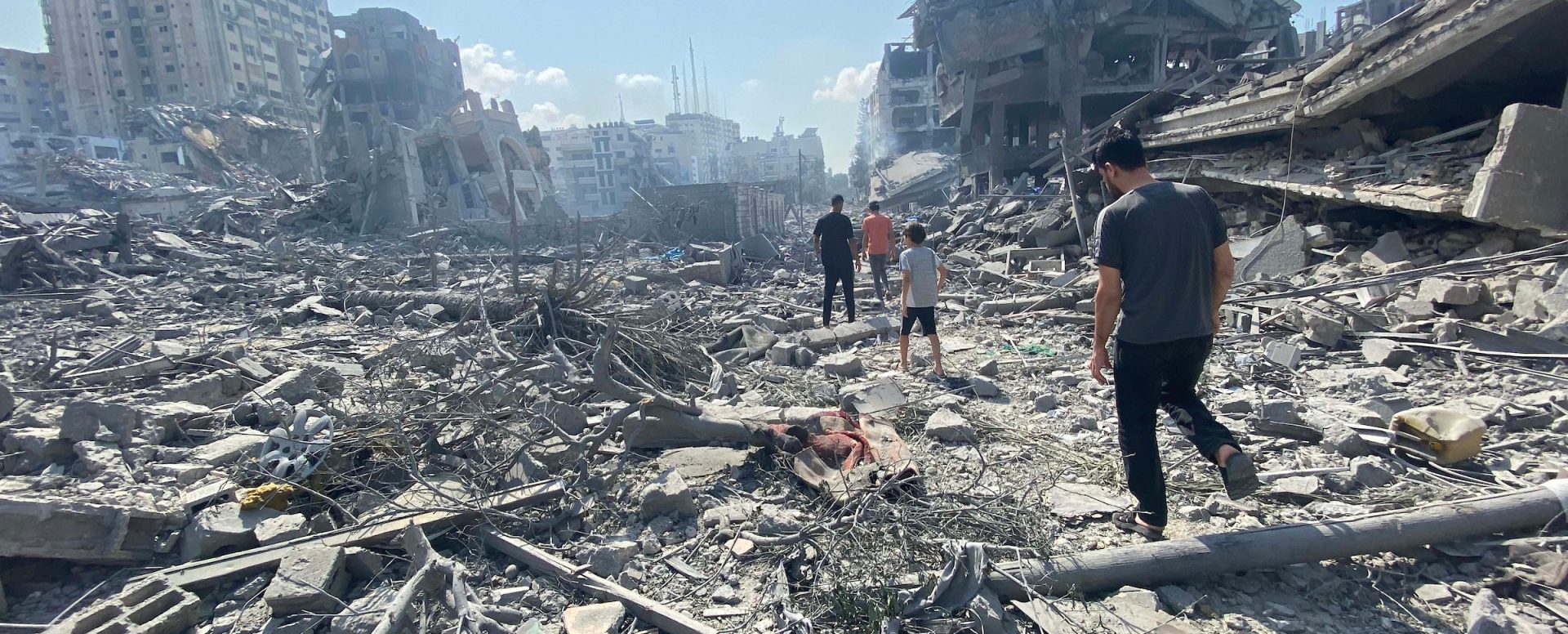
Israel responded to the Hamas-led attack on 7 October 2023 with an unprecedented and extensive military campaign of retaliation and collective punishment. None of the Israeli military’s other campaigns against this tiny Palestinian territory – in 2006, 2008-2009, 2012, 2014 and 2021 – reached the same degree of intensity, duration, destruction and lethality as the one conducted from 2023 to the present.
Reprisals and collective punishment operations have been a constant feature of Israeli military occupation policy. Their main objectives have been: to discourage the collaboration of the indigenous population with the emerging resistance movement, which rises up sooner or later under any foreign military occupation; to prevent the establishment of guerrilla warfare in the occupied territories, in particular, urban guerrilla warfare in the most densely inhabited areas such as the refugee camps and the Gaza Strip; and to periodically reaffirm its deterrence power in a regional environment considered predominantly hostile.
Following this historical pattern of behaviour, the Israeli ground offensive was accompanied by a media and social network offensive, aimed at dehumanizing the Palestinians and justifying an all-out war against the Gaza Strip. From different circles – political, military, media, religious and professional – of state and society, various pronouncements were made in revanchist and threatening terms. Isreali leaders did not hesitate to hold responsible, dehumanize and punish the entire Palestinian people of Gaza for the most psychosocial and lethal attack in the history of the Israeli State since its creation in 1948. Its President Isaac Herzog declared “A whole nation is responsible”; its Defence Minister Yoav Gallant stated “We are fighting human animals”; and, finally, its Prime Minister Benjamin Netanyahu sentenced “We’ll turn them into rubble… I’m telling the people of Gaza: get out of there now, because we’re about to act everywhere with all our force.”
Gaza: Military Target
To that end, Israel isolated the Gaza Strip from the world by hermetically sealing off the tiny coastal enclave, which had been under a tight blockade since 2007. It cut off all basic supplies and services, such as water, electricity, fuel, medicine and food; blocked humanitarian aid, on which some 80 percent of the population then depended; vetoed access to the international press, UN personnel and other international institutions; and intermittently interrupted telephone and telematic communications.
In an area of only about 365 square kilometres, the Gazan people – about 2.3 million people, almost half of whom are minors – were trapped, with no way out, no humanitarian corridor and no safe area in which to seek refuge. Since the beginning of the offensive in October 2023, Israel ordered the evacuation of northern Gaza in a southward direction, a stretch of about 45 kilometres in length. More than 1.1 million Gazans were forced to move in a record time of only 24 hours granted by Israel. Many people – with reduced mobility, along with the elderly, pregnant women and children – were forced to move on foot in the absence of transport. The evacuation corridors were not safe, and some convoys were attacked, leaving many dead bodies along the way. At the same time, southern Gaza lacked the infrastructure to accommodate such a large population, as did the rest of the Strip.
Since then, forced displacements have been a constant, with the same patterns of behaviour being repeated over and over again throughout 20 months of torment: continuous evacuation orders, forced relocations of an exhausted population, without any means of protection, shelter, security, infrastructure or humanitarian assistance; coupled with the systematic siege and onslaught of the Israeli army. The entire Gaza Strip was deliberately transformed into a battlefield and even “a killing field,” as UN Secretary-General Antonio Guterres put it. No safe zone was in sight. Even those nominally declared safe by Israel have been repeatedly targeted. Israeli bombardment has not distinguished between civilians and combatants. On the contrary, the Israeli army has deliberately targeted the Palestinian civilian population, and this was not the first time in the last two decades, as various reports and studies have shown.[1] However, this time it has been with a violence, scope and lethality that surpasses all such precedents.
Colonial Warfare
Israel has applied the logic of colonial counter-insurgency, that of making the civilian population pay for the presence of armed resistance. Its military offensive exacted a heavy toll on civilian lives, which continues to increase day by day with new killings. At the beginning of June 2025, more than 54,000 people had been killed, more than 125,000 wounded and some 12,000 buried under the rubble, in addition to an unknown number – estimated at around 20,000 – of missing persons and detainees at the hands of the Israeli army. By the end of May 2025, “more than 50,000 children have reportedly been killed or injured since October 2023,” according to UNICEF, which at the same time noted: “These children – whose lives should never be reduced to numbers – are now part of a long, harrowing list of unimaginable horrors.”
Israel initially shifted responsibility to Hamas, which it accused of using the population as human shields by, allegedly, mixing among them. But after Hamas’s military capacity was significantly reduced and virtually its entire political and military leadership eliminated, systematic attacks on civilians persisted and the military offensive was intensified and prolonged indefinitely. Israel’s repertoire was exhausted. So it renewed and expanded its objectives to justify the prolongation – sine die – of its military campaign in Gaza. Netanyahu introduced the idea of achieving “total victory,” an intentionally ambiguous term that enabled him to increased the goals of the Israeli offensive. In theory, he still sought the release of the hostages, even though most of those released had been the result of ad hoc agreements with Hamas through indirect negotiations mediated by third countries such as Qatar and Egypt, along with the US. Only now the Israeli government did not limit itself to reducing Hamas’s military and governmental capabilities, but also demanded its unconditional surrender, disarmament and exile. But, above all, it also sought to take control of the entire territory of Gaza, with the consequent plans for the deportation of its population – partial or total ethnic cleansing – , annexation and colonization.
The Israeli strangulation strategy
involves relentless military operations
and a humanitarian blockade (…)
which together produce the same outcome:
death by bombing or starvation
In this endeavour, Israel has adopted a continued strategy of siege and starvation, evidenced and visualized – even more – after Israel’s unilateral breaking of the truce on 18 March 2025. During the course of this brief truce, which began on 19 January – and lasted only about eight weeks -, Israel imposed a new blockade on the entry of humanitarian aid into the Gaza Strip from 2 March. The Israeli strangulation strategy, which targets the slightly more than two million Palestinians in Gaza, involves, on the one hand, relentless military operations, and, on the other, a humanitarian blockade, which together produce the same outcome: death by bombing or starvation. While bombs kill instantly, the blockade of humanitarian aid and basic supplies – food, water, fuel, electricity, medicine, medical care and hygiene – leads to a slower and more torturous death. Many people have died from injuries, diseases and infections that would be preventable under normal conditions or with humanitarian assistance.
On 20 May 2025, the UN warned that some 14,000 babies could starve to death within 48 hours without food relief. The use of hunger as a weapon of war has been another constant feature of the Israeli military campaign. This was established by the cutting off of all basic supplies from the beginning. Humanitarian aid has been constantly blocked and, when allowed in, has been piecemeal and insufficient to meet the basic needs of the Gazan population. Such behaviour is clearly a siege strategy, combining military pressure and starvation. Israeli Finance Minister Bezalel Smotrich considered it “moral” and “justified” to let two million Palestinians starve to death in Gaza, but that the world would not allow it.[2] While Benjamin Netanyahu echoed these limitations in May 2025: “Our best friends worldwide, the most pro-Israel senators… they tell us they’re providing all the aid, weapons, support and protection in the UN Security Council, but they can’t support images of mass hunger.”[3]
Instrumentalization of Humanitarian Aid
Humanitarian aid has been instrumentalized, militarized and privatized by Israel. Netanyahu excluded international humanitarian agencies from its distribution in favour – without any tender or transparent procedure – of an opaque organization known as the Gaza Humanitarian Foundation (GHF), whose murky origins are linked to former US military personnel, and which has seemingly appeared out of nowhere, created for the purpose, lacking neutrality, with no experience in humanitarian logistics, no legitimate international mandate and with secret or at least dubious sources of funding. This move has been heavily criticized by the UN and the range of humanitarian organizations that had previously been working on the ground, with adequate and experienced aid distribution systems.
Under the cover of humanitarian aid, Israel is trying to replace these specialized international agencies with a pseudo-humanitarianism or humanitarianism of surveillance as an instrument of control by biometric technology – facial recognition – coupled with the extortion of an exhausted and starving population, among which it tries to co-opt collaborators for the denunciation of militants from Hamas and other armed resistance groups. Indeed, a mysterious armed Palestinian militia has emerged in southern Gaza, calling itself the “Anti-Terrorist Service,” whose leader – Yasser Abu Shabab – has served time for criminal offences in Gaza prisons and been accused of looting humanitarian aid and collaborating with Israel.
This humanitarian camouflage also serves the political purpose of emptying northern Gaza of its population. The four aid distribution centres – one in Netzarim Corridor and three in Rafah – force the population of just over two million to move south for survival; being concentrated in these small areas, where they are cornered by the Israeli army. In parallel, Israel forced the closure of al-Awda hospital, the last partially functioning hospital in northern Gaza until the end of May 2025. With the dismantling of vital services and the declaration of the north as a combat zone, the Israeli government had been implementing the so-called Generals’ Plan since before its announcement – and without official endorsement – , which was conceived by a group of retired generals represented by former general and advisor Giora Eiland, which proposed a complete blockade on the entry of all basic supplies – food, water, medicine and fuel – to force the evacuation of the 300,000 Palestinians remaining in the north of Gaza and to declare those who remained a military target. In theory, its aim was to put pressure on Hamas and obtain the release of the hostages. In practice, it implemented plans for the ethnic cleansing of this region. Long before that, speaking to Israel’s Channel 12 on 1 December 2024, former Israeli Chief of Staff and Defence Minister Moshe Ya’alon had denounced Israel’s actions in Gaza as “ethnic cleansing.”
The Destruction
Since its inception, the Israeli offensive has not distinguished between civilian and military areas or, equally, between civilian and combat zones. Following the aforementioned logic of colonial counter-insurgency, all civilian buildings, services, institutions and infrastructure in the Gaza Strip were considered by Israel as a military target: schools, universities, hospitals, health centres, municipal services, markets, telecommunications, roads, sewage, workplaces, commerce, industry, warehouses, bakeries, farmland, farms, animals, fishing materials, UN facilities, aid distribution sites, community kitchens and even tents, as well as heritage such as churches, mosques and historical archives. The deliberate and indiscriminate shelling of Gaza’s civilian population and property were two sides of the same coin. Although there is no comprehensive count on the ground – only estimated figures -, the UN estimated in April 2025 that 92 percent of residential dwellings – some 436,000 – have been destroyed or severely damaged. Entire buildings, communities, neighbourhoods and residential areas have been flattened.
The Gazan education system has also been completely destroyed. Everything from primary and secondary schools to universities have been targeted by systematic Israeli bombardment. There were 815 schools in Gaza, housed in 564 school buildings, employing 22,000 teachers and serving more than 625,000 students. An estimated 95.2 percent of public and private schools in Gaza have been significantly damaged, with 88.5 percent in need of either complete reconstruction or substantial rehabilitation, according to the Education Cluster report of March 2025.
Neither were Gaza’s 12 existing universities spared by the Israeli attacks, all of which have been severely damaged or destroyed, along with their educational infrastructure, such as administration, lecture halls, offices, meeting rooms, laboratories and libraries. Some of their management, teaching, administrative, labour and student staff have been killed. Like primary and secondary school students, some 90,000 university students have seen their education dramatically interrupted. Repeated efforts to resume face-to-face and virtual education have been thwarted by continued bombing, a drastic deterioration of material living conditions and the humanitarian emergency situation, due to the lack of shelter, food, medicine, electricity, electronic devices – mobiles, tablets and computers – and internet. Despite these dire conditions, there are numerous testimonies of students struggling to study and teachers struggling to teach, reflecting the value placed on education in Palestinian society.
Another target of Israeli attacks has been the network of health centres and hospitals. The work of their staff has been deliberately obstructed, as well as the treatment and access of their patients. The Israeli army has bombed hospitals, entrances, environments, ambulances, paramedics and other health infrastructure. It has even raided these facilities, forced the eviction of their staff and patients and destroyed their equipment and material, including incubators, resulting in the death of neonates. The result has been the drastic reduction of health services, which function in a very precarious, partial and under siege manner.
All indications are that Israel sought,
from the outset, to create material
living conditions that would lead
to the collapse of Gazan society
While the impact on the ecosystem is difficult to assess, it is worth recalling the pollution resulting from the more than 50 million tons of debris and toxic materials involved, including unexploded ordnance and human remains; the thousands of tons of explosives recorded, which in less than a year alone were equivalent to two nuclear bombs; the dumping and overflow of raw sewage; the landfill sites that have sprung up; and the nearly 400,000 tons of waste. All indications are that Israel sought, from the outset, to create material living conditions that would lead to the collapse of Gazan society, with the destruction of its livelihoods, basic services – mainly health, education and production – and civilian infrastructure; and, in short, make its existence and continued presence in Gaza incompatible.
War Crimes and Genocide
After the Israeli executive approved Operation Gideon’s Chariots in May 2025, its Finance Minister, Bezalel Smotrich, stated that “Gaza will be entirely destroyed” and its population “will start to leave in great numbers to third countries.” Forcible population transfer in the context of armed conflict is codified as a war crime by the Rome Statute of the International Criminal Court. Even former Israeli Prime Minister Ehud Olmert (2006-2009), after denying these accusations, will not hesitate now in describing the Israeli offensive in these terms: “What we are doing in Gaza now is a war of devastation: indiscriminate, limitless, cruel and criminal killing of civilians. We’re not doing this due to loss of control in any specific sector, not due to some disproportionate outburst by some soldiers in some unit. Rather, it’s the result of government policy – knowingly, evilly, maliciously, irresponsibly dictated. Yes, Israel is committing war crimes.”[4]
An entire society has been forced into extreme material and psychosocial living conditions. Its men and women, old people and children, have been exposed beyond the limits of their strength and resilience. The physical and psychological damage is irreparable, with lifelong consequences for a whole generation. The wounds of humiliation and vexation, of loss and pain, will also remain open for successive generations in the shape of collective and individual trauma. The aim was to break social cohesion, community ties and the fabric of associations. A tearing apart that would prioritize family and individual survival strategies over collective and national ones. The social collapse of Gaza could be even greater than that of the 1948 Nakba (catastrophe). If then, ethnic cleansing was accompanied by massacres such as Deir Yassin or Tantura, now genocide is being used to achieve the same end.
The calculated and systematic – total or partial – elimination of a human group on the basis of its national, ethnic, racial or confessional status is codified as genocide. This was the understanding of South Africa, when, in December 2023, it filed a lawsuit against Israel at the International Court of Justice in The Hague for breaching the obligations contained in the UN Convention on the Prevention and Punishment of the Crime of Genocide. The UN Special Rapporteur on the situation of human rights in the Palestinian territories occupied since 1967, Francesca Albanese, has been decisive in her two reports, “Anatomy of a Genocide” (25 March 2024), and “Genocide as colonial erasure” (1 October 2024). In the latter, she pointed out that “the magnitude of destruction in Gaza has prompted allegations of domicide, urbicide, scholasticide, medicide, cultural genocide and ecocide.”
In similar terms several NGOs have denounced this genocidal practice in their respective reports: Amnesty International: “You feel like you are subhuman. Israel’s Genocide Against Palestinians in Gaza” (2024); Doctors Without Borders: “Gaza: Life in a Death Trap” (2024); and Human Rights Watch: “Extermination and Acts of Genocide. Israel Deliberately Depriving Palestinians in Gaza of Water” (2024). Not forgetting, finally, the unanimity of the world’s leading scholars in the field on the crime of genocide that Israel is committing in Gaza. This was revealed by an investigation by the Dutch newspaper NRC after interviewing seven world-renowned researchers (Shmuel Lederman, Anthony Dirk Moses, Melanie O’Brien, Raz Segal, Martin Shaw, Ugur Umit Ungor and Iva Vukusic) from six countries – including Israel – and reviewing 25 academic articles recently published in the Journal of Genocide Research.[5]
Politicide
The human and material devastation of Gaza pursues an obvious purpose: “Politicide,” defined by Israeli sociologist Baruch Kimmerling as “a process that covers a wide range of social, political and military activities whose goal is to destroy the political and national viability of a whole community of people and thus deny it the possibility of genuine self-determination. Murders, localized massacres, the elimination of leadership and elite groups, the physical destruction of public institutions and infrastructure, land colonization, starvation, social and political isolation are the major tools used to achieve this goal.” And it can also include “a partial or complete ethnic cleansing.”[6]
The violence perpetrated by Israel in the aftermath of 7 October is part of a longer process, which exploits the different conjunctures and opportunities offered in the international, regional and national space, both Israeli and Palestinian, to pursue a longer-term goal of an ongoing or continuous Nakba. This violence extends beyond Gaza and points, at the same time, to a partly similar scenario in the West Bank, where some 40,000 people have been forcibly displaced. This scenario is part of the same process of planned, gradual and systematic dispossession, confinement and expulsion of the Palestinian people. The aim is to complete the Israeli settlement colonial project within the geography of historic Palestine, but without its indigenous demography.
[1] Finkelstein, Norman. Gaza: An Inquest into Its Martyrdom. Oakland: University of California Press, 2018.
[2] “Israeli Finance Minister Smotrich: Starving Gazans ‘To Death’ May Be Moral, but World Won’t Let Us.” Haaretz, 5 August 2024.
[3] “Hunger Games: As Far as Netanyahu Is Concerned, Gaza’s Humanitarian Crisis Is a PR Problem.” Haaretz, 20 May 2025.
[4] Ehud, Olmert: “Enough Is Enough. Israel Is Committing War Crimes.” Haaretz, 27 May 2025.
[5] van Laarhoven, Kasper, Peek, Eva and Walters, Derk: “Zeven gerenommeerde wetenschappers vrijwel eensgezind: Israël pleegt in Gaza genocide.” NRC, 14 May 2025.
[6] Kimmerling, Baruch. Politicide: Ariel Sharon’s War Against the Palestinians. London: Verso, 2006 (updated).
Header Photo: Palestinians inspect the damage following an Israeli airstrike on the El-Remal area in Gaza City on October 9, 2023.
Author: WAFA Agency in contract with a local company (APAimages). CC 3.0
