


Introduction: From Superpower to Super Flexibility
Analysing Russian policy in the Middle East and North Africa (here mainly the Arab world) often involves an epistemological exercise: a critical study of the way in which Russia is presented in top-notch sources in the broadest sense (media articles, think tank productions, academic works, etc.). We will easily encounter hasty readings, often appealing because they are intelligible and “geopolitically” digestible: “alliances”, advances or setbacks, victories or defeats… In reality, however, Russian policy consists of a kind of constant adaptation, with a flexibility underpinned by a focus on economic factors or an “economization” approach[1] implemented since the end of the Soviet period – extended to the Middle East and North Africa (MENA) region since the 2000s –, by a desire to multiply partnerships (often in the name of this “economization”) and by the claim to a capacity for “stabilization” (in particular for the benefit of territorial logics that could be threatened by transnational actors).[2]
The factors explaining the historical importance attached by Russia to the Mediterranean are diverse (geography, economy, religion, the balance of power between empires),[3] and the aforementioned “flexibility” (greatly exacerbated in recent years) was already perceptible during the Soviet era, when the USSR did not particularly encourage communist parties to come to power in the Arab world,[4] instead accommodating itself to sometimes anti-communist policies. More fundamentally, several events show us that Russian foreign policy in the MENA region is above all compartmentalized. In other words, each bilateral relationship is designed to be protected from potential points of friction. In times of conquest as in moments of concession, in the MENA region, Russia gives the impression of compensating for the rigidity prevailing in Europe by making relations more fluid, including with certain adversaries as well as with non-state actors. In this respect, two points are worth noting: first of all, the distinction made between territorial actors (focused on local power relations) and reticular (transnational) ones, associated in the Russian imaginary with the Islamist groups that Moscow has historically fought both outside its borders (Afghanistan) and inside (Chechnya);[5] and secondly, the evolution – in two stages – of its Syrian policy towards Islamist rebel groups, initially treated indiscriminately as “terrorist” groups, then differentiated – once in the context of the first “loyalist” victories (2016-2017), then again with the fall of the Bashar al-Assad regime (late 2024). We therefore have an adjustment of a state-centric strategy, and the war in Syria will ultimately have been a privileged theatre for this flexibility.
Before addressing this flexible and compartmentalized strategy in the MENA region, using a few examples, it is of course worth considering the place of this region in the balance of power between Russia and the Atlantic Alliance (or what is often referred to as “the West”). Indeed, Russian policy in the Middle East and North Africa can hardly be dissociated from three concepts at once – economization and flexibility, but also “de-Westernization”.[6] In the Russian case specifically, this involves recourse to the concept of the “Global Majority” (Мировое большинство [Mirovoye bol’shinstvo]).[7] This Russian version of the “Global South” is now coming up against the ambiguous nature of the Russian-American relationship since the election of Donald Trump, lying somewhere between complicity and perpetuation of the standoff. The prevailing uncertainty about the future of the Russian-American relationship – even in the short term – is a central factor, because it implies another uncertainty: Russia’s future in Ukraine. This raises the question of whether the Middle East is not an adjustment variable in the Ukraine issue, for example. Beyond Moscow-Washington relations, and even before the invasion of Ukraine (February 2022) and the fall of Bashar al-Assad in Syria (December 2024), Russia engaged in transactions with one of the main regional powers – Turkey – one of the pillars of its regional strategy. The voluntarism of ten years ago (particularly in its military action in Syria) has quickly given way to caution.
The Making of Russian Foreign Policy in the Middle East and North Africa
Let us begin by recalling that, in Russian doctrine, binding alliances are abandoned in favour of partnerships – sometimes opportunistic ones. In these partnerships, the economy (and in particular the development of trade relations) plays a central role. And distrust of a world order dominated by “Western” powers and a history of destabilizing interference by European powers[8] is used to promote a narrative portraying Russia as an alternative power – to both former allies and adversaries who have become solid partners.
Among the great myths surrounding
Russia’s foreign policy is the temptation
to insert Russia into “blocs,” “axes,” or “alliances”
Among the great myths surrounding Russia’s foreign policy is the temptation to insert Russia into “blocs,” “axes,” or “alliances.” Russia is often hastily presented as an “ally” of the “Axis of Resistance” and Iran, or as part of an Algiers-Moscow axis versus a Rabat-Washington axis, for instance. This argument can be found in both the countries of the Atlantic Alliance (NATO) and those of the MENA region. Two factors help to explain this reflex: the habit and desire to see Russia in an identifiable camp; and the preponderance of a trivialized geopolitics favouring the simplest and most digestible interpretations.
In developing and implementing its policy in the region, Russia has mobilized a relatively diverse range of tools and actors: from seasoned diplomats with long experience in the region (foremost among them Mikhail Bogdanov, Deputy Foreign Minister until July 2025) to the military; and from a state-centric approach to the use of mercenaries (the Wagner group in Syria, Libya and the Sahel), now limited by a form of “domestication” of these fighters (replacement of Wagner by the Africa Corps in Mali, for example). Mikhaïl Bogdanov’s ousting last July – described by the man himself as a simple retirement – raises many questions. Among the most tempting hypotheses is that of a desire to turn the page on a privileged dialogue with the “Axis of Resistance” (notably Hezbollah, the former Syrian government, and Hamas – whose status is special in that it was not aligned with the positions of this axis and Moscow at the beginning of the Syrian conflict in 2012), now much weakened. In fact, some of Bogdanov’s regular contacts (dead or in exile) are no longer at the heart of Middle Eastern geopolitics. Nevertheless, it would be hasty to speak of a radical change in Russian policy in the region: with or without Bogdanov, Moscow intends to maintain channels of communication with all the players.
In addition to these actors, there are ideologists – from Sergei Karaganov[9] (one of the architects of the “Global Majority” doctrine) to Alexander Dugin[10] (and his “civilizational geopolitics”) – and “think tanks” (such as the Valdai Forum). We can legitimately wonder whether the oft-cited “geopolitical analysts” (like Alexander Dugin and his defence of a return to empires at the expense of nations) have any real influence on Russian policy or whether they simply end up lending meaning to a constant adaptation to reality by using appealing geopolitical communication (or communicational geopolitics).
The MENA Region and Russia’s Place on the International Stage: The Ukrainian and Palestinian Cases
Moments of tension with the Atlantic Alliance have already been conducive to Russian inroads in the region: the 2007-2008 period, for instance, witnessed heightened Russian diplomatic activity in the region during the dispute over the American missile defence shield project in Central Europe and the war in Georgia. The war in Ukraine, for its part, revealed a relative non-alignment in the region. In the wake of Russia’s invasion of Ukraine, the former realized that the countries of the Middle East and North Africa had not turned their backs on it.[11] Following the outbreak of the war, for instance, OPEC (in agreement with Russia) decided to pursue its production cuts (in order to maintain prices) despite American pressure. At the UN bodies, the countries of these regions, in all their diversity, have shown restraint. They have also refused to participate in a policy of sanctions against Moscow. For Russia, the war in Ukraine seemed to reveal a shift in its perception of priority threats. The Crocus City Hall attack (March 2024, Moscow suburbs), apparently perpetrated by the Islamic State in Khorasan, gave rise to a significant change in communication: the usual anti-terrorist and anti-Islamist rhetoric gave way to a clear desire to point the finger at Ukraine and its allies.
In many ways, this conflict has confirmed the thesis of “de-Westernization.” The Israeli massacres in Gaza, on the other hand, reveal its limits: it is Israel’s allies (from the United States to Europe) who have benefited from the pusillanimity of the Arab states of the Middle East and North Africa. Moreover, these massacres and, more generally, Israel’s tendency to free itself from any legal or political constraints in its regional action, appear to be a symbolic asset for Moscow in more ways than one. In the communications battle, Russian action in Ukraine is mitigated by a “double standards” argument. Likewise in the communications sphere, it should be noted that many of Moscow’s supporters take an anti-Israeli stance, while many pro-Ukrainian sympathizers explicitly show their solidarity with Israel. Of course, there is a European Left that shows solidarity with the Ukrainians and Palestinians, but two trends can be observed, both among many European elected representatives and on social networks: solidarity with Ukraine that goes hand in hand with solidarity with Israel in the name of a more or less asserted Westernism; and pro-Russian activists playing the double standards card to the full, together with Russia’s supposed complicity with the “Global South.”
Two other points should be added here: the minimum provided by Russia (in terms of condemnations or declarations) is enough to distinguish it from Israel’s “Western” allies who have offered it “unconditional support,” which is a low-cost victory with Arab public opinion in particular; Israeli action is a validation of the wager on balance of power to the detriment of law, and Israeli impunity is synonymous with daily discredit for those who speak out against the Russian invasion while turning a blind eye to Israeli action (in Palestine, Syria, Lebanon, Iran, etc.).
A Diversity of Sectors and Interlocutors
The fall of Syria’s Bashar al-Assad regime on 8 December was yet another illustration of the policy of adjustments and transactions that Moscow has been pursuing in Syria for a decade. Here, we believe it is important to revisit this multidimensional policy (oscillating between conventional methods and clandestine tools – such as recourse to mercenaries – and between state partners and non-state interlocutors) and Moscow’s compartmentalized action in the Maghreb and the Middle East.
Since Vladimir Putin’s second term (2005), Russia has been making economic inroads into the Arab world. These inroads can be seen in trade (including with countries that were not privileged partners of the Soviet bloc, such as Morocco, with which trade has increased significantly in recent years, particularly in the agricultural sector) and foreign investment (with a particular focus on the Gulf states).
Insofar as the military industry, Russia confirmed its role as the main supplier to the Algerian army (for the 2015-2019 period, during which Algeria became the sixth largest arms importer, becoming one of Russia’s top three customers), while consolidating its position as supplier to the Egyptian army (Russia was Egypt’s main supplier for the 2018-2022 period). However, while the war in Ukraine has not prevented Russia from being a major supplier of wheat to the region (increased purchases of Russian wheat in Morocco, Algeria, Egypt, etc.), questions are being raised about its arms industry (with exports weakened by both the “consumption” of equipment in wartime and sanctions). Compared with the 2014-2018 period, Russian exports fell by more than 50% during the 2019-2023 period. At the same time, Russia’s major customers (such as Algeria) have seen their arms imports fall sharply after particularly buoyant years.
In the theatres of war, in Libya as in Syria, Russia – despite its fiercely sovereignist discourse – has relied on a panoply of tools, ranging from the army to mercenaries (Wagner), from transactions between powers (Russo-Turkish relations playing a central role here, whereas the two countries have a relationship of interdependence in the energy sector, which ranges from gas to civil nuclear power) to the attempt to “domesticate” non-state groups (i.e. integrate them into the “loyalist” camp), whether Kurdish fighters from the People’s Protection Units [YPG] or Islamist groups. The ease with which Hayat Tahrir al-Sham (HTS) – the hard core of an Islamic rebellion that crystallized in Idleb following the “loyalist” conquests from 2016 onwards – was able to take Damascus last December indicates both the importance of Russian-Turkish dialogue and the existence of a channel of communication between Moscow and the former jihadists. With regard to the first point, the situation in the north of the country (and Idleb in particular) has been the subject of ongoing negotiations between Moscow and Ankara (whose close ties with the new Syrian government are undeniable). Regarding the latter point, the HTS fighters showed restraint and caution with regard to the Russian military presence in the first few weeks of the new regime. This was in response to the military passivity demanded by Moscow of the former Syrian government.
Today, Russia’s situation in Syria
is nowhere near as favourable as
it was under Bashar al-Assad –
although it is less costly
Since the end of 2016, in the wake of the rebel groups’ capitulation in Aleppo, Moscow has been transforming Islamist groups into “moderates” in anticipation of an agreement (among these groups, for example, we find Ahrar al-Sham, which would eventually move closer to HTS). Moreover, among the groups that were to reach Damascus in December 2024 from the south of the country was that of a man who had signed a reconciliation agreement with Russia in 2018: Ahmad al-Awda, head of the 8th Brigade of Syria’s 5th Army Corps – made up of former rebels who had pledged allegiance to Moscow – who had defected before joining HTS.
Today, Russia’s situation in Syria is nowhere near as favourable as it was under Bashar al-Assad – although it is less costly. The new Syrian authorities have terminated the contract for Russian management of the port of Tartus. Dialogue has nevertheless been maintained with the new Syrian government under President Ahmed al-Sharaa (former head of HTS), and Russia’s future in the Mediterranean is far from sealed. This will depend on both the diplomatic ties that Russia has already begun to forge with this new regime and relations between Moscow and the various influential regional powers with a presence in Syria, whether Turkey or the Gulf States, which are likely to help finance the country’s reconstruction.
The Art of Compartmentalizing Issues
Some strong bilateral relations (such as Russian-Algerian and Russian-Emirati relations) are accompanied by clear divergences in certain theatres of conflict. The case of Russia and Algeria is often mentioned (with questions being asked about Algeria’s balancing act between security concerns, Wagner having posed a threat in Mali, and Russian-Algerian proximity).[12] The issue had already arisen in Libya, with Moscow and Wagner’s mercenaries having provided support to Khalifa Haftar, who was perceived as a hostile element by Algiers. To a lesser extent, Russia has supported General Abdel Fattah al-Burhan in Sudan, while the latter regularly accuses the Emirates of subversive actions. However, there is no shortage of points of convergence between Moscow and Abu Dhabi, as illustrated by their joint support for Haftar in Libya.
In Libya, Syria and Yemen, Russia is giving itself
room to manoeuvre, enabling it to maintain channels
of communication with both official governments
and actors not recognized internationally
In Libya, Syria and Yemen, Russia is giving itself room to manoeuvre, enabling it to maintain channels of communication with both official governments and actors not recognized internationally. In Libya, Russia is consolidating its presence alongside Khalifa Haftar in the east and south of the country, while taking care not to break off dialogue with the Abdul Hamid Dbeibah government in Tripoli. In Yemen, the Russians are regularly accused of supporting the Houthis (in power in Sanaa), which did not prevent the internationally recognized president, Rashad al-Alimi, from visiting Moscow last May. In short, Russia is navigating between formalism and taking into account the reality of the balance of power on the ground.
The war in Syria, long before the fall of Bashar al-Assad, is a good illustration of this compartmentalization: while the Russians supported the efforts of the pro-Iranian militia network against the rebel groups, it was never a question of supporting the “Axis of Resistance” against Israel. In this respect, the restraint shown by Moscow when Iran was directly attacked (by both Israel and the United States) is not surprising: a partnership of convenience is not synonymous with an alliance. Moscow’s partners also practise this compartmentalisation. In Algiers, Rabat, Cairo or among the Gulf states, the consolidation of relations with Moscow in no way precludes a desire to benefit from American support – whether diplomatic or military.
Finally, Russia no longer presents itself in the region as a “superpower” capable of imposing its will on regional actors. The war in Ukraine has even lent Middle Eastern powers (Turkey and Saudi Arabia) the possibility of playing the role of mediating powers – as Russia formerly claimed to do in the Middle East.
Conclusions
Whether it’s a breakthrough or a setback, and even if Russia may have given the impression of a certain rigidity (by defending the Syrian government against all the rebel groups and part of the region in the early years of the war), it has also demonstrated the extent of its flexibility and its ability to adapt to reality. We have also seen it compartmentalize its bilateral relations: each issue is protected from potential points of friction elsewhere.
The war in Ukraine has served as a reminder of Moscow’s priorities, and the sudden fall of Bashar al-Assad in Syria has clearly shown that Russia had no intention of indefinitely protecting a power that could neither reconquer the whole of its territory nor maintain its position in a context where its supporters in the “Axis of Resistance” (Iran and Hezbollah) were being abused by Israel. In the face of the latter, through its modest condemnations, Russia is doing the minimum that allows it to distinguish itself from Israel’s unconditional allies. And when Israel and the United States attacked Iran, Moscow posed as a potential mediator. Caution prevails.
Of course, Russia unequivocally condemns Israeli and American acts of aggression on Iranian territory. But doubts remain about the reality of Russian-American relations (adding to the uncertainties raised by the attitude of the American president himself, who oscillates between supposedly rational transactions and contradictions): on the one hand, completely abandoning Iran (whose drones contributed to Russian military action in Ukraine) today would contradict Russia’s rhetoric of “de-Westernisation”; on the other hand, normalizing relations with the United States could be perceived as a significant asset in the carving up of Ukraine, a priority issue for Moscow.
Ultimately, one can see the vast difference between Russia’s stance in Europe and in the Middle East. In Europe, Moscow attempts to twist reality and challenge the order that has prevailed since the end of the Cold War. In the Middle East, it is not a question of bending reality to its will, but of attempting to adapt to it as best it can, by multiplying the number of partners and interlocutors and limiting conflicts as much as possible.”
[1] Facon, Isabelle. “Facteurs permanents et fédérateurs de la politique extérieure russe: entre blocage et renouvellement.” Revue d’études comparatives Est-Ouest 31-2, p. 157-189, 2000.
[2] Mohammedi, Adlene. “Moscou, garant de la logique territoriale face aux réseaux au Moyen-Orient?” Études internationales 47 (2-3), p. 197–218, June-September 2016.
[3] Malysheva, Dina. “La Russie en mer Méditerranée: géopolitique et intérêts contemporains” [in Russian], The International Affairs, 2015. https://interaffairs.ru/jauthor/material/1404.
[4] Rodinson, Maxime. “L’URSS et les pays arabes.” Politique étrangère 36 (5-6), p. 673-686, 1971.
[5] The (imprecisely used) concepts of “Wahhabism” and “Muslim Brotherhood” were singled out in official Russian speeches and texts as part of the struggle against terrorism in the 2000s and in the aftermath of the Arab Spring.
[6] Billion, Didier & Ventura Christophe. Désoccidentalisation : Repenser l’ordre du monde. Paris: Agone, 2023.
[7] Safranchuk, Ivan. “Features of the ‘Global Majority’: Increasing Importance with Limited Subjectivity.” Valdai Discussion Club, 7 November 2024. https://valdaiclub.com/a/highlights/features-of-the-global-majority/.
[8] Corm, Georges. L’Europe et l’Orient. Paris: La Découverte, 1989.
[9] Laruelle, Marlène. “Désoccidentaliser le monde: la doctrine Karaganov.” Le Grand Continent, 20 April 2024. https://legrandcontinent.eu/fr/2024/04/20/desoccidentaliser-la-majorite-mondiale-la-doctrine-karaganov/.
[10] Mohammedi, Adlene. “Le ‘néo-eurasisme’ d’Alexandre Douguine: une revanche de la géographie sur l’histoire?” Philitt, 4 July 2026. https://philitt.fr/2016/07/04/le-neo-eurasisme-dalexandre-douguine-une-revanche-de-la-geographie-sur-lhistoire-2/.
[11] Mohammedi, Adlene. “La Russie et le monde arabe à l’aune de la guerre en Ukraine.” Afkar-idées, summer 2022.
[12] Khettache, Assala. “Mercenary Politics: Algeria’s Response to Wagner in Mali.” The Royal United Services Institute (RUSI), 3 October 2024. www.rusi.org/explore-our-research/publications/commentary/mercenary-politics-algerias-response-wagner-mali.United Services Institute (RUSI), 3 October 2024. www.rusi.org/explore-our-research/publications/commentary/mercenary-politics-algerias-response-wagner-mali.
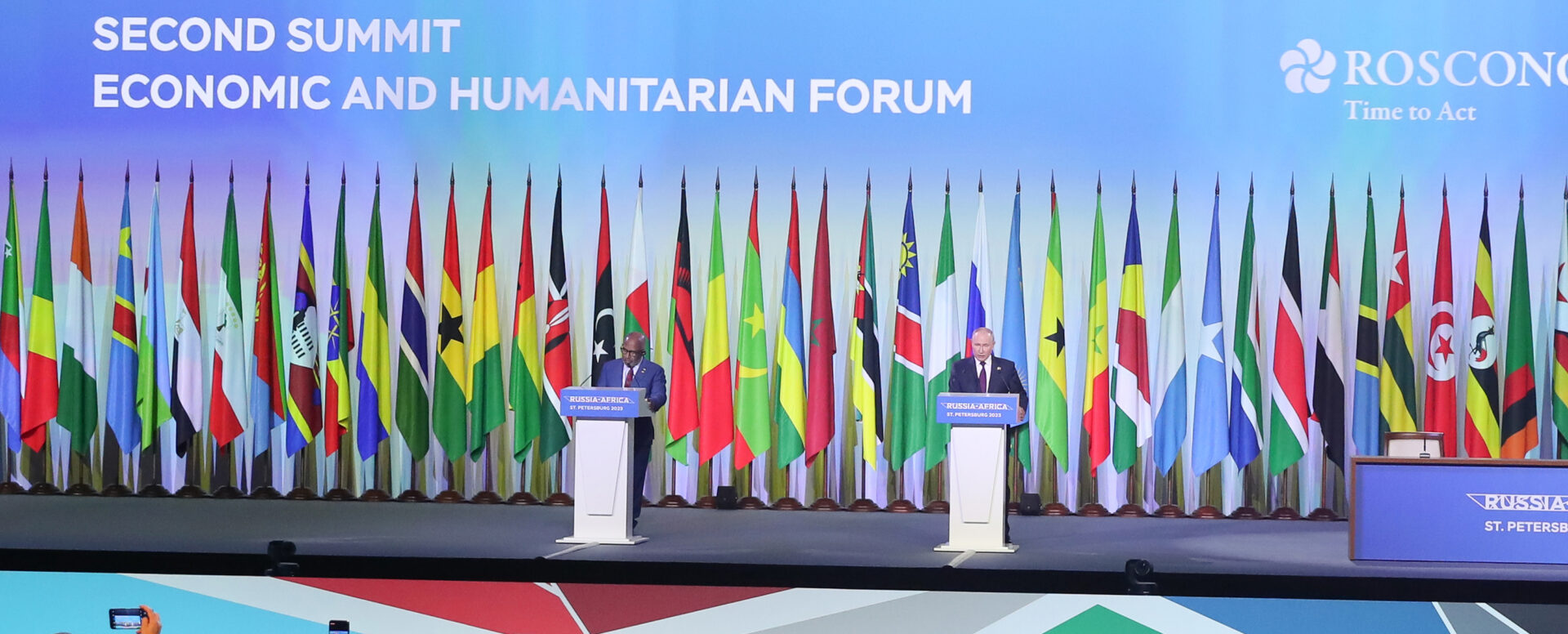
Header photo: Press statements by Vladimir Putin and Chairperson of the African Union, President of the Union of Comoros Azali Assouman, at the 2023 Russia–Africa Summit in St. Petersburg. 28.07.2023. Anatoliy Medved/RosCongress Photo Bank