



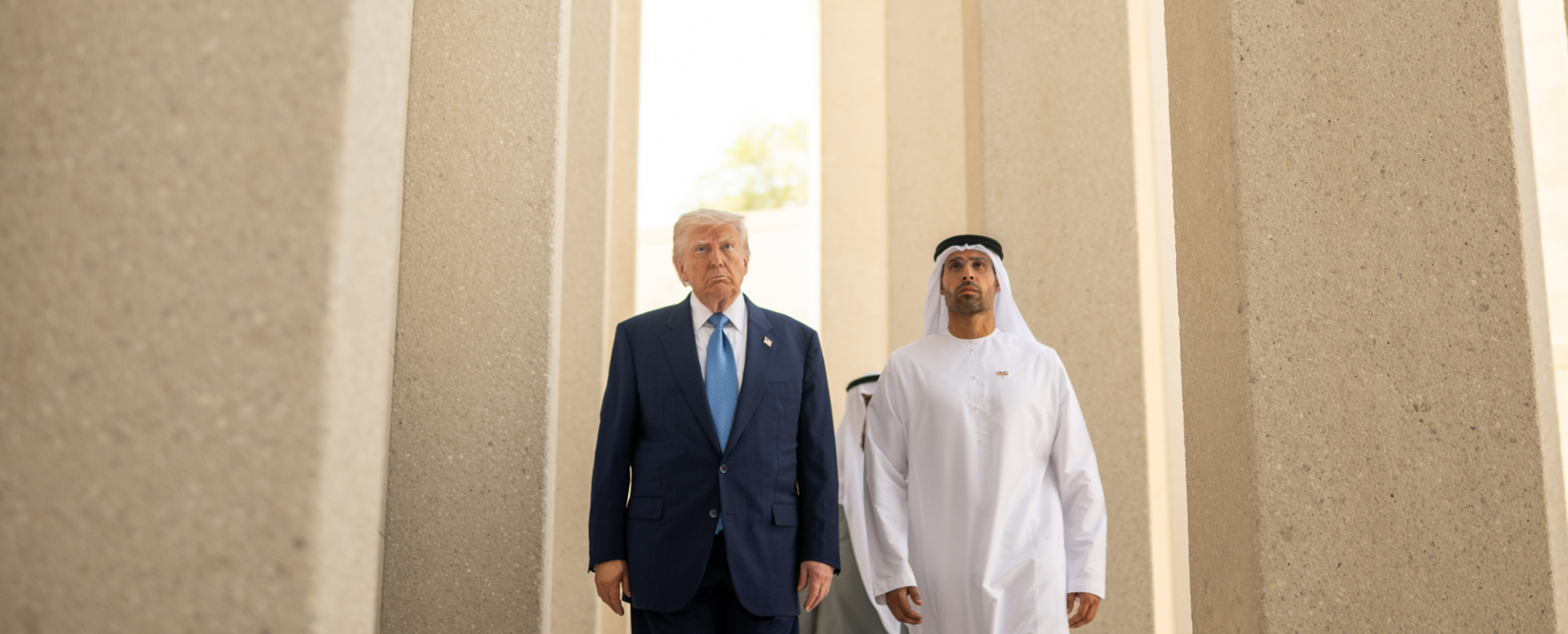
President Trump campaigned in 2024 for his second term in office by promising no more wars or nation-building ambitions in the Middle East, and a quick end to the Gaza war. He signaled that the Middle East would not be of paramount importance to his America First agenda, or to his role as a statesman and peacemaker. Yet his first overseas travel was to the Middle East: a four-day visit in mid-May, 2025, to three wealthy monarchies in the Gulf, and his assertion that he would end the war in Gaza quickly ran into the political headwinds of the century-long struggle over Palestine. His interest in Iran was hard to pin down, from restoring the “maximum pressure” campaign of his first term, to offering peace talks, and then, in June, joining Israel’s military campaign to set back Iran’s nuclear program with a one day demonstration of American military prowess. The short war between Israel and Iran could still lead to greater regional instability, or an opportunity for more proactive American diplomacy. .
This article first considers President Trump’s views of America’s role in the world, and then considers where the Middle East fits into his overall national security strategy, and his promotion of American economic interests as part of his America First agenda. It will assess the president’s priorities among regional states, his peacemaking efforts, and the consequences of dismantling other tools of American power, from security cooperation to foreign assistance and other soft power activities…
Does President Trump Have a Clear Strategy for American Leadership in the World?
President Trump does not fit easily into established concepts and theories of international relations. Is he a hard-nosed realist comfortable in a world of great power competition? An isolationist whose priorities are restructuring American society and institutions? An advocate of restraint who seeks to avoid military engagements that do not produce desired political outcomes? He clearly believes in American power and the deterrent effect of the world’s largest and most capable armed forces. He also believes that his involvement in world affairs and international crises can be a force for peace; it has become conventional thinking to ascribe the President’s various peace initiatives to his deep desire to be acknowledged as a Nobel Prize-worthy statesman. In his May speech in Riyadh, he extolled the American Armed Forces but said “We have the best weapons in the world, but we don’t want to use them.” [1]
His America First agenda signals a desire for the US to be less involved in chronic and unresolvable crises around the world, reflecting his deeply held view that the US has been too generous to other countries, and that international relations should be based on fair and equitable trade and investment, not on American largesse that has promoted the prosperity of others at the US’ expense. He shows a strong preference for rich countries, powerful and non-democratic leaders, and has very limited interest in the have-nots of the world, or in the virtues and salutary effects of soft power on advancing American interests across the globe.
It is important to note that his highly personalized approach to power, in international relations as well as domestic affairs, has already, in a few short months, had a significant impact on American institutions and global perceptions of the United States. His fearlessness in promoting unfettered executive power has brought the United States to the brink of a constitutional crisis. The legislative branch is already under his control by virtue of Republican majorities in both the Senate and the House, at least until the midterm elections in 2026, when the party out of power has historically regained at least one of the legislative chambers. The drama is playing out in the judicial branch, and legal experts see the fundamental checks and balances built into the US Constitution being compromised in multiple ways. Cases pending before the Supreme Court (where conservatives have a comfortable majority) will determine if the trend towards favouring unlimited presidential authorities prevails, thus calling into question the system the Founding Fathers put in place 250 years ago and the state of American democracy.
End of the post–1945 Legacy of American leadership?
It is ironic that President Trump shows disdain for the deeply held belief by virtually all of his predecessors since 1945 that American leadership in the world has accrued great benefit to the United States. The notion that US support for the prosperity and security of other nations is good for the US seems alien to him, yet his power on the world stage derives directly from that 80-year legacy of American leadership. The success of capitalism and globalization, the reliance on the US dollar, the effectiveness of American military prowess in preventing great power wars – all dimensions of the world that the US and others created in the middle of the 20th century – have given Donald Trump the stage on which he declares his disruptive agenda, upending diplomatic and financial policies and norms that have governed international relations in the modern era. He thinks the US should seek its own political and economic advantages in the permanently competitive world of international politics. He may be drawn to the spheres of influence concept, with American primacy mostly focused on the western hemisphere, breaking free of historic bonds to Europe, and accepting parallel roles for Russia in Eurasia, and China in its Asian neighbourhood, but he has not formally embraced that formulation of great power geopolitics.
Yet the hard-nosed realist paradigm is not entirely sufficient to explain President Trump’s current priorities in foreign policy. He seeks to avoid entanglements in conflicts old and new and believes his personal power as a successful dealmaker should bring the two major extant conflicts – Russia/Ukraine and Israel/Gaza – to a quick conclusion. By late spring 2025, it has become clear that neither the leaders of Russia or Israel are receptive to his quick fixes or coercive tactics. They have dug themselves into wars that are not likely to achieve their military or political objectives, but have become essential to the survival of both regimes. Despite Trump’s friendships with both Vladimir Putin and Benjamin Netanyahu, Trump’s peacemaking ambitions have been thwarted by the personal political interests of the two leaders.
Geopolitical Competition in the Middle East: An Emerging Problem
Largely absent from the public discourse on the Middle East in Washington is concern about growing Russian and Chinese interest in the region, and the way in which US retrenchment could reap windfalls for those two geopolitical competitors. In the 2020 presidential campaign, the Biden team confidently asserted that the Middle East was not an arena for great power rivalry, comfortable that the key regional players were highly dependent on the US as security guarantor. Once in office, however, they confronted growing evidence that America’s closest partners in the region sought to avoid committing to US primacy in their foreign policies, preferring to balance their ties to Washington and Beijing.
There is concern about growing Russian
and Chinese interest in the region, and
the way in which US retrenchment
could reap windfalls for those two
geopolitical competitors
Beijing, for its part, insists it has no ambition to replace the US in the region, but sees its strength in energy, trade and a judgment-free approach to the politics of the region. The Saudis in particular, while seeking a deeper security pact with Washington, make clear that Washington cannot have a veto over growing Saudi-China ties, presenting real challenges to the US national security system that has strict rules about blocking Chinese access to US technology and preventing security actors’ reliance on Chinese technology.
Russia is less threatening to the US as an actor in the Middle East due in part to the demise of the Assad regime and the disruption of Iran’s influence there. Given Trump’s desire for a more normal relationship with Moscow, he may not object to Russia’s efforts to maintain access to Syrian ports, or to restore or develop new projects with Libya, Egypt or other states around the Mediterranean. But Russia’s calculation may indeed be based on a reduced American role in the region, enabling the other great powers to deepen their presence.
President Trump Recalibrates US Interests and Engagement in the Middle East
Trump 1.0 – 2017-2021
In his first term, President Trump looked for ways to reduce the American footprint in the Middle East and end the “forever wars” that began after the 9/11 attacks on the United States by al-Qaeda. It was Trump who tasked his team to negotiate with the Taliban (not the recognized government in Kabul) to secure the safe withdrawal of American troops, with vague language that did not really bind the Taliban to a process of reconciliation with other parties. There were echoes of “peace with honour” that Henry Kissinger negotiated to end the war in Vietnam, without declaring that the US and its feckless ally had lost the war. It was President Biden who had the unenviable task of implementing Trump’s agreement in 2021.
President Trump enjoyed friendly relations with some of the regional leaders and the pomp and gilded glamour of his trips to the Gulf. He had not yet demonstrated his intention to dismantle the institutional bases of American presence and programming in the region, particularly to Egypt and Jordan, long standing recipients of American security and economic assistance, based on commitments made during their respective peace treaties with Israel in 1981 and 1994. His major achievement was the Abraham Accords, a series of bilateral normalization agreements between Israel and four regional states: United Arab Emirates, Bahrain, Morocco and Sudan.
The Abraham Accords emerged from the failure to achieve a settlement in the Israel-Palestine crisis. Trump’s son-in-law Jared Kushner spent months trying to convince the Palestinians and their Arab supporters to accept a plan that largely favoured Israel’s security requirements in the West Bank and Gaza Strip and did little to strengthen Palestinian institutions or commit to a clear path to two states. In fact, Kushner had achieved an easier rapport with the wealthy Gulf leaders, who sought security and financial benefits in normalization with Israel. Looking back, the main achievement of the Abraham Accords is the Jerusalem-Abu Dhabi connection, which has not been completely derailed despite the aftershocks of 7 October and now includes intelligence, tourism and military industrial cooperation. The UAE has not disguised its support for Israel’s was against Hamas, the ideology of which is anathema to the regime in Abu Dhabi. The other countries struck bargains with Washington that do not really commit the parties to deep engagement with Israel: Morocco sought and won US endorsement of its position that the Western Sahara is sovereign Moroccan territory, and Sudan, before it became paralyzed by civil war, sought Israeli help in agriculture and managing Ethiopia’s and Egypt’s irreconcilable positions on the huge dam project in Ethiopia, which will have profound effects on downstream countries.
The Abraham Accords can still be seen as a genuine foreign policy achievement, building on the logic established during the Carter administration and its successors, namely that true peace and stability in the region will require an acceptance by all states of each other’s legitimacy and sovereignty. Supporting the full integration of Israel in its neighbourhood has long been an American objective , and including Israel in the US Central Command area of responsibility is a clear demonstration of the progress that has been made in some forms of Israel-Arab cooperation. Critics point out, however, that full acceptance of Israel without equivalent efforts to achieve Palestinian self-determination, will fall short of creating a durable peace in the region. The ultimate prize will be normalization between Israel and Saudi Arabia, which appears to be on hold precisely because of the devastating effects of the war in Gaza on any prospects for a Palestinian path to statehood.
Trump 2.0 – 2025-2029
In the second term, there is more clarity about how to implement a serious retrenchment from the region. The President sees no virtue (or direct benefit to the US) in enduring commitments to economic development, democratization educational exchanges, and good governance, which have been hallmarks of American engagement in the region for decades. The abrupt and legally questionable closing of the US Agency for International Development has severe consequences for the less wealthy states of the region.[2] As the foreign assistance function is being reconfigured at the State Department, it appears that the legacy programmes in Egypt, Israel and Jordan will be protected, and Jordan may become the regional hub from which US aid activities in region, albeit severely reduced, are managed. Nonetheless, one can anticipate some losses of American influence in countries where aid programmes provided a platform for the US to engage with governments and civil society on shared interests in development and governance.
The President declared an end to moral
preaching or concerns about human rights.
Instead, he favours rich countries with strong
leaders, and states that have important economic assets
The President tends to look at countries and leaders in very concrete terms, rather than the mix of idealism and pragmatism that has characterized historic approaches to the Middle East, or from an institutional lens that favours regional cooperation in the security domain. His Riyadh speech underscored his disdain for liberal or neoconservative nation building and the “freedom agenda” of President George W. Bush. He declared an end to moral preaching or concerns about human rights. Instead, he favours rich countries with strong leaders, and states that have important economic assets that might lend themselves to mutually beneficial economic transactions.
By these metrics, one can assert that the major powers of the region of greatest interest to the President are: Saudi Arabia, Turkey and Israel. Each is increasingly playing a role in setting the regional agenda, whether or not that agenda aligns with traditional American interests. Instead, they win the President’s respect by using their own capabilities to manage the region’s problems, from Turkey’s prominent role in post-Assad Syria, to Israel’s tactical success in reducing the capabilities of Iran-backed terrorist groups and Saudi efforts to avoid conflict escalation with Iran. Each of these examples contains contradictions and complexities, at least from the earlier paradigm of the American role as security provider and conflict manager in the region. Another layer of complexity is how these three states interact. Omar Taspinar sees a growing convergence between Turkey and Saudi Arabia, despite historic antipathies. They may be able to work productively to help Syria stabilize, and to insist on progress on Palestine once the Gaza war ends. Iran is another arena of alignment, both seeking to prevent any military attack on Iran’s nuclear facilities. Israel is likely to remain the “odd man out”, given its poor relations with Turkey and Saudi, resistance to normalization, and the absence of progress on Palestine[1].
Saudi Arabia and the Gulf Monarchies: A New Take on Shared Values?
The wealthy Gulf states rank highest for the President, with potential trade and investment deals in energy and critical minerals, and opportunities for joint ventures for the Trump family’s financial interests and their counterparts in the Gulf royal families. These relationships are about long-term family dynastic cooperation that could well endure beyond his time in elected office. This is a dramatic swing from policies that sought to isolate Saudi Arabia for gross human rights abuses, namely the brutal murder of Saudi journalist Jamal Khashoggi, and to avoid any perception of corrupt practices or conflicts of interest in the large-scale government contracts for arms sales and other investments in the Kingdom.
It is clear that the President genuinely enjoys the culture of the Gulf monarchies, and sees Saudi Crown Prince Mohammed bin Salman as a forward-looking, effective leader. He admires the Saudi Vision 2030 plan and is eager to build business ties with the Gulf royal families that will endure for his family. The arrangements made to acquire the Qatar luxury aircraft to serve as Air Force One, and later, as property of a Trump Foundation, are a source of bipartisan dismay and pose ethical dilemmas that have been dismissed by the Defence Department, which took possession of the plane in May. The relationship with the United Arab Emirates is also robust, devoid of any expectations of political liberalization,
The President’s visit to Riyadh moved forward a number of ambitious projects and investment plans in defence, energy and infrastructure. Saudi Arabia has long sought US support for a civil nuclear energy programme, but resists the formal requirements to ensure that enrichment activities cannot be diverted for weaponization purposes. It is not clear if the administration provided any assurances on that front, but they did clarify that US support for nuclear energy reactors would no longer be tied to a trilateral process leading to Saudi-Israel normalization. The Saudis also pledged to invest in major AI (artificial intelligence) data centres and related infrastructure requirements, in sales of key minerals to the US and in expanding and deepening defence cooperation.
Turkey: Another Trump Bromance?
The President sees Turkey as a useful partner whose leader is a strongman with geopolitical assets. President Erdogan has shaped Trump’s approach to Syria, facilitating Trump’s encounter with Syrian leader Ahmed al-Sharaa and the decision to lift US sanctions.
In recent years, there have been tensions between the US military forces operating in eastern Syria in support of the Syrian Kurds and the anti-Islamic State campaign, and Turkish anxieties about implied US support for Kurdish rights, comparable to the political status of Kurds in Iraq. But after the fall of the Assad regime, Turkey has stepped in to protect its interests and is supporting the new interim government led by former Islamic extremist Ahmed al-Sharaa. During his trip to the Gulf, President Trump endorsed the Turkish role in Syria and began to align American policies with Turkey’s. Lifting sanctions, opening an Embassy in Damascus, removing the US troops that have been working with the Syrian Kurdish forces against the Islamic State, all suggest that Trump sees significant benefit in letting Turkey take the lead in this key country in transition. Another sign that Trump has outsourced Syria policy to Erdogan is naming the US Ambassador to Turkey, Thomas Barrack, as Special Envoy to Syria, thus ensuring close coordination with Ankara as the US restores relations with Syria.
Israel: Tactical Differences or a Deeper Shift?
Israel is a more complicated case, with its legacy as the most trusted US security partner in the region, as well as its status as a privileged political actor with strong support from ethnic, religious and national security constituencies in the US. But that deep relationship has been under considerable stress in the first months of the new administration. President Trump has met with Prime Minister Benjamin Netanyahu twice, in February and April, and, on both occasions, faced the press in the Oval Office with declarations that were a surprise to the Israeli leader. The President seems to relish asserting primacy, reminding Israel that US and Israeli interests are not perfectly aligned.
In February, the President startled his visitor with his desire to relocate the two million Palestinians in Gaza so that American companies could come in and reconstruct the area with luxury hotels and resorts, quickly dubbed Gaz-a-Largo. It was beyond what Netanyahu had envisioned, and he seemed to grasp that the displacement of the entire population, even if his far-right allies in government would rejoice, would be highly problematic.
By April, Trump had staked out several positions that were directly in conflict with Israel’s declared preferences: dealing directly with Hamas to secure the release of the only living dual national (US and Israeli) hostage; negotiating with the Houthis to end attacks on US commercial shipping, leaving Israel to deal with the Houthis on their own; recognizing the new government in Syria and lifting US sanctions, despite Israeli insistence that Syria remains a threat to regional stability; and, most significantly, opening talks with Iran over its nuclear programme and declaring a desire to avoid a military confrontation, placing the US directly at odds with Israel’s plans for military action.
Many national security professionals and conservatives who are part of Trump’s world remain supportive of Israel’s military campaigns against Hamas and Hezbollah. They see Israel’s fierce efforts against these groups as beneficial to US interests, with the potential to seriously weaken Iran’s influence and improve overall security in the region. The American public, however, has a different view. According to the latest Pew Research data, 53% of Americans now hold unfavourable views of Israel, compared to 42% in March 2022. And there is ample evidence that failures to address Palestinian suffering and to use US leverage effectively on Israel have rallied many Americans, not only citizens with ties to the region, to protest the policies of both the Biden and Trump administrations.
Where does President Trump stand? One can surmise that he is comfortable sustaining a strong US-Israel security partnership, including in intelligence sharing and arms sales. He has not made relief for the Palestinians a priority and may have concluded that the US should defer to Israel and Arab states to deal with the tragic consequences of the war. But he has been bruised by the many setbacks in negotiations over a ceasefire and return of hostages. Netanyahu’s defiance of the President’s commitment to a ceasefire has surely influenced the latter’s view of the relationship. Netanyahu’s occasional references to a new doctrine of permanent war, rather than managing its cross-border conflicts with limited force, must be worrisome to the US administration. Israel’s predatory action against Syria and Lebanon is also at odds with the administration’s policies towards both those states. And the President has demonstrated very limited interest in the catastrophic failure to provide humanitarian aid to Gaza,
Another strange dimension to the US-Israeli relationship at present is the weaponization of antisemitism as a tool to attack elite institutions and provide a pretext for deporting international students who express pro-Palestinian views. It is not in dispute that acts of antisemitic violence are on the rise, but, in the cases of Harvard and Columbia Universities, they are exaggerated. Harvard law professor Noah Feldman defends the First Amendment right to express opposition to Israeli policies, even including questioning the legitimacy of the Jewish State, but agrees that elite institutions need to rethink questions of campus safety and appropriate penalties for those whose political views veer towards denying rights to others or to threats of violence.
Part of Trump’s support base comes from white evangelical Christians, who form 27% of the electorate, and are passionate supporters of Israel. At the same time, the MAGA (Make America Great) movement includes openly antisemitic activists, white supremacists and others, including the President, who express historic tropes about Jewish power and influence in Western societies.
Iran: Diplomatic Opportunity or Chronic Source of Tension?
To the surprise of many, President Trump announced his willingness to engage in direct talks with Iran over its nuclear programme in April. Having withdrawn the United States from the JCPOA (Joint Comprehensive Plan of Action) in 2018, Trump has taken a hard stand against Iran for its nuclear and other regional activities. The strategy of his first term – maximum pressure – was widely seen by nonproliferation experts as a failure, since Iran actually increased the quantity and quality of its enrichment and was less cooperative with the International Atomic Energy Agency.
Returning to office in 2025, Trump revised the maximum pressure policy, insisted the US will not tolerate a nuclear-capable Iran, and hinted at the use of military force if necessary to prevent Iran from crossing the nuclear threshold. Yet in April he wrote to the Supreme Leader, and the first talks began in Oman, led by trusted Trump advisor Steve Witkoff and Iranian Foreign Minister and former nuclear negotiator Abbas Araghchi. The parties continued to meet and exchange drafts. The main sticking point appeared to be whether Iran would be permitted to maintain its enrichment capabilities; some compromise suggestions include a temporary waiver on enrichment, with a path to exporting any remaining enriched material, or to relying on third parties to provide for Iranian peaceful nuclear energy requirements.
June 2025 – War between Israel and Iran, and the US
Slow progress on a bilateral US-Iran deal provided part of the pretext for Israel’s decision to launch war with Iran to destroy or at least set back its nuclear program on June 13. Of course, Israel’s Prime Minister had passionately advocated military action for over a decade, but seemed to hesitate over uncertainty about the American response. For twelve nights, Israel and Iran fired hundreds of missiles at both strategic and civilian targets at each other. The Trump administration initially denied any prior knowledge or approval, and there is some evidence to suggest that President Trump was hoping to avoid such an event, risking a wider regional crisis that would draw the United States in. Israel’s military success, including its control of Iran’s airspace and its infiltration of key Iranian institutions, seemed to persuade the Administration that airstrikes with US “bunker busters” could bring the war to a quick conclusion, and would associate the US with the successful destruction of Iran’s nuclear capabilities. The US military has long planned for such a contingency, and for the president, selective use of American firepower that does not entail risky ground operations would still be compatible with his desire to demonstrate force while avoiding open-ended entanglements. As of July, the fighting has stopped, bomb damage assessments do not prove “obliteration,” and Iran may still be open to diplomacy, but not on terms that convey surrender or defeat.
Conclusion
President Trump’s approach to the Middle East has been a dizzying set of initiatives that have broken some long-standing norms and assumptions about US interests in the region, but have also entailed an unprecedented use of military force against Iran. At one level, he genuinely wants to reduce American obligations and sees little benefit to the US in promoting values and using soft power to win friends and influence. He finds only a few regional leaders as worthy of his time and attention and is content to defer to the leadership of Turkey, Saudi Arabia and Israel on regional problems. His decision to join Israel’s military campaign to disable Iran’s nuclear program may appear to be at odds with his objectives, but his team hopes that the high-stakes gamble will create diplomatic opportunities. Others would caution that radical transformation of the region is never a linear process, and Trump may find it hard to escape the long and often tragic story of America and the Middle East.
[1] www.whitehouse.gov/articles/2025/05/in-riyadh-president-trump-charts-the-course-for-a-prosperous-future-in-the-middle-east/.
[2] Alajlouni, Laith “Effects of US Foreign Assistance Reductions in the Middle East.” www.iiss.org/online-analysis/online-analysis/2025/03/effects-of-us-foreign-assistance-reductions-in-the-middle-east/.
Header Photo: President Donald Trump tours the Abrahamic Family House, Friday May 16, 2025, in Abu Dhabi, United Arab Emirates. (Official White House Photo by Daniel Torok) “P20250516DT-0781” by The White House, United States Government Work
