


For decades, most Middle East analysts and scholars had held strong assumptions on the region’s strategic landscape. One assumption was that Iran and Israel would continue engaged in a “shadow war” without crossing the line into a direct military confrontation. Another assumption was that Israel would not dare to attack Lebanon, given Hezbollah’s huge missile arsenal. A third assumption was that President Assad had won the civil war and was accepted by his fellow Arab leaders. For better or for worse, these three assumptions and many more have been proven wrong. Developments since October 2023 underscore the complexity of the Middle East region.
The Assad family ruled Syria for more than five decades (Hafez al-Assad 1971-2000 and Bashar al-Assad 2000-2024). Under the Assad family, Syria was considered a key player in the Arab-Israeli conflict and the most important ally Iran had in the Arab world. Damascus also had complicated relations with Ankara, which significantly deteriorated since the civil war started in 2011. The fall of President Assad is widely seen as a major setback for Iran, a huge victory for Turkey and a mixed bag for Israel. The three non-Arab Middle Eastern powers have already taken major steps to articulate a long-term strategy for the broader Middle East, in response to the change of government in Damascus.
Iran and post-Assad Syria
Iranian military strategists, like their counterparts in other countries, develop their defence policies based on their own perception of Iran’s geography and the lessons they have learned from recent wars in the Middle East and elsewhere. Being a Shiite-Persian nation, Iran is a minority in its neighbourhood. It is surrounded by the United States and its allies (Israel and Sunni/Arab countries), who enjoy massive military and economic resources. Within this context, Tehran’s defence strategy is based on two fundamental intertwined notions – asymmetrical warfare and its forward defence doctrine. This combination explains the key role Syria and Hezbollah (and other non-state regional actors) play in Iran’s national security.
One of the main strategic advantages Iran enjoys is its ability to build partnerships with states and non-state actors in its neighbourhood. Hezbollah was established in 1982 after Israel invaded Lebanon and has since proven to be Israel’s strongest military foe, able to engage Israel in a costly 34-day war in 2006. Iran has always viewed Hezbollah as its most trusted and effective ally, and, since the early 2000s, the Lebanese organization has played a growing role in shaping Iran’s regional policy. The relationship between the two sides is better described as a partnership than a client-proxy one.
Under Assad rule, Syria played a key role in ensuring Iran’s continued supply of arms to Hezbollah. The strong ties between Tehran and Damascus were initially driven in the early 1980s by their shared animosity of Iraq’s Saddam Hussein, Hafez al-Assad being the only Arab leader to support Iran in its war against Iraq. Over the years, this tactical relationship has evolved into a strategic alliance. Iran’s strong support for the Assad regime was both costly and controversial. Although there is no accurate assessment of the cost of Iranian intervention in Syria, Tehran undoubtedly diverted a considerable amount of badly needed resources from domestic development to the war in Syria. Furthermore, several senior Iranian military officers have been assassinated in Syria. Finally, Tehran’s support to the brutal Assad regime alienated many people in the Arab world, Turkey and elsewhere.
Israeli attacks on Hezbollah and the direct
confrontation with Iran have dealt a heavy
blow to their military assets and capabilities,
and neither Iran nor Hezbollah had the means
to protect the Assad regime
The close alliance between Iran and the Assad regime had faced several serious challenges since the early 2020s, and particularly since October 2023. Rather than share ideological or sectarian bonds, their relationship was shaped and driven by diverging interests and calculations. First, with an eye to potential Arab investment that could revive the Syrian economy, President Assad started to act independently from Iran, and the Syrian government restricted Iran’s religious and military activities. Second, unlike other members in the axis of resistance, like the Iraqi Shiite organizations, the Houthis in Yemen and Hezbollah in Lebanon, Syria under President Assad refused to attack Israel in support of Hamas. Third, Iranian officials became increasingly concerned about the low morality of the Syrian army and lack of support for the government. Shortly after President Assad escaped to Moscow, Iran’s top-ranking general in Syria, Behrouz Esbati, stated that the fall of the Assad regime was inevitable given the rampant corruption, political oppression and economic hardship that people faced. President Assad, General Esbati claimed, refused to contemplate reforms, despite the warnings. In the critical hours before President Assad left, Tehran concluded that it could not do the Syrian army’s job; the Assad regime was collapsing from the inside, and no foreign intervention could save it. Fourth, Israeli attacks on Hezbollah and the direct confrontation with Iran have dealt a heavy blow to their military assets and capabilities, and neither Iran nor Hezbollah had the means to protect the Assad regime.
Interestingly, Iran and the Trump administration share a similar explanation for the Assad regime’s downfall. President Trump stated that Syria was the victim of an “unfriendly” takeover by Turkey. Ayatollah Khamenei echoed these sentiments arguing that a neighbouring state of Syria played a key role in Assad’s undoing. Iranian officials have been warning the new government in Damascus that it cannot build its legitimacy by relying on Turkish intervention and support. Additionally, the Iranians have warned their Turkish counterparts that Syria is a quagmire and Ankara will pay a heavy political, military and economic price for its intervention.
Despite the ousting of President Assad, it is too early to conclude that Iran will not have any presence or leverage in the Syria that emerges. Iran has called for a national dialogue to establish an inclusive Syrian government and vowed to spare no effort in helping to ensure security and stability in Syria. Iran managed to establish ties with the Taliban after it took over in Afghanistan; perhaps it will take a similar course of action with the Sunni-led government in Damascus, leveraging the anti-Israel and pro-Palestine sentiments among the Syrian population. Additionally, Tehran has long enjoyed close ties with the Syrian Alawites and Kurds. The future role of Iran in Syria depends on: a) Developments inside the country, i.e. whether or not sectarian and ethnic minorities will be represented in the political system and how the new government in Damascus will be able to address the mounting social and economic challenges. According to a recent United Nations report, “50 percent of the country’s infrastructure has been destroyed or rendered dysfunctional and 75 percent of the population depends on some form of humanitarian aid.”[1] And b) How Israel and Turkey will play their hands in shaping post-Assad Syria. A Syrian/Arab backlash against assertive Israeli and/or Turkish intervention cannot be ruled out. President Ahmad al-Sharaa seeks to establish close ties with Turkey and has repeatedly stated his desire to avoid confrontation with Israel.
Turkey’s post-Assad Syria Policy
Political geography has played a key role in shaping Ankara’s interests and strategy towards Syria. The two neighbours share their longest land borders (approximately 900 km). The large Kurdish minorities are mainly located on both sides of these long borders. For decades, the Turkish government has utilized diplomatic and military means to reach an agreement with the Kurdistan Workers’ Party (PKK), established in 1978 with the goal of creating a unified and independent Kurdistan. In early 2025, Abdullah Ocalan, the jailed PKK leader, called on his followers to lay down arms. This was an important step to end the military confrontation between the Turkish government and the PKK, but the two sides have a long way to go before they iron out all the details. The PKK is designated as a terrorist organization by Turkey, the United States, the European Union and other countries. Ankara has always accused the PKK of having strong ties with and receiving support from the Kurds in Syria (and in Iraq).
Within this context, President Erdogan had good relations with President Assad throughout most of the decade prior to the Arab Spring. In 2004, Assad travelled to Ankara on the first official visit to the country by a Syrian president, and the two presidents’ families vacationed together on the Turkish coast. These warm relations came to an end in 2011 with the broad-based public protest against the Assad regime and the brutal approach adopted by the Syrian President. Assad’s refusal to engage in peaceful negotiation with his opponents and his insistence on using harsh repression forced millions of Syrians to cross the borders into Turkey (more than 3 million refugees). Confronted with these two serious challenges (the Kurds and refugees), Turkish forces occupied parts of northern Syria, established a buffer zone and created the Syrian National Army (SNA). Also, Turkey, along with Iran and Russia, founded the Astana Process, launched in January 2017 to build a consensus on ending the civil war.
The end of the Assad regime
has been widely seen as a clear
victory for Turkey,
and a loss for Iran (and Russia)
Prior to Assad’s fall, President Erdogan had considered holding a meeting with Assad and resuming relations between the two countries. Assad, however, still refused to negotiate with his opponents. There is no evidence that Ankara was involved in any way in the collapse of the Assad regime. But the Turkish government has had good relations with Hayat Tahrir al-Sham (HTS) and it wasted no time in engaging with the new Syrian government. Foreign Minister Hakan Fidan and intelligence chief Ibrahim Kalin were the first foreign leaders to visit Damascus only a few weeks after Assad left. A few weeks later, Ahmad al-Sharaa visited Ankara and met with President Erdogan. Turkey also opened its embassy in Damascus, which it closed in 2012.
The end of the Assad regime has been widely seen as a clear victory for Turkey, and a loss for Iran (and Russia). The agreement between HTS and the Kurdish militia, the Syrian Democratic Forces (SDF), will further help Ankara’s efforts to end the confrontation with the PKK. Furthermore, restoring peace and security in Syria will pave the road for the return of the millions of refugees. Turkish companies can take advantage of the warm relations between Ankara and Damascus and lead the construction efforts and the process of rebuilding the economy. Finally, Turkey has been excluded from regional powers’ efforts to develop natural gas deposits in the eastern Mediterranean, led by Egypt and Israel. Turkey can work with the new government in Syria (and in Lebanon) to accelerate offshore oil and gas exploration and development. Turkey’s ability to pursue these objectives and to stabilize Syria depends, to a great extent, on the policies of another major regional power – Israel.
Israel’s post-Assad Syria Policy
Like other players, Israel’s objectives and policies in Syria have evolved since the beginning of the civil war in 2011. One could argue that Israel, like other countries, does not wish to see instability on its doorstep. From the Israeli perspective, the situation in Syria before 2011 was not bad. President Assad had proved to be both predictable and deterrable. The borders between the two countries had been quiet for more than three decades, with no violations of the 1974 ceasefire agreement. Furthermore, both Assads had sought (unsuccessfully) to negotiate a peace agreement with Israel. In March 2000, President Bill Clinton met with President Hafez al-Assad in Geneva and presented proposals from the Israeli Prime Minister Ehud Barak. Eight years later (2008), President Bashar al-Assad exchanged messages with Israeli Prime Minister Ehud Olmert, with Recep Erdogan, then Turkey’s Prime Minister, serving as mediator. In 2010, one year before the civil war broke out, Assad called for the resumption of peace talks with Israel. In short, the Assad regime kept the borders quiet and was open to negotiations.
The Syrian war and the prominent role Iran, Hezbollah and other Shiite groups played in supporting President Assad changed Israel’s strategic calculation and presented a number of unfavourable options: victory for either the Sunni extremist groups or Assad and his Iranian allies spelled bad news for Israel. This complicated strategic landscape compelled Israel to avoid taking sides. Israeli intervention in the Syrian war was limited to strikes on Iran’s routes for supplying weapons to Hezbollah. The main objective is still to prevent the establishment of a territorial corridor, controlled by Iran and its allies, stretching through Iraq into Syria and Lebanon. Such a corridor would be seen as an existential threat.
The wars in Gaza and Lebanon changed Israel’s calculations and strategy in Syria. In support of Hamas and to relieve some of Israel’s military pressure, Hezbollah started bombing northern Israel, forcing tens of thousands of Israelis to leave their homes and move south. Furthermore, both Hezbollah and Iran boosted their presence and influence in Syria. Distracted by the war in Ukraine, Russia’s role in Syria waned significantly. Meanwhile, President Assad was re-admitted in the Arab League and many fellow Arab leaders started normalizing relations with him. President Assad controlled a big part of Syria and seemed on his way to winning the civil war. Israel responded to these developments by intensifying its military campaign against Hezbollah, both in Lebanon and Syria, as well as by bombing Iran’s military supplies and assets and assassinating top Iranian generals and Hezbollah leaders. In other words, Israel dealt a heavy blow to Iran and Hezbollah in Syria and, to a great extent, eliminated what it perceived as an existential threat.
The fall of the Assad regime again changed Israel’s strategic calculations and presented the Jewish State with both opportunities and challenges. The new government in Damascus, led by HTS, a Sunni movement, shows no tolerance to Iran and Hezbollah’s presence or influence. But, despite Ahmad al-Sharaa’s efforts to avoid confrontation with Israel, Prime Minister Netanyahu decided not to take a chance with HTS. Tel Aviv sees an Islamist-led government in Damascus backed by Ankara as an existential threat. In order to neutralize this threat, Israel destroyed almost all Syria’s military capabilities and assets, expanded its occupation of Syrian territory, demanded the complete demilitarization of areas south of Damascus and reached out to ethnic and sectarian minorities (i.e. the Kurds and Druze, among others). This Israeli policy has made it particularly hard for the government in Damascus to consolidate power, laying the groundwork for Syria’s fragmentation and increasing the odds of post-Assad Syria becoming a failed state.
Turkey and Israel seem to be on a collision course in Syria. Since October 2023, Israel has demonstrated its ability to fight on multiple fronts, simultaneously including Gaza, the West Bank, Lebanon, Yemen, Iran and Syria. This excessive reliance on military power and lack of strategic vision have fuelled resentment against Israel in the Arab world and beyond. Meanwhile, the expanding role of Turkey in Libya, Syria and other Arab countries raises fears of a resurrection of the Ottoman Empire or neo-Ottomanism. The Israeli and Turkish visions for Syria’s future seem to be mutually exclusive. The former wants to divide Syria along ethnic and sectarian lines and the latter is eager to build a strong ally with close economic, political and military ties to Ankara. It is yet to be seen how the Syrian people and the Arab world would react to this strategic rivalry between Tel Aviv and Ankara.
Iran at a Turning Point
Iran’s official Syria policy has been consistent for many years. Iranian officials have always maintained that any support they have given to Syria was in response to the request from the then legitimate government in Damascus. Iranians claim that whatever role they played in Syria was not meant to protect specific individuals, i.e. President Assad and his close associates, or a specific sect, i.e. the Alawites. Rather, it was to defend Syria’s territorial integrity and prevent its downfall at the hands of terrorist groups.
It is important neither to overestimate nor to underestimate Iran’s strategic impediment. There is no doubt that the fall of the Assad regime, along with the weakening of Hezbollah and Hamas, are major strategic setbacks to Iranian defence policy and its standing in the broader Middle East. It will take some time to figure out the shape and direction of the Syria that now emerges. Will the government in Damascus be able to fully control Syrian territory? Will the government be inclusive with representatives from all ethnic and sectarian minorities? How will global powers (i.e. the United States, Europe, China and Russia) react to developments in Syria? Both the European Union and the United States have lifted sanctions on Syria, but Brussels and Washington remain suspicious of Ahamad Al-Sharaa’s intentions. Finally, how will the Israeli-Turkish competition play out? All these dynamics will shape the emerging Syria and indeed the entire regional strategic landscape.
The nuclear programme is
by far the most important
challenge the two adversaries
and indeed the entire world face
Supreme Leader Ayatollah Ali Khamenei argues that resistance was not dead in Syria and stressed that the youth would reclaim their country. The Ayatollah stated that the “Resistance Front is not a piece of hardware that can be broken, dismantled or destroyed,” but rather it is a “doctrine” that will become stronger. Syria is an important puzzle in the complicated US-Iran confrontation. Other puzzles include Hezbollah, Hamas, the Shiite militias in Iraq and the Houthis in Yemen. These members of the so-called “axis of resistance” are not merely Iran’s proxies. They do not take orders from Tehran, but rather enjoy a level of autonomy, having become a key part of the social, economic and political fabric in their respective countries. They coordinate their policies with Tehran and with each other.
The nuclear programme is by far the most important challenge the two adversaries and indeed the entire world face. Iran has always maintained that its programme is entirely civilian, meant to generate nuclear power and with no intention of building nuclear weapons. On the other hand, the United States, and some other countries, have consistently accused Tehran of being less transparent about its intentions and capabilities. In March 2025, the US Intelligence Community concluded that “Iran is not building nuclear weapons and that Khamenei has not reauthorized the programme he suspended in 2003, though pressure has probably built on him to do so.”[2]
Despite this official assessment, President Trump withdrew from the nuclear deal/Joint Comprehensive Plan of Action (JCPOA) in 2018. Shortly after returning to the White House, Trump signed an executive order restoring his “maximum pressure” policy and threatened to take military action against Iran’s nuclear facilities. Not ruling out diplomacy, the President sent a letter to the Supreme Leader and the two nations agreed to resume negotiations. Reduced tensions and an understanding between Washington and Tehran would have a significant positive impact on stability in Syria, Iraq, Yemen, Lebanon and the rest of the Middle East.
Iran and Turkey share several similarities and major differences. Relations between the two nations have been less tense and occasionally warm since President Recep Erdogan and the Justice and Development Party (AKP) took office in 2002. The two neighbours share long borders and have extensive economic and trade relations. Both Iranian and Turkish leaders have repeatedly pledged to increase bilateral trade to $30 billion per year, but they still have a long way to go in order to reach this level. Natural gas and petroleum products constitute a big part of this volume of trade. After Russia, Iran is the second largest gas exporter to Turkey.
Faced with several regional crises in the last few decades, Tehran and Ankara have adopted different and sometimes conflicting policies. Both nations support the Palestinians, but Ankara has traditionally maintained economic and diplomatic ties with Israel. In the South Caucasus, Iran is officially neutral, but has close ties to Armenia. Turkey, however, has been a strong supporter of Azerbaijan. Turkey is a NATO member, while Iran sees the United States as its main global adversary. In Syria, Tehran and Ankara have played major opposing roles.
The Way forward
Iran’s foreign and security policies in the coming months and years will be largely determined by developments inside the country. This means how much the Iranian government is able to meet the economic expectations of its people and how stable the government in Tehran is. Obviously, economic prosperity and political stability are interconnected. Like many other countries, the Islamic Republic faces challenges and opportunities.
Iran holds some of the largest oil and natural gas reserves in the world. Its economy, like many other hydrocarbon exporters, depends heavily on oil revenues, an overdependency the government has been trying to reduce for decades. Ayatollah Khamenei has long called for strengthening the “resistance economy.” To be sure, the Iranian economy is more diversified than some of its neighbours, but it still has a long way to go, and oil revenues account for a large share of public income, rendering Iran vulnerable to economic sanctions. Economic indicators show a mixed performance. On the one hand, GDP growth in the first two decades of the 21st century was 3% and in 2024 it was 3.7%.[3] Moreover, despite mounting budgetary challenges, the authorities have largely avoided foreign debt. On the other hand, inflation and unemployment rates (particularly among youth and recent graduates) are high. Private sector and foreign investment do not play key roles in the economy due to decades-long sanctions. In order to mitigate the impact of Western sanctions, Iran has sought to expand economic, financial and trade ties with Russia, China and neighbouring countries. The rate of economic growth in the coming years will depend to a great extent on genuine economic reform, lifting economic sanctions and the country’s full integration in the global economy.
There is no doubt that Iran has experienced
key strategic setbacks since October 2023.
Still, it is important not to grossly
underestimate its ability to retaliate
and destabilize the entire Middle East
A sound economic performance would undoubtedly consolidate the government’s legitimacy. Iranian leaders have seen how corruption and the lack of any meaningful reform have led to the Assad regime’s downfall in Syria, concluding that there is an urgent need to build internal resilience and strengthen the bonds between the Iranian people and the government. Having strong public support would put the government in a better negotiating position with its adversaries.
Israel’s wars in Gaza and Lebanon and the fall of President Assad have led many analysts and policymakers to conclude that Iran is at its weakest and most vulnerable point in decades. Based on these assumptions, the United States and some European powers are seeking major concessions from Tehran on its nuclear programme, defence capabilities and regional policy. There is no doubt that Iran has experienced key strategic setbacks since October 2023. Still, it is important not to grossly underestimate its ability to retaliate and destabilize the entire Middle East. Iran’s military capabilities have been weakened but not destroyed. In March, Qatar’s Prime Minister warned that an attack on Iran’s nuclear facilities would entirely contaminate the waters of the Gulf and threaten life in Qatar, the UAE and Kuwait. Diplomacy has been and will continue to be the best option to address political and security disagreements between Tehran on one side, and Washington, Brussels and other European powers on the other.
[1] United Nations Development Programme The Impact of the Conflict in Syria, 3 April 2025. www.undp.org/syria/publications/impact-conflict-syria.
[2] Office of the Director of National Intelligence Annual Threat Assessment of the U.S. Intelligence Community, 28 March 2025. www.dni.gov/index.php/newsroom/reports-publications/reports-publications-2025/4058-2025-annual-threat-assessment.
[3] International Monetary Fund Regional Economic Outlook, Middle East and Central Asia, 30 October 2024. www.imf.org/en/Publications/REO/MECA/Issues/2024/10/24/regional-economic-outlook-middle-east-central-asia-october-2024.ral alliances and external partnerships dictate influence, leaving its collective potential tragically unfulfilled as individual actors navigate a turbulent regional order.
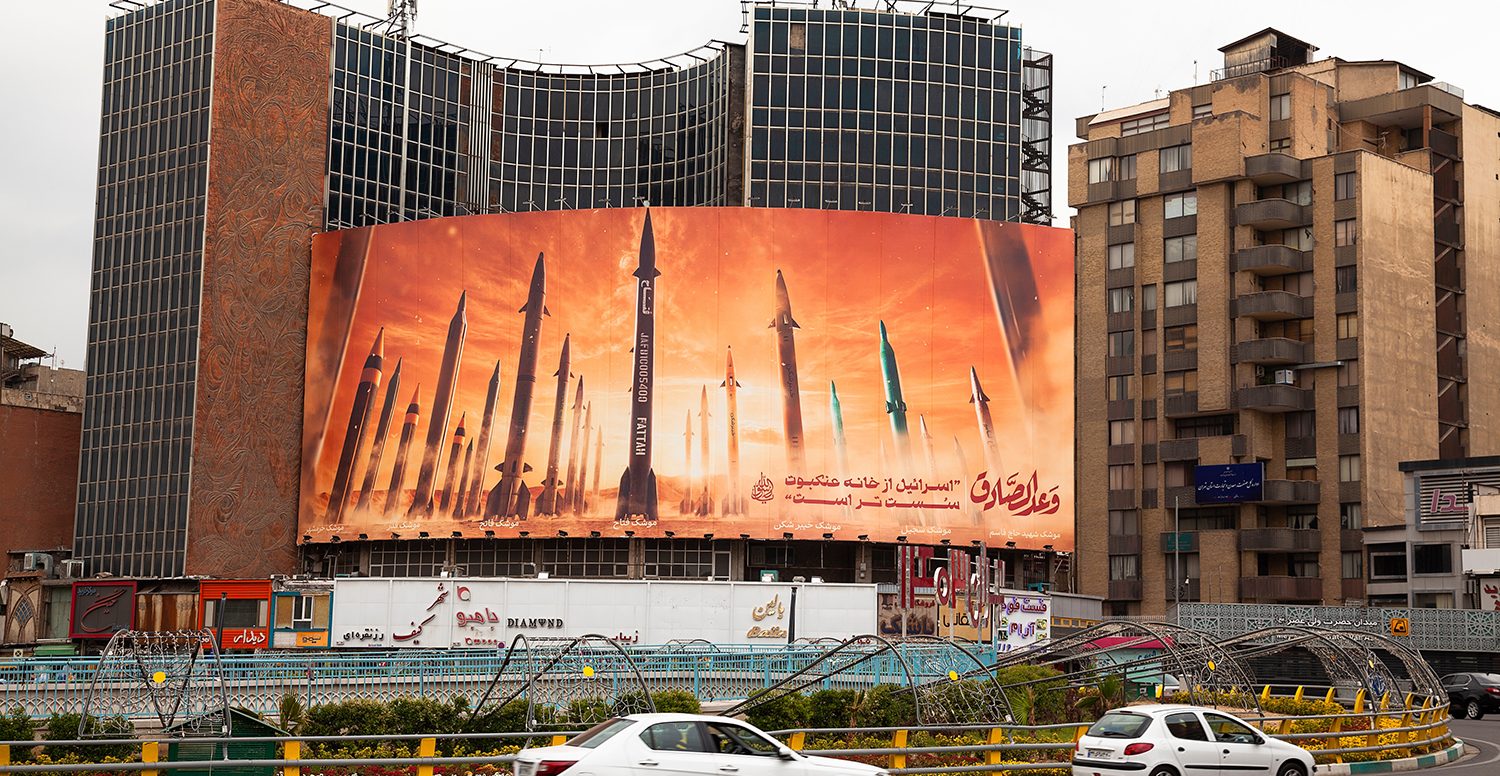
Header photo: Tehran – May 3, 2024, A billboard to show Iran’s ballistic missiles fired at Israel. Shutterstock.