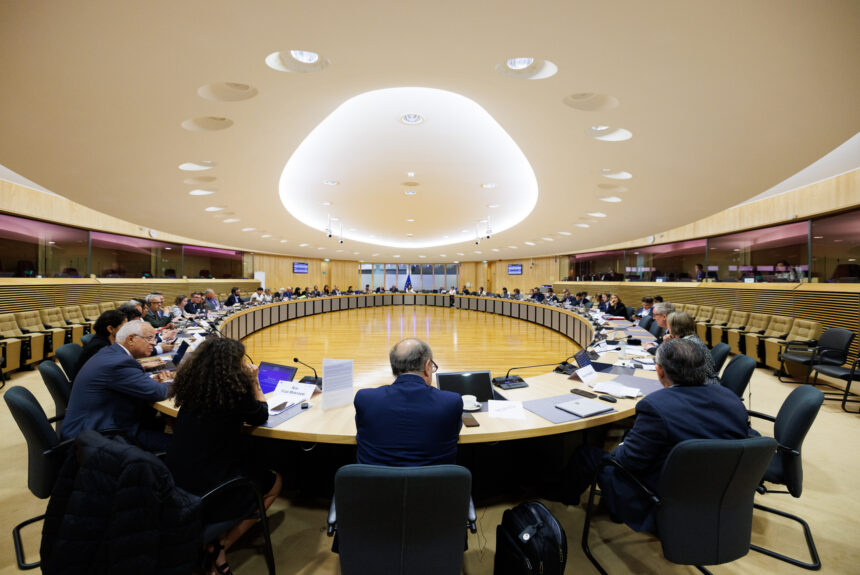
The success of the New Pact will depend on its capacity to turn consultation into genuine partnership, to balance ambition with realism and to show it has learned from past experience.
This webinar is intended to follow up on the first EMGN webinar dedicated to the role of Credit Guarantee Schemes (CGSs) in mitigating the degree of socioeconomic and financial consequences of the COVID-19 pandemic.
The end of World War II announced a new global order. Decolonization devastated the world and the creation of the United Nations in 1945 embodied the hopes of colonized peoples as an instrument of freedom during the first Cold War.
The rivalry between Saudi Arabia and Iran has had a major impact on politics and security in the Middle East since the Iranian revolution. However, there have been periods of growing rapprochement.
Western Mediterranean countries have been severly hit by the COVID-19 pandemic. This health crisis has uncovered the respective degree of unpreparedness of the different countries of the region, putting a huge strain on their health systems.
Although Palestine-Israel / Israel-Palestine “conflict” has been mainly understood as a conflict between two parties fighting for the same territory, it should be rather considered as a matter of active settlement colonialism.
The Middle East and North Africa (MENA) region has traditionally been rather peripheral to China’s interests. However, under President Xi Jinping this has notably changed. What security implications can its increasing presence in the MENA entail?
The Israeli-Palestinian conflict lies between two national movements with equal right to the place that need external help to find a compromise.
The constitutional change approved in the 2017 referendum and contested internally and externally, gives rise to a new presidential system in Turkey. Is Turkey important to the EU? And what are Turkey's interests in the Mediterranean?
The main candidates of ERC, JxCAT, Catalunya en Comú, PSC, Ciutadans and PP defend their programs in an electoral debate moderated by Mònica Terribas.
In recent years it has appeared that Russia has returned to become a major player in the Middle East and North Africa. While some have pointed at the new “Russian moment” as mere opportunism, others have attributed it to a broader strategy.
Christian Danielsson, Director-General of Neighborhood and Enlargement Negotiations (DG-NEAR) of the European Commission, explains his vision on the EC´s Mediterranean agenda as well as the challenges and opportunities facing the region.
Complementary to the Aula Mediterrània 2018-2019 conference series, this research workshop takes place to tackle a broad range of issues affecting the Mediterranean region bringing together experts on various topics related to the Euro-Mediterranean...