


How Did It Start?
On 1 July 2023, the Republic of Croatia celebrated its tenth anniversary as a member of the European Union. A decade earlier, thousands of Croatians celebrated integration with the EU in the main square in Zagreb. The celebrations at Ban Josip Jelačić Square culminated a long journey that had accompanied Croatians since the 1990s. On 1 January 2023, Croatia joined the group of countries most integrated with the EU by adopting the common currency and entering the Schengen area. By joining the so-called “hard core” of the EU, Croatia has overtaken countries such as Bulgaria and Romania, which joined the EU earlier, but which are not as integrated as the youngest member.
Croatia’s accession to the EU was included in the Association and Stabilization Process (1999), and in 2004, the country obtained candidate status. Adapting local law to Community law lasted till 2011 and included 35 accession chapters. The main challenges of the accession period were cooperation with the International Criminal Tribunal for the former Yugoslavia (ICTY), the so-called good-neighbourly relations (mainly with Serbia), and the dispute with Slovenia over the Gulf of Piran. Due to weak government activity and a lack of information, initially, Croatians were sceptical about EU membership (Kocijan & Kukec, 2016) they were also afraid to hand over the competencies of their newly established state. Disappointment with their own political class has significantly changed their attitude and now Croatians trust EU institutions more than their own government (Eurobarometer 2023).
Economic Landscape
The period of applying for EU membership was marked by the global recession in 2008. Croatia’s access to the common market and funds resulted in slow but stable development (approximately 2-3% GDP growth between 2015 and 2020). The change was also noticeable in Croatia’s GDP per capita; in 2013, it was 61% of the European average. In 2022, this rate increased to 73% of the European average. Ten years of EU membership did not solve Croatia’s main economic and political problems, i.e. an unfavourable business climate, low productivity and an ineffective public administration and justice system. All this, combined with overregulation of the market and high parafiscal fees, makes it difficult to run a business. Small and medium-sized enterprises have limited access to capital. Labour costs in Croatia remain higher than in most countries that joined the EU after 2004. Croatia had great hopes for improving its economic situation when joining the EU. However, the backlog of structural reforms weakened the positive effect of accession. The lack of strategic planning and inefficient administration seriously limit the use of EU funds. Although there is an improvement in this area, Croatia still lags behind other community countries and usually uses about 60% of the available funds. After 2019 and the departure of the former Minister of Regional Development and European Funds, Gabrijela Žalac, Croatia began to achieve better results here, and in 2022 its fund use stood at 72%.
CHART 1 Real GDP Growth Rate (percentage change on previous period)

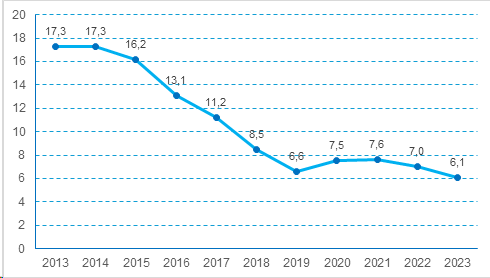
The most important successes of the Croatian membership period include a significant reduction in unemployment; in 2013, the unemployment rate was 17.25%, and in 2023 – only 6.1%. This decline of 10 percentage points over a decade is not solely linked to favourable economic circumstances but also correlates with adverse demographic shifts and the outflow of the workforce due to emigration. However, in the case of Croatia, it should be remembered that the service sector has been the basis of the country’s economy for years, accounting for as much as 75% of its entire GDP. The main problem remains the enormous dependence on tourism, which makes Croatia vulnerable to external shocks (up to a quarter of GDP is generated by tourism). The Croatian variety of the so-called “Dutch disease” was visible during the Covid-19 pandemic. Restrictions related to the epidemic caused the economy to decline by almost 9% in 2020. Additionally, the emphasis on tourism development contributes to the neglect of other sectors of the economy and the country’s deepening deindustrialization, which led to a negative foreign trade balance (-€11 billion in 2021).
CHART 2 Unemployment Rate (2013-2023)
Unpacking Croatia’s Challenges
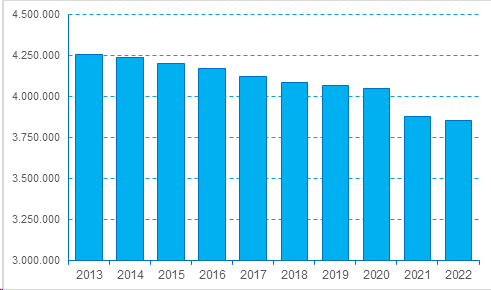
During the decade of Croatia’s EU membership, demographic problems have intensified. Ten years ago (2011), 4.2 million people lived in Croatia. According to the 2021 census, the country had 3.8 million inhabitants. Accession to the EU significantly intensified the problem of emigration because Croatians saw better development opportunities abroad. Access to the EU labour market has resulted in over 300,000 citizens leaving Croatia since 2013, mainly to Germany, Austria and Ireland. The continental parts of the country that cannot count on lucrative tourism revenues are being displaced en masse. Economic issues are not the only reason why Croatians decide to emigrate – there is also legal ambiguity, political instability, pervasive corruption, a culture of impunity, nepotism and an emphasis on historical grievances (Šelo Šabić, 2022). The high level of emigration, and thus the outflow of qualified staff, makes servicing the gigantic tourist traffic increasingly difficult.
Accession to the EU significantly intensified
the problem of emigration because Croatians
saw better development opportunities abroad
CHART 3 Population of Croatia
European Union membership has not translated into the fight against corruption, which remains one of the most critical problems in the country. The political and business connections system created in the 1990s has never been broken, even though expectations of effectively addressing corruption were a crucial requirement for EU membership. As a result, Croatia was required to develop an anti-corruption strategy (Grubisa, 2011). However, with Croatia’s accession to the EU, the pressure to combat this phenomenon decreased significantly, which meant that a problem, hidden only temporarily, returned to the surface. The phenomenon’s scale can be seen in the Eurobarometer 2023 survey, in which as many as 96% of Croatians declare that corruption is widespread in their country.
Foreign Policy Dynamics: Croatia’s Quest for a More Significant Role
Croatia used EU funds to build an LNG terminal on the island of Krk, a crucial facility from an energy security perspective. Thanks to this investment (43% of the investment value came from the EU’s Connecting Europe Facility), Croatia can strive to become a regional energy hub. This flagship energy diversification project turned out to be one of the most essential achievements in the context of the region’s departure from Russian gas. Currently, the country has a small gas surplus, which it sells to its neighbours (Hungary and Slovenia). Nevertheless, there are plans to increase regasification capacity in the near future (from the current 2.9 bcm per year to 6.1 bcm in 2025). Croatia wants to supply gas to its immediate neighbours and the broader region – Austria and Bavaria in Germany – which have expressed interest in this possibility.
The dispute over the Gulf of Piran with Slovenia
made the authorities in Zagreb realize how
the diplomatic position of a country that is
already a member of the European Union is changing
The dispute over the Gulf of Piran with Slovenia made the authorities in Zagreb realize how the diplomatic position of a country that is already a member of the European Union is changing. The Croatians, therefore, used their presence in the EU to achieve their foreign policy goals. For years, the most crucial point of Croatian foreign policy has been the issue of their compatriots living in Bosnia and Herzegovina (BiH). Thanks to Croatia’s presence in the EU, the issue of the Bosnian Croats has entered the European agenda. The government of Andrej Plenković was one of the most active in supporting BiH’s membership to the EU. In January of this year, the Croatian Prime Minister arrived in Sarajevo with the head of the European Commission, Ursula von der Leyen, and the Dutch Prime Minister Mark Rutte. The motivation of the Bosnian elites and the conviction of the Dutch, who were sceptical about enlargement, resulted in the opening of accession negotiations with BiH. The manner in which the government in Zagreb interferes in the internal affairs of Bosnia and Herzegovina and has used Croats in BiH is cause for concern (Kraske, 2023).
Conclusions
During Croatia’s first decade of EU membership, there has been discernible yet moderate economic progress. However, internal challenges such as corruption, institutional weakness, and an overreliance on specific sectors have hindered Croatia from fully realizing the potential of membership. The free movement of people within the EU has exacerbated Croatia’s major issue of emigration, leading to a gradual population decline. Unfavourable demographic trends pose challenges for Croatia’s tourism sector. In 2022, Croatia welcomed a record 18.9 million tourists, starkly contrasting with its population of 3.8 million. EU membership has positioned Croatia to become a regional energy hub, aided by EU support for infrastructure projects, such as the floating LNG terminal. This development is gaining significance amidst geopolitical shifts, such as the conflict in Ukraine and the diversification away from Russian energy sources. Politically, Croatia’s EU membership has provided it with a platform to engage more actively in regional issues. It has increased Croatia’s influence within the EU institutions. It has allowed the country to have a stronger voice on BiH’s path toward the EU, which has ultimately resulted in the opening of accession negotiations with that country.
References
Grubiša, Damir, “Anti-corruption Policy in Croatia: Benchmark for EU Accession.” in Politička misao, Vol.47 No5, 69-95, 10 May 2011. https://hrcak.srce.hr/68761.
Kocijan, Bojana and Kukec, Marko, “From Hard Consensus to Soft Euroscepticism: Attitudes of Croatian MPs on EU Integration.” in Historical Social Research, Vol. 41 No. 4, 38-60, 2016. www.jstor.org/stable/44062862.
Kraske Marion, “Misguided Balkans policy. Dangerous appeasement.” Heinrich-Böll-Stiftung Policy Brief, 15 February 2023. www.boell.de/en/2023/01/23/misguided-balkans-policy-dangerous-appeasement.
Šelo Šabić, Senada. “Demographic decline of Croatia: What is to be done?” OEGFE Policy Brief, 1 December 2022. www.oegfe.at/policy-briefs/demographic-decline-of-croatia-what-is-to-be-done/?lang=en.
Header photo: On 16 July 2020, Ursula von der Leyen, President of the European Commission, received Andrej Plenković, Prime Minister of Croatia. Source: EC – Audiovisual Service.
© European Union, 2020. Photographer: Jennifer Jacquemart