


For Effective Women’s Political Participation at Local Level in Luxor
A. INTRODUCTION
The National Association for the Defense of Rights and Freedoms (NADRF) is a civil society organization which aims at ensuring a dignified life for Egyptians, with a guarantee of constitutional, legal, and international rights and without discrimination based on gender, religion, or language. To achieve its purpose, NADRF works on:
• Spreading the culture of human rights among citizens.
• Supporting women’s rights as an integral and complementary part of human rights, and raising awareness among Egyptian women.
• Respecting human dignity, as well as civil, political, economic, social, and cultural rights.
• Contributing to the reform of laws, regulations, and administrative practices in Egypt to align them with human rights agreements and conventions; and encouraging the execution of international conventions inside Egypt.
The Association targets women as they form a vulnerable and marginalised segment of Egyptian society, especially in rural and remote areas. Its work also targets the youth, authorities, and decision makers.
Since its establishment, NADRF has sought to encourage the political participation of women. In fact, its first ever mission consisted of monitoring the 2005 parliamentary elections, in which only 3% of voters were women. Findings at the time revealed that votes cast by women were even affected by the opinions expressed by the heads of their households. Women’s choices weren’t based on their own opinions but were rather dictated by the heads of their households, and tribal considerations trumped any consideration of qualification. As for female candidates, in 2005, women were not allowed to assume any position within parliament, especially in rural areas, hamlets, and villages.
Following its first mission, NADRF decided to work on raising awareness among women of the importance of participating in elections. It established its own program to support the participation of women in public affairs through awareness sessions, seminars, and women empowering programs highlighting the important role women play as half of the population. In Egypt, as in many developing countries, women are facing numerous challenges stemming from customs and traditions, as well as from economic, social, and political factors. The engagement of women in public affairs can therefore be very impactful. As part of its mission to support women, NADRF has visited many areas and rural regions in Upper Egypt to encourage women and find the obstacles preventing their participation.
This diagnosis was prepared by Safaa Ali Hassan, Project and Program Director at NADRF, and reviewed by Wali Farouq, Chairman of NADRF. It involved some of the local cluster’s members: the Local Community Development in Dair village in Luxor, the Culture and Community Development of Women in Zenia village in Luxor, the Youth Parliament in Dair village in Luxor, the Family Association for the Development of Society in Luxor.
Methodology
The diagnosis relied on surveys to analyse the political engagement of women, with a focus on the local level, and considered the importance of the topic with Egypt’s coming local elections, and with widespread corruption and lack of accountability in local councils. The methodology maintained at its core the need to qualify and empower women so they can have experiences inside councils. It provided a comprehensive understanding of the situation, identified key challenges and gaps for intervention.
In general, the methodology followed the below steps:
• Workshop with the local cluster’s members to identify their roles and responsibilities
• Fast and participatory assessment of political engagement
• Identification of the issue to work on (participation of women in local councils)
• Communication with executive officials and leaders
• Communication with community leaders and influential figures in target regions.
Objective and context
The diagnosis responds to the following objectives:
• Collect initial data to draw an image of the reality of women’s participation in local councils
• Identify factors affecting the capacities of women
• Explore the image and representation of women in political parties
• Analyse political expectations and aspirations of women
• Identify obstacles preventing women from obtaining their political rights
• Produce recommendations for women to regain and practice their rights.
Stage Objectives:
• Reinforce the capacities of 30 women wishing to run for local elections
• Provide women with tools and mechanisms that they can use in their local communities and to run for local elections
• Build the abilities of local media outlets to highlight the need for women as partners in managing public affairs
• Support partner civil society organizations (CSOs) in their social roles.
Despite the fact that Egypt has signed many international agreements and conventions on women’s rights, due to various issues, women are still being denied their rights.
Women have played a role in all of Egypt’s historical moments but this participation has yet to lead to women holding positions of power alongside men where they can prove their competence and abilities. Historically, Egyptian women were the first Arab women to represent their people in parliament in 1957 after the late Egyptian President Gamal Abdel Nasser gave women the constitutional right to vote and to run for elections in 1956. Eight women ran for the elections at the time but their candidatures had to be approved by the revolutionary Liberation and Political Regulation Commission. On 14 July 1957, the first Egyptian parliamentarian, Rawya Ateya, took office with full membership representing the Giza Governorate, together with Amina Shukri representing Alexandria. During the 1964 elections, women held eights seats but the number dropped to six in 1967, then to three in 1969, only to rise to eight once again in 1971.
Considering this decline in the number of female parliamentarians between 1957 and 1967, the Egyptian government decided to allocate a certain number of seats for women and the quota was passed through Law No. 188 of 1979.
Indeed, the 1979 parliament witnessed an unprecedented surge in the number of women representatives with 35 female parliamentarians (30 women won quota seats, three won nonquota seats, and two were appointed by the president), equivalent to 9% of available seats. This percentage remained the same approximately in 1984 with 36 seats won by women. Despite the fact that the Quota Law No. 188 of 1979 was repealed in 1986 (the Supreme Constitutional Court deemed the law unconstitutional in 1986 as it discriminated between genders), adopting the proportional representation system was a relatively positive development for modern Egyptian women as they won 18 seats in 1987, only half the figure registered in 1984. Nonetheless, a return to the winner takes all system led to a decrease in the number of seats held by women to 11 seats (seven elected and four appointed), meaning 2.4% of the total number of seats available. In 2005, women only won four of the 444 parliamentary seats, the equivalent of 0.9%.
In recent years, Egypt has signed many international agreements to empower women, including the Convention on the Elimination of all Forms of Discrimination against Women (CEDAW), ratified in 1981, through which it committed to amending some of its laws in line with these agreements. One of these amendments covered equal representation in political life, which consequently led to imposing a quota of 64 seats for women. The 2010 parliament was the first elected in Egypt under the new quota and constituted an attempt to increase the engagement of women in political and parliamentary life, and compensate for decades of marginalisation. Supporters of the quota system claim that it opens new doors for Egyptian women, and gives them the opportunity to prove themselves as true partners in society. It allows them to represent the concerns of their constituencies in parliament, be part of the electoral experience, and initiate the electoral process themselves. However, critics of the system say it violates the principles of citizenship, equal opportunity, and equality, in addition to being unconstitutional since the constitution prohibits discrimination based on gender, colour, ethnicity, or religion.
Sixty-four seats were won by women in the 2010 parliament, but after only two sessions, the January revolution broke out and the female representatives were denied the opportunity to prove themselves.
During the latest uprisings, women stood side by side with men in the streets but their participation in decision making declined significantly to no more than 2% in the 2012 parliament. Unfortunately, even the women who gained seats failed to reflect a positive image of Egyptian women. Their performance was shameful to the point where they tried to pass regressive legislation (attempts to abolish the khula law -which allows women to seek divorce- as well as legal amendments extending the women’s right to child custody age to 15 instead of 10 for boys and 12 for girls…).
In terms of participation in local councils, the situation is worse. In 2008, NADRF examined the situation of women in local councils following the Association’s monitoring of the 2008 local elections. Women’s participation was almost non-existent in these elections, which were Egypt’s last local elections, whether in terms of candidates or voters. Following the January 25th and June 30th revolutions, NADRF kept working on this issue, especially considering that members of local councils are the closest to the people and engage most with them. With more support and better qualifications, women will be able to effectively participate in public affairs, and society’s opinion of women will change as women will be seen as capable partners in the decision-making process. NADRF has launched numerous large and powerful campaigns all over Egypt that have helped identify factors to drive the empowerment of women.
For the purpose of this diagnosis, the governorate of Aswan was first identified as a target region but due to the challenges NADRF faced in executing its work there, Luxor was then chosen. Indeed, the two governorates share the same landscape, demographic structure, and social perception and roles of women and their participation in public affairs. The two governorates have also been historically tied as one cannot be mentioned without the other.
In fact, the two governorates were separated and Luxor became its own governorate in 2009 according to Republican Decree No. 378 issued on 9 December 2009. The State was consequently obligated to develop the governorate and established the Luxor branch of the National Council for Women after 25 January 2017. The Council’s mission was to support women’s issues, and provide services such as ID cards, revolving loans, and other services that aim to support women on the political scene.
NADRF began its work in Luxor since its establishment in 2006 when Luxor was still administratively affiliated with the Qena governorate. Personnel and community leaders were identified, and the association was able to operate and reach remote hamlets, villages and cities. The Association also collaborated on a project to audit and update the registries (for example, they would remove the names of dead voters) in the governorate, monitor parliamentary elections and constitutional referenda, and monitor the recent events witnessed in Egypt.
Clarification of Key Terms and Notions
City: An urban settlement with vital services and urban structures that is bigger than a village. Community leaders: People who can influence individuals or groups to achieve a certain objective. Constitution: It is the supreme legal instrument on which all other legislation is based. It is a binding contract between the State and its citizens.
District: A fixed centre, from which other settlements derive. It is an administrative part of the governorate in Egypt and comprises several villages.
Executive officials: Public figures with the power to implement and take action.
Governorate: An administrative division within a State run by a governor.
Hamlet: A location chosen as a place to settle due to the availability of water and grass.
Local elections: A competition between Egyptian citizens who wish to represent the geographic areas where they live (such as their governorate, district, city, village, neighbourhood, hamlet, etc.). Local unit: The administrative unit that follows-up on decisions issued by the government or the elected local council.
Public figures: People who are regarded with high esteem among people but don’t have effective authority within the system.
Quota: A certain percentage set for a certain period of time to help some groups gain more representation within elected councils.
Village: A settlement of people, usually between 100 and 10,000, who form their own community. Inhabitants may belong to the same tribe, clan, or family or may come from different families. Many types of villages exist but most share one common characteristic: they are small in size and in population. Social ties are usually strong in villages, and houses are built close to each other either as a sign of union within the same village or to utilise the surrounding land for agriculture.
Luxor Governorate
Luxor Governorate is located approximately 670 km away from Cairo in the southern part of Upper Egypt. Its settlements and cities are mainly located on the banks of the Nile, and its capital is the city of Luxor, the ancient city of Thebes, once the capital of the Pharaohs. The governorate
is rich in archaeological sites, many of which have been excellently preserved. The governorate was named after its capital city that has had many names over the course of history including: city of the hundred gates, city of the sun, city of light, and city of the sceptre. The Arabs gave it the name Luxor deriving from the Arabic word Qasr meaning castle, possibly due to the many castles and temples it holds. It was chosen as the 2016 World Capital of Culture and the 2017 Arab Capital of Culture. Until 20 May 2015, the governorate’s official holiday marked the date of its establishment on December 9th. The Cabinet then approved to change the day to November 4 th to mark the date the tomb of Tutankhamun was discovered.
The governorate has a surface of 2,959.6 m 2 . It registered a population of 1,300,000 in 2017. It shares a border with the governorates of Qena in the north, Aswan in the south, New Valley in the west, and Red Sea in the east.
Luxor’s population includes many families and tribes that can trace their lineages to ancient Egypt, or to Arab families that migrated from the Arabian Peninsula after the Muslim conquest. Customs and traditions vary from village to village but remain largely similar as inhabitants are often keen on preserving tribal systems and customary councils, especially when it comes to solving problems, settling disputes, and regaining rights. Despite the fact that Western culture is widespread in tourist areas where locals interact with foreign visitors, the local population is still very conservative. Among the most famous tribes in Luxor are: Fahdi and Hajjaji in Luxor; al-Shalalein, al-Tamasih, Abu Asaba, al-Najeh al-Tawil, Badran, and al-Sayala in Karnak; al-Amari and Atito in al-Munshaa; al-Ashraf al-Adarisa, al-Tarabish, al-Qurinat, and al-Zambili in al-Zayniya; Nujuh al-Hubail, al-Khola, and al-Shaybaniya in al-Bayada; al-Waborat, al-Rashayida, al-Khulafa, and al-Zaayima in Armant; al-Hazin, al-Mujahed, and al-Rajih in Esna; al-Masaeed, and al-Salmaniya in al-Mataana, which includes al-Turaki al-Slamat, al-Hawaser, al-Jawadila, al-Husairat, al-Nawaji, al-Dafsh, and al-Khalfalat. Nubian tribes are mainly settled in the village of Manishet al-Nuba in al-Tod after migrating from Aswan to Luxor in 1933 bringing with them their culture, heritage, language, and traditions.
The governorate of Luxor has its own customs that are unique to its multicultural and multiethnic population. For example, in many villages, a bride must pay a visit to the pious worshipers of Allah the day before her wedding in a tradition known as “the visitors”, with the Mosque of Abu Haggag considered as the main stop during those visits. In the village of al-Mataana, girls can only marry their cousins, and in the village of Dabayya, bereaved families must eat lentils for 40 days. In the village of al-Qerna, and in many other villages, the art of Kafafa, folkloric songs accompanied by clapping, is widely practiced; and on holidays, families in Luxor send a meal of meat, vegetables and fruit to all married women and fiancées in the family.
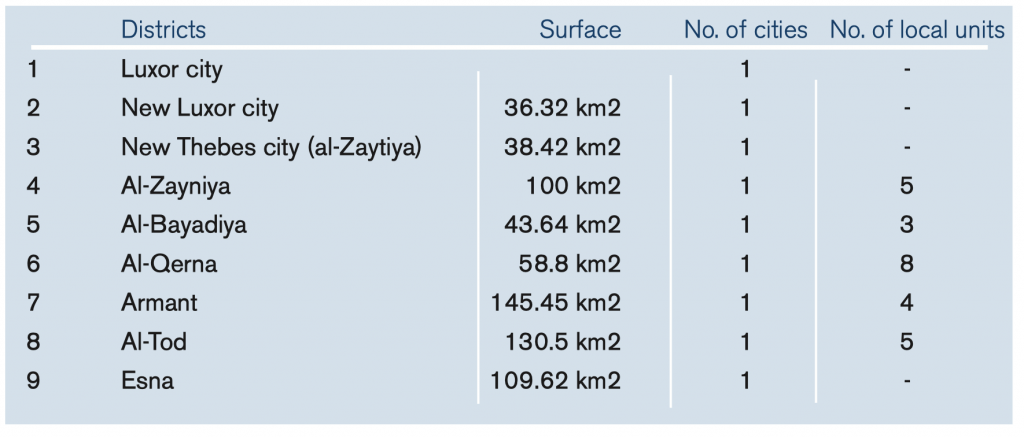
Administrative Structure
B. DIAGNOSIS OF WOMEN’S PARTICIPATION IN LOCAL COUNCILS
To achieve its objective of supporting the participation of women in local councils, NADRF implemented four activities:
First activity: Press conference “For the Effective Participation of Women”
A number of themes were chosen and discussed, and recommendations were reached (and will be followed-up on) for each theme. The press conference was organized over two days with over 90 male and female participants. Participants were responsive and interactive.
Target segments were:
• Organisations advocating for women’s development
• Executive officials (governor, deputy governor, executive secretary, city mayors, regional leaders)
• Local media (TV, radio, newspapers, local magazines)
• Previous male and female representatives in local councils
• Parliamentarians representing Luxor
• Figures from relevant national councils (National Council of Women, etc.)
• Unions operating in the governorate (Regional Union of NGOs, Women’s Union of Nubian NGOs)
• Community leaders (male and female)
• Political parties in the governorate
• Labour unions in the governorate
First Theme “Civil Society and Its Role in Supporting Women in Local Councils”.
It was led by Ahmed Obaid, Undersecretary for the Ministry of Social Affairs in Luxor, who spoke of the Ministry’s role in providing complete support to women to enable them to run for local elections. As part of the theme as well, Dr. Suad Saad, Secretary General of the National Council of Women in Luxor, spoke about the Council’s role in helping women overcome obstacles hindering their candidatures. She stated that the Council was ready to hold training sessions for women wishing to run for local elections. Ishraqa Ahmed, Director of the African Centre for Women in Luxor, was another speaker followed by Najla Bajum, Deputy Chairperson of the Ana Almasry organisation, and Ehab al-Fawli, Researcher at the Faculty of Economic and Political Science.
For half an hour each, the latter two speakers discussed the role civil society plays in empowering Egyptian women. The first session was concluded with recommendations that can reinforce the role of civil society in supporting female participation:
- Work on achieving a full economic, social, cultural, and scientific empowerment of women before tackling electoral empowerment.
- Analyse the local situation and identify the needs of women on all levels to guarantee target segments have access to services, and foster a positive environment that supports the access of women to senior leadership positions.
- Popular and executive institutions must collaborate and work based on a unified vision for women’s issues, especially women heads of households.
- Expand qualification and training programs for women, set clear standards and conditions for participation, and include all concerned institutions and entities to guarantee good representation for women.
Second Theme “Political Parties and Their Role in Supporting Women and Fair Representation in Local Councils”.
It was led by Hilal al-Dandrawi, Vice Chairman of the National Progressive Unionist Party. Speakers included Hani Nader, Secretary of the Homeland Defenders Party in Luxor, Sayed alBadri, Secretary of the National Progressive Unionist Party in Luxor, and Karim Nassreddin Bakhit, Secretary of the Liberal Socialist Party in Luxor.
The session was concluded with recommendations addressed to political parties:
- Restructure and review the services of national councils for women to guarantee target segments have access to all services and the councils represent all, political, age, and other groups.
- Draft a political honour code that sets rules and controls for electoral campaigns and female candidates.
- Empower women in political parties and support their access to leadership positions within the parties, rather than having their roles limited to secretariats concerned with women’s issues only.
- Expand qualification and training programs for female members of political parties and organizations concerning participation in public affairs, and the structures of political forces and parties.
- Encourage political parties and alliances to expand their base when choosing female candidates in order to identify the best choices, and enable women to reach leading positions on electoral lists.
- Work on reforming the current social and cultural perceptions of women.
Third Theme “Local Media and Its Role in Supporting and Empowering Women”.
It was led by Mohammed Abu al-Majd, Chairman of the Media Sector in the South. Speakers included Asma Manaa, Director of the Luxor Media Centre, Jihan Abduldayem, journalist at Teba TV and OnTV, and Mahmoud Najm, Director the Nile Media Centre on Luxor.
The session was concluded with recommendations that can be summarised as follows:
- Encourage media outlets and newspapers to adopt a media policy that supports and encourages the participation of women.
- Review education curricula and the image they offer of women to highlight positive examples from the feminist movement in Egypt.
- Support initiatives and projects that empower women in poor communities, and guarantee the access of all target segments and beneficiaries to these services without exception.
- Highlight and help publish stories on leading women in Egypt through various media outlets.
- Review legislation that might be hindering the participation of women, or encouraging qualitative or professional discrimination against women.
Fourth Theme “A Look into the New Local Elections Law” It aimed to discuss the draft law for local elections currently referred to parliament by the local electoral law committee to come up with fair recommendations concerning women. The session was led by Ehab Salam, attorney and legal expert, and speakers included Samir Hijazi, Chairman of the Union of Non-Governmental Organisations (NGOs) in Luxor, Mahmoud al-Malawani, previous Luxor Secretary General, Jamal Abdulsadeq, previous local council member, and Ahmed Abdo al-Mahdi, attorney.
The session was concluded with the following recommendations:
- Adopt an electoral code of conduct that encourages women’s participation in various forms of popular representation.
- Confirm that the necessary percentages and quotas are allocated to women in local administrations according to the provisions of the Egyptian constitution.
- Reform religious discourse to guarantee that a positive image of women, their roles, and the stance of divine religions regarding the participation of women are being disseminated.
At the end of the conference, the participants decided to add a few recommendations to each theme:
Expand qualification and training programs in collaboration with the Ministry of Social Solidarity and the National Council for Women to train women in all governorates on local monitoring tools, and the skills needed for local work.
Propose the adoption of collaboration protocols between political parties (women’s secretariats) and the National Council for Women and its branches to empower women politically, socially, economically, and culturally.
Invite the presidential institutions to hold a permanent national conference that supports women and sets a relevant agenda similar to the National Youth Conference.
Invite governors and State entities to organise permanent and continuous round tables to discuss women’s issues, and to adopt a unified agenda and unified proposals in this regard.
Second activity: Field visits to the five districts in Luxor to the offices of a development organisation operating in these areas.
The first visit was to the village of al-Deir where the Esna Youth Centre is located.
Al-Deir is a village in the district of Esna in the governorate of Luxor. It is situated on the western bank of the Nile, 55 km to the south of Luxor city. Esna has several historical names, including Iunyt, Ta-Senet, and Latopolis.
Population of the Esna district: The village of al-Deir, according to the 2006 census, was 33,568, including 17,328 men and 16,240 women.
Surface: 109.62 km2.
The visit was conducted by four leaders from partner organisations and were attended by 23 men and women.
The meeting was held inside the Youth Centre.
Among the issues discussed:
- Traditions and customs are dominant in the village and in nearby villages, and dictate that women should not express their opinions or participate in elections, neither as voters nor as candidates. Some families even prohibit girls from completing their education due to economic circumstances, preferring to educate boys rather than girls. Women also feel that their voices are not heard since they know the numerous problems they face better than anyone but their opinions are not taken into consideration. Therefore, qualification and training centres for women must be developed so that women can run for elections and prove to their communities that they are able to participate, and effectively.
- Another problem hindering the participation of women in public affairs is unemployment. While it is a general issue, it affects women in particular although they are quite qualified, and some even have higher degrees. Despite this, society prefers men over women in the workplace even if the latter are better qualified.
- Education is clashing with traditions. While education rates are on the rise in al-Deir and in Esna in general, the community is still reluctant to accept different cultures and the idea of women in leadership positions and in local councils. Some women have begun to challenge this stereotype and have taken active measures toward participating in elections and in politics.
- Women are not qualified to participate in local councils despite the existence of laws stipulating their rights to do so. Even when educated, popular women with leadership skills are present in the village, they don’t have the skills necessary to run for the councils and still lack institutional support.
- Women are passive when it comes to claiming their rights and actively participating in public affairs, despite being fully aware of their rights and obligations.
The second visit was to the village of Elmares in the al-Tod district – Elmares Youth Center.
Al-Tod is renowned for its archaeological sites rich in pharaonic, Islamic, and Christian history. It was established by Prince Diryas al-Kurdi at the time of Saladin and was mentioned under the name al-Salamiya in 1231 and was divided in 1888 to:
- Northern Salamiya (al-Tod)
- Southern Salamiya (al-Udaysat)
In 1904, it was renamed al-Tod. Former President Hosni Mubarak visited al-Tod and issued a decision to develop the district and the city of al-Tod, to include five districts (Southern Udaysat, Northern Udaysat, Western al-Tod, Manishet al-Nuba, and al-Murays).
Population: The population of the al-Tod district and city is around 107,297.
Surface: The overall surface of the al-Tod district and city is 130.5 km2.
The meeting was attended by 16 public figures and community leaders, and was held at the alTod district. Participants discussed several challenges facing women in the area:
- According to traditions and customs, parents won’t let their daughters leave the house, go to school, or travel to attend training sessions because they fear that they will mix with men. Men in rural areas also consider women who have proven themselves and their competence to bring shame to the family because they can move around freely while their male relatives remain at home.
- There is a lack of awareness in villages about the important role women play in the community and how they can participate in elections.
- Women who previously participated in elections didn’t make an impact because they weren’t qualified for the experience. The community therefore lost faith in women and considered them as mere numbers to complete an electoral list.
- Women are passive and accept their fate in the patriarchal society they live in. They don’t consider themselves responsible for their situation.
The third visit was to the Women’s Development and Education Association in al-Zayniya.
Al-Zayniya district
Al-Zayniya city is the capital of the district. The district and the city were established in 2007. The district comprises five local units in addition to the city of al-Zayniya:
- The village of Southern Zayniya
- The village of al-Saayida
- The village of al-Ashi
- The village of Southern al-Madamud
- The village of Northern al-Madamud
Population of the district and the city: The district’s population is around 65,000.
Surface: The overall surface of the al-Zayniya district and city is around 100 km2.
The meeting was attended by 16 public figures and community leaders who identified several challenges facing women in the area:
- Awareness and training were some of the key issues discussed during the meeting. Door to door campaigns and campaigns at public institutions must be organized, especially at institutions that include women. The campaigns must adopt modern methods such as the use of Facebook and Twitter, since these websites have users in every home.
- A constructive dialogue must be launched with women to increase their self-confidence and the confidence of the community in them so as to bring women to the forefront.
- Awareness must be raised of the importance of elected local councils, of the difference between them and parliament, and of the role local councils play in the new law that is currently being drafted.
- Women must be prepared for their role as representatives by being given the necessary information, attending conferences and workshops, and using self-development as a tool to access councils.
- Provide continuous education for women so they can obtain higher degrees that benefit their communities as a whole. Al-Zayniya is facing a big problem in this regard as girls are married young after completing preparatory school. Even more, the little schooling they get does not necessarily lead to a proper education since girls often face violence at schools and private lessons are a financial burden for families. The solution many families find to this problem is to marry their daughters to the first suitors. Furthermore, schools fail to attract young women since they lack the equipment and activities. Schools must therefore be used as a tool to raise awareness among girls and their mothers. Activities where both generations can participate can help highlight the need for continuous education and the role women can play in their communities.
- Participants also raised the issue of disabilities among women since the community has trouble accepting disabled women. A disabled woman is considered to bring shame to her family, which then tries to conceal the problem from the community. This is particularly worrying because disabled women have the right to participate in society and to be represented in local councils. Organizations working in this field must raise awareness and change the ways families think about disabled relatives to guarantee that people with disabilities are treated humanely and disabled women are given the right to participate in public affairs.
- Tribal issues in Upper Egypt, especially in al-Zayniyah, must be dealt with in general when it comes to women.
- Housewives should be informed of their rights through rural community leaders, and men must be informed of the rights granted by law to women as many men (fathers, husbands, brothers or sons) believe that the Shariah gives them the power to grant or refuse their female relatives their rights.
- Establishing awareness centres isn’t enough. People must be informed of the importance f such centres. A women’s club was established in the region but it has to diversify its activities to organize development activities and projects that can attract women, or to provide material support or information.
- Men must be made aware of the important role women play by holding meetings that gather both men and women in social clubs. Rural communities must accept the idea of women in clubs, as women are already mixing with men in the agricultural field.
- The participants agreed that the work must start with them. Every individual must do what he/she can and associations must work together rather than separately to achieve concrete results.
The fourth visit was to the Armant al-Heit Youth Centre in the district of Armant.
Armant benefits from a strategic geographic location and a special historical importance. It is close to Thebes (currently Luxor). As other Egyptian cities, Armant has had many names throughout its history: The Pharaohs called it Anu Knaat, the city of the burning sun. It was then called Ayun Mont, meaning the city of the god Montu. It was referred to as “the city” in Ancient Egypt because it was the most prominent city at the time. The Greeks called it Hermonthis, and the Copts Hermont. Its name in Arabic was changed to Armant.
Administrative division:
The Armant district is divided into:
• The local unit of Armant city, which includes:
Armant al-Waburat city, and Armant al-Heit city
• The local unit of al-Reyaina, which includes:
The main village of al-Reyaina
• The local unit of al-Ruzayqat, which includes:
The main village of northern al-Ruzayqat The smaller villages of southern al-Ruzayqat
• The local unit of northern al-Mahamid, which includes:
The main village of northern al-Mahamid The smaller villages of southern al-Mahamid, and the village of al-Dimqrat
The district of Armant mainly relies on cultivating sugar canes, with many sugar and feed factories operating in the area. A large percentage of the population works in agriculture, or on the Nile shipyard project building and repairing ships in the village of northern al-Mahamid. In the desert hinterland, people live in the village of Hajir al-Mahamid. The district also benefits from a wastewater projects, a large drinking water plant, and from mills located in Armant al-Heit.
Population of the district and the city of Armant: Approximately 154,552 in 2011.
Surface: The overall surface of the Armant district is around 145.45 km2. The city of Armant is located around 20 km from Luxor and 40 km from Esna.
The meeting was attended by public figures, community leaders, and religious leaders who identified several problems facing women:
- The village of Armant al-Heit is facing a big problem when it comes to harassment targeting young women, which makes them shy and afraid. It also makes parents afraid to let their daughters leave the house. This is not only an obstacle to participation but also an obstacle to education. The State and concerned organisations must take the necessary measures to find a solution. Awareness must be raised among girls on how to handle such situations, and among men and boys on the need to respect girls. Awareness seminars attended by both genders should be organised through CSOs and youth centres.
- One of the most important problems discussed was antiquated traditions and customs that keep women in rural areas and villages, especially in the south, from leaving their homes as women are excessively controlled (which leads to a lack of awareness and education, or to women’s isolation). Imams and religious figures in general (whether Christian or Muslim) must raise awareness about the important role women play in the community. They must explain that women are half of the population, with the same rights and obligations as men. If women are given more consideration and are treated equally, an equal society will develop. How can we prepare women to be representatives when we can’t prepare them to lead their own homes? Men must therefore be informed and they themselves must raise awareness as they hold the power. Awareness is key to developing targeted thinking with justice as its basis.
- Female leaders are failing to fulfil their own roles. They must find a way to send their message to the people through youth centres, home visits, and follow-up messages. Door to door campaigns to raise awareness about the role of women must be held and intensified in worship places, gathering locations, associations, etc.
- The high rate of divorce is leading to distrust toward women, as women – unlike men are blamed for these cases. Girls are in fact married at a young age when they are not aware of the nature of marriage and how to build a family. Engaged couples and their parents, both male and female, must be better informed.
- Education levels among women are low, whether in primary school, secondary school, high school, or higher education. The education process must be improved from the beginning, with special emphasis on social and psychological activities. Psychologists and sociology experts must play a special role in helping students solve their problems and in improving the education sector.
- The eternal problem remains that of women’s own perceptions of themselves. Even educated women who have been able to challenge traditions often compare themselves to men. They must be more confident because changing society’s perception must start with women themselves. The media must also raise awareness about the important role women play both at home and in the community. 7. The role of women is sometimes acknowledged by society and sometimes not. For example, when a man abandons his family, the woman is praised for taking care of her children. A common saying in Egypt highlights this view and describes mothers are homemakers and fathers as wanderers. Girls must be well informed before marriage, and awareness sessions must be provided to girls by influential community figures.
The fifth visit was to the Qerna district, at the Nur al-Hayat Association in western al-Qalit.
The Qerna district was established by Decree No. 9581 issued by the prime minister in 2006.
Local units include: Western Qamula, southern Qamula, al-Buayrat, al-Aqalita, al-Dabiya, Susan Mubarak, al-Milaha, Sheikh Amer.
The city of Qerna was an important city for the Pharaohs and their chosen location for many temples and palaces. It earned the name “city of the dead” due to the large number of tombs and mortuary temples it held.
The district and the city of Qerna rely on tourism, agriculture, and some handicraft activities. Tourism is the main source of income for the locals, and the town is renowned nationally and internationally for its archaeological importance and attractions. Archaeological items from Qerna count for 85% of Egyptian treasures found worldwide.
While the city of Qerna is one of Egypt and the world’s key tourist destination, it also offers religious tourism opportunities, festivals, and tourist activities on the Nile.
Population of the district and the city: The district has approximately 122,428 inhabitants.
Surface: The surface of inhabited lands is 58.8 km 2 . The surface of agricultural land within the district’s perimeter is 11,684.21 acres.
The meeting was attended by 20 public figures and community leaders from Qerna who identified several challenges facing women in the area:
- The main problem, from which other problems stem, is linked to customs and traditions.
If this problem is solved, many others will be too. In fact, women play a passive role in their own homes, which translates into a lack of participation in local councils and leadership positions. For example, in cases where women do participate in local councils, their work is often hidden and their attendance at meetings is considered unacceptable in the villages, because women cannot be seen working outside the house while their husbands are at home. Furthermore, men often prohibit their daughters from getting an education or working so the daughters don’t outperform their fathers.
One of the problems seen in villages is that women are perceived as mere objects of pleasure for men, and girls are often married young to much older men. This phenomenon has been recently rising in the hamlets and rural areas surrounding the villages where men are seeking to marry their daughters to richer families to either be free of their burden or to benefit from the marriage.
Girls rarely complete their education because they are expected to get married. If no suitors are available, and even if the girl is an excellent student, she must stay at home and wait for marriage due to fears she will be harmed in the streets, especially when schools and colleges are located far from the village.
Women must be well prepared to be able to effectively participate in public affairs.
One woman decided to run for the 2008 local elections but committee members refused to issue her candidature papers, and prohibited her from exercising her right to participate. An excellent student was also prohibited from pursuing higher education under the pretext that the ultimate goal for women is to get married and degrees have little value for them. She was an excellent student and her father was a teacher.
Divorce rates are high as girls are being married young without understanding the responsibilities that come with having a family. Society also looks down on divorced women, and hesitates to trust them in local councils as people see divorced women as having failed to maintain their own homes and solve their own problems.
Organisations must work on changing the community’s way of thinking by holding seminars and gatherings in villages and cities. They must focus on the youth whose ideas can still be shaped as older members are often too stubborn and set in their ways.
Third activity: Training sessions for women wishing to run for local councils.
A four-day training session was organised for 31 women wishing to run for local elections. The participants were trained to develop their skills, and notional and practical capacities, and listened to the experiences of other women who had participated in elections and won seats in parliament. The participants were also trained on how to convey their messages, how to convince people to choose them, how to acquire the financial, technical and human
resources necessary for their campaigns. They learned how to draft their messages, and how to communicate with voters.
The session was held from 20-23 May 2017 by Abdul Nasser Qindil, Hani Nadir, and Mohammed Abu al-Majd for eight hours a day with scheduled breaks. It used the following techniques: Brainstorming, work groups, team presentations, simulation, scientific data, other people’s experiences, scientific data concerning several fields (legal, media, etc.).
At the end of the training session, each participant received a work plan and an electoral campaign model to guide the start of their work, with follow-up expected from NADRF.
C. CHALLENGES AND OBSTACLES TO CHANGE
Obstacles to improving the status-quo:
• In terms of customs and traditions, change takes time and is not easy to achieve (lack of education for girls, child marriage, not allowing girls to leave the house for fear they would be harmed, the belief that political engagement is limited to men, the idea that women must stay at home, society’s negative perception of women, etc.).
• Legislation are an obstacle that can be dealt with since the constitution includes over 33 provisions that grant women rights, guarantee their equality, and provide them with support. Egyptian laws must be amended in line with these provisions.
• Executive regulations that complement these laws must also be amended and their implementation followed-up on in line with the abovementioned principles.
• CSOs have faced a lack of cooperation from Egyptian governments. This issue must be addressed to support citizens benefiting from the services offered by these organizations.
Analysis of the possible measures key actors and other actors, and local and regional authorities, can take in the target region:
The governorate of Luxor is giving a bigger role to the National Council for Women, CSOs are succeeding in creating a more positive environment for women in the region, and community leaders are having a positive impact. During meetings with the Undersecretary of
the Ministry of Social Solidarity in Luxor, NADRF sensed an understanding from the executive officials, and saw his support for organisations advocating for the empowerment of women.
The stage has been set and civil society has a role to play, supported by the will of the government, to improve the situation of Egyptian women so they can become partners in the decision-making process. The ultimate goal cannot be achieved without cooperation from the various actors concerned.
The Ministry of Social Solidarity, in collaboration with the Ministry of Youth and Sports, has taken a step forward by launching a project in 2015 in partnership with CSOs in the governorate. The project seeks to train women and the youth to run for local elections by providing the organisations with financial support. No significant change can be seen yet because the number of benefiting CSOs is still limited and participants are few. Nonetheless, this is an important attempt, and we therefore met with the organisations to put in place a mechanism that can help them reach the largest possible number of women. It was agreed to develop a training manual to be distributed to those who wish to run for elections. The offices of these organisations were also designated as information centres for anything concerning local elections and women.
All of these measures will effect change but this change cannot happen without the engagement of CSOs on various levels, and that of political parties, executive officials, journalists, etc. NADRF has drafted a proposal in this regard.
D. OPPORTUNITIES, RECOMMENDATIONS, AND CONCRETE MEASURES THAT CAN BE IMPLEMENTED TO OVERCOME THE PROBLEMS IDENTIFIED IN THIS DIAGNOSIS
Egypt is one of the first Middle Eastern countries that called for the liberation of women and gender equality. However, traditions and customs, or erroneous religious beliefs stemming from Salafist ideas, have led to women being treated as a commodity and as slaves that can’t do anything without the permission of their masters. These ideas must be replaced. Women are only demanding their right to equality and the rights given to them by the law, international instruments, and the Constitution. The opportunities for women to play a role in their communities are numerous. To overcome the obstacles they face, the following measures must be taken:
- Train women and empower them with the tools they need to succeed and become role models.
- Engage local community leaders to form part of advocacy efforts, and support women’s rights.
- Communicate with political parties to invite them to support women’s committees and increase confidence in women representing their parties in all local councils (district, village, centre, governorate).
- Produce and broadcast media content that encourages society to trust women.
- Reinforce the role of CSOs, youth centres, and service provision facilities to increase awareness of the role women play in the community.
- Hold awareness meetings in villages and hamlets that attract the youth to educate them on the important role of women.
- Highlight the positive characteristics of women in the governorate and draw an image of them as models if granted their rights.
To conclude, the diagnosis was able to reach several findings, implement activities, and communicate directly with the target group:
- There are currently 31 women in Luxor qualified to run in local elections, and each one has a low cost electoral plan she started working on after the training session was complete. NADRF will follow-up with them until the campaigns are implemented and the women have run for the elections.
- The press conference (For the Effective Participation of Women in Luxor) resulted in 22 recommendations for the concerned entities targeted by the conference (political parties, media, CSOs, parliament). Each recommendation can become its own project and needs to be put into action.
- The project’s various activities were covered by 2 TV channels and 5 websites (local newspapers, websites, etc.). Journalists also reached out to female candidates to follow their electoral journeys and inform the public about them.
- Among the institutions visited, communication was made with 10 organisations to discuss their work and interactions with citizens, and provide them with the technical support they need. Some of these organisations asked to sign a collaboration protocol with NADRF, which is being discussed with NADRF’s Board of Directors.
- A complete geographic survey of the Luxor Governorate was conducted, problems and intervention methods identified, and the parties concerned were engaged to reach the best solutions.
- A draft was prepared for the law on local elections, accompanied with comments, and a copy was sent to parliament for consideration when the law and its executive regulations are passed (available at https://www.euromedwomen.foundation/pg/en/documents/all).
E. REFERENCES
- https://ar.wikipedia.org/wiki/%D9%85%D8%AD%D8%A7%D9%81%D8%B8%D8%A9_ %D8%A7%D9%84%D8%A3%D9%82%D8%B5%D8%B1#.D8.A7.D9.84.D8.AC.D8.BA. D8.B1.D8.A7.D9.81.D9.8A.D8.A7_.D9.88.D8.A7.D9.84.D8.B3.D9.83.D8.A7.D9.86
- AL-AMARI, Iman, Episode 6: Luxor Families, 20/04/2014 http://www.albawabhnews.com/529038
- AL-SHARQ AL-AWSAT, 17/09/2010, http://archive.aawsat.com/details.asp?section=45& article=587063 &issueno=11616#.WWnvGbaxW1s
- CENTRAL AGENCY FOR PUBLIC MOBILIZATION AND STATISTICS (CAPMAS), 2006 population census,
- NATIONAL ASSOCIATION FOR THE DEFENSE OF RIGHTS AND FREEDOMS (NADRF), Egyptian Women: The maker of history, 2016
- Nubians in Luxor, kenanaonline, 26/12/2009, http://kenanaonline.com/users/kenozNobiia/posts/102964
- SHWAQI, Omar, Family Feuds in Luxor Won’t End by Winning Parliament Seat, 22/07/2011, https://www.masress.com/almessa/30833