



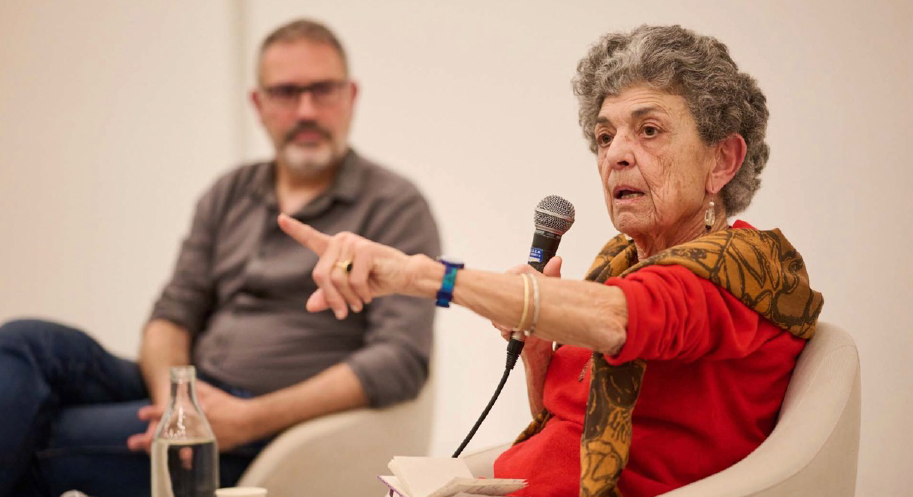
Can we really speak of the Judeo-Christian myth as one of the founding pillars of today’s Europe? On Wednesday 11 February, the Centre de Cultura Contemporània de Barcelona (CCCB) hosted a talk between the Franco-Tunisian journalist and historian Sophie Bessis and Manuel Forcano, poet, translator and doctor of Semitic Philology from the Universitat de Barcelona. They reflected on what is true (and what is imposed) in the definition of Europe as a “Judeo-Christian civilisation” and provided answers to this and other questions that challenge us and invite us to deconstruct the myths that have built our social and political identity.
Bessis has just published the essay La civilización judeocristiana. Historia de una impostura (Gatopardo, 2026) in Spanish. A short but provocative piece, with which the author once again sets herself up as a dissident, uncomfortable, but above all very necessary voice within the Euro-Mediterranean intellectual panorama. Critical of colonialism, post-colonialism and identity essentialisms, she questions the dominant ideological consensuses and defends a universalist feminism as a tool of emancipation. On feminism, in particular, she has left her mark in the pages of the first monograph of the new QM, which proposes a reflection on the myth of the Mediterranean. In her enlightening article, “Women, a Constant Presence around the Mediterranean Sea”, she challenges the historical narratives focused on men, tracing the persistent but hidden presence of women in history.
In this event at the CCCB, Bessis explained how the idea of a Judeo-Christian Europe is an ideological construct that is “recent, false, dangerous”andhistorically questionable, and has political consequences. Traditionally, the story of European civilisation has been told from a Greco-Latin perspective, but in recent decades the thesis that Europe is fundamentally rooted in Judeo-Christianity has been gaining ground. This paradigm shift is not accidental, but rather responds to certain political and ideological designs.
From a historical perspective, the concept of “Judeo-Christian civilisation” did not emerge until the 20th century. This formulation therefore conceals centuries of European anti-Semitism and the fact that, during the Middle Ages and the modern era, Europe was explicitly built in opposition to Judaism. In that imaginary, the “Jew” was positioned as an otherness from the East to exclude him or her from political and social life. According to Bessis, the inclusion of Judaism in European identity began after the Holocaust, when awareness of the Nazi genocide created a feeling of guilt and a desire to repay the debt that culminated, in part, with the creation of the State of Israel. Today, as we will see, the other, the personification of otherness, has changed hands.
According to Bessis, the notion of Europe as a Judeo-Christian civilisation distorts the historical relationships between the three monotheistic religions. On the one hand, the “Judeo-Christian” binomial Westernises Judaism, when in reality all three religions have their origins in the East, and tends to ignore the historical relevance of Jewish communities in North Africa and the Middle East. On the other hand, the binomial excludes Islam from the configuration of European civilisation, despite its contribution to the development of the continent. The case of the Iberian Peninsula is a clear example: the Islamic and Jewish presence coexisted for centuries with Christianity and left a decisive mark on society.
For Bessis, the “Judeo-Christian” formula is not innocent, but rather a political stance with important consequences. According to her, the term originated to justify European imperialism towards the Arab world, based on the idea that one cannot conquer someone who is equal. It was used to legitimise the civilisation/barbarism opposition, and to this day it still appears in discourses that present Islam as an incompatible and inferior otherness to Judeo-Christianity. The other, today, is the Muslim.
As the author argues, several actors benefit from this conception to strengthen their political narrative, especially in relation to the Palestinian people. The Zionist movement, which is markedly Western in nature, and Netanyahu’s far-right government have completely adopted this term, and the United States has also been a great champion of it, both Democrats and Republicans. This instrumentalization contributes to strengthening an exclusionary Western identity, setting a “Judeo-Christian” bloc against Islam, which stigmatises and fuels racism towards the Arab-Muslim population. This explains, but does not justify, why Palestine continues to be prey to colonialism well into the 21st century in the face of the silence of the international community.
The debate offered is fully situated in the present day, in an international context marked by the rise of the extreme right, in which Europe is no longer the centre of the world and where identity withdrawal is presented as a form of cultural preservation that reinforces social polarisation. The central problem with the term is not so much in the expression “Judeo-Christian” as in the very idea of civilisation, understood as a homogeneous and closed entity. Bessis recalls that all civilisations have emerged as a result of cultural exchanges, thefts and loans; no society has been built in a closed circuit. Quite the contrary, “all civilisations that close themselves off become uncivilised.”
In a globalised world like today, in which we are more interconnected, there are also opposing forces that point towards extremisms, walls and borders. Is it still necessary to talk about universalism? Another myth. In this respect, Bessis emphasised the fact that “the West has not stopped speaking in the name of universalism, but too often it has confused it with its own history.” It is worth noting that this universalism was created, from the beginning, in the image and likeness of the white man, and that three quarters of the world’s population were excluded from it: “women, slaves and the colonised.”
Myths shape our identities and grow from very deep roots, but that does not mean that we cannot rethink, re-signify and, on occasion, also deconstruct ourselves. Thus, with the debate on Judeo-Christian civilisation, Bessis has opened up another vision of an idea of Europe that we thought was immovable and out of the question. She has shown us that myths are also intentional and can be exploited by various interests. Critical and uncomfortable voices, like Sophie Bessis’, are crucial to breaking dominant narratives and redefining relationships between societies. As happens in the Mediterranean, a historically connected space, but also a border space.