


Spaces for Social Interaction and Protest in the Islamic World: From the Middle Ages to the Present Day
26 November 2026. From 18:30 | Conference | English | IEMed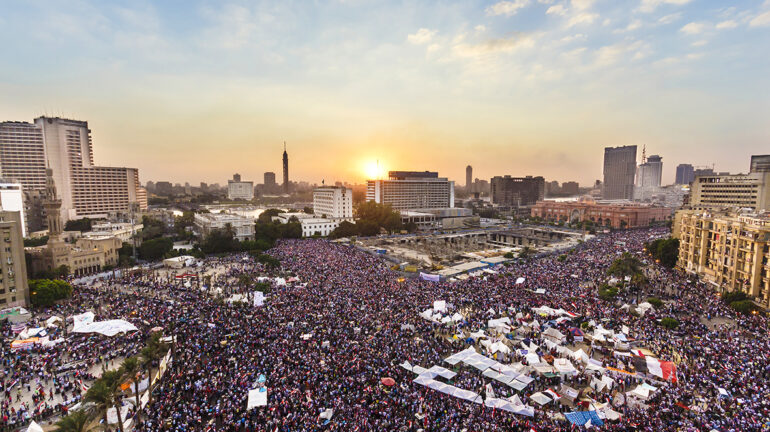
In the winter and spring of 2011, scenes of crowds protesting in various cities of the Arab world dominated television and media screens all over the world. Mydan Tahrir in Cairo became emblematic of centers of protest all over the region, and even in other parts of the world. While for some observers the rise of the “mydan” might have appeared to be a new development, history shows us that Arab-Muslim cities had various spaces for protest over different periods. The “mydan” as a concept might be related to 19th and 20th century developments in urban planning, state formation and the rise of public space, but the function it plays has roots dating back to the Middle Ages. In this regard, bringing into dialogue and comparing riots and mass movements in Arabic-speaking societies across different historical periods, particularly in Egypt and Syria, with their contemporary counterparts will allow us to understand the spaces and dynamics of protest and political participation over time. While perceptions of Arab and Islamic societies as quietist and authoritarian by default continue to persist, closer looks at historical precedents reveal different popular political dynamics whose roots continue to reverberate today.
A lecture by Amina Elbendary, an associate professor of Middle East history at the Sheikh Hassan Abbas Sharbatly Department of Arab and Islamic Civilizations at The American University in Cairo (AUC). She earned her PhD in Oriental Studies at the University of Cambridge in 2007. Throughout her career, she has received prestigious honors, including the Ryochi Sasakawa Young Leaders Graduate Fellowship and the Middle East Medievalists award. Author of the monograph Crowds and Sultans: Urban Protest in Late Medieval Egypt and Syria (AUC Press, 2015) and co-author of The Egyptian Coffeehouse (with Dalia Mostafa. I.B. Tauris, 2022), she is very active in the academic community. She serves on the board of trustees for the Women and Memory Forum (WMF), is an associate scholar at the Skilliter Center for Ottoman Studies at Cambridge and contributes to editorial boards for publications such as the Turkish Historical Review, Cairo Papers in Social Sciences, and Edinburgh University Press’s “Critical Approaches to Arabic Historiography” series.
Her research interests focus primarily on Mamluk social and cultural history, Arabic historiography, and Islamic political thought. Her scholarly work explores urban protest, dissent, and urban politics in late medieval Egypt and Syria under the Mamluk and Ottoman regimes.
A session of the Aula Mediterrània lecture series 2026-2027 moderated by Jorge Luengo, Tenure-Track Professor of Contemporary History (Universitat Pompeu Fabra, UPF), and co-organised by Master’s Degree in World History, UPF.
Language of the session: English
The lecture will be available on IEMed’s YouTube channel.
Speakers

Organised by


Within the framework of
