
Social inclusion in the Aftermath of the Arab Spring: from Politics to Policies
The Case for Social Protection and Inclusive Growth in the Med Countries
Programme-Pilote «Tayssir » Pour La Lutte Contre L’abandon Scolaire Au Maroc
Latifa El Abida, Programme Tayssir, ancien secrétaire d’État chargé de l’Éducation, Maroc
Dans le cadre de sa stratégie de lutte contre l’abandon scolaire, le Royaume du Maroc a mis en œuvre, à partir de l’année scolaire 2008/2009, un programme pilote de transferts monétaires conditionnels au profit des familles à revenus modestes, appelé TAYSSIR.
Les analyses effectuées aussi bien par les institutions nationales que par les partenaires internationaux ont montré que la disponibilité de l’offre ne suffisait pas à assurer l’inscription et le maintien des enfants à l’école. D’autres facteurs, liés à la demande, tels que l’alphabétisation des parents et le niveau des revenus de la famille entraient en ligne de compte, les enfants pouvant être mis à contribution en tant que force de travail, dans leur propre famille ou auprès de familles plus aisées, moyennant rémunération.
Ni l’existence d’une loi sur l’enseignement obligatoire et d’une loi interdisant le travail des enfants avant l’âge de 15 ans révolus, ni les campagnes de sensibilisation menées par le Ministère de l’Education nationale, ni les programmes d’alphabétisation de grande envergure, ou encore la mobilisation de la société civile, n’ont réussi à éradiquer le problème de la déperdition scolaire.
C’est ainsi qu’a été prise la décision d’expérimenter le système des transferts monétaires conditionnés par l’inscription et le maintien des enfants à l’école, qui a fait ses preuves dans d’autres pays d’Amérique Latine et d’Asie, et ce à partir de l’année scolaire 2008/2009, dans le cadre du programme pilote appelé TAYSSIR.
Dès la première année, le programme a montré son efficacité. Les taux d’abandon ont chuté et les taux de réinsertion ont sensiblement augmenté. Le Gouvernement a décidé d’étendre le programme, pour inclure le niveau collégial qui enregistrait des taux d’abandon élevés et pour toucher de nouvelles communes défavorisées.
Dans les développements qui suivent, nous présenterons successivement quelques éléments du contexte de l’expérimentation, le programme TAYSSIR proprement dit, avec ses résultats provisoires et nous conclurons par les perspectives de son évolution.
Elements de Contexte
- La problématique sociale a été à l’ordre du jour au Maroc depuis le début des années 1990, au lendemain de la mise en œuvre du programme d’ajustement structurel qui a permis de rétablir les équilibres macroéconomiques mais qui n’a pas épargné les couches défavorisées qui en ont payé le prix fort, de l’avis même des organismes internationaux qui l’avaient préconisé.
Plusieurs études et analyses ont été entreprises pour évaluer les programmes de protection sociale mis en œuvre et ont montré la nécessité de renforcer les filets de sécurité existants et de réformer le système de subvention des produits de base, dans le sens d’un meilleur ciblage des couches défavorisées.
- L’avènement du règne de Mohammed VI, en juillet 1999, a marqué un tournant en matière de prise de conscience et de prise en charge de cette problématique.
Une nouvelle dynamique a été insufflée à la stratégie de développement économique et sociale, visant à doter le pays des équipements de base nécessaires à son développement, et à mettre en chantier de grands projets structurants.
Des stratégies ambitieuses ont été adoptées dans les secteurs fondamentaux les plus prometteurs de l’économie, tels que le tourisme, l’industrie, l’habitat, l’énergie et les ressources en eau, ainsi que le secteur clef de l’agriculture.
Le PIB par habitant en dollars américains est passé de 1308 en 2001 à 3079 en 2011, la part de la population située au-dessous du seuil de la pauvreté est passée de 16.5% en 2002 à 8.8% en 2008 et le taux de chômage est passé de 13% en 2000 à 8.9% en 2011.
- Un programme d’envergure a été lancé dans le secteur de l’habitat, en 2003, dans le but de promouvoir l’habitat social, de lutter contre l’habitat insalubre et anticiper le développement urbain.
Trois leviers innovants ont été privilégiés: la mobilisation du foncier public, la révision de la fiscalité immobilière en vue d’encourager les promoteurs à augmenter l’offre de logements sociaux, le partenariat public/privé et la solvabilisation de la demande par la création d’un fonds de solidarité et d’un fonds de garantie pour inciter les établissements de crédit.
S’en est suivi une grande dynamique de promotion immobilière entre 2002 et 2010 avec des effets d’entraînement importants sur plusieurs secteurs d’activités économiques et sur l’emploi.
Le rythme de production de l’habitat social est passé de 40.000 unités avant 2003 à près de 100.000 unités par an ces dernières années. Le déficit en logements a sensiblement diminué et 40 villes, sur les 84 concernées, ont été déclarées « Villes Sans Bidonvilles ».
- En mai 2005, le Roi lance l’Initiative Nationale pour le Développement Humain (INDH), qu’il considère comme un complément indispensable des réformes engagées dans les domaines de la consolidation de l’Etat de droit, de l’élargissement de l’espace des libertés et de la promotion des droits de la femme.
L’INDH adopte une approche territoriale et participative, basée autant sur une politique de ciblage des zones et des catégories les plus démunies que sur la participation des populations et du tissu associatif pour une meilleure appropriation et viabilité des projets et des interventions.
Trois axes d’intervention lui sont fixés : l’accès aux équipements et services sociaux de base tels l’éducation, la santé, l’habitat salubre, etc ; les activités génératrices de revenus et d’emploi; et l’assistance aux personnes en grande vulnérabilité.
Dans un premier temps, l’INDH a ciblé 360 communes parmi les plus pauvres du monde rural et 250 quartiers pauvres en milieu urbain et périurbains.
La contribution du budget de l’Etat à l’INDH devait assurer un effet de levier, les collectivités locales et les ONG étant appelées à participer à cet effort.
Cette initiative qui a bénéficié à plus de 5.2 millions de personnes durant sa première phase 2005/2010, a permis d’accomplir des progrès considérables dans l’amélioration de l’inclusion, de la responsabilité et de la transparence des processus de prise de décision et d’exécution au niveau local. Les élus et les représentants de la société civile représentent plus des 2/3 des comités de gouvernance locale.
Son succès a justifié le lancement d’une deuxième phase de 5 ans qui double les budgets et le nombre de bénéficiaires (701 communes rurales et 530 quartiers urbains). La mise à niveau des zones montagneuses enclavées est au cœur de cette deuxième phase.
- Dans la foulée, et en s’appuyant sur les stratégies de ciblage développées dans le cadre de l’INDH, le Maroc lance l’expérimentation du Régime d’Assistance Médicale aux Economiquement Démunis (RAMED), dans le but de garantir le droit aux soins de santé aux personnes défavorisées, qui ne bénéficient pas de l’Assurance Maladie Obligatoire (AMO).
La généralisation de ce système, qui garantit la gratuité des soins et prestations médicalement disponibles dans les hôpitaux publics, les centres de santé et les services de l’Etat, est lancée en mars 2012, et devrait permettre la prise en charge de près de 8.5 millions de personnes, soit 26% de la population.
- Le secteur de l’éducation fait l’objet, de son côté, d’un programme de réforme, depuis l’année scolaire 2000/2001, sur la base de la Charte Nationale d’Education et de Formation (CNEF), qui constituait la feuille de route de la réforme, sur la période 2000/2009. Cette charte avait fait l’objet, pour la première fois dans l’histoire du Maroc indépendant, d’un consensus national.
La mise en œuvre de cette charte jusqu’en 2007 a permis de réaliser des avancées réelles, mais sans atteindre les objectifs ambitieux prédéfinis.
En 2007/2008, les taux de scolarisation spécifiques de la tranche d’âge 6-11 ans, sont de 91.4% et ceux de la tranche d’âge 12-14 ans ne dépassent pas 71.3%.
La même année, 193 400 élèves ont quitté l’école primaire, soit une proportion de 5.4%.
Au niveau du collège, ce sont 180 700 élèves qui ont abandonné, soit une proportion de 11.5%.
Les filles sont plus touchées que les garçons : 6% au primaire et 13.4% au collège.
S’adressant au Parlement issu des élections législatives de l’été 2007 et au Gouvernement qui allait être nommé, en octobre 2007, le Roi du Maroc demande que soit mis en place « un plan d’urgence pour consolider ce qui a été réalisé, et procéder aux réajustements qui s’imposent, en veillant à une application optimale des dispositions de la Charte nationale d’Education et de Formation».
Le Gouvernement, nommé en octobre 2007, décide de mettre en œuvre un plan d’urgence dont l’un des objectifs majeurs est de rendre effective l’obligation de scolarité jusqu’à l’âge de 15 ans. La réalisation de cet objectif passait par l’extension de l’offre scolaire, notamment au niveau du collège mais aussi par un paquet de mesures visant à neutraliser les obstacles socioéconomiques de la scolarisation : distribution de manuels et fourniture scolaires, augmentations des moyens alloués aux cantines et internats scolaires, développement du transport scolaire dans le milieu rural et transferts monétaires.
Amorcées dès la rentrée scolaire 2008/2009, ces mesures ont été consacrées dans le plan d’urgence 2009/2012, qui a bénéficié d’un effort budgétaire sans précédent, Profitant d’une embellie au niveau des finances publiques.
Le budget de fonctionnement, hors salaires, a augmenté de 152% à partir de 2009 et celui de l’investissement de 123%.
C’est donc dans ce contexte que Le programme TAYSSIR a été lancé. Contexte caractérisé par la mise en œuvre de politiques volontaristes de lutte contre l’exclusion.
Présentation du Programme-Pilote « Tayssir »
Le programme pilote devait mesurer l’impact des transferts monétaires sur la fréquentation scolaire, les performances des élèves et le niveau de vie des familles.
Il a été déployé dans 320 écoles primaires (appelées secteurs scolaires puisque comprenant plusieurs unités scolaires satellites), appartenant à des communes rurales éligibles au programme. Parmi les 320 secteurs scolaires, 260 ont été choisis de manière aléatoire pour bénéficier des transferts (groupe de traitement) et les 60 restants constituent le groupe témoin (groupe contrôle), pour pouvoir évaluer l’impact des transferts.
Les communes éligibles ont été choisies parmi les plus pauvres, sur la base de trois critères : communes ciblées par l’INDH ; avec un taux de pauvreté supérieur ou égal à 30% ; et un taux de déperdition scolaire supérieur ou égal à 8%.
Les 260 secteurs scolaires du groupe de traitement ont été subdivisés de manière aléatoire en 4 sous-groupes :
- Un sous-groupe non conditionnel où les subventions sont versées aux parents sans tenir compte de l’assiduité des élèves ;
- Trois sous-groupes conditionnels où les subventions ne sont versées que si l’enfant ne s’absente pas plus de 4 fois par mois, avec toutefois trois mécanismes de contrôle des présences (par l’enseignant ; par l’enseignant et l’inspecteur ; par machine biométrique).
Enfin, une autre différenciation a été introduite en répartissant, de manière aléatoire, les 260 secteurs scolaires en deux groupes selon que les subventions sont versées au père ou à la mère.
S’agissant des montants transférés, ils ont été fixés à 60 Dh /enfant/mois pour les élèves inscrits en première et deuxième année, 80 Dh pour les élèves inscrits en troisième et quatrième année et 100 Dh pour les élèves inscrits en cinquième et en sixième année du primaire (100 Dh équivalent à environ 9 Euros).
Les transferts sont effectués pour 10 mois, une fois tous les deux mois et sont plafonnés à trois enfants par ménage. La moyenne des transferts annuels par ménage s’élève à 2400 Dh, soit l’équivalent de 5% de la consommation annuelle moyenne des ménages. A titre indicatif, cette proportion est de 20% pour le programme mexicain PROGRESA.
Un travail minutieux d’analyse de l’existant et de suivi et analyse d’impact du programme a été assuré, entre avril 2008 et août 2010, par le laboratoire J-PAL (the Abdul latif Jameel Poverty Action Lab) du MIT, avec la collaboration avec la Banque Mondiale.
Les premiers résultats de l’expérimentation étaient disponibles fin 2010. Ils devaient être complétés, validés et publiés ultérieurement. A la date de l’écriture de ces lignes, le rapport final n’est toujours pas publié.
Aussi, les résultats présentés ci-après, le seront à titre tout à fait indicatif.
- Le programme Tayssir a réduit de façon significative l’abandon scolaire, le taux de déperdition au cours des deux années pilotes ayant diminué de 57% par rapport au groupe de contrôle.
- Il a aussi eu un impact sur la réinsertion scolaire : à la fin de l’année 2009/10, le taux de réinscription des enfants ayant abandonné l’école à la fin de l’année scolaire 2007/08 avait augmenté de 37% dans les écoles Tayssir par rapport aux écoles du groupe de contrôle.
- Le programme a aussi eu un impact significatif sur l’apprentissage des élèves.
- Etant donné les faibles taux observés d’absentéisme des élèves, conditionner les transferts monétaires sur un nombre maximum d’absences par mois ne semble pas avoir un impact suffisant sur l’absentéisme pour en justifier le coût et la complexité de gestion.
- L’impact des transferts sur les taux d’abandon et les taux de réinsertion scolaire semblent plus importants lorsqu’ils sont versés aux mères… ».
Par ailleurs, les transferts sont perçus, par les populations, comme un signal fort du Gouvernement sur l’importance de la scolarisation.
Comme cela a été mentionné plus haut, les résultats encourageants constatés dès la première année de mise en œuvre du pilote, sur les taux d’abandon et de réinsertion, ont amené le Gouvernement à engager l’extension du programme dès la deuxième année de son expérimentation. Extension géographique en 2009/2010, puis extension au cycle collégial en 2010/2011.
Le tableau ci-après présente les données relatives au programme depuis son démarrage.
| Année scolaire | Régions | Provinces | Communes | Ménages | Bénéfic– iaires | Cycle | Budget en Millions DH |
| 2008-2009 | 5 | 17 | 132 | 47 000 | 88 000 | Primaire | 61 |
| 2009-2010 | 11 | 30 | 242 | 160 000 | 300 000 | Primaire | 225 |
| 2010-2011 | 12 | 50 | 434 | 360 000 | 609 000 | primaire+1ère Année collège | 492 |
| 2011-2012 | 12 | 50 | 434 | 406 000 | 705 000 | primaire+1 ère et 2ème Année collège | 594 |
| 2012-2013 | 12 | 50 | 434 | 436 000 | 758 000 | les 6années du primaire+ les 3 années du collège | 725 |
C’est ainsi qu’en 2012/2013, le programme couvre quelques 18% des ménages ruraux et 33% des élèves inscrits au primaire et au collège, dans le monde rural.
La combinaison de cette extension avec les autres mesures d’appui social, mentionnées plus haut, a permis au terme du Plan d’Urgence 2009/2012 de réaliser une amélioration remarquable des indicateurs de scolarisation.
En se limitant à ces seuls indicateurs, on enregistre, entre 2007/2008 et 2012/2013, un gain de 8 points au niveau du taux spécifique de scolarisation de la tranche d’âge 6-11 ans (de 91.4% à 99.6%) et de 13.8 points pour la tranche d’âge 12-14 (de 71.3% à 85.1%), avec une réduction des écarts entre les villes et les campagnes et entre les garçons et les filles.
Conclusion
Lutter contre les causes de l’exclusion constitue une préoccupation permanente des pouvoirs publics au Maroc, en particulier depuis le début des années 1990, que ce soit à travers les politiques sectorielles ou à travers des programmes spécifiques.
En dépit des progrès indéniables, réalisés au cours de la dernière décennie, en matière de croissance économique et de lutte contre la pauvreté, Les causes de l’exclusion ne sont pas encore éradiquées. Elles sont liées notamment aux difficultés d’accès à des services sociaux d’éducation et de santé de qualité, à la situation de sous-emploi et de chômage des jeunes et à l’enclavement d’une partie importante des populations rurales.
Cette situation prive le Maroc du potentiel d’une large frange de sa population, qui ne peut participer à la vie collective et faire valoir ses droits économiques, sociaux et politiques.
Les programmes sociaux lancés au cours de la dernière décennie (INDH, TAYSSIR, RAMED, etc.) ont montré leur pertinence, grâce notamment à un meilleur ciblage des populations économiquement pauvres. Leur renforcement, au même titre que les politiques d’investissement dans le capital humain, notamment par l’extension de l’offre scolaire et l’amélioration de sa qualité, apparait aujourd’hui comme une nécessité impérieuse.
Même si la volonté politique d’aller de l’avant existe, deux contraintes majeures brouillent les perspectives d’avenir. Il s’agit de la contrainte financière, d’une part, et de celle du mode de gouvernance, d’autre part.
Sur le plan financier, la flambée des cours des produits énergétiques et des produits alimentaires sur le marché international a entrainé une aggravation des déficits des comptes publics, limitant les marges d’intervention des pouvoirs publics. Le coût de subvention des prix des produits énergétiques et alimentaires a atteint des niveaux qui menacent les équilibres financiers de l’Etat : 6,6% du PIB en 2012, au lieu de 1.7% en 2001. La réforme du système de subvention, longtemps reportée, devient une nécessité pour la mise en place d’un système de protection sociale efficace et viable.
S’agissant de la Gouvernance, la multiplicité des programmes et des intervenants dans le domaine du développement humain, le caractère centralisé de leur gestion, en dépit des progrès enregistrés ces dernières années, en matière de déconcentration et de décentralisation, limitent l’efficacité des ressources affectées à ces programmes.
Les principes de bonne gouvernance édictés par la Nouvelle Constitution du Royaume, liés à la régionalisation avancée, à la démocratie participative et à la reddition des comptes, devraient contribuer à une meilleure prise en charge des défis que pose la problématique sociale. Cependant, deux ans après l’adoption de la Constitution, en juillet 2011, les réformes qui préparent la mise en œuvre de ces principes, n’ont pas encore vu le jour.
Il appartient aux acteurs politiques de prendre leurs responsabilités et emprunter la voie des réformes indispensables.
Development Prospects for Arab Countries
Khalid Sekkat (University of Brussels, FEMISE and ERF)
Introduction
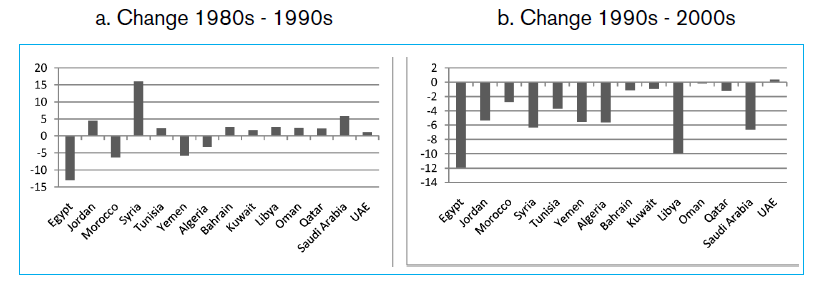
Almost 30 years ago many of Arab countries have implemented an important package of economic reforms consisting of opening to trade and giving more room to free market mechanisms. The reform intensity differs however across countries. Figures 1 highlights the efforts in term of trade policy. It compares the reduction in tariffs between 1980s and the 1990s to the one between 1990s and 200s. It shows that all the countries (except the UAE) have reduced their protection since the late 1990s. This is the most noticeable in Egypt, Jordan, Morocco and Tunisia. Moreover, World Bank (2009) reports that over the 2000s Arab countries have embarked on a wide range of reforms to improve the overall environment for growth. In terms of trade reforms, substantial progress has been made in reducing tariffs and the time required for import and export; a performance not matched in any other region of the World. The business climate has also witnessed notable improvements although the Region didn’t perform as well as elsewhere.
Figure 1: Change in average MFN applied tariff rates
Since the initiation of reforms some progresses have been achieved while some problems remain. The progresses concern economic growth, manufactured exports, FDI inflows and poverty reduction. The problems relate to exports diversification and sophistication, the low impact of preferential trade agreements, unemployment (especially graduates unemployment), income inequality and quality of institutions
At the time of Arab uprisings, the present paper seeks to set the stage of the economic and social situation in Arab countries and provide some suggestions for an inclusive growth strategy.
Progresses and Problems[1]
Progresses
In terms of progresses, the adoption of openness strategies resulted in significantly higher economic growth rate, manufactured exports and FDI inflows. Such a causal relationship is supported by empirical findings Makdissi et al. (2006) and Hassan et al. (2011), Sekkat and Varoudakis (2002) and Sekkat and Veganzones (2007).
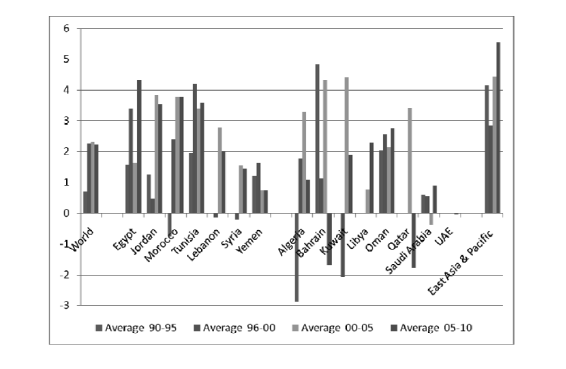
Growth: In the countries having opened their economies (Egypt, Jordan, Morocco and Tunisia), the per capita real growth rate over the period 1995-2010 was markedly higher than during the preceding periods. It was also higher than in the rest of the Arab world but still lower than in East Asia and Pacific (Figure 2).
Figure 2: Growth GDP per capita (PPP constant 2005 international $)
Manufactured exports increased markedly in Jordan, Morocco and Tunisia. Over the period 1995-2010 manufactured exports as percentage of GDP was much higher than during the preceding periods. In Jordan and Tunisia, it stands at a much higher level than the Arab world and the Latin American averages. It is comparable to the average of East Asia and Pacific (Figure 3).
Figure 3: Manufactured exports (% of GDP)

FDI inflows: Almost all Arab countries benefited from more FDI inflows during the 2000s than before. The differences across countries are, however, less informative than with growth and manufactured exports (Figure 4).
Figure 4: FDI inflows

Poverty: In parallel to these economic achievements, the share of poor in total population decreased. Focusing on extreme poverty (i.e. the share of population below US$ 1.25 PPP a day), it declined significantly but at different speed across countries. In Morocco, the share of the poor population increased between 1995 and 2000 and decreased afterward to stand at the level of the early 1990s. In Egypt, Jordan and Tunisia the shares deceased markedly since the early 1990s (Figure 5).
Figure 5: Poverty

Problems
Inequality: While poverty has decreased, income inequality has not improved and even worsened. Inequality is the lowest in Egypt (Figure 6). In all countries (except Jordan), income inequality was equal or higher in the 2000s as compared to its level in the 1990s.
Figure 6: Inequality
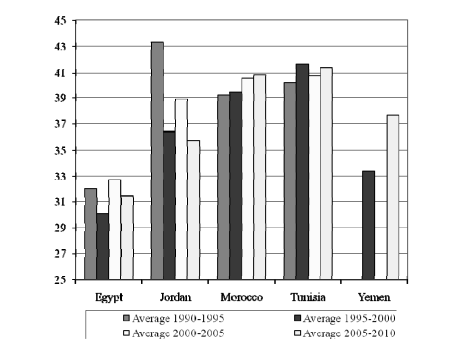
Exports diversification and sophistication: While the share of manufactures in total exports has increased, the Gini coefficients of export concentration (computed at a level of around 1500 products), shows that the specialization in all Arab countries is much higher than those of emerging countries. The minimum of the Gini index in Table 7 (above 0.94 in the UEA) is higher than in Turkey (0.88) or China (0.82) during the same period. Since 1995, the index decreased in a number of countries but specialization is still very high.
Figure 7: Evolution of exports diversification

Regarding exports sophistication, Abdmoulah and Laabas (2010) showed that the upgrading is slow in most Arab countries. A high number of goods are not exported or counts for less than 1 million US$. Even countries having diversified their exports from agriculture and raw materials and to more manufactured products, their high-tech exports do not exceed 10.5% in the best figure.
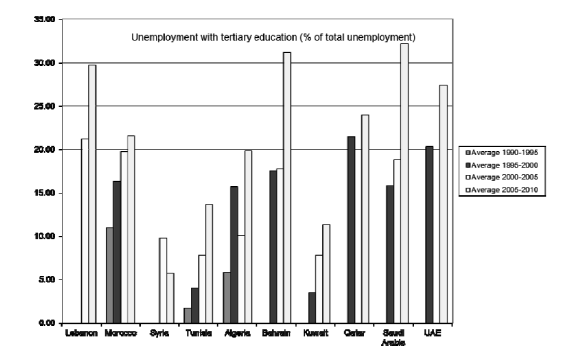
Unemployment is high especially among graduates: The unemployment situation remained preoccupying since the early 1990s in all countries. Although unemployment was on a declining path prior to the global economic crisis, it remains much higher than the average in Latin America or East Asia and Pacific. It is especially very high among graduates. In Gulf countries, unemployed workers holding a tertiary education degree represent more than 25% of total unemployment and the trend is upward. The same rate is 20% in Morocco and 14% in Tunisia. The upward trend is similar (Figure 8).
Figure 8: Unemployment especially graduates
Regional imbalances remain preoccupying. While difference in the rate of poverty (i.e. the share of population below US$ 2.50 PPP a day) across country’s regions decreased slightly in Jordan and Tunisia, it exhibit marked increase in Morocco and Egypt (Figure 9).
Figure 9: Regional imbalance

Bars are put in chronological order (older to recent). The dates of observation differ between countries due data availability. Sources: Egypt: El-laithy et al. (2003) Table1, Jordan: Abu-Al sondos and Abu-Kharmeh (2008) Table 2, Morocco and Tunisia: African Development Bank (2011), Tables 3 and 6
Preferential trade agreements: While multilateral trade policy reforms seem to have delivered to some extent, bilateral and plurilateral agreements both with Europe and between Arab countries didn’t boost trade as it could have. Trade between partners to intra-Arab integration agreements didn’t increase and Arab countries didn’t improve their presence on the European market in contrast to China, India and Turkey.
Figure 10: Merchandise imports from the Arab World (% of total merchandise imports) (Excluding Oil)
Governance: The record is highly worrying because it can hamper improvement in any of the above problems: Figure 11 presents the scores in term of the quality of market friendly institutions as measured by a simple average of the index of Kauffman and his team. The maximum a country can attain is 5. All Arab countries (except Qatar in 2010) have scores below 2 and the situation is deteriorating in many countries.
Figure 11: Governance

The Road Ahead
The analysis has shown that most Arab economies face difficulties in sustaining inclusive growth because of lagging industrialization and slow structural transformation. Fostering an environment that promotes entrepreneurship and investment in new activities is, therefore, critical to Arab development (Lall, 2004 and Rodrick, 2004). However, a traditional interventionist industrial policy is not recommended because a number of government failures that exist also in developed countries are more problematic in developing countries (Buigues and Sekkat, 2010). Instead a soft industrial policy consisting of advisory support, encouragement of partnerships, dissemination of best practices and decentralized management is able to better deliver.
In addition to measures addressing the issues of restrictive trade policies (especially the important non-tariff measures) and unfriendly business climate (including logistics and infrastructure), it is recommended to:
- Encourage firms’ sponsored training to address the mismatch between the demand and supply of skills and upgrade the quality of exports. This is especially important because evidence suggest that Arab firms are still not taking an active part in training programs. Over the 2000s the highest share of firms offering training in Arab countries was below 30% while it exceeded 50% in a number of other developing countries. Moreover, empirical studies document important positive impacts of firm sponsored training on employment, wages and productivity (Revenga et al., 1994; Attanasio et al., 2008; Rosholm et al., 2007 and Sekkat, 2011)
- Improve the ability of the countries to enter new and sophisticated exports markets through an effective presence of dedicated bodies in the targeted market. Comparison with major exporters from Asia (Korea and Japan) shows that although the costs of exporting are higher in Arab countries, the differences are not dramatic. The problem seems coming from the export strategies which are less active in terms of promotion, advertising, lobbying etc. While Arab countries have a variety of proactive export policies, they are lagging behind in term of effective presence of dedicated bodies in the targeted market (Lederman et al., 2010).
- Orient FDI inflows toward activities with high technological spillover. While FDI has been found to induce the development and dispersion of technological skills in a number of countries (Borensztein et al., 1998 and Keller and Yeaple, 2009), little or no effects have been found in Arab economies (Bouklia and Zatla, 2000; Omran and Bolbol, 2003 and Doucouliagos et al., 2010). Since the impact of FDI depends on human capital, the above discussion about workers training by firms is relevant here. FDI being sensitive to the openness of the economy, export promotion strategies have clearly their role to play. The same holds for the improved business environment inside the country and the Diaspora which is discussed below.
- Better rely on Arab Diaspora which is an untapped asset that can help the countries attracting “high spillover” FDI and upgrade the exports composition. The literature dealing with the effect of Diaspora on the origin country points to the positive feedbacks in terms of remittances, return migration and human capital. Besides, there is a growing and strong evidence of a positive effect of Diaspora, especially the skilled one, on exports from and FDI to the origin country (Felbermayr and Jung, 2009; and Kugler and Rapoport, 2007) and on the diffusion of knowledge and the quality of institutions (Kerr, 2008 and Beine and Sekkat, 2011).
- Support the free functioning of markets through an effective competition and competition policy in order to prevent liberalization from benefiting only few well politically-connected persons. While there is a theoretical controversy about the benefit of increased competition in a development context, a number of empirical evidence support the positive effect (Bartel and Harrison, 2005; Kim, 2000 and Pavcnik, 2002). Investigation for Arab countries showed that these economies face important competition and policy issues (Sekkat, 2008). First, their manufacturing sector is highly specialized in food, wearing and textiles. Second, the three industries exhibit much higher mark ups and much lower productivity growth than the rest of the manufacturing sector. Sekkat (2009) found a causal effect running from low competition to low productivity in Arab countries and Sekkat (2010) pointed to the role of low exit and entry rates. Interestingly, the weak competitive environment in Arab countries has survived the enactment of competition laws because of weak implementation and enforcement practices.
- Get institutions function right. The most crucial need is not the adoption of new rules but the firm enforcement of existing ones. The lack of commitments to and enforcement of rules depresses growth, contributes to an unfair wealth distribution and reduces trade and FDI. There is now an extensive literature on the importance of different institutional factors as determinants of economic growth and long-run development. This suggests that sound institutions deliver economic prosperity (Henisz, 2000; Mauro, 1995 and Méon and Sekkat, 2004) and change the distribution of wealth and income (Chong and Gradstein, 2007).
- Revive intra-Arab integration which could not only complement the above measures but also induce substantial political gains that will make the region attractive to traders and investors. Hoekman and Sekkat (2010) reviewed the literature on the gains and the reasons of failures of Intra Arab Integration (IAI) and showed that the economic debate is biased in two respects. First, the majority of the literature focuses on the goods market only to assess the desirability of integration. Integration of the goods market is not the only form of economic integration and is not a prerequisite for other forms of integration. There are important potential welfare gains from integration of services, labor or capital markets which might proceed independently of significant progress in goods market integration. Second, observing that such potential gains do not seem to motivate policy makers fostering IAI, they point to the role political considerations. The argument by Hoekman and Sekkat is that in contrast to European countries which put in place a set of supranational institutions that are responsible for “pushing” integration, Arab countries have always resorted to an intergovernmental approach. The latter reflects, to a large extent, the political tensions among Arab leaders and their reluctance to transfer any sovereignty to supranational bodies. Sekkat (2010) drew on the economic and political sciences literature to show that fostering IAI can calm political tensions between leaders which, in turn, could further facilitates integration. However, such impacts seem conditional on a number of factors among which democracy plays a major role. Therefore, the evolution of Arab countries toward more democratic regimes could foster IAI, not only because of its economic gains but also because of its impact on calming political tensions in the Region.
References
Abdmoulah W. and B. Laabas (2010), “Assessment of Arab Export Competitiveness in International Markets using Trade Indicators”, The Arab Planning Institute, WPS 1010
Aedo C. and S. Nuñez (2001), “The Impact of Training Policies in Latin America and the Caribbean: The Case of “ProgramaJoven””. Working paper, R-483, Washington, DC: Inter-American Development Bank.
Attanasio O., A. Kugler and C. Meghir (2008), “Training Disadvantaged Youth in Latin America: Evidence from a Randomized Trial”, Cambridge, MA: NBER Working Paper, No. 13931.
Bartel A. and A. Harrison (2005), “Ownership versus environment: disentangling the sources of public sector efficiency”, Review of Economics and Statistics, 87 (1), 135–147.
Beine M. and Kh. Sekkat (2012), “Skilled migration and the transfer of institutional norms”, ERF WP Number: 681
Borensztein E., J. De Gregorio and J-W. Lee (1998), “How does foreign investment affect economic growth?”, Journal of International Economics, 45,115-135.
Bouklia-Hassane R. and N. Zatla (2000), “L’IDE Dans le Bassin Méditerranéen: ses Determinants et son Effet sur la Croissance Economique”, FEMISE Research Programme Report.
Buigues, P. A. and Kh. Sekkat (2010), Industrial policy in Europe, Japan and the USA: Amounts, mechanisms and effectiveness, Palgrave-McMillan.
Chong A. and M. Gradstein (2007),”Inequality and institutions”, Review of Economics and Statistics, 89:3, 454-465.
Docquier F. and E. Lodigiani (2006),”Skilled migration and business networks”, Mimeo, Université Catholique de Louvain.
Dos Santos D. M. and F. Postel-Vinay (2003), ”Migration as a source of growth: the perspective of a developing country”, Journal of Population Economics 16(1), 161-75
Doucouliagos H., S. Iamsiraroj, and M.A. Ulubasoglu (2010), “Foreign Direct Investment and Economic Growth: A real relationship or wishful thinking?”, Deakin University, Working paper n° SWP 2010/14, Economics series.
Felbermayr G. J. and J. Benjamin, 2009. “The pro-trade effect of the brain drain: Sorting out confounding factors”, Economics Letters, 104:2, 72-75.
Hassan M. K. , B. Sanchez and, J.-S. Yu (2011), “Financial development and economic growth: New evidence from panel data”, Quarterly Review of Economics and Finance, 51, pp. 88–104
Henisz J.W. (2000), “The Institutional Environment for Economic Growth,” Economics and Politics 12, 1–31.
Hinnebusch, R. A. and A. Ehteshami (2002), The foreign policies of Middle East states, Lynne Rienner Publishers
Hoekman B. and Kh. Sekkat (2010),” Arab Economic Integration: Missing Links”, Journal of World Trade, 44, pp. 1273-1309.
Keller W. and S. R. Yeaple (2009), “Multinational enterprises, international trade, and productivity growth: firm-level evidence from the United States”, Review of Economics and Statistics, 91(4), 821-831.
Kerr W. R. (2008), “Ethnic scientific communities and international technology diffusion”, Review of Economics and Statistics, 90(3), 518-537.
Kim E. (2000), “Trade liberalization and productivity growth in Korean manufacturing industries: price protection, market power, and scale efficiency”, Journal of Development Economics, 62, 55–83.
Konan D. (2003),”Alternative paths to prosperity: trade liberalization in Egypt and Tunisia”, in Galal A., Hoekman B. (Eds). Arab economic integration: between hope and reality. Brookings Institution Press: Washington, D.C.
Kugler M. and H. Rapoport (2007), ”International labor and capital flows: Complements or substitutes?”, Economics Letters, 94(2), 155-162.
Lall S. (2004), “Reinventing Industrial Strategy: The Role of Government Policy In Building Industrial Competitiveness”, No. 28, United Nations Conference on Trade and Development.
Lederman D., M. Olarreaga and L. Payton (2010), “Export promotion agencies: Do they work?”, Journal of Development Economics, 91(2), 257-265.
Makdisi S., Z. Fattah and I. Limam, I. (2006), “Determinants of Growth in the MENA Countries”, Contributions to Economic Analysis, 278, 31-60.
Mauro P. (1995), “Corruption and growth”, Quarterly Journal of Economics, 110, pp. 681–712.
McCormick B. and J. Wahba (2001), ”Overseas work experience, savings and entrepreneurship amongst return migrants to LDCs”, Scottish Journal of Political Economy, 48, 2: 164-78.
Méon P. G. and Kh. Sekkat (2004), “Does the Quality of Institutions Limit the MENA’s Integration in the World Economy?”,The World Economy, 1475-1498
Olson M., N. Sarna and A. V. Svamy (2000), “Governance and growth: a simple hypothesis explaining cross-country difference in productivity growth”, Public Choice, 102, pp. 341–364.
Omran, M. and A. Bolbol (2003), “ Foreign Direct Investment, Financial Development and Economic Growth: Evidence from the Arab Countries”, Review of Middle East Economics and Finance, 1, 3.
Pavcnik N. (2002), “Trade liberalization, exit and productivity improvements: evidence from Chilean plants”, Review of Economic Studies, 69 (1), 245–276.
Rauch J. E. and V. Trindade (2002), ”Ethnic chinese networks in international trade”, Review of Economics and Statistics, 84, 1: 116-30.
Revenga A., M. Riboud and H. Tan (1994), “The Impact of Mexico’s Retraining Program on Employment and Wages (PROBECAT)”, World Bank Economic Review, 8 (2), pp. 247–77.
Rodrik D. (2004), “Industrial Policy for the Twenty-First Century”, Working Paper Series rwp04-047, Harvard University, John F. Kennedy School of Government.
Rosholm M., H. S. Nielsen and A. Dabalen (2007), “Evaluation of training in African enterprises”, Journal of Development Economics, 84 (1), pp. 310-329.
Sekkat Kh. (2008, Editor), Competition and Efficiency in the Arab World, Palgrave-McMillan,
Sekkat Kh. (2009)”Does competition improve productivity in developing countries?”,Journal of Economic Policy Reform, 12, 2, 145 – 162.
Sekkat Kh. (2010, Editor), Market Dynamics and Productivity in Developing Countries: Economic Reforms in the Middle East and North Africa, Springer,
Sekkat Kh. (2011),”Firm sponsored training and productivity in Morocco”, Journal of Development Studies, 47, 9, 1391-1409.
Sekkat Kh. and M.-A.Veganzones (2007), “Openness, Investment Climate and FDI in Developing Countries “, Review of Development Economics, 11, 4, 607–620.
World Bank (2009), “Economic Developments and Prospects”, The World Bank East, Middle, and North Africa Region.
Social Dialogue in Political Transition
Social Dialogue in Political Transitions
Montserrat Mir International and Development Department CCOO (Research support of Alejandra Ortega, Responsible of Arab Countries, Africa and Asia)
Regional and Local Context
Over recent years the Euro-Mediterranean area has been through very negative times, with backward progress in its social situation and living conditions that have made it necessary to strengthen trade union rights, the principles of collective bargaining and the various stages of social dialogue.
The political changes that have taken place since the beginning of the “Arab Springs” are reconfiguring the political scene in a region which has long been considered as the most reluctant to change.
Added to the difficulties of previous years for building up effective proposals are the current political processes in the Arab Mediterranean countries since early 2011, which in many cases have weakened economic policies in the area still further and left unanswered the many calls for dignity and social justice in the different countries.
Social mobilisations and the emergence of new forms of activism among the youth have strongly expressed the aspirations for dignity and freedom of the Arab people and their will to put an end to the authoritarian rule of corrupt regimes.
However, transition to democracy and related adjustments are as yet incomplete in the area: The social conflict and political pressure persists, demonstrations and/or strikes are still persecuted and repressed. Legislation in the area of individual and collective freedoms, especially freedom of assembly, is subject to a policy of deliberate deceleration and, in some cases, there is no assurance of future legislation guaranteeing individual or collective freedoms. Current legislation in some countries, as a legacy from the previous era, makes it easy for employers to exploit workers with the support of public powers and bogus unions. At the same time, trade union representatives and workers backing the strikes are slandered.
In some countries, we can see also that the pre-existing rules of the game are maintained within a legal framework that has not been fine-tuned. The structures in place in the times of so-called “vertical” trade unions still stand: the result is gridlock. Employers take advantage of this situation and so, very principally, does the Islamist administration. Both groups have grasped the usefulness of these “vertical” unions as a means of coercing independent unions and offsetting their influence.
In the new context of change and ongoing processes in some Arab Mediterranean countries there are now hopes of change resulting from the review of public policies and development plans as well as the necessary review of global Euro-Mediterranean policies. However, hopes are moving forward slowly, without meeting the aspirations of the country’s independent trade union movement.
In fact, conditions have become even worse over recent months. Not only has the legal framework for trade union organisations not been reformed in some countries but laws on freedom of association and expression have become harsher.
As example, in Egypt the limits are being placed on the outside aid that may be received by Egyptian non-governmental organisations – including trade union organisations – from organisations working in the field or abroad.
The course of events confirms that the lack of an effective reform of the law on trade union freedoms (which dates from 1976) leaves a legal framework in Egypt in which it is not possible to reliably ensure that stable, independent trade unions can be created, nor it is possible to avoid the constant and numerous violations of trade union rights that are constantly taking place with the connivance of certain allies of the former Mubarak regime. The right to strike for which people have been fighting for decades has now been criminalised.
After a bill of law passes through an initial study commission, it also has to be subject to public debate before it can be endorsed by specialist legislative and labour committees. The draft that initially went through the first stages with representatives of trade unions, employers and government under the previous transition government in Egypt was passed on for approval from the Supreme Council of the Armed Forces (SCAF), but went no further. The process covering basic elements to guarantee trade union freedoms and basic principles came to a temporary stop.
Over recent years, in several countries, the fundamental rights have been violated systematically. This has been recognised by successive conferences of the International Labour Organisation (ILO) and by the International Trade Union Confederation (ITUC) in its study on the violation of human and trade union rights in the Mediterranean region. The situation requires new strategies allowing the newly-created organisations to meet their objectives and, basically, to make themselves known inside and outside the country. The trade union organisations are currently in a situation of internal fragility, which often means that developments are not properly disseminated amongst their own members throughout the countries nor amongst international organisations that might be able to provide the necessary support. This makes it even more difficult to obtain internal and external support and to effectively structure legal and trade union claims.
Independent Trade Unions in the Mediterranean Area
As trade union organisations working in the Mediterranean region, CCOO is also supporting these processes. The independent trade union organisations that played a key role in previous processes and during 2011, the year that some dictatorial regimes came to an end, are starting to re-emerge and get organised, but their legal, social and political context is a complex one involving huge challenges for these organisations, which are still weak.
Political change is a long and complex process that involves many dimensions of institutions. The forces that oust a powerful regime may not be capable of building a consistent set of democratic institutions at a similar speed. This exposes nascent democracies to many risks, which were pretty evident in some countries.
Countries that are undergoing political transitions should be aware of these risks and seek ways of mitigating them. Internal and external dialogue is key to this end. Internal dialogue may generate the basis for reconciling political, economic and social goals in a feasible medium-term agenda and to build trust as a basis for a new coexistence. External dialogue may generate peer pressure and speed up learning to find the most appropriate solutions for each country.
Trade unions organisations are well positioned to support internal and external dialogue in Arab countries in the current environment of change, given its recognized competencies in this field. They can also support social dialogue by helping to articulate agreements, providing technical assistance in their implementation, and assessing progress
Trade unions, as essential organisations in this process, also face a great number of obstacles. In order to focalise and to have a better understanding of the ongoing processes in the different contexts, and political, geographic, cultural and economic spaces in the Arab Springs, the Trade Union Confederation of CCOO has promoted several seminars and conferences between the years 2011 and 2013. The purpose was to develop joint support strategies to very complex processes and to keep our trade union officials informed of the events taking place
The aim of these seminars and conferences was to organise the interaction of different trade union organisations of the region and to compile their analysis and reflections in several documents that could be disseminated by trade union organisations in Spain and used to raise awareness.
One of the major challenges for which the independent trade union organisations have been fighting since the start is the reform of legislations on trade union freedoms in the area. For this purpose, throughout 2011, they drew up recommendations for bills of law in order to change the obsolete legal framework that was in force during the previous regimes. But the course of events in some cases has not been what was desired by the organisations, nor have events led to any real reform of the legal framework.
With this analysis we would like to deepen our knowledge of the dynamics that are taking place in the different contexts, and political, geographic, cultural and economic spaces:
- common characteristics that can be highlighted in the political changes in each country
- elements that should be guaranteed in order to ensure the success of the political transition processes
- main threats and resistance factors that could prevent democratisation processes
- the role that trade unions could play since 2010 in the political scene
- the role that the youth and women could play and the impact of feminist movements and their demands
- the role that trade unions from the North, South and East of the Mediterranean could play in the construction of democratic societies in the region
In our dialogue with some independent trade unions in the Mediterranean area during the last two years, we concluded that some common characteristics in the processes are:
- Weakness of left-wing and national parties on the organizational and popular levels, and their lack of capacity to influence policies
- Unclear orientation and total absence of an economic, social and political program of all political parties. So far, none of them has put forward a clear political program, neither in Tunisia or Egypt, the two countries where the government is dominated by the Muslim Brotherhood, nor in Gaza or Libya, although it is the exception to the rule. The situation is similar to what is happening in Jordan and Morocco. Perhaps the only exception is Bahrain, where the opposition is proposing a clear program of reform and democratic transition, and has real popular backing through the trade unions, civil society organizations, women and students’ movements.
- Establishment of dozens of political parties, some of them working under a coordinating umbrella, in addition to the establishment of independent trade union federations in Egypt, Palestine, Jordan and Lebanon, and reactivation of youth and women organizations
- Control of the authority by the Muslim Brotherhood in Egypt, Tunisia, Gaza and Libya, and their attempt to achieve this in Syria, clearly revealed their readiness in all these countries to provide anything desired by the US and European countries in return for their support to stay in power and their silence over all their violations of the rights of their peoples, in particular women’s rights. In general, they do not differ from the former regimes in their policies, except for their attempt to take over all organizations and islamize the society, which represents a threat to citizenship. This has happened in Egypt, and is happening in Gaza, Syria and Libya.
- The popular uprisings that brought down the regimes in Tunisia and Egypt were led by workers and youth, students and graduates, as well as women, not trade union leaderships that were allied, in some cases, to the regimes. In Egypt, as mentioned, workers managed to establish independent trade unions. In Tunisia, the Tunisian General Labour Union (UGTT) through its long history of struggle managed to become an influential actor in the change process.
The elements that should be guaranteed to ensure the success of the political transition processes are:
- Strengthening the power of social movements, and unifying democratic trade union forces so that they can form alliances and lead the social movement alongside civil society organizations
- Strong pressure campaigns on European Union countries to boycott any regime that does not respect human rights and fundamental liberties, does not work on building a state of citizenship and on guarantying the right to participate in political, social and economic life
- Providing assistance for a process of sustainable economic development
The main threats and resistance factors that could prevent a democratisation process are:
- A continuation of policies that confiscate the right to political pluralism, the right to participate in policy and decision-making, the right to association and to organize, the right to peaceful assembly, and the determination of one party to monopolize power and try to politicize governmental institutions as is the case in Egypt, Tunisia, Gaza and Libya through the appointment of those affiliated to the Muslim Brotherhood, which leads to the exclusion of political parties, social forces and Christians
- Being subjected to the requirements of the World Bank and the International Monetary Fund, continue to raise prices and stop supporting basic goods, with the continuation of unemployment among workers in general and youth in particular; in Palestine, unemployed youth constitute 40% of general unemployment rate, and in Egypt 65%. A growing number of people are living below the poverty line in the context of a faltering developmental process and increasing indebtedness of governments, which makes it impossible to achieve what the youth sacrificed their lives for through their uprisings. In addition, the opposition is unable to change and influence policies and the Muslim Brotherhood is determined to take over the state institutions and priority is given to supporting the Muslim Brotherhood in Syria, Jordan and Gaza. This does not only hamper democratic transition, but threatens to throw these countries into chaos punctuated by fighting, not to say civil war, which will lead to the collapse of some of these countries.
- The establishment of political, economic and trade relations by European countries with governments formed by the Muslim Brotherhood will reinforce their determination to pursue their current policies, because they seek broad international recognition especially since some of their organizations had been placed on the list of terrorist organizations
- The continuous incapacity of the opposition to develop a clear program that shows their orientations and identifies their objectives for the public
About the role could that trade unions could play since 2010 in the political scene and the role of youth and women and the impact of feminist movements and their demands:
- Trade unions are the only organized power that represents the interests of its members and their families, and whose members unite everyday behind their demands. The independence of trade unions in their policies and decisions, and their coordination with civil society organizations and the expansion of their women and youth councils, and coordination with left-wing and national political forces could change the rules of the game. Not only could it reduce the influence of the Muslim Brotherhood, but it could also prevent them from winning the next parliamentary or political elections; it can also influence legislative or economic policies. Without the cooperation of trade unions, there can be no production and the tourism sector will be paralysed. This is an opportunity for trade unions to unify, in particular for democratic unions, and form alliances with all those, who oppose the policies of the Muslim Brotherhood.
- There is also an opportunity to reinforce the role and power of women federations in light of the policies of the members of the Muslim Brotherhood that violate their rights, and their silence about the actions taken by Salafists, who assault women who are not veiled, or as happened in Gaza where IDs of men walking with women are checked and those who are not their husbands are detained.
About trade union organisations’ role from the North, South and East of the Mediterranean in the construction of democratic societies in the region:
These trade union organizations can play an important role, through the following proposed actions:
- A great number of international federations have not yet freed themselves from policies they adopted during the Cold War, which led them to accept the membership of a number of undemocratic federations, whose leaders have occupied a leadership position for more than thirty years. These leaderships are either appointed by state agencies, as is the case in Jordan, Syria and Yemen, or appointed by their political factions as in Palestine and Lebanon. Thus, helping in democratizing trade unions and ensuring their independence, and putting pressure on them to hold free labor elections is extremely important. It is also crucial and an urgent priority to assist independent trade unions in reinforcing their organizational and leadership capacities, and their bargaining and trade union skills in general
- Solidarity campaigns and campaigns to expose the policies of the Muslim Brotherhood and interventionist policies of northern countries as happened in Libya and Iraq, and is happening now in Syria, as well as launching an e-campaign in the name of the Arab Spring to monitor all developments at the trade union, labor and social levels in order to influence the democratic transition process
Some independent trade unions in the area describe the many external challenges they must face, especially:
- The lack of full recognition.
- The staying power of legislation that does not respect internationally recognized labor union freedoms. Rather, the reality is a patchy and inequitable implementation of legislation.
- The criminalization of using the right to strike.
- The fact that “official” unions are in connivance with the public authorities and employers’ associations.
On the other hand, some of them acknowledge the following internal challenges:
- The need to instruct and coach union leaders so as to facilitate their interactions with employers and government representatives alike.
- The need to improve internal accountability and to require democratic practices, also internally, as well as that of improving union leaders’ negotiating skills so that they be able to offer compelling alternatives.
- The need to recapture support, in society in general and in work centers in particular, to consolidate freedoms and regain the restructuring of trade unions.
- The need to boost their appeal to demonstrators.
- The need to build up women’s involvement within the labor union structure and, more broadly, at a national level.
Some experiences about Euromed Social Dialogue before the beginning of the “Arab Springs”
Some information about the First Euro-Med Social Dialogue Forum, 11 March 2010, Barcelona (Extracts from some official documents, 2010)
The first EuroMed Social Dialogue Forum took place on 11st March 2010 in Barcelona in accordance with the 2008 UfM-EuroMed Employment and Labour Ministerial conclusions. The meeting was hosted by the Spanish EU Presidency and was organised in cooperation between the UfM Co-Presidency and the European Commission.
In accordance with the 2008 Marrakesh conclusions, the aim of the UfM-EuroMed Social Dialogue Forum was two-fold. Firstly, promoting social dialogue in the Euro-Mediterranean countries and region. Secondly, allowing for a consultation of UfM social partners on the implementation of the Marrakesh Framework of Action on employment, employability, and decent work with a view to preparing the UfM-EuroMed Employment and Labour Ministerial Conference on 21-22 November 2010 in Brussels. In this context, it was proposed that the discussion at the UfM Euro-Med Social Dialogue Forum puts a particular emphasis on youth employment and youth employability, matching skills development with labour market needs, including related aspects of vocational training. The discussion will also address decent work issues, in particular aspects related to health and safety at work and social protection.
The UfM-EuroMed Social Dialogue Forum has a key role in promoting effective social dialogue which is of crucial importance in addressing socio-economic challenges and for enhancing employment, employability and decent work in the Euro-Mediterranean countries and region. The Forum gathered high-level representatives of employers and trade unions. In a first part of the meeting, social partners were invited to have a bipartite dialogue amongst social partners, followed by a meeting at ministerial level with the UfM Co-Presidency, the next Belgian EU Presidency (who should host the UfM-EuroMed Ministerial Conference by the end of 2010) and with the European Commissioner.
Synthesis report: First meeting of the Union for the Mediterranean-EuroMed Social Dialogue Forum. 11 March 2010 in Barcelona.
Context
The establishment of the UfM-EuroMed Social Dialogue Forum is a concrete follow-up to the 2008 Ministerial Conference. At Marrakesh, Ministers emphasised the key role of the Forum in promoting effective social dialogue – which is of crucial importance in addressing socio-economic challenges – and for enhancing employment, employability and decent work in the Euro-Mediterranean countries and region.
The conclusions of the first Euro-Mediterranean conference of Employment and Labour Ministers, held in Marrakech on 9 and 10 November 2008, recommended an integrated approach “indivisibly combining employment policy with economic, tax, social and environmental policies, as well as with education and training policies”. More particularly, the conference highlighted the need to develop the necessary skills, “with reforms, at a national and regional[2] level, concerning the framework of qualifications and skills”.
Ministers agreed that tripartite dialogue between the social partners and governments is a key element in this regard. At the same time, the importance of bipartite dialogue between employers and trade unions was highlighted to enhance social partners’ contribution to managing economic and social change. It was agreed that the capacity of the social partners needs to be reinforced in many UfM partner countries. In this context, the cooperation of social partners across the Euro-Mediterranean region should be further developed.
At Marrakesh, the Ministers therefore invited social partners of the UfM partner countries to “… contribute through a “Euro-Med Social Dialogue Forum” which would discuss the positions of the social partners with a view to their consultation in the follow-up [to the 2008 Ministerial Conference] process, and which should aim at promoting social dialogue in the Euro-Mediterranean countries and region.” The Forum’s meeting was also organised with a view to the preparations of the next UfM-EuroMed Employment and Labour Ministerial Conference, to be hosted by Belgium on 21-22 November 2010 in Brussels.
Summary results
Bipartite meeting
- Both trade union and employers’ representatives strongly welcomed the establishment of the Forum and the opportunity to meet for the first time with their respective counterparts under the Union for the Mediterranean. Social partners expressed their hope that the Forum will enhance cooperation among social partners in the region. They also underlined the importance of an autonomous dialogue between employers and trade unions, respectively selected according to their own mechanisms.
- The meeting was seen as a first step in a longer process, taking also account of limitations in terms of capacity and networking structures across the Euro-Mediterranean region.
- Social partners’ representatives referred to the existence of some common challenges of economic and social change, notably in the context of the economic crisis and recovery, while also referring to differences across the region.
- Social partners shared the view that focusing on concrete issues and practices could be beneficial in developing cooperation among employers and trade unions across the region.
- As a first concrete step for cooperation under the SDF framework, social partners agreed to focus on an exchange of experts on how to match skills development with labour market needs. This exchange would address issues of human capital development, with an emphasis on youth employability and vocational training, while also taking a life-long training/learning perspective. The European Commission offered to organise an experts’ workshop on New Skills for New Jobs for a small group of UfM-EuroMed social partners’ representatives, which will be held on 26 May 2010.
Tripartite meeting
- Ministers welcomed the readiness of social partners to contribute to the employment and social dimension of the Union for the Mediterranean. Both Ministers and social partners reiterated their commitment to the Marrakesh UfM-Euromed Framework of Actions on Employment, Employability, and Decent Work, underlining the prevailing importance of all three dimensions in times of crisis and recovery as well as the horizontal priorities of this framework (on youth employment; gender equality – referring to the 2009 UfM Ministerial Conference on Strengthening the role of women; transition of informal economy, and issues related to migration, which referred to the Euro-Mediterranean Ministerial meeting on Migration in 2007).
- Social partners were informed about the preparation of the 2nd Conference of UfM-EuroMed Employment and Labour Ministers in November 2010, and its focus on enhancing concrete cooperation activities.
- In this context, the key role of autonomous social dialogue and social partners’ involvement in policy development were emphasised. Ministers welcomed that as a first step in the follow-up to the Forum social partners would take up an exchange of experts on skills and jobs, including regarding youth employability and vocational training, underlining also the importance of these themes under the Europe 2020 strategy. Social partners were encouraged to continue identifying issues of common concern on which they could develop further cooperation activities.
- The establishment of the UfM Secretariat was welcomed as an important step for enhancing cooperation under the UfM framework. As the UfM Secretariat has been mandated to manage the UfM priority projects, several speakers also expressed expectations that also employment and social issues would be taken up by the UfM Secretariat with a view to developing within the UfM concrete projects in this area in the future.
- Ministers envisaged to duly take account of the social partners’ contribution in the next UfM-Euromed Meeting of Employment and Labour Ministers in Brussels.
In this context, the Euro-Mediterranean forum on technical and vocational education and training, held in Marseille on 18 December 2008, outlined the framework for a professional training agenda in the region’s states. This Statement is thus in line with the post Marrakech agenda.
Social Dialogue – A Challenge for Society Building. Europe and Southern Mediterranean
Peter Seidnek, Advisor for the Mediterranean, European Unions Confederation (CES), Belgium
Europe
Social dialogue is “in” since decades when it comes to the issues of democratization, policies and society building. It is the key word in the agenda of the ILO and the European Union since the former president of the EU Commission, Jacques Delors, started the process with the European social partners in Val Duchesse.
In the European Union, in general terms, the relations between employers and trade unions are ruled by autonomous relations, bilateral and based on a complex system of collective bargaining on all levels of the economy, namely in sectors, branches and companies. State and government are not involved. They only have to provide the legal framework and to guarantee the freedom of association. In that respect the social dialogue is exclusively bilateral and this is what industrial relations are about.
The European level is different and needs a special treatment. Conditions are different compared to the national situations. Social partners only have a limited mandate in the field of industrial relations so that a system of transnational negotiations does not exist. The Delors idea – developed in close consultations with the European social partners – was to open the door for a participative option for the recognized European social partners (on the employers side mainly UNICE (today BusinessEurope) but also CEEP (public enterprises) and UAPME (small and medium enterprises) and on the trade union side the ETUC. The concept is clear: whenever it comes to the need for legislation in an area where the social partners could conclude a negotiated agreement they are invited to do so and if they agree, the agreement gets a legal recognition in all EU member states. In a way, social partners are replacing the classical law makers. This concept is anchored in the European treaty and offers a special role to the recognized social partners. The role of the EU Commission is that of monitoring and facilitating but not to be a direct negotiation partner. In that respect, the EU model is bipartite.
A frequent misunderstanding is about the role of the EU Economic and Social Committee. The ECOSOC is part of the EU institutions and a consultative body, composed out of three groups (employers, workers and divers interest groups). This does not correspond to the ILO definition of tripartism that includes social partners and the governments.
The ECOSOC is not the place for social dialogue and industrial relations. It represents an important segment of the civil society and is insofar the place for a civil dialogue, in addition to its role as a consultative body in the framework of the EU institutional architecture.
A similar situation exists in member states with Economic and Social Councils (majority of the member states but namely not in Scandinavia, Germany and Britain): industrial relations are social partners’ affairs. Nevertheless it must be stated that under the significant changes of the labor market structure the national partner do not reach out to relevant parts of the labor market so that these segments can hardly be covered by collective agreements. This is the major reasons why most member states fix minimum salaries by law and after consultation.
Southern Mediterranean
The EU and above all the ILO try to promote since years through a multitude of projects a tripartite social dialogue system mainly in the Arab countries. The ILO tripartite model where employers, unions and governments are represented is without any doubt the most adequate for societies in transition and continues to play a role in Central and Eastern Europe where direct relations between social partners are still fragile.
Social dialogue has to be seen in its various dimensions: It is more than about economic and social interests. It is also political because a real social dialogue needs a democratic environment. Freedom of association and independence of social partners are prerequisites for a fully functioning system. In that respect, there is room for improvement in mostly all Arab countries of the Euromed zone.
The employers’ associations, especially in the Middle East, are often lodged by the Chambers or are simple business associations. Both, chambers and business clubs, have a poor tradition in social dialogue. Industrial relations are the product of social history and social history cannot be replaced by the schematic transfer of the ILO system.
On the trade union side, different situations should be considered. One is characterized by excessive pluralism promoted by the law that allows creating trade unions all over the place which leads to a counterproductive scenario (Morocco is an example). In other cases, the political power in place is trying to exercise control on the existing trade union center (which in a limited way is the case of Algeria) and tries to bloc the development of trade union pluralism by refusing a fair dialogue with new trade unions (again Algeria) even though on law paper everything corresponds to the ILO criteria. In these cases, tripartite social dialogue exists but suffers from indirect interventions of the power in place. It is a step in the right direction but needs further development.
To clarify the trade union situation, criteria of representativeness are basic. Without that, a strong and far reaching social dialogue cannot be implemented.
When it comes to the establishment of social dialogue mechanism, the role of the government must be kept “under control”[3]. Some governments still believe that the tripartite dialogue must be mastered and steered by the government and that the social partners have to follow governments’ decisions. Here a basic “misunderstanding” has to be noted. Social dialogue in its tripartite form, according to the ILO concept, is an exercise between three equal partners. The role of the government is to organize, to support materially SD institutions and to use the instrument for consultation. For some governments (Palestine, Jordan) it seems to be difficult to understand that approach.
Democracy building and social dialogue are linked to each other. The term of social dialogue maybe misleading because it has the appeal of harmony and talks free of conflict but in real life it is about conflicting interests. The free articulation of interests is a part of a pluralistic society. To master these interests and to help to find compromises – these are corner stones of the social dialogue which in most transition societies need
The development of social dialogue cannot not be “teleguided” from the outside. The process is time-consuming and is closely linked to the democratic development. It is about society building which can only be driven successfully by the vital forces inside the societies. The external support should be a stand-by approach, based on the exchange of experience – especially interregional[4] – and of the promotion and involvement of local experts. These experts are closer to the reality than any external expert. As a footnote it should be added that it makes little sense to deliver external expertise in another language than the respective national one.
Projects should not start with the “roof” building of institutions if the basic conditions are not in place: independence of the social partners and equality among the three parties without any domination exercised by the government.
To achieve that, the management structure of the tripartite system must be agreed among the partners and should include in its executive bodies representatives of the three partners. Legislation should be drafted accordingly. Only if these conditions are in place, funding for projects to establish the mechanism will be successful. Projects should be preceded by a feasibility study. There are circumstances where the investment in a project for the establishment of social dialogue is a lost investment. Therefore a careful “step-by-step” approach, taking into account the respective reality, will be the most successful. Not everywhere where social dialogue in on the label one will find social dialogue inside.
ANNEX (I)
Draft Charter for the Euro-Mediterranean network of Economic and Social Councils of the EU
The Euro-Mediterranean network of Economic and Social Councils and similar institutions proposes that the members of the network adhere to the following charter of non-binding principles as the basis for closer cooperation between the network members in the current transition period in the Euro-Mediterranean region, and beyond. The network considers adherence to the principles of this charter as an important stepping stone towards the consolidation of existing partnerships between the networks’ members, as well as towards the possible future creation of a Euro-Mediterranean assembly/forum of ESCs and civil society organisations:
- The national economic and social councils and similar institutions should strive for the broadest possible representation of civil society within their respective institutions. It is important that a significant majority of their membership is drawn from a representative range of civil society organisations that are independent of government.
- Candidates for membership of a national economic and social council or similar institution should be put forward by their organisations of origin without interference from government authorities or any other source, irrespective of subsequent government appointment procedures.
- The appointment to internal governing bodies within the institution should be carried out by a democratic process of election. This applies also to economic and social councils where the president has been appointed rather than elected.
- A national economic and social council or similar institution will be considered as a functioning institution if it is allowed to play its consultative role fully and on a regular basis, meaning that it is able to express its views, either through consultation or on its own initiative, on all or most issues arising from legislation or policies that are proposed by the government.
- It is desirable for the existence of a national economic and social council or similar institution to be enshrined in the national constitution or in national law. The institution should be defined as a consultative institution that forms an integral part of the institutional set up of the country.
- The members of a national economic and social council or similar institution should be supported in their work by a politically neutral and independent secretariat.
- The national economic and social council or similar institution should dispose of an annual budget that enables it to carry out all its essential functions independently.
- A national economic and social council or similar institution should have the right to determine its rules of procedure. These rules should guarantee a democratic balance in the internal organisation of the institution, including an adequate gender balance.
- Key information regarding an economic and social council’s or similar institution’s structure, membership and activities should be made accessible to the public.
The Always Difficult Labour Market Reforms
Structural Challenges of Arab Labour Markets
Gisela Nauk, Economic and Social Commission for Western Asia (UN ESCWA)
More inclusive economies are a key objective of current policy reforms in Arab countries. After decades of economic growth that failed to trickle down to all parts of society, and after partial liberalization that largely failed to increase competitiveness and to create a level playing field, the challenge is now to broaden the economic base such that it provides fair economic opportunities to all parts of society.
Labour markets hold the key to a number of related social and economic goals. Well functioning labour markets are able to provide the economies with human creativity, innovative capacity, skills and knowledge they need in order to stand well in national, regional and global competition. On the other side, social outcomes directly depend on the employment situation and the ability of the population to earn fair wages under decent conditions of employment.
Current data, however still point to substantial deficits in this regard. Neither are the economies able to provide the quantity and quality of jobs people need, nor are companies able to benefit from a competitive economic environment and to satisfy all their human resources needs on the jobs market. Significant shares of especially young talent are not utilized and investment into education wasted.
In this discussion paper the importance of achieving more inclusive economies for all countries across the region is first highlighted by looking at labour force participation in the Arab region. It then briefly looks into economic structures and their capacity to utilize the available workforce. Although labour force participation rates are one of the basic labour market indicators, they reveal some prominent features of Arab economies today. And interestingly, despite of the otherwise diverging economic and growth perspectives between the members of the GCC and the other countries in the region, the main economic and labour market challenges are surprisingly similar.
Labour Force Participation
Across the region and according to most recent estimates, out of a total of 202.7 million people in the working age, only 111.9 million are active in the labour market. More than three quarters of these (87 million) are men, and only one quarter is women 24.8 million. But among the 11.4 million unemployed, women make up over 40 per cent. In other words, available statistical data show that less than one in five women in working age are working.
Figure 1: Estimated population, employment and unemployment in 18 Arab countries (in million)[5]

Sources: DESA UN Population Prospects 2010 revision; Algeria, Bahrain, Egypt, Morocco, Qatar, Syrian Arab Republic, Tunisia, Palestine: 2010 data from ILO Laborsta; Kuwait, Saudi Arabia 2009 data from ILO Laborsta; Iraq: calculations based on 2011 data from Labour Force Fact Sheet. COSIT http://cosit.gov.iq/english/pdf/2011/LBFactsheet-English.pdf , Jordan: calculations based on 2011 data from Department of Statistics Employment and Unemployment Surveys; Lebanon: 2009 data from Lebanon Central Administration of Statistics and UNICEF: Multiple Indicator Cluster Survey Round 3, 2009; Oman: 2008 rates calculated based on LFS conducted by the Ministry of National Economy (nationals only), Sudan: 2008 Census; United Arab Emirates: Calculations based on LFS 2009; Yemen: 2009 Estimates from www.cso-yemen.org ; Libya: unemployment data from www.arabianbusiness.com/libya-bucks-trend-for-female-unemployment-450358.html
Low female labour force participation rates are a key feature of all countries in the region. And although this may be typical for middle income countries around the globe, the lowest level on a world average lies just above 40 per cent,[6] while the rates reached in most Arab countries average around 30 per cent at best. Even in low income countries like Palestine or Yemen no more than 26 per cent of women are active in the labour market. Within the Arab region, countries of the Mashreq (Egypt, Iraq, Jordan, Lebanon and Syria) as well as Palestine and Saudi Arabia show the lowest activity rates. In most other world regions, by comparison, above 50 per cent of women are active on the labour market.[7]
Figure 2: Labour force participation rates in selected Arab countries[8]
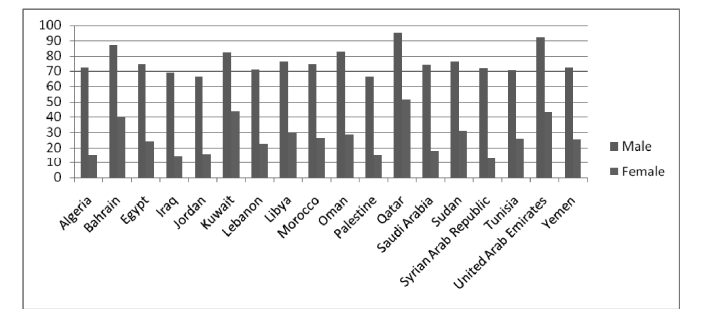
At first glance the GCC countries seem to show higher female participation rates (around 40 per cent), but a closer look reveals a high influence of female foreign labour. Among GCC nationals, women are hardly more active in the labour market than their sisters in other Arab countries. The lowest rate with 14.7 per cent is observed in the Kingdom of Saudi Arabia, while female activity in the other GCC countries broadly correspond to the regional average.
Figure 3: Labour force participation rate in the GCC countries by nationality most recent data
| Country | Male national | Male non-national | Female national | Female non national | Total national | Total non-national | Total |
| Bahrain [9](2010) | 63.2 | 99.6 | 32.3 | 63.4 | 47.8 | 90.4 | 72.0 |
| Kuwait (2011)[10] | 37.0 | 83.0 | 27.4 | 58.5 | 32.1 | 73.4 | 58.7 |
| Oman | .. | .. | .. | .. | .. | .. | .. |
| Saudi Arabia (2012)[11] | 61.5 | 94.4 | 14.7 | 37.1 | 38.1 | 79.7 | 53.4 |
| United Arab Emirates(2009)[12] | 62.5 | 93.7 | 27.5 | 47.7 | 45.1 | 79.0 | 72.4 |
| Qatar(2011) [13] | 63.6 | 98.0 | 34.1 | 58.6 | 48.7 | 91.3 | 86.7 |
The reasons for the absence of women from the formal labour market are not yet sufficiently addressed. Cultural norms of patriarchic societies are often quoted as underlying explanations.[14] These go hand in hand with strict views about what kind of jobs are suitable or not acceptable for women – often reinforced by labour legislation.[15] In some member countries such as Palestine, Iraq, Yemen further reasons may include the prevalence of violence and physical dangers, which impede free movement of especially female workers. Care responsibilities are another factor influencing the female activity rate, especially given the declining but still significant dependency rates in most countries.[16]Unpaid household and care work of women is very insufficiently recognized or recorded. In addition, labour force surveys tend to insufficiently capture marginal work, especially of women.
Other observations lead to the conclusion that the level of education strongly influences labour market activity of women. As female education rises across the region, so does labour market participation. In Lebanon and in Jordan, women with university degrees are more than twice as active on the labour market compared to women with secondary education.[17] Similarly in Palestine, 65 percent of women with more than 13 years of schooling participate in the labour force, compared to 35 per cent of women with education below that level.[18] Male activity rates, by contrast, do not seem to correlate highly with levels of education.
Figure 4: Labour force participation rate by level of education and sex, selected counties (in percentages)

Activité, emploi et chômage, résultats détaillés, 2011;; Lebanon: 2009 data from Lebanon Central Administration of Statistics and UNICEF: Multiple Indicator Cluster Survey Round 3; Jordan 2012 Department of Statistics Employment and Unemployment Surveys; Palestinian Bureau of Statistics 2012: Labour Force Survey Annual report 2011 available from www.pcbs.gov.ps/pcbs_2012/Publications.aspx; UAE 2009 Labour Force Survey available from www.uaestatistics.gov.ae
The complexity of labour force developments may be illustrated by the case of Syria, where substantial growth rates in GDP over 10 years prior to the current conflict did not lead to increased employment, but were accompanied by a surprisingly sharp decline in labour force participation. Although GDP growth rates in the years 2001 – 2010 hovered around six percent annually, total labour force participation declined from 52 per cent in 2001 to 42.7 per cent in 2010.[19] One of the main underlying factors for this rather surprising development was a structural change in the agricultural sector in Syria, caused by changes in the subsidies regime and amplified by the impact of severe drought, which led to substantial job losses, especially for women.[20] Around the same time, increasing numbers of enrolment in secondary education led to the effect that a calculated number of 1,174 thousand individuals dropped out of the labour force.
Similarly in Morocco, labour force participation declined by about five per cent over the past 12 years, to the effect that by the year 2011 less than half of the working age population (49 per cent) were economically active on the labour market. This decline is most pronounced among the higher educated population, where activity rates fell from about 72 per cent in 1999 to 64 per cent in 2011.[21] This development illustrates that the Moroccan economic growth rates between 3 and 8 per cent in the period 2003-2012[22] were not sufficient to integrate the growing working age population, discouraging an increasing percentage of especially the most educated talents.
Figure 5: Morocco, Labour force participation rate 1999-2012, by educational attainment
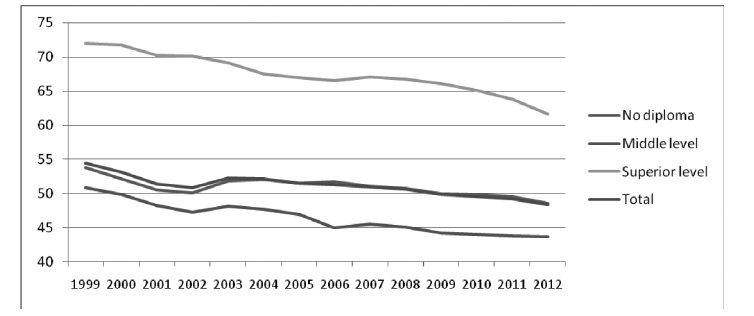
The cases of Syria and Morocco show in a nutshell, how much questions of labour force participation are related to problems of actually utilizing the available labour force, and to the flexibility of labour markets. These are both further salient issue for Arab economies today. Substantial change in the economic structure, like a move away from public sector employment, changes from agriculture to industry and services, but also from low to high productivity industries require flexible adjustment of the workforce and a high capacity of the labour market to quickly re-allocate human resources. If labour markets are too slow and rigid to adjust, structural change results in increased unemployment. In general, the more the labour market is divided and people only move within limited segments of the economy, the smaller is the possibility of the economy to adjust to shocks and changes.
Labour Force Utilization
Almost all economies of the region are marked by fragmentation into multiple segments and highly paradoxical economic and employment structures. The economic sectors with the largest shares in GDP, like the oil and gas industries, provide a rather small share of employment. On the other hand, the industries with the highest shares of employment, like construction, tourism and other services contribute rather small shares to GDP.[23] The result is a split into relatively small segment of secure and rewarding employment in the formal public and private sectors and a large stratum of low-skill, low-productivity, low-value-added jobs. Recent estimates accord to about one third of GDP and two thirds of employment being generated in the informal sector.[24]
Similarly, a limited number of well established and often state owned enterprises are contrasted by a surrounding vast array of micro- and small enterprises (MSEs). The lack of a middle segment of competitive, medium size private sector enterprises points to a difficult business environment where state owned enterprises dominate profitable markets.[25] Existing competition laws, competition councils or antitrust legislation is not effective in preventing preferential treatment in access to land, to finance or in the application of tax legislation. Such practice produces a business environment that is highly unequal and marked by patronage and discretion.[26]
The gap between the two different sides of the economy is also illustrated by a closer look at the development of GDP. While the overall economic growth trends had been encouraging in the region over the past decade, per capita growth rates have not been commensurate with overall GDP growth. The average GDP per capita growth rates over the period 2000-09 had been only 2.5 percent– in contrast to an overall average growth rate of 4.8 percent over the same period.[27]
This comparison shows that higher growth rates are required to accommodate population growth, and it shows the urgent need for a broader economic base, a more diversified economic structure, and for improvements in productivity such that overall growth can translate into a higher standard of living.
Productivity increases, however have been difficult to achieve over the past decades. Over the past years and as far as data are available, Arab countries show stagnating or declining labour productivity – with the notable exception of Syria and Kuwait.[28]This situation reflects the high labour input in economic output, and a generally low knowledge content of a given economy which corresponds to the low-skill, low value added character of the majority of existing jobs, mentioned above.
Table 1: Labour Productivity, selected Arab countries
| Labour Productivity in Mining & Quarrying (in US dollars)(*) | |||||||||||||
| Country | 2004 | 2005 | 2006 | 2007 | 2008 | 2009 | 2010 | ||||||
| Jordan | 44,536 | 44,980 | 51,243 | 54,898 | … | … | … | ||||||
| Kuwait | 4,682,268 | 4,663,553 | 4,429,576 | 3,995,655 | 4,296,896 | 3,138,171 | 2,952,047 | ||||||
| Palestine | 42,976 | 53,356 | 42,208 | 51,603 | 68,029 | 46,338 | 44,296 | ||||||
| Qatar | 1,176,110 | 915,576 | 531,798 | … | 400,414 | 584,860 | … | ||||||
| Saudi Arabia | … | … | 1,016,446 | 977,557 | 986,294 | 919,080 | … | ||||||
| Syrian Arab Republic | 96,023 | 83,489 | 83,435 | 84,441 | 85,367 | 85,847 | … | ||||||
| Tunisia | 114,235 | 122,719 | 113,546 | 141,347 | … | … | … | ||||||
| United Arab Emirates | 993,150 | 898,245 | 983,436 | 875,290 | 808,205 | … | … | ||||||
| (*) Labour Productivity indicates the value added of Mining & Quarrying, including electricity and water supply, per capita in constant 2005 US dollars | |||||||||||||
| Labour Productivity in Manufacturing (in US dollars)(*) | |||||||||||||
| Country | 2004 | 2005 | 2006 | 2007 | 2008 | 2009 | 2010 | ||||||
| Egypt | 11,354 | 11,355 | 11,356 | 11,357 | 11,358 | 11,359 | 11,360 | ||||||
| Jordan | 13,051 | 13,061 | 14,790 | 14,411 | 14,428 | 15,003 | … | ||||||
| Kuwait | 60,029 | 60,431 | 59,369 | 58,143 | 46,823 | 50,274 | 54,677 | ||||||
| Morocco | 16,964 | 18,730 | 17,662 | 18,365 | 19,490 | 20,023 | 20,601 | ||||||
| Oman | 71,515 | 71,516 | 71,517 | 71,518 | 71,519 | 71,520 | 71,521 | ||||||
| Palestine | 10,182 | 10,946 | 8,207 | 9,159 | 9,704 | 8,749 | … | ||||||
| Qatar | 82,466 | 79,493 | 64,900 | … | 62,146 | 70,010 | … | ||||||
| Saudi Arabia | … | … | 47,685 | 48,300 | 48,409 | 47,349 | … | ||||||
| Syrian Arab Republic | 1,730 | 1,697 | 1,614 | 1,895 | 1,915 | 2,187 | … | ||||||
| The Sudan | 14,315 | 14,502 | 15,419 | 16,271 | … | … | … | ||||||
| Tunisia | 11,472 | 12,006 | 11,635 | 11,284 | … | … | … | ||||||
| Yemen | 7,752 | 7,349 | 6,178 | 11,426 | 11,747 | 9,654 | 8,419 | ||||||
| (*) Labour Productivity indicates the value added of Manufacturing per employee in constant 2005 US dollars | |||||||||||||
Taking into account that the knowledge content as well as productivity in sectors like construction, trade or transport often lie far below those shown in Table 1 above further deepens the impression of highly divided economic structures between the extractive and the productive sectors. Available data show that in Egypt, Iraq, Palestine and Yemen between 40 percent and 55 percent of the employed are working in sectors with below-average productivity.[29] Existing industries generate a high demand for uneducated low skill labour, and thus it may come to no surprise that unemployment in Arab countries is especially high among the most educated in the workforce.
In Tunisia, the unemployment rate of persons with secondary education or higher levels of education reaches up to double the national average unemployment rate.[30] Also in Jordan, the unemployment rate of persons with higher and secondary levels of education lies significantly above the rate of workers with lower education. In Palestine and Morocco persons with higher grades of education are more than twice as often looking for work than other people.
Figure 6: Unemployment rates by level of education and sex, selected countries (in percentages)[31]

Interestingly, some recent research for Jordan found that high-skilled Jordanians are often emigrating or working abroad, while the country is importing low-skilled laborers, who are often employed in the informal sector. The import of foreign labour for little benefit or social security undercuts Jordanian wages while at the same time the inflow of remittances increases the reservation wage.[32] Such divergent developments may well constitute an important explanation to the prevailing low employment rates[33] in Jordan, but possibly also in other Arab countries.
Most recent data show that in Egypt, Morocco, Syria and Tunisia only around 40 per cent of the working age population are gainfully employed. In Jordan and Palestine the share lies even lower, around 30 per cent. Compared to other world regions, which lie well above 51 per cent[34] this is a rather low level and it shows how far the societies are vulnerable to economic shocks that might affect their means of subsistence.
Figure 7: Employment rates, selected countries and regions, most recent data in percentages
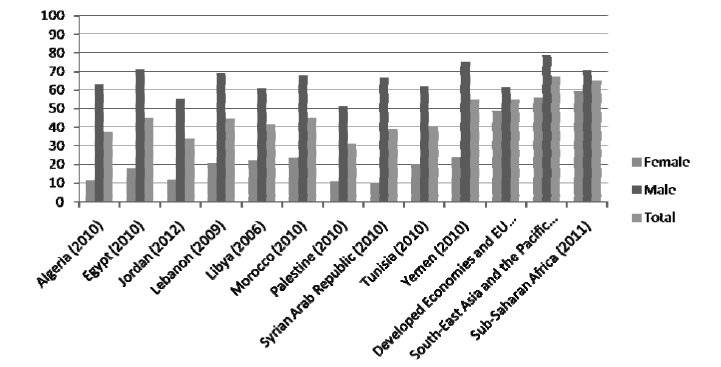
The comparably high employment rates in the GCC countries are again a result of the influence of migrant labour. Looking only at the proportion of the national working age population in employment reveals very low rates, ranging from just above 20 in Bahrain, to about 30 per cent in Kuwait, Saudi Arabia , 38 per cent in the UAE to 48 per cent in Qatar. Most of the GCC countries undertake targeted efforts to improve this balance through various nationalization policies that aim at substituting migrant labour by national workers. However, success has been limited so far. Any future breakthrough will possibly depend on an increased mobilization and integration of the female workforce into the economy, which currently meets the obstacles of labour market segmentation and segregation policies as mentioned earlier.[35]
Figure 8: Employment rates, selected GCC countries, most recent data (percentages)
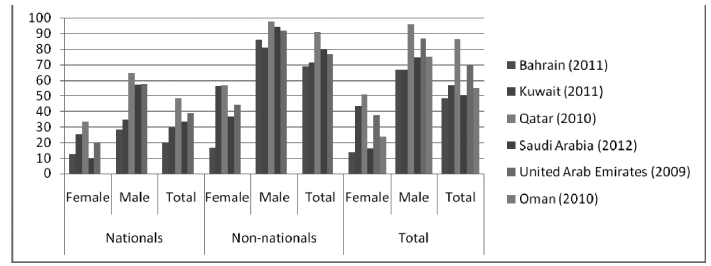
Unlimited availability of cheap labour – be it from abroad or from other regions within a country – reinforces imbalances in the economy and the existing labour market segmentation. The most visible examples of this multiple fragmentation are again the labour markets in some countries of the GCC. In the United Arab Emirates, according to the 2009 labour force survey, mean wages were around only 29.4 per cent of mean income,[36] which reflects huge differences between national and foreign workers, between the public and private sectors, between skilled and non-skilled workers, as well as across the different Emirates within the UAE.
Available data from Egypt, Jordan, Palestine, Syria and the United Arab Emirates all point to higher average wages in the public sector than in the private sector, especially if data from the informal private sector is included. In Jordan the wage distribution exhibits a very wide base of low wages, with the majority of workers (52.6 per cent) making less than JD 300 per month.[37] 14.9 per cent earn less than 200 Jordanian Dinar (JD) a month, while the established minimum wage lies at 190 JD per month. The National Employment strategy of Jordan acknowledges that the large supply of low wage foreign workers creates pressure at the bottom end of the wage scale.[38]
The case of Jordan illustrates that wages in the informal sector tend to be at the lower ends of the wage scales, significantly below those of formal sector workers. The size of the gap varies across countries and amounts to about 10 percent higher wages in the formal sector in Syria to about 50 percent difference among youth in Morocco. In Egypt and Lebanon the gap amounts to 30 percent, and for women in Egypt even to 50 percent.[39] Minimum wage legislation exists in most countries of the region, but is not necessarily always enforced.
Such disadvantages in wages in the informal sector have to be seen in connection to other disadvantages related to higher working hours and less annual leave, poorer working conditions, and especially no coverage by the existing social security systems like pension schemes or health care insurance. In the region almost 70 percent of workers are not covered by social security schemes.[40]
Difficult Times Lie Ahed
Over the longer term, the recent social and political changes in the region may be able to pave the way for solutions to the deeply rooted economic and social challenges facing the countries. But for the moment, difficulties have visibly increased. Employment statistics only highlight a part of the challenges, but they clearly show how the crises directly affect peoples’ lives.
Egypt and Tunisia are in the centre of the ongoing regional changes, and as they are also countries with relatively well established statistical systems, the effects of the crises can be traced. Other countries like Libya, Syria or Yemen are facing even bigger problems, but updated statistics are not currently available.
Unemployment in Egypt rose by 800 thousand people between the last quarter of 2010 and the first quarter of 2011, an increase of about three per cent. Two years on, in the first quarter of 2013, this number has increased even further to 3.6 million people unemployed and looking for work. A similar development challenges the government of Tunisia, where between May 2010 and May 2011 the number of the unemployed rose by 213 thousand people, or by about five per cent of the labour force. Since May 2011 the number of unemployed in Tunisia has slowly started to decline, although the level is still significantly higher than before the political events.
Figure 8: Development of unemployment, Tunisia and Egypt (in thousands)
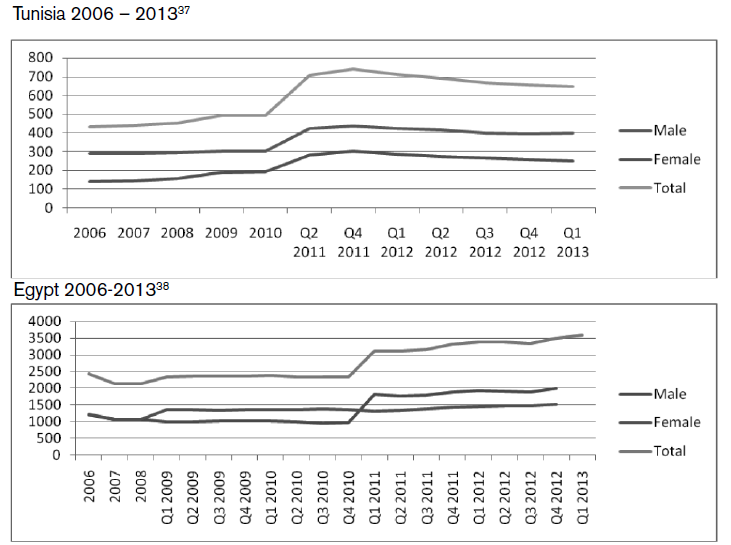
For many governments such as Tunisia, Egypt or Yemen the employment challenges increase at a time when the fiscal space for policy interventions is minimal. Previously, governments intervened into the labour markets in order to provide certain protection against some fluctuations of economic conditions, to support the match between labour supply and demand, to raise the quantity and the quality of human resources available to the economy, and to improve the functioning of the labour market. Instruments employed ranged from reforms of labour market regulation and the overhaul of employment services and training programmes to public works programmes, employment subsidies and the promotion of SMEs.[43]
The potential of such programmes as a quick response mechanism in crisis situations is currently being exploited in Tunisia and in Egypt, where several donors and the Government initiated employment creation through labour intensive work programmes. The focus is on improving the living conditions in disadvantaged regions in the country and in urban areas.[44]
Among the GCC countries, Saudi Arabia has started targeted activation policies to address the low levels of labour force participation among women. By implementing more forcefully a law dating from 2006, Saudi women are now supposed to replace male foreign migrant workers in most of the retail shops catering to women.[45] At the same time, the ministry of labour has started an initiative to encourage women to work from home.[46]
A number of countries have reformed labour legislation, notably Egypt, Oman and Yemen in 2003; Iraq and Qatar in 2004, the United Arab Emirates in 2007; Saudi Arabia in 2005, and Jordan, Kuwait and the Syrian Arab Republic in 2010.[47] Most reforms relaxed the conditions for fixed term contracts, making it easier for employers to adjust their workforce to economic conditions. Several countries also consider introducing unemployment insurance. At present, schemes are effective in Tunisia, Egypt and Bahrain. In Jordan, unemployment insurance is currently phased in as a defined contribution scheme.[48] Saudi Arabia[49] and Oman[50] introduced a programme of unemployment benefits in 2011, and the United Arab Emirates are debating a similar move.[51]
However, new and more radical approaches seem to be required. The persistence of the employment crisis in Arab countries despite of the considerable funds and efforts vested by governments and international donors alike into labour market reform and job creation programmes over the past decade is a source of concern. The MANFORME programme in Tunisia,[52] the Al Manar project in Jordan,[53] Vocational Education projects in Egypt and Morocco, and parts of the MEDA project in Jordan, Lebanon and Syria[54] have absorbed hundreds of millions in financial support. As results remain insufficient and unemployment and especially underemployment continue to unsettle societies, easy answers cannot be expected.
Some analysis suggests that the mentioned reform programmes have created ‘islands of excellence’ but failed to initiate broader systemic change.[55] Systemic change in terms of a structural transformation of Arab economies, diversification away from rents and a move into other technologically advanced sectors has been on the agenda for a while, and in some aspects it is on an encouraging path. The share of the manufacturing sector, as well as services such as telecommunications, trade and tourism are increasing rapidly. Manufacturing is now the second largest sector in Egypt and Jordan.[56] However, many manufacturing enterprises continue the low-skill, low-value-added, low productivity trend in the region – often utilizing foreign migrant labour, which further underlines the rather low knowledge content of the economy.
This discussion leads to the general impression that especially the Gulf States, but to a certain extent also other Arab countries seem to maintain conflicting agendas. On the one hand, almost all development plans and models for the future set the objective of building a knowledge economy and, correspondingly, put high investments in education and advanced infrastructure. On the other hand, however, many countries entertain a business model, which is based on cheap labour, low skills and low productivity. This business model is not able to utilize the growing knowledge and abilities of a young and ambitious workforce. It does not offer attractive jobs to those young people, who have been well educated under great expenses, and as a result these fill the ranks of the unemployed and malcontent.
The availability of cheap labour, often even in combination with subsidized energy resources, does not encourage sufficient investment in innovation and technology to increase creativity and competitiveness to the effect that businesses become dependent on low prices and high factor input, and are unable to survive otherwise. Indeed, recent growth accounting studies have concluded that factor accumulation has been the main source of growth in the region.[57]
Where to Start?
As an entry point into structural change, a corporate dialogue between policy makers and the private sector would be useful. Such dialogue would need to revisit the overall policy objectives and to discuss the development path of the individual countries. In the GCC countries such dialogue would also need to include discussions about the longer-term migration policy. The objective would be to encourage investment that increases competitiveness and labour productivity. Better availability of good jobs in the private sector would also reduce the pressure on public sector employment.
Pressure on public sector employment could also be decreased by a dedicated policy to increase part-time employment. Among other advantages, the overwhelming preference for public sector jobs, especially among women, also stems from the shorter working hours in public administration. Better availability of part-time jobs might accommodate some of these concerns while at the same time mobilizing higher female labour force participation. Care, however, must be given to proper adjustment of social security contributions for part-time jobs and to fencing off underemployment.
Comprehensive regulatory reform is an essential part of a reform agenda. And here a de-monopolization of product markets, dismantling formal and informal monopolies, and equal level application of laws and rules is more important than to further relax employment protection. This would largely benefit small and medium enterprises, which in most countries are the engines of employment growth. It needs to be supported by improved access to finance for SMEs, by legal support services as well as support for better linkages with partners along the value chain. Egypt’s ‘National suppliers Development Programme’ could serve as an example.
With regard to regulation, it may further be important to look into social security. Social insurance laws and institutions are currently important factors that contribute to labour market segmentation as benefits are different, portability is limited, and a large number of employees remain outside of formal social security systems. Also contributions are important cost factors for employers. In order to encourage an expansion of coverage, support labour mobility and decrease costs for enterprises, governments may consider phasing-out fuel subsidies in order to phase-in (or increase) subsidies to social insurance. In the same direction, contribution-based unemployment insurance should better replace the current system of high severance pay. A growing number of countries currently move in this direction.
For the unemployed but even more for jobless workers not covered by unemployment insurance, public employment services can do more to help people into employment. A larger network of offices, better integrated with cash transfer programmes, qualification, training or enterprise support programmes, and in close partnership with the private sector can help governments to broaden their social policy infrastructure to deliver targeted support. And here it is essential that workers in the informal sector are more actively engaged. Creative solutions need to be found how experience and qualifications gained in the informal sector can be formalized to bridge the gaps in the labour market.
Overall labour market governance is too often neglected. This concerns the important roles of employers’ and workers’ syndicates for the functioning of the labour market, its transparency and its rules. For the government they would be indispensable partners in the corporate dialogue mentioned above, but also for any improvement of the public policy infrastructure. Public policy instruments ranging from employment services to vocational training, public works programmes or employment subsidies would ideally be consulted and shaped in continuous dialogue with the partners in businesses and workers representatives.
And finally, better labour market information systems, better statistical data and more substantial information about the informal sectors are a condition for targeted policy interventions. This includes better access to high quality and detailed statistical data beyond policy circles for all interested parties, including academia and private sector companies.
References
Abu-Qarn, A., Abu-Bader, S. Sources of Growth revisited: Evidence from Selected MENA Countries, in: World Development Review Vol. 35, No. 5, 2007
Aita, S. 2009. Labour Markets Policies and Institutions, with a Focus on Inclusion, equal Opportunity and the Informal Economy. National Background Paper. The Case of Syria.
Al Subauhi, Th. Push for jobless Emiratis to be paid unemployment benefits in UAE. Article in The National. 2012
Allam, A. 2012. Saudi Arabia looks to Female workforce. Article in Financial Times. 2012. London
Arabian Business.com 2013 Libya bucks trend for female unemployment, http://www.arabianbusiness.com/libya-bucks-trend-for-female-unemployment-450358.html accessed 14-6-2013
Bahrain. Central Informatics Organization (CIO). Governorate Indicators, Labour Force. 2010 Census. Available at http://www.cio.gov.bh/cio_eng/SubDetailed.aspx?subcatid=563
CAS and UNICEF. 2009. Multiple Indicators Cluster Survey. Round 3. 2009. Lebanon
Central Administration of Statistics (CAS) and United Nations Children’s Fund (UNICEF). 2009. Multiple Indicator Cluster Survey (MICS), Lebanon Round 3, 2009
Central Agency for Punlic Mobilization And Statistics (CAPMAS). 2012. Quarterly Labor Force Sample Survey (2006-2012). Egypt. Available at http://www.capmas.gov.eg/pepo/Labour%20Force/sdds_lb2_e2.pdf
Central Bureau of Statistics (CBS). 2011. Labour Force Survey. Annual Report 2011. Palestine. Available at http://www.pcbs.gov.ps/pcbs_2012/Publications.aspx
Central Bureau of Statistics. 2010. The Annual Abstract 2010 and 2011. Syria. Available at http://www.cbssyr.org/index-EN.htm
Central Bureau of Statistics. Fifth Population and Housing Census 2008. Sudan. Available at http://www.cbs.gov.sd/en/node/15
Central Department of Statistics and Informations (CDSI). Manpower Research Bulletins 2012. Available at http://www.cdsi.gov.sa/socandpub/manpower . Saudi Arabia
Central Informatics Organization (CIO). 2011. The Statistical Abstract. 2011. Bahrain. Available at http://www.cio.gov.bh/CIO_ENG/SubDetailed.aspx?subcatid=119
Central Informatics Organization (CIO). 2013. Governorate Indicators. Bahrain. Available at http://www.cio.gov.bh/cio_eng/SubDetailed.aspx?subcatid=563
Central Organization for Statistics. 2011. Iraq Knowledge Network, Labour Force Factsheet. 2011. Iraq. Available at www.cosit.gov.iq
Central Statistical Bureau. 2011. The annual Statistical Abstract. 2011. Kuwait. Available at http://www.csb.gov.kw/Socan_Statistic_EN.aspx?ID=18
Central Statistical organization Yemen 2009, Labour Force Statistics, www.cso-yemen.org, accessed on 16-3-2013
Department for International Development and World Bank. 2003. Knowledge and Skills in the MENA Region, Tunisia. Washington: World Bank.
Department of Statistics. 2011. Population and Housing Surveys. Employment and Unemployment Survey 2011. Jordan. available from http://www.dos.gov.jo/dos_home_e/main/index.htm accessed on 18/9/2012
Department of Statistics. 2012. Population and Housing Surveys. Employment and Unemployment Survey 2012. Jordan. Available at http://www.dos.gov.jo/dos_home_e/main/index.htm accessed on 18/9/2012
ESCWA 2010. Women’s Control Over Economic Resources and Access to Financial Resources. Arab Women and Development Series, No.36. Beirut: United Nations
ESCWA 2011. Compendium of Social Statistics and Indicators, 2010-2011: Arab Society, Issue No. 10. Beirut: United Nations. Available at http://www.escwa.un.org/divisions/sd/pubs/default.asp
ESCWA and IDMO. 2012. Bulletin of Industrial Statistics for Arab Countries 2004-2010. Issue No. 7. Beirut: United Nations
ESCWA 2012a. Addressing Barriers To Women’s Economic Participation in the ESCWA Region. Beirut: United Nations.
ESCWA 2012b. Integrated Social Policy Report IV: Labour Markets and Labour Market Policy in the ESCWA Region.Beirut: United Nations. Available at http://www.escwa.un.org/information/pubaction.asp?PubID=1110
ESCWA 2012c, Active labour market policy in Arab countries, Beirut
European Training Foundation (ETF). 2006. Employment Policy Reforms in The Middle East And North Africa. Italy: ETF
European Union, MEDA Programme. 2013. Accessed from http://europa.eu/legislation_summaries/external_relations/relations_with_third_countries/mediterranean_partner_countries/r15006_en.htm on 12/2/2013
Gatti, R. (ed). 2011. Striving for Better Jobs. The Challenge of Informality in the Middle East and North Africa Region. Overview. World Bank.
General Authority Information. 2006. Population Census 2006. Final Results. Libya. Available at http://gia.gov.ly/modules.php?name=Mygroups&file=articles&topicid=16&gid=21
Global Extension of Social Security (GESS). Social Security Profile. Jordan, Tunisia, Egypt and Bahrain, http://www.social-protection.org/gimi/gess/ShowRegionProfile.do?rid=10 accessed 10-2-2013
Haut Commissariat au Plan (Direction de la Statistique) 2011 Activité, emploi et chômage, résultats détaillés, Rabat, Morocco
Haut-Commissariat Au Plan (HCP). 2012. Activité, Emploi et Chômage, résultats détaillées. 2011. http://www.hcp.ma/downloads. Morocco.
Haut-Commissariat Au Plan (HCP). 2012. Enquête Nationale sur lémploi. 2011. Available at http://www.hcp.ma/Enquete-nationale-sur-l-emploi_a89.html. Morocco
Haut-Commissariat Au Plan (HCP). 2012. Indicateurs & Agregats. Activité. Taux dáctivité national selon le diplôme. http://www.hcp.ma/Taux-d-activite-national-selon-le-diplome_a370.html. Morocco
Haut-Commissariat au Plan 2013 Taux d’activite national selon le diplome , accessed from www.hcp.ma/Taux-d-activite-national-selon-le-diplome_a370.html, Morocco
ILO . 2012. ILO, EU and Tunisia sign ambitious programme on employment creation. Article in ILO Newsletter, Issue No.3.2012. Geneva: ILO
ILO and UNDP. 2012. Rethinking Economic Growth: Towards Productive and Inclusive Arab Societies. Geneva: ILO
ILO. 2010. LABORSTA. Available at http://laborsta.ilo.org
ILO. 2011. LABORSTA. Economically Active Population, Estimates and Projections, Seventh Edition. 2011. Availiable at http://laborsta.ilo.org/applv8/data/EAPEP/eapep_E.html
ILO. 2013. Global Employment Trends 2013, Recovering from a second jobs dip. Geneva: ILO
IMF. 2011. Oman -2011 Article IV Consultation Concluding Statement of the IMF Mission. 2011. Available at http://www.imf.org/external/country/OMN/index.htm
IMF. 2012. Libya-Staff Visit Concluding Statement. 2010 estimates.
International Social Security Association (ISSA) 2013 Country Profiles, http://www.issa.int/Observatory/Country-Profiles
Jordan: Department of Statistics Employment and Unemployment Surveys, multiple years, www.dos.gov.jo/dos_home_e/main/index.htm accessed on 15-4-2013
Kingdom of Jordan. 2012. National Employment Strategy 2011-2020. Ministry of Planning and International Cooperation and Ministry of Labor.
Knickmeyer, E. Saudis Push Young People, Including Women, Into Jobs. Article in The Wall Street Journal. 2012
Kuwait. Central Statistical Bureau (CSB). Annual Statistical Abstract 2011. Chapter six, Employments and Establishments. Available at http://www.csb.gov.kw/Socan_Statistic_EN.aspx?ID=18
Lebanon Central Administration of Statistics and UNICEF: Multiple Indicator Cluster Survey Round 3, 2009;
Moghadam M. Valentine. 2010. Women, Structure, and Agency in the Middle East: Introduction and Overview to Feminist Formations’ Special Issue on Women in the Middle East.Volume 22, Issue 3, 2010.
Nasser, R. and Mehchy, Z. 2012, Determinants of Labour Force Participation in Syria (2001-2010). Working Paper No.698.
National Bureau of Statistics (NBS). 2009. Labour Force Survey Report. Annual Report 2009. United Arab Emirates. Available at www.uaestatistics.gov.ae/ReportDetailsEnglish/tabid/121/Default.aspx?ItemId=1850&PTID=104&MenuId=1 accessed on 10/5/2012
National Bureau of Statistics 2009 Labour Force Survey, Monthly Mean and Median wages and Monthly Mean and median income, UAE accessed on 18/10/2012 from www.uaestatistics.gov.ae/ReportDetailsEnglish/tabid/121/Default.aspx?ItemId=1850&PTID=104&MenuId=1
National Centre for Human Resources Development, Jordan. 2008. Al Manar Project. Available at http://www.almanar.jo/almanaren/WhoWeAre/tabid/168/language/en-US/Default.aspx
National Institute of Statistics, 2012. Employment National Survey 2011.(Table 26 and 36).Tunisia’s Statistics. Tunisia. Available at http://www.ins.nat.tn/indexen.php
National Institute of Statistics, 2012. Most Recent Indicators. Employment. Tunisia. Available at http://www.ins.nat.tn/indexen.php
Oman Ministry of National Economy 2008 Labour Force Survey
Palestinian Bureau of Statistics 2012: Labour Force Survey Annual report 2011 available from www.pcbs.gov.ps/pcbs_2012/Publications.aspx
Palestinian Central Bureau of Statistics, Labour force survey 2011, available from www.pcbs.gov.ps/site/881/default.aspx#Labour accessed 15-3-2013
Statistics Authority 2010 Census of population and housing and establishments 2010 accessed from www.qix.gov.qa/portal/page/portal/qix/subject_area/Publications?subject_area=181 on 10-3-2013
Statistics Authority. Annual Bulletin of Labour Force Sample Survey. 2011. Qatar. Available at http://www.qix.gov.qa/portal/page/portal/QIXPOC/Documents/QIX%20Knowledge%20Base/Publication/Labor%20Force%20Researches/labor%20force%20sample%20survey
Sudan: 2008 Census, available from www.cbs.gov.sd/en/node/15
Sugita, S. 2010. Social Care and Women’s Labor Participation in Lebanon. The Institute for Women’s Studies in the Arab World, Lebanese American University, Al Raida, issue 128, winter 2010.
Syrian Arab Republic 2010 Annual Statistical abstract http://www.cbssyr.org/index-EN.htm
Syrian Arab Republic 2011 Annual Statistical abstract http://www.cbssyr.org/index-EN.htm
The Ministry of National Economy. Manpower 2008. Oman
The National Bureau of Statistics. Labour Force Survey 2009. United Arab Emirates. Available at http://www.uaestatistics.gov.ae/ReportsByDepartmentEnglish/tabid/104/Default.aspx?MenuId=1
The World Bank.2009. From privilege to competition. Unlocking Private-Led Growth in the Middle East and North Africa. Washington DC 20433: The World Bank
UN-DESA, Population Division. 2010. World Population Prospects. The 2010 Revision. Online database available at http://esa.un.org/wpp/unpp/panel_population.htm
United Arab Emirates. National Bureau of Statistics. Labour force 2009. (Table 11). Available at http://www.uaestatistics.gov.ae/ReportDetailsEnglish/tabid/121/Default.aspx?ItemId=1850&PTID=104&MenuId=1
Wahba, J. 2012. Immigration, Emigration and The Labor Market In Jordan. Working Paper No.671. Economic Research Forum
World Bank 2009 From privilege to competition, Washington
World Bank 2011, Striving for better jobs, Washington
World Bank: World Development Indicators, Morocco, Accessed 14-6-2013
World Economic Forum (WEF) and OECD. 2011. Arab World Competitiveness Report 2011-2012. Geneva: World Economic Forum.
The Always Difficult Labour Market Reforms
Yousef Qaryouti, Director of Decent Work Team (DWT) Cairo Office for North Africa, ILO
“The best anti-poverty program anyone has ever seen is the creation of an institutional environment in which human beings are able to make maximum use of the talents with which they are endowed.[58]”
Introduction
Despite the North African sub-region having witnessed considerable progress in some human development indicators in recent years, challenges mainly relating to inequality and exclusion remain. Gender discrimination, considerable local differences in economic development within countries, and unequal access to services and education are some expressions of this. Increasing inequality and exclusion were indeed amongst the driving forces behind the demonstrations in the streets of all countries in the sub-region, most importantly in Egypt, Tunisia and Libya. Besides these issues limited freedom, lack of social justice, undemocratic regimes, weak civil society, and undemocratic decision processes were claimed to be missing, turning societies into places people did not appreciate living in. In one way or another, many of the deficiencies in these societies were and continue to be related to the labour market and the limited access to, and availability of, decent work for people in the sub-region. Therefore, addressing labour market issues through the provision of decent jobs can help respond to the aspirations of people and add to building the basis for democratic, peaceful regimes[59].
Labour Market Situational Analysis in North Africa
Notwithstanding solid growth rates and successful economic reform processes in some areas before the economic and financial crisis in 2008/2009 and in spite of quick consolidation in the aftermath of the crisis, the labour market situation in North Africa remains challenging. It is widely recognized that these
labour market challenges are structural in nature rather than cyclical. Moreover, the turbulent political transformation processes in the aftermath of the Arab Spring has been unable to lay the ground for finding solutions in the future, given the destruction of production sites, the damage done to infrastructure especially in the case of Libya, the losses following serious disruptions in production and exports, stock market turbulences, capital flights, as well as migration flows caused by the changes could very likely lead to a further deterioration of the labour market situation in the short term. These immediate disturbances need to be addressed urgently in order to ensure that they do not add to the longer-term challenges, characterized as followed:
1) Low employment-to-population ratios and high unemployment rates especially for young people and women and across all levels of education
Employment-to-population ratios – a good indicator of how effective a country uses its productive potential – in North Africa are amongst the lowest in the world. This is mainly due to the low ratios for young people and women. The overall ratio stood at 44.1 per cent in 2012 (compared to a world average of 60.3 per cent). This means that out of 100 people that could potentially work, not even half of them did in North Africa. Even though some of the non-working people might be in education, this share still creates an unnaturally high employment dependency ratio: Every job owner has to cater for him- or herself and roughly three other people.
Despite some variations amongst countries levels of unemployment are extremely high in the sub-region (10.3 per cent in 2012), once more especially for women (17.2 per cent) and young people (23.8 per cent). Young women face the highest unemployment rate of all groups with 37.0 per cent. Overall the situation for women is particularly worrisome given that they only participate in labor markets in small numbers. Young people’s risk to be unemployed is four times higher than adults’ risk. Thereby, young people in North Africa carry the second highest unemployment risk in the world compared to adults and due to the economic downturn after the Arab spring they face the second highest youth unemployment rate in the world.
Unemployment is a feature that appears across all income groups. Given that educational levels and income per household are closely linked, it also indicates that highly educated people are affected by unemployment just as much as those with lower education – a phenomenon which is unique in the world. In some countries in the sub-region, unemployment amongst the highly skilled is even higher than among the low-skilled.
This generates frustration amongst highly educated young people and their families who invested a lot in their children’s education, especially when education does pay off in other regions. This frustration became visible during the social unrest across some countries in the sub-region at the end of 2010 and beginning of 2011, which was dominated by young educated people. And until today young educated people continue to fight for their right to find decent employment opportunities across the sub-region.
3) Insufficient number of high quality jobs
Almost four out of ten people working in the sub-region in 2012 had a vulnerable job, working either as own-account workers or as unpaid contributing family workers. The share is even above 50 per cent in Morocco. In all countries the share is considerably higher for women than for men. Wage and salary work – the type of job with a higher likelihood of being decent – has not increased considerably over time.
4) Slow structural shifts
Sectoral shifts have been relatively small in the recent past. In North Africa, agriculture continues to play strong role, accounting for almost one third of all employed people in 2012. This important sector has only recently attracted the attention of policy makers as a source of employment creation and a good starting point for sustainable poverty reduction. The largest sector is the service sector which accounts for almost 50 per cent of overall employment. In the majority of countries in the sub-region, working in the service sector does not guarantee decent employment as many jobs in this sector are of very poor quality and pay low salaries. Examples of this are jobs in the tourism sector and domestic worker jobs which are often in the informal sector.
5) High share of public sector employment
A characteristic feature of the sub-region is the entrenched belief in, and the practice of, the direct role of the public sector in job creation. The Government is seen as the employer of first choice as well as that of last resort. Public sector reforms and policies to encourage privatization and to support private sector development, introduced recently in several countries in the sub-region, have not yet succeeded in changing this ideology. Workers are still not convinced of the attractiveness of the private sector even in cases where the private sector pays higher wages and provides additional social security. According to
2004 data, in the Middle East and North Africa Region, the public sector represented some 29 per cent of total employment, and wages represented some 38 per cent of current expenditure, in which is almost double the world average (excluding China). More recent data at the country level indicates little changes in these shares. However, variations between countries are considerable: Whereas in Egypt
Government employment counts for almost 40 per cent of total employment, it is only around 20 percent in Algeria and even less in Morocco with a share of around 10 per cent.
6) Limited growth in productivity
The increase in productivity levels (measured as output per worker employed) in the sub-region has been minimal in recent years, especially when compared to other regions in the world. Whereas productivity in North Africa has increased by 22.2 percent over the last two decades, the increase was 356.7 per cent in East Asia, leading to a situation in which the productivity level of East Asia will become higher than that of North Africa within the next years. This limits future growth in two ways: First, there is very little room for wage increases which has a negative impact on demand as well as on levels of household investment in education and health. Second it gives little incentives to investors to invest in these countries when at the same time there are countries with productivity increases that are much higher.
The fact that the majority of jobs created in North Africa were low productivity jobs is reflected in the relatively high share of working poverty at the US$2 a day level, which stands at around 40 per cent. Most of these people who despite their work live with their families in poverty work in the informal sector, far removed from decent and productive employment. Increases in productivity in the sub-region are usually achieved through investments in technology, often accompanied by shedding of labour. Increasing productivity through better working conditions, organizational innovations, pro-workers policies and practices, respect for workers’ rights, improved enabling environment for sustainable enterprises, gender equality, social dialogue and fundamental investments in health and physical infrastructure have so far seldom been the path taken. Also, achievements in education across the countries have not led to satisfactory growth in productivity.
7) Weaknesses in social dialogue
The presence of social dialogue based on freedom of association and collective bargaining is stronger in
most countries of North Africa than it is for the rest of the Arab world, but weaknesses remain particularly in Egypt and Libya. Even though all countries in North Africa have ratified at least some, if not all conventions related to social dialogue, freedom of association and collective bargaining, they still lack implementation and enforcement. The right to organize was in the past exposed to several violations as sometimes employers rejected the principle of negotiation. In these cases, trade union activists risked being harassed and even sued. In the past Governments also often tried to limit social dialogue and restrict it to negotiations on salaries or working condition demands, with little regard to larger socioeconomic development goals and other issues such as employment, education and the state’s relationship with society and the economy. Until today, and despite the Arab Spring, social dialogue is often limited and not practiced on a regular and institutionalized basis.
The Maghreb countries (excluding Libya) were strongly influenced by the French system of social dialogue. Laws derived from the French legislation guarantee the right to organize, to strike and to negotiation. In Tunisia, Algeria and Morocco, trade unions had some independence that enabled them to play a fundamental role in the battle against the occupation and after that in the building of State institutions and labour legislation whereby basic rights for workers were ensured. Also, employers’ organizations in these countries are relatively developed and active compared to others in North Africa.
8) Limited social protection
Social protection schemes, including social security, wage regulations, working conditions and occupational safety and health regulations, exist in all countries in the North African sub-region in different forms and with different scope. The level as well as the coverage is much higher than in the rest of Africa (especially regarding working conditions and occupational safety and health conditions in the Maghreb countries) and significant progress has been observed in recent years. This is one of the reasons behind the improved human development indicators in the sub-region. Despite this, the challenge of social protection still exists, failing to always cover the most vulnerable to such an extent that they are in a position to escape their vulnerable situation.
Regarding social security, the sub-region of North Africa spends around 11 per cent of GDP on social security. This is the third highest share of GDP spent on social security in all world regions (excluding spending on health security systems which is relatively small compared to other regions, with 2.5 per cent of GDP). However, the challenges are particularly high for social security schemes as a result of the political transformation process but also as a result of demographic developments. The demands on the systems have increased to a level whereby systems are at risk of being overburdened. Besides this, social security in the North African sub-region faces a series of other common concerns, including the increased migration of workers, the expansion of informal economies, the future of health-care coverage, governance, investment strategies and fiscal space limitations, especially in the “revolution” countries of Egypt and Tunisia. In Libya a new social security system needs to be built from scratch, but hopefully resources will be made available to build a solid system.
One important part of social protection is wages. Given the low increases in productivity, there has been little room for wage increases in the past decade in all of the countries where data are available. Most of the jobs created have been in the informal sector with wages too low to even guarantee that people can live with their families outside of poverty. Even in the fastest growing sector, the service sector, many jobs are of low quality and in the informal sector. And even formal service sector jobs, especially in the education and health sectors, are low paid compared to international standards. Given that these jobs are mainly occupied by women, this is another area of discrimination. Also, wage gaps between men and women are observed in all countries where information is available. Minimum wage legislation exists in most countries but is only functional in Tunisia. In Egypt – prior to the revolution – due to a court decision, the minimum wage increased after 25 years of being far below a level that would ensure people could escape poverty, but so far implementation has not taken place. In all countries in the sub-region the public debate on minimum wages has started in the aftermath of the Arab Spring, however so far there have been no legally endorsed changes.
9) Poor quality of education systems
Despite there being large differences in the quality of education between countries in the sub-region, there are common complaints. One primary issue regarding the quality of education in all levels, including vocational education, is that the type of knowledge needed by workers in competitive labour markets is not produced.
Across the North African sub-region, employers often identify the lack of the right skills as one of the most important barriers to expanding business and employment, however, this level of concern does not appear to be matched by a similar level of commitment to provide on-the-job learning opportunities.
The sub-region has the lowest incidence of formal training at the workplace. Vocational training in the sub-region was already at significantly lower shares when compared to secondary education. Vocational training was only attended by 27 per cent of young people in education in Egypt, 22 per cent in Libya, 12 per cent in Algeria, 8 per cent in Tunisia, and 6 per cent in Morocco. The relatively large share of academic secondary education reflects social preferences for academic pathways but also indicates the low quality of vocational training. Also, diplomas attained in the sub-region are often not recognized internationally which makes migration rather difficult especially for highly educated young people.
10) Weak performance of public employment services and absence of a regulated framework for private employment agencies
Public employment services are chronically understaffed and do not have the means and the knowledge to provide good services. In a situation where neither the labour demand side nor the labour supply side work properly, having an insufficient “matching system” increases the difficulties for people to find jobs and employers to find suitable workers. The absence of a regulatory framework for private employment services on the one hand increases the risk of abuses and fraudulent practices, and on the other, it unnecessarily limits the labour market intermediation to underperforming public services and to informal networks. Once again the capacities of employment services vary considerably across the sub-region, so does the intention of Governments to improve their performance. Whereas in Tunisia and Morocco there is a strong commitment towards improving the services, other Governments do not invest in them at all.
11) Non-conducive environment for MSMEs
Creating and starting their own business is often not an option for people in the sub-region. This is the result of a weak entrepreneurship culture, insufficient capacities of people to open and run businesses, and also the result of a non-conducive business environment across the countries of the sub-region. Especially for young people it is difficult to get financial support and also non-financial support is week in all countries. Contrary to these facts, all countries see MSME creation as one of the most important sources of employment creation.
12) Mismanaged migration flows
Migration in the sub-region could offer possibilities for many people. However, this opportunity is often not used, or when used, leads to unfortunate situations for the migrants. This is the case for migrants coming to the sub-region, but also for migrants within and outside of the sub-region. Many migrants end up with poor quality jobs, no social protection and no respect for their rights. This is mainly the result of poor management of migration policies and related management systems.
The economic and financial crisis in 2008/2009 as well as the recent economic crisis in Europe further limited the chances of people to find jobs outside of the sub-region. Also, the violent uprising that toppled the old political regime in Libya – an important destination for migrants from Tunisia and Egypt – had a negative impact on migrant workers and their families.
13) Considerable local disparities
In all countries covered by this strategy local disparities become obvious in the degrees of poverty one finds in a single country. Lack of infrastructure, limited access to services and education and unequal access to information technologies are some of the causes for inequality within countries. The disadvantaged regions are caught in a viscous cycle whereby their disadvantaged position hinders them from improving their situation which in turn prevents them from increasing their productivity, leaving no room for income increases, thus further fostering their weak position.
14) Limited existence of solid analysis of labour markets and of labour market policies
Due to limited availability of information on the labour market, both data analysis and policy making is very difficult in the sub-region. As a result, policies made are often not based on facts. It is also difficult to properly assess the impact of labour market policies given the limited availability of transparent and
up-to-date information.
15) Labour legislation not in accordance with International Labour Standards (ILS) and/or ILS are not implemented
Some of the labour market deficiencies are also a result of labour codes and labour legislations not often being in accordance with International Labour Standards. Ratification of ILO Conventions has been very slow with implementation often weak. This is particularly the case for Conventions related to social dialogue, social protection systems, labour market governance and employment policy. Problems of implementation of these standards have been accentuated in the sub-region by the financial crisis and halted altogether by subsequent freezes in application due to uprisings in some of the countries in the sub-region. This has most likely had a strong impact on workers whose rights are most precarious or vulnerable, such as women, youth, migrant workers and the disabled.
Aside from all these structural issues, the current social movements and political transformation processes in many countries in the sub-region have added to the difficult situation. The challenge is to overcome the short-term negative impact of the transition and to assist the countries in their democratization processes, which in the long-run will lead to more freedom, better working conditions and a participatory approach on the way to ensure decent work for all. In detail, the short term negative impacts include:
- Destruction of production sites and damage done to infrastructure, especially in the case of Libya;
- Economic losses following serious disruptions in production and exports, stock market turbulences and capital flight;
- Migration flows, and the related human resource drain on the one side, and additional pressure on labour markets as a result of inward migration on the other;
- Withdrawal of foreign direct investment (FDI) as a result of the increased insecurity in some countries;
- Increasing demands on social security systems;
- Political instability and uncertainty.
The Way Forward to Decent Work for Stability and Socioeconomic Progress
Economic growth in North Africa turned negative in 2011, in some countries as a by-product of the Arab Spring. There was a near-collapse of economic activity in Libya, and deceleration of growth in all countries in the region except Morocco. Economic growth in Egypt dropped from 5.1 per cent in 2010 to 1.8 per cent in 2011 and remained low at 2.0 per cent in 2012, while Sudan registered negative economic growth (-11.2 per cent) in 2012 following the independence of South Sudan in 2011. In 2013, economic growth in the region s projected at 4.4 per cent, subject the down side risks arising from continuous political uncertainty in some economies as well as depressed demand from the nearby Euro area. The unemployment rate is projected to remain elevated at 10.3 per cent in 2013, which underlines the urgent need inclusive decent work. North Africa faces several other labour challenges besides the lack of employment opportunities. Although levels of working poverty at the US$1.25 a day poverty line are low in the region, the working poverty rate at the US$ 2 a day is still high. In 2012, 19.7 per cent of the employed was living with their families below this poverty line. Furthermore, the vulnerable employment rate in 2012 amounted to 41.4 per cent, indicating a high proportion of workers in informal working arrangements and without adequate social protection. More than half of female workers are in vulnerable employment (61.2 per cent) compared with slightly more than one out of three men. Vulnerable employment in the region is expected to remain high[60]. Three important labour market strategies/policies are outlined hereunder to mitigate against the adverse political situation in some Arab Spring countries as well as pave the way for much needed structural adjustments in the labour market to reverse the entrenched inherent challenges.
- Creating opportunities for young women and men and the most rate vulnerable
- Public works programmes and employment intensive investment with an emphasis on local economic development/recovery implemented
The Employment Intensive Investments should work with Governments, employers and workers’ organizations, the private sector and community associations in orienting infrastructure investments towards the creation of higher levels of productive employment. This, in turn, leads to the improvement of access to basic goods and services for the poor. Ensuring local participation throughout the project cycle and combining the utilization of locally available skills, technology, materials and appropriate work methods has proven to be an effective and economically viable approach to infrastructure works in the short-term as well as in the longer run.
- MSMEs, social economy organizations (especially cooperatives and social enterprises) and income generating activities supported
Through strengthening the capacity of people to start and improve and/or expand their own businesses and income generation activities, as well as cooperatives, through training on entrepreneurial skills and coaching of young entrepreneurs, people will be in a position to create and run their own job. Capacity of intermediary organization (GOs, NGOs, associations, and business development service providers) should be built to continue the delivery to the final beneficiaries. At the same time, an enabling and conducive environment should be created and strengthened and business services should be improved. Social economy organizations such as cooperatives, collective enterprises and community-based associations are particularly appropriate in post-crisis and transformation situations and play a key role in mitigating future crises. This is why a specific focus should be put on the support of such organizations in the short as well as in the long run. Both approaches – SME development and social economy approaches – have the advantage that while creating job opportunities they are important means to empower people and when well designed and supported can become additional systems of social protection.
c. Employment services and job insertion schemes strengthened
Through reinforcing the number and competences of staff the capacity of Public Employment Services (PES) to organize (central level) and deliver services (local level) should be strengthened. The PES should thereby be in a better position to scope demand and canvass vacancies at the local level as well as to provide job seekers with services of guidance, placement, self employment creation and quick reskilling.
In addition, to augment the enrolment of youth into job insertion programmes, particularly apprenticeship schemes, access modalities should be enlarged, incentives to enterprises to employ youth under the schemes should be provided and employment finalization by the enterprises should be supported.
The short-term interventions should lead into long-term interventions in the attempt to increase the essential contribution of employment services and job placement systems needed to play in improving the labour market situation in countries.
The medium- to long-term intervention should focus on a more effective participation by employers in
TVET. TVET systems need to better connect education to technical training, technical training to labour
market entry and labour market entry to workplace and lifelong learning. Moreover, employment services and labour market information provided by Government agencies are needed, so is the cooperation with private agencies to make training institutions capable to anticipate future needs. Improved career guidance to young people should also become essential. Other issues to be tackled should be workplace learning and commitment by employers and workers to take advantage of such opportunities; attention by Government programmes and by TVET institutions to expand the range of occupations and industries available to young women in order to diminish occupational segregation and improve their labour market participation and employment; and partnerships between Governments and social partners to work in the framework of social dialogue to promote the integration of skills development into economic and social development strategies.
d. Employment policies at national and sub-state level developed and/or improved
In the case of countries undergoing political transformation processes it should be essential to quickly build the capacity of stakeholders to understand how to design and implement well functioning labour market policies. In countries where the process of designing and implementing labour market policies is ongoing, capacity gaps of stakeholders need to be identified and closed. One of these gaps is the limited capacities on evaluating policies and programmes.
In order to be able to find gaps in the legislation, employment policies and their impact need to be analyzed. In addition, a review of current labour codes regarding their compliance with International Labour Standards is needed. Special attention should be given to wage legislation and working condition matters. Countries should be assisted in designing and improving national and sub-national employment policies. All employment policies need to be based on solid labour market information which is why the building of better functioning labour market information and analysis systems should be an essential part of this output.
e. Labour governance and labour administration improved
While ensuring that good polices should be in place, it should be important at the same time to build and strengthen the institutions needed for enforcement. Labour inspection and administrations systems play a key role in this regard. Based on a thorough review of labour inspection and administration systems, gaps should be identified where interventions and improvement are needed. Support should be provided to strengthen the institutional organization and management of both labour inspection and administration systems. Regarding labour administration systems, assistance in strengthening the influence of labour administrations on national economic and social policy should be provided. Regarding labour inspection systems, assistance should be provided to modernize and support implementation of these systems.
2. Empowering social partners and other stakeholders through social dialogue
a. Social dialogue strengthened through the support of social dialogue institutions
Strong social dialogue institutions are the basis for well-functioning social dialogue. Requests have been submitted to the ILO to help strengthen social dialogue institutions by countries in the sub-region. Careful evaluation is needed to find out which of the existing institutions are in a position and willing to really contribute to social dialogue, especially in the countries that are currently undergoing a political transformation process. If need be, new social partners’ organizations need to be supported to ensure real freedom of association and collective bargaining.
b. Capacity built of social partners at the national, sectoral and sub-national level with a special focus on crisis response mechanisms, negotiation skills and International Labour Standards
In the case where old structures are not in force anymore as a result of the transformation process and where new structures are created that need to be involved in social dialogue but also in the case where the old structures continue to be in force it should be essential to (re-)enforce the capacities of social partners on crisis resolution. It should also be necessary to facilitate an internal dialogue within the different groups of social partners through the creation of a common platform of action to contribute to crisis resolution. It should be important to incorporate other organized representative stakeholders on the process of an extended social dialogue which should revise priorities to move towards the resolution (or prevention and preparedness) of crisis. Employers’ and workers’ organizations should be in a better situation when negotiating with the Government. This will lead to a more balanced social dialogue process which in turn should decrease the risk of unbalances in policy making.
Whether during the political transformation process or the ongoing process of labour market reforms, the processes need to be guided by International Labour Standards which are the effective tools and useful guidance in developing good policies. This is why it will be essential to build the capacity of the social partners in these areas.
c. Organization of other social stakeholders supported, such as informal sector workers,workers in rural areas and other vulnerable groups (especially amongst young people and women)
The establishment of voluntary, democratically-managed and economically self-sufficient organizations
and associations at the local level should be an important output to contribute to the empowerment of
people. The formation of horizontal networks (sectoral and regional/local) and vertical structures (national or sectoral apex organizations) of such primary associations should help to strengthen their capacities and importance. However, only through the implementation of mechanisms that allow the primary and secondary structures to actively participate in policy dialogue at the local, sectoral and national levels will these newly formed groups be in a position to have a real impact.
d. Important role of social dialogue, freedom of association and participation of other stakeholders advocated through social dialogue platforms
Given the current weakness of social dialogue, the creation of social dialogue platforms where exchange can take place should be essential for the democratization process. These platforms should be built at national and sub-national levels.
e. International Labour Standards used as promotion and implementation support tool to empower social partners and other stakeholders
Knowledge about International Labour Standards and their implementation is key for social partners.
Therefore, capacity building on, and promotion of, International Labour Standards will be a major outcome of the strategy. This is an important basis for social dialogue amongst equal partners. It is an important part of social dialogue to discuss the ratification and implementation of International Labour Standards. Also, countries will be assisted in ratifying relevant Conventions (according to their individual situation) as well as in the implementation process of ratified Conventions.
3. Extending and improving social protection especially for the most vulnerable
a. Improved migration policies and migration management capacities of Governments and other stakeholders involved in the migration process
To turn migration into a valid and safe option for young people, national and regional migration policies need to be carefully evaluated. Based on this evaluation, national migration strategies should be developed and/or improved, taking into account that migrant workers have the same rights as other workers to a decent job. Migration management systems in all countries need to be improved. The approach taken should include capacity building of relevant ministries, awareness raising amongst people willing to migrate on their rights as well as working with civil society institution involved in migration issues.
b. Fostered consensus on areas of improvement of existing social security systems
Dissatisfaction with social security systems is widespread in the sub-region. This is not surprising given the low coverage of many schemes as well as their inefficient implementation. Failures to improve the social security systems can thereby easily lead to great degrees of dissatisfaction which could become a threat to the newly created, as well as ongoing regimes. The momentum of the current political transformation process should be used to foster a discussion on social security systems to identify gaps and to build consensus on where improvements could be made. It should also be identified which type of short term measures need to be taken to react to the losses due to the recent events as well as the observable migration flows that can further destabilize economies such as in Egypt and Tunisia. This work should build on the extensive work the ILO has already done in the sub-region in terms of assisting countries in evaluating and improving their social security systems. It should be participatory as in the past these systems were sometimes designed without taking into account the real needs of the most vulnerable.
c. Locally and nationally identified social protection components implemented
Based on the above, actions should be taken to fill the identified gaps. Whenever possible, the interventions should build on existing social security structures given that in most cases, such structures are in place but lack implementation capacities, appropriate size and scope. In some cases, new systems – such as for example an unemployment scheme in Egypt – should be built. Appropriate monitoring and evaluation systems should be designed and implemented.
d. Working conditions and conditions of employment improved
Improved working conditions, including setting minimum wages, occupational safety and health, maternity protection, as well as fair employment arrangements should be key to increasing the satisfaction and trust of workers. This in turn should increase their productivity. This connection between better working conditions and productivity should be promoted through social dialogue. Employers should be provided with tools on how to improve working conditions and legal frameworks should be established to ensure that proper contracts and good working conditions become an obligation for Government and employers. Implementation, monitoring and evaluation systems should be put in place accordingly. Countries should be assisted in improving their labour inspection systems, which should guarantee that better working conditions are sustained.
Labour Market Reforms in Post-Transition North Africa
Gita Subrahmanyam and Vincent Castel [61] – African Development Bank
Countries in North Africa can be distinguished according to their natural resources endowments (net oil exporting countries, net oil importing countries), the level of diversification and sophistication of their economy (from poorly diversified to more diversified economies; and from unsophisticated to sophisticating economies) and, more recently, according to the way that transition is taking place in the aftermath of the Arab Spring (from relatively smooth to difficult; and being driven more by bottom-up or by top-down processes). However, regardless of substantive differences in their economic, social and political bases, all of the countries in the region are facing relatively uniform employment challenges and have implemented broadly similar labour market policies, even if differences can be observed in the level of resources mobilised for their implementation.
It is now widely acknowledged that the region’s labour market policies have produced vast income inequalities, separating formal sector – in particular, government sector – workers from the rest of the labour force. Moreover, during the course of the recent crises (world food and global financial) that have struck the region, public policies for mitigating their impacts have tended to reinforce – rather than bridge – income inequalities, leading to the largest and weakest groups in the countries – that is, informal sector workers, the unemployed and the poor – emerging even weaker from the crises (Subrahmanyam, 2013). These issues are central to understanding the outbreak of the Arab Spring, which has resulted in major economic disruptions and a further loss of jobs. The region is now at a crossroads where it needs to strike the right balance between supporting private sector development and the creation of new jobs, and protecting existing jobs and current workers.
In order to nurture the debate among policymakers, this note provides an overview of the issues that should be taken into account in this process. The note begins by highlighting the key features of the labour market in North Africa and the factors that explain high unemployment and informality, particularly among young people and women. It shows how North African labour market policies have produced a dual labour market characterised by vast inequalities between formal and informal sector workers and between large and small firms, and how government responses to recent crises have widened the gap between these groups. The note then critically analyses the new policies that governments have adopted in the aftermath of the Arab Spring and demonstrates that, while North African countries are facing a challenging situation in terms of trying to balance social expectations against governments’ capacity, the current situation also presents them with a unique opportunity to implement deep reforms. This note briefly concludes with recommendations of key measures that countries could implement to reform their labour markets, as well as highlighting long-term issues that should not be overlooked while trying to address job creation during the transition.
Labour Market Trends in North Africa
The labour market situation in North Africa (Algeria, Egypt, Libya, Morocco and Tunisia) was already dire in 2010 and has deteriorated since that time. Its key features include: high unemployment; high disengagement from the labour market; a large but inadequately skilled supply of workers with unrealistic employment expectations; insufficient job creation with an inadequate supply of skilled jobs for educated workers; an inadequate regulatory framework producing high unemployment and widespread informality; and limited voice options for worker groups wishing to highlight these problems and agitate for systemic reforms.
Low labour force participation, high unemployment and widespread informality
Across the region, the labour market is characterized by low labour force participation rates (at below 50%), together with high levels of unemployment (see Figure 1). North Africa has the second highest unemployment rates in the world, close to 10% in most of the countries (ILO, 2013a: 85).[62] The population is unevenly affected by this phenomenon, with some categories of workers more at risk than others.
Figure 1: Labour force participation and unemployment rates in 2010
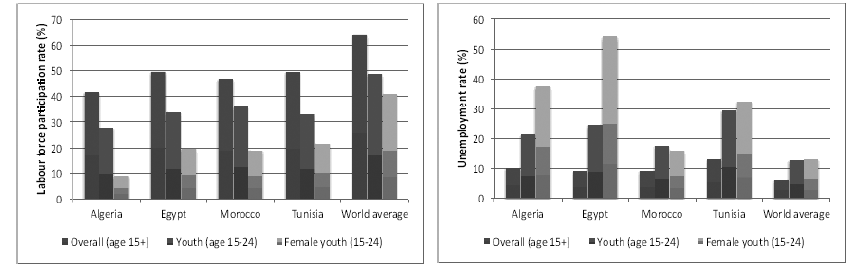
Young people aged 15-24 are three times more likely to be affected by unemployment than adult males aged 25 and above (ILO, 2013a: 85). Unemployment increases with education level, and well-educated youth suffer higher rates of unemployment than their less educated counterparts (see Figure 2).[63] Underemployment is an additional problem affecting young people, who are classified as ‘employed’ even when they work for negligible time periods. Hence, there is a high incidence of working poverty in the region, and young people’s transition to adulthood is often blocked because of income issues.
Women are also more vulnerable: they are over twice as prone to unemployment as males in the region (ILO, 2013a: 134). Young women are especially disadvantaged: the unemployment rate among women aged 15-24 is six times that of adult males (ILO, 2013a: 85). In Egypt, 55% of economically active young females were out of jobs in 2010 (see Figure 1).
There are also notable regional disparities. In some regions of Tunisia, only 1 in 10 people of working age has a job (Institut National de la Statistique, 2010). Most of the economic opportunities in Tunisia are concentrated in the country’s coastal regions. Similar trends can be found in other North African countries.
Vulnerable groups often enter a downward spiral: difficulty in finding jobs leads to their widespread discouragement and withdrawal from the labour market. Less than one-third of young people – and less than one-fifth of young women – in North Africa are economically active (see Figure 1).
Figure 2: Unemployment rate (%) by education level in 2010

Moreover, of those that are employed, a high proportion work in the unregulated ‘informal’ sector of the economy in poor quality jobs (World Bank, 2007). Informality accounts for over 41% of non-agricultural jobs in North Africa and is associated with non-standard, precarious employment without contracts or social protections (ILO, 2013a: 86).[64] Only 30% of workers in Morocco, 46% in Tunisia and 50% in Egypt have an employment contract (Achy, 2010: 21; Tunisia Labour Force Survey 2007; De Gobbi and Nesporova, 2005). Informal workers do not enjoy the same working conditions as formal sector employees, who are the main beneficiaries of North African countries’ labour market regulations and social protection policies. Formal sector workers enjoy high levels of protection, while informal workers are subject to precarious working conditions (Subrahmanyam, 2011: 9).
Women are more prone to informality than men: nearly two-thirds (61.2%) of women across North Africa are in vulnerable employment, compared with one-third of men (ILO, 2013a: 86). They also tend to be unpaid for their work: only 34% of working women in Morocco, 39% in Algeria and 51% in Egypt were in paid employment between 2006 and 2010 (ILO Department of Statistics, 2011: 9).
Young people are also more susceptible to informal sector employment than older groups. Lack of opportunities in the formal sector has forced many new labour market entrants into the informal sector. For example, in Egypt, whereas less than 20% of new entrants’ first jobs were in the informal sector in the 1970s, this proportion had increased to 60% by the end of the 1990s (Wahba and Mokhtar, 2002). Moreover, most young people (95%) continued to remain in insecure employment eight years after they had secured their first post. Hence, for the bulk of the population, informality is not a transient stage en route to formal sector employment (World Bank, 2004).
Additionally, informality is higher in regions where job creation is limited. Hence, across North Africa, young women in rural areas have a higher tendency towards informal employment than all other segments of the population (World Bank, 2007).
Several factors explain the high rates of unemployment and informality across the region, particularly affecting youth and women. These include on the supply side: rapid growth of the youth population, which has put pressure on labour markets; persistent gender discrimination, which has impeded women’s economic inclusion; and an outdated or inadequate education system, which creates skills mismatches and provides young people with a penchant for public sector jobs. On the demand side, factors include: an unconducive investment climate and rigid labour market policies blocking formal private sector growth and job creation; low access to financing, which has prevented the formation of dynamic new enterprises; and insufficient economic diversification and sophistication, which has inhibited the creation of skilled jobs to absorb educated workers.
On the supply side: A youth bulge, persistent gender discrimination, a failing education system and a penchant for public sector jobs
Changing demographics are one factor explaining high youth unemployment in the region. In the 1990s, North African countries underwent a demographic transition, where growth in mortality and fertility rates slowed, producing an increase in the prime-age working population relative to other groups.[65] Rapid growth in the youth population has put a strain on countries’ abilities to generate jobs at a sufficient pace to absorb new entrants to the labour market. Figure 3 shows the average annual jobs created in North Africa, alongside the average annual number of new entrants to the labour market from 2000 to 2008. In Algeria, job creation exceeded new entrants, enabling the country to significantly reduce its high youth unemployment rates. In Tunisia, the number of new jobs generated was insufficient to cover the increase in the labour force – so both youth and overall unemployment rates increased. In Morocco, job creation occurred in excess of labour force growth; however, the new jobs did not substantially benefit youth, so youth unemployment continued to increase (Boudarbat and Ajbilou, 2007: 17).
Figure 3: Job supply and labour force increase, 2000-2008
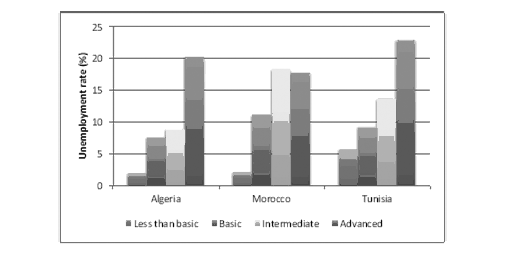
Persistent gender discrimination, despite improved female access to education and employment (see Figure 4), explains why young women are especially prone to high unemployment in North Africa. In Tunisia, for example, legislative reforms in the late 1950s enabled girls to attend school on an equal basis to boys and allowed women to work or establish a business without the permission of their husbands or fathers (Ben Salem, 2010: 488). The combined effect of these reforms was an increase in female labour force participation, from less than 5% in 1960, to 10% in 1970, to 20% in 1980 and to more than 20% after 1990 (Institut National de la Statistique, various years). However, social attitudes towards women have remained entrenched, making it difficult for women to secure decent work in the formal sector. The public sector is thus the main provider of formal sector employment opportunities for educated women in Tunisia (Stampini and Verdier-Chouchane, 2011).
Figure 4: Enrolment rates and gender parity in education in North Africa, 2009
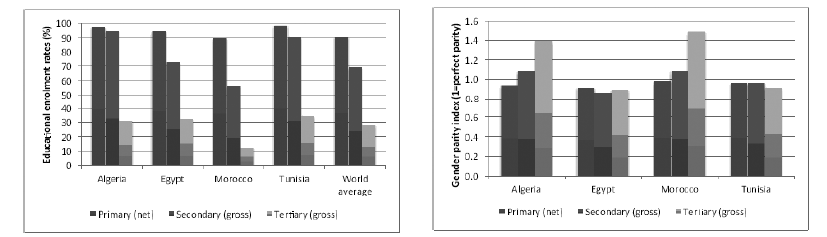
High levels of educated youth unemployment are largely attributable to the failure of North African education systems to adjust their curricula and processes to the post-structural adjustment era. Since the mid-1980s, most North African governments have implemented economic reform packages requiring progressive privatisation, greater economic openness and an end to governments’ role as the main employer of graduates. The public sector has shrunk over time: in Algeria, for example, the public sector employed only 25% of the labour force in 2004, compared with 65% in 1987 (Aita, 2008: 40-44). Yet education systems across North Africa are still preparing young people for jobs in the public sector, rather than providing them with skills and training appropriate for private sector work. There is an emphasis on theory, rather than application, and a high proportion of students major in law, economics and management (Stampini and Verdier-Chouchane, 2011: 1). In addition, young people do not receive effective career guidance, informing them of the limited employment opportunities in the public sector. Hence, they continue to display a strong appetite for public sector jobs, which creates distortions in the labour market. In some countries, young graduates prefer to remain unemployed as they wait for job opportunities in the shrinking public sector (Stampini and Verdier-Chouchane, 2011: 14). In the aftermath of the Arab Spring, there has been significant social pressure on governments to create more public sector jobs. This produces a vicious circle, since governments’ propensity to episodically create jobs for higher-skilled workers raises the level of expectations among university graduates, fuelling frustrations.
In addition, the skills produced by the education system are not necessarily those in demand by employers. Skills mismatches take place on several dimensions. First, the topics covered in schools are generally not those demanded by private sector firms. Across the region, there is an oversupply of university students majoring in social science and humanities subjects and an undersupply of engineers, scientists and technicians – the drivers of economic growth in other regions (see Figure 5). Second, while access to education has increased in line with global trends (see Figure 4), educational quality has not. North African students perform below global averages in international exams, such as the Trends in International Maths and Sciences Study (see Figure 6) and the OECD Programme for International Student Assessment (Subrahmanyam, 2011: 5-6). Students’ low performance reflects North African educational systems’ reliance on rote learning rather than on problem solving or application of knowledge (World Bank, 2007: 5). In addition, skills mismatches are not corrected by employers through training: according to the World Bank Enterprise Survey 2007, only 17% of firms in Algeria, 22% in Egypt and 25% in Morocco have offered their employees formal training – a low proportion even among MENA countries (26.5%) and well below the global average (35%).
Figure 5: University students by field of study, 2003
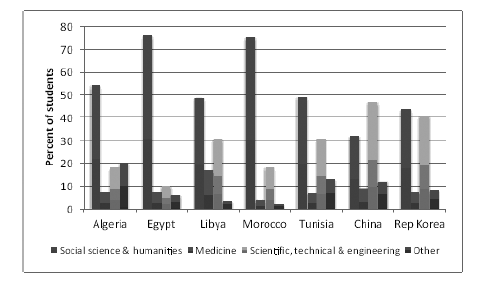
Figure 6: TIMSS 8th grade math & science scores, 20
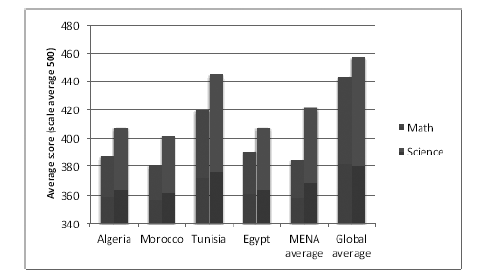
On the demand side: job creation is affected by an unconducive business climate; low access to credit; and insufficient economic diversification and sophistication
On the demand side, the region’s unpredictable investment climate, high costs of doing business and rigid labour market regulations have deterred private sector growth and employment and encouraged informality (Subrahmanyam, 2011: 7-9). Notwithstanding their distinct rankings in the World Bank’s Doing Business report (World Bank, 2013a), all of the countries in the region share certain common attributes. Red tape, corruption and prohibitively high costs for certain start-up procedures, such as obtaining construction permits or registering property, encourage smaller firms to operate in the informal sector and to remain small to avoid detection.[66] High corporate tax rates for businesses employing labour,[67] restrictive hiring/firing policies and high minimum wage levels provide incentives to employers to either not hire workers or to hire them ‘off the books’ at below minimum wage. Strict worker termination policies make firms reluctant to hire young workers, in particular new entrants without a prior work history. Tunisia ranks at the bottom in the 2013 Doing Business database on Employing Workers in terms of rigidity of rules regarding the dismissal of workers (World Bank, 2013a). The considerable costs of funding social security and retirement contributions encourage employers to avoid paying them, either by hiring fewer workers or by hiring them on a temporary or illegal basis (Dyer, 2005: 24).[68] Social security costs alone comprise 15% of the wage bill in Algeria, 24% in Morocco and 28% in Tunisia, and between one-half to three-quarters of the costs are borne by employers (Blanc and Louis, 2007: 61-71). Mandatory retirement plans bring the total up further, adding 15% to the wage bill in Algeria and 12% in Morocco, with employers funding 10% and 6%, respectively. In addition, companies wishing to terminate workers must pay severance, averaging 85 weeks’ salary in Morocco and 17 weeks’ in Algeria and Tunisia (Achy, 2010: 21). These high costs provide strong incentive for evasion, creating a self-perpetuating cycle of worker insecurity.
Low access to credit inhibits self-employment opportunities and the formation of dynamic new enterprises. Access to financing is a major constraint to doing business, according to 19% of firms in Morocco, 18% in Tunisia and 16% in Algeria (WEF, 2010). Weak creditors’ rights, low auditing and reporting standards, and weak contract enforcement laws makes lending a risky business in North Africa, so banks and investors prefer to lend to ‘safe’ governments or large firms, rather than to ‘risky’ SMEs (Allen et al, 2011: 3; World Bank, 2011a). Collateral requirements are set at high levels to protect banks: 131% of the loan amount in Egypt, 171% in Morocco, 185% in Algeria and nearly 200% in Tunisia (World Bank, 2007; Hengel et al, 2008; AfDB et al, 2011). Since most small businesses cannot afford to take out loans at these levels, entrepreneurs have to rely on private capital. This is usually not an option for young people, in particular young women. Lack of access to finance, combined with the high costs of formally setting up businesses, have led to the proliferation of small, unregistered companies that do not provide many jobs and are unlikely to grow bigger (Subrahmanyam, 2011). Over 90% of businesses in North Africa are micro-enterprises employing less than five workers (AfDB, 2013).
A lack of economic diversification and sophistication has prevented North African countries from generating a sufficient number of skilled jobs in the private sector to absorb the growing supply of educated youth entering the labour market each year (AfDB, 2012a). Not all North African economies have the same capacity to generate skilled jobs. It is clear that undiversified or poorly diversified economies, like Algeria or Libya, are facing tremendous challenges generating skilled jobs for their educated youth outside of the oil sector. However, even more diversified economies, such as Morocco or Tunisia, are facing similar challenges due to a lack of sophistication in their service and industry sectors. Over the past 20 years, these countries have experienced a decline in their manufacturing sectors relative to all other sectors, owing to a failure to develop industrial sectors, such as electronics, which have driven fast growth and aided a movement up the value-added ladder in other regions. In Egypt, for instance, high-technology exports[69] made up less than 1% of all manufactured exports between 2008 and 2011 (World Bank, 2013b). In parallel, because most jobs created in the countries’ fast-growing services sector are characterised by low productivity and low wages, there has been a shift in the overall composition of employment towards lower skilled jobs. Given these dynamics, the government remains the main provider of skilled jobs for educated youth in North Africa – which explains why graduates continue to ‘queue’ for these positions (Stampini and Verdier-Chouchane, 2011). Yet the public sector has been shrinking.
Overall picture: dual labour market, income inequalities and limited voice options
Putting the two sides together, the overall picture of the labour market in North Africa is one of dualism and inequality: on the one side, there are large firms and formal sector workers, who earn at least the minimum wage and enjoy high levels of social protection; on the other, there are small firms and the remainder of the labour force, who are unemployed or informally employed, generally under poor working conditions. North African labour market policies have created vast income inequalities between the two groups. Moreover, people in the latter category cannot easily transit to the former category, owing to systemic barriers – including gender discrimination, inadequate skills or experience, high barriers to setting up a business amid low access to financing, and an insufficient number of skilled jobs in either the private or the public sector.
Until the Arab Spring, social tensions arising from these issues were only episodically expressed in the form of ‘bread riots’ or other small-scale outbursts, because open expression was generally not permitted (Subrahmanyam, 2013). Most private sector workers – not just informal sector workers – had limited voice options for venting their frustrations or agitating for better conditions, given the nature of trade union legislation. In Algeria, trade unions could only operate with prior authorisation from the government (Blanc and Louis, 2007: 43). In Morocco, the judiciary could dissolve unions that did not meet strict criteria. The right to strike was not guaranteed in Tunisia or Algeria (Aita, 2008: 53-56).
Moreover, government groups heavily controlled trade unions. In Algeria, a single trade union monopolised labour activity, and public sector employees made up half of its members (Blanc and Louis, 2007). In Tunisia, one union dominated labour activity, and 60% of its members were government employees (Aita, 2008: 57). In Morocco, there were 17 recognised trade unions, but four government-connected syndicates enjoyed the greatest influence (European Commission, 2010b: 25-31). In Egypt, government and public enterprise employees comprised 75% of trade union members (Bardak et al, 2006). Not surprisingly, in all of the countries, public sector workers enjoyed the highest wages and best benefits.
Inequalities between formal sector – in particular, government sector – workers and the large remaining bulk of the labour force were a main factor in the Arab Spring, but were not the proximate cause. Instead, the riots and revolutions that rocked North Africa were ignited by a series of crises that struck the region beginning in 2003. The impacts of the crises and the effects of government policy responses resulted in a growth in inequality, which was the main cause of the Arab Spring.
Recent Crises, Labour Market Impacts and the Making of the Arab Spring
The series of crises that have struck – and continue to affect – North African countries since 2003 have led to widening inequalities between large businesses and small enterprises, as well as between formal sector workers and all other groups. Small firms, informal sector workers, the unemployed and the poor were hardest hit by crisis impacts; yet government policy responses bolstered privileged groups and sectors, rather than protecting weaker groups and sectors (Subrahmanyam, 2013). The growing divide between the ‘haves’ and the ‘have nots’, in a difficult environment characterised by rising living costs, heavy job destruction and increasingly binding constraints on job creation and new enterprise formation, was the main cause of the Arab Spring. Moreover, the countries where revolutions were ‘successful’ and where transition was more prolonged have suffered major economic disruptions, resulting in high job losses and reduced fiscal capacity.
The impacts of the world food crisis, which began in 2003, and the global financial crisis, which took hold in 2008, were most severe on the weakest groups and sectors in North Africa. While the world food crisis did not produce loss of jobs or other direct labour market effects, rising food and fuel prices during the crisis created greater difficulties for those on low (or no) wages. This explains the eruption of the ‘bread riots’ in Algeria, Egypt, Morocco and Tunisia, which caused small-scale disruptions to business activities (Subrahmanyam, 2013). The spillover effects of the global financial crisis has had a more direct impact on North African labour markets: there were heavy job losses in the manufacturing, agricultural and tourism sectors, affecting women and young people more than other groups (ILO, 2011; Subrahmanyam, 2011). In addition, increased restrictions in accessing credit and capital impacted small businesses more than large firms.
Government responses to the crises led to a growth in the income gap between wealthier and poorer groups in three ways. First, policies to increase public sector wages – which Egypt, Algeria and Morocco implemented during the world food crisis – and/or minimum wages – which Algeria, Morocco and Tunisia implemented during the global financial crisis – widened the remuneration gap between formal sector workers and everyone else. [71] Second, every country in the region introduced subsidies to support consumption and aid the poor; however, in every case, subsidies were ill-targeted, and the vast bulk (80% or more) of benefits accrued to non-poor groups (Subrahmanyam, 2013). Third, governments tended to prioritise wealthier groups over the poor in their resource allocations. For instance, during the global financial crisis, large export firms were inundated with funds and guaranteed loans, while small enterprises were offered only credit and, even then, continued to experience difficulties in obtaining loans.[72] During the world food crisis, 89% of Egypt’s additional budget to address the crisis was used to raise public sector wages and pensions, while only 11% was devoted to the food ration card scheme for the poor (Egypt Ministry of Finance, 2009: 3).
The main support that informal sector workers, the unemployed and the poor received during the two crises was through government investments in active labour market programmes (ALMPs). However, these programmes were largely unsuccessful in creating decent, sustainable private sector jobs for several reasons. First, the programmes were offered mainly by government providers, who generally face financing, capacity and knowledge constraints. Until 2009, ANAPEC[73] in Morocco was the monopoly supplier of ALMPs (Subrahmanyam, 2011; 18). Second, programmes often suffered from key design flaws: the newly self-employed completing entrepreneurship programmes had difficulties accessing credit; jobs created through subsidised employment schemes rarely lasted past the subsidy period; vocational training programmes did not teach marketable skills, because businesses were not involved in their design; and job placement services had low success rates placing their mainly educated youth clientele in unskilled jobs (Subrahmanyam, 2011). Hence, the governments that could afford to do so (mainly the net oil exporting countries in the region) reduced unemployment rates by creating new civil service positions – a short-term solution that failed to address the main blockages to private sector growth. Unemployment and poverty could not be resolved by the private sector because of continuing constraints to long-term job creation and weaknesses in the skills sets of the labour pool.
Widening income inequalities fuelled social tensions, which boiled over into the Arab Spring – an internally generated crisis that has had greater negative impacts on economic growth and jobs than the two previous crises combined (Subrahmanyam, 2013). Direct damage to companies, sit-ins and strikes disrupted economic activities, especially in the transition countries (Shahin and Zreik, 2011). Tourists and foreign investors fled countries experiencing social turbulence and violence, and did not return until they were convinced that the situation had stabilised. The economic and social costs to countries undergoing transition were huge. In Egypt, tourism fell by almost half in the first quarter of 2011, costing Egypt about $1 billion per month; factories were reportedly working at half capacity even after the fall of Mubarak; FDI plunged from $6.4 billion to $500 million; and unemployment reached double-digit levels (Hakimian, 2011; The Economist, 2012). In Tunisia, 120 foreign firms left the country, leading to a loss of 40,000 jobs. In Libya, oil production ground to a near-halt during the eight-month battle between rebel and pro-government forces (World Bank, 2011b: 24).
Adding to the problems of a region still reeling from the Arab Spring, a new crisis – the euro zone debt crisis – has emerged that threatens the region’s economic recovery. North African countries are heavily dependent on Europe for trade and capital flows, so economic slowdown in Europe carries consequences for North Africa (Subrahmanyam, 2013). For example, a fall in European demand for North African exports would likely result in job losses, especially in the net oil importing countries’ tourism, manufacturing and agricultural sectors. These impacts would affect some groups – such as women and young people – more than others, so would widen social inequalities and add to existing tensions.
North African governments have taken steps to meet the pressing social demands for jobs that have emerged since the Arab Spring; however, they have done so by expanding public sector employment. In Egypt, one million new public servants were recruited in 2011, increasing the country’s wage bill by 15% (AfDB, 2012b; Subrahmanyam, 2013). In Tunisia, the public sector expanded, both directly and indirectly, in the aftermath of the revolution: directly through the creation of 40,000 additional civil service posts, and indirectly through Tunisair, the government-owned aviation company, absorbing its service providers (Subrahmanyam, 2013; Belhadj Ali, 2011). In Libya, demobilisation of militias has occurred alongside massive absorption of ex-combatants (and others) into the public forces (Saleh, 2013).
Attempting to address unemployment through the public sector has several negative consequences. First, it is an expensive measure that places immense pressure on state finances – so is ultimately unsustainable. Second, it creates false labour market signals, reinforcing graduates’ propensity to queue for government positions. Third, it does nothing to address the true causes of unemployment, so masks rather than reducing unemployment. Third, it creates a self-perpetuating cycle, whereby unemployment continues to grow and the public sector must continually expand to keep it under control. The only way to break this cycle is to undertake the necessary structural reforms to unleash private sector-led growth, so that sustainable jobs are created and unemployment is permanently reduced.
In the aftermath of the Arab Spring, the region’s recovery is complicated by high social expectations for change, coupled with countries’ reduced fiscal capacity to execute such change amid a difficult economic environment. On the other hand, North African countries – in particular, those undergoing transition – are now presented with a unique opportunity to implement deep labour market reforms, which could lead to major economic and social transformation.
Labour Market Reforms: the Road Ahead
North African countries are at an important historical juncture, where a rare confluence of events could place them on the path to more rapid, sustained and inclusive growth, so long as they implement the correct policies at the right time. The region’s youth bulge is expected to last until 2020; so if countries are able to implement effective measures to correct skills mismatches and generate enough good-quality jobs to utilise the skills of their educated youth population before the window of opportunity disappears, then they can enjoy significant ‘demographic dividends’ in the form of rising per capita output and enhanced savings and investment, such as the East Asian ‘tiger’ economies did between 1965 and 1990 (Bloom and Canning, 2008). The current post-transition environment offers North African governments a chance to initiate the bold structural reforms that would make this possible, since the post-Arab Spring era demands that a greater number of groups be included in policy decisions. Greater inclusiveness tends to weaken the power hold of long-standing vested interests, which enables change to occur. Moreover, greater inclusiveness combined with a focus on policies that drive forward private sector growth and innovation can bridge the gap between formal and informal sector workers, large and small firms, and the rich and the poor. This would is turn increase countries’ resilience to future shocks, rendering growth more sustainable.
However, several factors need to be considered when rethinking labour market policies pertaining to North African countries. First, one should keep in mind the four principal dimensions in which labour market policies are effected: active labour market programmes, labour regulations, social protection legislation and collective representation.
The success of active labour market programmes (ALMPs) can be boosted by keeping in mind lessons learned from international experience (AfDB, 2012b; Subrahmanyam, 2011):
- ALMPs should involve multiple partners for greatest effectiveness and coverage. Including a wide range of partners and stakeholders in ALMPs increases the levels of financial, technical and personal support available to beneficiaries and can ensure the success of programmes, so long as efforts are coordinated and integrated.
- To ensure that ALMPs deliver the right skills, private sector firms should be involved in the design and implementation of programmes. This seems an obvious point, but did not occur in Tunisia following the Arab Spring. Tunisia’s AMAL (or’ hope’) programme was designed to be a job activation mechanism for young graduates. However, it was initially implemented as a direct cash transfer programme without any on-the-job training component.
- Reliable information about the labour market and the skills needs of employers is required for designing effective employment programmes. Governments need to place a greater emphasis on knowledge generation and the production of reliable statistics. Labour market information also needs to be communicated early and widely – for example, through career guidance for young people.
- Effective targeting of programmes is essential to ensure that the groups most in need of assistance receive state support. In many cases, the benefits of government programmes are ‘creamed’ by less needy or privileged groups; so attention to targeting is necessary. Disadvantaged groups may require special programmes designed to overcome the blockages to their employment – for example, entrepreneurship programmes targeting young women who face job discrimination issues.
- Finally, a comprehensive approach should be adopted – so that, for example, skills training programmes are complemented by job placement and support services, and entrepreneurship schemes provide access to finance and markets as well as training.
During the transition phase, the three remaining dimensions (revising labour regulations; making sure that social safety nets are in place; and improving collective representation and bargaining) should occur in parallel in order for the government and the population to strike the right balance between protecting workers and protecting jobs (World Bank, 2012). As previously indicated, labour regulations may be need to be revised to allow for greater flexibility, so that they support formal employment growth. However, this change in legislation simultaneously creates the need to protect workers who are in between jobs. The region currently lacks adequate social safety nets, so this would need to be addressed to prevent further growth in inequalities. In the post-Arab Spring era, reforms to labour regulation will be difficult to pass, finance and sustain without some form of collective representation and bargaining. In most countries in the region, a national dialogue is needed to renegotiate the social contract, so that formal sector employment is expanded in a manner that benefits both firms and workers. This dialogue should include previously excluded civil society representatives. Tunisia initiated this process in 2012, and its New Social Contract was signed on 14 Jan 2013 with the participation of the government and two major social partners.[74] However, much remains to be done to include more partners in the process, which is necessary for tackling some of the fundamental issues that have thus far prevented job creation in the country.
Second, the capacity of countries to implement reforms differs, depending on their structural composition. There are five fundamental differences between North African economies, which influences their capacity to easily implement labour market reforms:
- The net oil exporting economies have greater capacity to finance labour market reforms than the net oil importing countries. However, given their reliance on a single sector that lacks high potential for job creation, they tend to rely on public sector employment programmes to reduce unemployment levels. The countries need to undertake reforms to avoid ‘Dutch disease’.
- The level of human capital differs widely across the region, affecting job creation and employment opportunities. For instance, Morocco has a much less educated and skilled population than Tunisia, both in terms of years of schooling and education quality indicators (Subrahmanyam, 2011: 5; African Development Bank et al, 2013: 168).
- A country’s level of economic diversification and sophistication affects the capacity of its private sector to absorb new labour market entrants, particularly those with higher levels of education.
- The solidity of institutions varies across countries in the region. In Libya there is a quasi-absence of institutions, while in Tunisia and Morocco the administrative apparatus is fairly robust. Countries with stronger institutions have a greater capacity to implement policy reforms. However, across the region, institutions are insufficiently decentralised, which limits the effectiveness of labour market reforms.
- Finally, the nature of transition varies across the countries, influencing their capacity to implement policy reforms. The transition has been relatively smooth in Morocco, but very difficult in Libya. Continuing social tensions within Libya affect the new government’s capacity to engage in constructive social dialogue.
Third, labour market policies need to be viewed as part of a wider comprehensive reform and investment package. During the transition period, decision makers need to bear in mind that they are constantly dealing with two time horizons: the short-term horizon, which is characterised by multiple social demands for particular measures and outcomes; and the long-term horizon. They must take care that policies implemented in the short-term do not detrimentally affect long-term development objectives. The long-term objective must be to reduce inequalities and strengthen the private sector’s capacity to create ‘decent’ and sustainable jobs.
As a matter of conclusion, it may be important to reiterate some fundamental guiding principles, which should be observed by decision makers in the short-term during the transition, but also to support job creation in the mid- to longer-term:
1. Macroeconomic stability is paramount and needs to be preserved. This stability is currently being weakened in some countries in the region because of a tendency to implement expensive short-term measures. Without macroeconomic stability, there will be no job creation.
2. An enabling business environment needs to be in place. Often the administrations in the region do not realise how deep these reforms have to be, and that basic laws and regulations are not yet in place to attract investors and favour innovation in the region, which is required to facilitate the economic transformation.
3. The right type of human capital should be developed. The nature of skills mismatches varies across the region, but we can make two general observations: (a) vocational training is undervalued in the region, and there is a critical need for workers with job-relevant skills; and (2) the education and economic systems need to work together to produce the skills required for the 21st century.
4. Finally, the rule of law needs to be observed to attract ‘good’ investors, who will bring innovation and sophistication to the countries, which is needed to drive forward the economies and produce more rapid, high-productivity growth. It is also the only way for the region to create the kinds of jobs that are needed today and in the future.
References
Achy, L. (2010) Trading High Unemployment for Bad Jobs: Employment Challenges in the Maghreb (Washington DC: Carnegie Endowment for World Peace).
African Development Bank (2013) African Economic Outlook 2013 (Tunis: AfDB).
African Development Bank, Government of Tunisia and Government of the United States (2013) Towards a New Economic Model for Tunisia: Identifying Tunisia’s Binding Constraints to Broad-Based Growth (Tunis: AfDB).
African Development Bank (2012a) Jobs and Justice and the Arab Spring (Tunis: AfDB).
African Development Bank (2012b) ‘Short term job creation – lessons learned’. Deauville Partnership – Secretariat for the International Financial Institution Coordination Platform – Meeting of Finance Ministers, Washington DC April 2012.
African Development Bank (2011) Libya Post-War Challenges (Tunis: AfDB).
African Development Bank, OECD, UNECA and UNDP (2011) African Economic Outlook 2011: Africa and its Emerging Partners – Algeria Full Country Note (Tunis: African Development Bank).
Allen, F., Otchere, I. and Senbet, L.W. (2011) ‘African financial systems: A review’, Review of Development Finance, vol. 1, no. 2, pp. 79-113.
Amereller (2013) Doing business in Libya – Opportunities and challenges of the transition (Tripoli: Amereller Associates).
Aita, S. (2008) Employment and Labour Law in the Arab Mediterranean Countries and the Euro-Mediterranean Partnership (Madrid: Fundación Paz y Solidaridad Serafín Aliaga de Comisiones Obreras).
Bardak, U., Huitfeldt, H. and Wahba, J. (2006) Employment policy reform in the Middle East and North Africa: Selected issues on the functioning of the labour market (Torino: European Training Foundation).
Belhadj Ali, A. (2011). Tunisie – Transport aérien: Tunisair reprend ses filiales! webmanagercenter | 04 Février 2011.
Ben Salem, L. (2010) ‘Tunisia’, in Kelly, S. and Breslin, J. (eds) Women’s Rights in the Middle East and North Africa: Progress Amid Resistance (Lanham, MD: Rowman & Littlefield).
Blanc, F. and Louis, M. (2007) The Challenge of Employment in the Maghreb Countries (Marseille: FEMISE).
Bloom, D. and Canning, D. (2008) ‘Global Demographic Change: Dimensions and Economic Significance’, Population and Development Review, vol. 34, pp. 17-51.
Boudarbat, B. and Ajbilou, A. (2007)Youth Exclusion in Morocco: Context, Consequences and Policies (Dubai: Middle East Youth Initiative Working Paper).
De Gobbi, M.S and Nesporova, A. (2005) ‘Towards a new balance between labour market flexibility and employment security for Egypt’, Employment Strategy Papers, no. 2005/10 (Geneva: ILO).
Dyer, P. (2005) Labour Supply, Unemployment and the Challenge of Job Creation in the Maghreb (Draft report, Washington DC: World Bank).
Egypt Ministry of Finance (2009) Egypt Response to the Global Crises (Nasr City: Macro Fiscal Policy Unit, Ministry of Finance).
European Commission (2010a) ‘Labour Market Performance and Migration Flows in Arab Mediterranean Countries: Determinants and Effects – Volume 1: Final Report and Thematic Background Papers’, European Economy Occasional Papers, no. 60, April 2010.
European Commission (2010b) ‘Labour Market Performance and Migration Flows in Arab Mediterranean Countries: Determinants and Effects – Volume 2: National Background Papers Maghreb’, European Economy Occasional Papers, no. 60, April 2010.
Gubert F. and Nordman C.J. (2011) ‘Return Migration and Small Enterprise Development in the Maghreb’, in Diaspora For Development In Africa, Sonia Plaza and Dilip Ratha, Editors, The World Bank, Washington, DC.
Hakimian, H. (2011) ‘The Economic Prospects of the ‘Arab Spring’: A Bumpy Road Ahead’, Development Viewpoint, no. 63 (June), Centre for Development Policy and Research, School of Oriental and African Studies.
Hengel, E., Kechida, S., Koldertsova, A. and Sultan, S. (2008) ‘Access to Finance in the MENA Region – Recent developments and Challenges’, OECD Working Group on SME Policy, Entrepreneurship and Human Capital Development Presentation, Manama, 18 November 2008.
Institut National de la Statistique (various years) Enquête Nationale sur la Population et l’Emploi (Tunis: INS).
International Labour Organisation (2013a) Global Employment Trends 2013: Recovering from a second jobs dip (Geneva: ILO).
International Labour Organisation (2013b) Global Employment Trends for Youth 2013: A generation at risk (Geneva: ILO).
International Labour Organisation (2011) Global Employment Trends 2011: The challenge of a jobs recovery (Geneva: ILO)
International Labour Organisation (2010) Global Employment Trends for Youth, January 2010 (Geneva: ILO).
ILO Department of Statistics (2011) Statistical Update on Arab States & Territories and North African Countries, May 2011 (Geneva: ILO).
International Monetary Fund (2012) Libya beyond the Revolution: Challenges and Opportunities (Washington DC: IMF).
PwC, World Bank and IFC Paying Taxes Team (2013) Paying Taxes 2013: The global picture (London: PwC).
Saleh, H. (2013) ‘Militias drain Libya’s coffers’, Financial Times, 10 April 2013.
Shahin, H. and Zreik, N. (2011) ‘The Impact of Egypt’s Revolution on the Corporate Sector’, Zawya Equity Capital Markets Research, July 2011 – available at http://www.zawya.com/viewFullPdfStory.cfm/sidpdf_040711073220 (accessed 1 April 2012).
Stampini, M. and Verdier-Chouchane, A. (2011) ‘Labour Market Dynamic in Tunisia: The Issue of Youth Unemployment’, African Development Bank Working Paper Series, no. 123 (Tunis: African Development Bank).
Subrahmanyam, G. (2013) ‘Promoting crisis-resilient growth in North Africa’, Economic Brief (Tunis: African Development Bank).
Subrahmanyam, G. (2011) ‘Tackling youth unemployment in the Maghreb’, Economic Brief (Tunis: African Development Bank)
The Economist (2012) ‘Arab Spring Economies: Unfinished Business, The Economist, 2 February 2012 – available at http://www.economist.com/node/21546018 (accessed 25 April 2012).
Wahba, J. and Mokhtar, M. (2002) ‘Informalization of Labor in Egypt’, in Assaad, R. (ed) The Labor Market in a Reforming Economy: Egypt in the 1990s (Cairo: American University in Cairo Press).
World Bank (2013a) Doing Business 2013: Smarter Regulations for Small and Medium-Size Enterprises (Washington DC: World Bank).
World Bank (2013b) 2013 World Development Indicators (Washington DC: World Bank).
World Bank (2012) World Development Report 2013: Jobs (Washington DC: World Bank).
World Bank (2011a) Doing Business 2011 (Washington DC: World Bank and International Finance Corporation).
World Bank (2011b) Regional Economic Update May 2011: MENA Facing Challenges and Opportunities (Washington DC: World Bank).
World Bank (2010) 2010 World Development Indicators (Washington DC: World Bank).
World Bank (2008) The Road Not Travelled: Education Reform in the Middle East and North Africa (Washington DC: World Bank).
World Bank (2007) Youth – An Undervalued Asset: Towards a New Agenda in the Middle
East and North Africa (Washington DC: World Bank).
World Bank (2004) Unlocking the Employment Potential in the Middle East and North Africa: Toward a New Social Contract (Washington DC: World Bank).
World Economic Forum (2010) The Global Competitiveness Report 2010-2011 (Geneva: World Economic Forum).
Public Administration: Improving Transparency and Accountability
Public Administration: Improving Transparency and Accountability
Ghada Ali Moussa, Director, Governance Center, National Management Institute, Egypt
Introduction : Social Inclusion and Political legitimacy
SOCIAL INCLUSION evokes the issue of political legitimacy through a sustained reflection on the dual legitimating and regulating function of modern legal political systems.
The conception of deliberative democracy and the inclusion of the Other–mentioned by Juergen Habermass- in which the burden of legitimating state power is borne by informal and legally institutionalized processes of political deliberation. Its guiding intuition is that there is an internal relation between the rule of law and popular sovereignty. Analysis of political legitimacy and the future of the nation state rests upon a welfare state, and the prospects of a politics of human rights. [75]
Achieving an inclusive society is a goal with universal appeal. An inclusive society is one that rises above differences of race, gender, class, generation and geography to ensure equality of opportunity regardless of origin, and one that subordinates military and economic power to civil authority. In an inclusive society, social interaction is governed by an agreed set of social institutions, and social interaction with the government representing the state is governed by an agreed upon social contract. The capability of all citizens to determine how those institutions function is indeed a hallmark of an inclusive society. An inclusive society is also one that, when confronted with new challenges, such as economic crises, social tensions, political turmoil, climate change, gives everyone a say and everyone a responsibility.
Enabling individuals to live up to their full potential to take part in social and economic life in
society entails supporting people at critical junctions in their lives. This starts with responding to people’s needs and aspirations and investing in people, especially youth, and continues thereafter. Social inclusion is an integral part of necessary adjustments by testing new policy approaches and selecting the most effective ones, using the available resources more efficiently and effectively, through simplifying, better targeting and considering conditionality when designing policies.
The term social inclusion reveals also the term of “social exclusion”, which evokes notions of “agency”. Through what mechanisms, and as a result of whose actions, are people excluded? How far are people responsible for their own situation? These are important questions, and agency is a key element in studying social exclusion.
The goal of social inclusion is not an abstraction; its achievement is vital in today’s political climate. Exclusion from the exercise of political and economic power fuels rebellion sometimes armed rebellion) and undermines peaceful democratic transition. In a less extreme form, social exclusion lies behind urban rioting and the disaffection of people. In many countries, there are various powerless groups that could extend to the majority of the population (including ethnic communities, minorities, etc.) that suffer poverty and social exclusion; In Egypt there are regions – in upper Egypt- that have been left behind by economic progress; and there are barriers to social mobility. Full gender equality remains to be achieved.
There is therefore a high degree of political salience in the issue of social inclusion. Achieving greater social inclusion is a political imperative, which has in turn made imperative the need to measure the progress of societies towards the reduction of marginalization, poverty and social exclusion.
Reflections of Social Inclusion in the aftermath of the Arab Spring – the case of Egypt
Discussing social inclusion in the aftermath of the Arab spring, though a vital component of a peaceful democratic transformation, is a sensitive and critical issue during this period which witnesses a third wave of a revolution – in preparation- that is sweeping Egypt, maybe other parts of the world as well. PEOPLE ARE NOT SATISFIED. PEOPLE LACK HUMAN SECURITY IN THE ARAB/ MENA WORLD.
The former observation does not exclude the public administration and the employees. Employees are CITIZENS AS WELL. They are held accountable and they hold the government accountable. Although social and economic demands have existed pre the 25th revolution, it accelerated post 25th and were concentrated in the state apparatus with the public administration in the center. The provision of certain rights to employees, such as full employment, adequate salaries, bonuses, housing facilities, adequate social protection and a health care system, and training were at the heart of their demands.
Preventing exclusion from the civil service and labour market and supporting integration into employment of people at a disadvantages still dominates employees demands. The persistence of poverty and joblessness and the growing complexities of multiple disadvantages necessitated comprehensive, integrated policies which failed to exist. With a view to modernizing social protection systems, adequate income support is not yet combined with a link to the labour market and access to quality services in an integrated active inclusion strategy. There still exist calls for active inclusion policies that could facilitate the integration into sustainable, quality employment of those who can work and provide resources which are sufficient to live in dignity, together with support for social participation, for those who cannot, particularly in a country like Egypt where half of the population financially support the other half.
The January 25 Revolution can be explained by many reasons one of which was societal frustration, marginalization with corruption and state capture by the ruling elite. Whereas the first phase of enhancing transparency and integrity in the public administration and combating corruption was focused on assessing and understanding the context of corruption, governance and anti-corruption measures relevant for the public administration, the current phase puts a stronger emphasis on generating knowledge and specific contextual relevance of effective preventive measures as well as the underlying factors for effective implementation. The eventual new Government (s) of Egypt –as well as the public at large- will urgently need access to high quality anti-corruption policy recommendations relevant to the Egyptian context. Through the inclusion of a separate activity result on communication, the Egyptian public administration will gain stronger capacities to address various target audiences believed to be vital for furthering an effective public administration reform and a preventive fight against corruption. In the current democratic transition context, enlightened and critical public debate is necessary to arrive at the best possible policy outcomes that have the power to persuade and engage for effective implementation and cooperation. There are knowledge gaps that are of fundamental importance to future effective policy implementation and for contributing usefully to the national strategy development.
In this interim period defined by uncertainty as to what government set-up there will eventually be, a greater focus would be on the impact of a transparent, impartial and accountable civil service on the success of “ a democratic” transformation, which is related to the following requirements:
Transparency and integrity in civil service laws
Where patronage prevails, the criteria for selecting recruits to the public administration and for promotion is not based on achievement (meritocracy) but social, political and economic factors. Law 47/1978 on the civil service provides for impartial, independent and fairly managed civil service. But, there are two main challenges with the law: there are important gaps to the prevention of patronage, nepotism and cronyism in the law, as well as weak adherence to the law. That public authority is used in a particularistic[76] and non-meritocratic manner where civil servants are often not hired based on merits, nor are they evaluated according to professional criteria. This limist the effectiveness of relying on managerial and technical approaches alone in achieving change in the public administration, including the efforts to curb corruption. Where patronage is well established as a means to secure loyalty, there are risks that the freedom to implement needed reforms will depend on the interests of the sources of funding. Subsequently, the prospects for enhancing implementation effectiveness of law as an instrument of governance is undermined. In sum, the effects of corruption undermine the many factors that help states to develop. Instead, these are replaced by uncertainty, unpredictability, inequality, inefficient resource allocation, and social injustice. Corruption, therefore, reflects a democracy, human rights and governance deficit that negatively impacts on poverty and human security, thus results in more social exclusion.
Information disclosure, freedom of information law – political relevance of transparency for controlling corruption
The empirical proof that access to information laws is associated with better control of corruption is evident. The fundamental importance of transparency for democratic control is a well-established fact, in that it enables just political and administrative accountability. Coupled with inclusive political institutions, it has relevance for sustained economic growth as it undermines the possibility for abuse of public office. Though the new constitution of 2012 stressed in its articles 47-49 the right for access to information and the state apparatus obligation to disclose information and to be held accountable for reducing it. Five proposed laws for information disclosure were discussed pre and post the 25th of January, the current proposed law was submitted by the Ministry of Justice and has been discussed in the 2nd chamber of parliament (Shura Council). Several official agencies and civil society organizations opposed the proposed law in two aspects: the definition of national security and the composition of the national council for information. If the law is to be issued after electing the 1st chamber of parliament ( Council of Representatives), it will be in conflict with other laws among ahead of it the civil service law 47/78 which prohibits the civil servant from disclosing information and releasing documents related to his/her work. In an attempt to verify the current disclosure policies in Egypt, the Governance Center cooperated with “Da3m Center for Information Technology, a civil society organization to assess the disclosure policies in three ministries (education- environment and health) through its web pages. According to several indicators (the information that should be disclosed on regular basis- procedures for reaching information). The three target ministries scored less than 25% on both indicators.
Many international best practices were studied in that regard ( India- Canada- South Africa- Mexico), in addition to international subject matter experts visited concerned Egyptian authorities in that regard. The most problematic issue occurred in discussing this law as well as other related law that enhance integrity and accountability in the public administration was the struggle with the notion of civil society and its inclusion in the discussions. Its exclusion was apparent when insisting on only including public figures as representatives of civil society organizations.
Adjusting to new demands that follow upon a new state-citizen relationship
The laws of civil service set out the framework which regulates the conditions of work of civil servants. Such laws may also contain the values of the civil service and the principles to be observed and guide how public authority shall be exercised. Civil service have developed in Egypt since the beginning of the 19th century governed by a set of underlying ideas and principles that even discussed the importance of political impartiality of civil service. Civil Service laws and regulations (law 47/78- law 5/91 regulating hiring senior public officials ) discussed the importance of service delivery satisfaction (for citizens and private corporations), the efficiency in performance, the rule of law in the public administration, impartiality, and controlling corruption. However – taking into consideration the need for rethinking the current law(s), implementation is weak and not free from influencing factors. For example new salary scales is a demand for ALL public servants in Egypt ( 6.8 M) and is an indication of effective reform solutions for those contexts.
Public procurement regulations as relevant instruments and institutions for integrity in the process where the private and the public sectors intersect
The regulation of public procurement can have many different aims but commonly, it relates to ensuring value for public money by ensuring fair competition for private sector companies trying to win public contracts. Corruption cases in post 25th of January unveiled heavy misconduct in allocation of public contracts especially in land tenure, privatization process and a weakness in public procurement regulations. Unfair or illegal practices to win contracts, were widely expected as the norm in a state capture context and in a weak horizontal and vertical accountability atmosphere. Public procurement has become an instrument of extraction. Though some good practices existed within the government prior to the 25th of January such as amending the procurement law 89/98 and establishing the e-tender portal (which was developed by the Ministry of State for Administrative Development and operated by the Government Services Agency), to ensure more transparency in public procurement processes, there was a strong resistance for proper implementation, particularly in contexts of patronage where the rule of law is weak.
The post 25th of January witnessed the exposure of government officials to various international experiences s which include e-procurement, and strengthening the Central Audit Organization which became under the new constitution 2012 an independent agency with vast authorities ( article 205) and the establishment of new oversight institutions concerned with integrity pacts and solving the issue of conflict of interests. Proper implementation can contribute to expand the potential arsenal for enhancing public procurement in Egypt.
Changing the relationship between the civil service/public administration and the public for strengthening social accountability
A new political system has created a new relationship whose various factors need to be aligned in order for it to function properly. The challenge which faces the public administration in Egypt is how to actually bring about a change of behavior which conforms to the new state-citizen relationship. Fundamental underpinnings for this required change is the principle of popular control over government and the various means that enable that, as well as the idea of serving the citizens, the idea of the state, and the fundamental ideas and principles by which public services are provided. The introduction of e-government pre 25th of January and the initiative made post the 25th of January concerning open / responsive government is a positive step for engaging citizens and public servants in policy making and monitoring public service delivery. The impact was high regarding the use of ICT in automating a large part of the election process (social media- sms). Also monitoring the elections relied heavily on ICT and scored a good response from the higher election committee and concerned government agencies. It is worth mentioning that the election process witnessed “the highest “civil society inclusion, in addition to citizens voices.
Though the former, Egyptian practitioners in the development field have stressed the important integration of social accountability pillars, which deal with information, transparency, combating corruption and civil society freedom in ensuring that basic public services are being provided based on citizen engagement and demands, and ensuring the establishment of accountability mechanisms that stresses social accountability which is evident post the 25th of January but needs to be institutionalized. Strengthening transparency and social accountability by the government will lead to well- informed citizens and will provide public support for political and economic reform policies.
Regulating and financing public services in a structurally corrupt environment with resource scarcity.
The Weberian ideal of the state-citizen relationship is based on the understanding that there is a social contract; citizens pay their taxes to the state and in return, they expect to get free or subsidized access to public services of a certain decent quality provided in an impartial manner, i.e. where the law is implemented without regard for anything but what is stipulated in law or policy. A fundamental assumption in the Weberian ideal is that there is rule of law. Part of that concept is the impersonal equal treatment of equal cases.
Pre the 25th of January the majority of the Egyptian citizens were denied access to quality basic services according to region, gender and income. Public services provisions continued to deteriorate across the country, middle class were added to the deprived poor though the practice of social accountability is strengthened. Third parties penetrated the citizen- state relationship to provide scarce public services ( oil- gas- electricity- bread).
That means that where impartiality does not matter in the exercise of public authority, access to public services is not universal and available to anyone regardless of individual characteristics. If a bribe is offered/extracted or a personal contact used to have access to a public service, then impartiality holds no strong value. This type of citizen-state relationship cannot be said to be based on equality.
But where that tax relationship does not exist, there is a different type of state-citizen relationship than in the Weberian ideal. The demand for free or subsidized decent and equally accessible public services without contributing to them could be perceived as free-riding and the loss of an individual stake in governance outcomes (reducing the incentive for exercising accountability). Further, if the public service provision is monopolized by the state and in order to have access to the services, illegal ‘user fees’/bribes are necessary to pay (sometimes justified by the underfunding of the public sector), then there is little that really distinguishes such service provision from commercial service transactions in the private sector.
Resolving conflict of interest: the relevance of impartiality in preventing corruption
Conflict of interest is related to the civil service and public procurement reform. Therefore the principal-agent theory and practice in corrupt environments apply in Egypt as an alternative or reinforcing approaches to achieve change in the public administration.
The connection to corruption is obvious: corruption entails the exercise of public authority for private gain or other narrow interests that cannot be motivated by satisfying the public interest. In extractive political systems, using public office in a particularistic manner is the norm. Conflict of interest provisions is one way of protecting equality by requiring that decision shall be made impartially in accordance with legal norms by avoiding the risk for the influence of personal or group bias.
Most public and private organizations are organized hierarchically. The key relationship in a hierarchy is the one between a subordinate employee (agent) and his or her superior (principal). Incentive or Principal-Agent theory highlights the importance of divergent objectives, asymmetric information, incentives and penalties, recruitment and salaries etc. A lack of information, for example, makes it difficult for the Principal to monitor the Agent’s actions and hold the agent accountable. However, a central assumption to this theory is that the principal can be trusted to monitor and steer the work of subordinate employees toward organizational goals assuming the integrity of the principal. In corrupt environments where patronage prevails rather than the rule of law, the theory falls short to meet the demands of reality.
Article 204 in the new Egyptian constitution emphasizes in the context of establishing a higher anti-corruption delegation the need to solve conflict of interests. Egypt needs setting up an open and fair regulatory framework with clear roles and responsibility for both public and private sectors.
In that regard, the Ministry of Justice in cooperation with Ministry of Sate for Administrative Development and UNODC held working sessions to discuss drafting a conflict of interest legislation according to disclosure of financial assets of public exposed persons, the role of the conflict of interest committee and it composition. The working sessions discussed the role of civil society and the private sector, though did not involve them in the discussions.
Social Inclusion in Communicating Egyptian Commitments towards the United Nations Convention Against Corruption (UNCAC) and the Millennium Development Goals (MDGs)
Increased public interest in United Nations Convention Against Corruption (UNCAC) and the global experiences of fighting corruption has been recognized by media, civil society and government agencies alike. For Egypt, one reason for why UNCAC has received so much attention concerned the possibility of recovering assets hidden abroad stemming from corrupt transactions involving the previous regime. The UNCAC offers a range of tools that can be used to fight corruption, based on international experiences accumulated over time. However, UNCAC offers little advice as to the prioritization of measures in relation to the specific Egyptian context. The chapters forming part of the peer country reviews are not chosen based on country needs but rather out of necessity for managing the country reviews under the implementation review process of UNCAC. Still, the commitment to UNCAC is very important to maintain the focus on preventing corruption.
In relation to the global agenda to enhance governance outcomes, such as the Millennium Development Goals (MDGs) and human development, corruption undermines these efforts in that policies and legal norms are ignored, hence weakening the factors intended to contribute to policy implementation success. Where implementation of/adherence to law is not the dominant reason for governance outcomes, other authoritative sources guiding the exercise of public authority exist such as patronage[77], in addition to qualitative factors like the lack of professionalism in the civil service. The frequent resort to allegiance to a patron rather than to the stipulations of legal norms is a problem across the Egyptian public sector.
In 2005, the Government of Egypt declared fighting administrative corruption a key priority of its new mandate. Since then, a number of Ministers have developed anti-corruption initiatives in their ministries. Egypt has a plethora of both institutions and laws with a mandate to fight corruption. The main institutions include the General Prosecution Services, the Administrative Prosecution Authority, the Auditor General’s Office, the Administrative Control Authority, the Information and Decision Support Center, the Parliamentary Complaints Committee, the Financial Investigation Unit, the Egyptian Team for Anti-Corruption and the Transparency and Integrity Committee (TIC).
With the establishment of the TIC in 2007, the Government has expressed interest to address corruption, enhance performance of the civil service, build trust with citizens and improve its ranking on indicators such as the CPI. However, this large number of different, partly uncoordinated institutions with differing mandates complicates the coordination with regard to effectively and efficiently combating corruption. This requires an institution which is able to adopt a lead role in this system like the above-mentioned TIC.
The Transparency and Integrity Committee (TIC) was established in 2007 by a decree promulgated by the Prime Minister. It is composed of 15 members, representing at that time – the ruling party, the opposition party, civil society, the media, the private sector and institutions fighting corruption. Its mandate is to act as an independent think tank for the Prime Minister on matters of transparency and integrity in the civil service. To date, the TIC has produced 3reports and a study taking into consideration the legal and institutional framework and the overstaffed and underpaid civil service.. It has been working on issues, such as Egypt’s obligations towards the UNCAC, supporting the Government of Egypt, in particular the Transparency and Integrity in the civil service and the development of an Anti- Corruption Strategy and liaising with civil society and the media in fighting corruption. Its mandate focuses on the prevention aspects in the civil service.
A new institution, the National Committee for Combating Corruption (NCCC), has been established in 2010 as a response to the need to horizontally coordinate all parts of government to effectively respond to the demands of UNCAC implementation. The UNODC project Supporting Measures to Combat Corruption and Money Laundering in Egypt was developed to assist with meeting these demands. It aims to establish effective mechanisms to combat corruption and money laundering in Egypt, as well as to establish the necessary framework for implementing the UNCAC. The key areas of activity consist of the development of a national strategy for combating corruption and developing legal reform proposals to enhance the legal framework to effectively address corruption. The project also aims to increase institutional capacities to combat corruption, money laundering and to recover stolen assets. Finally, the project aims to raise public awareness on the negative effects of corruption and money laundering. The project is coordinated and implemented in close coordination with the Ministry of State for Administrative Development (notably the Transparency and Integrity Committee), the Ministry of Justice and the Ministry of Interior. The Ministry of State for Administrative Development has the focal role in the implementation of the project activities.
Improving Social Inclusion in Public Administration Reform: Designing Indicators
Regarding the private sector, the Government of Egypt of pre 25th of January was notably concerned with targeting the promotion of transparency in cooperation with UNDP, namely within the framework of the project “Supporting the Ministry of Investment in Enhancing Transparency and Fighting Corruption”.
The first principle is that an indicator should analyze the Egyptian context and the essence of the problem. Translation of policy goals into quantitative measures inevitably means that we have to focus on certain aspects of the problem to the exclusion of others. The indicator should be recognized as meaningful by users of all kinds and it must be acceptable to the general public. This implies that the general principles of the method
used must be understandable. For this reason, it is important to adopt a participatory approach to the construction of civil service and public service delivery performance indicators, involving the civil society and, in particular, those at risk of poverty and social exclusion and the organizations that represent their views. Local ownership may contribute to promoting social inclusion. . A “system- wide analysis” is required.
The designed indicator should reflect the required direction of change, thus assist in future policy formulation.
Designing indicators is related to the availability of data and statistics. The availability of data is much greater today than in the past. Availability is one issue; a second issue is quality of data sources. In considering this, it is important, first, to underline that our concern here is with the entire population. This needs to be emphasized, since a number of statistical sources leave out important groups. Surveys are often limited to the household population. This leaves out those living in institutions, such as civil servants students and the military and other groups.
Designing indicators requires a participatory approach at the subnational, national and international levels, which can significantly contribute to disseminating knowledge and to ensuring greater transparency and awareness of the objectives of social inclusion and making the work credible and meaningful, both politically and popularly, especially while the allocation of public funds which needs the involvement of all sectors in society.
A last aspect is that when designing social inclusion indicators, it must be taken to ensure that the results are trusted by the public and civil society and that accountability mechanisms work properly in addition to capacity building programs for using indicators to measure social inclusion in the public administration and the state apparatus at large.
Tolerant Reciprocity as the Basis of Accountability: A Focus on the Middle East1
Geoffrey D. Prewitt, Deputy Head of the Regional Center in Cairo of the Regional Bureau for Arab States, UNDP
The Lion and the Mouse
Once when a Lion was asleep a little Mouse began running up and down upon him; this soon wakened the Lion, who placed his huge paw upon him, and opened his big jaws to swallow him. “Pardon, O King,” cried the little Mouse: “forgive me this time, I shall never forget it: who knows but what I may be able to do you a turn some of these days?” The Lion was so tickled at the idea of the Mouse being able to help him that he lifted up his paw and let him go. Sometime after the Lion was caught in a trap, and the hunters who desired to carry him alive, tied him to a tree while they went in search of a wagon to carry him on. Just then the little Mouse happened to pass by, and seeing the sad plight in which the Lion was, went up to him and soon gnawed away the ropes that bound the King of the Beasts. “Was I not right?” said the little Mouse.
Aesop’s Fable
Introduction
In 1945[ii], a two-volume book entitled “Open Society and its Enemies” was published. Written by the famous political philosopher, Karl Popper, it provided a lengthy defense of liberal democracy. In this seminal work, as contained in his notes, the author reveals the so-called paradox of tolerance[iii] (later espoused by others such as John Rawls) – to what extent should a tolerant society tolerate intolerance? If an individual shows antipathy to intolerance, don’t they – then too – become narrow-minded? Popper states, however, that whereas intolerant ideologies can be clarified and rectified through popular opinion, if rational argument fails to prevail, then individuals may result to violence and this outcome should not be tolerated. By proposing a model predicated on government accountability, he concludes that the paradox can be avoided with the following, “We demand a government that rules according to the principles of equalitarianism and protectionism; that tolerates all who are prepared to reciprocate, i.e. who are tolerant; that is controlled by, and accountable to, the public. And we may add that some form of majority vote, together with institutions for keeping the public well informed, is the best, though not infallible, means of controlling such a government.”[iv]
The principles found within Popper’s reasoning remain a compelling point of departure for discussing transparency and accountability in the MENA region and beyond. Although he resolves that government should be held to account, should this responsibility not also be extended to citizens? This paper will argue that an “open society” and tolerance involves multiple partners. Rather than place the onus solely on institutions of government (re: public administration), the unit of analysis should focus on reciprocity between and amongst the State and Citizens. Viewing one party in isolation of the other may lead to increasing tension rather than collaboration.
In simplistic terms, reciprocity can be meted out through reward or punishment. A prevalent, yet rather crude, interpretation of this concept remains an “eye for an eye”. Conversely, a form of tolerant (or benevolent) reciprocity would result in positive sum results for those involved. For purposes of this paper, this framework suggests mutual respect based on principles of social, political, economic, and legal obligations and values where all parties benefit (or, in the words of Popper, tolerance of each other until intolerance dictates otherwise). Some may draw parallels to the social accountability framework. Social accountability, however, relies mainly on civic engagement in public affairs with the flow of exchange occurring between the two parties in a linear and –generally – static fashion.
“Tolerant reciprocity” reaches a bit deeper. In the framework of State and Citizen[v] relations, it obliges a role and responsibility toward each other (horizontal) and amongst each other (vertical) in the aim of achieving public goods and a comprehensive social contract. It extends beyond tangible mechanisms (re: community score-cards, participatory budgeting exercises) with a view to more normative and ethical principles such as trust, shared social identity, respect, confidence, diversity, and equality. Clearly, governance is more than mechanisms such as a ballot box but a manner of interaction embodied by institutions and peers.
Applying tolerant reciprocity at the societal-level may seem impractical. Daily news feed tell us a very different real-politick. Moralistic premises do not shape domestic or international politics. In stating the obvious, life and relations are complex and value-biased, often hostile and selfish. Even those with great intellectual aplomb in modern times – from Marx to Weber to Polanyi – may be challenged to adequately describe the current ferocity of violence in Syria, the vastness of the US spy networks and “black sites”, the occupation of a people, the systemic treatment of women as second-class citizens in many countries, etc.
Is tolerant reciprocity worth pursuing as a model or incompatible with reality in the MENA region (or elsewhere)? According to one recent deliberation on Arab events, the consensus was, “the search for models is at best elusive, at worse distracting”[vi] but – STILL – we have to ask the right questions and challenge ourselves. What are the guiding principles for newly emerging governance systems in MENA region? Whereas this paper will not provide the answers, it serves to prompt the debate. And this debate is a collective responsibility, one premised on the same chants heard in Tahrir Square, those of “bread, freedom, and human dignity”.
Context in the MENA Region
As noted in UNDP’s Arab Development Challenge Report (2011), the history of the region has centered on the role of the State and capture of the polity and economy. That is, the modest development outcomes in the region –from youth unemployment to gender inequality to continued civil and sectarian violence to environmental degradation – are largely due to the corrupting influence of rents and the politics of patronage that have weakened the mutual accountability between State and Citizens. As a result of poor governance mechanisms, for example, private sector investment[vii] has been skewed towards speculative activities (re: luxury real estate and extraction of natural resources) that have favored the consumption patterns of the rich and public investments have had limited effectiveness. In short, the prevailing form of the social contract in the past and – in some cases continuing – was essentially one where the population exchanged (or sacrificed) political freedom in return for the provision of uneven social services and subsidies.
Therefore, for the past several decades in the region, there was a sense of acknowledged paternalism toward Citizens from their leaders and the private sector, often in collusion with foreign actors. Citizens were characterized as either voters, although mostly in scripted elections, or consumers but not as active participants in governance. In many countries, this endures. For those undergoing transition, how can countries best break with this legacy for a new beginning – one premised on overcoming the patterns of the past?
History shows that transitions seldom follow a predictable path, but rather hit periods of uncertainty and, unfortunately, violence. Within the context of the region’s several uprisings, local security forces have been weakened by fragmentation, weapon dispersal, and a general inability to maintain or re-establish law and order. The resulting security vacuum can be extremely detrimental during a period of transition. It can imply a complete re-negotiation of the socio-political order and power balances, leading to a vicious cycle that can prevent a return to stability and seriously hinder socio-economic development. Indeed, the World Bank estimates that, on average, it takes 41 years for countries to successfully re-establish the rule of law and for a functioning democracy to take hold.
In the MENA region, it proves vital to balance and nurture the evolution of indigenous governance structures, including a re-emergent political Islam. The question remains – and may for many years – “will Arab countries emerging from transformative changes accept globalized norms of constitutionalism, good governance, and human rights, adapting them to local socio-cultural contexts, or will they attempt a full reinvention of a developmental state and social compact paradigm?” What will be the guiding principles in Egypt, in Tunisia, in Libya, and other countries in the Middle East? The litmus test for the international community – and in reference to the signatories of the Universal Declaration of Human Rights – is to uphold values and principles enshrined in our global covenants without being confrontational or challenging national sovereignty. But, ultimately, the Citizens of each country must decide what equation best fits their own governance needs.
Global experience implies that any transition is about re-shaping the engagement between Citizens and the State. In essence, it is about forging a new legitimacy for the State that relies on the confidence and political and economic inclusion of all sectors[viii] of society. This certainly applies to the MENA region, since exclusion and illegitimacy were fundamental catalysts behind the protests that dismantled autocratic regimes. So far, however, the trends toward improved governance – as traditionally defined – are mixed. In spite of good intentions, tolerant reciprocity has stalled.
Governance Trends and Reciprocity
The Record in the Past Two Years – How has the State been performing in MENA?
In general, political accountability has been mostly absent across the region’s governments. The events of 2010-2011 notwithstanding, according to some studies[ix], the region remains the least free in the world – as measure by full rights and civil liberties. The rapid changes in some countries should not obscure the fact that most of the region has seen little transformation in governance. Announcements of political reform often lack credibility or focus on one-off or limited initiative. Although amendments to the old systems have been introduced, progress towards democracy has been halting on key governance indicators, including civil society engagement. In an effort to control or prevent political changes, some countries have dissolved or suspended parliaments, restricted the press, and hampered freedom of assembly. One third of the Arab countries are in conflict or in a socially volatile state, with adverse effects on stability, economic activity, and predictable government.
Whereas longitudinal empirical studies are not extensive in the region, there have been some. In examining pre (2010) and post (2012) Arab up-rising studies, trends in the last two years have illustrated some regression in key areas. Access to information, public transparency and rule of law constitute three critical pillars in the establishment and maintenance of good governance and accountability. Today’s Citizens are calling for more inclusive and participatory politics – a state on which they can depend for security and essential services, and with which they can engage more freely in order to shape policy-design and monitor institutional performance. Therefore, it seems important to try to determine whether any of these core demands have been met. In order to do this, several selected indicators offer insights for each factor – access to information, public transparency and rule of law.
Media
Freedom House’s annual Freedom of the Press index provides an indicative measure of the degree of print, broadcast and internet freedom in countries around the world. While both new and traditional forms of media are clearly playing a rapidly growing socio-political role in most MENA countries, the Freedom of the Press index highlights the fact that the Arab States continue to constitute one of the more repressive environment for journalists in the world.
The recently published 2013 annual report notes that while “in 2011, the Arab Spring uprisings led to extraordinary openings in Libya and Tunisia, and more modest improvements in Egypt (…) these gains were not yet supported by a broad array of institutional, legal, and regulatory structures in 2012, remaining tenuous in the first two countries and quickly eroding in the third.”[x] After passing from the ‘Not Free’ to the ‘Partly Free’ category in 2011 (along with Tunisia and Libya), Egypt subsequently returned to the ‘Not Free’ category in 2012. Jordan, Iraq, and countries across the Arabian Peninsula have also experienced some negative developments over the past two years, with a variety of measures taken by governments to either censor or intimidate the media. As recently as early June 2013, the Jordanian government blocked more than 300 websites for failing to register under the Press and Publications Law, in a clear move to silence growing political dissent and despite promises not to target media freedoms. According to the Committee to Protect Journalists, in 2013 Iraq continues to rank as the country with most unsolved murders of journalists per capita.[xi] In the Committee’s Impunity Index, Iraq’s rating in 2012 was at least 3 times worse than that of any other nation.
Public Transparency
By measuring the availability of information on public financial management, the International Budget Partnership’s Open Budget Index gives a good indication of a government’s transparency and openness. In 2012, MENA remains the worst performing region of the world, with a regional average of 18 compared to a world average of 43. This average means that most countries in the region continue to have very low levels of openness and transparency, with little to no independent oversight over public financial management and very little public engagement in budgeting processes. Only one MENA country (Jordan) received an Open Budget Index score above 40. With regards to Public Engagement specifically, Algeria (14) and Jordan (11) are the only two MENA countries to receive a score above 10, which means all countries arrive well below the already low global average of 19.
Jordan leads the region with a score of 57, but has only made modest gains since 2010 and was already receiving a score of 50 as early as 2006. Meanwhile, between 2010 and 2012 Egypt has undergone the biggest decline of all countries included in the global survey, with a drop of 36 points which brings it down to 13 – even below the score of 19 attributed in 2006. Similarly, Yemen has also experienced a significant decline – after rising from a score of 10 in 2008 to 25 in 2010, the country has fallen back down to 11 in 2012. Most of the region’s other countries perform very poorly.
Rule of Law
From the highest levels of the state down to routine administrative processes, corruption and patronage are very common features Arab politics and have been significant in fueling the grievances behind the region’s social unrest. In Libya, Tunisia and Egypt, the deposed leaders and their clans stand accused of having looted vast amounts from state coffers, with some estimates reaching into the tens of billions of dollars.[xii] In Iraq, corruption is endemic – the International Crisis Group reports that “billions of dollars have been embezzled from state coffers, owing mostly to gaps in public procurement; parties treat ministries like private bank ac-counts; and nepotism, bribery and embezzlement thrive.”[xiii] As a result, despite the tremendous revenues flowing to the state from oil export, public infrastructure and essential services continue to be very poor and the country’s wealth is having very little impact on the quality of citizens’ living conditions.
Once again, Transparency International’s annual Corruption Perceptions index provides a revealing measure of the degree to which citizens might be seeing improvements in the levels of corruption and respect for the rule of law in MENA states. Comparing countries’ scores and rankings between 2010 and 2012, we find that most countries have made very little, if any, progress in terms of scores and continue to fall below the 50/100 mark , and that most have dropped considerably in terms of rankings.
One can indeed engage in the polemics of methodology, criteria, and application techniques. Figures and assessments do not always provide a full depiction of a context. Facts are a matter of interpretation. And, in principle in the aggregate picture, considerable advances have been made after the fall of authoritarian regimes.
Definitive judgments pertaining to early 2011 in the Arab region – that unleashed pressures, claims, organizations, conflicts, and “facts on the ground” not adhering to abstract orthodoxies – are still emerging. Moreover, there is a spectacular heterogeneity of States in the region and thus generalities don’t apply. Admitting that public authorities have an imperfect record, however, the concept of tolerant reciprocity nonetheless requires that we also ask -how have Citizen’s in the region fared?
But, Are the Citizens also Fulfilling their Responsibilities?
In the traditional political definition of a “democracy”, however, Citizens are sovereign. Therefore, people – as Citizens – represent the highest form of political authority. Power arises from people to the leaders of government, the latter being only temporary. If one holds the above assumptions as accurate, then the key role of Citizens in a democracy is to engage actively in public life.[xiv] The Citizen agrees to compliance of rationale law but also takes voluntary collaborative action to bring attention to common needs. Consequently, Citizens must both embrace their responsibilities as a counter-veiling force to state directives and institutions, and reciprocate in good-faith based on normative values. A powerful and unifying theme across the Arab protests over the past two years has focused on demands for full citizenship and recognition of individual human rights. How these demands translate into political emancipation and collective economic justice will largely shape the next ten years.
There is a tendency to lionize civil society and – in the case of the transitional events in the Arab World – this is well deserved. The courage illustrated in late 2010-2011 was exceptional and righteous. Youth and women merit special commendation. The world – for many decades to come – may not witness such a compelling and non-violent achievement exercised by a group of determined Citizens as it did in countries such as Tunisia, Yemen, and Egypt.
However, much pressure has been placed on keeping the State accountable – particularly in the context of socio-political transition. Is this a fully fair equation? Don’t public actors also deserve tolerance and reciprocity in return for their good acts? There is a second half to the State-Citizen equation that should also be questioned, one that focuses on the oversight of civilian activities, both by authorities and fellow citizens – not in the sense of an intrusive infringement of rights, but rather in view of citizens’ duty and responsibility to constructively engage and treat each other with parity. As with the State, the composition of Citizens is shaped by multiple factors. Citizens can be passive subjects or involved activists, and have the ability to manifest progressive, neutral, or negative values.
Due to many years spent under autocratic regimes, many elements of a new civil society and the media are still nascent in the Arab Region. Frustrations are understandable. However, freedom of expression does not equate with shouting fire in a crowded movie theater, starting unmitigated rumors in the press, or destroying public and private property. Nor do new found freedoms require the suppression of one population in favor of another. Civil society and the media must be harnessed to serve as peaceful forces against repressive tactics or, in other words, keeping the transition honest and moving forward progressively. As with a solid rule of law, this type of organization will take time.
As there is no base-line to assess progression of Citizen action in the Arab World, it cannot be measured as with specific criteria applied to State accountability. The somewhat chaotic and emerging space of political contestation will require a “learning by doing” environment, particularly on organizing principles. One assumes, however, that Citizens desire a basic standard of respect, tolerance, and goodwill based on education, health, security, and inclusion.
Unfortunately, some of these basic values are declining in the Arab region with the emergence of less tolerant elements. The role and treatment of women serves as an important example. In spite of a courageous role in the social and political transformation in the region and a partial opening of civic space, the last year has witnessed a contraction in progressive gender positioning in the political, social, economic, and institutional sphere. The dramatic and documented increase in sexual harassment[xv] and violence against women is hardly an illustration of supporting and promoting equality. Similarly, nor is the decline in the very modest percentage of Egyptians that believe it is very important that Coptic Christians and other religious minorities can practice their religion freely- – down from 38 percent in 2012 to 32 percent in 2013.[xvi]
Lastly, increases in violent demonstrations are not a positive sign. Citizens should have the right to associate and organize actively in public. Protection against police (or security forces) brutality can be – in some cases – justifiable. Wanton violence or destruction of property is excessive and outside the rule of law. Hence, is worth evaluating the fuzzy area between legitimacy and legality.
As noted, other indicators pertaining to ethical principles in Citizens such as the treatment of the environment, openness, etc. are difficult to arrive at empirically[xvii] and more studies must be conducted. It should be stressed that that the near majority of Arab Citizens (and certainly their organizational forms – Civil Society Organizations) are law-abiding, transparent, and work to promote mutual and public benefit. The important point is that no sector – private, public, or voluntary – is beyond reproach. Citizens must be equally tolerant toward each other as well as to accountable public authorities.
Governance Actions and Reciprocity
In spite of an uncertain trajectory, there are many excellent examples of public authorities reaching out and citizen’s responding with proactive feedback and vice-versa. Although relatively embryonic, measures of reciprocity are starting to take root. These are useful illustrations of intent for the future. Some good (yet very selective) cases include:
- In June 2012, the Yemeni Parliament approved the Access to Information Law, making Yemen the second country in the region to pass such legislation. This step was a result of several years of advocacy work by civil society organizations in the country. The Economic Media Centre was at the forefront of advocacy work, forming a team of advocates, including lawyers, human rights activists and journalists, holding seminars inside government agencies to educate employees about the law’s implications, and sending regular text messages to parliamentarians on the subject. General information campaigns to raise awareness among the public were also organized. The next steps will involve developing a procedure to uphold the right of access to information outlined in the law and implementing the law’s provisions in all institutions and government bodies.
- Organized between January 2011 and August 2012, the Interfaith Cooperation Project (ICP) was a 19 month initiative in Iraq intended to deepen public knowledge, and promote dialogue, about Iraq’s diverse religious heritage and to enhance religious freedom, interfaith cooperation, trust and mutual respect among faith communities. Given the prominence of sect-based social cleavages in Iraqi society and politics since 2003, the Iraq Foundation conducted a nationwide video short competition to select the best amateur documentaries—filmed, researched, and narrated by interfaith groups of university youth from all provinces of Iraq—about the country’s religiously diverse and historical places of worship, educating the broader public about the historic and contemporary human experience of faith communities belonging to these heritage sites. The 5 best documentaries were edited and broadcast on national television. Project participants held 63 discussion-based screenings of the documentaries in 15 provinces, reaching an audience of over 8,000 people. Documentaries were broadcasted on five national Iraqi TV stations. It is estimated that one in four Iraqis has seen at least one of the documentaries.
- The National Observatory on Human Development (NOHD) was established in Morocco to ensure that policy decisions are backed by research evidence. The Observatory began by monitoring the implementation of human development programmes at the local level, and then proceeded to design a monitoring framework for local governance. The analysis on the local scale required checking the inter-relations between local, regional and national levels. Special focus was made on assessing core principles of governance criteria – participation, transparency, equality, and the coherence of diverse human development and poverty policies implemented on local level. This study piloted an innovative research approach on local levels and tested a set of qualitative indicators related to local inter-sectorial coherence of the national programmes.
- The Participatory Budgeting (PB) initiative in Tunisia was pioneered at the municipal level in Sayada municipality, when some newly-elected mayors realized they could improve their public image by engaging citizens in difficult decisions about resources through public meetings involving communities and government representatives. PB created mechanisms for citizens and the civil society and government to discuss budget constraints together and make trade-offs and optimize the use of scarce public resources. Citizens were able to then vote on their budgetary priorities and had an established channel through which they submitted this information to the government. PB helped to allocate scarce resources to those citizens who needed them most, and to push the decentralization agenda forward. The PB process also educated citizens about their right to information, to voice their opinion, to vote for public policy priorities, and to hold decision makers accountable for allocation of government.
- The Morsimeter in Egypt was conceived of and launched the same day President Mohamed Morsi was announced as having won Egypt’s first freely contested presidential elections. MorsiMeter is an online scorecard ranking the performance of President Mohamed Morsi against his campaign promises by assessing the state of campaign promises in the first 100 days in administration. It strived to represent Morsi’s record in an unbiased fashion to inform average voters. MorsiMeter –and the data it has generated—has been featured extensively in the Egyptian press, radio, and private satellite media channels, and in dozens of international publications and media outlets. Although it did not intend to cultivate relationships with government institutions and representatives of the opposition parties, the office of President Morsi reached out to MorsiMeter to engage it in the reporting process. Supporters and opponents of the President shared information on a daily basis, acting as funnels for information gathering on the president’s performance.
There are many more such as Marsad in Tunisia (proving information on elected officials), the Egyptian Association for Community Participation Enhancement (engaged in election oversight), numerous anti-corruption activities, etc. These praiseworthy actions require scaling-up, institutionalization, and replication.
Conclusions
Coupled with instability in the MENA region is uncertainty. What was thought highly implausible a few years ago is now the norm. Dissident voices once based in European capitals have been replaced by in-situ street protests; previously banned (or regulated) religious movements are gaining political authority; state controlled media no longer monopolizes the flow of news; new forms of expressing political views have emerged, though of course not with the same vigor in every country of the region. Media access and use is growing rapidly, particularly for youth. Arabic is the fastest growing language on twitter. It will take years before judgment can be passed on the consequences of these various phenomena.
Beyond basic philosophical underpinnings of moral codes and universal rights, there are no prescribed models for governance in transitional countries. Each country will decide based on an interactive dialogue between the State and the Citizens. That dialogue can be conducted peacefully or violently. Interaction can be exclusive or inclusive.
In conclusion, the process here matters as much as the substance. Shutting out voices, even if the final result is more or less in line with what those voices are prepared to accept, is not a healthy foundation for accountability. The tough development choices desirable in the Arab region can only be made by a responsive and accountable governance structure that represents the needs and representation of the many, not the few. Moreover, it is not about appearance but rather action and reciprocity. As Nelson Mandela once said, “For to be free is not merely to cast off one’s chains, but to live in a way that respects and enhances the freedom of others.” This may be the fundamental challenge to Popper’s paradox of tolerance in the MENA region.
Notes
[1] Unless specified otherwise, all data are from the World Development Indicators (2012). The choice of countries depends on data availability.
[3] The EU ECOSOC adopted on its last summit in Jordan 2012 remarkable criteria for the recognition of similar institutions, containing clear conditions for the international recognition of Ecosocs by the EU ECOSOC. The criteria include independence of the partners and exclude the inclusion pf governments and members.
[4] There are encouraging examples of good progress of direct relations between trade unions and employers in Morocco and Tunisia to be taken into account when it comes to an interregional exchange. These new relations facilitated social pacts and agreements in the tripartite mode.
[5] Please note that unemployment figures exclude Libya, for which no data could be obtained.
[6] ILO and UNDP 2012, Rethinking Economic Growth, p.55
[7] The world average is 51.1 per cent labour force participation rate for women. ILO – Global employment trends 2013
[8] International Labour Organization Economically Active Population, Estimates and Projections (6th edition, October 2011) accessed from http://laborsta.ilo.org/applv8/data/EAPEP/eapep_E.html
[9] Calculations based on data from Central Informatics Organization (CIO). 2013. Governorate Indicators. Bahrain. Available at http://www.cio.gov.bh/cio_eng/SubDetailed.aspx?subcatid=563
[10] Calculations based on data from Kuwait Statistical Office: Kuwait Annual Statistical Abstract 2011 available from http://www.csb.gov.kw/Socan_Statistic_EN.aspx?ID=18
[11] Calculations based on Kingdom of Saudi Arabia Manpower Research Bulletin 2012 available from http://www.cdsi.gov.sa/socandpub/manpower
[12] UAE National Bureau of Statistics Labour force 2009 available from http://www.uaestatistics.gov.ae/ReportDetailsEnglish/tabid/121/Default.aspx?ItemId=1850&PTID=104&MenuId=1 Data based on 2009 Labour Force Survey
[13] Qatar Statistics Authority Population (15 +) by relation to labour force, nationality and sex from http://www.qix.gov.qa/portal/page/portal/QIXPOC/Documents/QIX%20Knowledge%20Base/Publication/Labor%20Force%20Researches/labor%20force%20sample%20survey
[14] Moghadam, V., Women, Structure, and Agency in the Middle East: Introduction and Overview to Feminist Formations’ Special Issue on Women in the Middle East, p. 2
[15] ESCWA 2010, WOMEN’S CONTROL OVER ECONOMIC RESOURCES AND ACCESS TO FINANCIAL RESOURCES p.17
[16] Sugita, S., Social Care and Women’s Labor Participation in Lebanon, The Institute for Women’s Studies in the Arab World, Lebanese American University, Al Raida, issue 128, winter 2010, pp.32 – 34
[17] Lebanon Central Administration of Statistics and UNICEF: Multiple Indicator Cluster Survey Round 3, 2009
[18] Palestinian Central Bureau of Statistics, Labour force survey 2011
[19] Nasser, R. and Mehchy, Z., 2012, Determinants of Labour Force Participation in Syria (2001-2010), ERF, p.3
[20] Aita, S., 2009, Labour Markets Policies and Institutions, National Background Paper, SYRIA, p.3
[21] Morocco Royaume Maroc Haut-Commissariat au Plan 2013 Taux d’activite national selon le diplome
[22] World Bank: World Development Indicators, Morocco, Accessed 14-6-2013
[23] ESCWA, 2012, Labour markets and labour market policy in the ESCWA region, Annex table 11, pp.93-100
[24] World Bank, 2011, Striving for better jobs, overview, p.5
[25] World Economic Forum and OECD, 2011, pp 43, 47
[26] World Bank, From privilege to competition, 2009, p.79
[27] World Economic Forum and OECD, 2011, p. 52
[28] ESCWA and IDMO, 2012, Bulletin of Industrial Statistics, p. 11
[29] ESCWA,2012b, p.51 and annex table 11
[30] Tunisia, National Institute of Statistics, 2011. Calculations based on table 26, p. 24 and table 36, p.29
[31]Morocco Royaume Maroc Haut-Commissariat au Plan www.hcp.ma/downloads/
Activité, emploi et chômage, résultats détaillés, 2011;; Lebanon: 2009 data from Lebanon Central Administration of Statistics and UNICEF: Multiple Indicator Cluster Survey Round 3; Jordan 2012 Department of Statistics Employment and Unemployment Surveys; Palestinian Bureau of Statistics 2012: Labour Force Survey Annual report 2011 available from www.pcbs.gov.ps/pcbs_2012/Publications.aspx; UAE 2009 Labour Force Survey available from www.uaestatistics.gov.ae
[32] Wahba, J., 2012, Immigration, emigration and the labour market in Jordan, ERF working paper No 671, p. 5/6
[33] The employment rate, or employment to population ratio, measures the percentage of the working age population that is actually employed. Low rates of labour force participation combined with high rates of unemployment thus lead to low employment rates.
[34] International Labour Organization 2013 Global employment trends –Recovering from a second jobs dip, Geneva pg 45
[35] For a recent further discussion of female employment in the region please see: ESCWA, 2012, ADDRESSING BARRIERS TO WOMEN’S ECONOMIC PARTICIPATION IN THE ESCWA REGION, pp. 8, 19-28
[36] National Bureau of Statistics 2009 Labour Force Survey, Monthly Mean and Median wages and Monthly Mean and median income, UAE
[37] Department of Statistics 2011. Population and Housing Surveys. Employment and Unemployment Survey 2011. Jordan.
[38] Kingdom of Jordan 2012 National employment strategy 2011-2020, Amman, Jordan pg 60
[39] World Bank, 2011, p. 22
[40] Ibid, p. 6
[41] National Institute of Statistics Tunisia, 2012.
[42] Central Agency for Punlic Mobilization And Statistics (CAPMAS). 2012. Quarterly Labor Force Sample Survey (2006-2012). Egypt.
[43] For a recent overview of labour market policies in Arab countries see: ESCWA 2012b and ESCWA 2012c
[44] ILO Newsletter, No.3, May 2012 ; World Bank and Republic of Egypt (2012), Interim Strategy Note, http://documents.worldbank.org/curated/en/2012/05/16341961/egypt-arab-republic-interim-strategy-note
[45] Allam, A. 2012. Saudi Arabia looks to Female workforce. Article in Financial Times. 2012. London
[46] Ibid
[47] ESCWA, 2012a, pp. 103-106
[48] Global Extension of Social Security (GESS) (accessed 20-11-12) and ISSA (accessed 13-06-2013)
[49] Knickmeyer, E. Saudis Push Young People, Including Women, Into Jobs. Article in The Wall Street Journal. 2012
[50] Please see IMF, 2011
[51] For more information see Al Subauhi, Th. Push for jobless Emiratis to be paid unemployment benefits in UAE. Article in the National. 2012
[52] For further information see Department for International Development and World Bank. 2003. Knowledge and Skills in the MENA Region, Tunisia. Washington: World Bank.
[53]For further information see Jordan, National Center for Human Resources Development, Al Manar Project
[54] For further information see European Union, MEDA Program
[55] European Training Foundation, 2006, p.64
[56] ESCWA, 2012a, p.48 and Annex table 11
[57] Abu-Qarn, A., Abu-Bader, S. (2007) , p. 770
[58] Miller, R.L., Benjamin, D. K., & North, D.C (15th ed). (2008). The Economics of Public Issues. Boston, M.A.: Pearson Education Inc. p.85
[59][59] This intervention is based, by and large, on the ILO Sub-Regional Strategy for North Africa: Employment for Stability and Socioeconomic Progress 2011-2015.
[60] ILO Global Employment Trends 2013: Recovering from a Second Jobs Dips
[61] This note was prepared by Gita Subrahmanyam (Research Associate, LSE Public Policy Group, London School of Economics and Senior Consultant, African Development Bank) and Vincent Castel (Principal Program Coordinator, Regional Department for North Africa, African Development Bank) for the International Conference on ‘Social Inclusion in the aftermath of the Arab Spring: from politics to policies’, which took place on 27-28 July 2013 at the Palau Centelles in Barcelona. The authors were panelists in the third session, titled ‘The ever difficult labour market reforms’.
[62] The unemployment rate in Libya is much higher, estimated at 26% overall and 33% for youth in 2010 (IMF, 2012: 16).
[63] However, the bulk of unemployed have basic or less than basic education (ILO Dept of Statistics, 2011: 11).
[64] Lack of job security and social protection were central social demands during the Arab Spring.
[65] Youth bulges are a common feature in most developing countries today. North Africa’s youth bulge is expected to last until 2020 (Achy, 2010: 5; Gubert and Nordman, 2009)
[66] Corruption is a major obstacle to doing business in the region, according to 64% of businesses responding to the 2007 Enterprise Survey. Two-thirds of Algerian firms said they were expected to make informal payments to officials to ‘get things done’ (WEF, 2010: 246).
[67] North African countries’ corporate tax rates tend to be higher than the world average, and labour taxes and social contributions account for a large component of the overall sum. Labour taxes and social security contributions range from 22.7% in Morocco to 29.7% in Algeria – much higher than the global average of 16.2% (World Bank, 2013a; PwC et al, 2013: 30). Only Libyans pays a lower rate (Amereller, 2013: 9-13).
[68] Despite their high costs, social protection mechanisms in the region are weak and do not do not cushion many workers from economic shocks. Less than 20% of dismissed workers in Algeria, 19% in Morocco and 5% in Tunisia can apply for unemployment benefits (Blanc and Louis, 2007; Tunisia Labour Force Survey 2007; European Commission, 2010b: 25-31). In Egypt, only workers laid off as a result of court-approved firm closures qualify for unemployment benefits (Bardak et al, 2006: 52). Retirement benefits are paid to only 5-10% of the elderly across all MENA countries (European Commission, 2010a: 40).
[69] products with high R&D intensity, such as in aerospace, computers, pharmaceuticals, scientific instruments, and electrical machinery
[70] This section derives from Subrahmanyam (2013)
[71] Informal workers are not subject to minimum wage legislation.
[72] A recent report on Tunisia stated: ‘In essence, the government swamped companies with cash and guaranteed loans’ (Oxford Business Group, 2010: 28).
[73] National Agency for the Promotion of Employment and Competencies
[74] Social partners were the Tunisian General Labour Union and the Tunisian Union of Industry, Trade and Handicrafts
[75] HABERMAS ,Jurgen, CRONIN Ciaran, DE GREIFF Pablo, Inclusion of the other: studies in political theory ,praeger publishers,1996, p.5
[76] Treating a person not as an indistinct individual, but according to particular ties or group affiliations (Mungiu-Pippidi, 2011).
[77] Patronage refers to the support or sponsorship of a patron (wealthy or influential guardian). Patronage is used, for instance, to make appointments to government jobs, promotions, contracts for work, etc. However, most patrons are motivated by the desire to gain power, wealth and status through their behavior. Patronage transgresses the boundaries of legitimate political influence, and violates the principles of merit and competition. (Source: U4)
[i] This paper was prepared by Geoffrey D. Prewitt (Deputy Head of the Regional Center in Cairo of the Regional Bureau for Arab States, UNDP) for the International Conference, “Social Inclusion in the aftermath of the Arab Spring: from Politics to Policies”, June 27-28th 2013 (Barcelona). The author would like to acknowledge the research support and comments of Arthur Neron-Bancel.
[ii] Popper’s instinct has older roots that extend beyond Western philosophy. For example, many concepts in Islam support notions of mutual benefit as prescribed in the social contract between the State and the Citizen. One such praiseworthy activity according to the Qur’an is the shura or consultation. According to the idea of shura, Muslims must engage in mutual consultation with other believers in managing their political affairs. The Qur’an calls for “mutual advice through mutual discussions on an equal footing.” The people as the caliphate, or the agents of God, delegate their authority to the ruler, but their opinion must be sought in the conduct of state. Ijma’, or the consensus of the Muslim community has significant weight in Sharia law; this consensus is reached through consultation.
[iii] The Open Society and Its Enemies: The Spell of Plato by Karl Raimund Popper, Volume 1, 1947, George Routledge & sons, ltd., pg 226, Notes to chapter 7, http://www.archive.org/details/opensocietyandit033120mbp
[iv] Ibid
[v] There is, of course, a third and equally important pillar of a modern nation-state, that of the market or private sector. For the purpose of this paper, and without discrediting the extreme significance of economic interests or corporate social responsibility, this core of the analysis will focus on the relationship between governing authorities and citizens in its most rudimentary forms.
[vi] The Hollings Center, The Economies of the Arab Spring, October 27-29, 2011
[vii] According to the ILO and UNDP report, Rethinking Economic Growth: Towards Productive and Inclusive Arab Societies of 2013. (p35)”The investment rate as a percentage of GDP has traditionally been low in the Arab region. (…) Even those low rates [of investment] favoured mining and real estate, which attracted almost two thirds of the total between 2003 and 2010. As a result, private sector investments were skewed and, coupled with declining levels and limited effectiveness of public expenditure, and did not have a commensurate impact on economic growth or employment creation.”
[viii] By all sectors, including religious minorities, the importance of women and youth should be stressed.. For example, if basic rights for women are repressed, which clearly they are in the Arab region as noted in the World Economic Forum’s Global Gender Gap Report, how can gains in other areas such as access to information be valued? If only men are producing and controlling this information and – in some countries in the region where over 50% of the women are illiterate – transparency of information remains rhetorical.
[ix] Freedom in the World 2013: Democratic Breakthroughs in the Balance, Freedom House
[x] Freedom House annual report on Freedom of the Press, 2013. (p8)
[xi] The number of journalist murders is cumulative since 2003 – in fact no murders were reported in 2012, for the first time since 2003. CPJ website Special Reports – Getting Away With Murder: CPJ’s 2013 Impunity Index spotlights countries where journalists are slain and the killers go free. Published May 2, 2013
[xii] The Economist. Recovering stolen assets: Making a hash of finding the cash. Published May 11th, 2013
[xiii] ICG, 2011: ii
[xiv]Larry Diamond, “What is Democracy?”, Lecture at Hilla University for Humanistic Studies (January 2004)
[xv] New research from U.N. Women finds that 99.3 percent of women have suffered sexual harassment in Egypt (June 2013)
[xvi] Pew Global Attitudes Project, 2013
[xvii] One such tool, the Civicus Civil Society Index (CSI) does attempt to measure values adhered to, practiced and promoted by civil society (or Citizens) as a critical assessment of legitimacy and credibility. Principles include gender equity, non-violence, environmental stability, and tolerance. Only a few countries in the MENA region have prepared such studies and none post-2010.
Public Administration: Improving Transparency and Accountability
Lamia Moubayed Bissat, Director of the Institute of Finance Basil Fuleihan, Beirut, Lebanon
Introduction
In view of current transformations taking place in countries of the Mediterranean, all Arab countries are called upon to contribute actively to the global thinking and policy dialogue on issues of Governance and public administration; and to focus in particular on the importance of anticipation and forward thinking at a time when dramatic developments in the Arab world are raising questions about new risks and the fundamental qualities of government.
Risks Elements In The Aftermath Of The Arab Spr
The present contribution will call attention to four categories of risks which in our views face Arab governments today; and which are assessed to be the “strongest challenges yet posed to the post-Ottoman order in the Levant”[xvii].
Geopolitical Risk
The first risk is the geopolitical risk impacting government formation or fracture. Will the map of the Middle East remain the same in the years to come is a question posed by many today.
While we continue to refer to Iraq, Palestine, Syria, Lebanon and others by the names that they were given in the aftermath of World War I, the realities on the ground are much more confusing.
- Are we witnessing a big fracture and the rise of mini-states? How is this going to impact other Arab countries, the Mediterranean and the world? Which future approaches to the region are likely to bear fruit—and which are likely to be a waste of time?
- Along the same lines comes the breakdown of models of governance widely contested, often accused of granting special privileges, distorting markets and competition and a gradual move toward strengthening local governance. This was the case in Tunisia, Egypt and Libya and may be the case for Syria.
- In fine, though the old order is broken, (in many places) no one seems to have the authority and know- how to put the pieces back together in an obvious way. In those countries, citizens are under the impression that the State has failed. In others, founding questions are posed.
Size of Government and Quality of Leadership
The second category of risk heavily weighing on the economy is the size of government and the quality of leadership:
- Bloated public sectors, including government agencies and State Owned Enterprises employ 22 percent of Tunisians and around 33–35 percent of Syrian, Jordanian, and Egyptian labour force. These percentages jump to 42 percent in Jordan and 70 percent in Egypt, if only non-agricultural employment is considered[xvii].
- At times of crisis, the first reaction of governments was to increase salaries and jobs in the public sector as a short-term response to social discontent. The government of Egypt has announced a 15% increase to the base wage of all civil servants (estimated at 5.8 million employees) and incentives schemes for the lowest-paid government employees (around 1.9 million people, working mostly in municipalities). Tunisia’s transitional government has also announced an employment plan, which includes the creation of 20,000 jobs in the public sector[xvii].
- Although such measures may be considered helpful in mitigating unemployment on the short term, and in appeasing social discontent, they certainly are dangerous on the long term and may damage substantially civil service; in addition to increasing pressure to already strained public budgets in resource-poor countries.
- In a context of increasing budget deficits, such policies also bring large financial risks: The risk to see the new powers in place not being able to address the economic and social causes behind the revolutions; not being able to create the 50–75 million jobs needed over the next decade to absorb new entrants let alone reduce unemployment rates; the risk to see the gap grow wider.
Financing Risk
The third risk is the financing risk:
- The amplitude of fiscal constraints facing the region’s governments is explained by an existing financing gap of approximately $30–40 billion a year[xvii]. The Dubai International Financial Center Authority had estimated the region’s need for infrastructure investment at over UDS160 billion annually; a share that has definitely increased following recent events in Syria. Yet, low investor appetite and high risk perceptions have been exacerbated by the increasing security and political uncertainty.
- Private investment is not only hesitant but actual capital flight has taken place. Just to consider the Egyptian example: the Egyptian stock exchange saw its volume and market value traded half in 2011. In addition, the raft of transition governments has provided counterparts with limited decision-making ability power, and left many governments in a weak position to commit and engage in long-term initiatives such as PPPs.
- Confronted to a prominent risk of scarcity from the North, decreased development aid funding from bilateral, and multilateral organizations, as well as risk avert resources-rich sovereign funds and declining oil prices, countries of the region, especially of the Levant, seem to be left to face their challenges alone and become countries of immigration and conflicts. This is a risk that may spill over the GCC as well as the Mediterranean countries, as we are witnessing emigration to these countries, which already host significant shares of Arab immigrants, on the rise.
The capacity to forecast and anticipate
The fourth risk revolves around the capacity to forecast and anticipate.
- This is a reflexion on the need to invest in knowledge creation, in think tanks, in information, counter-information, debate and in evidence-based research; in instruments and institutions that allow the Arab world to critically analyze and act in anticipation; that allow the Arab world to dialogue with the East and West. But also in instruments that are free enough to allow critical thinking and the Arab youth to create their own knowledge.
- Businesses master risk to reap profit. Today more than ever, what is good for business is good for Governments that have to learn to structure their investments and build capacity to screen, monitor and anticipate risk.
The Way Forward
- Focusing on State building and on Public Administration is an integral part of the solution.
- What is needed today more than ever before is to invest in the professionalization of the Civil Service:
- Only a highly professional Civil Service is able to ensure efficiency and prudency in the management of public funds;
- To transform lessons learned from international experiences into useful practices, norms and standards.
- To set a constructive dialogue with partners
- And to design strategies that break with a past of public sector led economies and forge new ones that centre on the development of a competitive private sector
- A civil service that consults and accepts Civil Society Organizations and the media as partners of growth[xvii].
- Professionalizing recruitment is the start point to attracting new blood to the civil service, reaching out to talents and help creating a depoliticized and meritocratic service. Only a civil service, staffed with talented individuals, recruited through competitive procedures, trained and retained based on attractive pay and incentive schemes would be able to address the challenges ahead.
- Building leadership is also an essential step towards professionalization: Empower ethical leaders that are expected to show innovation, understand business risks and their global implications. Leaders who have the will, power, and technical capacity to move away from the endemic and widespread corruption to meet citizens and investors half way; To recognize and encourage women leadership in the public and private sectors; And to speak the language of the global world.
- Finally, much focus is needed on capacity development, training and exchange as these are the only tools that are able to change deeply embedded cultural norms, instil more professional practices and promote a new generation of highly skilled staff.
- What the Arab world and its Civil Service are striving for today are overall performers that are prepared to face the increasing phenomenon of money laundering, terrorist financing, and corruption in the current environment of reduced control; Overall performers that are able to stand at the forefront of economic and social reforms and help their countries navigate smoothly through the transition.
Lessons Learned: The Case Of Lebanon
Rethinking the State: the failed coherence
- In the last decade, Lebanon was able to leverage talent from its public and private sectors to prevent the country from collapsing and to wither the global financial crisis. The country achieved on average 8.2% economic growth between 2007 and 2011[xvii].
- Since after the civil war that ended in the early 1990’s, Lebanon invested heavily in resilience at all levels of society but unfortunately not enough in Government[xvii]. It did not invest enough in rethinking State institutions and in bringing about organizational coherence, attracting to the civil service the many talented Lebanese around the world.
- One major entry point to break the cycle of fiscal imbalances and growing indebtedness would have been to slim the civil service now eating up 35% of budget resources[xvii]; It would have been to anticipate for effective staff planning and modern human resources management.
- Progress started to be achieved when Public Administration started to be part of the solution; when new capacity development tools were created such as the Institute of Finance Basil Fuleihan in 1996; and the GIFT-MENA network of civil service training schools in 2006 that was created to foster the development of South-South cooperation and offer a space for dialogue, experience-sharing and peer-to-peer learning with countries of the Mediterranean.
Capacity Development as point of entry
- At the Institute of Finance – training and communication agency of the Ministry of Finance of Lebanon, the choice was made to anchor training in the 4 pillars of good financial governance:
- Direction: Training strived to provide strategic vision to civil servants by giving them a better perspective on best practices in their job as well as insights on the way forward.
- Performance
- Accountability: Training was utilized to prepare people to serve other people, in the public interest
- And Ethics.
- Staff training and development have been precursors to, and/or concomitants of, the main categories of reform and of the introduction of new technologies. They have been both necessary and sufficient conditions of performance improvement and program success.
- Likewise, job and organizational redesign have gone hand-in-hand with improvements to operating effectiveness and efficiency, and with the introduction of new areas of operation.
- By taking a closer look at the introduction of one major fiscal reform in 2002, namely of the Value Added Tax: the ‘new generation’ of employees selected to set up, operate and manage the newly established unit, received up to 140 days of specialized training on the systems before commencing their jobs. In addition, before the introduction of the new tax, extensive public awareness raising and education campaigns were conducted targeting different client groups. The project also brokered the establishment of an information centre, a user-friendly website, and a toll free telephone number for enquiries.
- In result, from the point of view of thetaxpayer, and according to a Satisfaction Survey conducted in 2007, the administration of VAT is said to be seen as ‘revolutionary’, -up and able to achieve a 98% level of compliance in a very short period.
Access to information as a path to confidence building
- The Ministry of Finance and the Institute also designed and implemented many strategies and tools (such as the Citizen guides awareness series, ASSADISSA, Economic and financial literacy programs, TV spots, awareness-raising campaigns, public events and seminars, the Library of Finance, the website, the Consultation Committees with Private sector on tax and customs issues, Youth programs, etc.) that contributed to build an image and culture of service to the public, and improve citizen awareness on public finance related issues. These initiatives were able to enhance public participation in the process of devising policies and improving practices and procedures at the Ministry of Finance. It provided easier access to relevant information with professional clarity and accuracy. Finally, it fostered networking opportunities among researchers, civil servants, practitioners, and policy makers towards improved public financial management.
- The Ministry and the Institute also joined in 2009 the National Network for the Right of Access to Information (together with the Lebanese Transparency Association and the American Bar Association Rule of Law Initiative in Lebanon), lobbying for a new Access to Information law to be ratified at Parliament. They were the only two government representatives in the coalition.
- Notes on the legislation regulating the Disclosure of Information by Civil Servants:
- Article 15 of Public Service Law prohibits employees from 1) conveying speech or publishing articles, statements or publications without the supervisor’s written permission or 8) giving official information he had known because of his/her job, even after the end of his/her service, unless the ministry authorizes such disclosure in writing.
- Article 9 of Bylaw regulating the functions of the Prime Ministry states that cabinet deliberations are secret.
- Article 34 of the Bylaw of Lebanese Parliament states that the sessions, minutes, deliberations, voting of parliamentary committees are confidential unless the committee decided otherwise.
- Article 35 of the Law of Municipalities provides that the sessions of the municipal council are secret. The Mayor may invite any employee or individual to attend a session.
- The various initiatives gave all stakeholders a clear view of policy, implementation, and results: a hands-on tool for active influence on PFM.
- Still, despite the many initiatives conducted to improve access to information in Lebanon, a recent survey performed in 2012 by the Lebanese Transparency Association, the Carthage Center for Research and Information and the Lebanese Development Network[xvii], revealed that 72% of professionals still find it very difficult to access information in Lebanon. Of the methods by which one could most easily access information, 81% mentioned “wasta”/political pull as the most successful means, while 23% referred to paying to get access to information. 48% of respondents also said that public employees and officials are the primary recipients of these payments.
- The blame for the non-implementation of access to information rights was allotted by 49% to the government, 48% to the parliament and 42% to the indifference and inaction of Lebanese citizens in not demanding these rights.
- And Transparency International, according to its Corruption Perceptions Index 2012, ranks Lebanon as 128 out of 174 countries (whereas Lebanon was ranked 99 out of 179 in 2007).
- Such results clearly mean that even in a democratic republic like Lebanon, good governance, access to information and accountability mechanisms cannot be guaranteed by the Constitution only. They have to be embedded in well-designed public policies and wide-spread practices enforced in the public and private sectors.
- They also need to be supported by a strong positive organizational culture: Staff should see themselves as belonging to an organization that is ‘on the move’, that is ‘getting things done’, that is ‘innovative and responsive’, that is ‘committed’, that is ‘welcoming to creativity and suggestions’, and that is ‘well led’.
South-South and MED-MENA Cooperation
- At another level, peer-to-peer exchange and regional benchmarking can also play a leading role in transforming public administration.
- Lebanon and the Institute of Finance have been quite active on the front of regional cooperation. Through the GIFT-MENA network of Civil Service Training Schools and Institutes, the Institute[xvii] has been invested since 2006 in facilitating the exchange of good practices and promoting dialogue, knowledge-sharing and analysis between the North and South as well as across the South, specifically on issues on governance and public administration. It has launched and maintained the GIFT-MENA network as a pioneering model of South-South cooperation in the Arab world and in the Euro-Mediterranean context.
- Reaping the benefits of lessons learned from international development and from the distinct experience of emerging Southern aid providers, today, countries of the region as well as the various development cooperation funds have the opportunity to rethink their role, position and support mechanisms to the region.
- Still, the success of such initiatives remains strongly embedded in the political commitment of all partners and countries engaged in the cooperation process. As advanced in the book “Development Aid Confronts Politics”, aid providers are now trying to “learn how to think and act politically… and to introduce more politically informed methods throughout their work”[xvii] to chart a constructive way forward.
Concluding Remarks: Opportunities Are Not Hard To Find
- In conclusion, it is essential to remember that the Arab world is a not only a land of resources but also a land of talents and opportunities.
- IMF Chief, Ms. Christine Lagarde, has fervently promoted on the most recent International Financing Conference (IFC), the Middle East as a land of untapped opportunities, strongly encouraging investors to put their capital in the region.
- Indeed Intra-MENA trade still accounts today for fewer than 20% of total MENA trade and that the closeness of MENA to European markets is an incredible comparative advantage to utilize.
- According to the 2011 MIGA-EIU Political Risk Survey, more than 50% of surveyed companies said they would raise investment in the region if there was greater stability under democratic government.
- Governments of the region are also genuinely committing to the agenda of global thinking on public administration and comparative thinking in respect to cultures and traditions. Recently, the Middle East Public Administration Research (MEPAR) was launched in Bahrain, on the occasion of the 2013 Joint IIAS-IASIA Congress and on the initiative of the Bahrain Institute of Public Administration. Bringing together leading thinkers in public administration from across the Arab World, MEPAR provides a forum for research, analysis, and academic-practitioner exchange on the urgent topic of managing transitions in public governance, with a special focus on the Middle East.
- So, Rebuilding trust in Government and building efficient resilient and ethical State institutions continues to be a leading priority.
The Arab Change: Reform of Public Administration
Kinda Hattar, Regional Coordinator, Transparency International 2013
“One of the greatest delusions in the world is the hope that the evils in this world are to be cured by legislation”
Thomas Brackett Reed
Almost three years have passed since the transformation began in the MENA region; nonetheless, countries’ attempts to integrate principles of integrity, transparency and fight corruption remain hindered by problems of unaccountability, nepotism, political interference.
Reforming Public Administration (PA) has become a priority for countries after the wave of Arab Change; new and old governments are revising PA structures, discussing new policies on transparency and integrity, creating public independent institutions to monitor, and drafting legislations to meet the people urging demands.
This fast track for cure is proving no tangible results in building the public trust in the PA, as we can see in the Global Corruption Barometer (GCB) 2013 that Transparency International conducted shows that in MENA and average 55% of people perceive governments to be ineffective in fighting corruption, specifically in countries where new governments took position like Tunisia which 67% of people perceive that government fails to fight corruption.
It is clear that in the wake of these changes, some took the opportunity to perpetuate corrupt behaviours and mal practices even if there were new legislations in place.
“The challenge for governments, is to meet (the reform) demand and regain trust in their management of the public good. And transparency is essential to maintaining public trust in the government and public service”[xvii].
Public Administration: Reform Efforts
PA institutions in the MENA region often operate on the basis of authority. When a citizen walks into a PA building he does not expect to be served by public servants, he/she is mostly ignored or sometimes forced to using corruption methods like nepotism and bribe. For example, 67% of Jordanian People surveyed in the GCB state that they have paid a bribe for registry and permit services.
PA should be accountable to tax payers. PA issues of transparency and accountability can vary from appointment of public servants to lack of conflict of interest laws for public officials. In some countries for example, a person can notice how many public servants drink coffee and read newspapers for the lack of work. At the same time, public servants on the counters would rather talk on the mobile and serve citizens after finishing their private businesses. In many cases, a person can get his/her request accomplished through nepotism. In other occasions, a person pay the “coffee boys” to sign his/her documents because they are the ones that have access to all employees and have mutual benefits from them[xvii].
The governance of the Public Administration in the Arab countries including the public monitoring institutions requires major revisions concerning gaps in applying anti-corruption and transparency measures and a widespread lack of commitment to apply existing provisions[xvii].
It is difficult, in unstable political environments, to eliminate or decrease the effects of a 30 year legacy of corruption embedded in public administrations. This has been proven by the fact that countries which witnessed change have not improved according to the Corruption Perception Index (CPI) of 2012 compared with the years before.
Tunisia ranked 73 in 2012 CPI results, dropping down from 75 in year 2011, despite the transitional government and constituent assembly’s efforts incorporate the principles of transparency and integrity into national legislation.
The problem is deeply entrenched in societies and cannot be addressed simply through legal frameworks. We must examine the root causes and develop culturally appropriate solutions.
In “…the socioeconomic environment and cultural heritage of the Arab region and the greater Middle East … favouritism and nepotism frequently undermine the integrity of government because culturally there is no clear distinction between providing legitimate assistance and crossing the line into corruption in the form of nepotism and favouritism”[xvii].
Many countries across the region started the process of reform by amending constitutions or drafting a new one. The Moroccan constitution included a separate chapter for good governance. While Tunisia still struggles to embed anti-corruption articles into their constitution. However, “The existence of corruption in the first place disturbs the construction of a legal state”[xvii].
A weak political party system, lack of independence and low capacity in public institutions are among the primary causes for the failure to implement reform. The exclusion of key actors (among which one can mention the media, civil society and activists) from the re-construction process, has crippled whatever efforts have been made towards legal reform.
The question remains, are constitutional principles enough? Is the reform a constitutional and legislative process only? Is there a need to draft PA reform plans based on these principles and bring stakeholders to approve and monitor the process.
Legal frameworks are being discussed across the region aiming to integrate that can help integrate transparency and good governance:
- Whistle-blower Protection: One of the most effective ways to expose corruption is to encourage whistle-blowers to come forward and present their evidence.
- Access to Information (ATI) laws: ATI a crucial part of any good integrity system. It allows the public to monitor, engage and participate in setting up policies that can affect all aspects of life. However, legislating such a right does not necessarily lead to full enjoyment of that right by the public. “This lack of access to information compromises transparency and meaningful public participation and hinders the public’s ability to uncover corrupt practices. This is particularly problematic for the media, as it restricts journalists’ ability to investigate suspicions of corruption without encountering legal obstacles”[xvii].
Challenges to the PA are both external and internal. Obstacles to reform are often embedded in different other issues, such as the lack of cooperation between public administration institutions, a low degree of autonomy, in addition to political interferences.
Role of Civil Society in particular NGOs
“Before the Arab Spring, the denial of space to civil society was one of the big reasons that nepotism and patronage were allowed to grow to such outrageous proportions”[xvii].
The authoritarian approach of the governments across the Arab countries has always disregarded the crucial role that this sector can play in the fight against corruption. Civil society institutions are easily labelled by the public sector as blind “blockers”, and are clamped in their operations, or are simply not allowed to exist, when governments consider them a direct threat. This approach is shifting, however slowly. There is a real need to bridge the gap between CSOs and the public administration by working mutually on finding a common ground.
For example, the National Integrity System study that was conducted by Transparency International (TI) Palestine in 2009 concluded that there is a need for “a phased approach that engages the participation of the community, civil society organisations, the private sector, the media and religious institutions. Such a holistic reform programme would address all aspects of governance, including the institutional framework … and work toward legislation to protect civil liberties and address corruption in government as well as policies and planning that reflect the needs and desires of all sectors of society”[xvii].
In some countries, some NGOs have played a vital role in guiding government initiatives to further strengthen the anti-corruption legislations. Transparency Morocco played a big role in introducing the right of access to information in the constitutional amendments implemented by King Mohammed VI. The recommendations that the TI Chapter put forward were adopted by the drafting committee, which lead to dedicating a whole chapter to Good Governance principles. “To varying degrees, civil society has increasingly assumed a stronger role in combating corruption in the countries … over the last few years” [xvii].
CSOs particularly NGOs can:
- Raise awareness on integrity and transparency for public institutions
- Raise awareness of the public and provide tools for fighting corruption
- Conduct researches and surveys that can feed into policy making processes and recommendations for law amendments
- Space for whistle-blowers to come forward with evidences on corruption
- Monitor public administration and bring forward issues of concern
- Participate in budget monitoring and practice the right of access to information in a democratic atmosphere
Emerging NGOs in countries where they were not allowed to exist, should work on raising awareness of the public on the vital role they play in fighting corruption. Linking to people’s needs and building the trust of citizens. An example of this linkage is provided by TI’s Advocacy and Legal Advice Centres (ALACs).
TI has ALACs in more than 45 countries … that typically operate toll-free hotlines, encouraging citizens to report corruption.
- They have received more than 100,000 complaints since 2003.
- From this effort (TI) has learned that we need to travel out to rural isolated communities to encourage people to come forward[xvii].
CSOs and active NGOs should be providing consistently good advice, constructive criticism and strategic engagement of the public administration is the key step for civil society organization, if they want to enjoy, at the same time, the role of watch-dog of the public administration’s performance. They should find common grounds of communication with the public administration. Opening doors of communication and discussion with governments does not mean that CSOs should give up the right to voice concerns and criticize when needed.
The challenge is put forward for both sides to work on. It is not only the task of the NGOs to build their own competency, but it is also the fact the in the long-term development of public institutions, there will be a need for governments to borrow expertise from CSOs in particular NGOs in order to train public servants on anti-corruption measures, to rely on their outreach in raising awareness of the public on anti-corruption measure, and to engage with on different policy making and decision levels…
Opportunity: the adoption of the code of conduct in public office: in 2012, The Palestinian General Bureau of Civil Service in cooperation with CSOs including AMAN – TI Palestine chapter, prepared the “Code of Conduct and Ethics” for public office, which was adopted later by the Council of Ministers. As a follow up step, the Civil Service Bureau signed a cooperation agreement with AMAN to raise awareness throughout 2013, within governmental departments on the principles of ethics and integrity[xvii].
Closing Remark
- “Governments should further civil service reform by introducing enforceable codes of conduct and greater public transparency requirements, as well as by expanding the opportunities for citizen involvement in monitoring public sector activities”[xvii].
In the realm of the change, the political will to engage the people is the major solution to the fight against corruption. Drafting laws and legislations that guarantee integrity will not be enough if they are not supported with the best enforcement mechanism. At the same time, enforcement mechanisms will require the active participation of civil society monitoring, evaluating and raising awareness.
Change requires time; however, it shall be complemented with the proper engagement between stakeholders in a transparent environment.
The Case for Social Protection and Inclusive Growth in Mediterranean Countries
Mohammed Pournik, Former Poverty Practice Leader at the Regional Centre in Cairo of the Regional Bureau for Arab States (RCC), UNDP
This short piece on the case for inclusive growth and role of social protection within it is based on a detailed analysis of development dynamics and trends in the Arab region carried out by the UNDP regional centre in Cairo over 2011 and published as “Arab Development Challenges Report 2011: towards the developmental state in the Arab region” (ADCR 2011). That report was published in early 2012 and has since been widely disseminated within and outside the region.
The ADCR 2011 highlights the distorted nature of relationships amongst the citizen, the state and the market, with the state relying directly on economic or political rents to maintain its power through engaging in politics of patronage by distributing part of its rent to key population groups, while undermining traditional and modern countervailing powers. The economic system in operation as well, while having the formal trappings of a market system does not have the basic quality of a free market in terms of allowing economic agents to freely enter and exit activities. Political and economic elites are intermingled in an unholy alliance against the ordinary citizen, who is neither allowed to participate in the political process or have his/her rights as a worker or consumer protected against politically well connected businesses.
The above basic characteristic of the political economy of the region creates a situation where socio-economic development is synonymous with exclusion of large numbers from new economic opportunities and active destruction of their traditional livelihood systems. This is very different from the experience of many other regions, where the development process improves the lot of many people, while causing frictional problems at the margins for certain population groups or areas that are bypassed and need special attention which active social policies can deal with through giving preferences in use of public resources and access to public jobs to deprived regions and population groups. These remedial policies work in contexts where there exists a compact of mutual accountability between the state and citizens and where certain population groups or areas are left out not by design but by lack of dedicated attention to their special needs. In these situations the interplay of social forces can create the necessary political will for remedial actions to be taken.
in the Arab region on the other hand since the processes of marginalization and exclusion of particular population groups or areas from the development process are not aberrations but rather by design, a change requires a major overhaull in the way society is organized and managed. This major change is what is advocated as moving towards developmental states in the aforementioned ADCR.
What is thus required in the Arab region is a change in the nature of the State away from a distorted “benevolent state” that hands out favors to particular groups in exchange for their political allegiance, while being busy with enriching a small political and economic elite through a web of destructive rent seeking behaviors. The typical state in he region has a dual characteristic of being strong in so far as the repressive arms of the state are concerned, but weak in providing quality social services and facilitating the operation of a genuinely competitive market economy where productive investments are promoted. The demands for change that are reverberating throughout the Southern Mediterranean region are asking for a check on the repressive apparatus of the state, together with a more deliberate and strong state when it comes to its developmental duties. What is required is thus a capable and accountable state that lays the foundations for a sustained expansion of productive activities in services, industry and agriculture and more sustainable management of the extractive sector and use of economic rents for long term investments.
Most investments that do take place in these countries are either in the extractive sector or in real estate construction or trading activities with quick pay back but limited ability to create decent jobs for an increasingly educated labour force. The economic structure of the region is thus one where an increasing number of new entrants into the labour force have no choice but to enter a low productivity informal sector with no social protection.
Given the prevalence of mutually supporting processes of socio-economic and political exclusion that have characterized developments in most Arab countries at least since the 1960s, the success of the movement for transformative change that has been sweeping the region since late 2011 is contingent upon simultaneous attention to underlying factors that perpetuate socio-economic and political exclusion. Excessive focus on the political track alone risks creating a situation where one set of corrupt rulers are replaced by a new set, with rent seeking behavior continuing to characterize economic and political life. In this context there is urgent need for action on two fronts to supplement work on drafting and rendering operational new democratic constitutions. On the one hand, currently dormant mechanisms for dealing with social conflicts and advocating for social justice need to have new life injected into them, through establishment of representative labour unions, chambers of commerce and industry and consumer associations. These institutions have a major role in promoting social dialogue and underpinning inclusive markets that produce quality goods under decent working conditions. They can also act as an effective countervailing power to the state that has been used to running public affairs with no meaningful popular oversight of its activities. On the other hand the role of the state as an anchor for economic activities and guarantor of a free market needs to be strengthened.
While there is now general agreement that the State should not directly engage in activities of a commercial nature, such as running airlines and telecommunications, there is need for a debate on the extent to which the State should deliberately intervene to encourage economic actors to undertake certain socially desirable actions by strengthening planning machineries and developing and implementing distinct strategies for main economic sectors with potential for creating decent jobs. In the Southern Mediterranean region there is no escape from a strong socio-economic planning system, given the need to overcome many years of exclusionary development that has to be reversed and the role of the state in this process, through providing a well laid out set of basic economic and social infrastructure to facilitate and encourage private sector investment in neglected regions. There is also need for affirmative action to allow reasonable access to economic opportunities for hitherto excluded population groups.
Traditional social protection measures have been used in many Arab countries as part and parcel of the politics of patronage to buy allegiance of certain key population groups to the ruling elite. The high cost of such measures makes their generalization difficult in the short term. Hence there is need for development of innovative schemes that can provide progressively greater coverage to currently unprotected workers, starting with some minimal level of health insurance to keep them healthy and mitigate against the risks of falling into poverty subsequent to sickness due to high out of pocket health care costs. In order to avoid politicization of such coverage and ensure access to all, regulations meant to introduce them has to be drafted in clear and unequivocal terms and popular oversight mechanisms be foreseen to enforce them. Extension of social protection measures to the large informal sector has to be an integral part of a process of formalizing the sector, rather than as a lone measure.