North Africa’s Intifadas: Is Algeria Next?
The uprisings that swept away the authoritarian regimes in Tunisia and Egypt in early 2011 did not so much inspire similar acts in Algeria as intensify and extend long-festering socioeconomic and political grievances that found almost daily expression in street demonstrations, political protests, and labor strikes. To be sure, the conditions that led to the uprisings in other parts of North Africa including those in Libya—massive youth unemployment, legions of underemployed and overeducated young people, an atmosphere of political suffocation, and widespread corruption at the highest levels of power—have long existed in Algeria. Yet these system challenges have rarely threatened the regime’s existence as long as le pouvoir[1] remained united in its determination to safeguard the state’s coercive, economic, and technocratic assets. What cannot yet be determined, however, is the extent to which the dramatically altered regional environment, in which the state-society equilibrium has shifted significantly in favor of democratic forces within civil society and at the expense of regime legitimacy, will strain the already fragile fabric of Algerian politics. Clearly, pressures have been building up since the beginning of 2011 as wave after wave of protests, demonstrations, strikes, and other forms of public contestation have swept over the country almost on a daily basis.
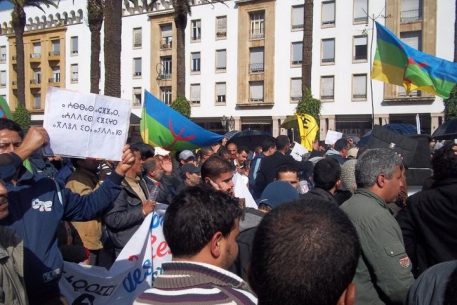
In early January 2011 disturbances over rising food prices and chronic unemployment spiraled out from Algiers with youths setting government buildings on fire and shouting “bring us sugar!” Security forces were brought in to block off streets in the working class neighborhoods of Bab el Oued and the Casbah as areas outside the capital were swept up in the rampages. The violence followed price increases for milk, sugar and flour in the previous days, and amid simmering frustration that Algeria’s abundant gas and oil resources had not led to broader prosperity. Despite a heavy police presence following Friday prayers, rampaging youths continued their attacks that now spread to the east and west of the capital in cities like Oran, Bouira, Annaba, and Bejaia. By the end of the month and following the departure of President Ben Ali from power in Tunisia on January 14, events in Algeria began taking a more confrontational turn as riots, demonstrations, and protests began to sweep the capital and other cities defying the ban on public gatherings put into place following the coup of 1992, also in January. This pattern of civil disobedience and popular protest accelerated following the fall of the Mubarak regime in Egypt on February 11, almost a month after Ben Ali’s removal in Tunisia. Emboldened by the successes of their neighbors to the east, Algerians began to articulate their grievances in explicitly political terms as placards, banners, and slogans appeared declaring “no to the police state,” “give us back our Algeria,” “Boutef[2] out,” and “le pouvoir assassins.”
Riots and protests have long been a regular feature of Algerian political life given the widespread socioeconomic grievances held by large swaths of Algeria’s population and the elite’s seeming indifference to such grievances and generally contemptuous attitude (hogra) towards the mass public.[3] Public sector strikes occur almost daily in a wide variety of professions from medical personnel, schoolteachers, oil and gas industry workers, municipal guards, etc. When such strike activity becomes overwhelming, the regime has the ability to meet some of the short-term economic demands of the protestors by rescinding, for example, the price hikes that initially brought protestors to the streets. The country’s large oil stabilization fund (Fonds de régulation des recettes) makes such policy reversals possible.
The depth and scope of anti-regime activity occurring in a dramatically changed regional environment in the first quarter of 2011 forced the regime into broader concessions than those usually made under similar conditions. For the first time since coming to power in 1999, Bouteflika convened the National Security Council (Haut conseil de securité), the body established to advise the president on security matters, especially those concerning terrorist threats by GSPC and AQMI. Its first decision was to lift the emergency laws imposed in 1992 that limited political activities, demonstrations, protests, and other forms of public contestation not authorized by the state. For its part, a loosely coordinated group of opposition figures formed the National Coordination for Democratic Change (CNCD or Coordination nationale pour le changement et la démocratie) to serve as a spearhead for political change using mass demonstrations, political protests, and other forms of public contestation to achieve fundamental changes in the country’s political economy reflecting the popular demand, over many years, for such changes.[4]
Having kept virtually silent throughout the first three months of 2011 as the country was being rocked by public unrest echoing the protests taking place in other parts of the Arab world, President Bouteflika finally went on state television in mid-April to announce a series of constitutional changes intended to “strengthen democracy.” Speaking in a low and hoarse voice reflecting the fragile state of the president’s health, he declared that it was important to introduce the necessary amendments to the constitution that would “crown the institutional edifice with the aim of strengthening democracy.”[5] He went on to state that “active political currents” would join constitutional law experts in drawing up the amendments. In addition, the electoral law would be “revised in depth,” with the participation of “the political parties, whether present [in parliament] or not.”[6] A new information law would also be introduced to replace existing legislation under which journalists have been jailed after writing articles critical of the president. The new law would include “regulations for responsible blogging,” he added.[7]
Given the intensity and longevity of public demands for major political change, most observers felt that Bouteflika’s speech did not go far enough in responding to those demands, especially since no clear timeline was provided regarding the implementation of these constitutional reforms. Opposition groups like the CNCD have all along been calling for deeper changes including the dissolution of the current government and parliament as well as the creation of a constitutional council that brings together all of the country’s political forces in advance of organizing genuinely free and democratic presidential and legislative elections.[8] Other critics of the president’s proposals referenced the intrigues and machinations surrounding the struggle for power currently under way between the president’s office and the military-industrial complex highlighted by the Sonatrach scandal and its political aftermath discussed earlier.[9]
To what extent, therefore, do the conditions in place in Algeria today forecast a fundamental change in the political system à la Tunisia and Egypt or are the calls for reform little more than symbolic gestures that leave political power centralized in the military-industrial complex? Or, given the many distinctive if not unique features of the Algerian political experience, will a hybrid form emerge that is neither fully democratic nor fully authoritarian but whose oil-generated wealth can be sustained into an indefinite future? As of this writing, the protests in Algeria have not coalesced into a nation-wide opposition movement seeking the overthrow of the Bouteflika regime in the manner that happened in Tunisia and Egypt. By hiking food subsidies, doubling the salaries of state workers, offering free land, and ending the emergency laws, the regime has contained the most excessive aspects of the unrest. Additionally, the recent memory of the civil war in the 1990s that nearly tore the country apart and left nearly 200,000 people dead hangs over the national consciousness serving as a brake to large-scale domestic violence. Indeed, to the extent that the chaos in neighboring Libya festers or deepens, with all the implications this has on national security concerns and the fight against the al Qaida insurgency in the country (AQIM), this may serve to dampen the support for those calling for violence against the regime. However, “were Algerians to protest forcefully and coherently against the structure of the government, particularly the concentration of power in the executive and the military, the regime lacks the flexibility or credibility among the people to meet their demands through constitutional means.”[10] Given its recent history, there is little doubt that the security forces and the army would intervene in a forceful if not deadly way to prevent any attempt at an extra-constitutional transfer of power that is not engineered by le pouvoir itself.
The “Arab Spring” has arrived at a critical juncture in Algeria’s modern history as a state and society are in the midst of great uncertainty with a weakened president who, because of visible illness, is unlikely to complete his third presidential term in 2014, a constitutional system that does not provide a clear mechanism for political succession, an emboldened national security apparatus headed by an individual who is himself, at 72, exhibiting signs of physical weakness, a politically manipulated and economically mismanaged hydrocarbon industry from which virtually all sources of state revenues derive, and an increasingly animated civil society no longer willing to be placated by either rhetorical promises or short-term economic rewards as a condition for political compliance. However these conflicting forces ultimately resolve themselves, what is clear is that the previous modes of rule-making and rule-enforcement will have to be fundamentally reconfigured in ways that respond to populist demands for social advancement, economic opportunity, and political freedoms. Whether this process develops peacefully or violently is ultimately in the hands of le pouvoir—as it has been since the founding of the republic.
Notes
[1] Le pouvoir (“the power”) is a very commonly used term in the Algerian context to refer to the “powers behind the throne,” meaning the key members of the independence-era old guard within the army high command of the ANP (Armée nationale populaire) and the intelligence services (DRS) often working in conjunction with high level elites in the party and bureaucratic apparatus of the state, constituting a kind of “military-industrial complex.” Le pouvoir operates behind closed doors, its activities opaque and unknown to the overwhelming majority of Algerians.
[2] The diminutive for Bouteflika widely used by Algerians in a critical not complimentary sense.
[3] Symptomatic of the frustration held by so many of the youth is the statement by one out-of-work 29-year old Algerian, Bilal Boudamous, who declared to a New York Times reporter during one large demonstration in the capital that saw as many security forces as protesters, that the police forces “can’t kill us because we are already dead. We live with our parents, and we have no future.” Adam Nossiter and Timothy Williams, “Security Forces Halt Protest in Algeria”, The New York Times, February 12, 2011 (www.nytimes.com).
[4] Numerous petitions in favor of such democratic change have circulated nationally and internationally by respected Algerian scholars, lawyers, human rights activities, journalists, and others including Mohammed Harbi, Madjid Benchikh, Aïssa Kadri, and Ahmed Dahmani. See “Appel pour une transition démocratique en Algérie,” El Watan, February 10, 2011 (www.elwatan.com).
[5] “Algeria leader Bouteflika pledges constitutional reform,” BBC News Africa, April 15, 2011 (www.bbc.co.uk/news/world-africa).
[6] Ibid.
[7] Ibid.
[8] See El Khabar (Algiers), April 17, 2011. See also El Watan, April 18, 2011, which described the president’s proposals as another way by which the system “wants to keep things in hand while making it appear that it is reforming—which it is not.”
[9] For a broader analysis of the political sclerosis currently confronting the Algerian regime, see Rachid Tlemcani, “Le discours de Bouteflika confirme qu’il n’y a pas une volonté politique de sortie de crise”, El Watan, April 18, 2011 (www.elwatan.com).
[10] The Economist Intelligence Unit, “Country Report: Algeria,” April 2011, p. 5.