
Jordan Bracing for Strong Winds from Arab Spring
The Arab spring, an optimistic codename for uprisings in various Arab countries, has blown unusually strong winds towards Jordan, prompting King Abdallah II and his people to think about and debate seriously ways to evade storms like those that have so far brought down two well entrenched regimes and are threatening the others.
The uprisings have not created new problems for Jordan. In some ways they have negatively affected economic sectors, like tourism and foreign investments, and stirred street protests. But mostly they have accentuated existing problems and posed by far the biggest challenge to the authority of the 48-year-old King, apart from throwing into the unknown the future of the whole Middle East region, including particularly small countries with limited resources like Jordan.
Signs of trouble have been evident for some time but the loudest and clearest arrived six months before the first uprising in Tunis in December, when military retirees, traditionally the powerbase of the Hashemite ruling family, lashed out in a statement dated May 1 at appointments by the King of unqualified and inexperienced cronies to senior cabinet posts, at the increasingly alarming rate of corruption and graft cases being suspected, at the sky-rocketing cost of living and even the undue influence in the decision-making process of Queen Rania, who as the King’s wife has no executive powers under the constitution.
The Arab spring merely gave credence to the retirees’ calls for fundamental reforms, in the framework of asserting the Jordanian identity in the face of what they saw as attempts to dilute it by Jordanians of Palestinian origin, like the Queen and the prime minister at the time, Samir Rifai, whose great grandfather hails from Palestine. The retirees, who generally represent the loyalist hardcore East Bank Jordanians, took this stance well before the newly elected Lower House of parliament gave an overwhelming vote of confidence to a “second” cabinet formed by Rifai soon after his “first” government which oversaw the parliamentary elections in November had resigned, throwing even greater doubt on the credentials and representative authenticity of the two estates of government.
Today Jordan finds itself between a rock and hard place. Political instability in the neighbourhood threatens to hit home hard if political reforms are not made—and this cannot be done without the King giving up at least a number of his absolute powers, like dismissing parliaments and governments at will and conducting foreign policy literally single-handedly, in essence assuming full executive authority without any legal liability, and enjoying total protection from public and personal criticism under the law. On the other hand, badly needed economic reforms to trim the high budget deficit and to reduce rising public debt, which are fast approaching levels not witnessed since the economic crisis that led to the bread riots of 1989, cannot be introduced because the political balance has become so shaky that any tinkering with oil and food prices, any kind of job lay-offs, any new thought of harsh economic decisions as were envisaged or embarked on under Rifai, could have dangerous implications for stability in the country as a whole.
At one stage before the Arab spring began, but not necessarily since Benjamin Netanyahu came to power in Israel two years ago, there was a chance for a peace settlement that could help solve, or at least reduce to acceptable levels, Jordan’s economic and political problems, represented mainly by the identity and citizenship tensions that have divided East Bank and Palestinian Jordanians (the population split is 50 percent or more in favour of the latter). However, with the peace process at a standstill now, maybe until after the next presidential and national elections in the U.S. and Israel, there is little chance of Jordan reaping any time soon the benefits of regional peace and stability which it has long sought and hoped it would be a panacea for these two critical woes.
So precarious is the situation in Jordan in fact that even the earthquake and tsunami that hit faraway Japan in early March threatened to make matters worse for the home front. The catastrophe there, apart from its human impact on Jordanians (which was not necessarily reflected in the national media), has cast doubt on the prospects of building nuclear reactors to generate electricity in the absence of national oil and coal resources in Jordan. The reactors were conceived to be a critical component of a number of mega projects to give a boost to the economy, to create job opportunities, and to provide Jordan with water for both drinking and agriculture use, and helping in the process to save the Dead Sea from drying up. Further, the tragedy in Japan reduced the chance of Jordan receiving more aid than the $3.6 billion that the Japanese have extended to the Jordanians since 1985.
So what is to be done? How could the King stave off the deepening dangers resulting from hardships and disenchantment with the regime at home and resulting from the sudden, but not unexpected, awakening of the Arab masses everywhere?
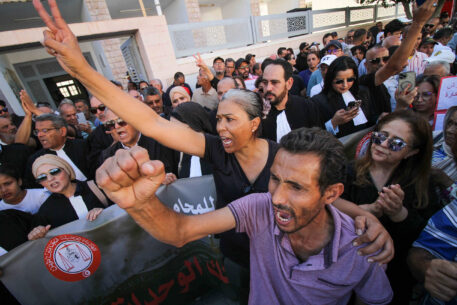
On the internal front, King Abdullah sacked his childhood friend and his team and asked an old hand, trusted by the military establishment and the tribes (being himself the scion of one of them), to replace Rifai at the helm of a new government . Marouf el Bakhit, a former general and ambassador to both Turkey and Israel, knew he had a three-fold mission to accomplish to rebuild bridges of confidence between the people and the regime. The first and most important part was to assuage the fears of a growingly restive population about the direction in which the country was going and how it was being governed. The second was to calm widespread protests (in the first week of March, a cabinet minister counted 120 demonstrations taking place throughout the Kingdom on a particular day, costing the economy more than $20 million a month). And, third, to open a dialogue with a vocal opposition which appeared unwilling to accept anything less than constitutional amendments by which the King would cede some of the powers he inherited from his father, King Hussein. The late King had taken for himself powers his father, King Talal, did not have under the constitution that he enacted in 1952 in the aftermath of annexing the West Bank.
Dr. Bakhit’s new cabinet took upon its shoulders, after it was sworn in (early February) to fight corruption, tackle rising costs of living and create job opportunities for Jordanians without any pretences that it could so and at the same time reduce the budget deficit and Jordan’s foreign—and local–debt or being able to find lasting solutions for the troubled economy.
To do this, the new, more conservative cabinet formed a National Dialogue committee, headed by Taher Masri, the widely respected speaker of the Upper House, to enact new election and political party laws, and probably to agree on the parameters and contours of amendments sought by the opposition and other groups to return to the 1952 constitution. King Abdallah has so far taken no public position on a resolution the committee adopted in the last week of March to take up discussion of such amendments, after a significant bout of hesitation and threats by the opposition to boycott the panel, and possibly to issue some recommendations at the end of its mandate in three months on what the amendments should be.
Meanwhile the King has maintained a high profile in calling and issuing directives for reforms, stressing most on the need to fight corruption, even “at the Royal Court” and in cases when people who were very close to him were involved.
Since the uprisings began, the Monarch has refrained from leaving on any trip abroad, official or otherwise, devoting his time instead to meeting with various sectors and representatives of civil society, opposition groups, including the Islamists, and visiting poor and distant villages as well as army units throughout the country. For her part, Queen Rania, who was seen as leading a lavish lifestyle by some, has been assuming a lower profile, limiting her public appearances to visiting schools and meeting with women’s and other civil society groups.
While these are needed steps to strengthen and rebuild confidence on the home front, they may not be sufficient for and cannot be an alternative to establishing real genuine democratic rule and addressing citizenship rights and freedoms needed to stave off instability, whether homegrown or imported from the volatile neighbourhood. Bloody riots have come so close to Jordan, specifically when they reached the Syrian city of Deraa right on the Kingdom’s northern border, and the regime cannot be complacent about these developments.
In any way, even if the home front is solid enough to withstand all pressures and tensions, the political and economic challenges facing the Kingdom cannot all be solved internally, no matter how deep and profound reforms are. More is needed to be done at home, it is true, especially in the area of enacting genuine economic reforms and strengthening ,even reinventing, socio-economic behavioural patterns, like reducing dependency on government, security and military jobs and filling them with mainly East Jordanians. State subsidies for petrol and food have to continue for now, but they cannot be a permanent solution either. Likewise, attention has to be focused on the private sector for job creation and bringing in investments. But beyond all of that a new set of work ethics and rules has to be found and adopted. Those who think that the state is there merely to serve their narrow interests have to change attitudes towards civic life and birth rights, and consequently they have to learn to lead by example, both in the public and private sectors.
Jordan has to continue to look abroad for more permanent solutions to its existential problems. Economically, job opportunities have to continue to be found in the Gulf, and elsewhere, but for that to happen on more lasting and equitable basis, not only does the Arabian Gulf need not to be politically and economically stable, it also has to be ready and willing to open its borders to Arab brothers from the north who in general can provide an educated and professional, even artisan, labour source. Just like Saudi Arabia and other Gulf countries promised additional aid to president Hosni Mubarak to bolster his regime before it fell, and more recently extended a $20 million aid program to Oman and Bahrain, Riyadh, and its allies in Kuwait and Abu Dhabi, have to help Jordan and probably Syria and Lebanon, whose stability and well being are crucial to the security of the Gulf states. It is not clear what chances there are now of Jordan getting an injection of badly needed cash from especially Saudi Arabia. What is certain though is that unless the rich Arabs extend aid, regardless of the fact their situation too is clearly unsettled, poorer Arab countries might not be able to be of much help to themselves or to their brethren in the Gulf, now or later.
The “oil deficit” and “the vacuum of hope”, as the former Crown Prince of Jordan Hassan Ibn Talal calls them, can drag the whole region, and not only the Arabian Peninsula, into further uncertainty and anarchy.
Water, oil and energy, security, employment and investment are all interconnected. Furthermore, and according to U.N. studies, there will be a need to create 100 million jobs in the Arab world in the next 10 years.
Jordan must therefore revive efforts and find for itself a central role in shaping a new regional order, based on solid and creative ways and attempts to close the gap in the rich Arab-poor Arab divide. Most importantly this can be done by leading fresh efforts to find a solution to the Palestinian problem, and ending the 63-year-old plight of the refugees, many of whom are now Jordanian citizens.
The new regional order must ensure political stability for all countries in the region, including Israel and Iran. But if Jordan is to be successful in playing such role, its efforts must rely on carefully playing a balancing act, that it used to perform well in the past, and take into consideration the conflicting interests of Jordanians from different backgrounds, origins and loyalties.
This is where democracy is most needed, but where perhaps it cannot be the ultimate solution.